Models of Health Psychology
Dr Neeta Gupta
Practitioner Of CBT,REBT &
EFT
Associate Professor
DAV (PG) College
Dehradun
The Biopsychosocial model:
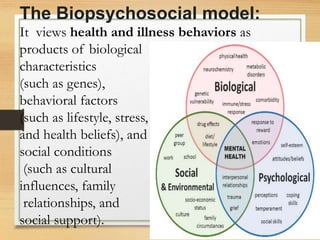
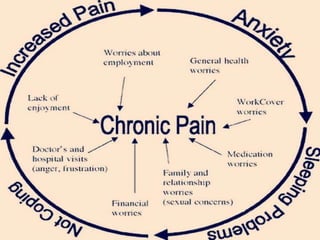
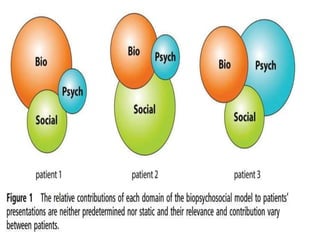
It views health and illness behaviors as
products of biological
characteristics
(such as genes),
behavioral factors
(such as lifestyle, stress,
and health beliefs), and
social conditions
(such as cultural
influences, family
relationships, and
social support).
The biopsychosocial model is an inter-
disciplinary model that looks at the
interconnection
between biology, psychology, and socio-
environmental factors. The model
specifically examines how these aspects
play a role in topics ranging from health and
disease, to human development. The model
was first advocated by George L. Engel in
1977, and has become an alternative to
the biomedical dominance of many health
care systems.
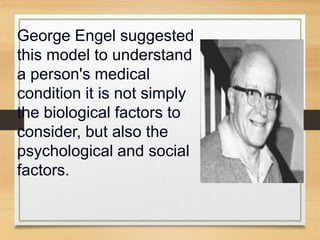
George Engel suggested
this model to understand
a person's medical
condition it is not simply
the biological factors to
consider, but also the
psychological and social
factors.
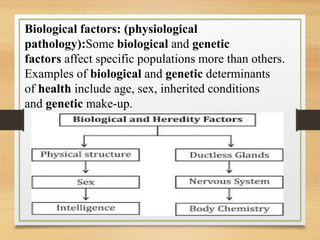
Biological factors: (physiological
pathology):Some biological and genetic
factors affect specific populations more than others.
Examples of biological and genetic determinants
of health include age, sex, inherited conditions
and genetic make-up.
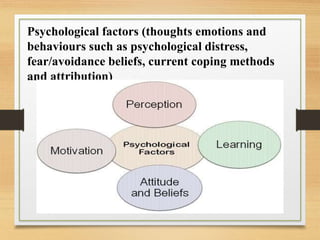
Psychological factors (thoughts emotions and
behaviours such as psychological distress,
fear/avoidance beliefs, current coping methods
and attribution)
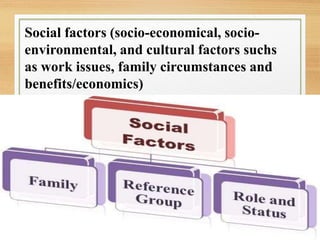
Social factors (socio-economical, socio-
environmental, and cultural factors suchs
as work issues, family circumstances and
benefits/economics)
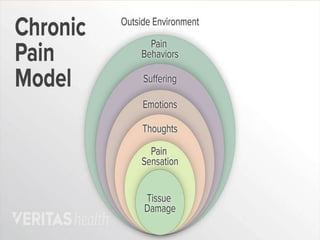
This model is commonly used
in chronic pain, with the view that the
pain is a psychophysiological behaviour
pattern that cannot be categorised into
biological, psychological, or social
factors alone. There are suggestions
that physiotherapy should integrate
psychological treatment to address all
components comprising the experience
of chronic pain.
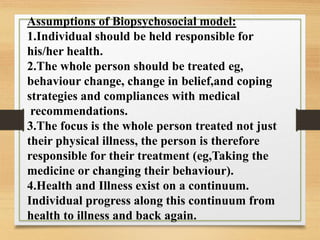
Assumptions of Biopsychosocial model:
1.Individual should be held responsible for
his/her health.
2.The whole person should be treated eg,
behaviour change, change in belief,and coping
strategies and compliances with medical
recommendations.
3.The focus is the whole person treated not just
their physical illness, the person is therefore
responsible for their treatment (eg,Taking the
medicine or changing their behaviour).
4.Health and Illness exist on a continuum.
Individual progress along this continuum from
health to illness and back again.
5. The focus is on interaction between the
mind and the body.
6.Psychological factors are not only
consequents but they are contributory
factors to all stages along the continuum
from health to illness.
Evaluation of bio-psychosocial model
Strengths:
1.Improve patient satisfaction, better adherence to
prescriptions, more maintained behaviour change,
better physical and psychological health.
2.Development and application of techniques to
reduce health risk behaviour.
3.Reduce multiple visits and admission into
hospitals.
4.Individuals with health challenges are
acknowledged to be active participants in the
recovery process and good health, rather than
mere passive victims.
6.Bio-psychosocial model can be used as a predictor of pain
and other psychosocial problems resulting into
development appropriate prevention and intervention
strategies.
7.Development and introduction of programmes of life
quality improvement for chronic patients, physically
disabled individuals and the elderly patients.
8.Development and application of psychosocial support for
the terminally ill patients and their families.
9.The use of the biopsychosocial model as a clinical practice
guide in physiotherapy allows the physiotherapist to be
aware of all the factors that influence the patient's state of
health. In addition, it allows laying the foundations of pain
neuroscience education.
Limitations of bio-psychosocial model:
•Time-consuming and expensive.
•It requires more information be gathered during the
assessment about an individual’s socioeconomic
status, culture, religion, as well as psychological
factors that might affect the individual’s condition.
•There is a lack of theoretical basis of bio-
psychosocial model and scientific evidence to support
the model.
•The complex relations between causes and effects of
biological, psychological and social factors to
influence the state of health and or occurrence of
diseases.
REFERENCES;
https://www.open.edu/openlearn/ocw/pluginfile.php/1
223815/mod_oucontent/oucontent/62622/da4ddc15/a
c0d8e1b/s826_ol_fig7_bpse_model_for_mental_healt
h.small.png
https://onlinelibrary.wiley.com/cms/asset/a9411043-
620b-4308-9e1d-f06d1603ec64/anp_1029_fu1.gif
https://pbs.twimg.com/media/DfuevOOX4AAStgI.jpg
https://embed.widencdn.net/img/veritas/cgcqmeax1g/
1200x675px/chronic-pain-model.webp
https://www.intechopen.com/books/psychology-of-
health-biopsychosocial-approach/introductory-
chapter-bio-psychosocial-model-of-health
https://pbs.twimg.com/media/DfCM_6sWAAIcNCc.j
pg

Biopsychosocial Models

  • 1.
    Models of HealthPsychology Dr Neeta Gupta Practitioner Of CBT,REBT & EFT Associate Professor DAV (PG) College Dehradun
  • 2.
    The Biopsychosocial model: Itviews health and illness behaviors as products of biological characteristics (such as genes), behavioral factors (such as lifestyle, stress, and health beliefs), and social conditions (such as cultural influences, family relationships, and social support).
  • 3.
    The biopsychosocial modelis an inter- disciplinary model that looks at the interconnection between biology, psychology, and socio- environmental factors. The model specifically examines how these aspects play a role in topics ranging from health and disease, to human development. The model was first advocated by George L. Engel in 1977, and has become an alternative to the biomedical dominance of many health care systems.
  • 4.
    George Engel suggested thismodel to understand a person's medical condition it is not simply the biological factors to consider, but also the psychological and social factors.
  • 5.
    Biological factors: (physiological pathology):Somebiological and genetic factors affect specific populations more than others. Examples of biological and genetic determinants of health include age, sex, inherited conditions and genetic make-up.
  • 6.
    Psychological factors (thoughtsemotions and behaviours such as psychological distress, fear/avoidance beliefs, current coping methods and attribution)
  • 7.
    Social factors (socio-economical,socio- environmental, and cultural factors suchs as work issues, family circumstances and benefits/economics)
  • 8.
    This model iscommonly used in chronic pain, with the view that the pain is a psychophysiological behaviour pattern that cannot be categorised into biological, psychological, or social factors alone. There are suggestions that physiotherapy should integrate psychological treatment to address all components comprising the experience of chronic pain.
  • 11.
    Assumptions of Biopsychosocialmodel: 1.Individual should be held responsible for his/her health. 2.The whole person should be treated eg, behaviour change, change in belief,and coping strategies and compliances with medical recommendations. 3.The focus is the whole person treated not just their physical illness, the person is therefore responsible for their treatment (eg,Taking the medicine or changing their behaviour). 4.Health and Illness exist on a continuum. Individual progress along this continuum from health to illness and back again.
  • 12.
    5. The focusis on interaction between the mind and the body. 6.Psychological factors are not only consequents but they are contributory factors to all stages along the continuum from health to illness.
  • 13.
    Evaluation of bio-psychosocialmodel Strengths: 1.Improve patient satisfaction, better adherence to prescriptions, more maintained behaviour change, better physical and psychological health. 2.Development and application of techniques to reduce health risk behaviour. 3.Reduce multiple visits and admission into hospitals. 4.Individuals with health challenges are acknowledged to be active participants in the recovery process and good health, rather than mere passive victims.
  • 14.
    6.Bio-psychosocial model canbe used as a predictor of pain and other psychosocial problems resulting into development appropriate prevention and intervention strategies. 7.Development and introduction of programmes of life quality improvement for chronic patients, physically disabled individuals and the elderly patients. 8.Development and application of psychosocial support for the terminally ill patients and their families. 9.The use of the biopsychosocial model as a clinical practice guide in physiotherapy allows the physiotherapist to be aware of all the factors that influence the patient's state of health. In addition, it allows laying the foundations of pain neuroscience education.
  • 15.
    Limitations of bio-psychosocialmodel: •Time-consuming and expensive. •It requires more information be gathered during the assessment about an individual’s socioeconomic status, culture, religion, as well as psychological factors that might affect the individual’s condition. •There is a lack of theoretical basis of bio- psychosocial model and scientific evidence to support the model. •The complex relations between causes and effects of biological, psychological and social factors to influence the state of health and or occurrence of diseases.
  • 17.