A SEMINAR
ON
BIOPOLYMERS
BY
DINESH KHILADKAR
ROLL NO:301218
PROF. PRASHANT THORAT
GUIDE
SCOE
DEPARTMENT OF BIOTECHNOLOGY, PUNE 2016-17
SCOE
DEPARTMENT OF BIOTECHNOLOGY, PUNE 2016-17
CONTENTS
Introduction
Need &
Application
Production
,Extraction,
Future prospects
References
SCOE
DEPARTMENT OF BIOTECHNOLOGY, PUNE 2016-17
INTRODUCTION
 Biopolymers are polymeric biomolecules which contain
monomeric units that are covalently bonded to form
larger molecules.
They are solid ,higher molecular weight non-metallic
compounds
Biopolymers are biological macromolecule which can
be derived from renewable sources such as plants, animal
and living organisms.
Important property of biopolymers is
‘Biodegradability’
SCOE
DEPARTMENT OF BIOTECHNOLOGY, PUNE 2016-17
There are three main classes of biopolymers based on
the differing monomeric units used and the structures of
biopolymers formed:
 Polynucleotide
Polypeptides
 Polysaccharides
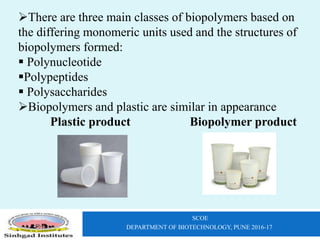
Biopolymers and plastic are similar in appearance
Plastic product Biopolymer product
SCOE
DEPARTMENT OF BIOTECHNOLOGY, PUNE 2016-17
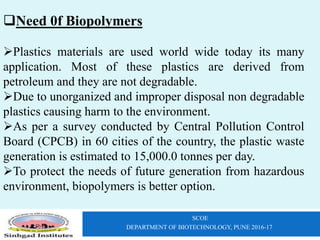
Need 0f Biopolymers
Plastics materials are used world wide today its many
application. Most of these plastics are derived from
petroleum and they are not degradable.
Due to unorganized and improper disposal non degradable
plastics causing harm to the environment.
As per a survey conducted by Central Pollution Control
Board (CPCB) in 60 cities of the country, the plastic waste
generation is estimated to 15,000.0 tonnes per day.
To protect the needs of future generation from hazardous
environment, biopolymers is better option.
SCOE
DEPARTMENT OF BIOTECHNOLOGY, PUNE 2016-17
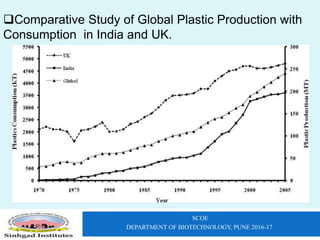
Comparative Study of Global Plastic Production with
Consumption in India and UK.
SCOE
DEPARTMENT OF BIOTECHNOLOGY, PUNE 2016-17
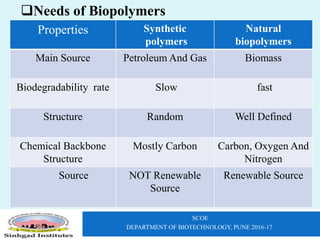
Properties Synthetic
polymers
Natural
biopolymers
Main Source Petroleum And Gas Biomass
Biodegradability rate Slow fast
Structure Random Well Defined
Chemical Backbone
Structure
Mostly Carbon Carbon, Oxygen And
Nitrogen
Source NOT Renewable
Source
Renewable Source
Needs of Biopolymers
SCOE
DEPARTMENT OF BIOTECHNOLOGY, PUNE 2016-17
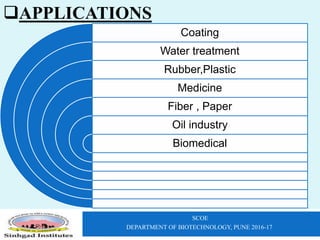
Coating
Water treatment
Rubber,Plastic
Medicine
Fiber , Paper
Oil industry
Biomedical
APPLICATIONS
SCOE
DEPARTMENT OF BIOTECHNOLOGY, PUNE 2016-17
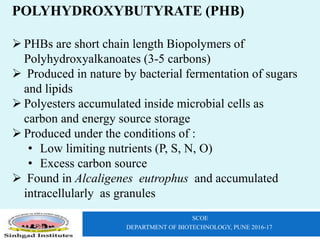
POLYHYDROXYBUTYRATE (PHB)
 PHBs are short chain length Biopolymers of
Polyhydroxyalkanoates (3-5 carbons)
 Produced in nature by bacterial fermentation of sugars
and lipids
 Polyesters accumulated inside microbial cells as
carbon and energy source storage
 Produced under the conditions of :
• Low limiting nutrients (P, S, N, O)
• Excess carbon source
 Found in Alcaligenes eutrophus and accumulated
intracellularly as granules
SCOE
DEPARTMENT OF BIOTECHNOLOGY, PUNE 2016-17
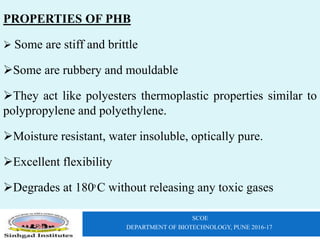
PROPERTIES OF PHB
 Some are stiff and brittle
Some are rubbery and mouldable
They act like polyesters thermoplastic properties similar to
polypropylene and polyethylene.
Moisture resistant, water insoluble, optically pure.
Excellent flexibility
Degrades at 180ͦ C without releasing any toxic gases
SCOE
DEPARTMENT OF BIOTECHNOLOGY, PUNE 2016-17
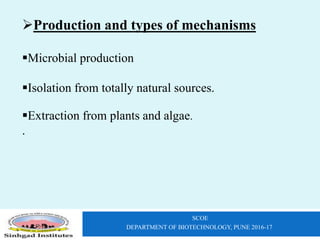
Production and types of mechanisms
Microbial production
Isolation from totally natural sources.
Extraction from plants and algae.
.
SCOE
DEPARTMENT OF BIOTECHNOLOGY, PUNE 2016-17
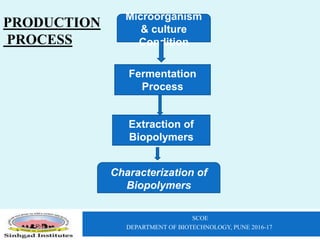
Microorganism
& culture
Condition
Fermentation
Process
Extraction of
Biopolymers
Characterization of
Biopolymers
PRODUCTION
PROCESS
SCOE
DEPARTMENT OF BIOTECHNOLOGY, PUNE 2016-17
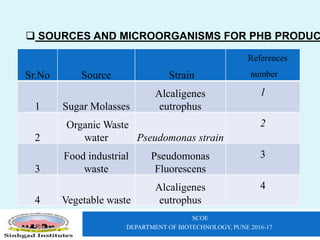
 SOURCES AND MICROORGANISMS FOR PHB PRODUC
Sr.No Source Strain
References
number
1 Sugar Molasses
Alcaligenes
eutrophus
1
2
Organic Waste
water Pseudomonas strain
2
3
Food industrial
waste
Pseudomonas
Fluorescens
3
4 Vegetable waste
Alcaligenes
eutrophus
4
SCOE
DEPARTMENT OF BIOTECHNOLOGY, PUNE 2016-17
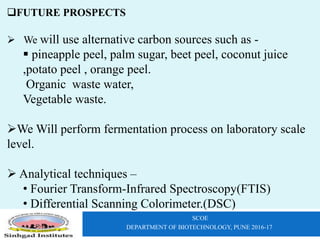
FUTURE PROSPECTS
 We will use alternative carbon sources such as -
 pineapple peel, palm sugar, beet peel, coconut juice
,potato peel , orange peel.
Organic waste water,
Vegetable waste.
We Will perform fermentation process on laboratory scale
level.
 Analytical techniques –
• Fourier Transform-Infrared Spectroscopy(FTIS)
• Differential Scanning Colorimeter.(DSC)
SCOE
DEPARTMENT OF BIOTECHNOLOGY, PUNE 2016-17
REFERENCES
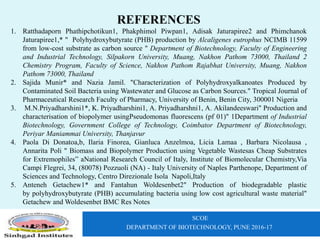
1. Ratthadaporn Phathipchotikun1, Phakphimol Piwpan1, Adisak Jaturapiree2 and Phimchanok
Jaturapiree1,* " Polyhydroxybutyrate (PHB) production by Alcaligenes eutrophus NCIMB 11599
from low-cost substrate as carbon source " Department of Biotechnology, Faculty of Engineering
and Industrial Technology, Silpakorn University, Muang, Nakhon Pathom 73000, Thailand 2
Chemistry Program, Faculty of Science, Nakhon Pathom Rajabhat University, Muang, Nakhon
Pathom 73000, Thailand
2. Sajida Munir* and Nazia Jamil. "Characterization of Polyhydroxyalkanoates Produced by
Contaminated Soil Bacteria using Wastewater and Glucose as Carbon Sources." Tropical Journal of
Pharmaceutical Research Faculty of Pharmacy, University of Benin, Benin City, 300001 Nigeria
3. M.N.Priyadharshini1*, K. Priyadharshini1, A. Priyadharshni1, A. Akilandeeswari" Production and
characterisation of biopolymer usingPseudomonas fluorescens (pf 01)" 1Department of Industrial
Biotechnology, Government College of Technology, Coimbator Department of Biotechnology,
Periyar Maniammai University, Thanjavur
4. Paola Di Donatoa,b, Ilaria Finorea, Gianluca Anzelmoa, Licia Lamaa , Barbara Nicolausa ,
Annarita Poli " Biomass and Biopolymer Production using Vegetable Wastesas Cheap Substrates
for Extremophiles” aNational Research Council of Italy, Institute of Biomolecular Chemistry,Via
Campi Flegrei, 34, (80078) Pozzuoli (NA) - Italy University of Naples Parthenope, Department of
Sciences and Technology, Centro Direzionale Isola Napoli,Italy
5. Anteneh Getachew1* and Fantahun Woldesenbet2" Production of biodegradable plastic
by polyhydroxybutyrate (PHB) accumulating bacteria using low cost agricultural waste material"
Getachew and Woldesenbet BMC Res Notes
SCOE
DEPARTMENT OF BIOTECHNOLOGY, PUNE 2016-17
THANK YOU
......!!!!!!
Biopolymers

Biopolymers

  • 1.
    A SEMINAR ON BIOPOLYMERS BY DINESH KHILADKAR ROLLNO:301218 PROF. PRASHANT THORAT GUIDE SCOE DEPARTMENT OF BIOTECHNOLOGY, PUNE 2016-17
  • 2.
    SCOE DEPARTMENT OF BIOTECHNOLOGY,PUNE 2016-17 CONTENTS Introduction Need & Application Production ,Extraction, Future prospects References
  • 3.
    SCOE DEPARTMENT OF BIOTECHNOLOGY,PUNE 2016-17 INTRODUCTION  Biopolymers are polymeric biomolecules which contain monomeric units that are covalently bonded to form larger molecules. They are solid ,higher molecular weight non-metallic compounds Biopolymers are biological macromolecule which can be derived from renewable sources such as plants, animal and living organisms. Important property of biopolymers is ‘Biodegradability’
  • 4.
    SCOE DEPARTMENT OF BIOTECHNOLOGY,PUNE 2016-17 There are three main classes of biopolymers based on the differing monomeric units used and the structures of biopolymers formed:  Polynucleotide Polypeptides  Polysaccharides Biopolymers and plastic are similar in appearance Plastic product Biopolymer product
  • 5.
    SCOE DEPARTMENT OF BIOTECHNOLOGY,PUNE 2016-17 Need 0f Biopolymers Plastics materials are used world wide today its many application. Most of these plastics are derived from petroleum and they are not degradable. Due to unorganized and improper disposal non degradable plastics causing harm to the environment. As per a survey conducted by Central Pollution Control Board (CPCB) in 60 cities of the country, the plastic waste generation is estimated to 15,000.0 tonnes per day. To protect the needs of future generation from hazardous environment, biopolymers is better option.
  • 6.
    SCOE DEPARTMENT OF BIOTECHNOLOGY,PUNE 2016-17 Comparative Study of Global Plastic Production with Consumption in India and UK.
  • 7.
    SCOE DEPARTMENT OF BIOTECHNOLOGY,PUNE 2016-17 Properties Synthetic polymers Natural biopolymers Main Source Petroleum And Gas Biomass Biodegradability rate Slow fast Structure Random Well Defined Chemical Backbone Structure Mostly Carbon Carbon, Oxygen And Nitrogen Source NOT Renewable Source Renewable Source Needs of Biopolymers
  • 8.
    SCOE DEPARTMENT OF BIOTECHNOLOGY,PUNE 2016-17 Coating Water treatment Rubber,Plastic Medicine Fiber , Paper Oil industry Biomedical APPLICATIONS
  • 9.
    SCOE DEPARTMENT OF BIOTECHNOLOGY,PUNE 2016-17 POLYHYDROXYBUTYRATE (PHB)  PHBs are short chain length Biopolymers of Polyhydroxyalkanoates (3-5 carbons)  Produced in nature by bacterial fermentation of sugars and lipids  Polyesters accumulated inside microbial cells as carbon and energy source storage  Produced under the conditions of : • Low limiting nutrients (P, S, N, O) • Excess carbon source  Found in Alcaligenes eutrophus and accumulated intracellularly as granules
  • 10.
    SCOE DEPARTMENT OF BIOTECHNOLOGY,PUNE 2016-17 PROPERTIES OF PHB  Some are stiff and brittle Some are rubbery and mouldable They act like polyesters thermoplastic properties similar to polypropylene and polyethylene. Moisture resistant, water insoluble, optically pure. Excellent flexibility Degrades at 180ͦ C without releasing any toxic gases
  • 11.
    SCOE DEPARTMENT OF BIOTECHNOLOGY,PUNE 2016-17 Production and types of mechanisms Microbial production Isolation from totally natural sources. Extraction from plants and algae. .
  • 12.
    SCOE DEPARTMENT OF BIOTECHNOLOGY,PUNE 2016-17 Microorganism & culture Condition Fermentation Process Extraction of Biopolymers Characterization of Biopolymers PRODUCTION PROCESS
  • 13.
    SCOE DEPARTMENT OF BIOTECHNOLOGY,PUNE 2016-17  SOURCES AND MICROORGANISMS FOR PHB PRODUC Sr.No Source Strain References number 1 Sugar Molasses Alcaligenes eutrophus 1 2 Organic Waste water Pseudomonas strain 2 3 Food industrial waste Pseudomonas Fluorescens 3 4 Vegetable waste Alcaligenes eutrophus 4
  • 14.
    SCOE DEPARTMENT OF BIOTECHNOLOGY,PUNE 2016-17 FUTURE PROSPECTS  We will use alternative carbon sources such as -  pineapple peel, palm sugar, beet peel, coconut juice ,potato peel , orange peel. Organic waste water, Vegetable waste. We Will perform fermentation process on laboratory scale level.  Analytical techniques – • Fourier Transform-Infrared Spectroscopy(FTIS) • Differential Scanning Colorimeter.(DSC)
  • 15.
    SCOE DEPARTMENT OF BIOTECHNOLOGY,PUNE 2016-17 REFERENCES 1. Ratthadaporn Phathipchotikun1, Phakphimol Piwpan1, Adisak Jaturapiree2 and Phimchanok Jaturapiree1,* " Polyhydroxybutyrate (PHB) production by Alcaligenes eutrophus NCIMB 11599 from low-cost substrate as carbon source " Department of Biotechnology, Faculty of Engineering and Industrial Technology, Silpakorn University, Muang, Nakhon Pathom 73000, Thailand 2 Chemistry Program, Faculty of Science, Nakhon Pathom Rajabhat University, Muang, Nakhon Pathom 73000, Thailand 2. Sajida Munir* and Nazia Jamil. "Characterization of Polyhydroxyalkanoates Produced by Contaminated Soil Bacteria using Wastewater and Glucose as Carbon Sources." Tropical Journal of Pharmaceutical Research Faculty of Pharmacy, University of Benin, Benin City, 300001 Nigeria 3. M.N.Priyadharshini1*, K. Priyadharshini1, A. Priyadharshni1, A. Akilandeeswari" Production and characterisation of biopolymer usingPseudomonas fluorescens (pf 01)" 1Department of Industrial Biotechnology, Government College of Technology, Coimbator Department of Biotechnology, Periyar Maniammai University, Thanjavur 4. Paola Di Donatoa,b, Ilaria Finorea, Gianluca Anzelmoa, Licia Lamaa , Barbara Nicolausa , Annarita Poli " Biomass and Biopolymer Production using Vegetable Wastesas Cheap Substrates for Extremophiles” aNational Research Council of Italy, Institute of Biomolecular Chemistry,Via Campi Flegrei, 34, (80078) Pozzuoli (NA) - Italy University of Naples Parthenope, Department of Sciences and Technology, Centro Direzionale Isola Napoli,Italy 5. Anteneh Getachew1* and Fantahun Woldesenbet2" Production of biodegradable plastic by polyhydroxybutyrate (PHB) accumulating bacteria using low cost agricultural waste material" Getachew and Woldesenbet BMC Res Notes
  • 16.
    SCOE DEPARTMENT OF BIOTECHNOLOGY,PUNE 2016-17 THANK YOU ......!!!!!!