BIOPROCESS
PRINCIPLES
Unit Operations in
Upstream& DownstreamProcessing
August 29, 2022 Unit Operation in a Bioprocess
(Upstream & Downstream)
Definition
These “fundamental” operations are what are
called “unit operations”.
Chemical and Bioprocess Industries
consist of widely varying sequences of
steps that have different combinations
for different manufacturing cycles.
What is a Unit operation?
However these widely varying steps can be reduced or broken down
to simple operations which are identical in fundamentals regardless
of the material being processed.
August 29, 2022 Unit Operation in a Bioprocess
(Upstream & Downstream)
Historical Definition
 This definition was used by A.D Little in 1915 to
describe Unit Operations.
 “Unit operations deal mainly with the transfer of
energy and the transfer and change of materials
primarily by physical means”.
 What is a Unit Process?
August 29, 2022 Unit Operation in a Bioprocess
(Upstream & Downstream)
Different Unit Operations
 Drying
 Distillation
 Adsorption
 Membrane separation
 Leaching
 Sedimentation
 Mixing
 Liquid Liquid Extraction
 Absorption
TRANSPORT PHENOMENA
 Momentum Transfer
 Fluid Flow
 Sedimenation
 Mixing
 Heat Transfer
 Drying
 Evaporaytion (SHMT)
 Distillation
 Mass Tranfer
 Absorption
 Adsorptin
 Distillation
August 29, 2022 Unit Operation in a Bioprocess
(Upstream & Downstream)
Stages of a Bioprocess
 A biotechnical process to produce a product can be
subdivided into five successive major segments, with
some overlap:
• upstream processing
• fermentation
• downstream processing
• product finishing
• treatment of waste if any
August 29, 2022 Unit Operation in a Bioprocess
(Upstream & Downstream)
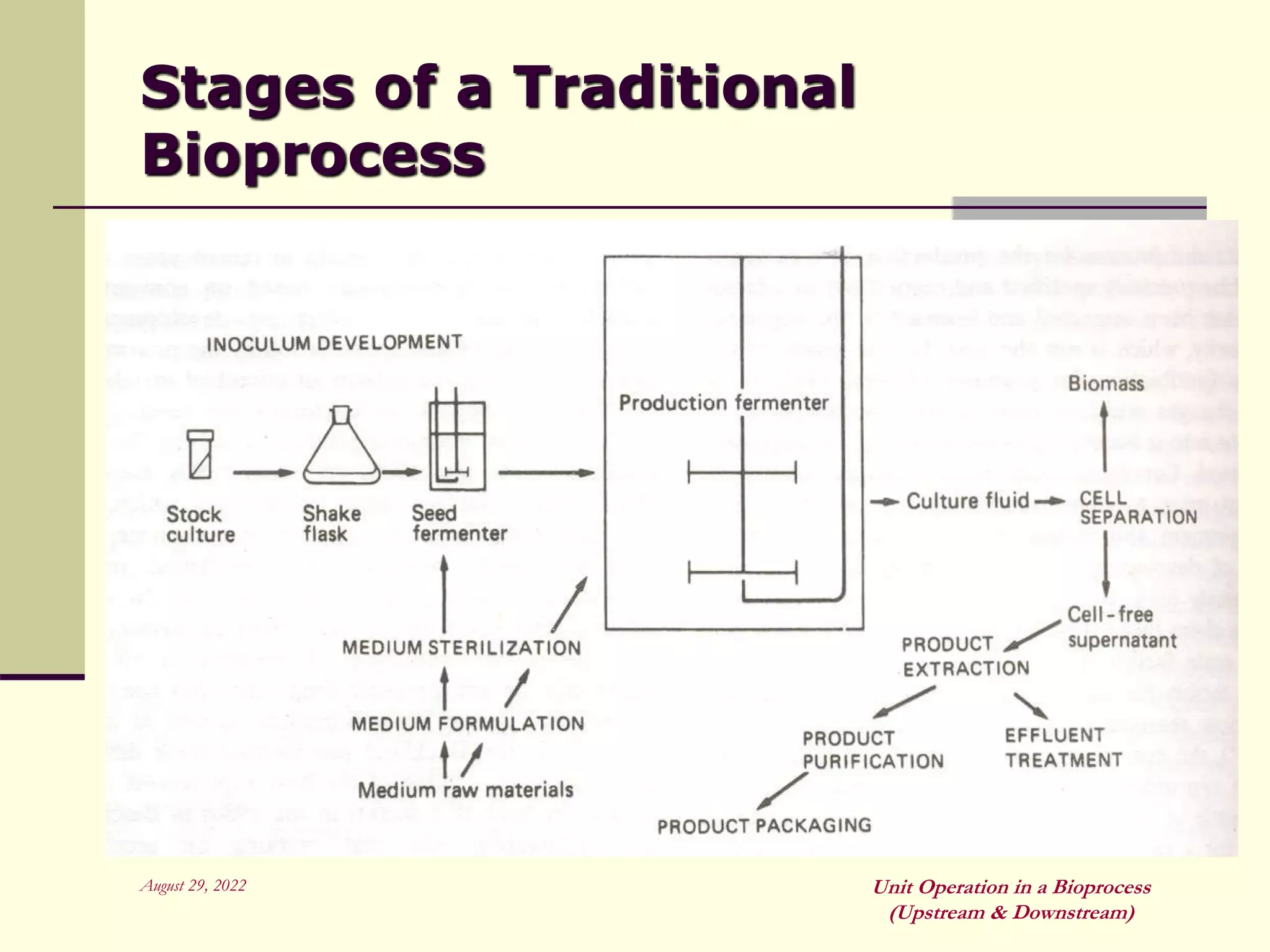
Stages of a Traditional
Bioprocess
August 29, 2022 Unit Operation in a Bioprocess
(Upstream & Downstream)
Stages of a Bioprocess (Details)
 Preparation of sterile medium.
 Addition (inoculation) of microbe ( pure culture) into this
medium
 Cultivation (incubation) under controlled conditions
 Sterilising fermentation apparatus and preparing and
sterilising feed streams to the fermentor
FERMENTATION
 Isolation and purification of the product from the fermented
medium
 Packaging of the product
 Treatment of the waste products if any
August 29, 2022 Unit Operation in a Bioprocess
(Upstream & Downstream)
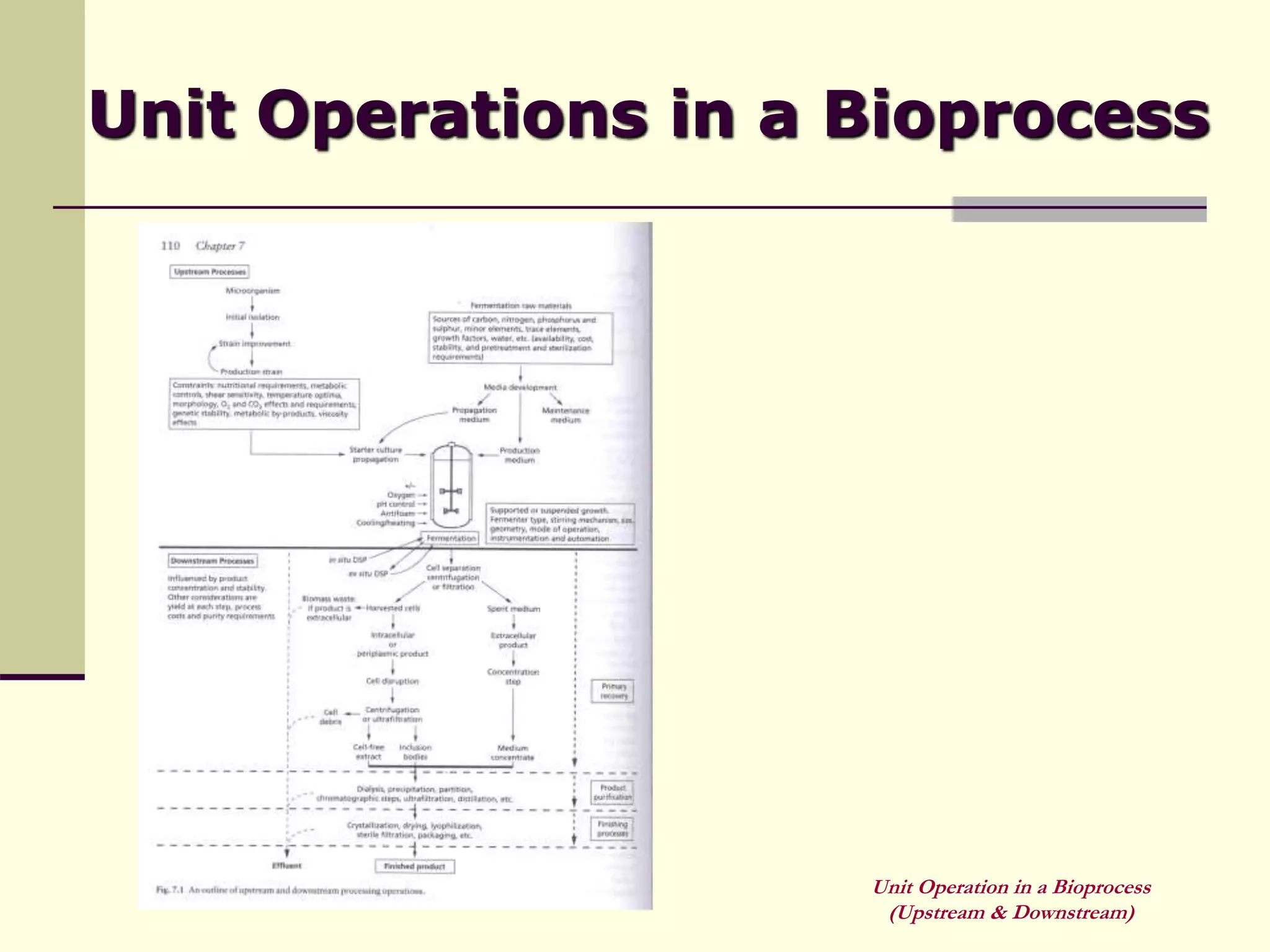
Unit Operations in a Bioprocess
August 29, 2022 Unit Operation in a Bioprocess
(Upstream & Downstream)
Upstream Processing
“Pure Upstream processing” has essentially
three functions:
 Growth of a pure culture of microorganisms in one
or more steps its scale up and strain development.
 Sterilization of the apparatus and piping.
 Mixing and sterilizing the necessary raw materials
and fermentation media to be supplied to the
fermentation unit.
August 29, 2022 Unit Operation in a Bioprocess
(Upstream & Downstream)
Fermentation Stage
 Sometimes considered as an Upstream process while some
bioprocess engineers consider it as a separate Stage in itself.
Never considered as a downstream processing stage
 Actual fermentation is commonly a batch or fed batch
process in a stirred tank fermentor.
 It lasts from a few hours to several days.
 The optimal conditions for growth of the organisms and
production of the product are established. Those include
temperature, pH, sterile aeration and, in fed-batch processes,
continuous addition of substrate at its optimal composition.
August 29, 2022 Unit Operation in a Bioprocess
(Upstream & Downstream)
SCALE UP (DEFINITION)
 Shake flash Experiments
 Lab scale fermentor (5-10 L)
 Pilot scale fermentor (300-3000 L)
 Commercial fermentor (10,000-500,000 L)
•Scale up: The transfer of a process from small-scale
laboratory equipment to large-scale commercial
equipment
August 29, 2022 Unit Operation in a Bioprocess
(Upstream & Downstream)
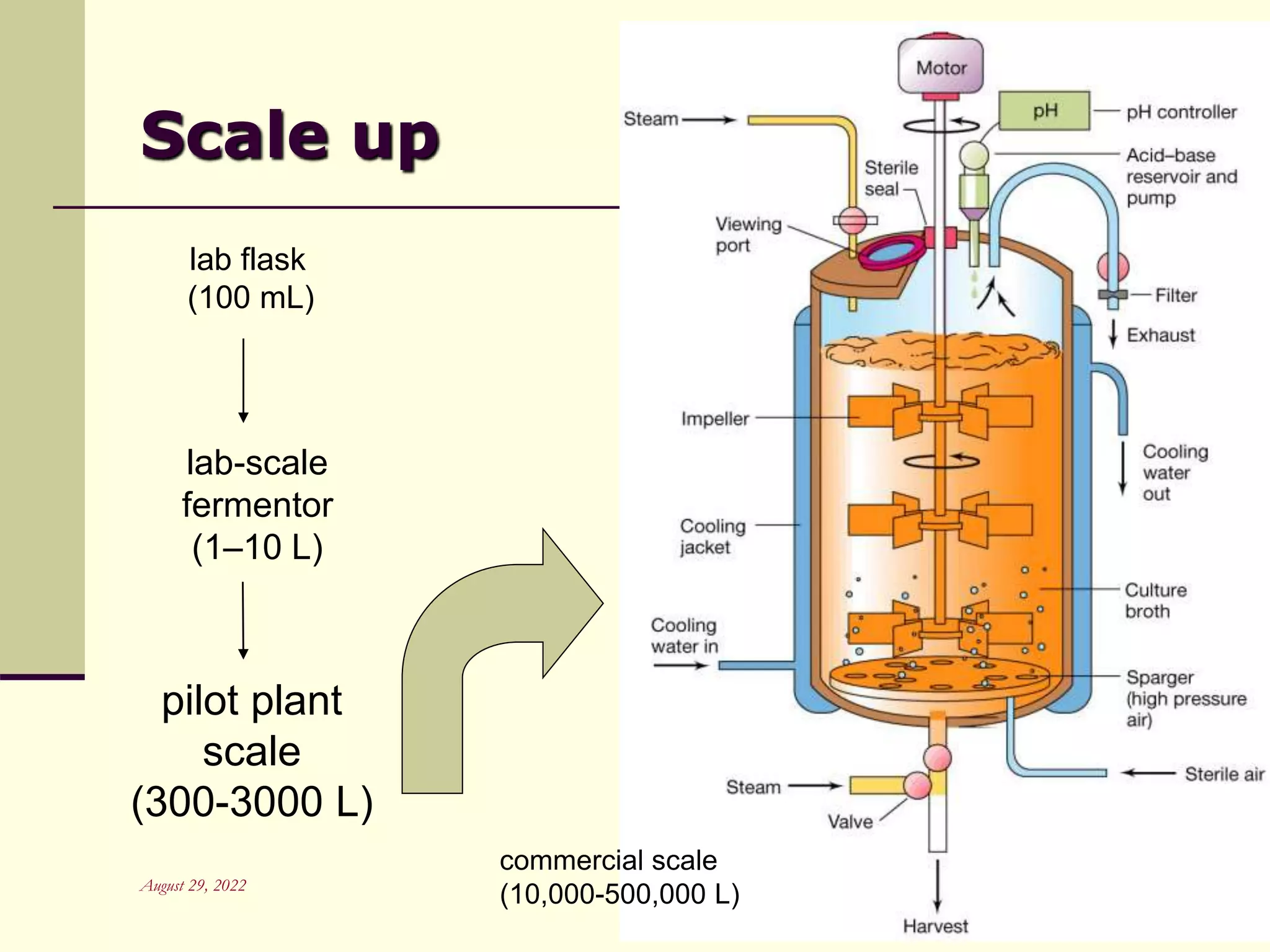
lab flask
(100 mL)
lab-scale
fermentor
(1–10 L)
pilot plant
scale
(300-3000 L)
commercial scale
(10,000-500,000 L)
Scale up
August 29, 2022 Unit Operation in a Bioprocess
(Upstream & Downstream)
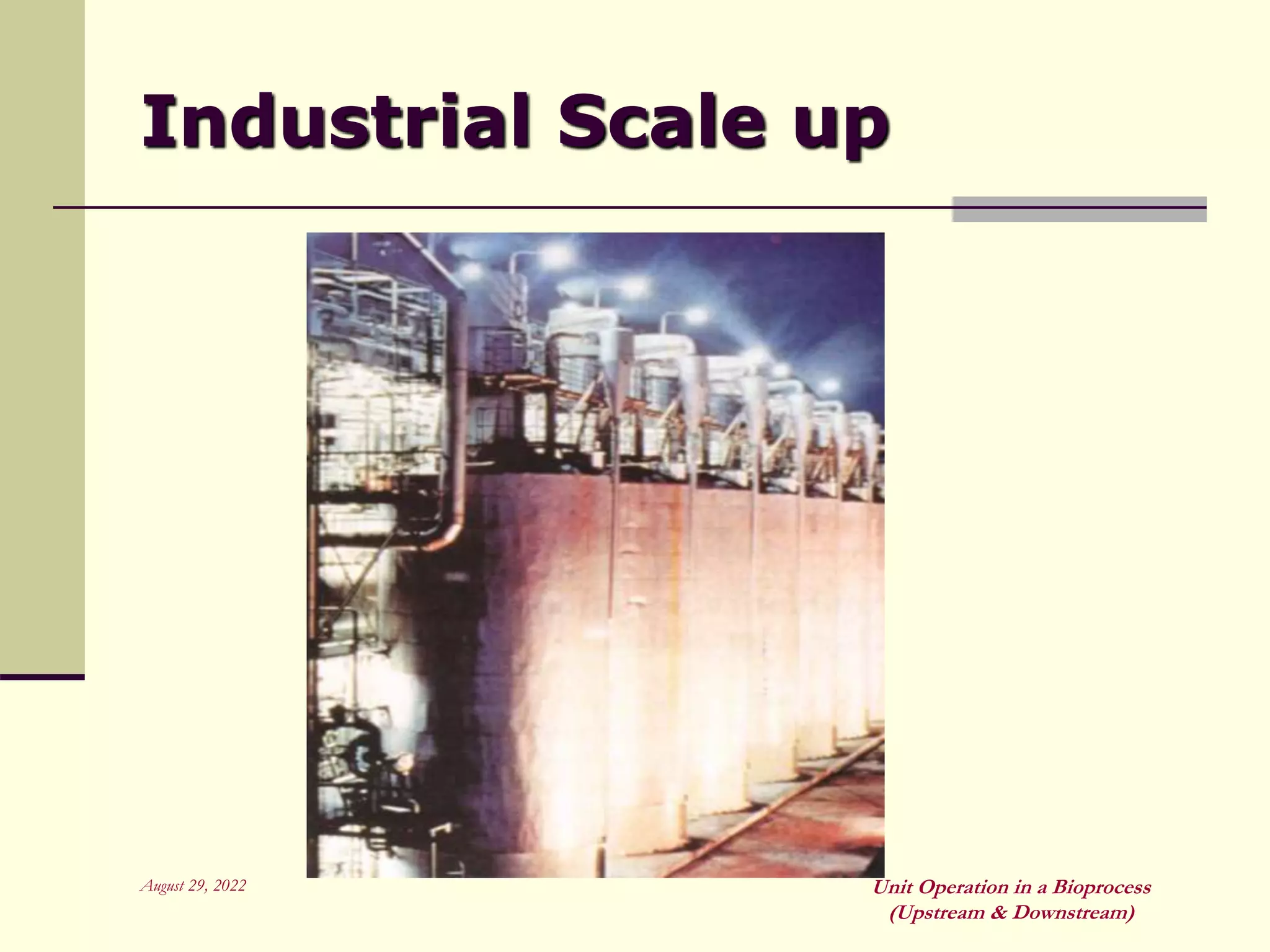
Industrial Scale up
August 29, 2022 Unit Operation in a Bioprocess
(Upstream & Downstream)
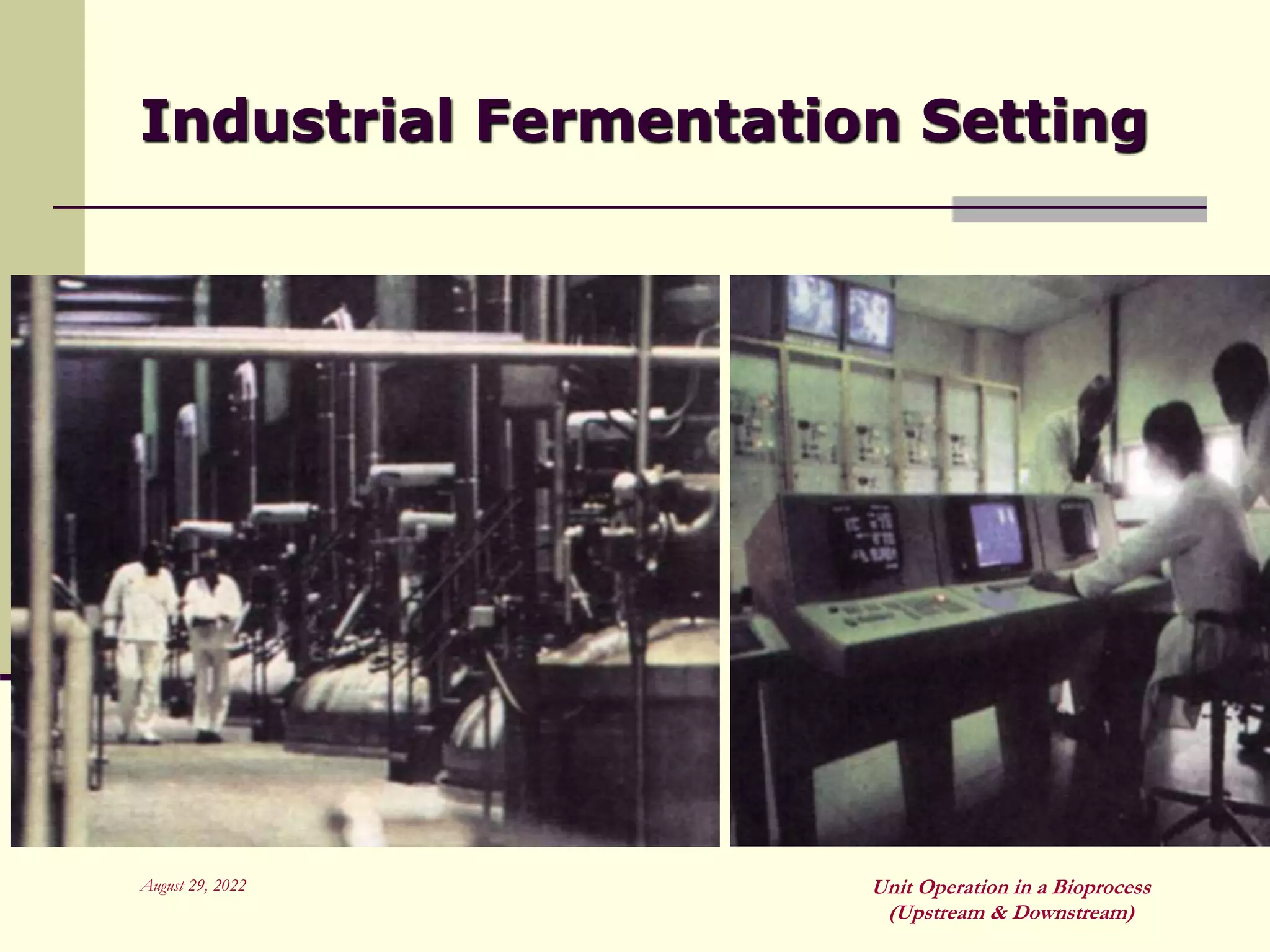
Industrial Fermentation Setting
August 29, 2022 Unit Operation in a Bioprocess
(Upstream & Downstream)
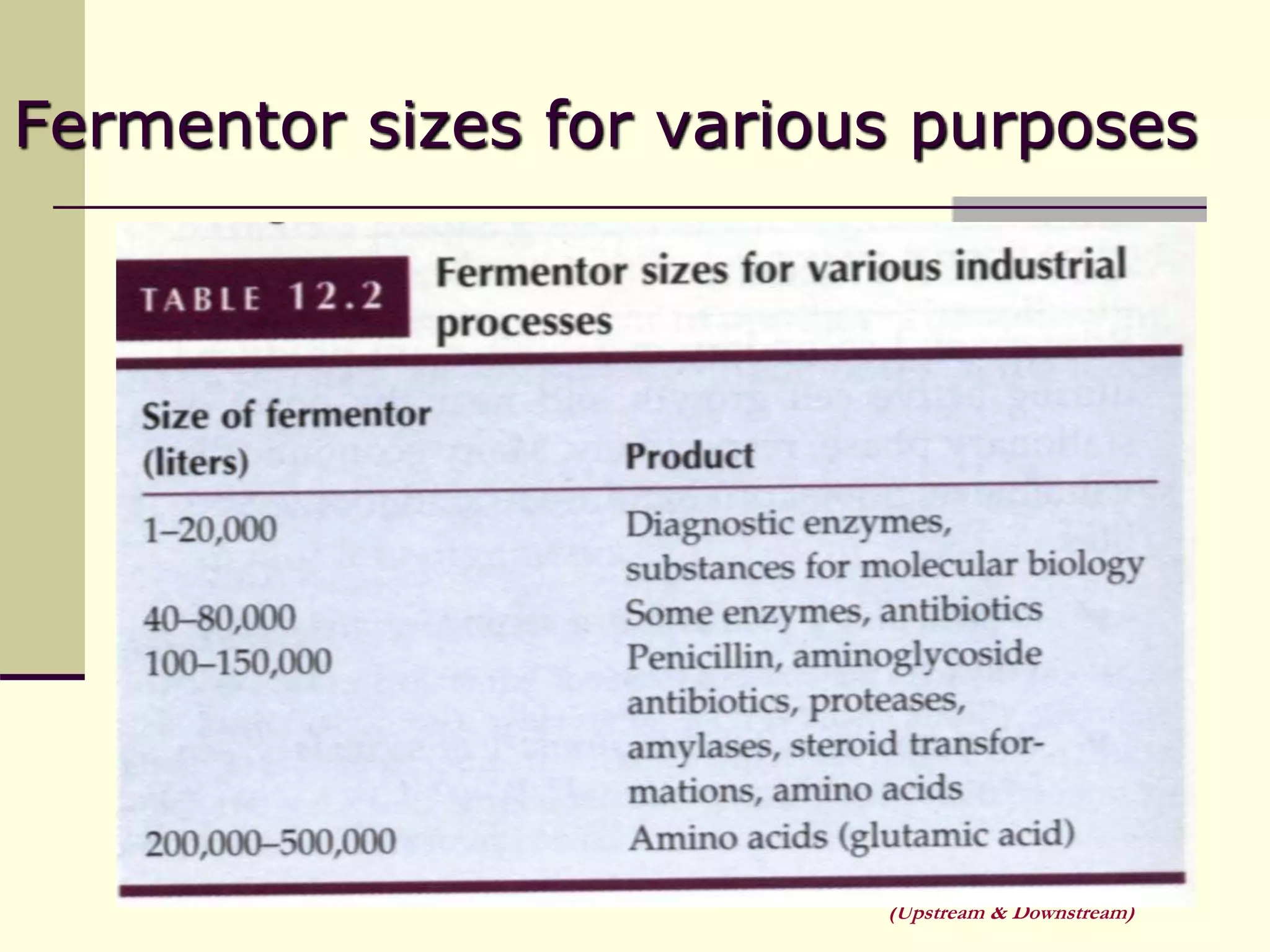
Fermentor sizes for various purposes
August 29, 2022 Unit Operation in a Bioprocess
(Upstream & Downstream)
Some problems in Scale up
 Oxygen transfer is much more difficult to obtain in
large-scale
 Mixing and aeration more easily accomplished in
small volumes
 Methods of temperature control must change with
scale-up
 Sterilization protocols must change with scale-up
 Bioprocess Engineers required with Chemical
Engineering skills: adept in gas and mass transfer,
fluid dynamics, mixing, thermodynamics
August 29, 2022 Unit Operation in a Bioprocess
(Upstream & Downstream)
Downstream processing
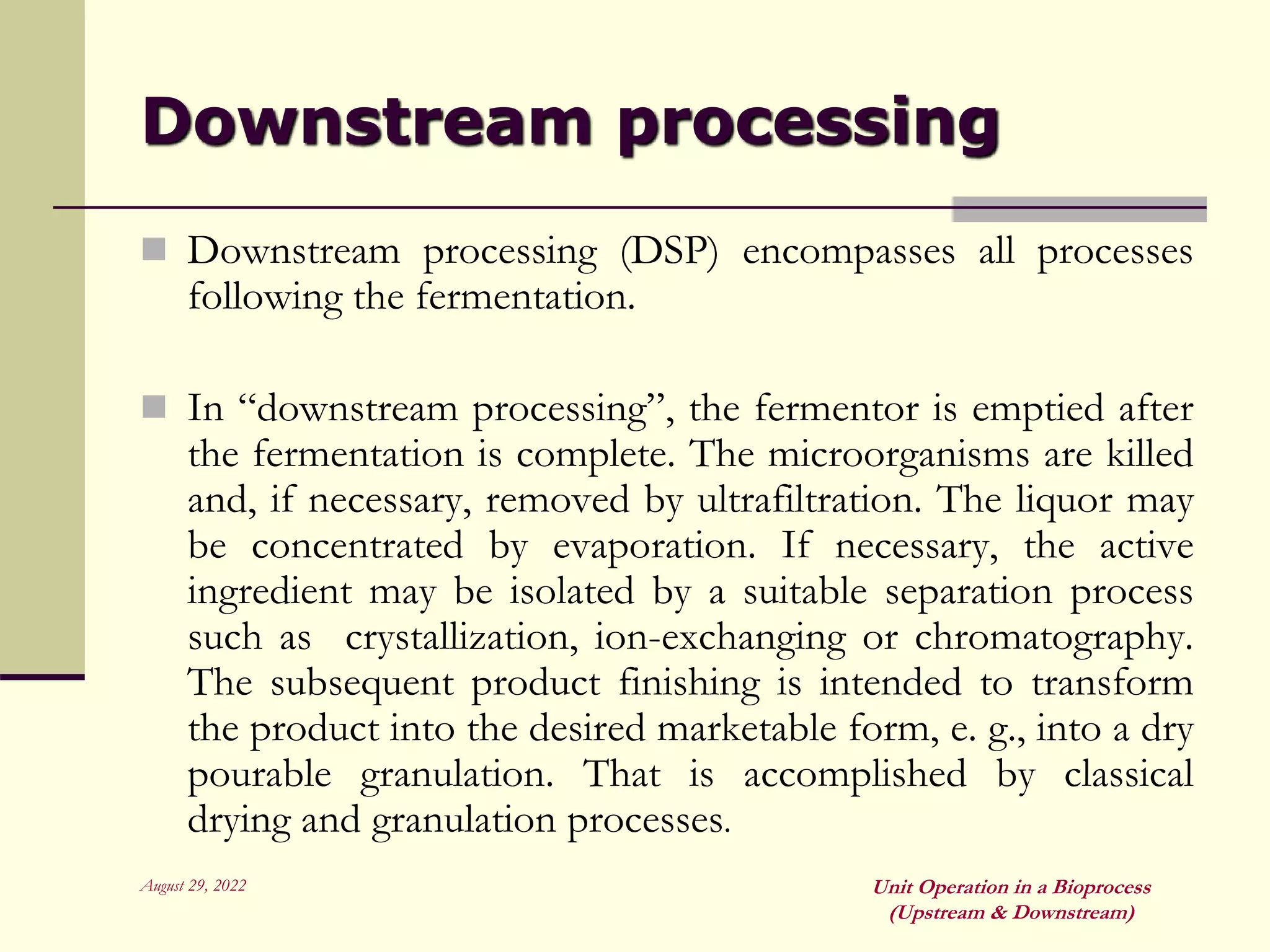
 Downstream processing (DSP) encompasses all processes
following the fermentation.
 In “downstream processing”, the fermentor is emptied after
the fermentation is complete. The microorganisms are killed
and, if necessary, removed by ultrafiltration. The liquor may
be concentrated by evaporation. If necessary, the active
ingredient may be isolated by a suitable separation process
such as crystallization, ion-exchanging or chromatography.
The subsequent product finishing is intended to transform
the product into the desired marketable form, e. g., into a dry
pourable granulation. That is accomplished by classical
drying and granulation processes.
August 29, 2022 Unit Operation in a Bioprocess
(Upstream & Downstream)
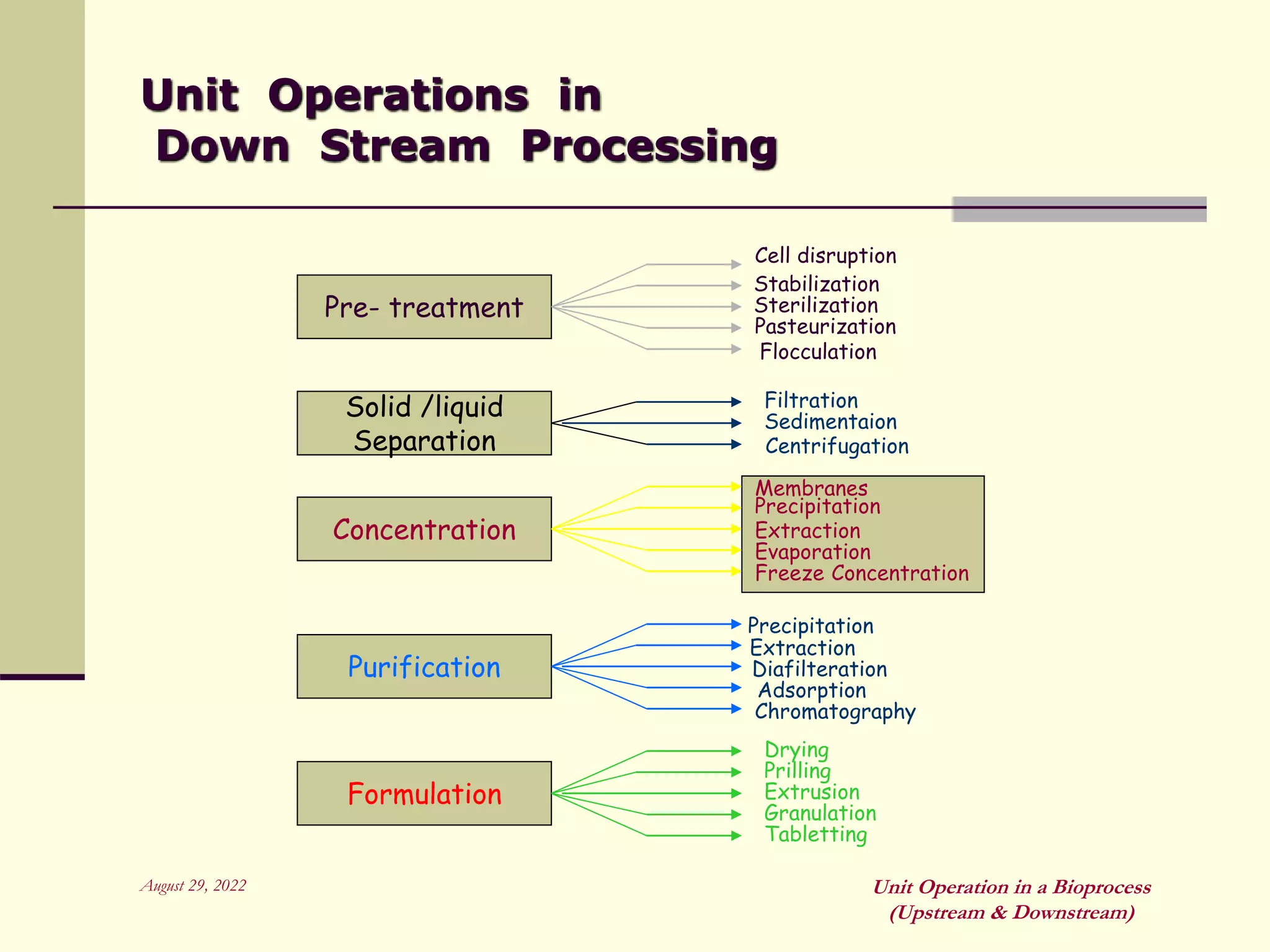
Unit Operations in
Down Stream Processing
Pre- treatment
Solid /liquid
Separation
Concentration
Purification
Formulation
Cell disruption
Stabilization
Sterilization
Pasteurization
Flocculation
Filtration
Sedimentaion
Centrifugation
Membranes
Precipitation
Evaporation
Extraction
Freeze Concentration
Precipitation
Extraction
Diafilteration
Adsorption
Chromatography
Drying
Prilling
Extrusion
Granulation
Tabletting
August 29, 2022 Unit Operation in a Bioprocess
(Upstream & Downstream)
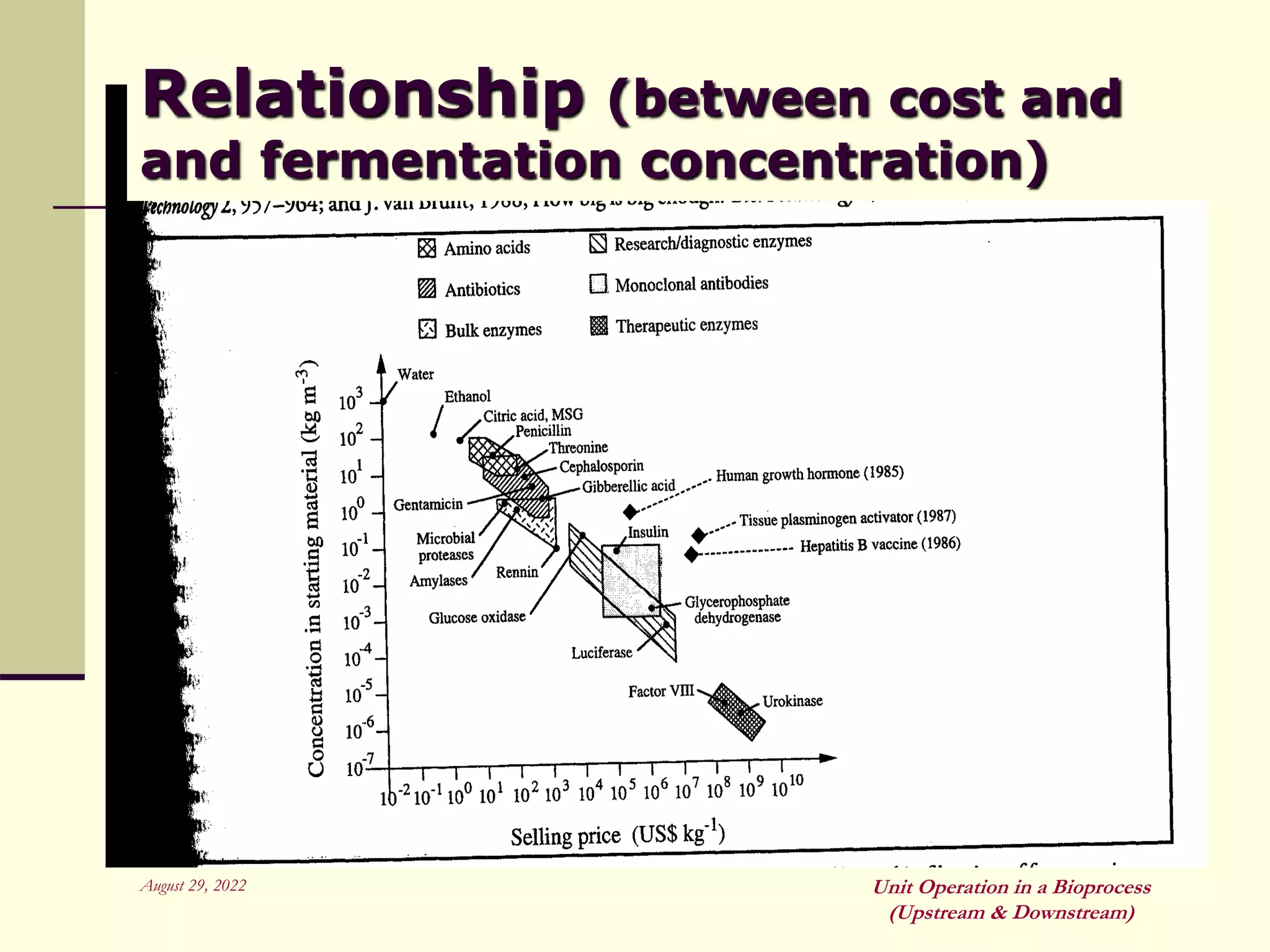
Relationship (between cost and
and fermentation concentration)
August 29, 2022 Unit Operation in a Bioprocess
(Upstream & Downstream)
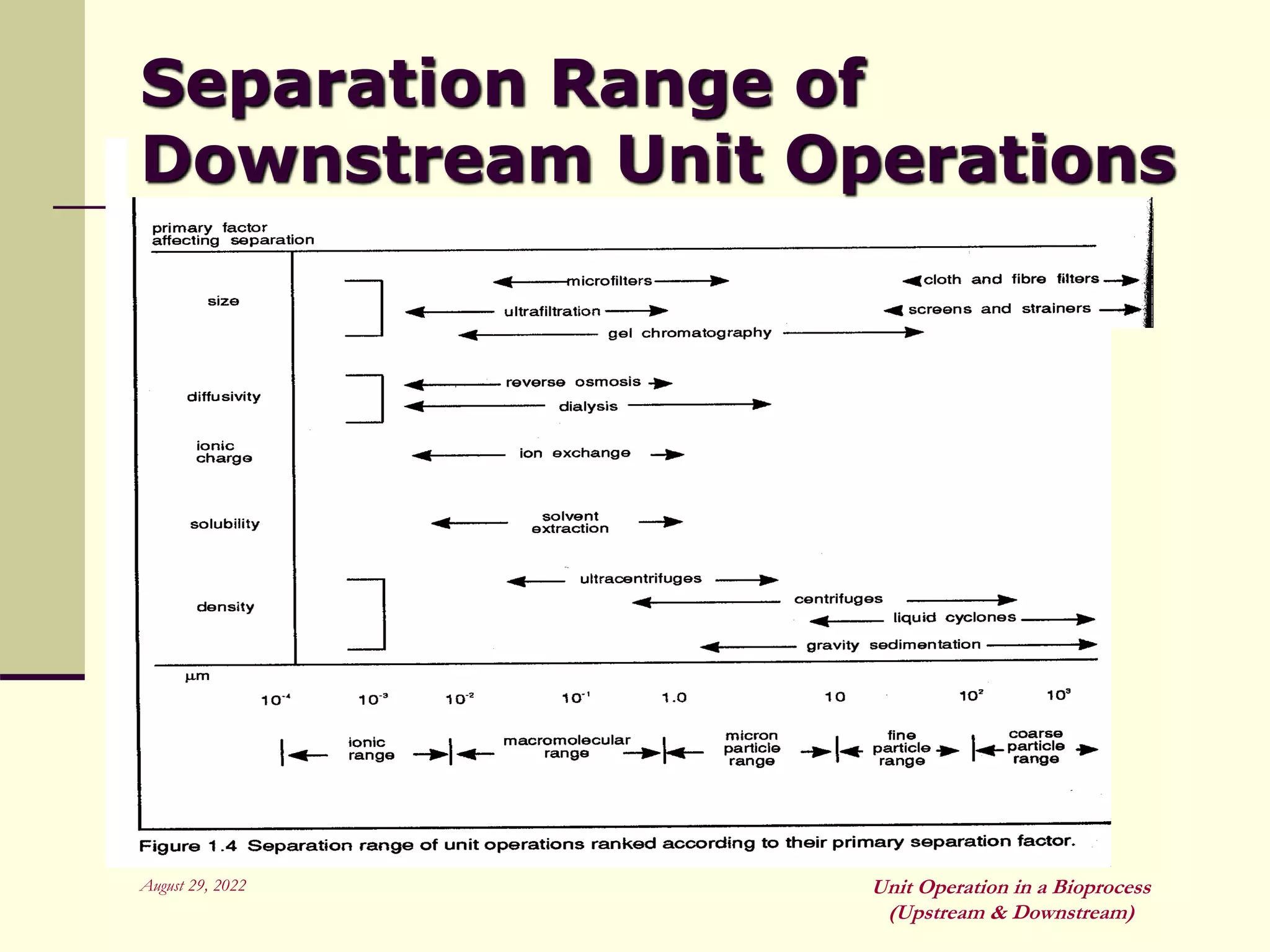
Separation Range of
Downstream Unit Operations
August 29, 2022 Unit Operation in a Bioprocess
(Upstream & Downstream)
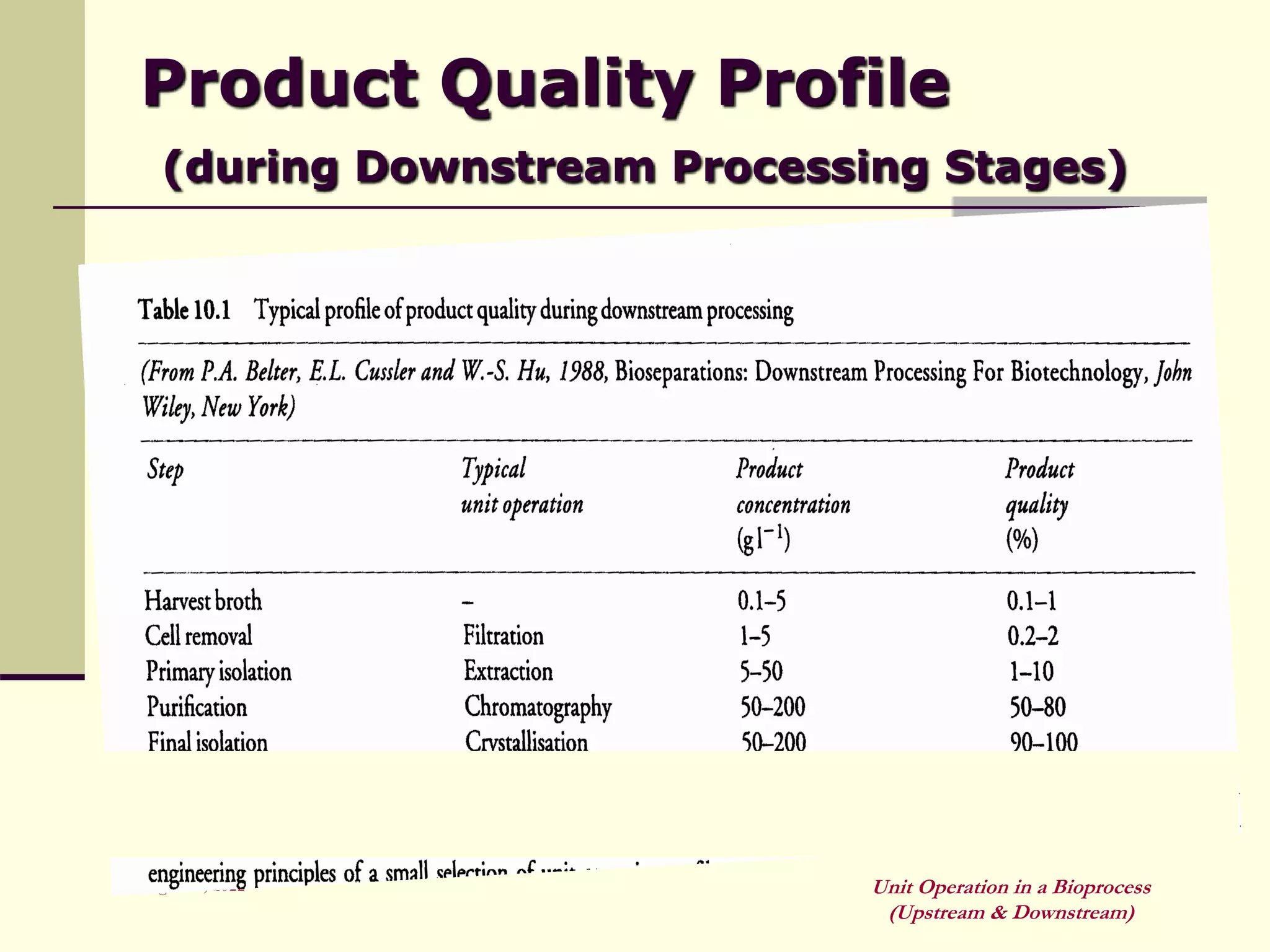
Product Quality Profile
(during Downstream Processing Stages)
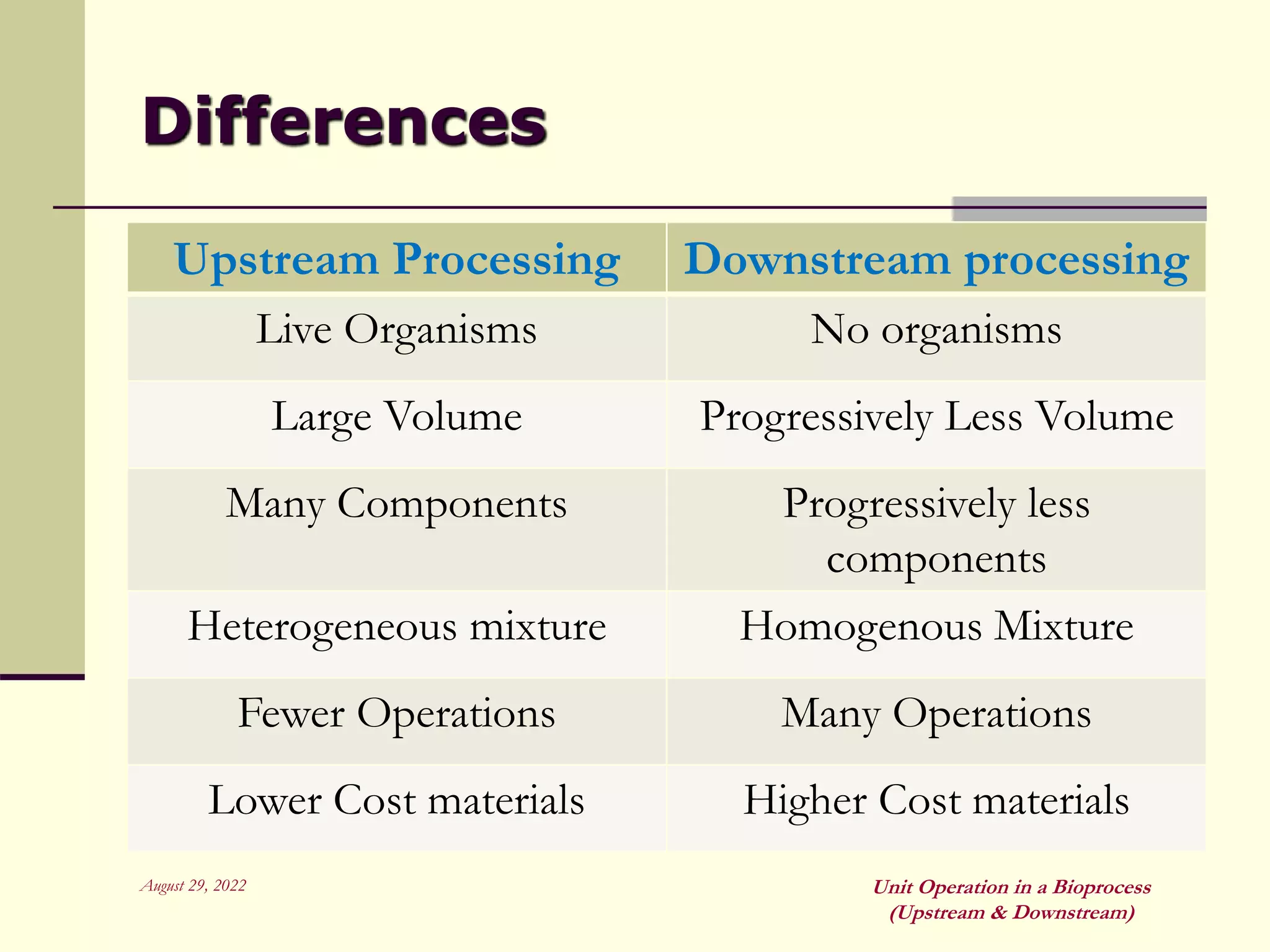
Differences
Upstream Processing Downstream processing
Live Organisms No organisms
Large Volume Progressively Less Volume
Many Components Progressively less
components
Heterogeneous mixture Homogenous Mixture
Fewer Operations Many Operations
Lower Cost materials Higher Cost materials
August 29, 2022 Unit Operation in a Bioprocess
(Upstream & Downstream)
August 29, 2022 Unit Operation in a Bioprocess
(Upstream & Downstream)
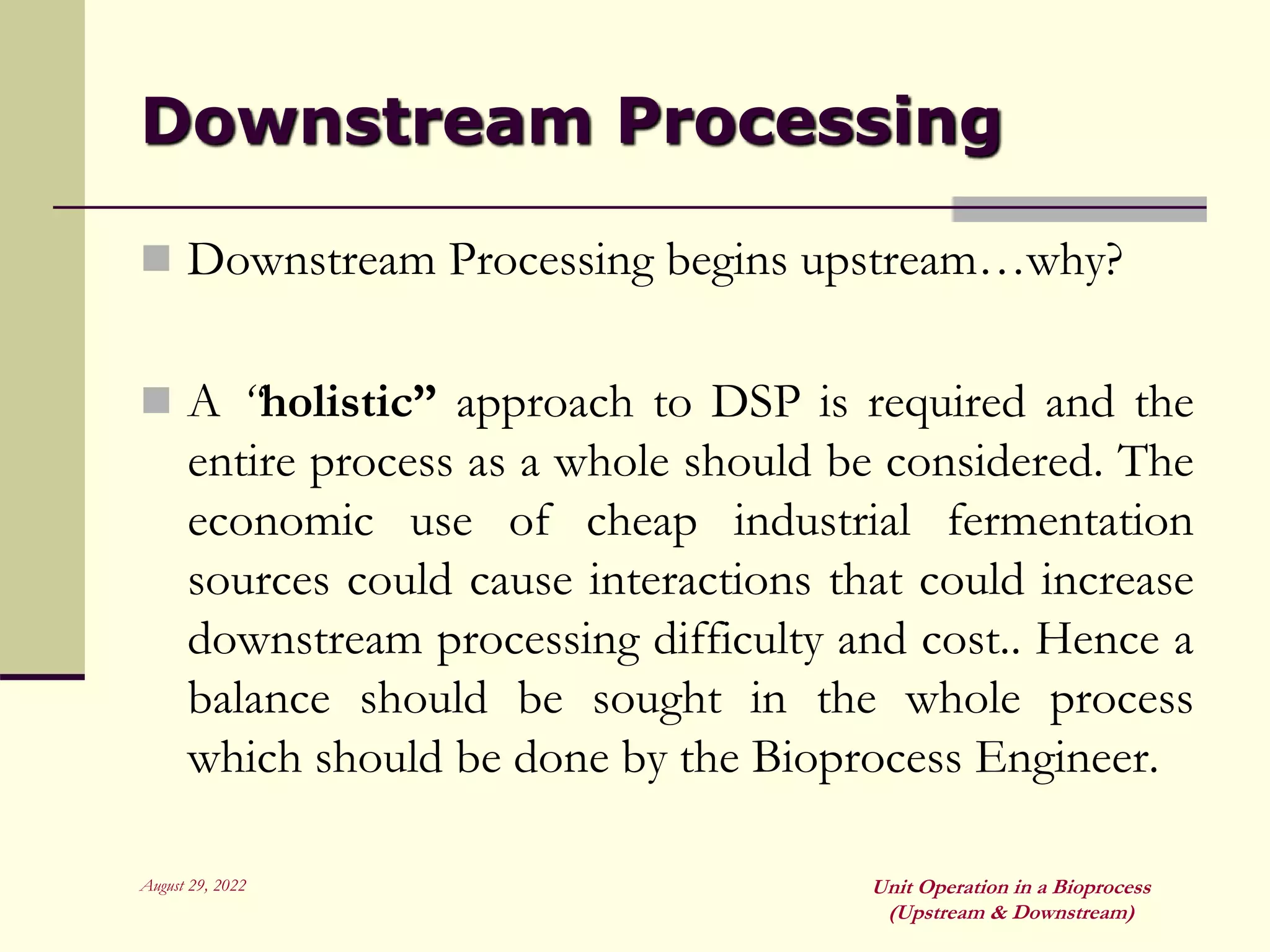
Downstream Processing
 Downstream Processing begins upstream…why?
 A “holistic” approach to DSP is required and the
entire process as a whole should be considered. The
economic use of cheap industrial fermentation
sources could cause interactions that could increase
downstream processing difficulty and cost.. Hence a
balance should be sought in the whole process
which should be done by the Bioprocess Engineer.
August 29, 2022 Unit Operation in a Bioprocess
(Upstream & Downstream)
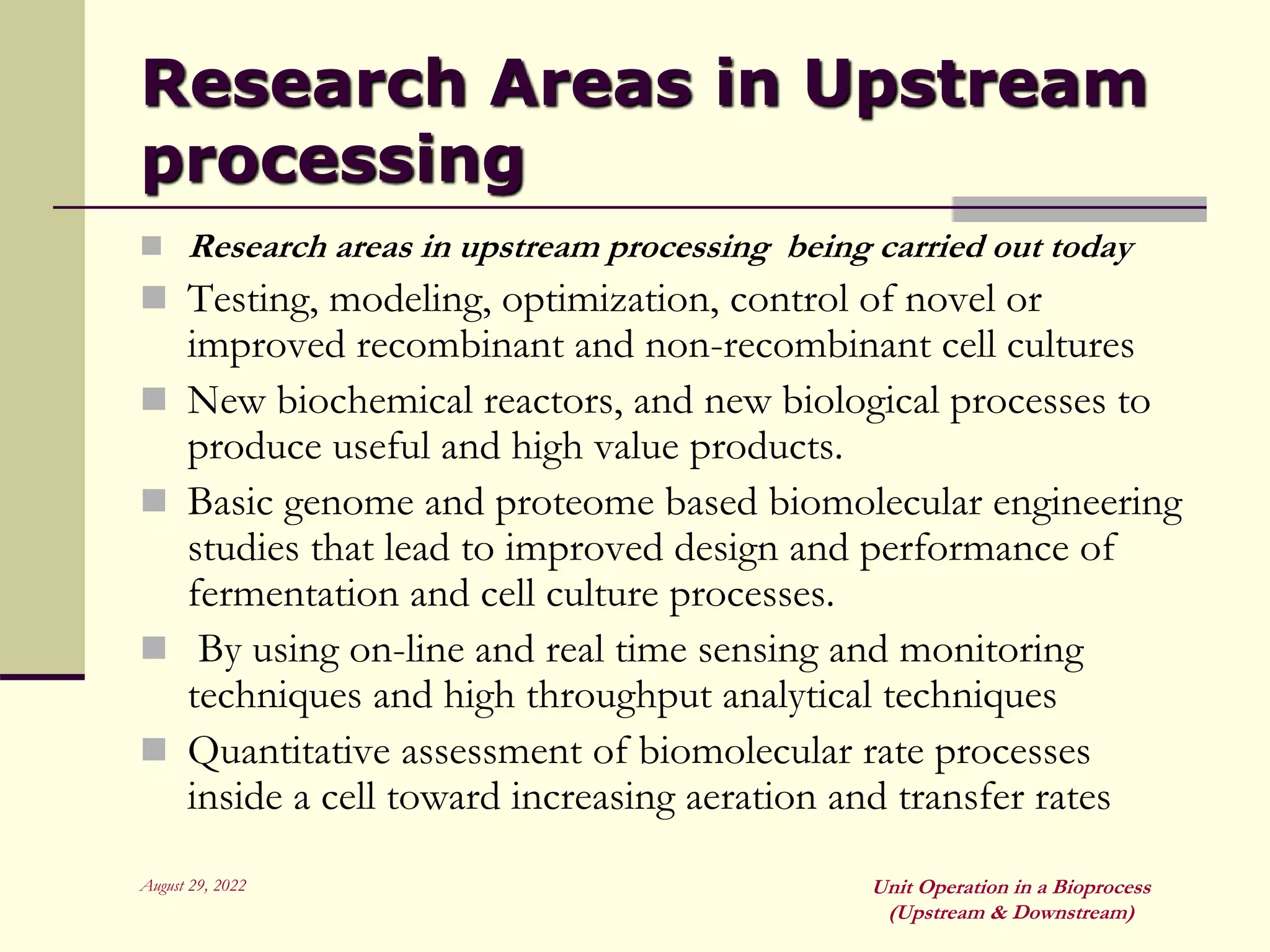
Research Areas in Upstream
processing
 Research areas in upstream processing being carried out today
 Testing, modeling, optimization, control of novel or
improved recombinant and non-recombinant cell cultures
 New biochemical reactors, and new biological processes to
produce useful and high value products.
 Basic genome and proteome based biomolecular engineering
studies that lead to improved design and performance of
fermentation and cell culture processes.
 By using on-line and real time sensing and monitoring
techniques and high throughput analytical techniques
 Quantitative assessment of biomolecular rate processes
inside a cell toward increasing aeration and transfer rates
August 29, 2022 Unit Operation in a Bioprocess
(Upstream & Downstream)
Research Areas in
Downstream processing
 The capability to purify bioproducts in a cost-effective
manner on a commercial scale and to meet the required high
purity specification for the medical grade bioproducts is an
important technical goal of R & D.
 Research in areas as posttranslational protein processing,
protein refolding, protein purification techniques, membrane
technology,
 Various types of chromatography including bioaffinity
systems, separation techniques using combined force fields,
and filtration methods.

Bioprocess basic principles ppt.ppt

  • 1.
  • 2.
    August 29, 2022Unit Operation in a Bioprocess (Upstream & Downstream) Definition These “fundamental” operations are what are called “unit operations”. Chemical and Bioprocess Industries consist of widely varying sequences of steps that have different combinations for different manufacturing cycles. What is a Unit operation? However these widely varying steps can be reduced or broken down to simple operations which are identical in fundamentals regardless of the material being processed.
  • 3.
    August 29, 2022Unit Operation in a Bioprocess (Upstream & Downstream) Historical Definition  This definition was used by A.D Little in 1915 to describe Unit Operations.  “Unit operations deal mainly with the transfer of energy and the transfer and change of materials primarily by physical means”.  What is a Unit Process?
  • 4.
    August 29, 2022Unit Operation in a Bioprocess (Upstream & Downstream) Different Unit Operations  Drying  Distillation  Adsorption  Membrane separation  Leaching  Sedimentation  Mixing  Liquid Liquid Extraction  Absorption TRANSPORT PHENOMENA  Momentum Transfer  Fluid Flow  Sedimenation  Mixing  Heat Transfer  Drying  Evaporaytion (SHMT)  Distillation  Mass Tranfer  Absorption  Adsorptin  Distillation
  • 5.
    August 29, 2022Unit Operation in a Bioprocess (Upstream & Downstream) Stages of a Bioprocess  A biotechnical process to produce a product can be subdivided into five successive major segments, with some overlap: • upstream processing • fermentation • downstream processing • product finishing • treatment of waste if any
  • 6.
    August 29, 2022Unit Operation in a Bioprocess (Upstream & Downstream) Stages of a Traditional Bioprocess
  • 7.
    August 29, 2022Unit Operation in a Bioprocess (Upstream & Downstream) Stages of a Bioprocess (Details)  Preparation of sterile medium.  Addition (inoculation) of microbe ( pure culture) into this medium  Cultivation (incubation) under controlled conditions  Sterilising fermentation apparatus and preparing and sterilising feed streams to the fermentor FERMENTATION  Isolation and purification of the product from the fermented medium  Packaging of the product  Treatment of the waste products if any
  • 8.
    August 29, 2022Unit Operation in a Bioprocess (Upstream & Downstream) Unit Operations in a Bioprocess
  • 9.
    August 29, 2022Unit Operation in a Bioprocess (Upstream & Downstream) Upstream Processing “Pure Upstream processing” has essentially three functions:  Growth of a pure culture of microorganisms in one or more steps its scale up and strain development.  Sterilization of the apparatus and piping.  Mixing and sterilizing the necessary raw materials and fermentation media to be supplied to the fermentation unit.
  • 10.
    August 29, 2022Unit Operation in a Bioprocess (Upstream & Downstream) Fermentation Stage  Sometimes considered as an Upstream process while some bioprocess engineers consider it as a separate Stage in itself. Never considered as a downstream processing stage  Actual fermentation is commonly a batch or fed batch process in a stirred tank fermentor.  It lasts from a few hours to several days.  The optimal conditions for growth of the organisms and production of the product are established. Those include temperature, pH, sterile aeration and, in fed-batch processes, continuous addition of substrate at its optimal composition.
  • 11.
    August 29, 2022Unit Operation in a Bioprocess (Upstream & Downstream) SCALE UP (DEFINITION)  Shake flash Experiments  Lab scale fermentor (5-10 L)  Pilot scale fermentor (300-3000 L)  Commercial fermentor (10,000-500,000 L) •Scale up: The transfer of a process from small-scale laboratory equipment to large-scale commercial equipment
  • 12.
    August 29, 2022Unit Operation in a Bioprocess (Upstream & Downstream) lab flask (100 mL) lab-scale fermentor (1–10 L) pilot plant scale (300-3000 L) commercial scale (10,000-500,000 L) Scale up
  • 13.
    August 29, 2022Unit Operation in a Bioprocess (Upstream & Downstream) Industrial Scale up
  • 14.
    August 29, 2022Unit Operation in a Bioprocess (Upstream & Downstream) Industrial Fermentation Setting
  • 15.
    August 29, 2022Unit Operation in a Bioprocess (Upstream & Downstream) Fermentor sizes for various purposes
  • 16.
    August 29, 2022Unit Operation in a Bioprocess (Upstream & Downstream) Some problems in Scale up  Oxygen transfer is much more difficult to obtain in large-scale  Mixing and aeration more easily accomplished in small volumes  Methods of temperature control must change with scale-up  Sterilization protocols must change with scale-up  Bioprocess Engineers required with Chemical Engineering skills: adept in gas and mass transfer, fluid dynamics, mixing, thermodynamics
  • 17.
    August 29, 2022Unit Operation in a Bioprocess (Upstream & Downstream) Downstream processing  Downstream processing (DSP) encompasses all processes following the fermentation.  In “downstream processing”, the fermentor is emptied after the fermentation is complete. The microorganisms are killed and, if necessary, removed by ultrafiltration. The liquor may be concentrated by evaporation. If necessary, the active ingredient may be isolated by a suitable separation process such as crystallization, ion-exchanging or chromatography. The subsequent product finishing is intended to transform the product into the desired marketable form, e. g., into a dry pourable granulation. That is accomplished by classical drying and granulation processes.
  • 18.
    August 29, 2022Unit Operation in a Bioprocess (Upstream & Downstream) Unit Operations in Down Stream Processing Pre- treatment Solid /liquid Separation Concentration Purification Formulation Cell disruption Stabilization Sterilization Pasteurization Flocculation Filtration Sedimentaion Centrifugation Membranes Precipitation Evaporation Extraction Freeze Concentration Precipitation Extraction Diafilteration Adsorption Chromatography Drying Prilling Extrusion Granulation Tabletting
  • 19.
    August 29, 2022Unit Operation in a Bioprocess (Upstream & Downstream) Relationship (between cost and and fermentation concentration)
  • 20.
    August 29, 2022Unit Operation in a Bioprocess (Upstream & Downstream) Separation Range of Downstream Unit Operations
  • 21.
    August 29, 2022Unit Operation in a Bioprocess (Upstream & Downstream) Product Quality Profile (during Downstream Processing Stages)
  • 22.
    Differences Upstream Processing Downstreamprocessing Live Organisms No organisms Large Volume Progressively Less Volume Many Components Progressively less components Heterogeneous mixture Homogenous Mixture Fewer Operations Many Operations Lower Cost materials Higher Cost materials August 29, 2022 Unit Operation in a Bioprocess (Upstream & Downstream)
  • 23.
    August 29, 2022Unit Operation in a Bioprocess (Upstream & Downstream) Downstream Processing  Downstream Processing begins upstream…why?  A “holistic” approach to DSP is required and the entire process as a whole should be considered. The economic use of cheap industrial fermentation sources could cause interactions that could increase downstream processing difficulty and cost.. Hence a balance should be sought in the whole process which should be done by the Bioprocess Engineer.
  • 24.
    August 29, 2022Unit Operation in a Bioprocess (Upstream & Downstream) Research Areas in Upstream processing  Research areas in upstream processing being carried out today  Testing, modeling, optimization, control of novel or improved recombinant and non-recombinant cell cultures  New biochemical reactors, and new biological processes to produce useful and high value products.  Basic genome and proteome based biomolecular engineering studies that lead to improved design and performance of fermentation and cell culture processes.  By using on-line and real time sensing and monitoring techniques and high throughput analytical techniques  Quantitative assessment of biomolecular rate processes inside a cell toward increasing aeration and transfer rates
  • 25.
    August 29, 2022Unit Operation in a Bioprocess (Upstream & Downstream) Research Areas in Downstream processing  The capability to purify bioproducts in a cost-effective manner on a commercial scale and to meet the required high purity specification for the medical grade bioproducts is an important technical goal of R & D.  Research in areas as posttranslational protein processing, protein refolding, protein purification techniques, membrane technology,  Various types of chromatography including bioaffinity systems, separation techniques using combined force fields, and filtration methods.