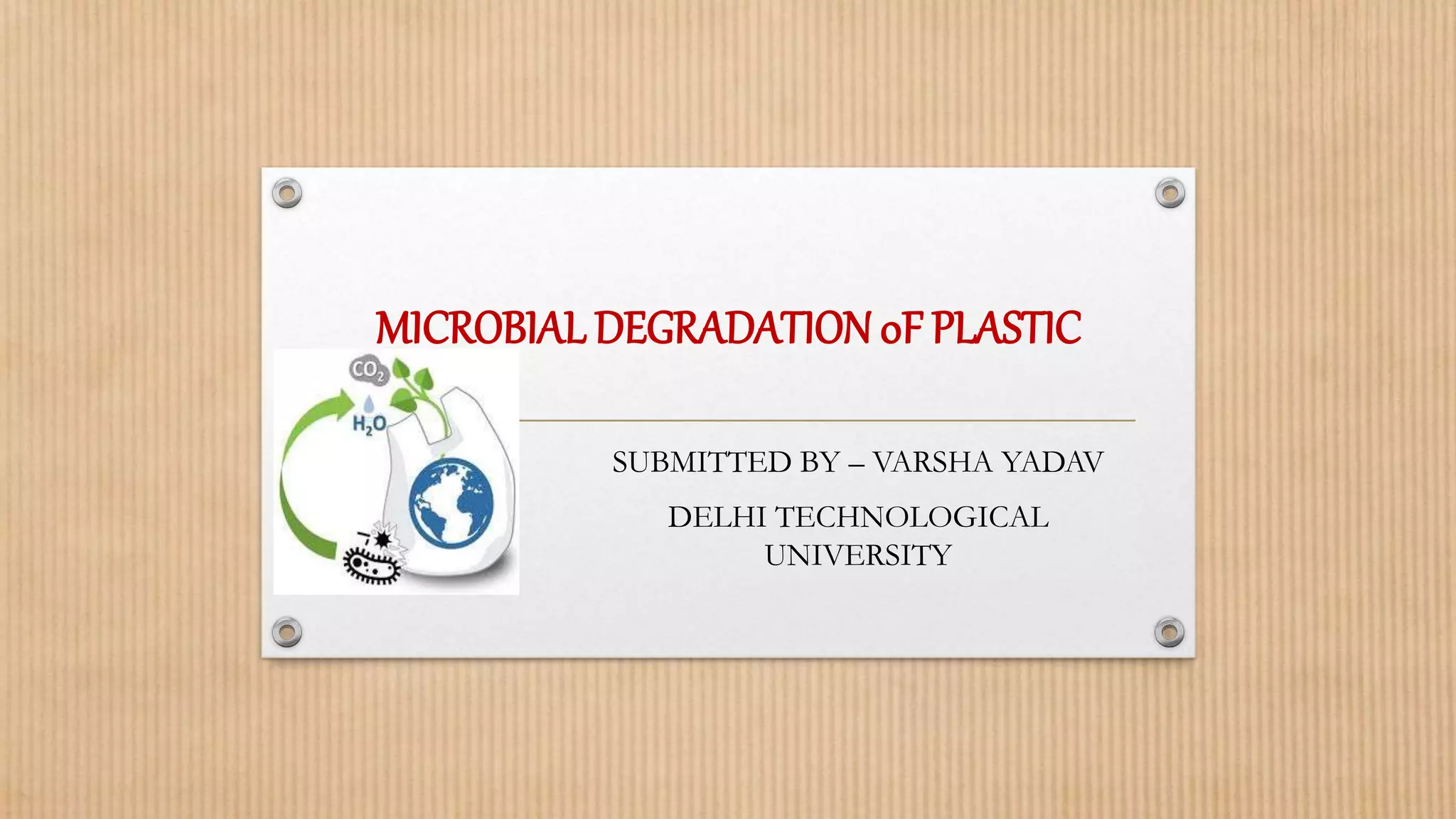
MICROBIAL DEGRADATION 0F PLASTIC
SUBMITTED BY – VARSHA YADAV
DELHI TECHNOLOGICAL
UNIVERSITY
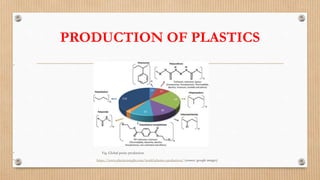
PRODUCTION OF PLASTICS
•
• Fig. Global pastic production
• https://www.plasticsinsight.com/world-plastics-production/ (source: google images)
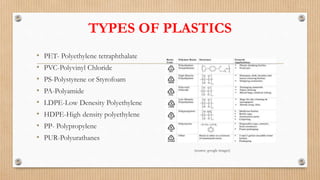
TYPES OF PLASTICS
• PET- Polyethylene tetraphthalate
• PVC-Polyvinyl Chloride
• PS-Polystyrene or Styrofoam
• PA-Polyamide
• LDPE-Low Denesity Polyethylene
• HDPE-High density polyethylene
• PP- Polypropylene
• PUR-Polyurathanes
(source: google images)
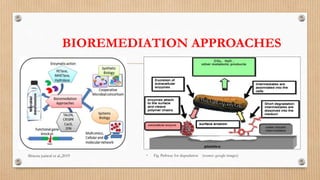
BIOREMEDIATION APPROACHES
Shweta jsaiwal et al.,2019 • Fig. Pathway for degradation (source: google images)
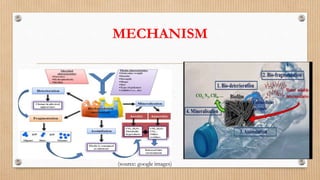
MECHANISM
(source: google images)
Bacterial and Fungi Species Involved in
Biodegradation
There are many microorganisms (especially of bacterial and fungal origin) that
have a mechanism to degrade large and complicated hydrocarbons into simpler
biomolecules.
They are in particular Gram-positive and Gram-negative as well as a few
species of fungal origin like Aspergillus. Other species of microbes like
Streptococcus, Staphylococcus, Micrococcus (Gram-negative), Moraxella and Pseudomonas
(Gram-positive) and species of fungi (Aspergillus glaucus and Aspergillus niger) are
involved in biodegradation system. In addition,Bacillus megaterium, Ralstonia
eutropha, Azotobacter, Halomonas species are involved in the breakdown method.
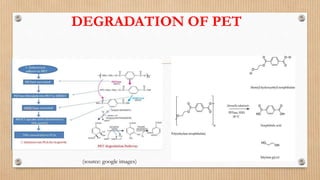
DEGRADATION OF PET
(source: google images)
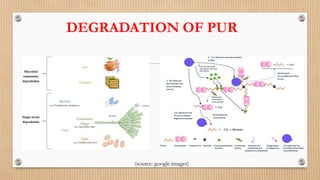
DEGRADATION OF PUR
(source: google images)
CONCLUSION
• Microbial degradation of plastics is better then chemical processes , burning
or landfilling, because it consumes less energy and is environmental friendly
option.
• But the diversity of microbes and enzymes that can degrade plastics is still
limited. So, the future prospects include identification, isolation and
modification of microbes against all the synthetic plastics
REFERENCES
• Yutaka Tokiwa 1,Buenaventurada P. Calabia ,Charles U. Ugwu andSeiichi Aiba , Biodegradability of Plastics,Int. J. Mol. Sci. 2009,
10(9), 3722-3742; https://doi.org/10.3390/ijms10093722
• Shosuke Yoshida,Kazumi Hiraga,Toshihiko Takehana,A bacterium that degrades and assimilates poly(ethylene
terephthalate),March 2016Science 351(6278):1196-1199.DOI: 10.1126/science.aad6359
• Plastics: Environmental and Biotechnological Perspectives on Microbial Degradation,Dominik Danso, Jennifer
Chow, Wolfgang R. Streit, DOI: 10.1128/AEM.01095-19
• Jiakang Ru, Yixin Huo,and Yu Yang, Microbial Degradation and Valorization of Plastic Wastes,. Front. Microbiol.,
21 April 2020 | https://doi.org/10.3389/fmicb.2020.00442

Microbial degradation of plastic

  • 1.
    MICROBIAL DEGRADATION 0FPLASTIC SUBMITTED BY – VARSHA YADAV DELHI TECHNOLOGICAL UNIVERSITY
  • 2.
    PRODUCTION OF PLASTICS • •Fig. Global pastic production • https://www.plasticsinsight.com/world-plastics-production/ (source: google images)
  • 3.
    TYPES OF PLASTICS •PET- Polyethylene tetraphthalate • PVC-Polyvinyl Chloride • PS-Polystyrene or Styrofoam • PA-Polyamide • LDPE-Low Denesity Polyethylene • HDPE-High density polyethylene • PP- Polypropylene • PUR-Polyurathanes (source: google images)
  • 4.
    BIOREMEDIATION APPROACHES Shweta jsaiwalet al.,2019 • Fig. Pathway for degradation (source: google images)
  • 5.
  • 6.
    Bacterial and FungiSpecies Involved in Biodegradation There are many microorganisms (especially of bacterial and fungal origin) that have a mechanism to degrade large and complicated hydrocarbons into simpler biomolecules. They are in particular Gram-positive and Gram-negative as well as a few species of fungal origin like Aspergillus. Other species of microbes like Streptococcus, Staphylococcus, Micrococcus (Gram-negative), Moraxella and Pseudomonas (Gram-positive) and species of fungi (Aspergillus glaucus and Aspergillus niger) are involved in biodegradation system. In addition,Bacillus megaterium, Ralstonia eutropha, Azotobacter, Halomonas species are involved in the breakdown method.
  • 7.
  • 8.
  • 9.
    CONCLUSION • Microbial degradationof plastics is better then chemical processes , burning or landfilling, because it consumes less energy and is environmental friendly option. • But the diversity of microbes and enzymes that can degrade plastics is still limited. So, the future prospects include identification, isolation and modification of microbes against all the synthetic plastics
  • 10.
    REFERENCES • Yutaka Tokiwa1,Buenaventurada P. Calabia ,Charles U. Ugwu andSeiichi Aiba , Biodegradability of Plastics,Int. J. Mol. Sci. 2009, 10(9), 3722-3742; https://doi.org/10.3390/ijms10093722 • Shosuke Yoshida,Kazumi Hiraga,Toshihiko Takehana,A bacterium that degrades and assimilates poly(ethylene terephthalate),March 2016Science 351(6278):1196-1199.DOI: 10.1126/science.aad6359 • Plastics: Environmental and Biotechnological Perspectives on Microbial Degradation,Dominik Danso, Jennifer Chow, Wolfgang R. Streit, DOI: 10.1128/AEM.01095-19 • Jiakang Ru, Yixin Huo,and Yu Yang, Microbial Degradation and Valorization of Plastic Wastes,. Front. Microbiol., 21 April 2020 | https://doi.org/10.3389/fmicb.2020.00442