
The Building Blocks of Life
Chapter 6 Lesson 4
p.166-171
Vocabulary
• Macromolecule
• Polymer
• Carbohydrate
• Lipid
• Protein
• Amino acid
• Nucleic Acid
• Nucleotide
Important Greek terms to make life
easier
• Poly- = many
• Mono- = one
• Di- = two
• Meros- = part
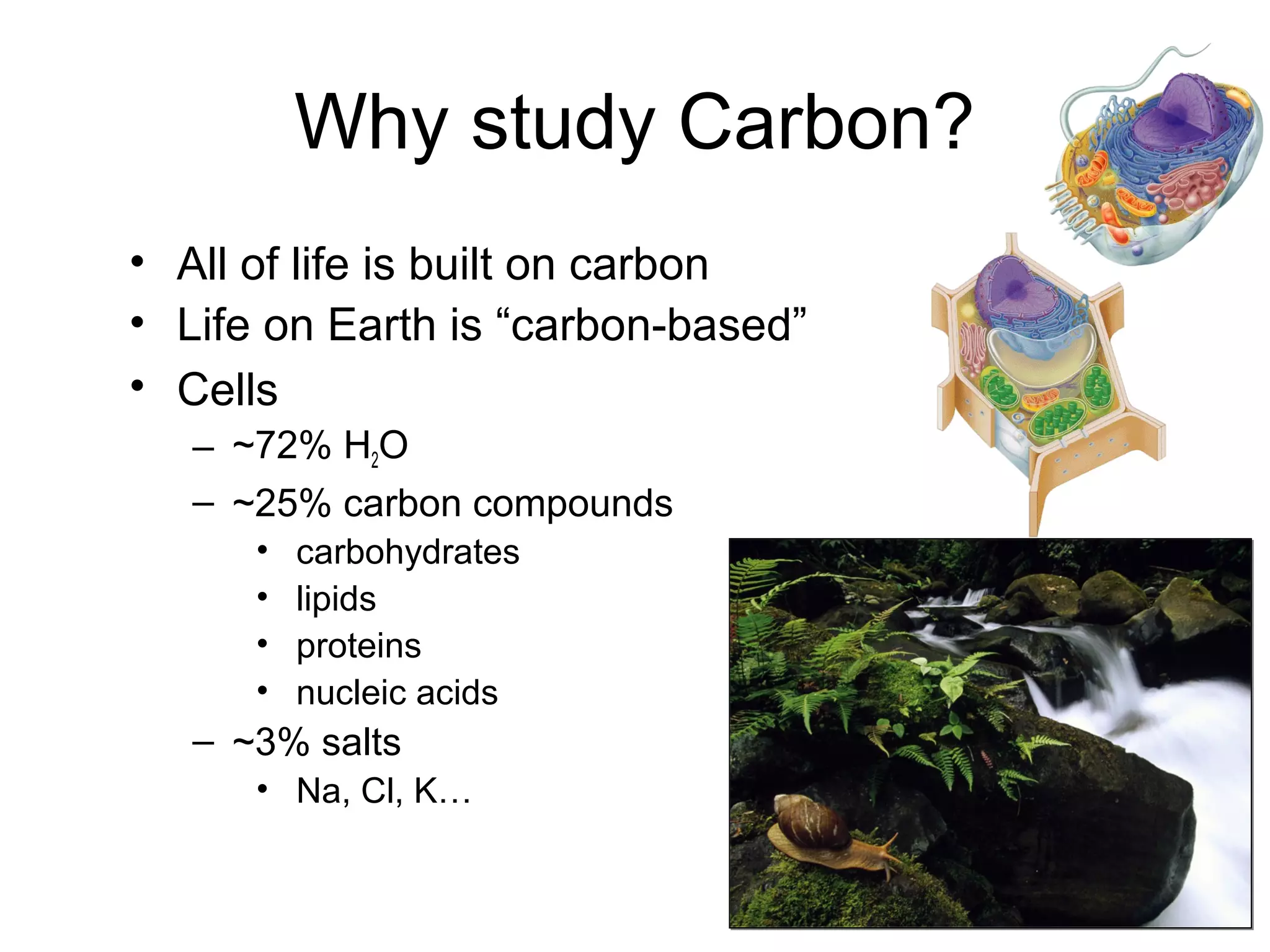
Why study Carbon?
• All of life is built on carbon
• Life on Earth is “carbon-based”
• Cells
– ~72% H2O
– ~25% carbon compounds
• carbohydrates
• lipids
• proteins
• nucleic acids
– ~3% salts
• Na, Cl, K…
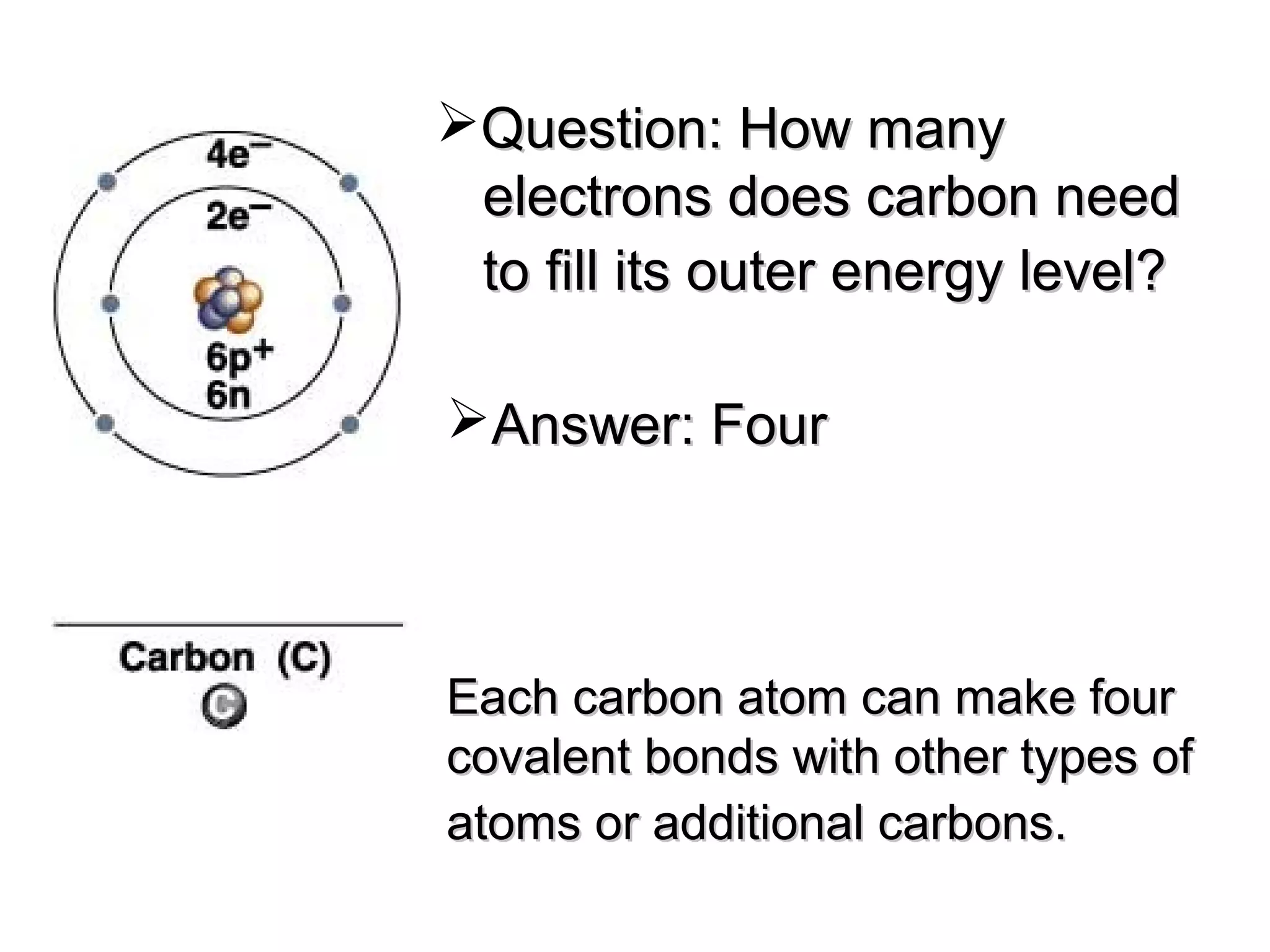
Each carbon atom can make fourEach carbon atom can make four
covalent bonds with other types ofcovalent bonds with other types of
atoms or additional carbons.atoms or additional carbons.
Question: How manyQuestion: How many
electrons does carbon needelectrons does carbon need
to fill its outer energy level?to fill its outer energy level?
Answer: FourAnswer: Four
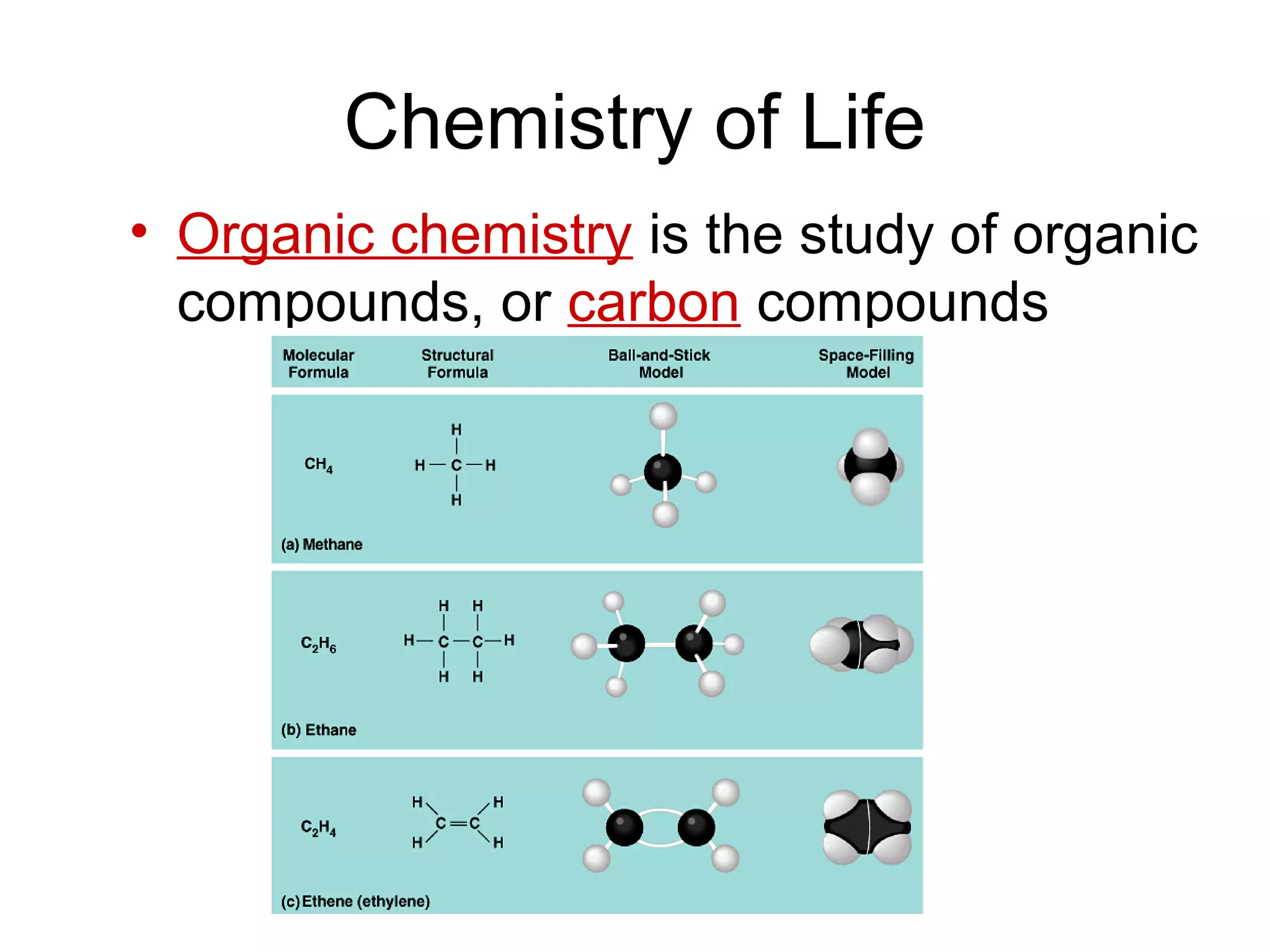
Chemistry of Life
• Organic chemistry is the study of organic
compounds, or carbon compounds
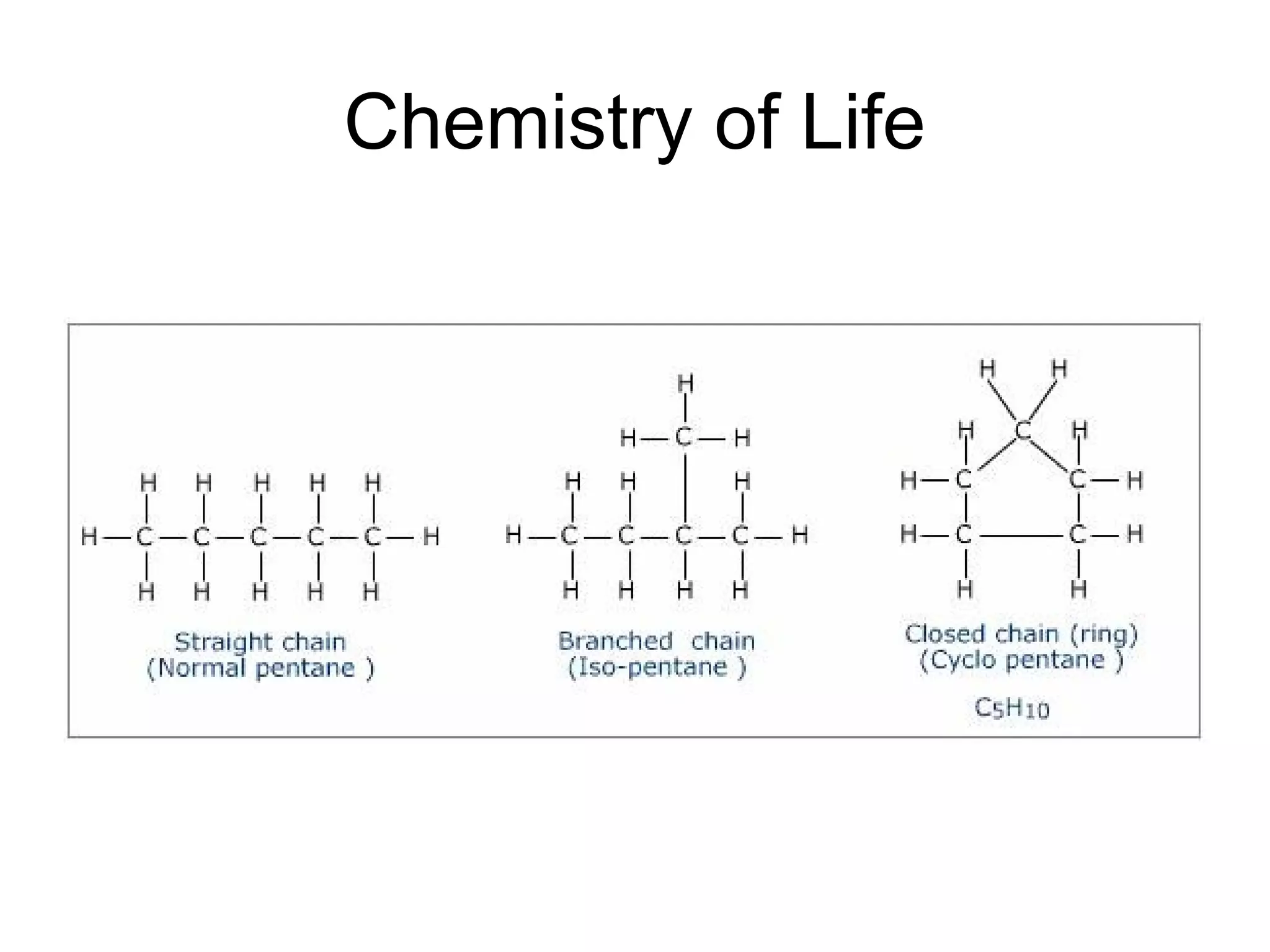
Chemistry of Life
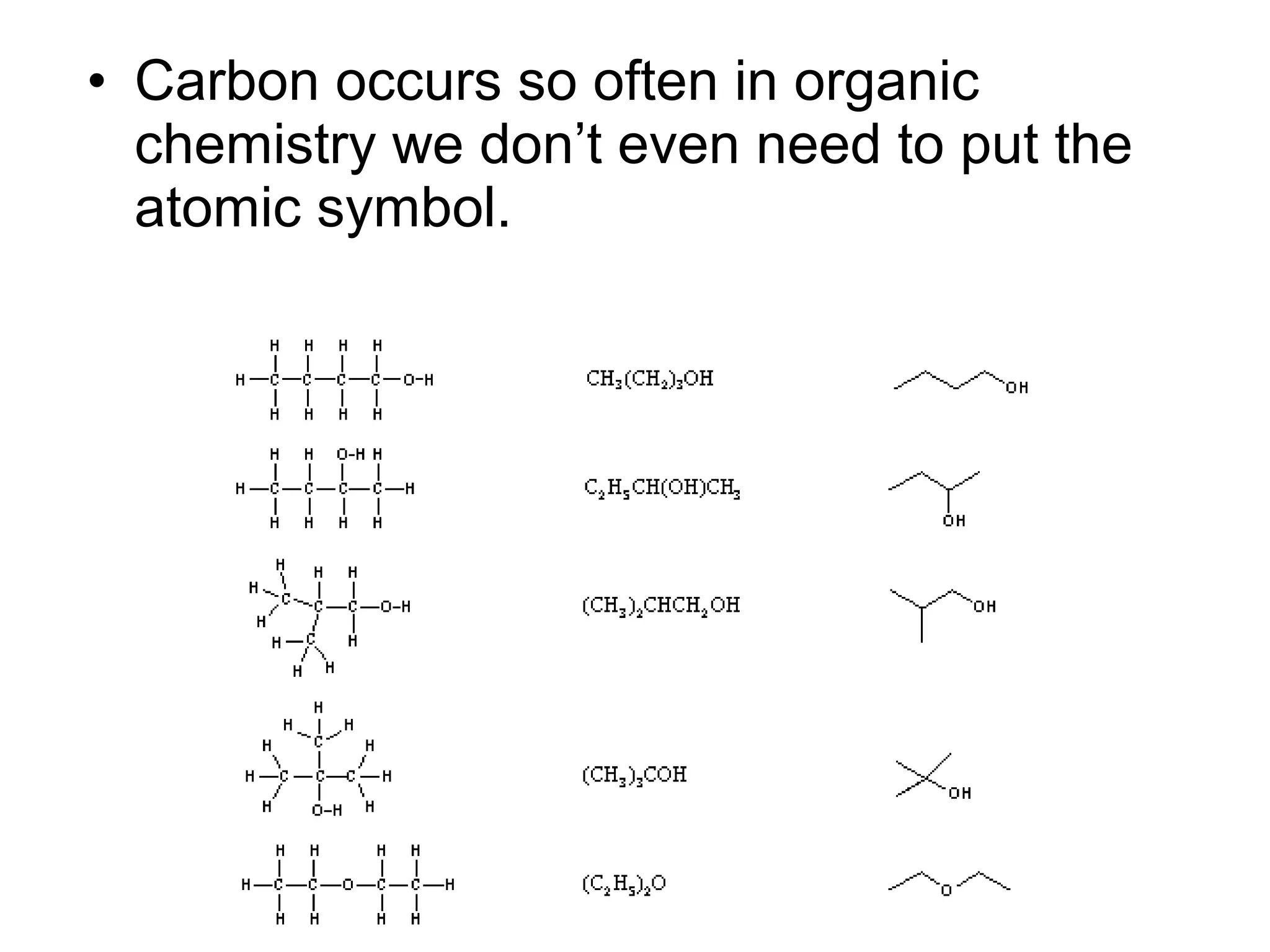
• Carbon occurs so often in organic
chemistry we don’t even need to put the
atomic symbol.
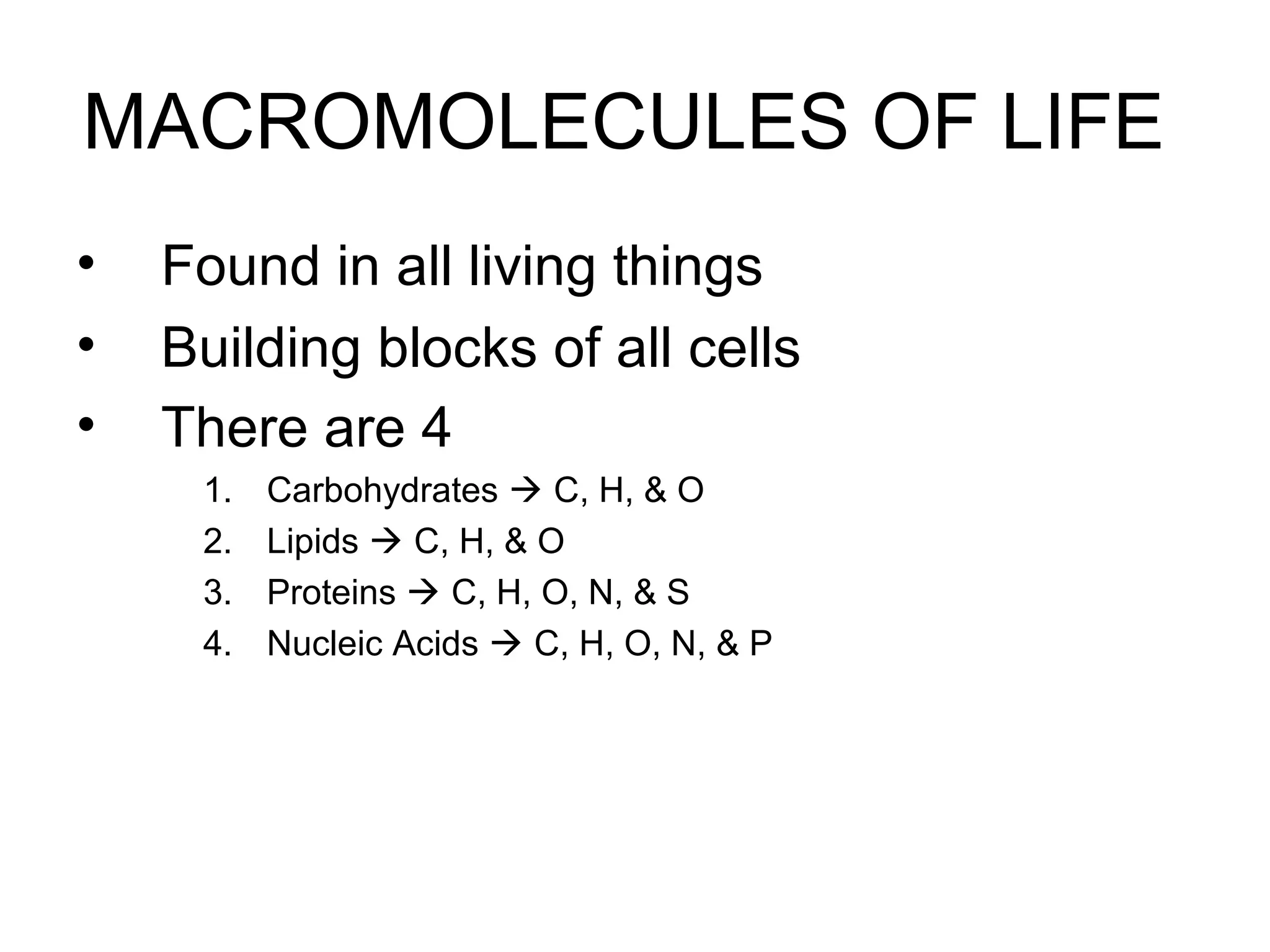
MACROMOLECULES OF LIFE
• Found in all living things
• Building blocks of all cells
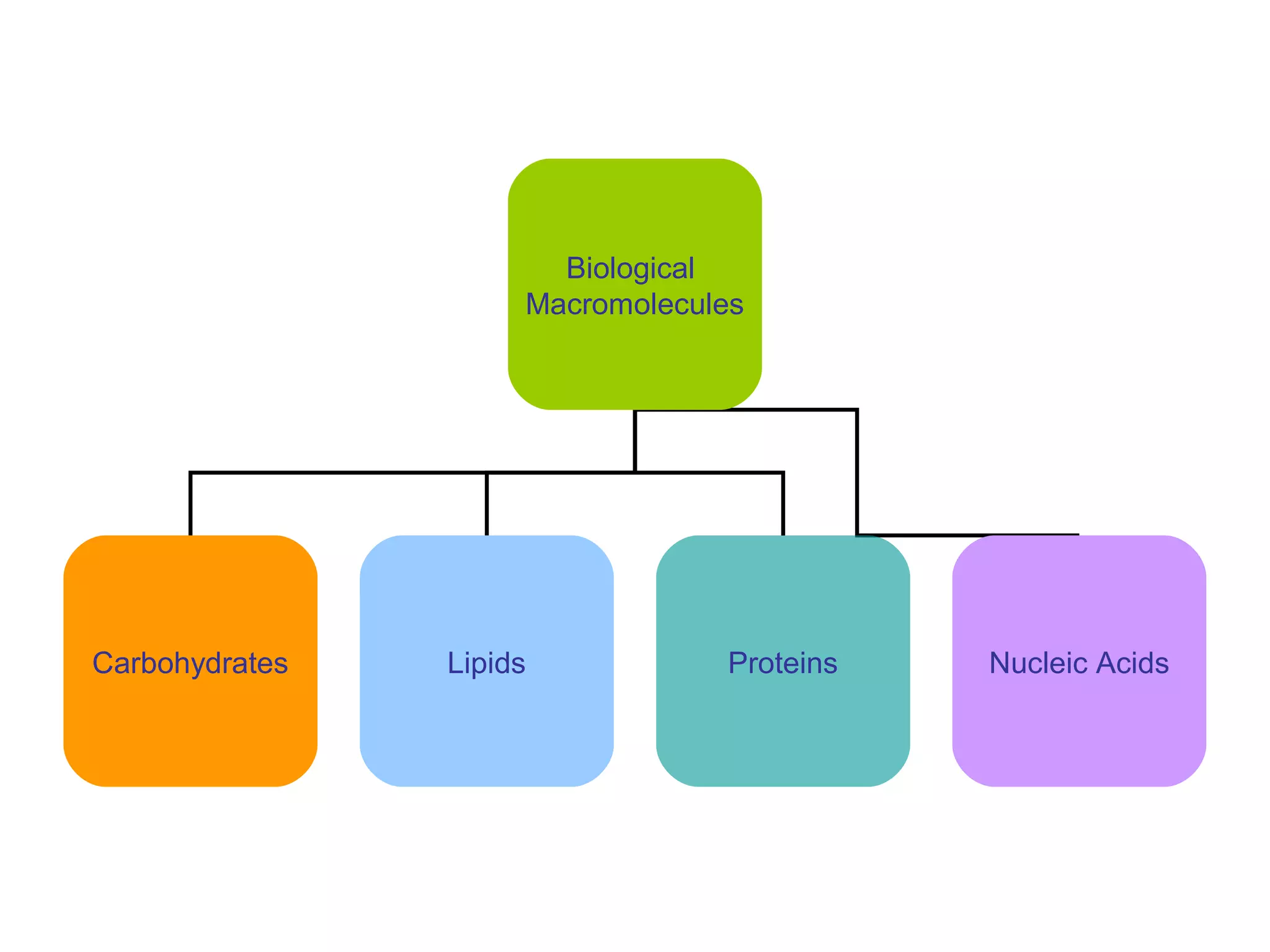
• There are 4
1. Carbohydrates  C, H, & O
2. Lipids  C, H, & O
3. Proteins  C, H, O, N, & S
4. Nucleic Acids  C, H, O, N, & P
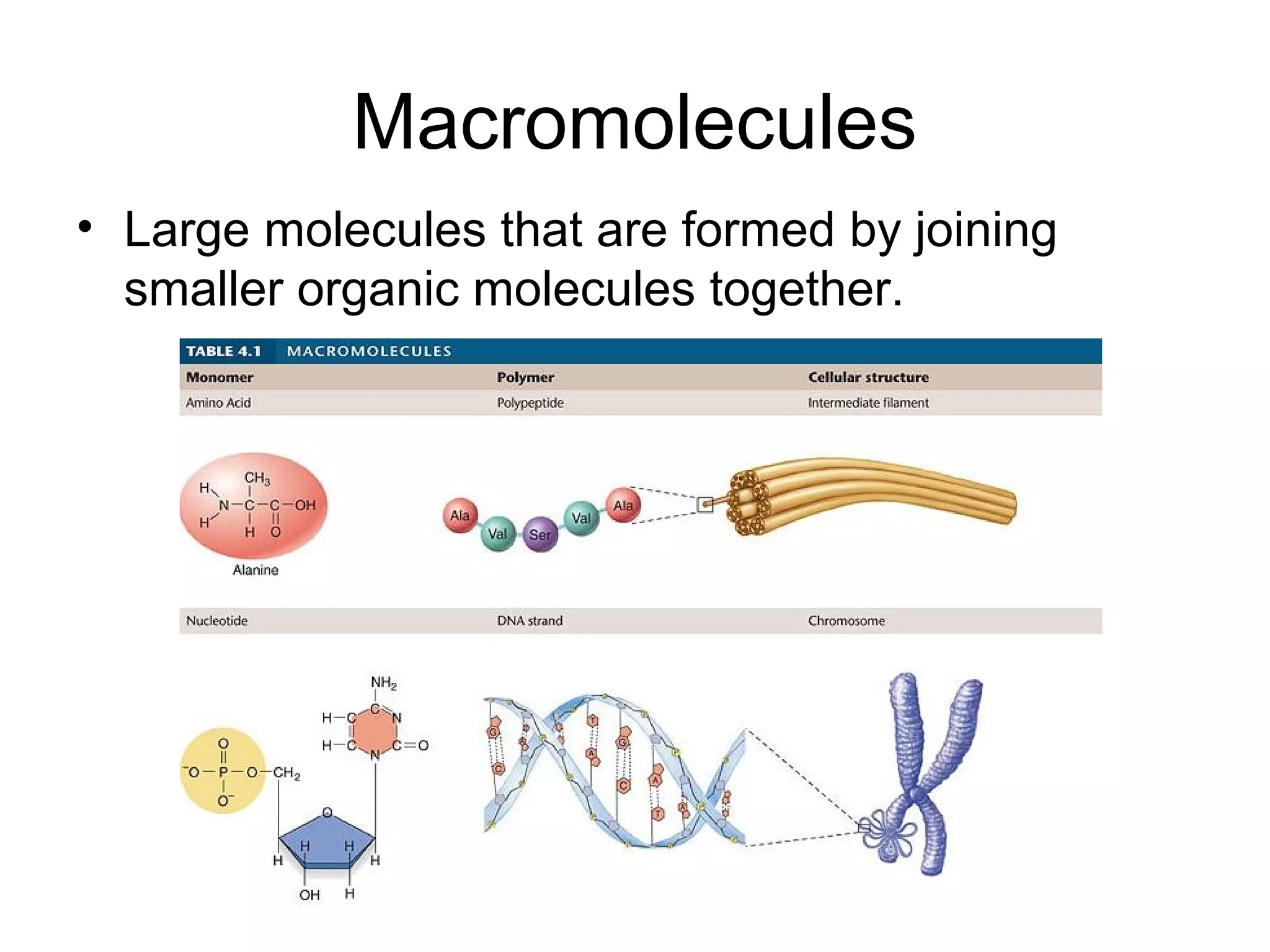
Macromolecules
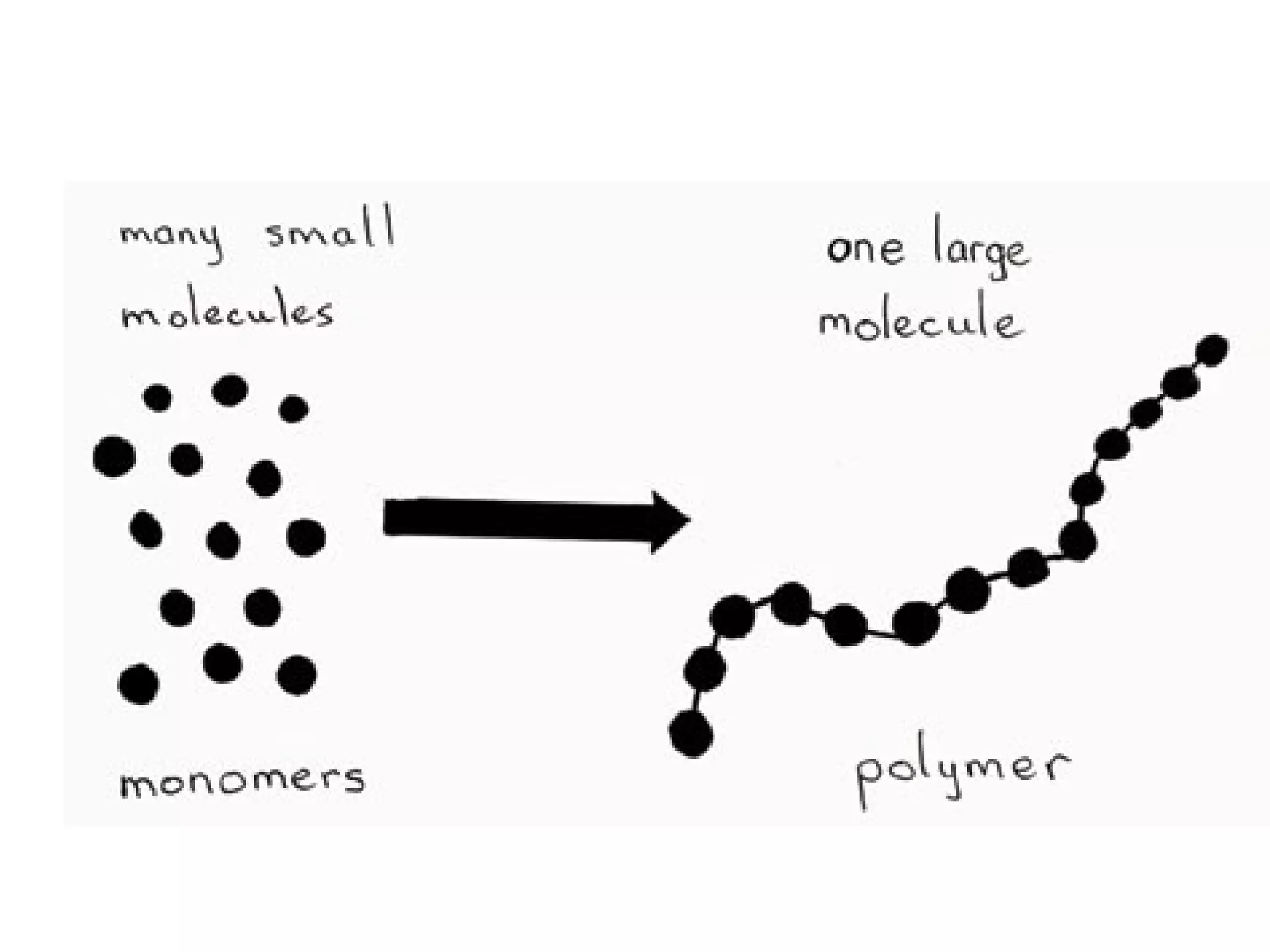
• Large molecules that are formed by joining
smaller organic molecules together.
Macromolecules
Monomers & Polymers
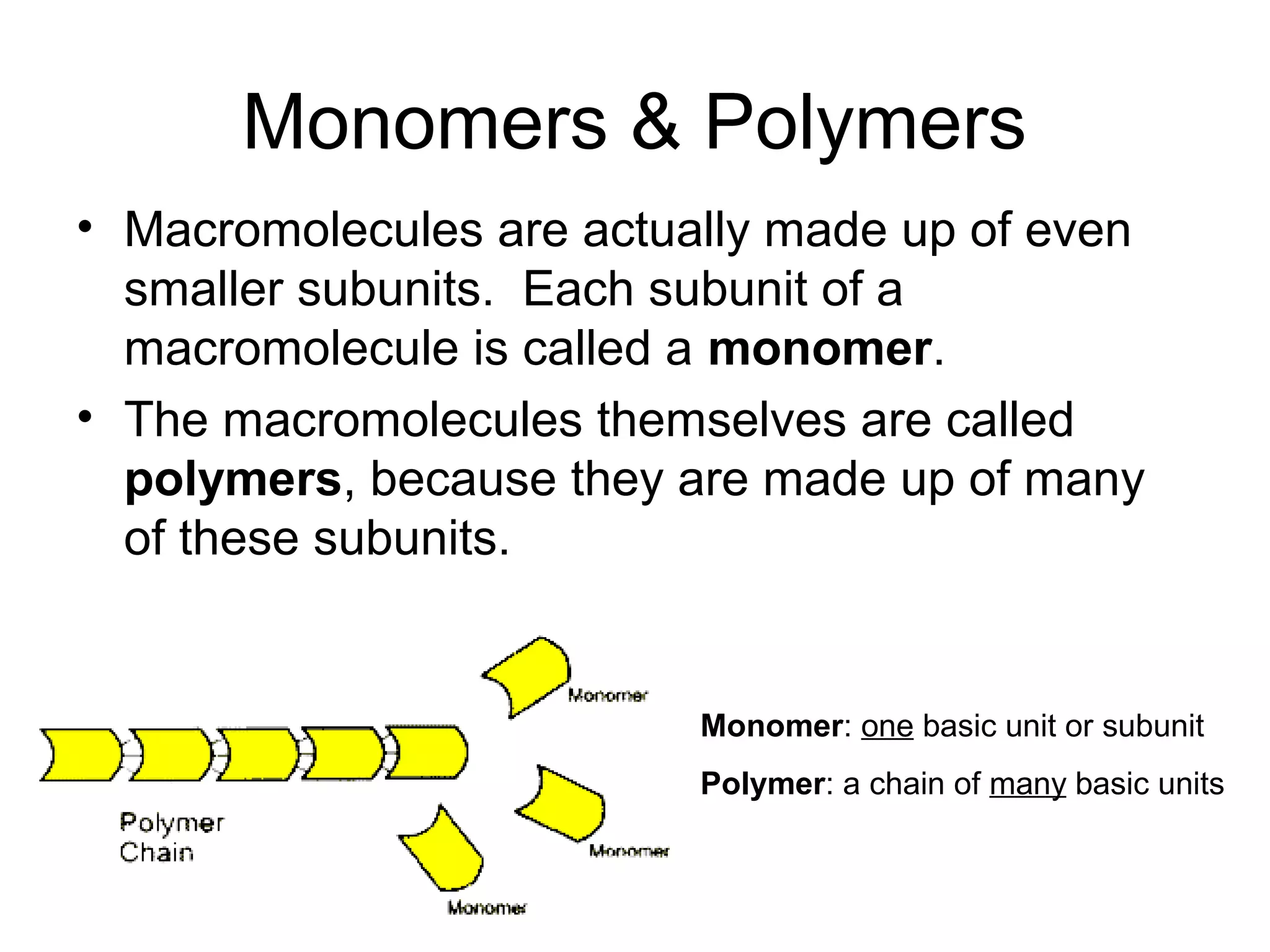
• Macromolecules are actually made up of even
smaller subunits. Each subunit of a
macromolecule is called a monomer.
• The macromolecules themselves are called
polymers, because they are made up of many
of these subunits.
Monomer: one basic unit or subunit
Polymer: a chain of many basic units
Biological
Macromolecules
Carbohydrates Lipids Proteins Nucleic Acids
Carbohydrates
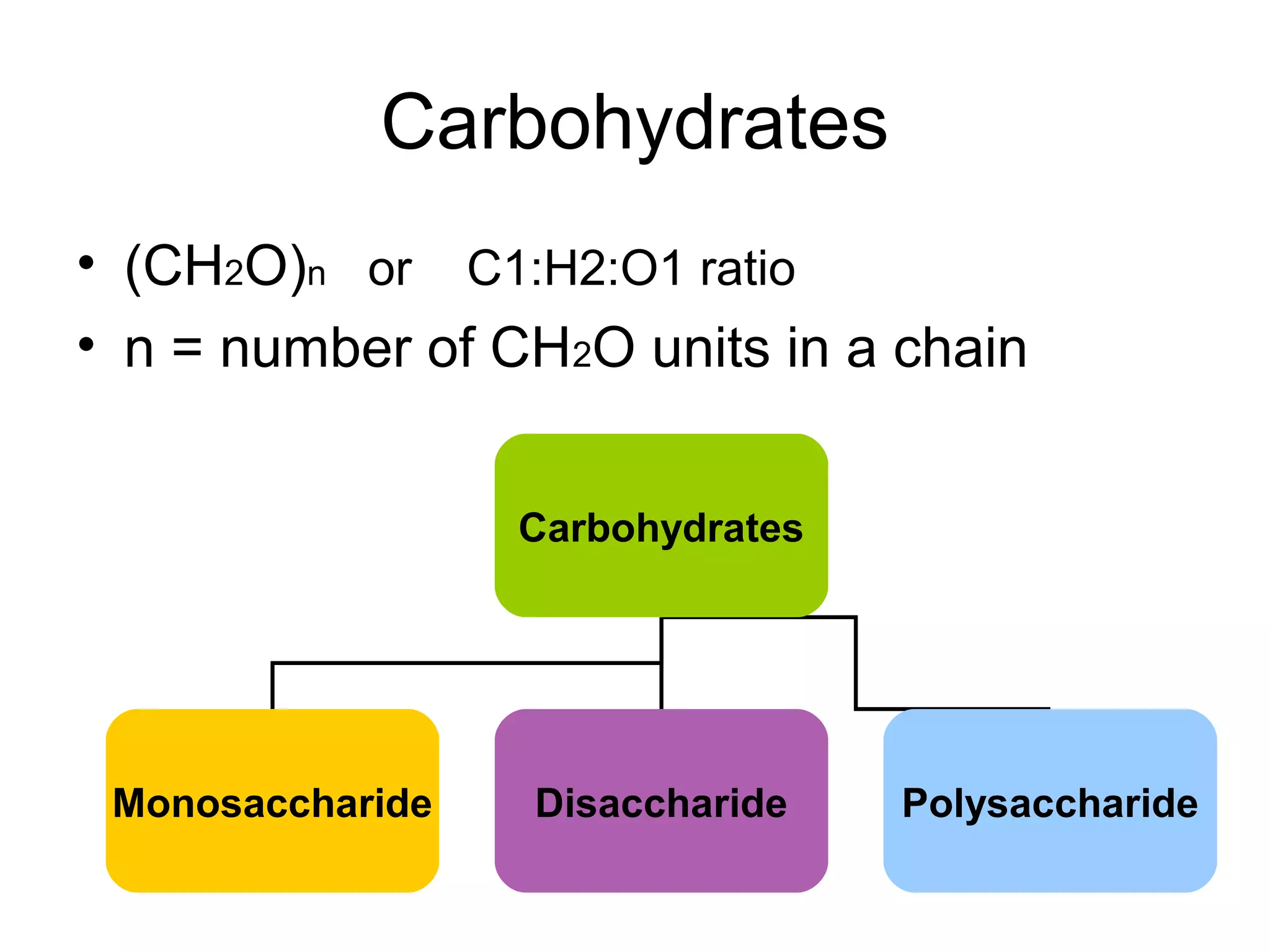
• (CH2O)n or C1:H2:O1 ratio
• n = number of CH2O units in a chain
Carbohydrates
Monosaccharide Disaccharide Polysaccharide
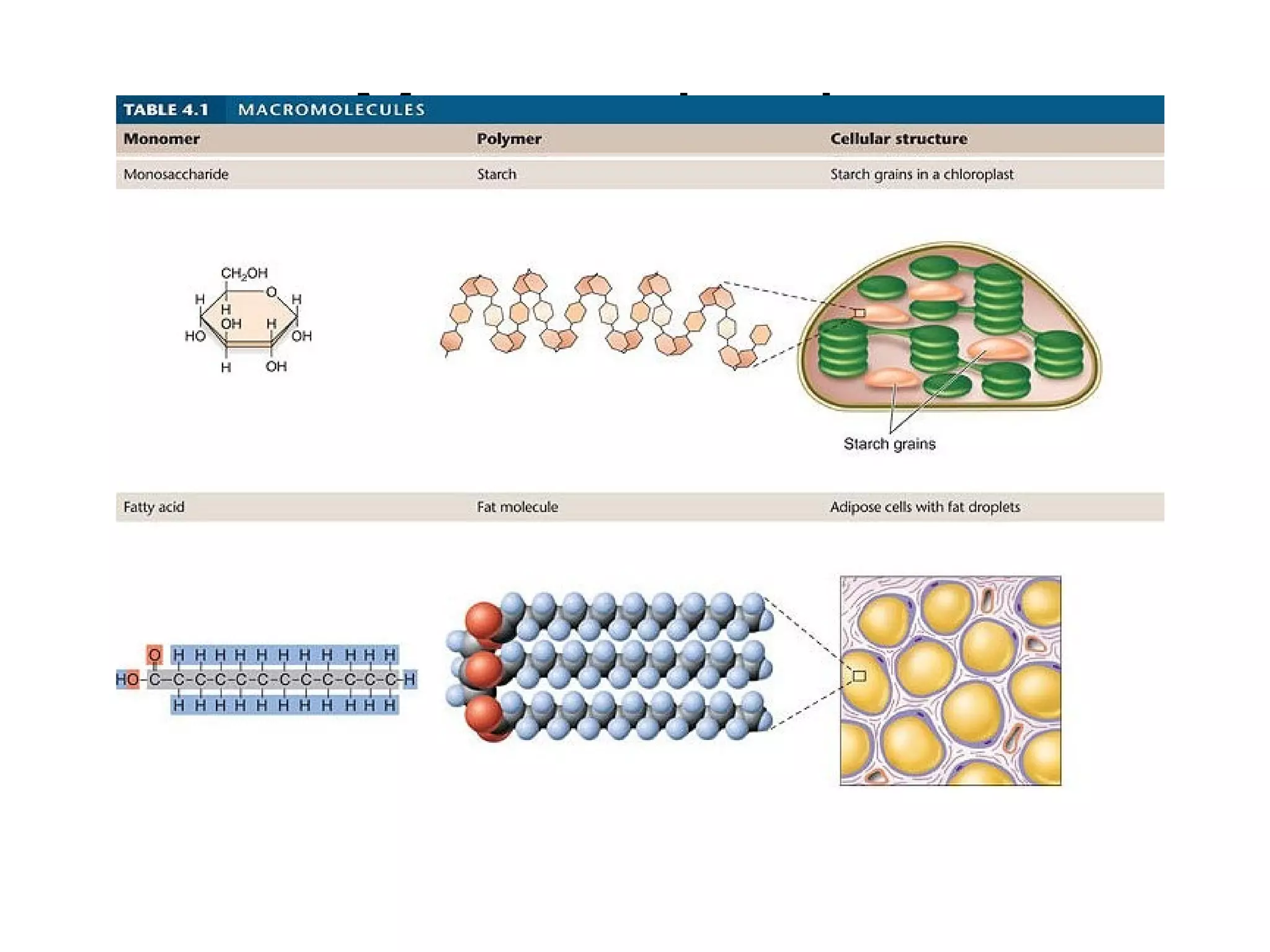
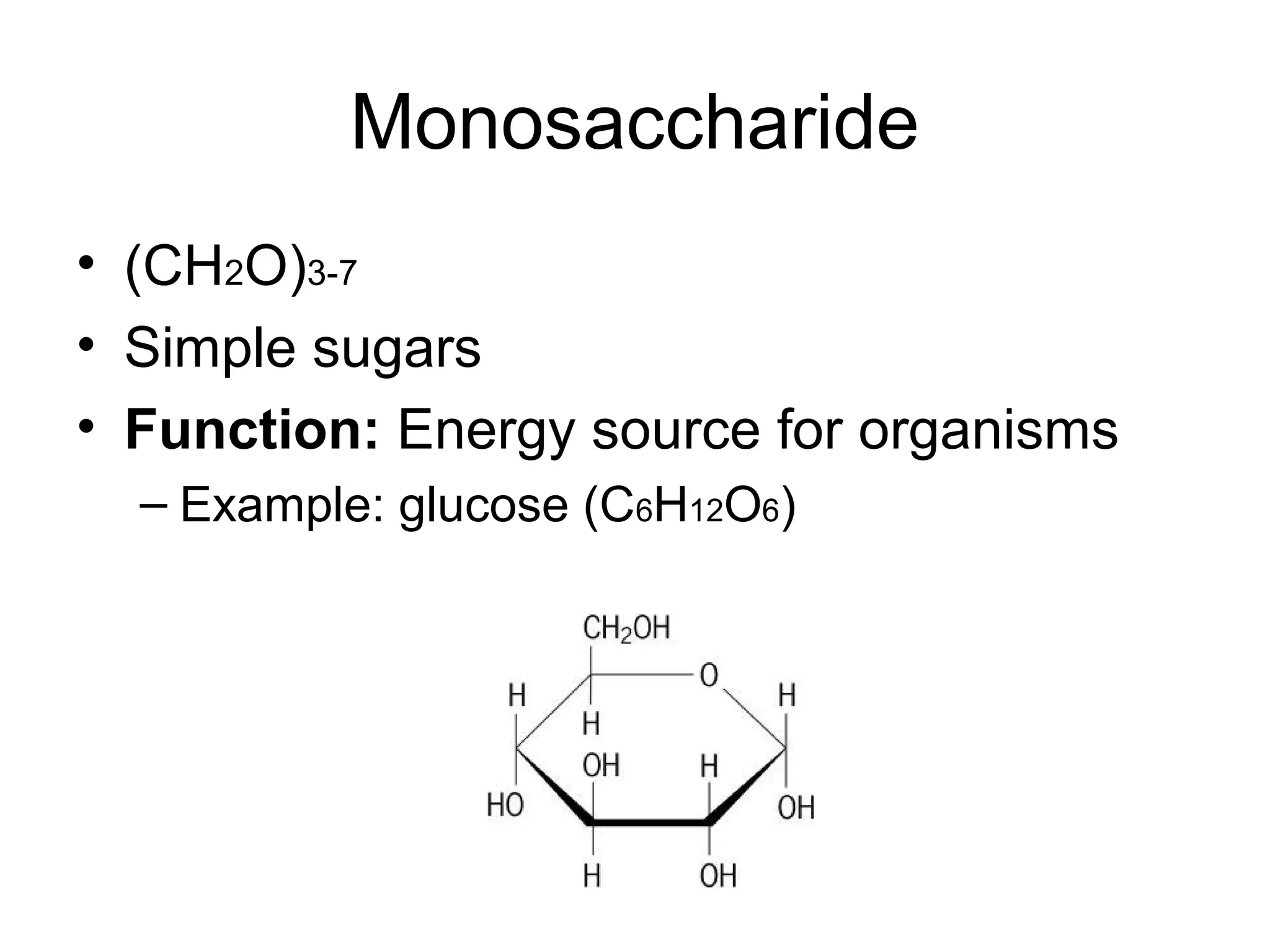
Monosaccharide
• (CH2O)3-7
• Simple sugars
• Function: Energy source for organisms
– Example: glucose (C6H12O6)
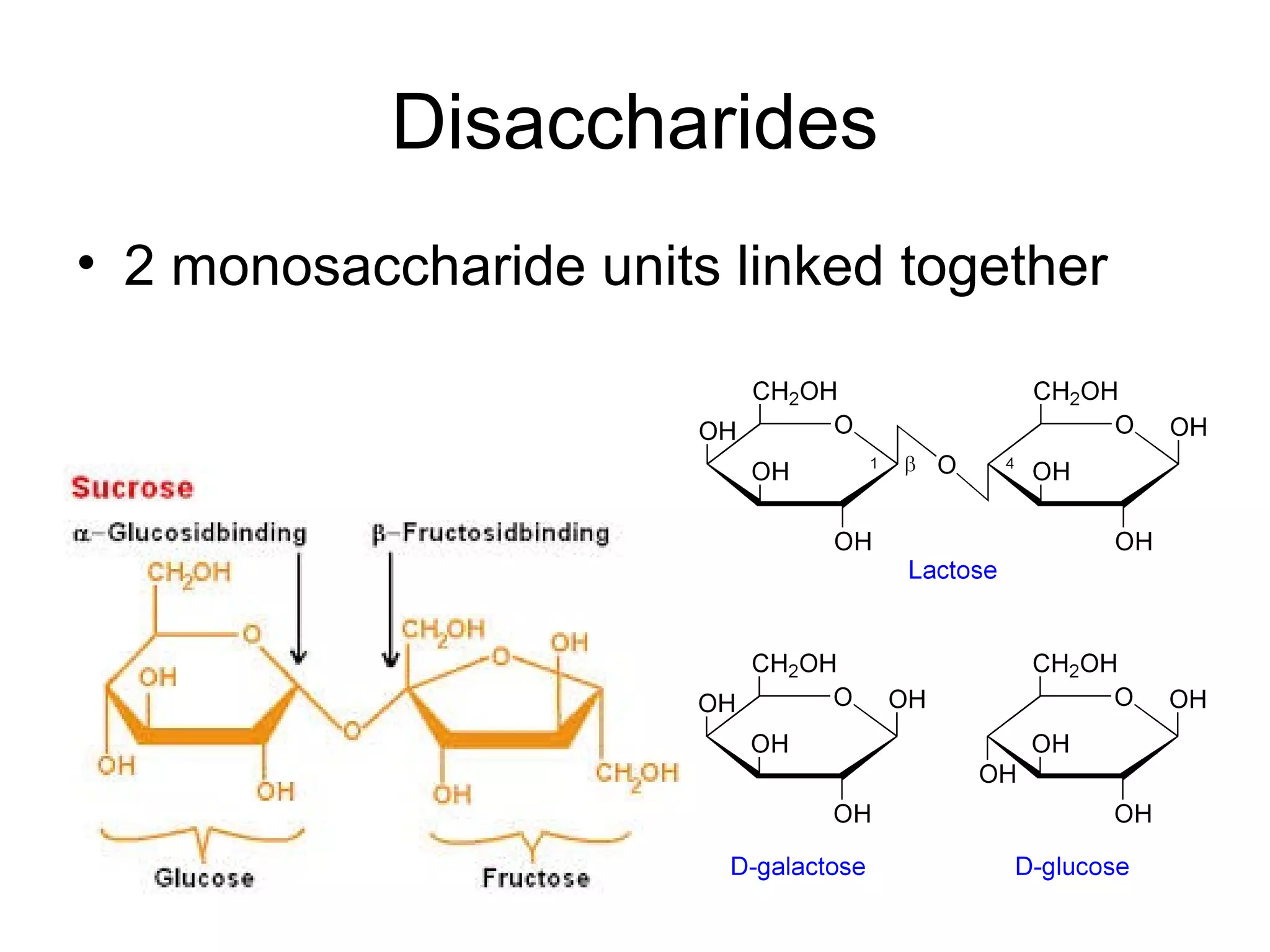
Disaccharides
• 2 monosaccharide units linked together
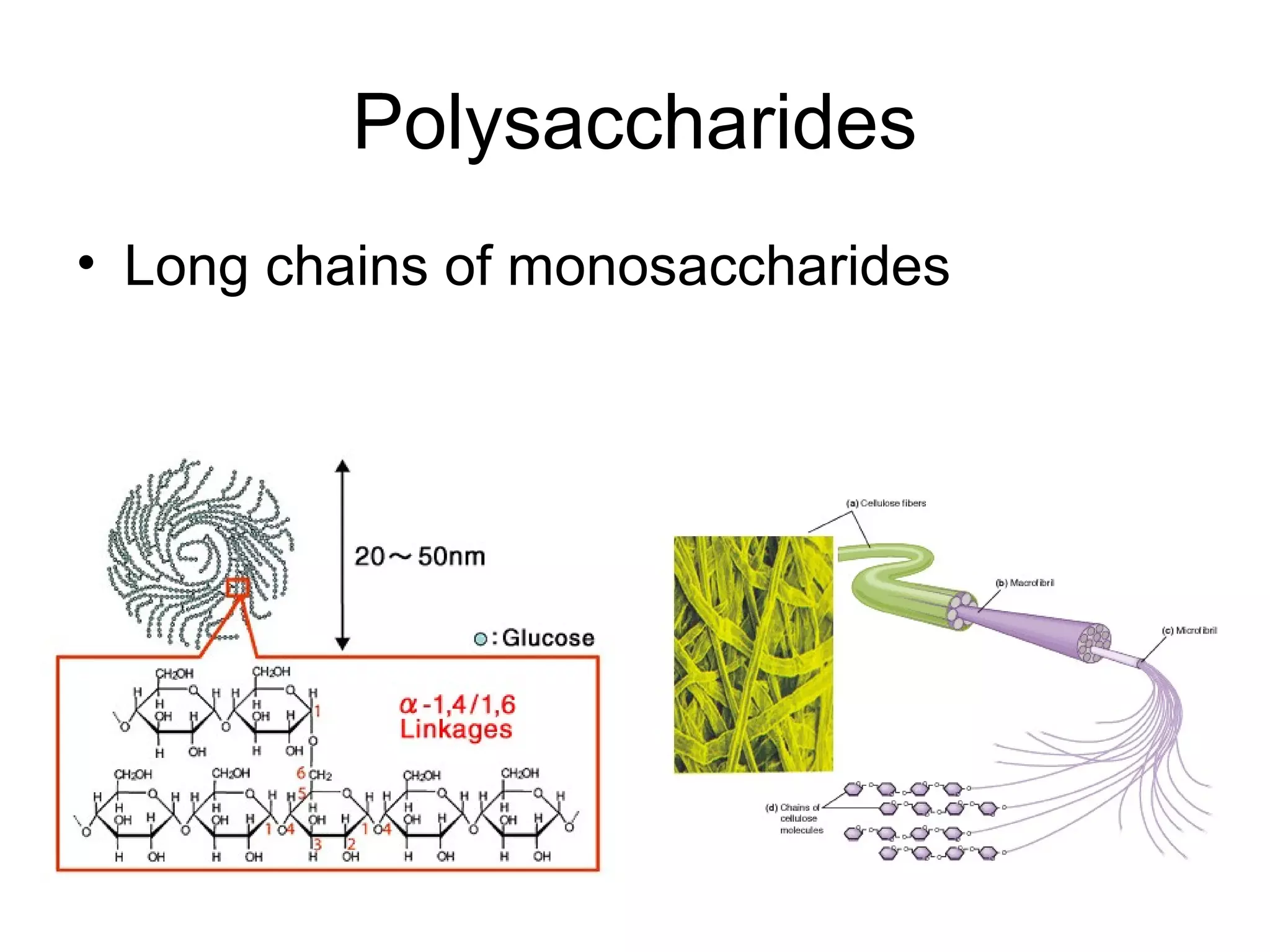
Polysaccharides
• Long chains of monosaccharides
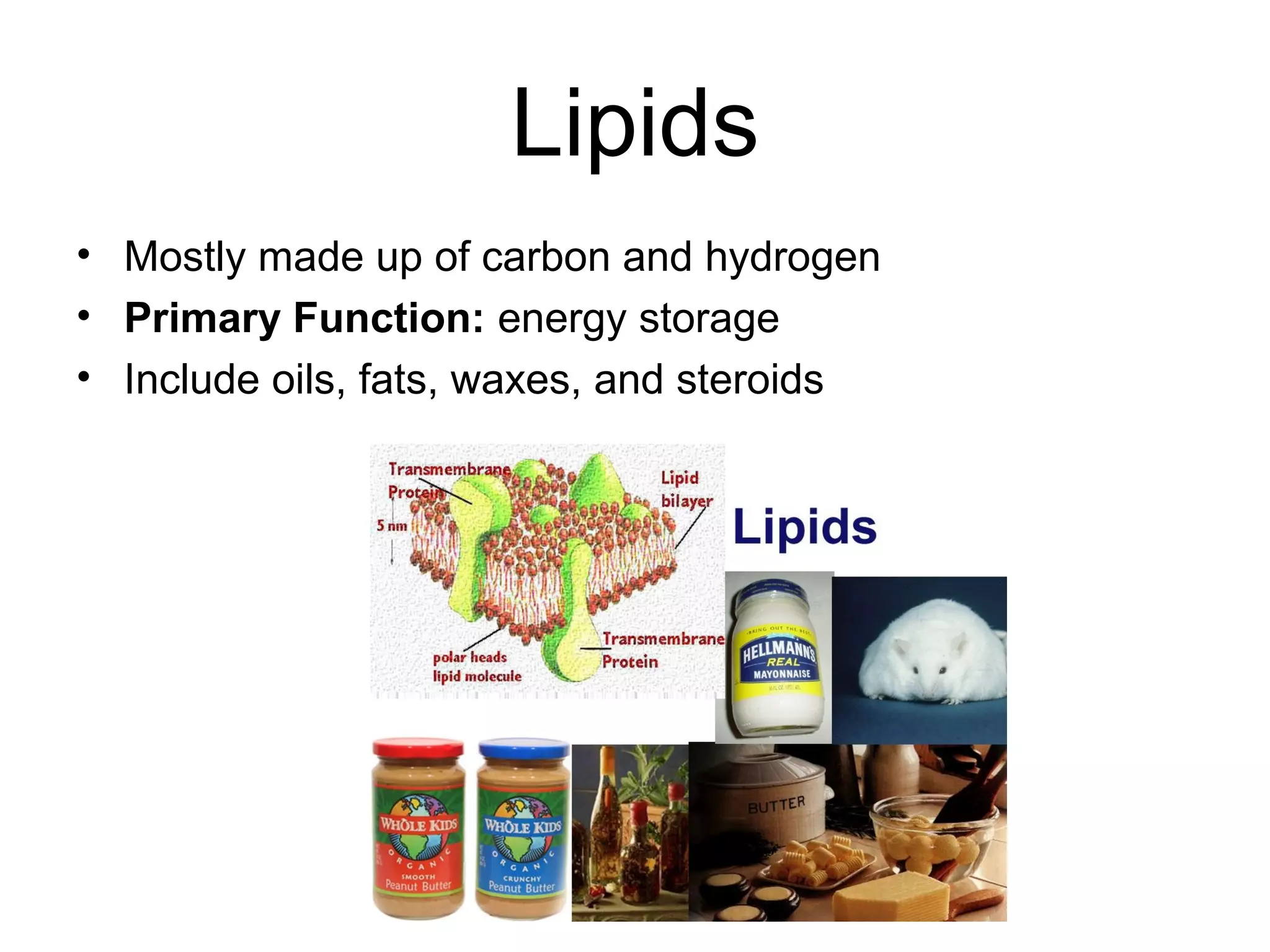
Lipids
• Mostly made up of carbon and hydrogen
• Primary Function: energy storage
• Include oils, fats, waxes, and steroids
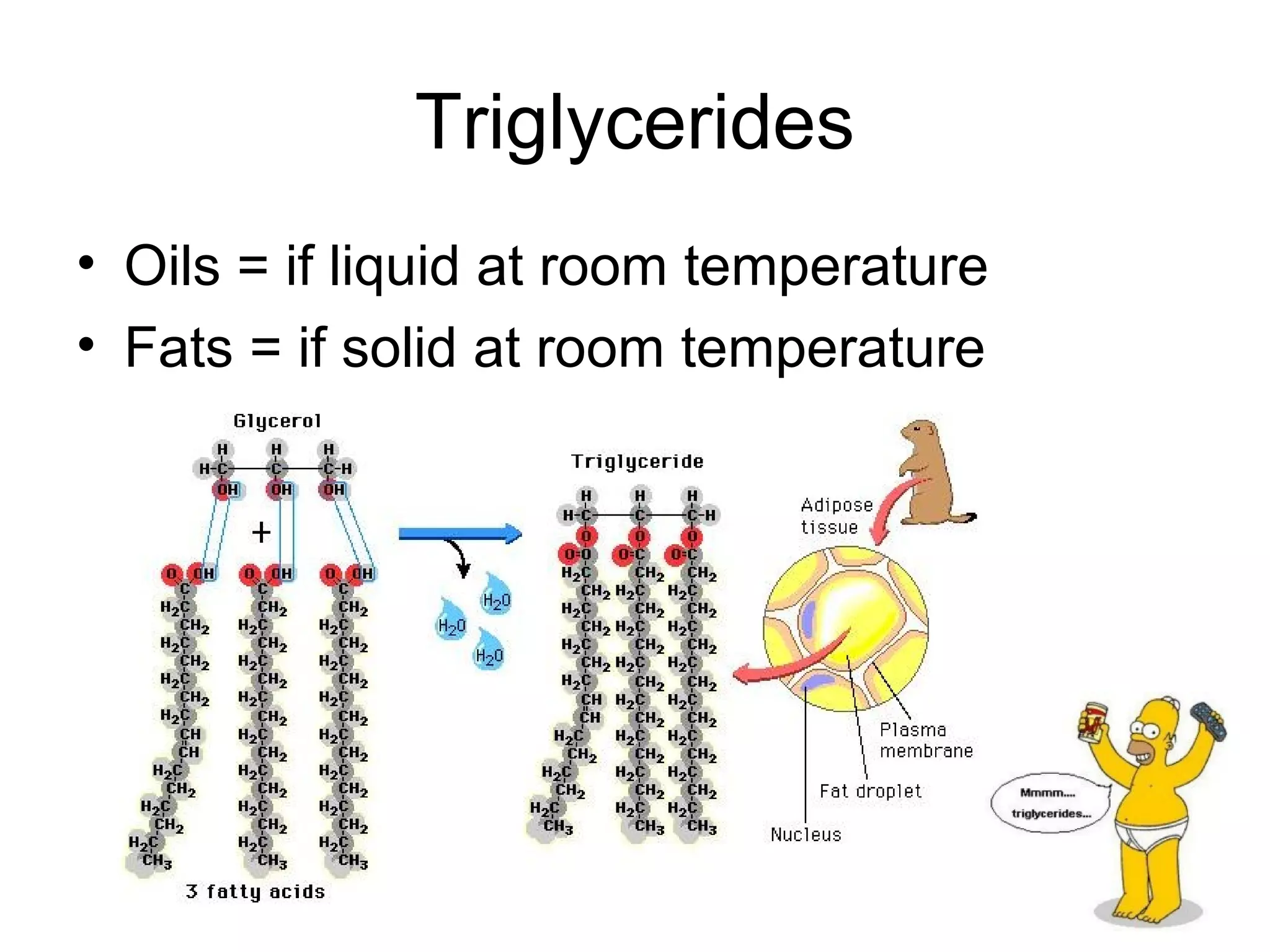
Triglycerides
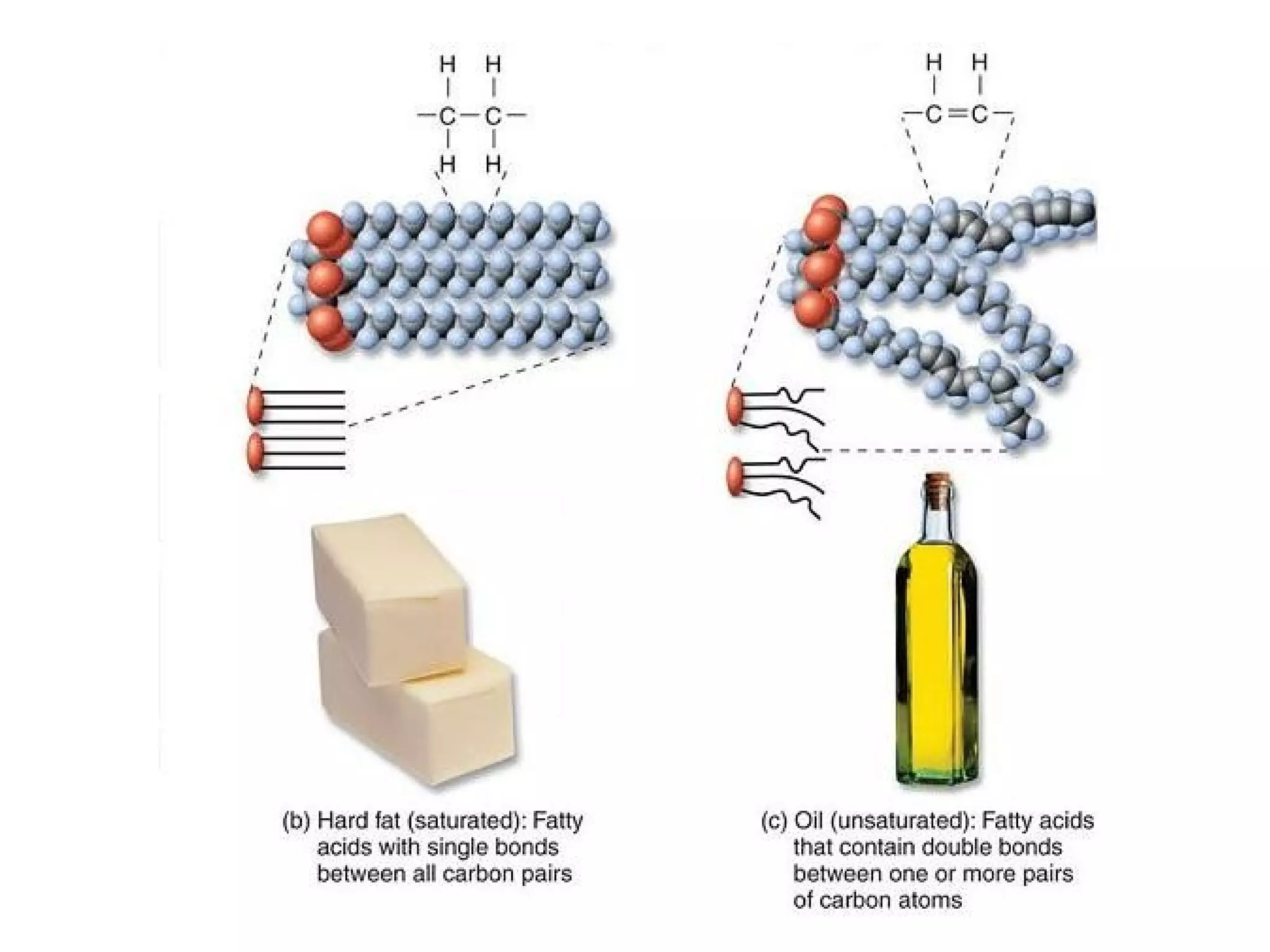
• Oils = if liquid at room temperature
• Fats = if solid at room temperature
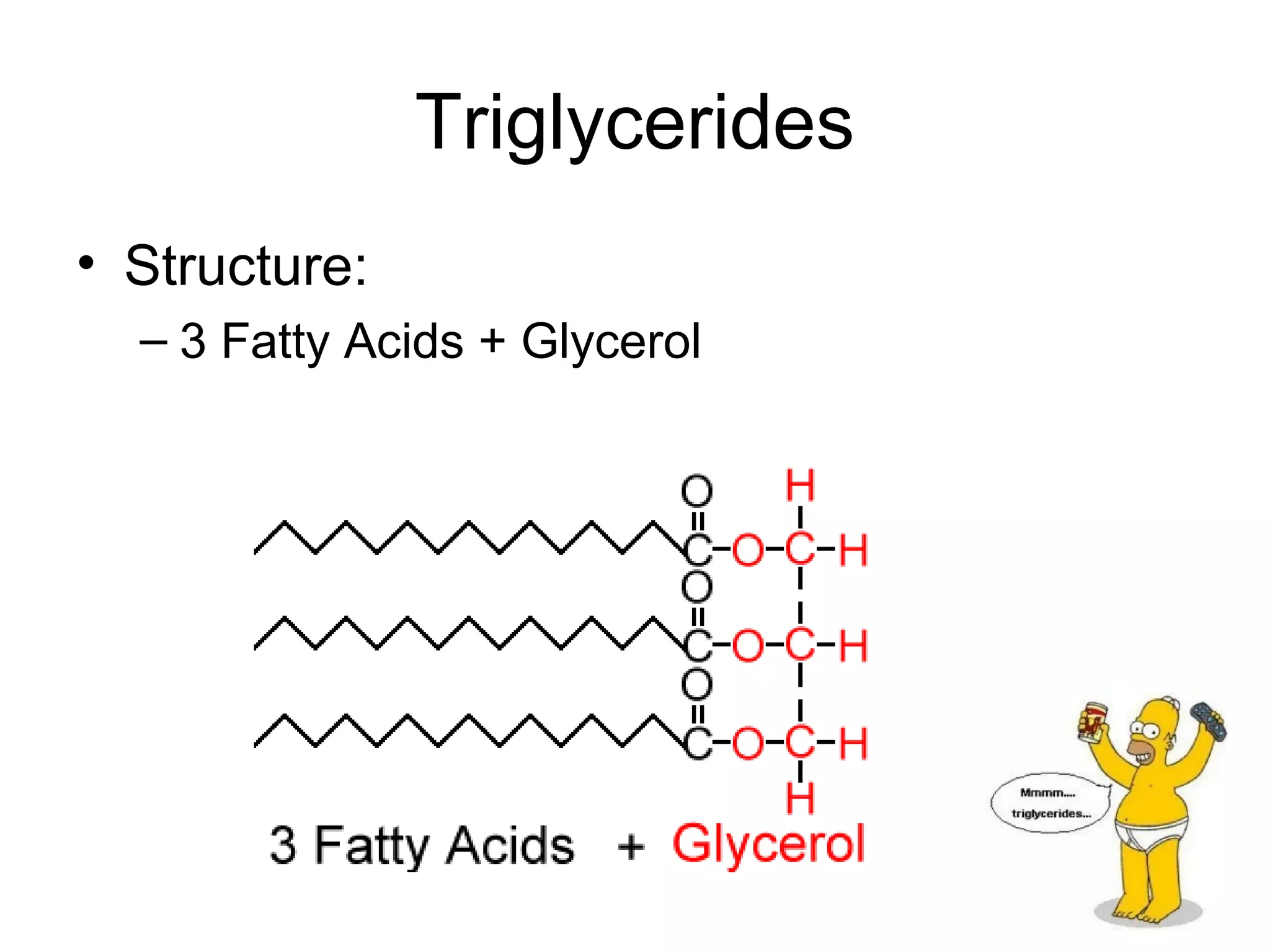
Triglycerides
• Structure:
– 3 Fatty Acids + Glycerol
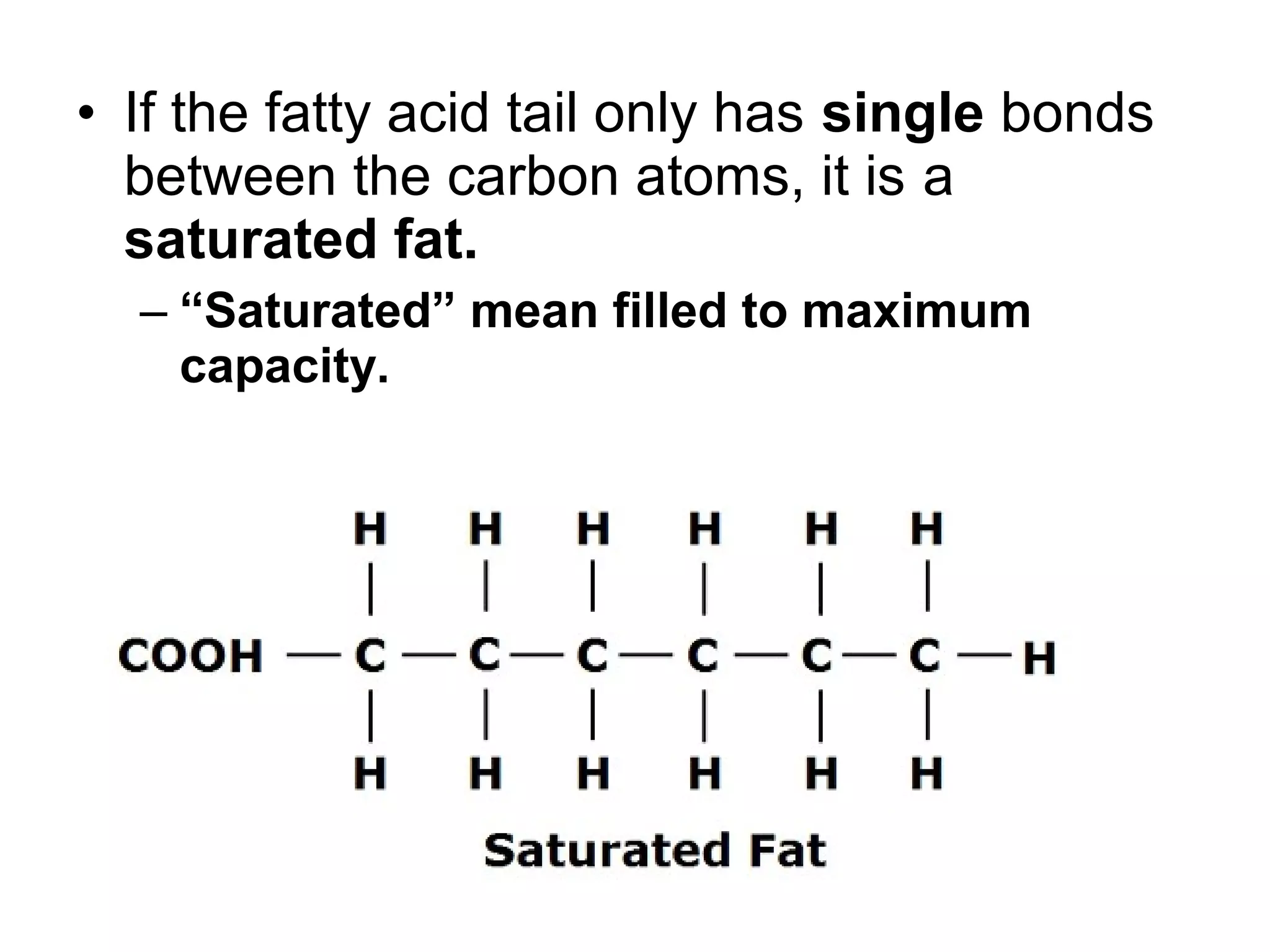
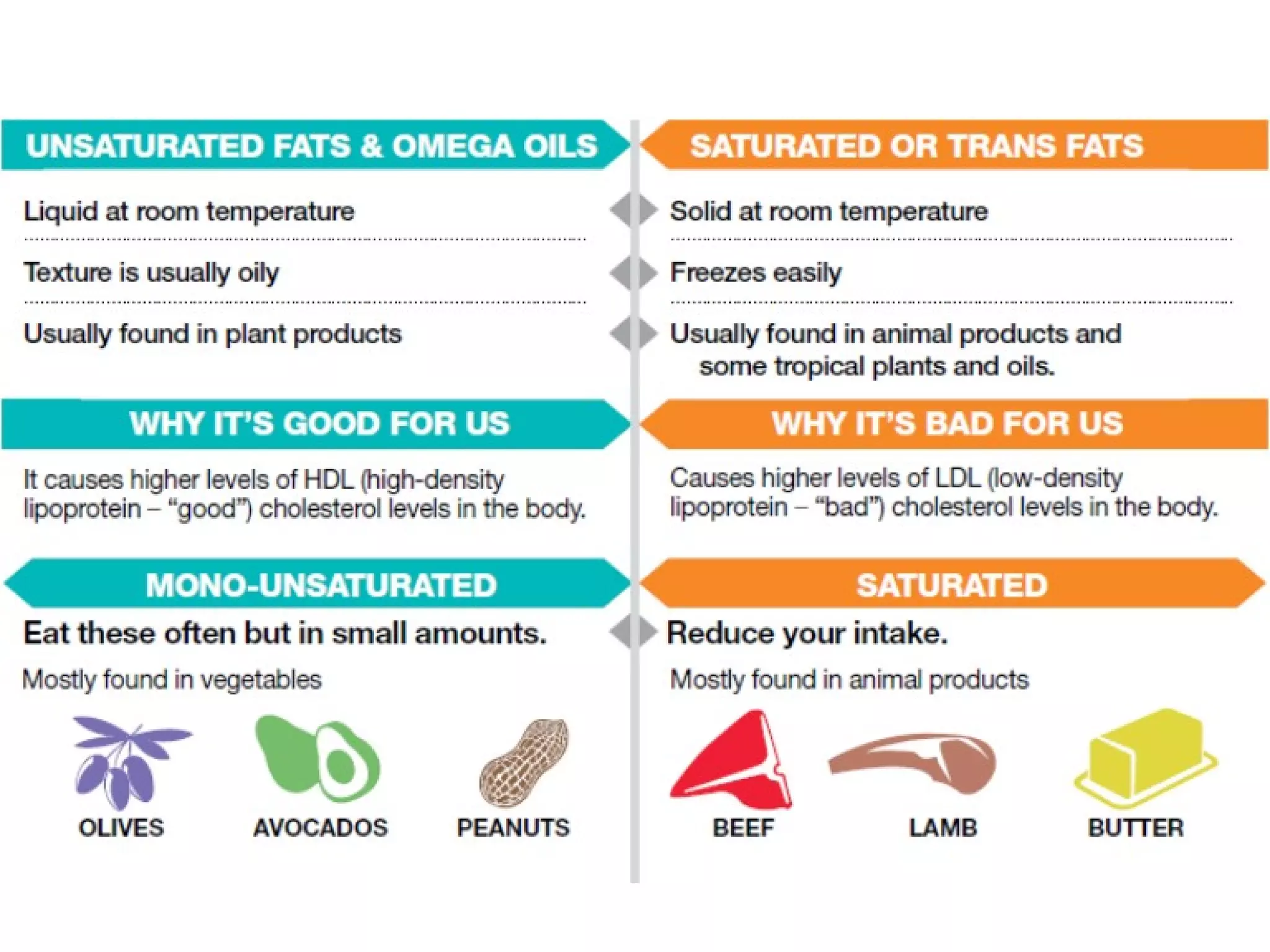
• If the fatty acid tail only has single bonds
between the carbon atoms, it is a
saturated fat.
– “Saturated” mean filled to maximum
capacity.
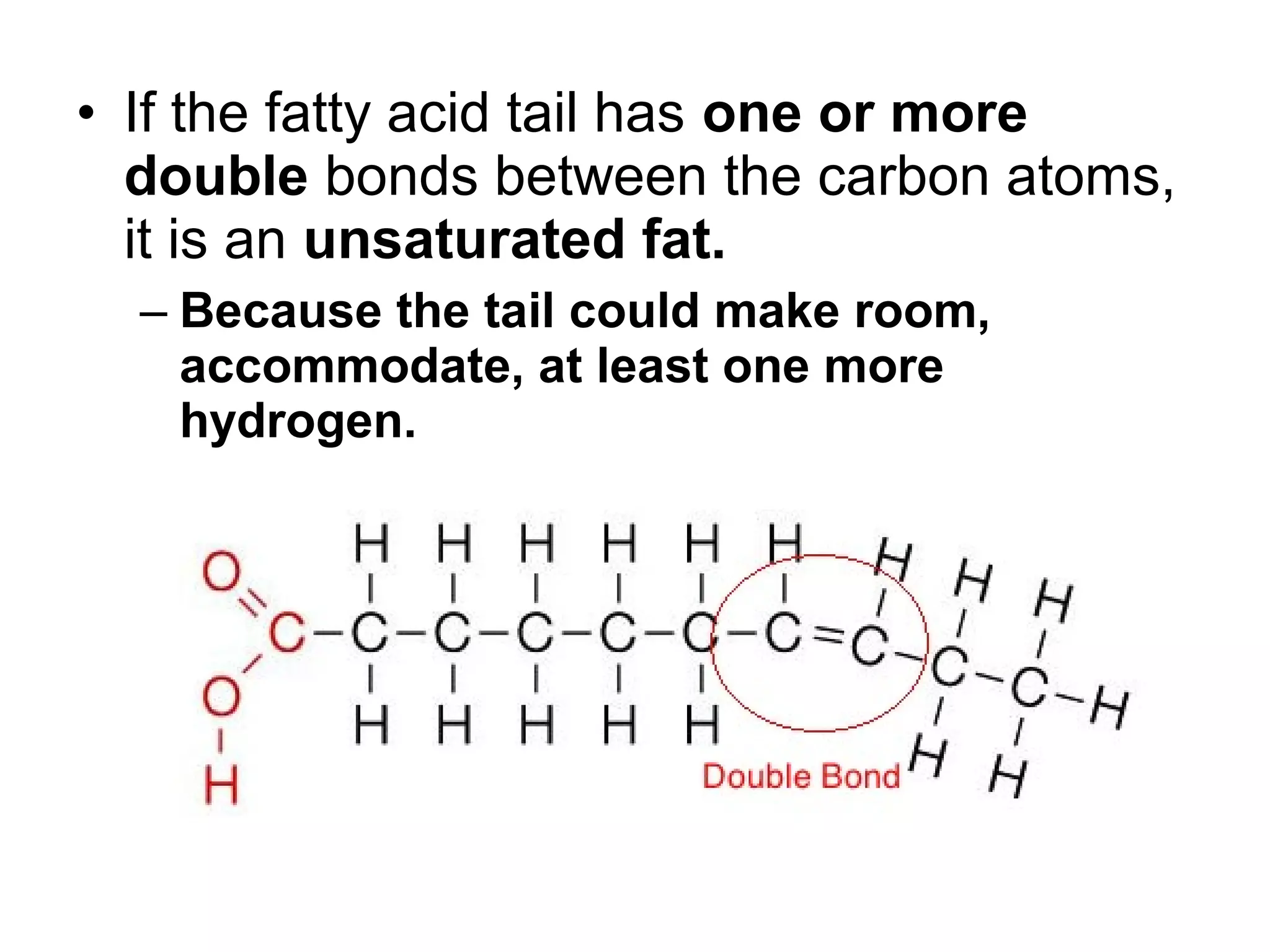
• If the fatty acid tail has one or more
double bonds between the carbon atoms,
it is an unsaturated fat.
– Because the tail could make room,
accommodate, at least one more
hydrogen.
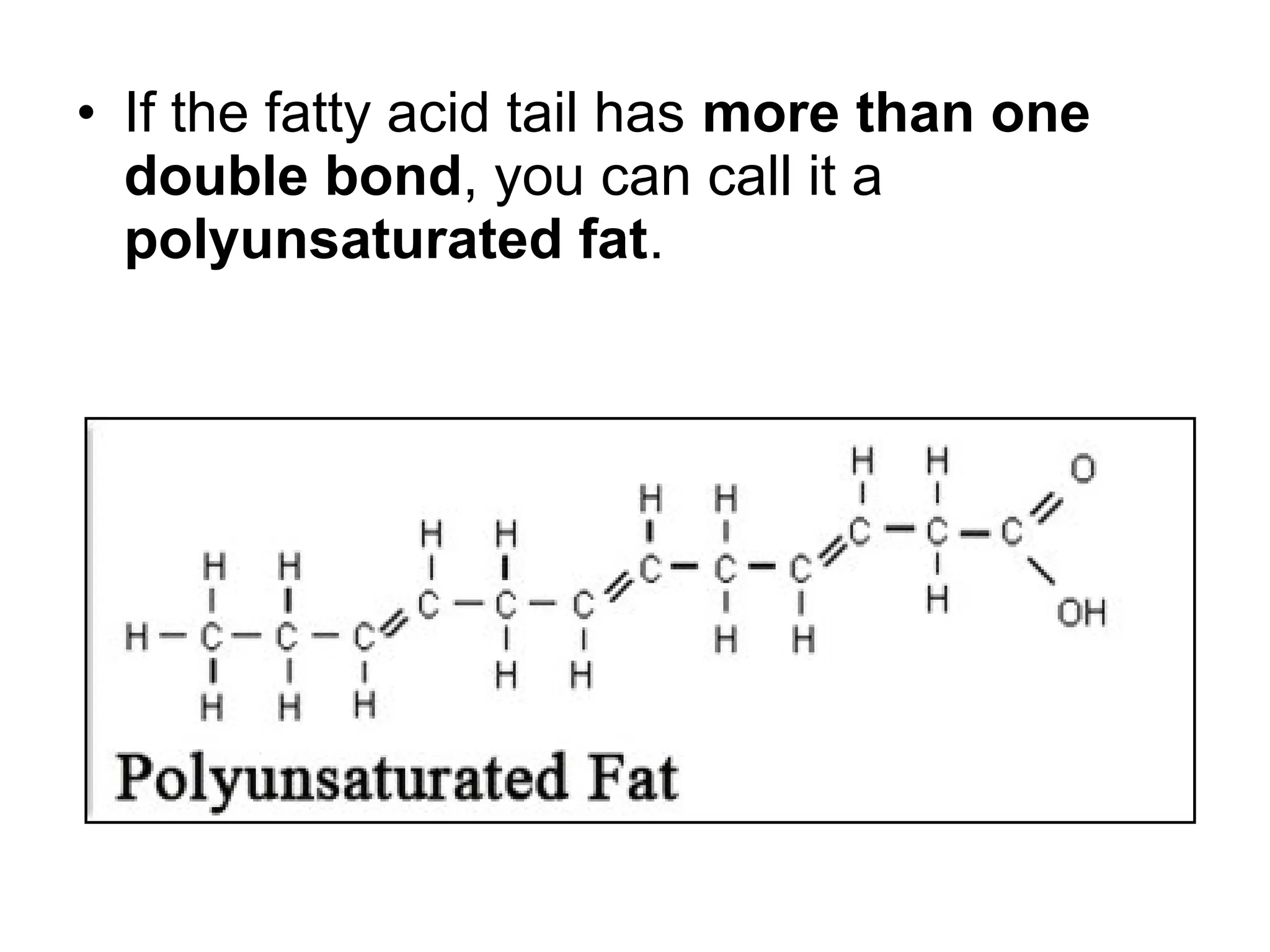
• If the fatty acid tail has more than one
double bond, you can call it a
polyunsaturated fat.
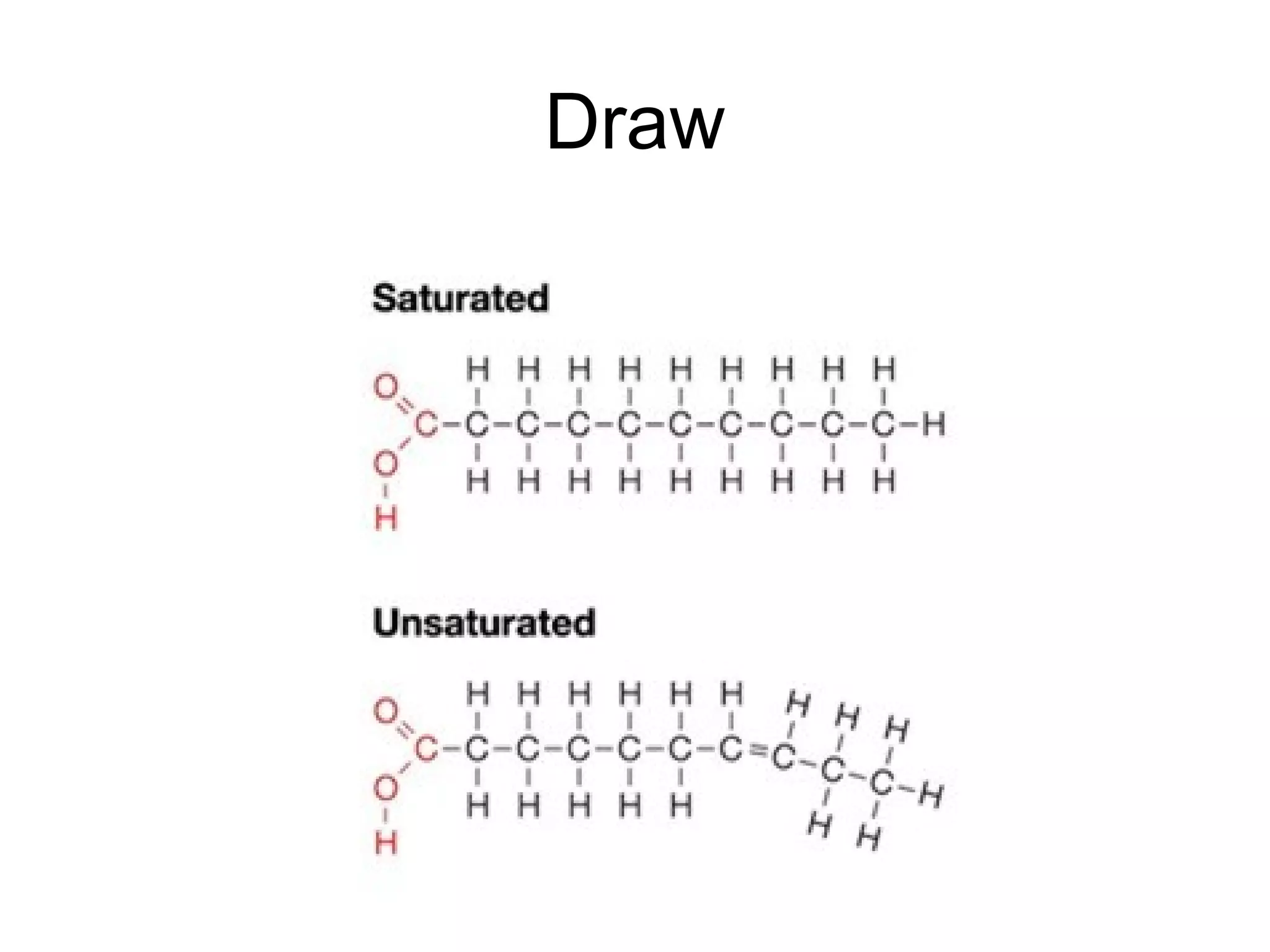
Draw
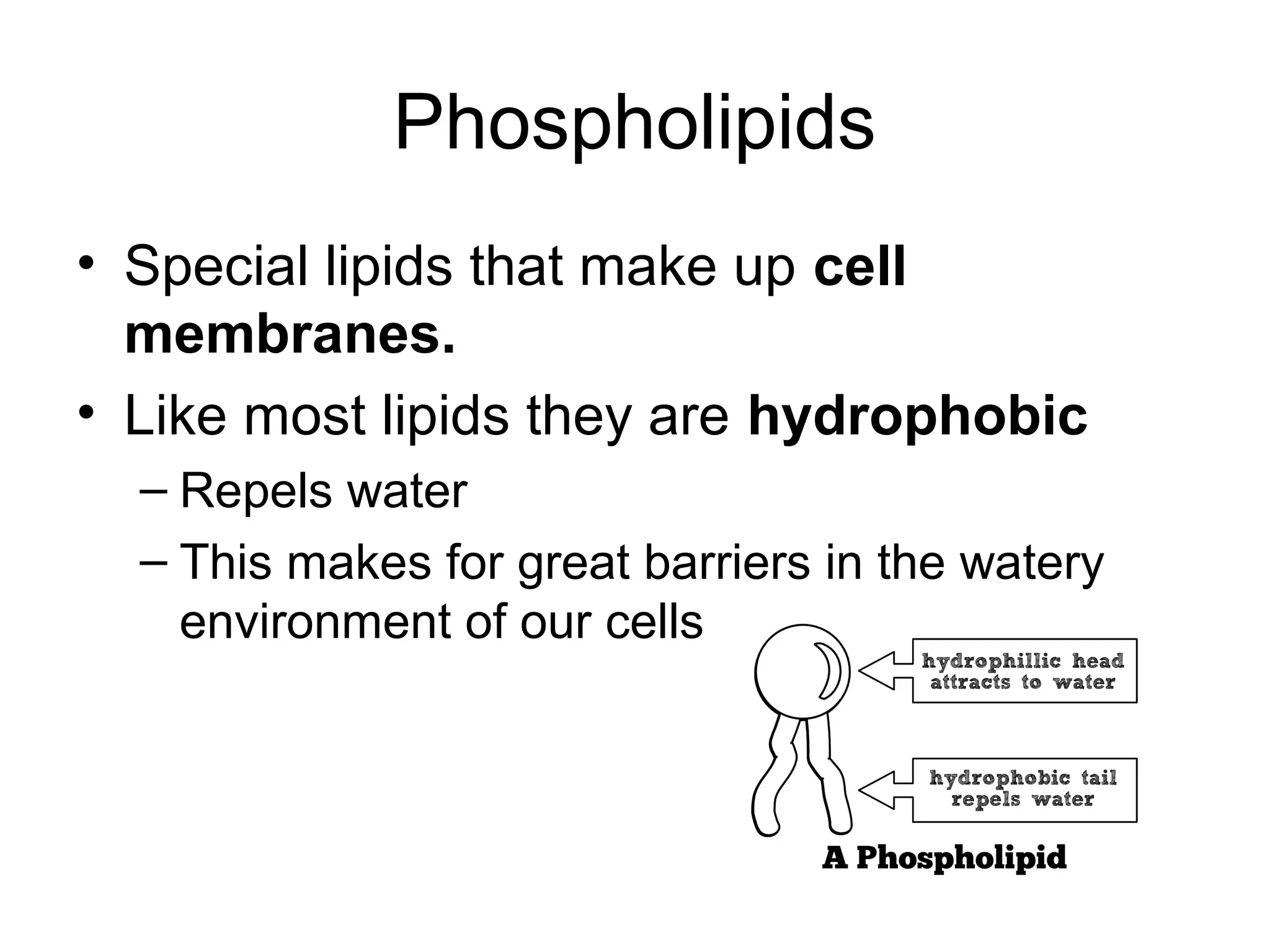
Phospholipids
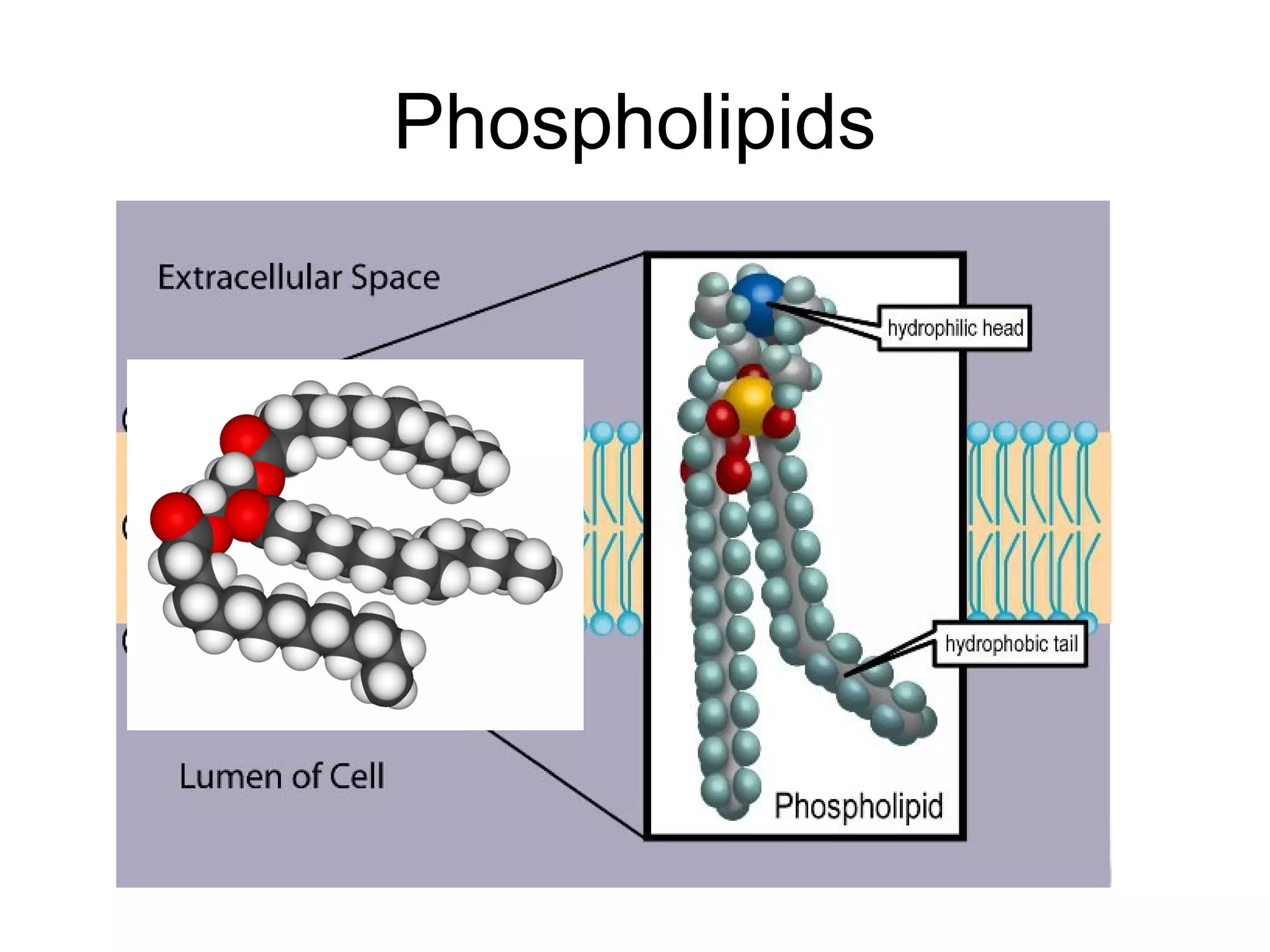
Phospholipids
• Special lipids that make up cell
membranes.
• Like most lipids they are hydrophobic
– Repels water
– This makes for great barriers in the watery
environment of our cells
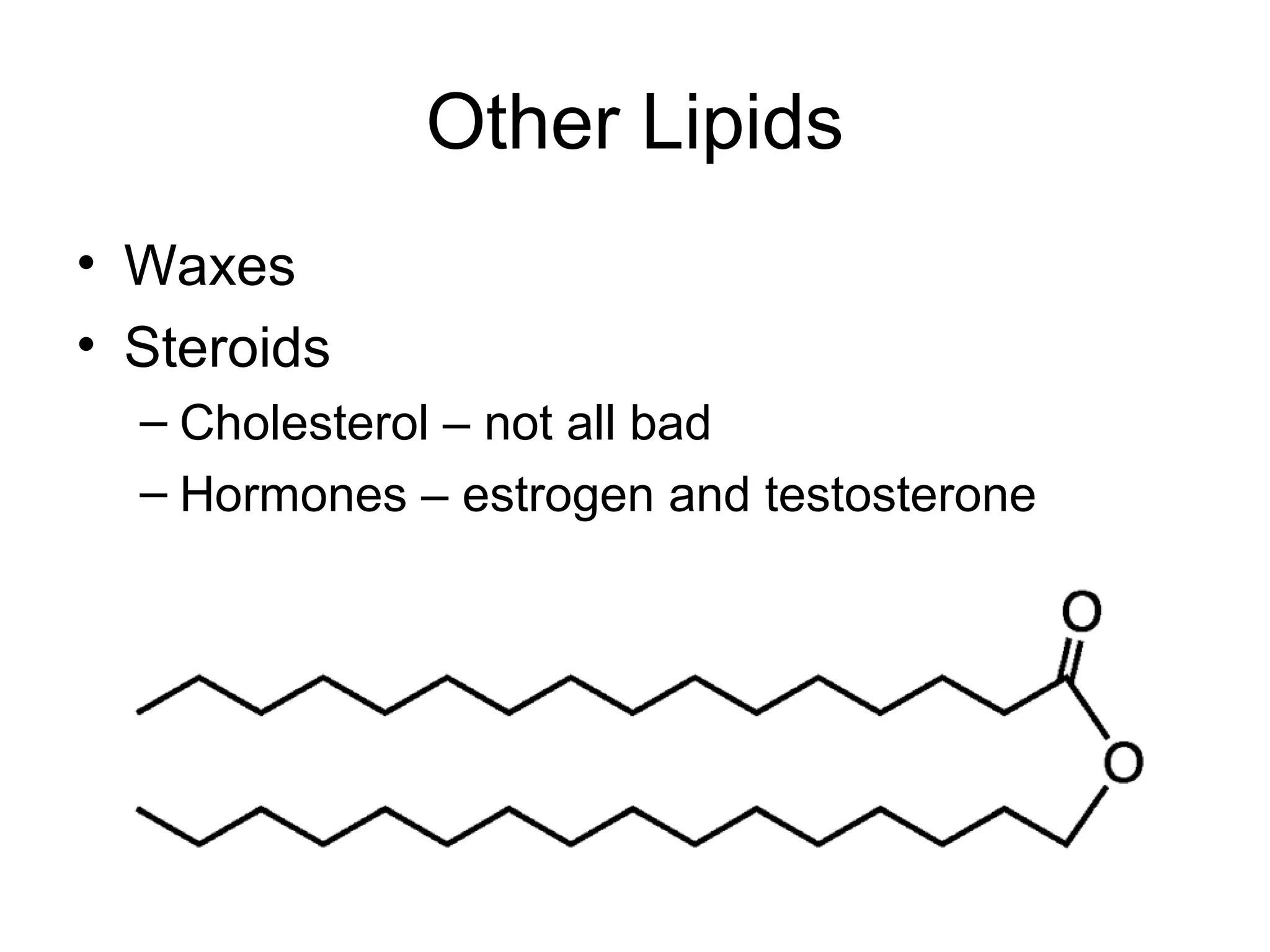
Other Lipids
• Waxes
• Steroids
– Cholesterol – not all bad
– Hormones – estrogen and testosterone
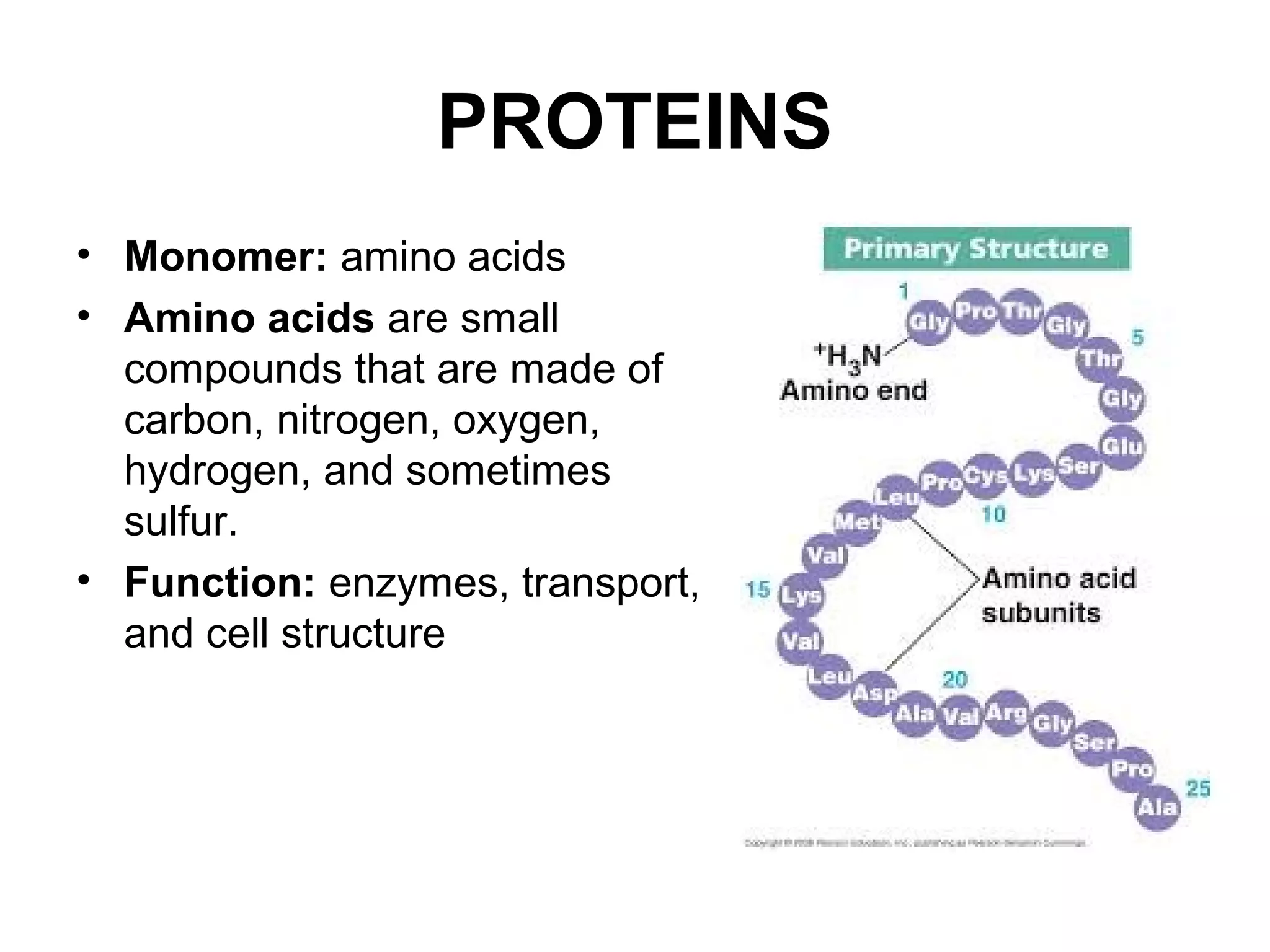
PROTEINS
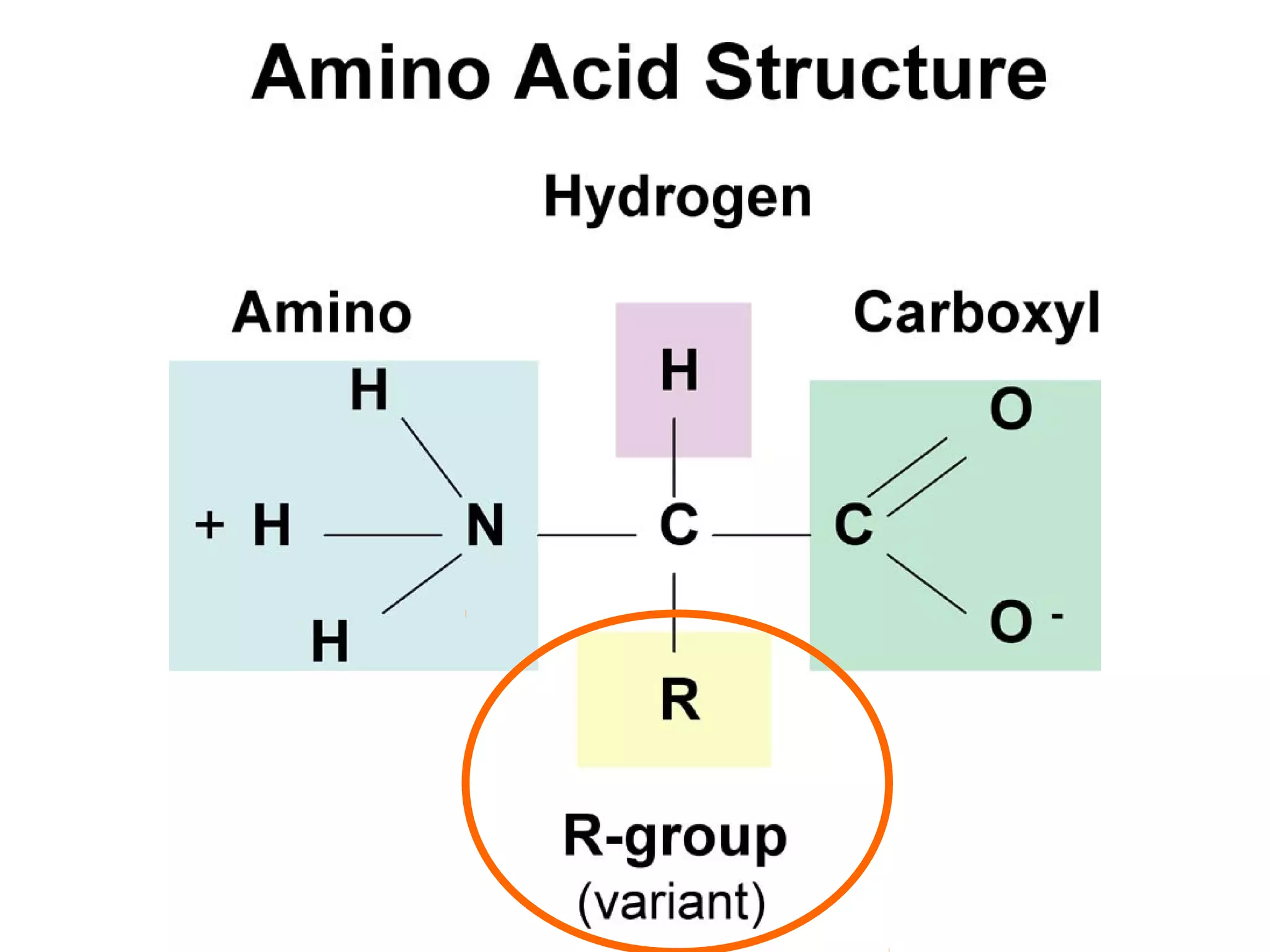
• Monomer: amino acids
• Amino acids are small
compounds that are made of
carbon, nitrogen, oxygen,
hydrogen, and sometimes
sulfur.
• Function: enzymes, transport,
and cell structure
Amino Acids
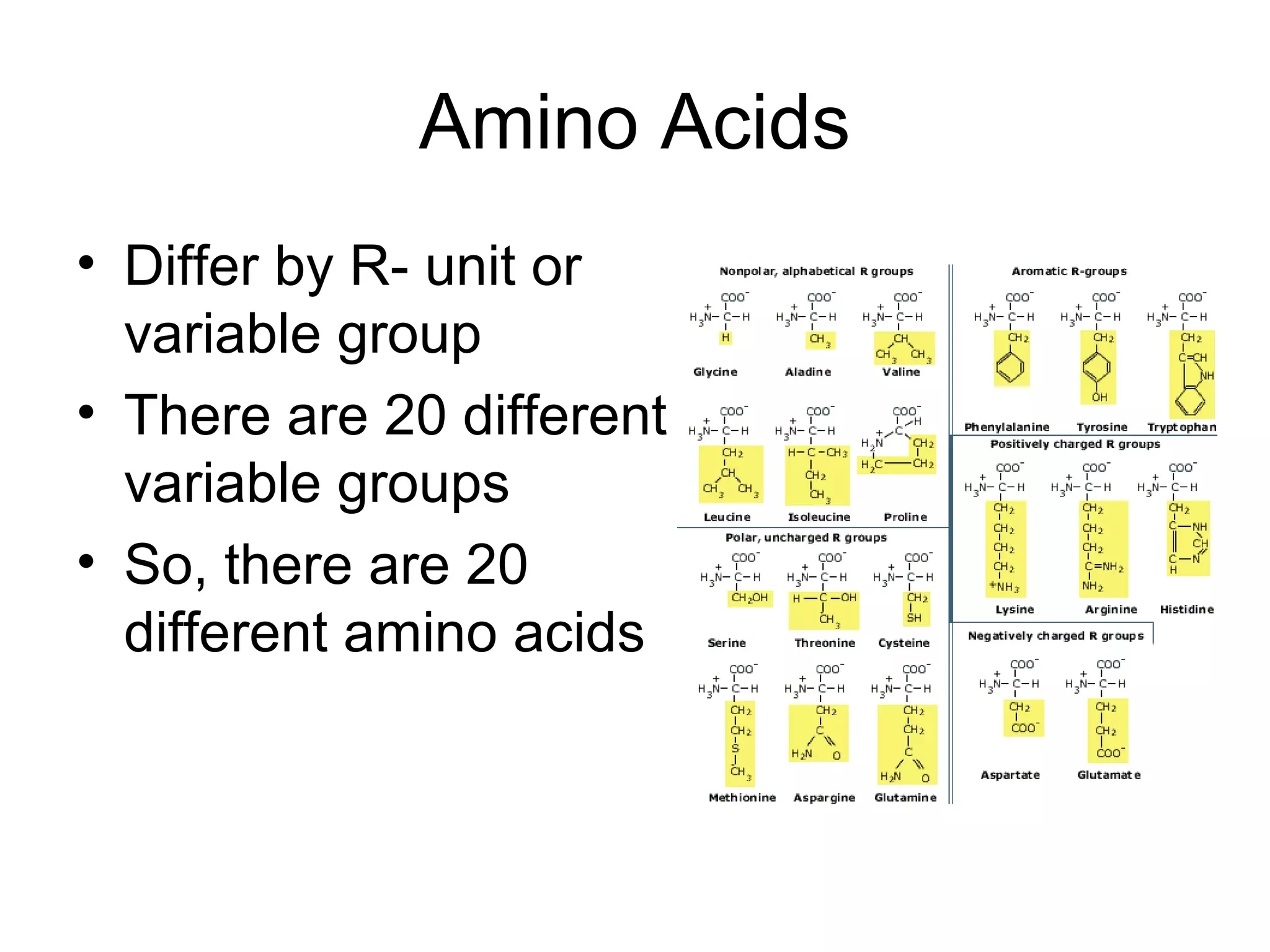
• Differ by R- unit or
variable group
• There are 20 different
variable groups
• So, there are 20
different amino acids
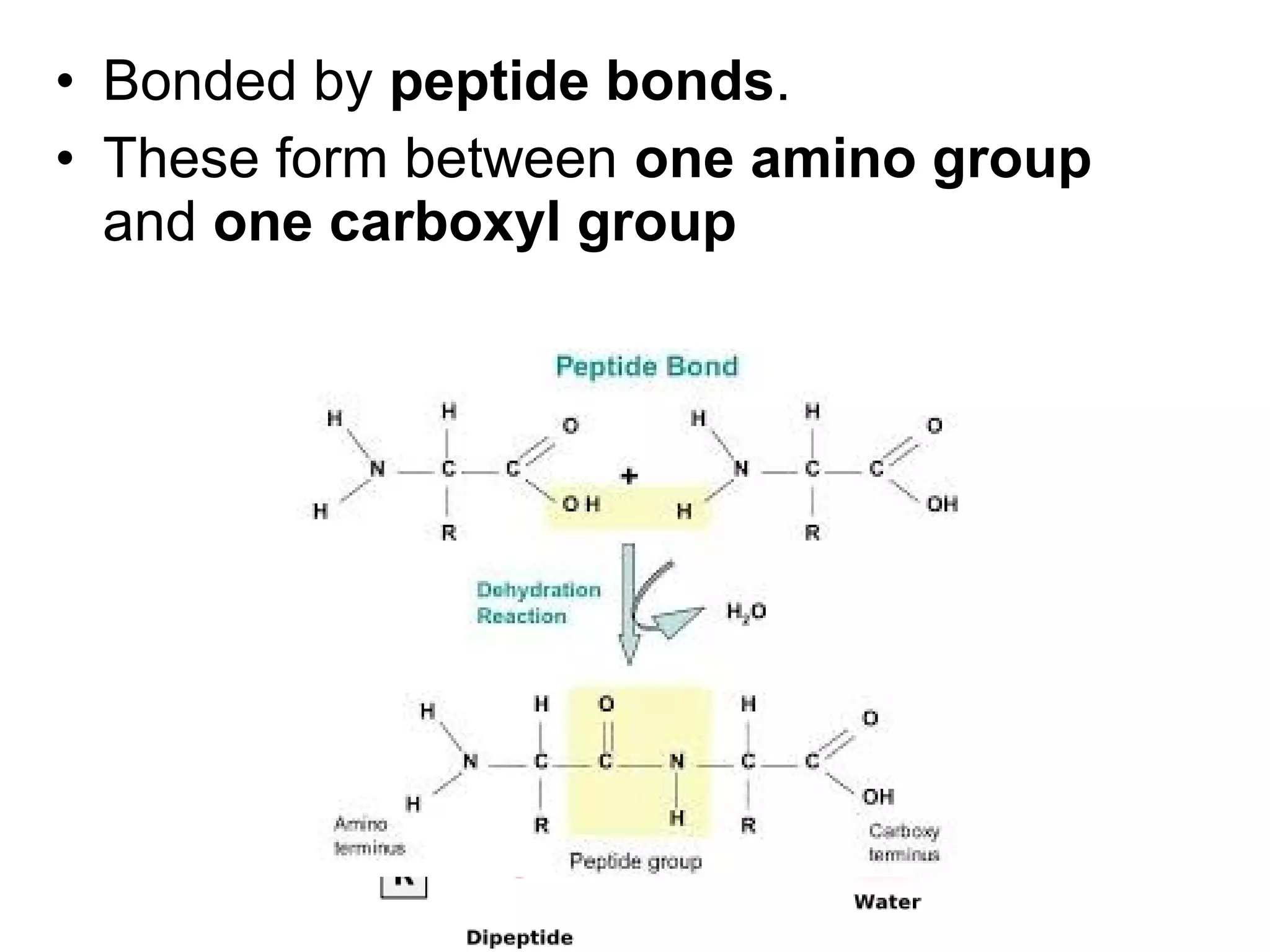
• Bonded by peptide bonds.
• These form between one amino group
and one carboxyl group
Protein structure
• Proteins, amino acid chains, can be any length
and any combination.
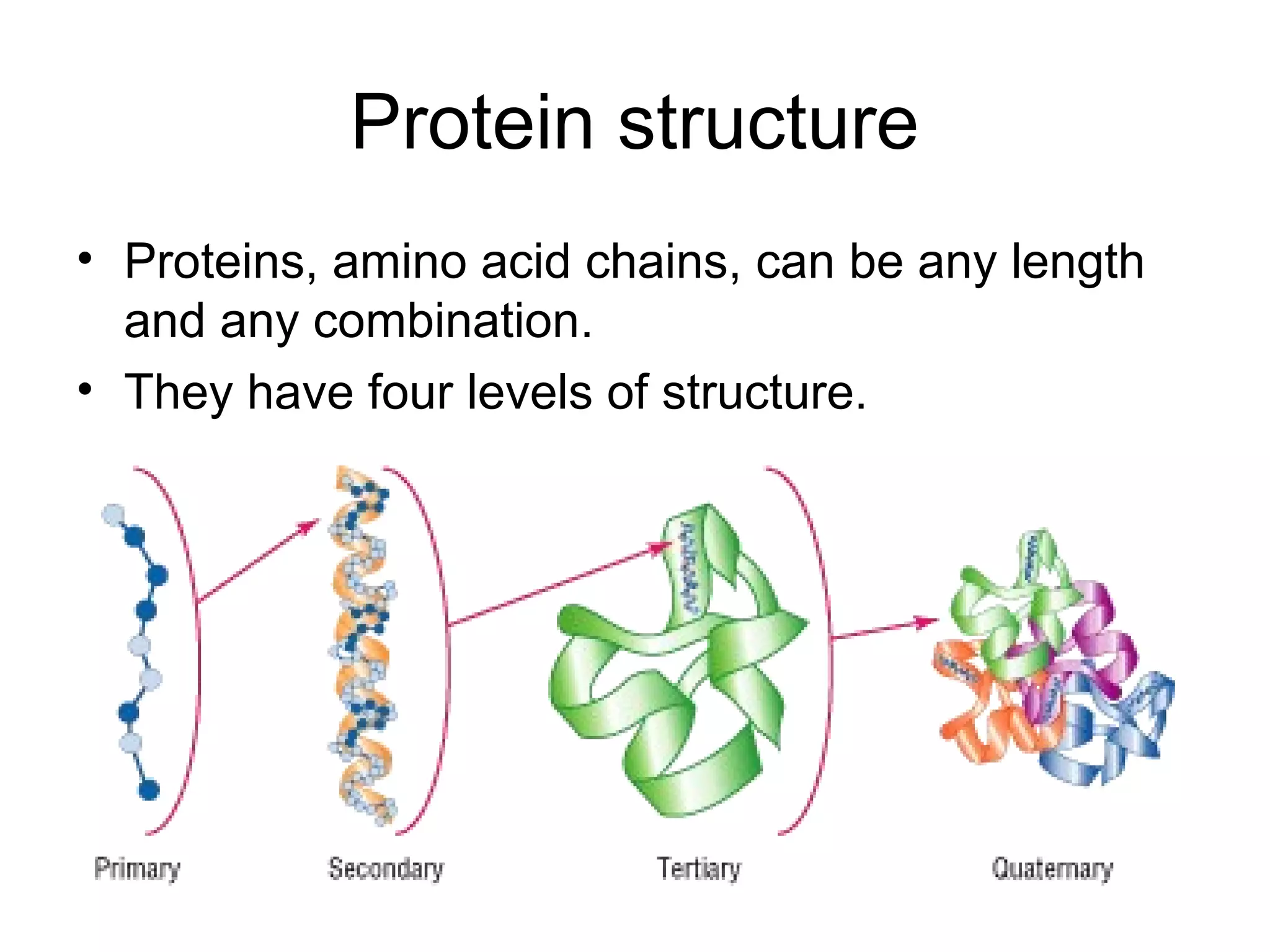
• They have four levels of structure.
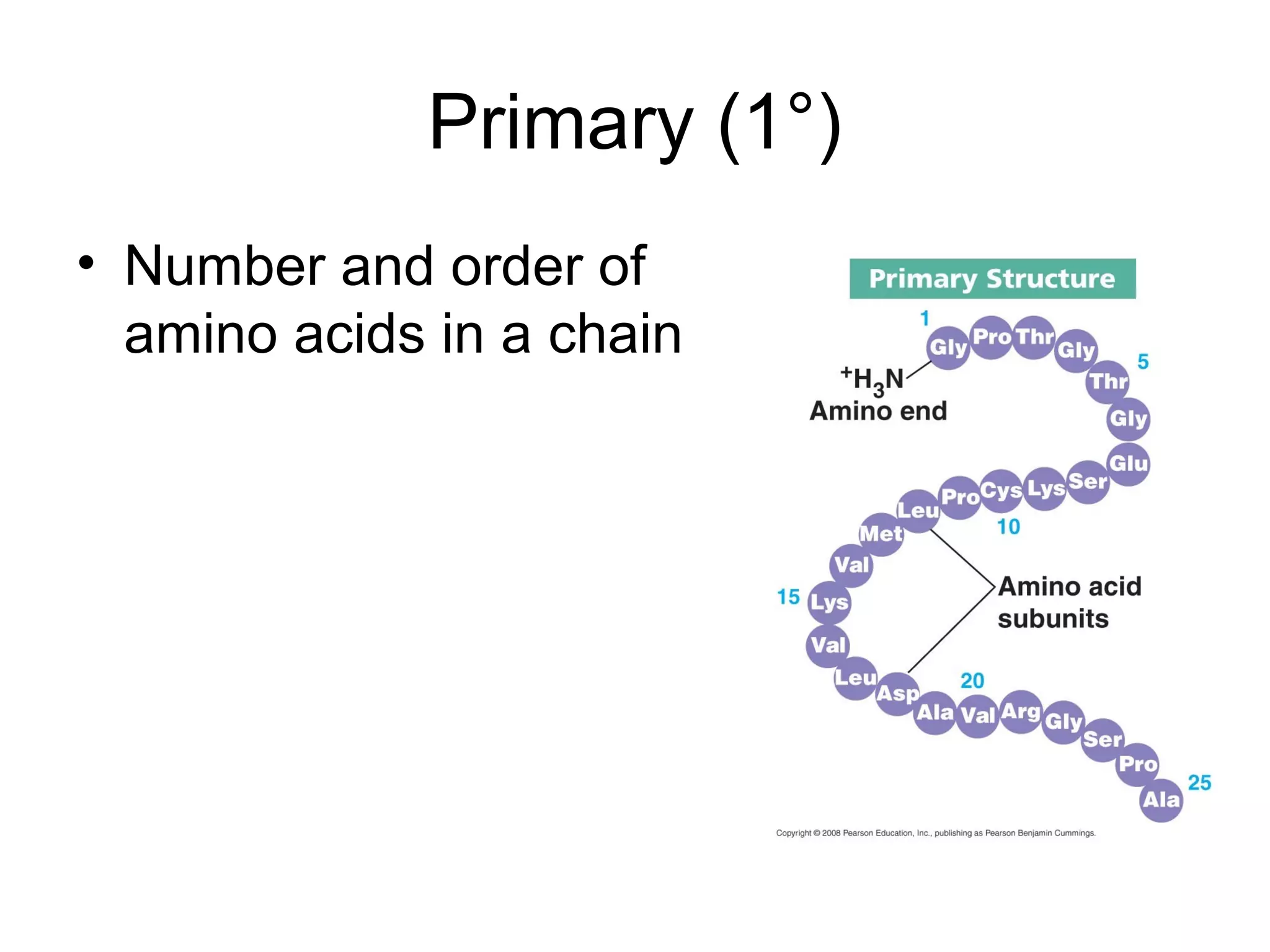
Primary (1°)
• Number and order of
amino acids in a chain
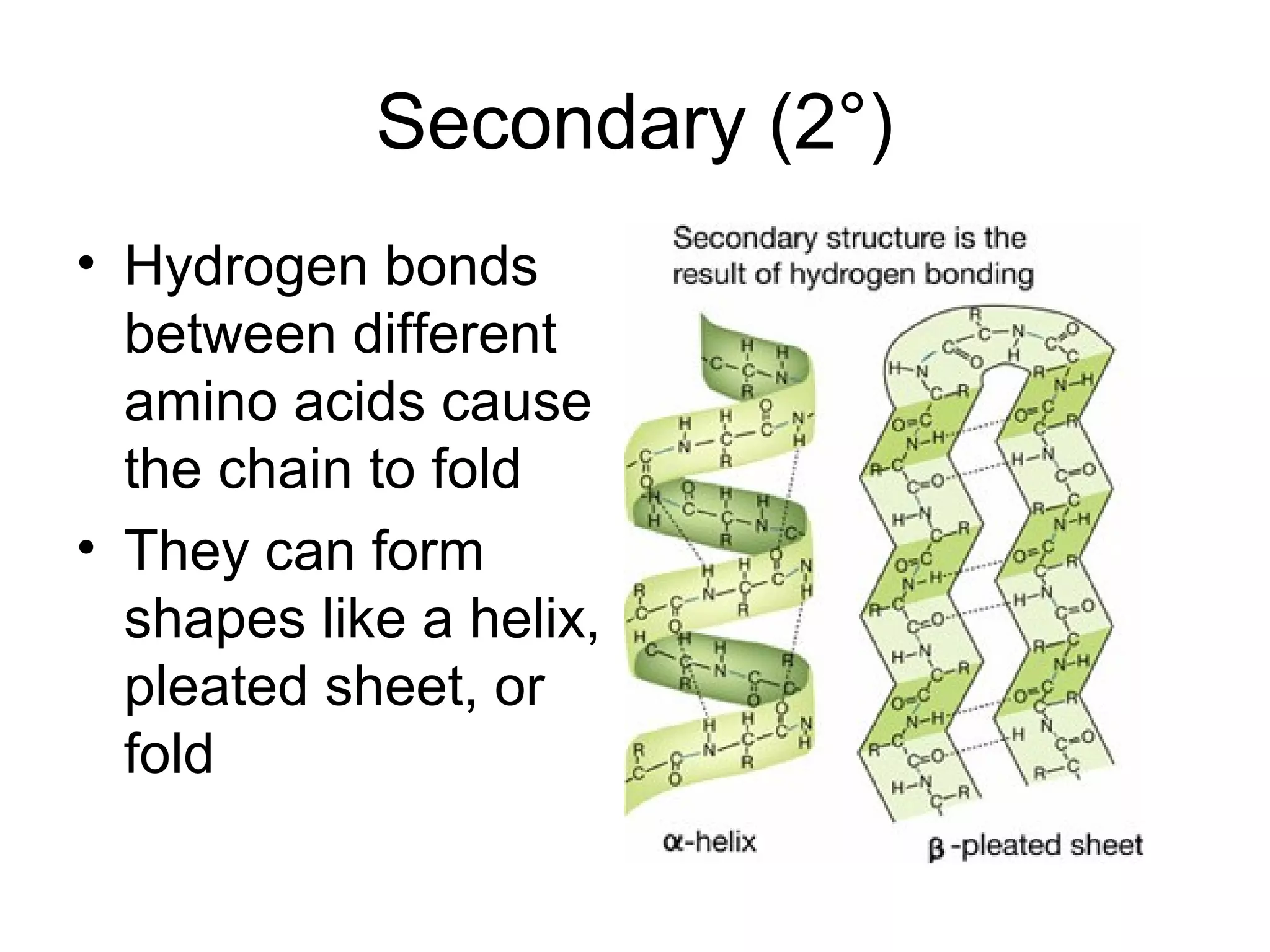
Secondary (2°)
• Hydrogen bonds
between different
amino acids cause
the chain to fold
• They can form
shapes like a helix,
pleated sheet, or
fold
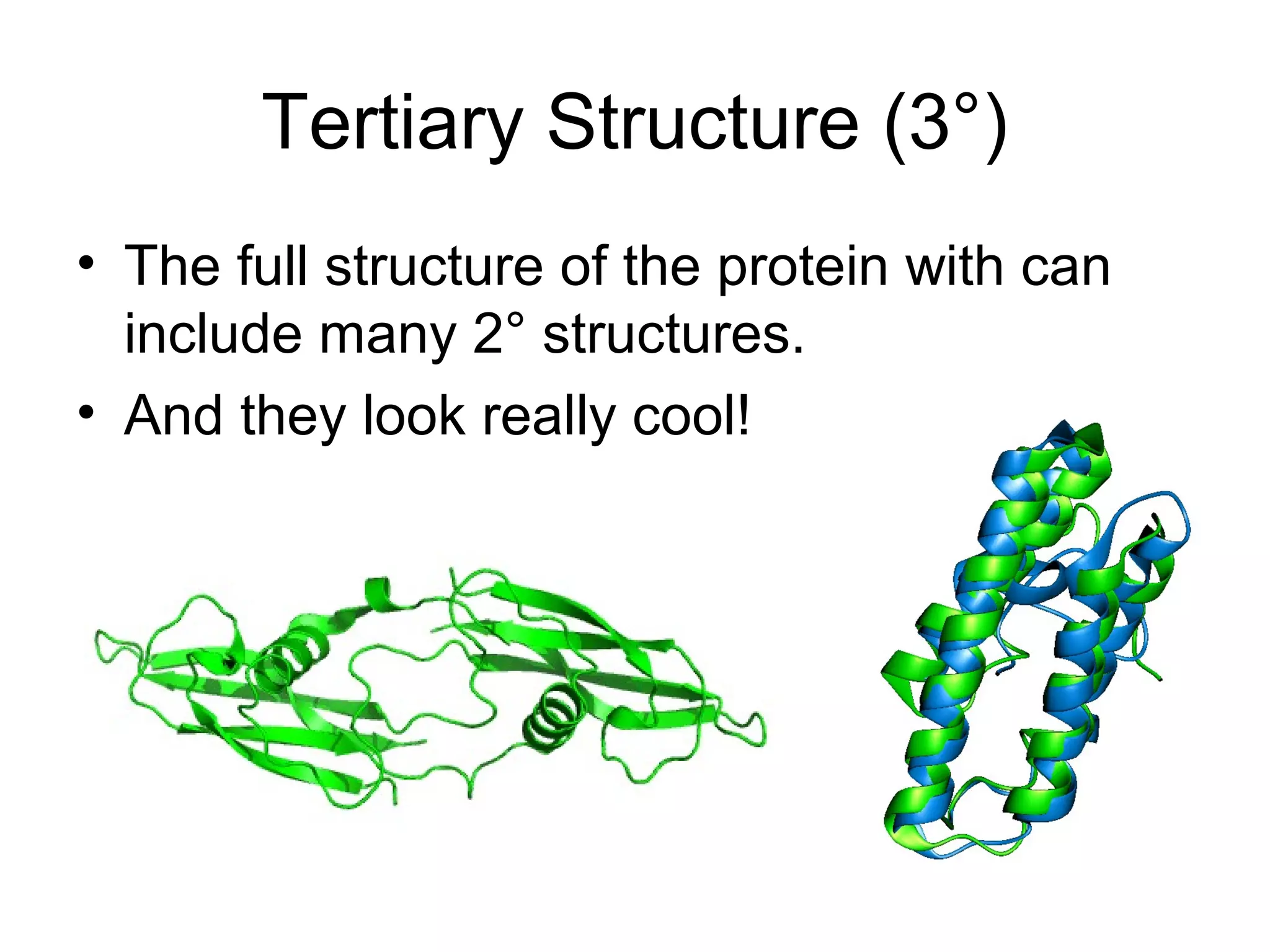
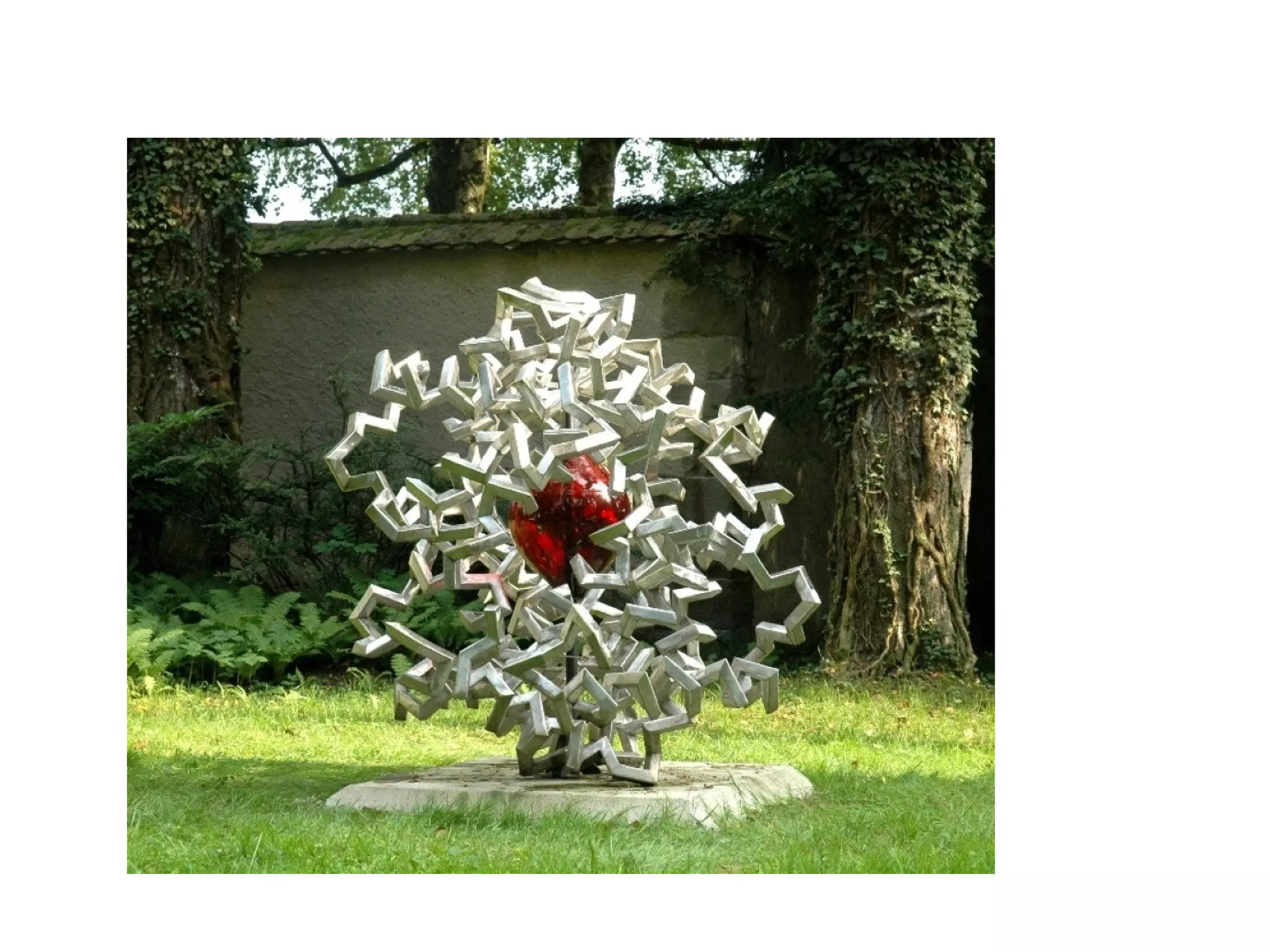
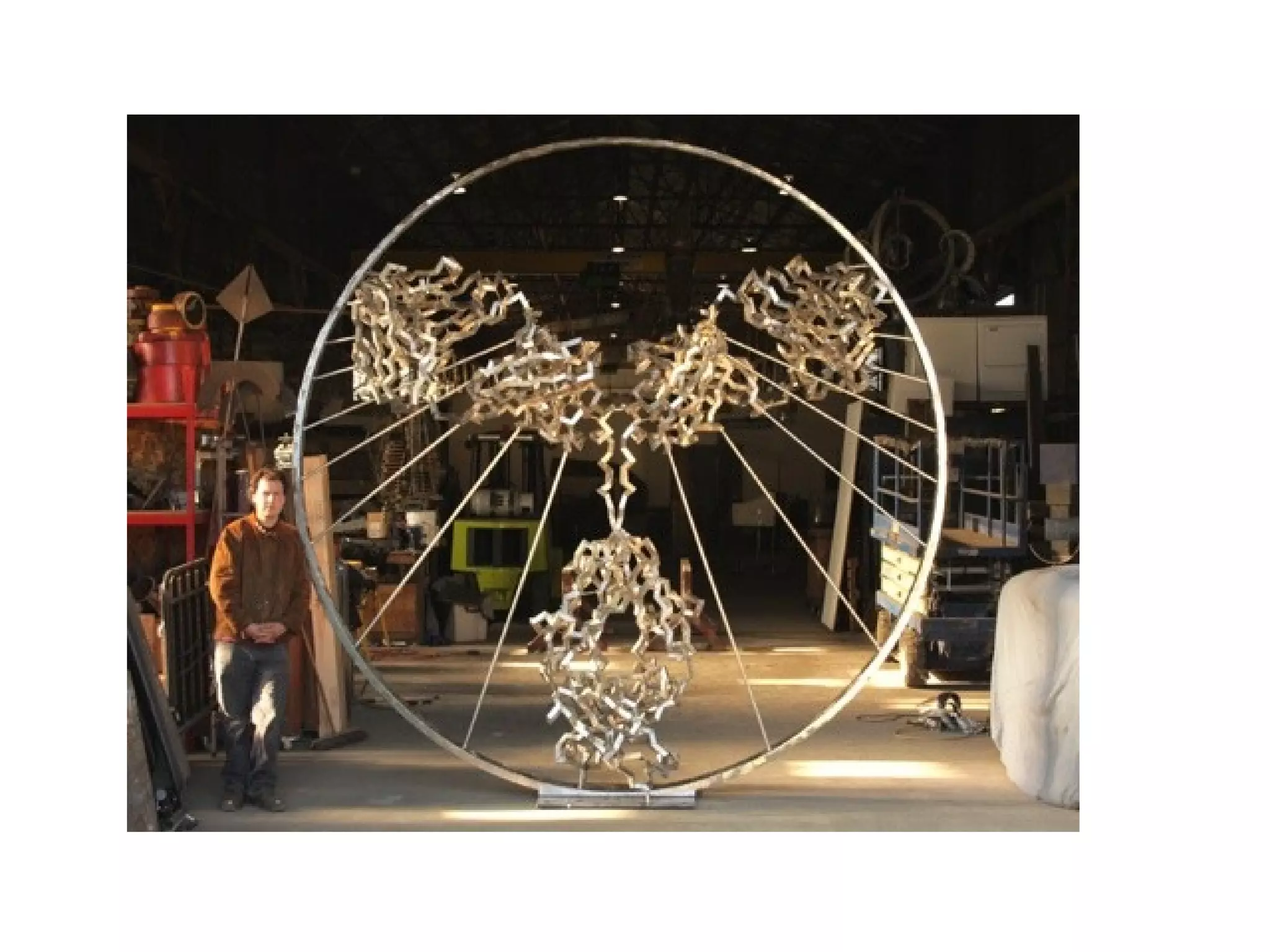
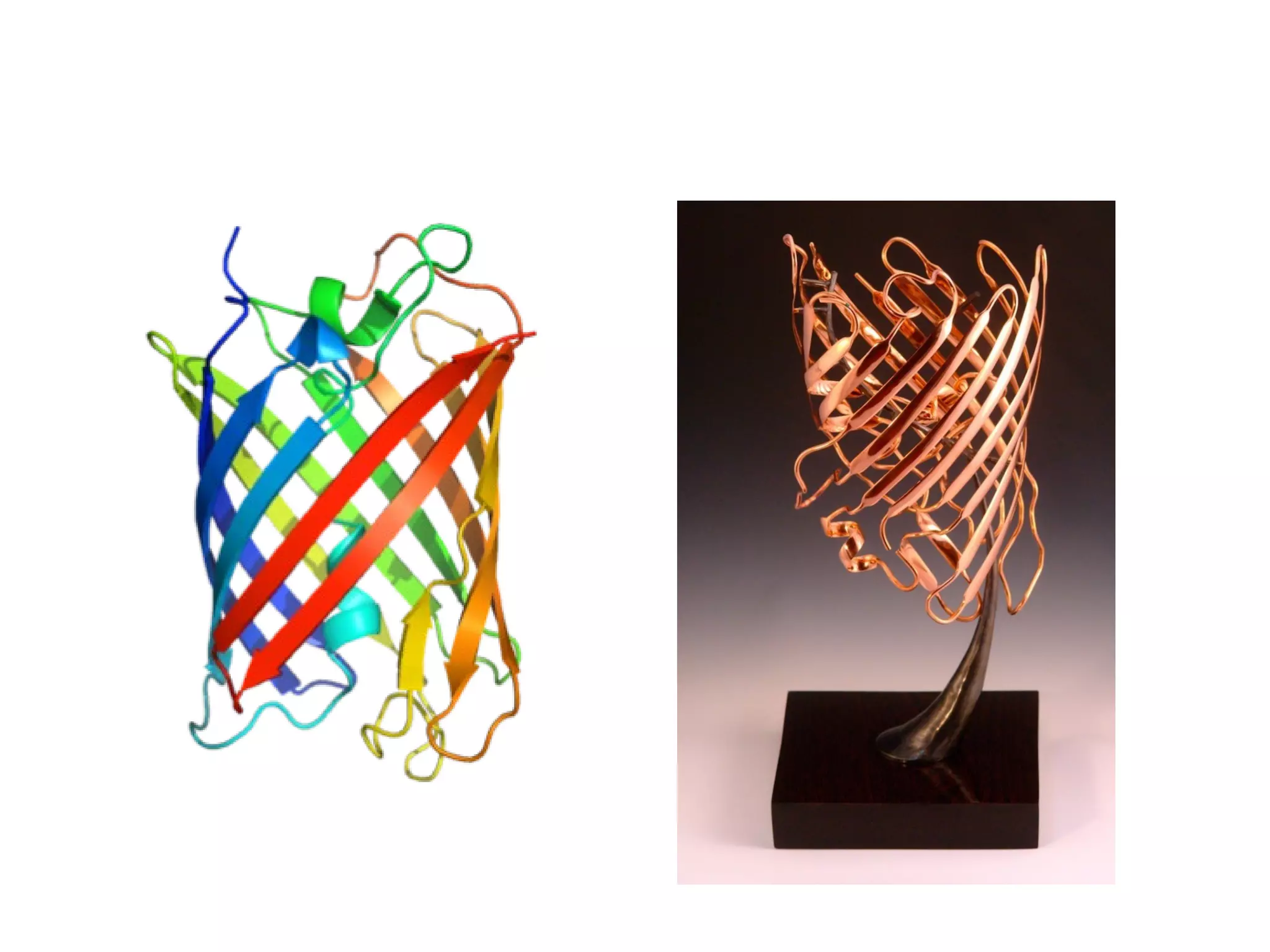
Tertiary Structure (3°)
• The full structure of the protein with can
include many 2° structures.
• And they look really cool!
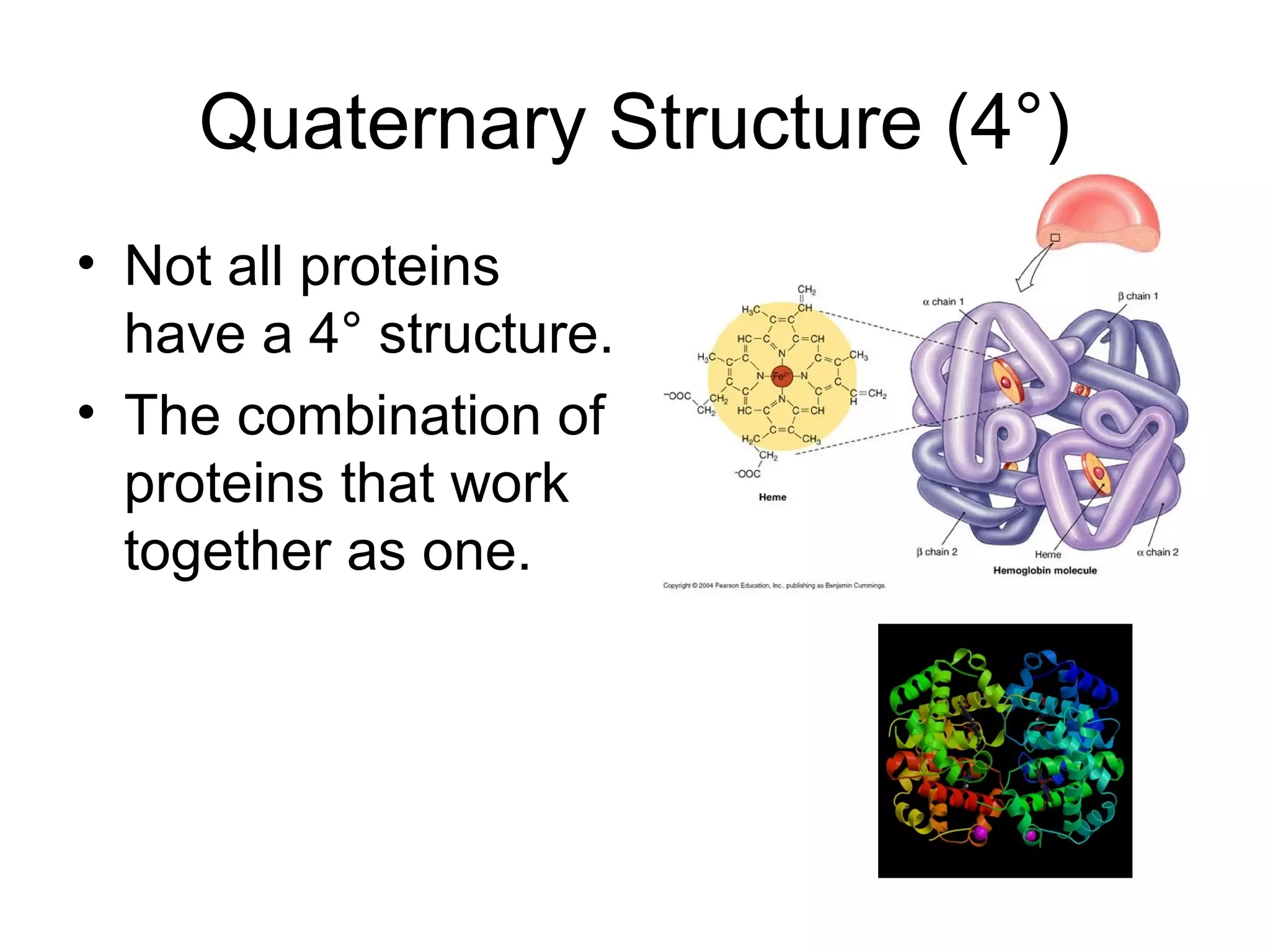
Quaternary Structure (4°)
• Not all proteins
have a 4° structure.
• The combination of
proteins that work
together as one.
Protein Function
• Proteins are ~15% of your total body mass
• Involved in almost every function:
– Muscles, skin, hair
– Cellular communication
– Enzymes
– Control cell growth
– Protection (immunity)
– Storage
• Our cells contain over 10,000 different proteins
Nucleic Acids
• Function: store and transmit genetic
information
• Monomer: nucleotides
– Nucleotides are composed of C, N, O, P, H
• There are 5 major nucleotides
– The book says 6, because it includes ATP
(wrong)
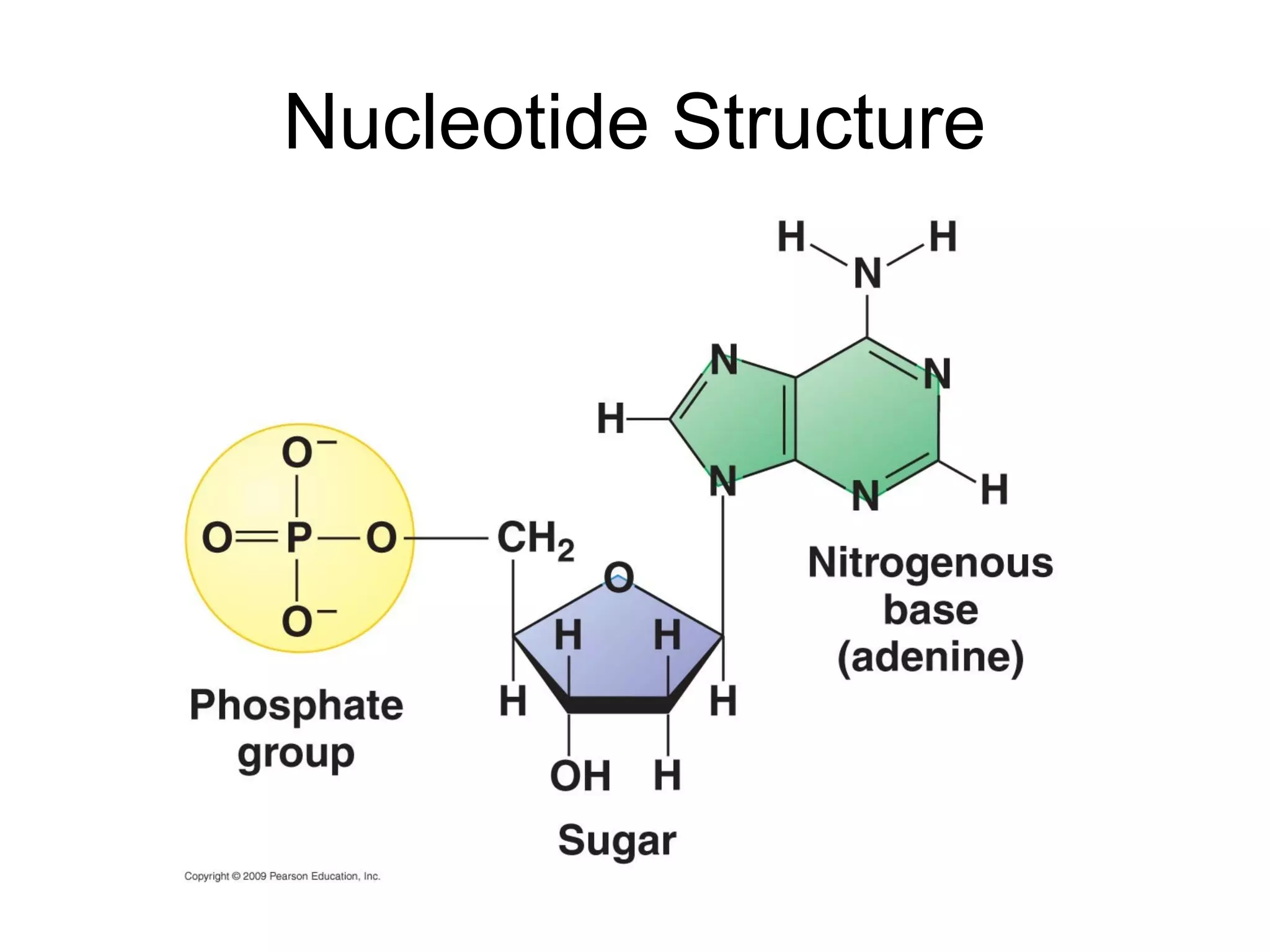
Nucleotide Structure
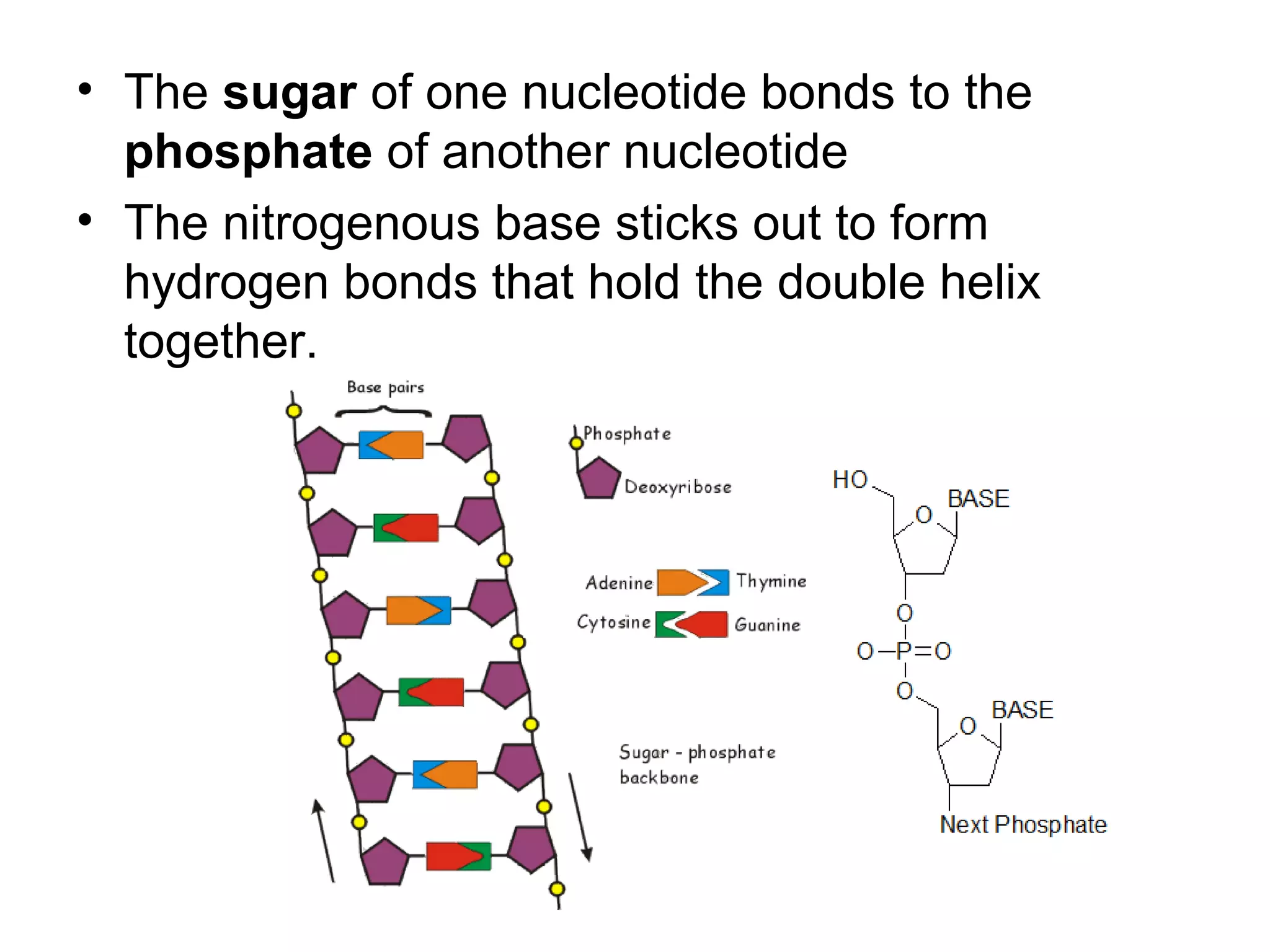
• The sugar of one nucleotide bonds to the
phosphate of another nucleotide
• The nitrogenous base sticks out to form
hydrogen bonds that hold the double helix
together.
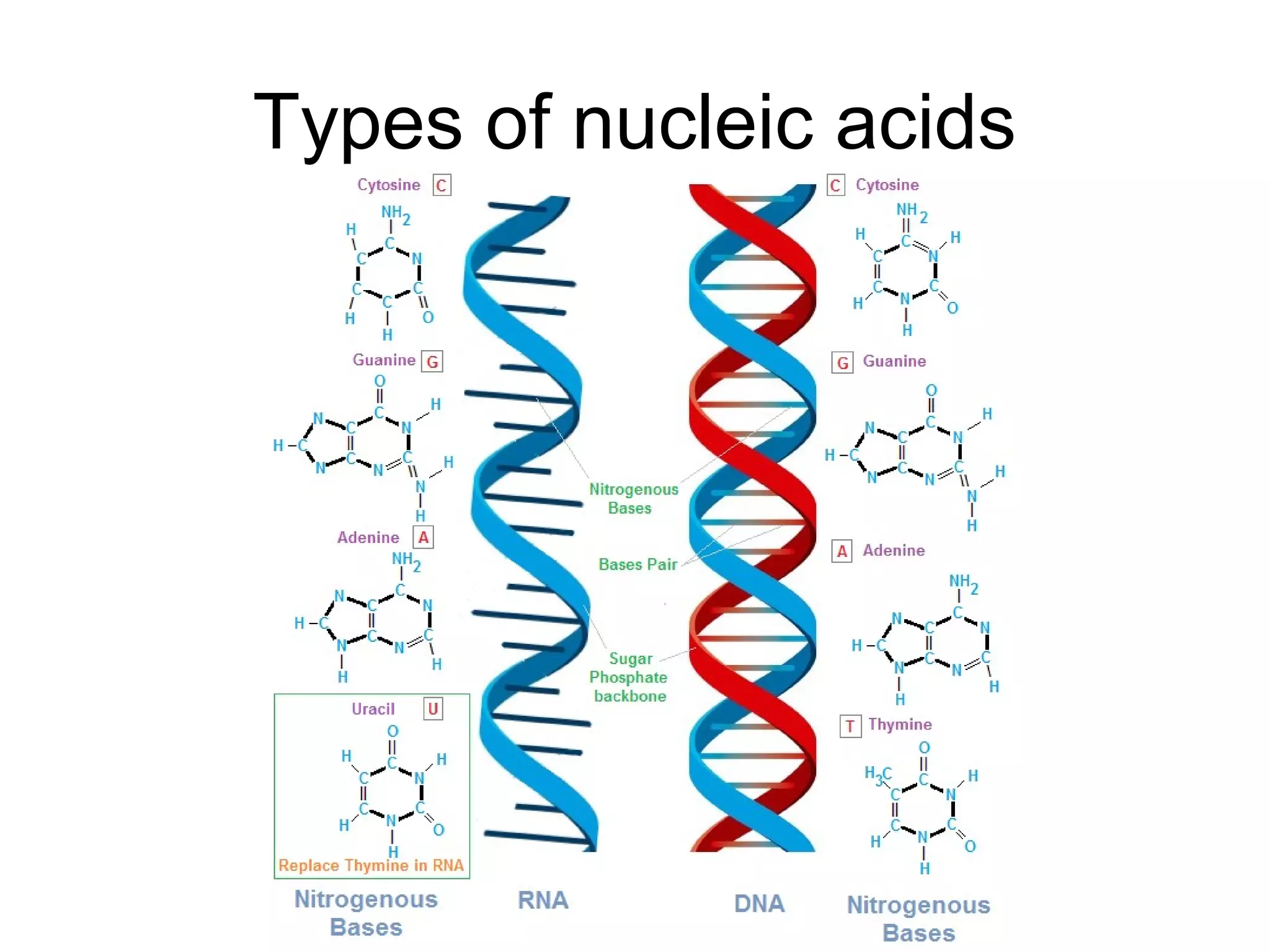
Types of nucleic acids
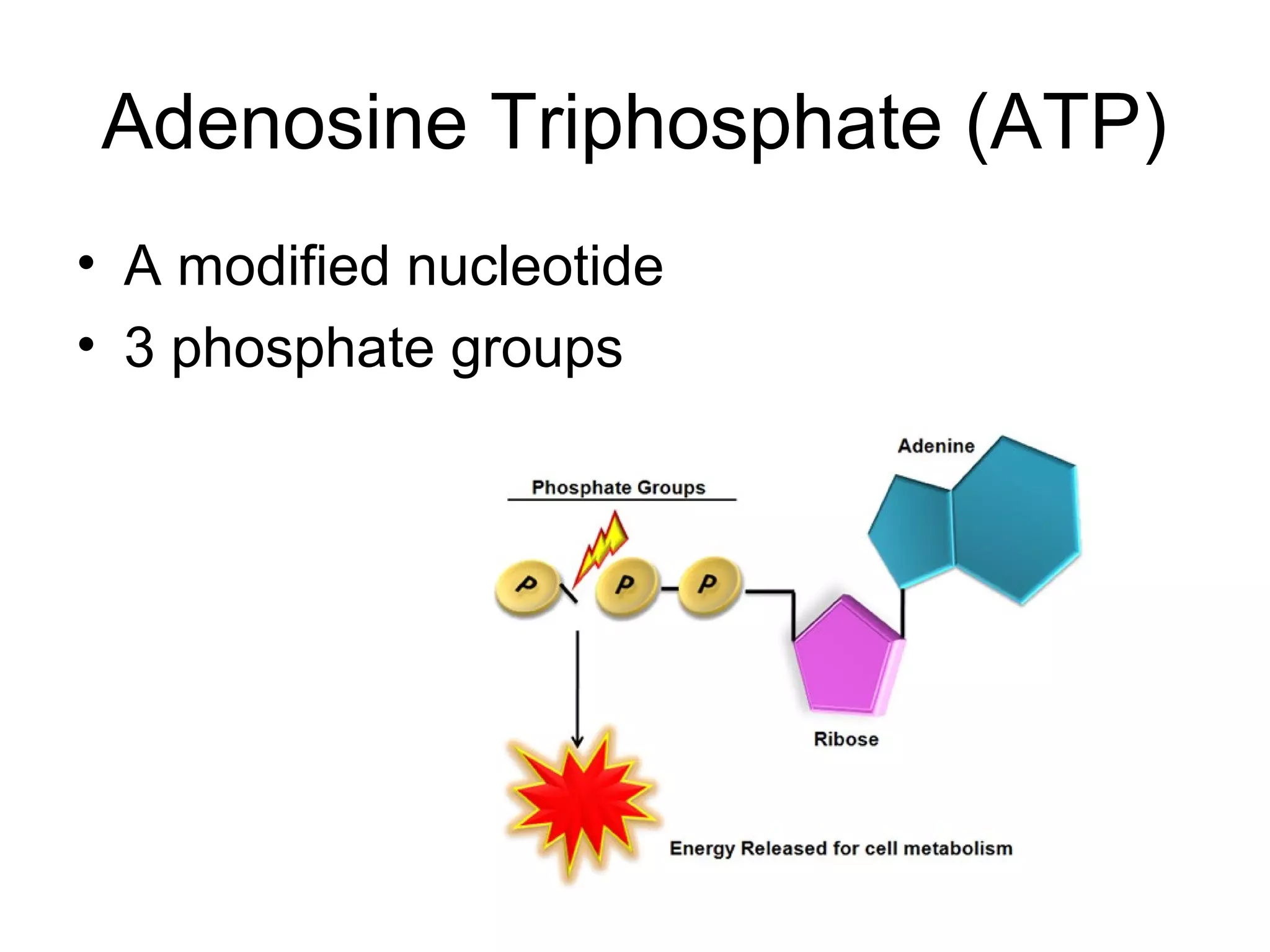
Adenosine Triphosphate (ATP)
• A modified nucleotide
• 3 phosphate groups
Ch6.4 - Building Blocks of Life

Ch6.4 - Building Blocks of Life

  • 1.
    The Building Blocksof Life Chapter 6 Lesson 4 p.166-171
  • 2.
    Vocabulary • Macromolecule • Polymer •Carbohydrate • Lipid • Protein • Amino acid • Nucleic Acid • Nucleotide
  • 3.
    Important Greek termsto make life easier • Poly- = many • Mono- = one • Di- = two • Meros- = part
  • 4.
    Why study Carbon? •All of life is built on carbon • Life on Earth is “carbon-based” • Cells – ~72% H2O – ~25% carbon compounds • carbohydrates • lipids • proteins • nucleic acids – ~3% salts • Na, Cl, K…
  • 5.
    Each carbon atomcan make fourEach carbon atom can make four covalent bonds with other types ofcovalent bonds with other types of atoms or additional carbons.atoms or additional carbons. Question: How manyQuestion: How many electrons does carbon needelectrons does carbon need to fill its outer energy level?to fill its outer energy level? Answer: FourAnswer: Four
  • 7.
    Chemistry of Life •Organic chemistry is the study of organic compounds, or carbon compounds
  • 8.
  • 9.
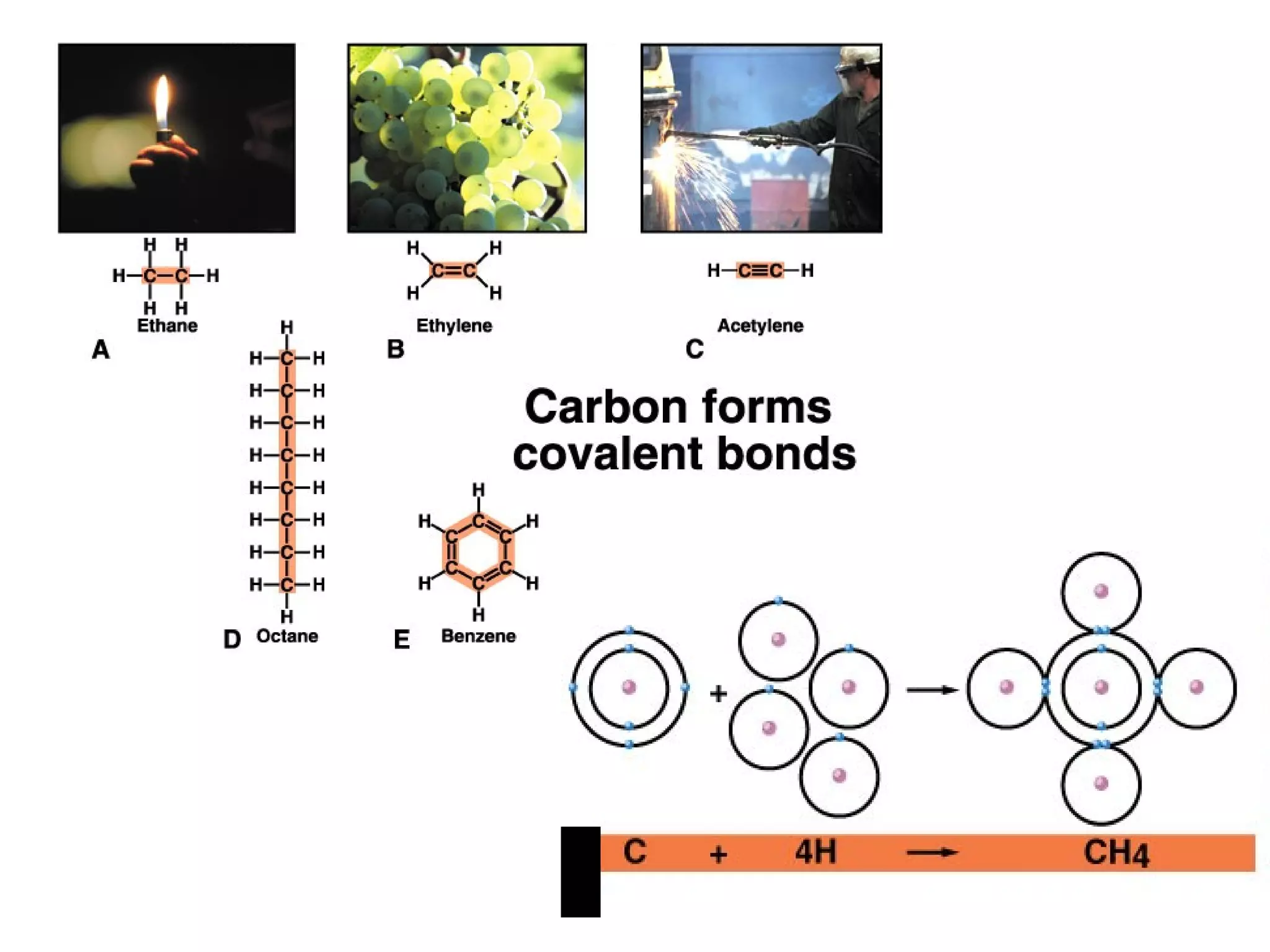
    • Carbon occursso often in organic chemistry we don’t even need to put the atomic symbol.
  • 10.
    MACROMOLECULES OF LIFE •Found in all living things • Building blocks of all cells • There are 4 1. Carbohydrates  C, H, & O 2. Lipids  C, H, & O 3. Proteins  C, H, O, N, & S 4. Nucleic Acids  C, H, O, N, & P
  • 11.
    Macromolecules • Large moleculesthat are formed by joining smaller organic molecules together.
  • 12.
  • 13.
    Monomers & Polymers •Macromolecules are actually made up of even smaller subunits. Each subunit of a macromolecule is called a monomer. • The macromolecules themselves are called polymers, because they are made up of many of these subunits. Monomer: one basic unit or subunit Polymer: a chain of many basic units
  • 15.
  • 16.
    Carbohydrates • (CH2O)n orC1:H2:O1 ratio • n = number of CH2O units in a chain Carbohydrates Monosaccharide Disaccharide Polysaccharide
  • 17.
    Monosaccharide • (CH2O)3-7 • Simplesugars • Function: Energy source for organisms – Example: glucose (C6H12O6)
  • 18.
  • 19.
  • 20.
    Lipids • Mostly madeup of carbon and hydrogen • Primary Function: energy storage • Include oils, fats, waxes, and steroids
  • 21.
    Triglycerides • Oils =if liquid at room temperature • Fats = if solid at room temperature
  • 22.
    Triglycerides • Structure: – 3Fatty Acids + Glycerol
  • 23.
    • If thefatty acid tail only has single bonds between the carbon atoms, it is a saturated fat. – “Saturated” mean filled to maximum capacity.
  • 24.
    • If thefatty acid tail has one or more double bonds between the carbon atoms, it is an unsaturated fat. – Because the tail could make room, accommodate, at least one more hydrogen.
  • 25.
    • If thefatty acid tail has more than one double bond, you can call it a polyunsaturated fat.
  • 27.
  • 28.
  • 29.
    Phospholipids • Special lipidsthat make up cell membranes. • Like most lipids they are hydrophobic – Repels water – This makes for great barriers in the watery environment of our cells
  • 30.
    Other Lipids • Waxes •Steroids – Cholesterol – not all bad – Hormones – estrogen and testosterone
  • 32.
    PROTEINS • Monomer: aminoacids • Amino acids are small compounds that are made of carbon, nitrogen, oxygen, hydrogen, and sometimes sulfur. • Function: enzymes, transport, and cell structure
  • 34.
    Amino Acids • Differby R- unit or variable group • There are 20 different variable groups • So, there are 20 different amino acids
  • 35.
    • Bonded bypeptide bonds. • These form between one amino group and one carboxyl group
  • 36.
    Protein structure • Proteins,amino acid chains, can be any length and any combination. • They have four levels of structure.
  • 37.
    Primary (1°) • Numberand order of amino acids in a chain
  • 38.
    Secondary (2°) • Hydrogenbonds between different amino acids cause the chain to fold • They can form shapes like a helix, pleated sheet, or fold
  • 39.
    Tertiary Structure (3°) •The full structure of the protein with can include many 2° structures. • And they look really cool!
  • 40.
    Quaternary Structure (4°) •Not all proteins have a 4° structure. • The combination of proteins that work together as one.
  • 44.
    Protein Function • Proteinsare ~15% of your total body mass • Involved in almost every function: – Muscles, skin, hair – Cellular communication – Enzymes – Control cell growth – Protection (immunity) – Storage • Our cells contain over 10,000 different proteins
  • 45.
    Nucleic Acids • Function:store and transmit genetic information • Monomer: nucleotides – Nucleotides are composed of C, N, O, P, H • There are 5 major nucleotides – The book says 6, because it includes ATP (wrong)
  • 46.
  • 47.
    • The sugarof one nucleotide bonds to the phosphate of another nucleotide • The nitrogenous base sticks out to form hydrogen bonds that hold the double helix together.
  • 48.
  • 49.
    Adenosine Triphosphate (ATP) •A modified nucleotide • 3 phosphate groups

Editor's Notes

  • #5 Why do we study carbon -- is it the most abundant element in living organisms? H & O most abundant C is the next most abundant
  • #8 Carbon chemistry = organic chemistry Why is it a foundational atom? What makes it so important? Can’t be a good building block if you only form 1 or 2 bonds.