By
Susan Martin
Biology Standard
• Standard 5.0 - The student will investigate the
diversity of organisms by analyzing taxonomic
systems, exploring diverse environments, and
comparing life cycles.
• Learning expectation 5.2- infer the types of
organisms native to specific major biomes
• Performance indicator level 1 - Infer animals
or plants indigenous to an environment, given
pictures or diagrams of the organisms and a
description of the environment.
Link to TN Curriculum Standards
Why Would This Standard Be Hard
to Teach?
• Each Biome’s characteristics contains a
great deal of information
• Some biomes share similar plant and
animal life
• This may be the first time some students
are exposed to the terminology
What is a Biome?
• Scientists have developed the term Biome to describe
areas on the earth with similar climate, plants, and
animals.
• The plants and animals that live in a specific biome are
physically well adapted for that area.
• Plants and animals that live in a specific biome share
similar characteristics with other plants and animals in
that biome throughout the world.
• The types of biomes that will be explored during this
exercise include: Tundra, Deserts, Grasslands, Taiga,
Temperate Forests, and Rainforests
EXIT

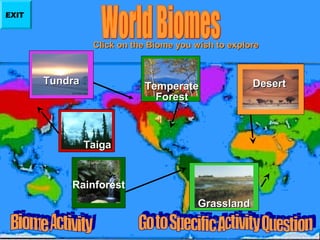
Click on the Biome you wish to explore

Tundra

Temperate
Forest

Taiga

Rainforest
Grassland

Desert
Click on the Question you wish to go back to
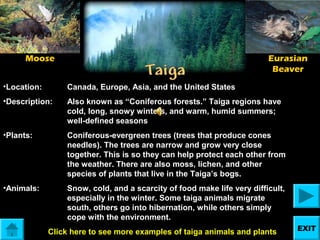
Moose

Eurasian
Beaver

•Location:

Canada, Europe, Asia, and the United States

•Description:

Also known as “Coniferous forests.” Taiga regions have
cold, long, snowy winters, and warm, humid summers;
well-defined seasons

•Plants:

Coniferous-evergreen trees (trees that produce cones
needles). The trees are narrow and grow very close
together. This is so they can help protect each other from
the weather. There are also moss, lichen, and other
species of plants that live in the Taiga’s bogs.

•Animals:

Snow, cold, and a scarcity of food make life very difficult,
especially in the winter. Some taiga animals migrate
south, others go into hibernation, while others simply
cope with the environment.
Click here to see more examples of taiga animals and plants

EXIT
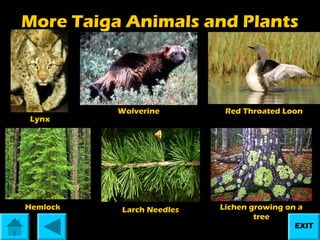
More Taiga Animals and Plants

Lynx

Hemlock

Wolverine

Larch Needles

Red Throated Loon

Lichen growing on a
tree
EXIT
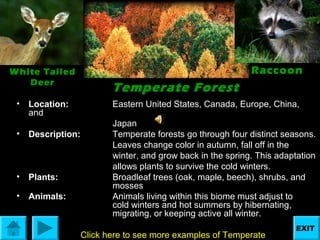
White Tailed
Deer
•

Location:
and

•

Description:

•

Plants:

•

Animals:

Raccoon

Temperate Forest
Eastern United States, Canada, Europe, China,
Japan
Temperate forests go through four distinct seasons.
Leaves change color in autumn, fall off in the
winter, and grow back in the spring. This adaptation
allows plants to survive the cold winters.
Broadleaf trees (oak, maple, beech), shrubs, and
mosses
Animals living within this biome must adjust to
cold winters and hot summers by hibernating,
migrating, or keeping active all winter.
Click here to see more examples of Temperate

EXIT
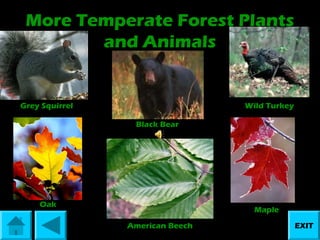
More Temperate Forest Plants
and Animals

Grey Squirrel

Wild Turkey
Black Bear

Oak

Maple
American Beech

EXIT
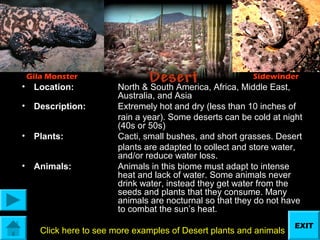
Gila Monster

•

Location:

•

Description:

•

Plants:

•

Animals:

Sidewinder

North & South America, Africa, Middle East,
Australia, and Asia
Extremely hot and dry (less than 10 inches of
rain a year). Some deserts can be cold at night
(40s or 50s)
Cacti, small bushes, and short grasses. Desert
plants are adapted to collect and store water,
and/or reduce water loss.
Animals in this biome must adapt to intense
heat and lack of water. Some animals never
drink water, instead they get water from the
seeds and plants that they consume. Many
animals are nocturnal so that they do not have
to combat the sun’s heat.

Click here to see more examples of Desert plants and animals

EXIT
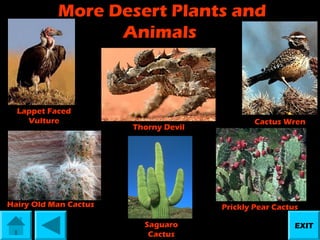
More Desert Plants and
Animals

Lappet Faced
Vulture

Thorny Devil

Hairy Old Man Cactus

Cactus Wren

Prickly Pear Cactus
Saguaro
Cactus

EXIT
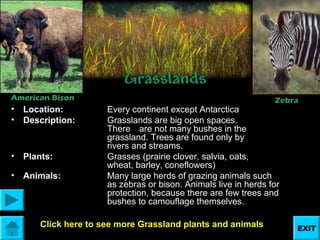
American Bison

•
•

Location:
Description:

•

Plants:

•

Animals:

Zebra

Every continent except Antarctica
Grasslands are big open spaces.
There are not many bushes in the
grassland. Trees are found only by
rivers and streams.
Grasses (prairie clover, salvia, oats,
wheat, barley, coneflowers)
Many large herds of grazing animals such
as zebras or bison. Animals live in herds for
protection, because there are few trees and
bushes to camouflage themselves.

Click here to see more Grassland plants and animals

EXIT
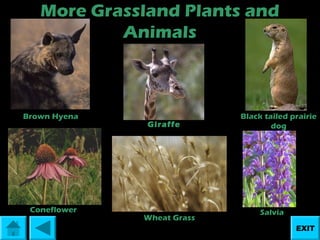
More Grassland Plants and
Animals

Brown Hyena

Coneflower

Giraffe

Wheat Grass

Black tailed prairie
dog

Salvia
EXIT
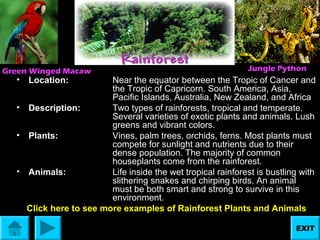
Green Winged Macaw

•

Jungle Python

Location:

Near the equator between the Tropic of Cancer and
the Tropic of Capricorn. South America, Asia,
Pacific Islands, Australia, New Zealand, and Africa
• Description:
Two types of rainforests, tropical and temperate.
Several varieties of exotic plants and animals. Lush
greens and vibrant colors.
• Plants:
Vines, palm trees, orchids, ferns. Most plants must
compete for sunlight and nutrients due to their
dense population. The majority of common
houseplants come from the rainforest.
• Animals:
Life inside the wet tropical rainforest is bustling with
slithering snakes and chirping birds. An animal
must be both smart and strong to survive in this
environment.
Click here to see more examples of Rainforest Plants and Animals
EXIT
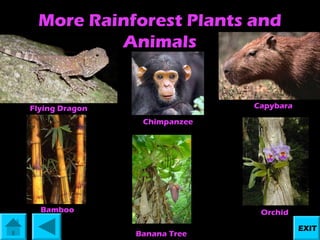
More Rainforest Plants and
Animals

Capybara

Flying Dragon
Chimpanzee

Bamboo

Orchid
Banana Tree

EXIT
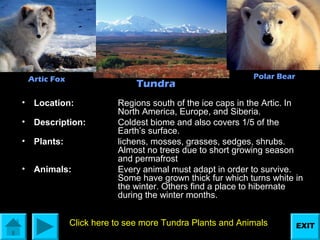
Artic Fox

Tundra

•

Location:

•

Description:

•

Plants:

•

Animals:

Polar Bear

Regions south of the ice caps in the Artic. In
North America, Europe, and Siberia.
Coldest biome and also covers 1/5 of the
Earth’s surface.
lichens, mosses, grasses, sedges, shrubs.
Almost no trees due to short growing season
and permafrost
Every animal must adapt in order to survive.
Some have grown thick fur which turns white in
the winter. Others find a place to hibernate
during the winter months.

Click here to see more Tundra Plants and Animals

EXIT
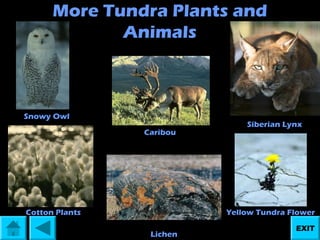
More Tundra Plants and
Animals

Snowy Owl
Caribou

Cotton Plants

Siberian Lynx

Yellow Tundra Flower
Lichen

EXIT
Given identifying factors (such as
plants and animals) identify the
biome.
Click here to begin activity

EXIT
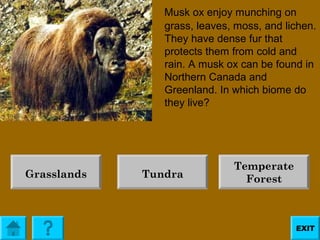
Musk ox enjoy munching on
grass, leaves, moss, and lichen.
They have dense fur that
protects them from cold and
rain. A musk ox can be found in
Northern Canada and
Greenland. In which biome do
they live?

Grasslands

Tundra

Temperate
Forest

EXIT
You did a
Good Job!

EXIT
Better Luck
Next Time,
Please
TRY AGAIN

EXIT
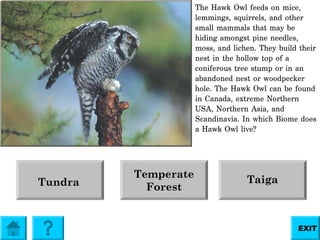
The Hawk Owl feeds on mice,
lemmings, squirrels, and other
small mammals that may be
hiding amongst pine needles,
moss, and lichen. They build their
nest in the hollow top of a
coniferous tree stump or in an
abandoned nest or woodpecker
hole. The Hawk Owl can be found
in Canada, extreme Northern
USA, Northern Asia, and
Scandinavia. In which Biome does
a Hawk Owl live?

Tundra

Temperate
Forest

Taiga

EXIT
Better Luck
Next Time,
Please
TRY AGAIN

EXIT
You did a
Good Job!

EXIT
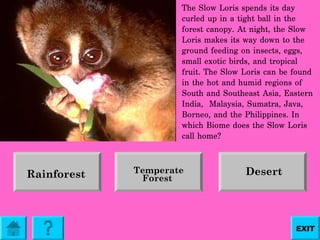
The Slow Loris spends its day
curled up in a tight ball in the
forest canopy. At night, the Slow
Loris makes its way down to the
ground feeding on insects, eggs,
small exotic birds, and tropical
fruit. The Slow Loris can be found
in the hot and humid regions of
South and Southeast Asia, Eastern
India, Malaysia, Sumatra, Java,
Borneo, and the Philippines. In
which Biome does the Slow Loris
call home?

Rainforest

Temperate
Forest

Desert

EXIT
You did a
Good Job!

EXIT
Better Luck
Next Time,
Please
TRY AGAIN

EXIT
EXIT
Resources
• education.discovery.com/. ../freeimagebig.jpg
• earthobservatory.nasa.gov/ Laboratory/Biome/
•
•
•
•

community.webshots.com
www.blueplanetbiomes.org
http://www.mbgnet.net/index.html
www.tobinphoto.com/ wildlifeanimals/moose-102.htm
• http://sagehen.ucnrs.org/Photos/animals/other/sl
ides/Wolverine,%20tom_kucera.jpg
• www.danielbergmann.com/
html/gallery/birds/06.html
• www.photographyblog.com
• http://www.radicalphotography.com/SierraMadre.htm
• bio.bd.psu.edu/.../
American_Beech_01b_Leaf.html
• http://media.gmu.edu/start/mats/Zebra.jpg
• http://www.petandwildlife.com/rodents/ima
ges/articles/Cynomys_ludovicianus_black
_tailed_prairie_dog.jpg

Biomes prj

  • 1.
  • 2.
    Biology Standard • Standard5.0 - The student will investigate the diversity of organisms by analyzing taxonomic systems, exploring diverse environments, and comparing life cycles. • Learning expectation 5.2- infer the types of organisms native to specific major biomes • Performance indicator level 1 - Infer animals or plants indigenous to an environment, given pictures or diagrams of the organisms and a description of the environment. Link to TN Curriculum Standards
  • 3.
    Why Would ThisStandard Be Hard to Teach? • Each Biome’s characteristics contains a great deal of information • Some biomes share similar plant and animal life • This may be the first time some students are exposed to the terminology
  • 4.
    What is aBiome? • Scientists have developed the term Biome to describe areas on the earth with similar climate, plants, and animals. • The plants and animals that live in a specific biome are physically well adapted for that area. • Plants and animals that live in a specific biome share similar characteristics with other plants and animals in that biome throughout the world. • The types of biomes that will be explored during this exercise include: Tundra, Deserts, Grasslands, Taiga, Temperate Forests, and Rainforests
  • 5.
    EXIT Click on theBiome you wish to explore Tundra Temperate Forest Taiga Rainforest Grassland Desert
  • 6.
    Click on theQuestion you wish to go back to
  • 7.
    Moose Eurasian Beaver •Location: Canada, Europe, Asia,and the United States •Description: Also known as “Coniferous forests.” Taiga regions have cold, long, snowy winters, and warm, humid summers; well-defined seasons •Plants: Coniferous-evergreen trees (trees that produce cones needles). The trees are narrow and grow very close together. This is so they can help protect each other from the weather. There are also moss, lichen, and other species of plants that live in the Taiga’s bogs. •Animals: Snow, cold, and a scarcity of food make life very difficult, especially in the winter. Some taiga animals migrate south, others go into hibernation, while others simply cope with the environment. Click here to see more examples of taiga animals and plants EXIT
  • 8.
    More Taiga Animalsand Plants Lynx Hemlock Wolverine Larch Needles Red Throated Loon Lichen growing on a tree EXIT
  • 9.
    White Tailed Deer • Location: and • Description: • Plants: • Animals: Raccoon Temperate Forest EasternUnited States, Canada, Europe, China, Japan Temperate forests go through four distinct seasons. Leaves change color in autumn, fall off in the winter, and grow back in the spring. This adaptation allows plants to survive the cold winters. Broadleaf trees (oak, maple, beech), shrubs, and mosses Animals living within this biome must adjust to cold winters and hot summers by hibernating, migrating, or keeping active all winter. Click here to see more examples of Temperate EXIT
  • 10.
    More Temperate ForestPlants and Animals Grey Squirrel Wild Turkey Black Bear Oak Maple American Beech EXIT
  • 11.
    Gila Monster • Location: • Description: • Plants: • Animals: Sidewinder North &South America, Africa, Middle East, Australia, and Asia Extremely hot and dry (less than 10 inches of rain a year). Some deserts can be cold at night (40s or 50s) Cacti, small bushes, and short grasses. Desert plants are adapted to collect and store water, and/or reduce water loss. Animals in this biome must adapt to intense heat and lack of water. Some animals never drink water, instead they get water from the seeds and plants that they consume. Many animals are nocturnal so that they do not have to combat the sun’s heat. Click here to see more examples of Desert plants and animals EXIT
  • 12.
    More Desert Plantsand Animals Lappet Faced Vulture Thorny Devil Hairy Old Man Cactus Cactus Wren Prickly Pear Cactus Saguaro Cactus EXIT
  • 13.
    American Bison • • Location: Description: • Plants: • Animals: Zebra Every continentexcept Antarctica Grasslands are big open spaces. There are not many bushes in the grassland. Trees are found only by rivers and streams. Grasses (prairie clover, salvia, oats, wheat, barley, coneflowers) Many large herds of grazing animals such as zebras or bison. Animals live in herds for protection, because there are few trees and bushes to camouflage themselves. Click here to see more Grassland plants and animals EXIT
  • 14.
    More Grassland Plantsand Animals Brown Hyena Coneflower Giraffe Wheat Grass Black tailed prairie dog Salvia EXIT
  • 15.
    Green Winged Macaw • JunglePython Location: Near the equator between the Tropic of Cancer and the Tropic of Capricorn. South America, Asia, Pacific Islands, Australia, New Zealand, and Africa • Description: Two types of rainforests, tropical and temperate. Several varieties of exotic plants and animals. Lush greens and vibrant colors. • Plants: Vines, palm trees, orchids, ferns. Most plants must compete for sunlight and nutrients due to their dense population. The majority of common houseplants come from the rainforest. • Animals: Life inside the wet tropical rainforest is bustling with slithering snakes and chirping birds. An animal must be both smart and strong to survive in this environment. Click here to see more examples of Rainforest Plants and Animals EXIT
  • 16.
    More Rainforest Plantsand Animals Capybara Flying Dragon Chimpanzee Bamboo Orchid Banana Tree EXIT
  • 17.
    Artic Fox Tundra • Location: • Description: • Plants: • Animals: Polar Bear Regionssouth of the ice caps in the Artic. In North America, Europe, and Siberia. Coldest biome and also covers 1/5 of the Earth’s surface. lichens, mosses, grasses, sedges, shrubs. Almost no trees due to short growing season and permafrost Every animal must adapt in order to survive. Some have grown thick fur which turns white in the winter. Others find a place to hibernate during the winter months. Click here to see more Tundra Plants and Animals EXIT
  • 18.
    More Tundra Plantsand Animals Snowy Owl Caribou Cotton Plants Siberian Lynx Yellow Tundra Flower Lichen EXIT
  • 19.
    Given identifying factors(such as plants and animals) identify the biome. Click here to begin activity EXIT
  • 20.
    Musk ox enjoymunching on grass, leaves, moss, and lichen. They have dense fur that protects them from cold and rain. A musk ox can be found in Northern Canada and Greenland. In which biome do they live? Grasslands Tundra Temperate Forest EXIT
  • 21.
    You did a GoodJob! EXIT
  • 22.
  • 23.
    The Hawk Owlfeeds on mice, lemmings, squirrels, and other small mammals that may be hiding amongst pine needles, moss, and lichen. They build their nest in the hollow top of a coniferous tree stump or in an abandoned nest or woodpecker hole. The Hawk Owl can be found in Canada, extreme Northern USA, Northern Asia, and Scandinavia. In which Biome does a Hawk Owl live? Tundra Temperate Forest Taiga EXIT
  • 24.
  • 25.
    You did a GoodJob! EXIT
  • 26.
    The Slow Lorisspends its day curled up in a tight ball in the forest canopy. At night, the Slow Loris makes its way down to the ground feeding on insects, eggs, small exotic birds, and tropical fruit. The Slow Loris can be found in the hot and humid regions of South and Southeast Asia, Eastern India, Malaysia, Sumatra, Java, Borneo, and the Philippines. In which Biome does the Slow Loris call home? Rainforest Temperate Forest Desert EXIT
  • 27.
    You did a GoodJob! EXIT
  • 28.
  • 29.
  • 30.
    Resources • education.discovery.com/. ../freeimagebig.jpg •earthobservatory.nasa.gov/ Laboratory/Biome/ • • • • community.webshots.com www.blueplanetbiomes.org http://www.mbgnet.net/index.html www.tobinphoto.com/ wildlifeanimals/moose-102.htm • http://sagehen.ucnrs.org/Photos/animals/other/sl ides/Wolverine,%20tom_kucera.jpg
  • 31.
    • www.danielbergmann.com/ html/gallery/birds/06.html • www.photographyblog.com •http://www.radicalphotography.com/SierraMadre.htm • bio.bd.psu.edu/.../ American_Beech_01b_Leaf.html • http://media.gmu.edu/start/mats/Zebra.jpg
  • 32.