Energy systems and architecture
ARC 5342
Dr.Arch. Nagham Ali Hasan
Biomass
1st 0semester 2017-2018
1
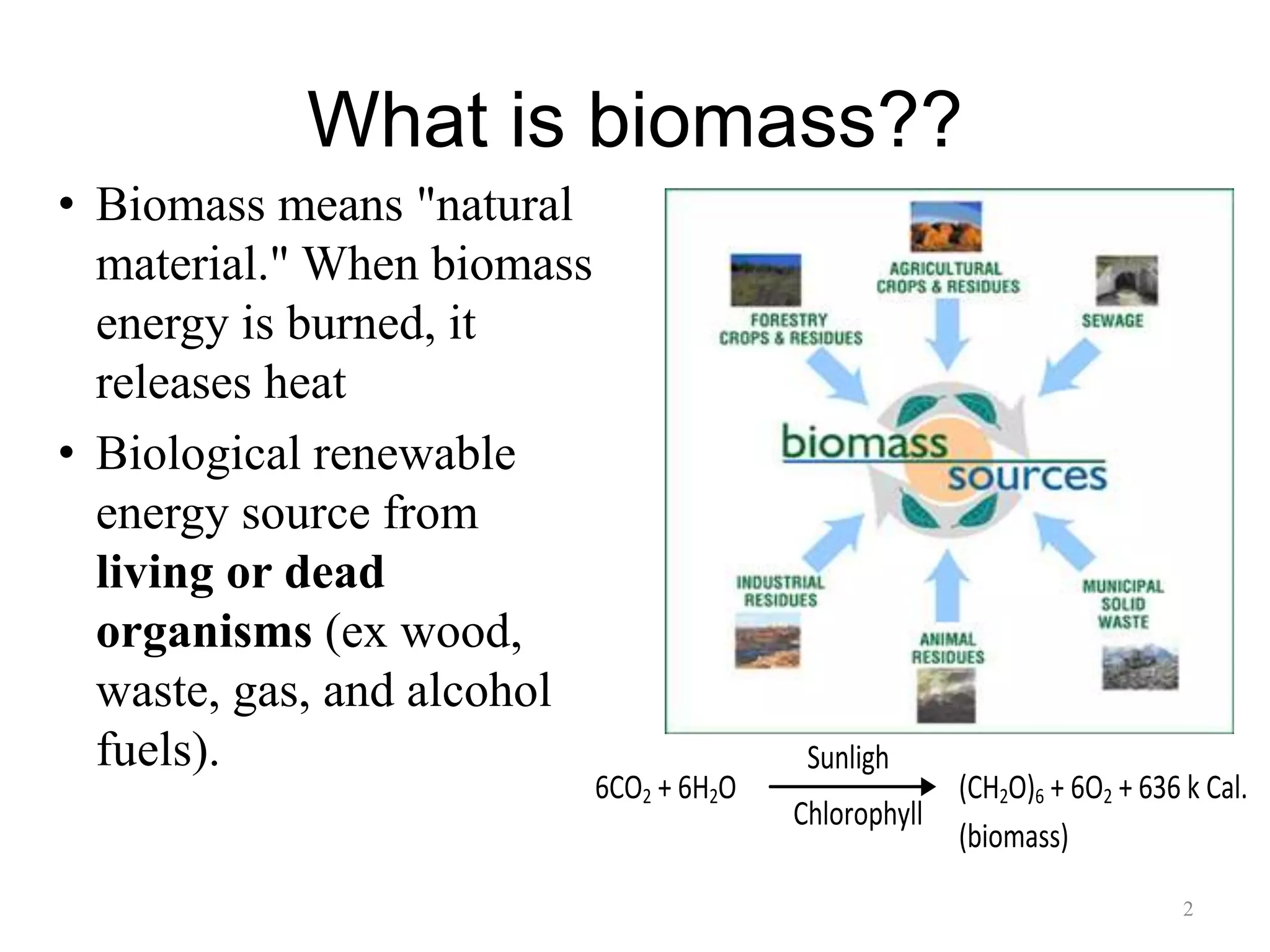
What is biomass??
• Biomass means "natural
material." When biomass
energy is burned, it
releases heat
• Biological renewable
energy source from
living or dead
organisms (ex wood,
waste, gas, and alcohol
fuels).
6CO2 + 6H2O (CH2O)6 + 6O2 + 636 k Cal.
(biomass)
Sunligh
tChlorophyll
t
2
• Energy is stored in the form of complex organic compounds of
carbon, hydrogen, nitrogen, etc.
• The biomass can be converted to useful energy forms such as:
– Heat, Gaseous fuel, Solid fuels, Organic chemical, Liquid fuels
3
4
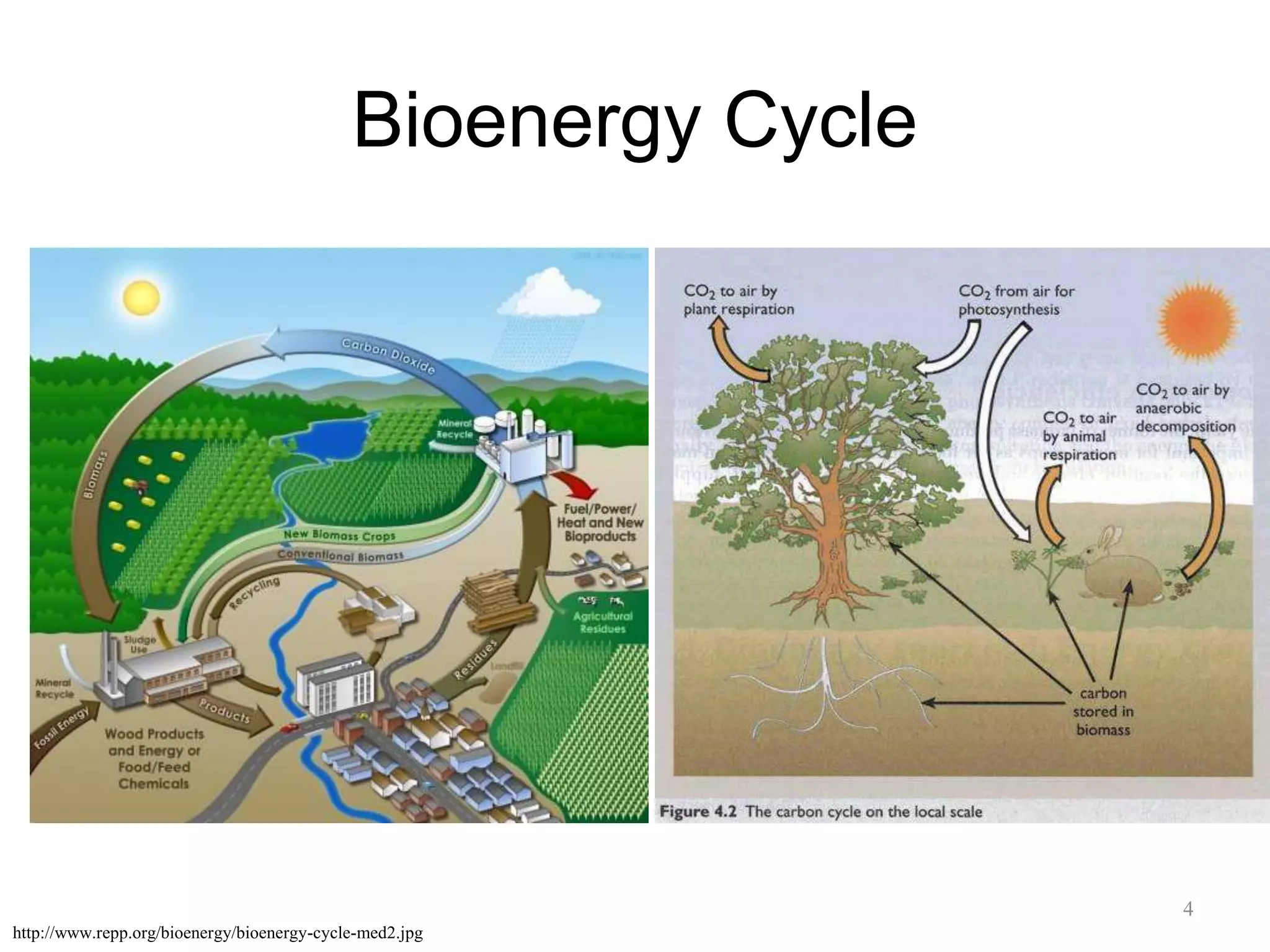
Bioenergy Cycle
http://www.repp.org/bioenergy/bioenergy-cycle-med2.jpg
5
Corn ‫ذرة‬
http://www.geo.msu.edu/geo333/corn.html
6
Soybeans ‫الصويا‬ ‫فول‬
http://agproducts.unl.edu/
7
Sorghum ‫الرفيعة‬ ‫الذرة‬
http://www.okfarmbureau.org/press_pass/galleries/grainSorghum/
8
Sugar Cane Bagasse
‫قصب‬ ‫تفل‬‫السكر‬
http://www.nrel.gov/biomass/photos.html
9
Switchgrass ‫التبن‬
http://www.nrel.gov/biomass/photos.html
10
Olive Residue ‫الجفت‬
http://www.nrel.gov/biomass/photos.html
11
Corn Stover ‫الذرة‬ ‫حطب‬
http://www.nrel.gov/biomass/photos.html
12
Wood Chips & Sawdust
http://www.nrel.gov/biomass/photos.html http://www.energytrust.org/RR/bio/
13
Municipal Solid Waste
http://www.eeingeorgia.org/eic/images/landfill.jpg
14
Shows how biomass takes up a lot of land
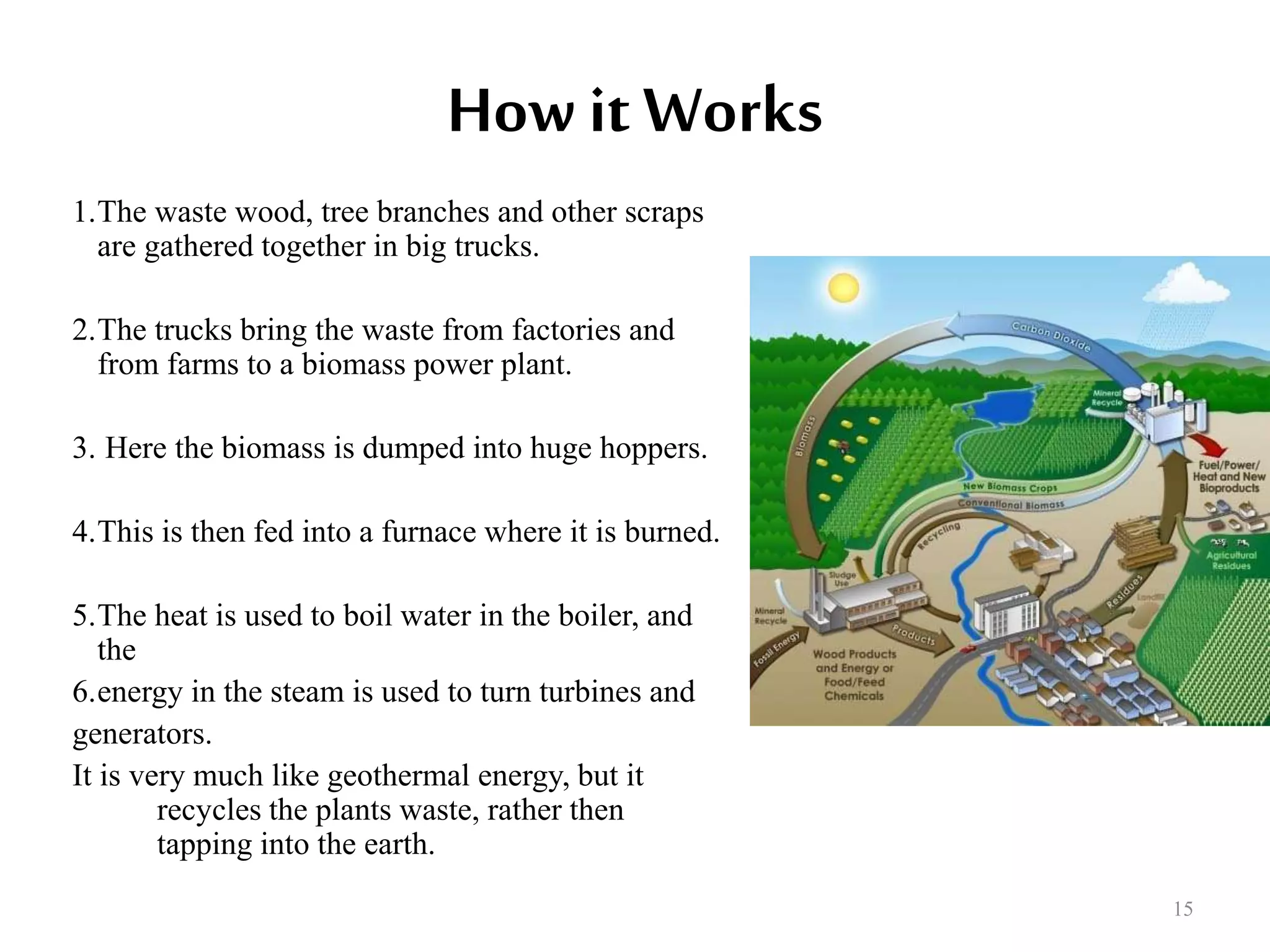
How it Works
1.The waste wood, tree branches and other scraps
are gathered together in big trucks.
2.The trucks bring the waste from factories and
from farms to a biomass power plant.
3. Here the biomass is dumped into huge hoppers.
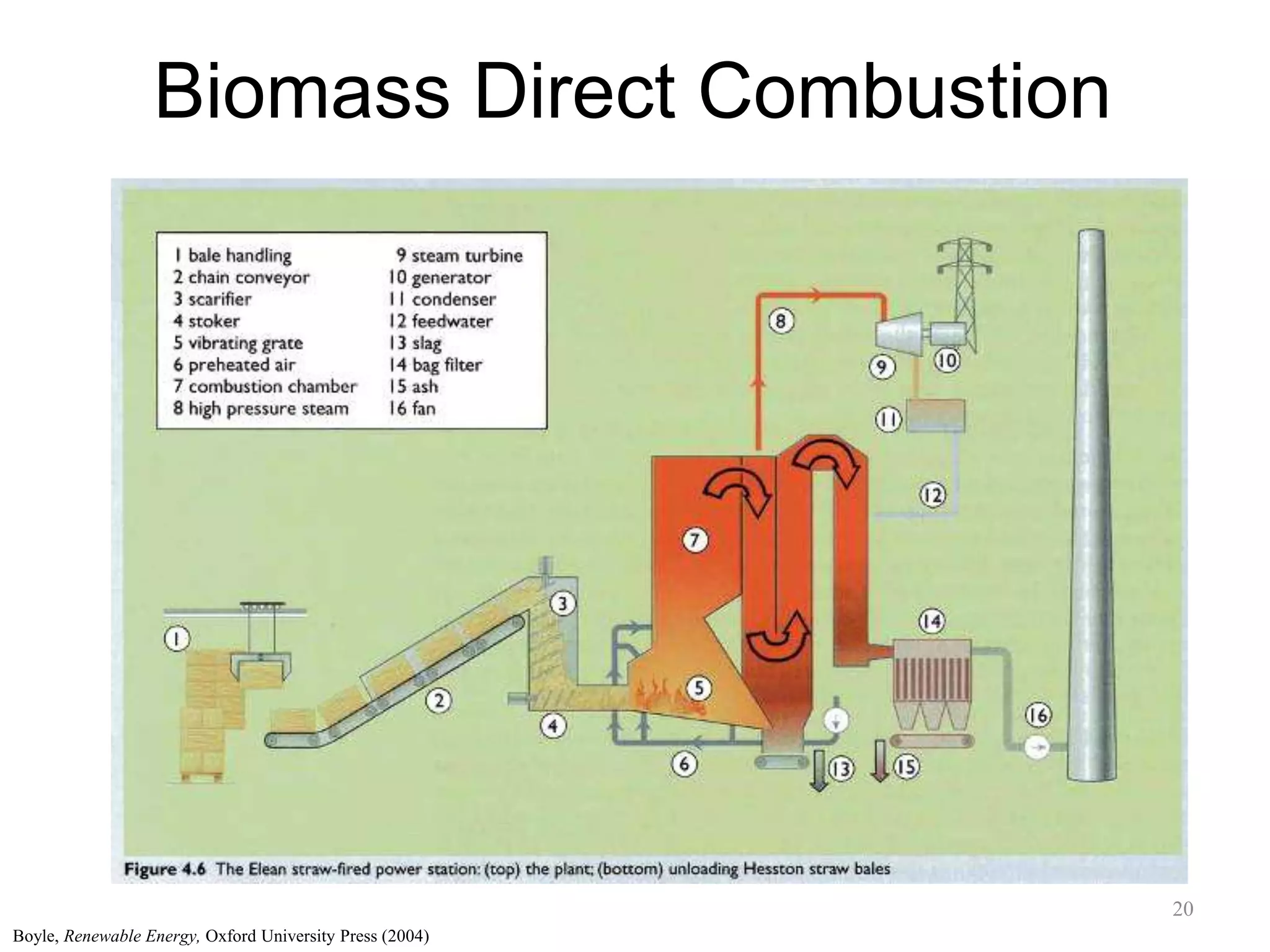
4.This is then fed into a furnace where it is burned.
5.The heat is used to boil water in the boiler, and
the
6.energy in the steam is used to turn turbines and
generators.
It is very much like geothermal energy, but it
recycles the plants waste, rather then
tapping into the earth.
15
we used to produce energy from biomass are three
main categories:
Energy conversion technologies-
o Combustion
o Gasification
o Pyrolysis
16
Creating Energy from Biomass:
Truck unloading wood chips that will fuel
the Tracy Biomass Plant, Tracy, California.
http://www.eia.doe.gov/cneaf/solar.renewables/page/biomass/biomass.html
Tracy
Biomass
Plant
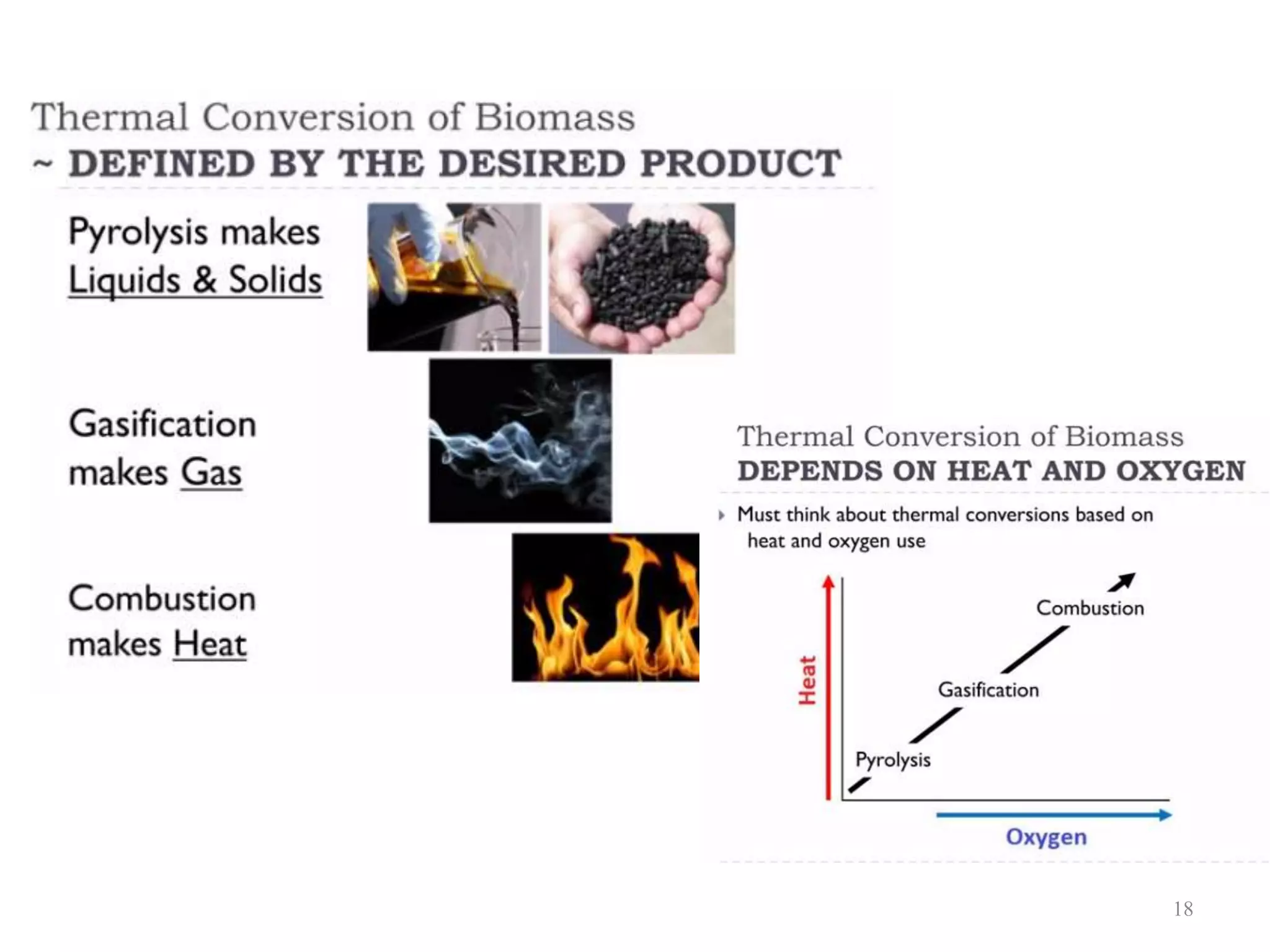
Primary energy conversion technologies
 Combustion – ‫االحتراق‬ direct combustion of biomass is the
most common way of converting biomass to energy - both
heat and electricity. Compared to the gasification and pyrolysis
it is the simplest and most developed.
 Gasification - gasification is a high-temperature (1200-1400
Degree Celsius) thermo chemical conversion process but the
process is used for production of gas, instead of heat.
 Pyrolysis - thermal decomposition occurring in the absence
of oxygen. We use pyrolysis to produce a liquid fuel, bio-oil or
pyrolysis oil.
17
18
19
Bioenergy Conversion
Boyle, Renewable Energy, Oxford University Press (2004)
Thermal conversion
Chemical conversion
Biochemical conversion
20
Biomass Direct Combustion
Boyle, Renewable Energy, Oxford University Press (2004)
21
Biomass Gasifier
• 200 tons of wood chips
daily
• Forest thinnings ‫;رقيق‬
wood pallets
• Converted to gas at
~1000 ºC
• Combined cycle gas
turbine
• 8MW power output McNeil Generating Station
biomass gasifier – 8MW
http://www.nrel.gov/biomass/photos.html
22
23
Heat Energy Content
Boyle, Renewable Energy, Oxford University Press (2004)
1 GJ (gigajoule) = 277.78 kWh (kilowatt hour)
Biomass energy Conversion Routes
24
25
Landfill Gasses
Boyle, Renewable Energy, Oxford University Press (2004)
There are two types of Biogas Plants
1. Fixed head
2. Floating head
26
floating gas-holder type bio-gas plant
27
Floating Dome Type Biogas Plant
(a) Position of dome with less gas in the dome.
(b) Position of dome with more gas in the dome.
28
29
BioFuels
• Ethanol
– Created by fermentation of starches ‫النشويات‬ /sugars
– US capacity of 1.8 billion gals/yr (2005)
– Active research on cellulosic fermentation
• Biodiesel
– Organic oils combined with alcohols
– Creates ethyl or methyl esters
• SynGas Biofuels
– Syngas (H2 & CO) converted to methanol, or
liquid fuel similar to diesel
30
http://www.eere.energy.gov/RE/bio_fuels.html
Biofuel Fossil fuel
Bio-fuel is produced directly from
plant matter typically corn, sugar
cane, sugar beets, or cellulose
transforming it into alcohol.
Fossil fuels are produced by either
the decomposition of plant or
animal matter over long periods of
time under certain conditions such
as high temperature and pressure.
Fossil fuels are coal, oil, and
natural gas.
31
Bioenergy Calculation
32
Composition Percent % kJ/kg Total
Paper 7.73 16,750 1,295
Plastic 18.29 32,500 5,944
Food waste 26.56 4,650 1,235
Wood and yard 8.52 18,600 1,585
*Others 14.92 15,000 2,238
Ferrous 2.47 0 0
Aluminium 0.06 0 0
Glass 1.93 0 0
Sand/fine materials 14.41 0 0
Other inorganics 5.11 0 0
Total 100.00 12,297kJ/kg
kJ --> kWh 0.000278
Throughput: 1800 tons/day
Thermal Power : 256 MW/hour
Electricity Efficiency : 7.5 % 5-10% for a "normal" design
Nomimal power gen : 19.2 MWe/hour [460 MWh/day]
BIO-MASS STORAGE METHODS
Silage piling
33
Euro bagging
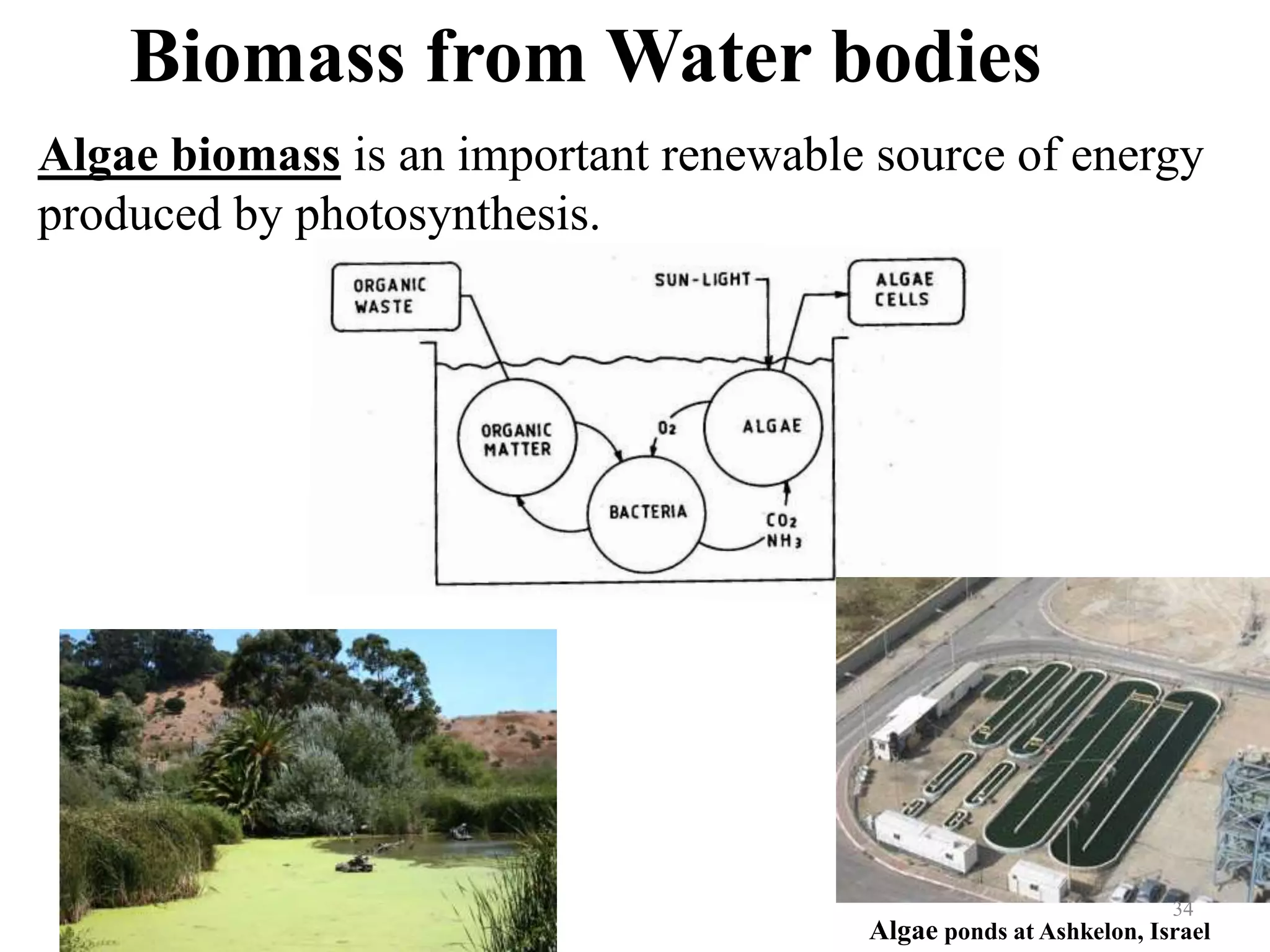
Algae biomass is an important renewable source of energy
produced by photosynthesis.
Algae ponds at Ashkelon, Israel
Biomass from Water bodies
34
Environmental
Advantages
• Biomass can make
electricity and heat
– Can replace fossil fuels
• More efficient than
traditional rendering
• Doesn’t contribute to global
warming
Disadvantages
• Unstable
– Raising of waste material
– Contributes to global warming
gases in the environment
• Huge amount of animal
killing
– MORE MEAT to replace fuel
35
• Less demand on fossil fuel
• Cheaper than fossil fuel
• More environmentally friendly
Political
Advantages
• Reduction of dependency on
imported oil
– Countries don’t have to rely
on foreign bio fuels
• More jobs
– 20X more jobs than coal and
oil
• Rural development and
income opportunities
• Can create good
relationships if exported
Disadvantages
• Takes up too much energy
and resources of country
• Biomass collection is
difficult and expensive
– Politicians may argue whether
it is worth the cost
36
37
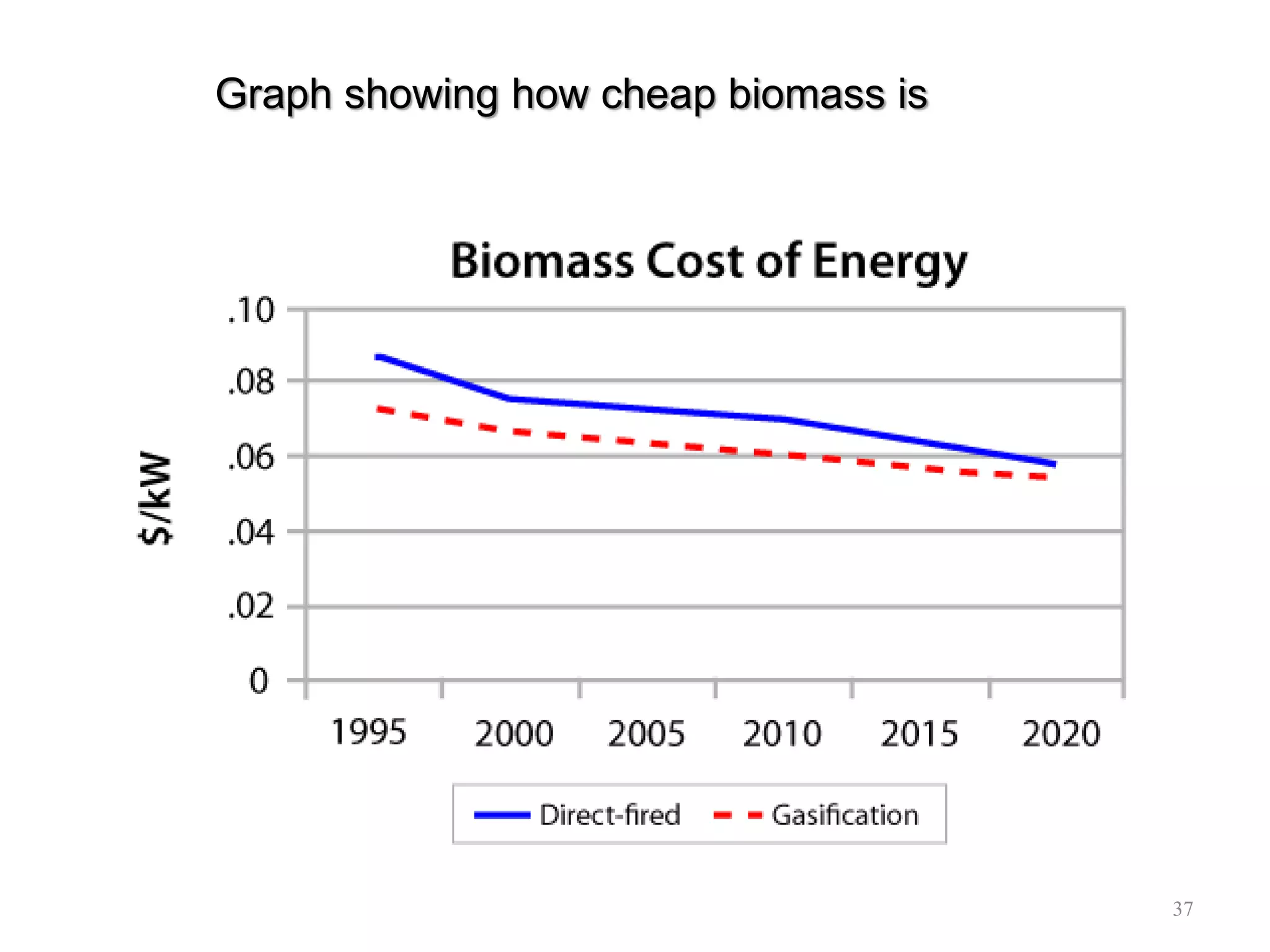
Graph showing how cheap biomass is
38
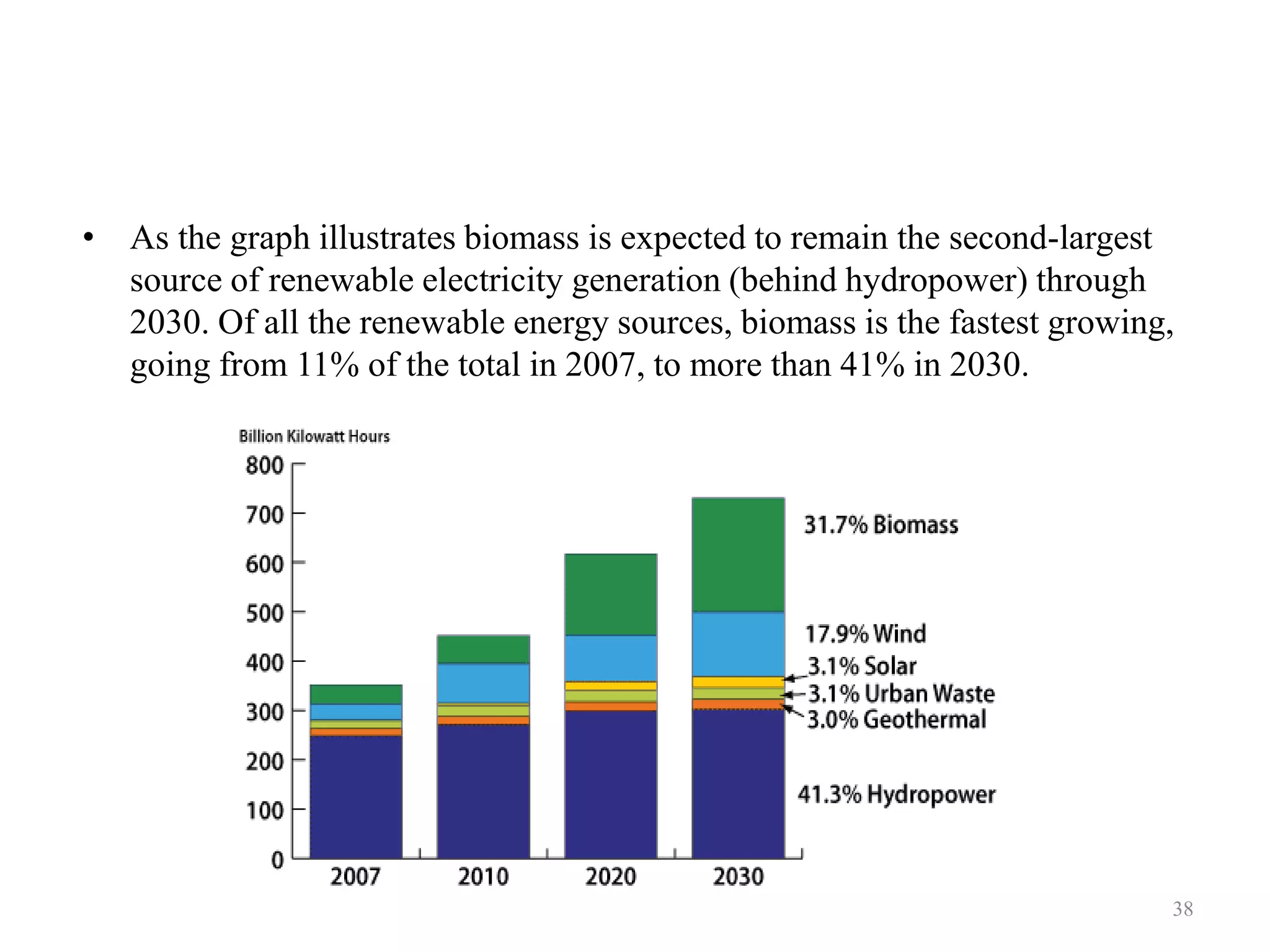
• As the graph illustrates biomass is expected to remain the second-largest
source of renewable electricity generation (behind hydropower) through
2030. Of all the renewable energy sources, biomass is the fastest growing,
going from 11% of the total in 2007, to more than 41% in 2030.
Comparison of Fixed and Floating head
Biogas plant
Janta / Fixed dome type Floating Dome type Biogas Plant
1 Gas is released at variable pressure Gas is released at constant pressure
2 Identifying defects is difficult Identifying the defects in gas holder
easy
3 Cost of maintenance is low Cost of maintenance is high
4 Capital cost is low (for some
capacity)
Capital cost is high
5 Space above the drum can be used Floating drum does not allow the use
of space for other purpose
6 Temperature is high during winter Temperature is low during winter
7 Life span is comparatively longer Life is short
8 Requires move excavation work Requires relatively less excavation
39
PRINCIPAL BIOMASS ENERGY RESOURCES AND
CONVERSION PROCESS
Category Name of the Biomass
Source
Conversion Process
Cultivated
Energy
Resource
Trees, (Wood chips,
saw dusts)
Burning to produce heat
and electricity
Aquatic crops, algae,
green plants
Producing biogas and
biochemical
Agricultural crops Production of gas and
manure -Wood gasification
Fruit farms Production of wood oil and
charcoal. Wood to oil
process
40
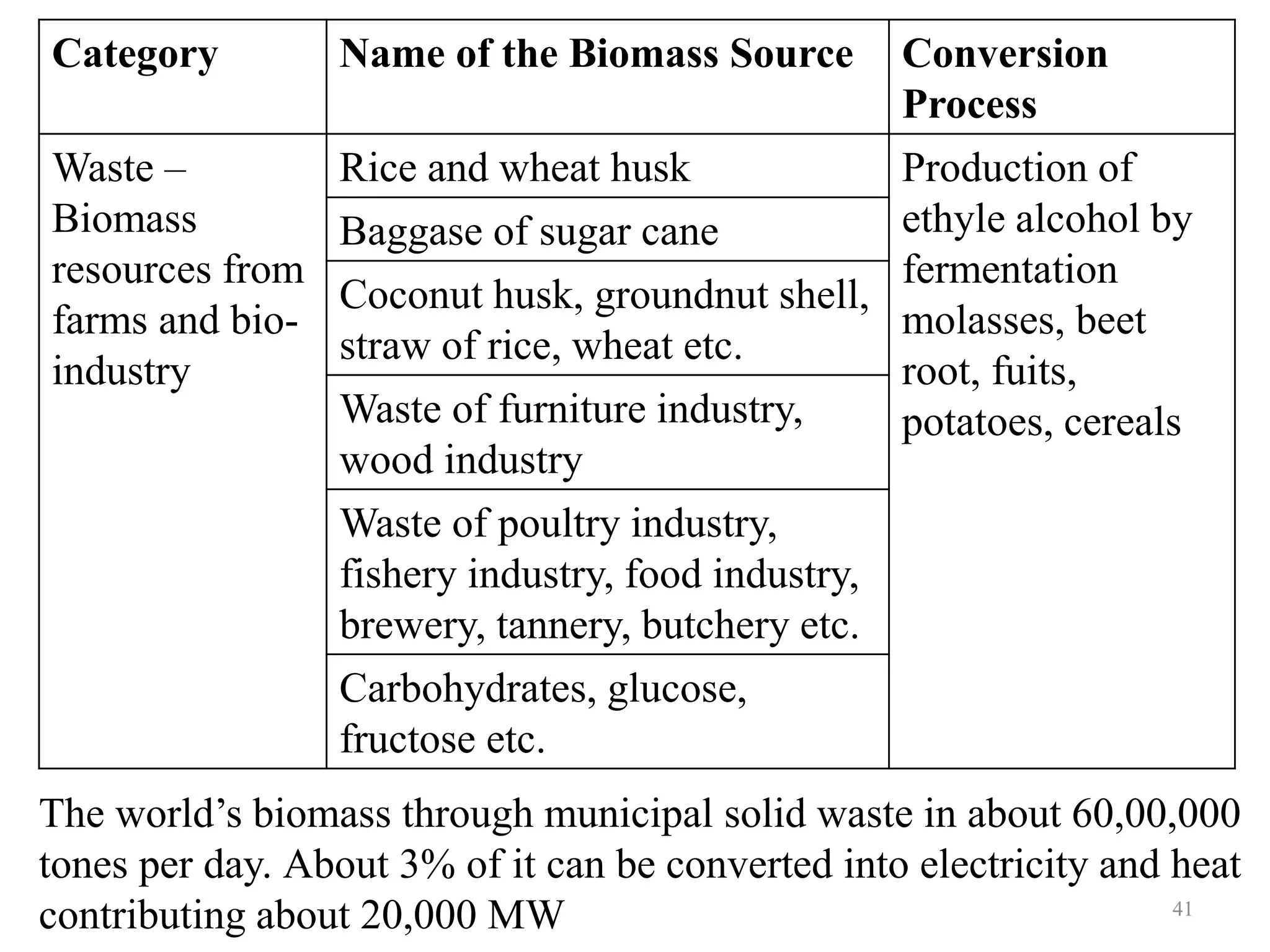
Category Name of the Biomass Source Conversion
Process
Waste –
Biomass
resources from
farms and bio-
industry
Rice and wheat husk Production of
ethyle alcohol by
fermentation
molasses, beet
root, fuits,
potatoes, cereals
Baggase of sugar cane
Coconut husk, groundnut shell,
straw of rice, wheat etc.
Waste of furniture industry,
wood industry
Waste of poultry industry,
fishery industry, food industry,
brewery, tannery, butchery etc.
Carbohydrates, glucose,
fructose etc.
The world’s biomass through municipal solid waste in about 60,00,000
tones per day. About 3% of it can be converted into electricity and heat
contributing about 20,000 MW 41

Biomass

  • 1.
    Energy systems andarchitecture ARC 5342 Dr.Arch. Nagham Ali Hasan Biomass 1st 0semester 2017-2018 1
  • 2.
    What is biomass?? •Biomass means "natural material." When biomass energy is burned, it releases heat • Biological renewable energy source from living or dead organisms (ex wood, waste, gas, and alcohol fuels). 6CO2 + 6H2O (CH2O)6 + 6O2 + 636 k Cal. (biomass) Sunligh tChlorophyll t 2
  • 3.
    • Energy isstored in the form of complex organic compounds of carbon, hydrogen, nitrogen, etc. • The biomass can be converted to useful energy forms such as: – Heat, Gaseous fuel, Solid fuels, Organic chemical, Liquid fuels 3
  • 4.
  • 5.
  • 6.
  • 7.
  • 8.
    8 Sugar Cane Bagasse ‫قصب‬‫تفل‬‫السكر‬ http://www.nrel.gov/biomass/photos.html
  • 9.
  • 10.
  • 11.
    11 Corn Stover ‫الذرة‬‫حطب‬ http://www.nrel.gov/biomass/photos.html
  • 12.
    12 Wood Chips &Sawdust http://www.nrel.gov/biomass/photos.html http://www.energytrust.org/RR/bio/
  • 13.
  • 14.
    14 Shows how biomasstakes up a lot of land
  • 15.
    How it Works 1.Thewaste wood, tree branches and other scraps are gathered together in big trucks. 2.The trucks bring the waste from factories and from farms to a biomass power plant. 3. Here the biomass is dumped into huge hoppers. 4.This is then fed into a furnace where it is burned. 5.The heat is used to boil water in the boiler, and the 6.energy in the steam is used to turn turbines and generators. It is very much like geothermal energy, but it recycles the plants waste, rather then tapping into the earth. 15
  • 16.
    we used toproduce energy from biomass are three main categories: Energy conversion technologies- o Combustion o Gasification o Pyrolysis 16 Creating Energy from Biomass: Truck unloading wood chips that will fuel the Tracy Biomass Plant, Tracy, California. http://www.eia.doe.gov/cneaf/solar.renewables/page/biomass/biomass.html Tracy Biomass Plant
  • 17.
    Primary energy conversiontechnologies  Combustion – ‫االحتراق‬ direct combustion of biomass is the most common way of converting biomass to energy - both heat and electricity. Compared to the gasification and pyrolysis it is the simplest and most developed.  Gasification - gasification is a high-temperature (1200-1400 Degree Celsius) thermo chemical conversion process but the process is used for production of gas, instead of heat.  Pyrolysis - thermal decomposition occurring in the absence of oxygen. We use pyrolysis to produce a liquid fuel, bio-oil or pyrolysis oil. 17
  • 18.
  • 19.
    19 Bioenergy Conversion Boyle, RenewableEnergy, Oxford University Press (2004) Thermal conversion Chemical conversion Biochemical conversion
  • 20.
    20 Biomass Direct Combustion Boyle,Renewable Energy, Oxford University Press (2004)
  • 21.
    21 Biomass Gasifier • 200tons of wood chips daily • Forest thinnings ‫;رقيق‬ wood pallets • Converted to gas at ~1000 ºC • Combined cycle gas turbine • 8MW power output McNeil Generating Station biomass gasifier – 8MW http://www.nrel.gov/biomass/photos.html
  • 22.
  • 23.
    23 Heat Energy Content Boyle,Renewable Energy, Oxford University Press (2004) 1 GJ (gigajoule) = 277.78 kWh (kilowatt hour)
  • 24.
  • 25.
    25 Landfill Gasses Boyle, RenewableEnergy, Oxford University Press (2004)
  • 26.
    There are twotypes of Biogas Plants 1. Fixed head 2. Floating head 26
  • 27.
    floating gas-holder typebio-gas plant 27
  • 28.
    Floating Dome TypeBiogas Plant (a) Position of dome with less gas in the dome. (b) Position of dome with more gas in the dome. 28
  • 29.
  • 30.
    BioFuels • Ethanol – Createdby fermentation of starches ‫النشويات‬ /sugars – US capacity of 1.8 billion gals/yr (2005) – Active research on cellulosic fermentation • Biodiesel – Organic oils combined with alcohols – Creates ethyl or methyl esters • SynGas Biofuels – Syngas (H2 & CO) converted to methanol, or liquid fuel similar to diesel 30 http://www.eere.energy.gov/RE/bio_fuels.html
  • 31.
    Biofuel Fossil fuel Bio-fuelis produced directly from plant matter typically corn, sugar cane, sugar beets, or cellulose transforming it into alcohol. Fossil fuels are produced by either the decomposition of plant or animal matter over long periods of time under certain conditions such as high temperature and pressure. Fossil fuels are coal, oil, and natural gas. 31
  • 32.
    Bioenergy Calculation 32 Composition Percent% kJ/kg Total Paper 7.73 16,750 1,295 Plastic 18.29 32,500 5,944 Food waste 26.56 4,650 1,235 Wood and yard 8.52 18,600 1,585 *Others 14.92 15,000 2,238 Ferrous 2.47 0 0 Aluminium 0.06 0 0 Glass 1.93 0 0 Sand/fine materials 14.41 0 0 Other inorganics 5.11 0 0 Total 100.00 12,297kJ/kg kJ --> kWh 0.000278 Throughput: 1800 tons/day Thermal Power : 256 MW/hour Electricity Efficiency : 7.5 % 5-10% for a "normal" design Nomimal power gen : 19.2 MWe/hour [460 MWh/day]
  • 33.
    BIO-MASS STORAGE METHODS Silagepiling 33 Euro bagging
  • 34.
    Algae biomass isan important renewable source of energy produced by photosynthesis. Algae ponds at Ashkelon, Israel Biomass from Water bodies 34
  • 35.
    Environmental Advantages • Biomass canmake electricity and heat – Can replace fossil fuels • More efficient than traditional rendering • Doesn’t contribute to global warming Disadvantages • Unstable – Raising of waste material – Contributes to global warming gases in the environment • Huge amount of animal killing – MORE MEAT to replace fuel 35 • Less demand on fossil fuel • Cheaper than fossil fuel • More environmentally friendly
  • 36.
    Political Advantages • Reduction ofdependency on imported oil – Countries don’t have to rely on foreign bio fuels • More jobs – 20X more jobs than coal and oil • Rural development and income opportunities • Can create good relationships if exported Disadvantages • Takes up too much energy and resources of country • Biomass collection is difficult and expensive – Politicians may argue whether it is worth the cost 36
  • 37.
    37 Graph showing howcheap biomass is
  • 38.
    38 • As thegraph illustrates biomass is expected to remain the second-largest source of renewable electricity generation (behind hydropower) through 2030. Of all the renewable energy sources, biomass is the fastest growing, going from 11% of the total in 2007, to more than 41% in 2030.
  • 39.
    Comparison of Fixedand Floating head Biogas plant Janta / Fixed dome type Floating Dome type Biogas Plant 1 Gas is released at variable pressure Gas is released at constant pressure 2 Identifying defects is difficult Identifying the defects in gas holder easy 3 Cost of maintenance is low Cost of maintenance is high 4 Capital cost is low (for some capacity) Capital cost is high 5 Space above the drum can be used Floating drum does not allow the use of space for other purpose 6 Temperature is high during winter Temperature is low during winter 7 Life span is comparatively longer Life is short 8 Requires move excavation work Requires relatively less excavation 39
  • 40.
    PRINCIPAL BIOMASS ENERGYRESOURCES AND CONVERSION PROCESS Category Name of the Biomass Source Conversion Process Cultivated Energy Resource Trees, (Wood chips, saw dusts) Burning to produce heat and electricity Aquatic crops, algae, green plants Producing biogas and biochemical Agricultural crops Production of gas and manure -Wood gasification Fruit farms Production of wood oil and charcoal. Wood to oil process 40
  • 41.
    Category Name ofthe Biomass Source Conversion Process Waste – Biomass resources from farms and bio- industry Rice and wheat husk Production of ethyle alcohol by fermentation molasses, beet root, fuits, potatoes, cereals Baggase of sugar cane Coconut husk, groundnut shell, straw of rice, wheat etc. Waste of furniture industry, wood industry Waste of poultry industry, fishery industry, food industry, brewery, tannery, butchery etc. Carbohydrates, glucose, fructose etc. The world’s biomass through municipal solid waste in about 60,00,000 tones per day. About 3% of it can be converted into electricity and heat contributing about 20,000 MW 41