This document discusses the history of the theory of biogenesis. It describes experiments by Redi, Needham, Spallanzani, and Pasteur that provided evidence against spontaneous generation and in favor of biogenesis, the idea that life only arises from preexisting life. Redi's experiments with flies and meat in jars showed that maggots only appeared in open jars where flies could lay eggs. Spallanzani and Pasteur's experiments boiling broth in sealed flasks found no new life developed, supporting biogenesis over abiogenesis. Pasteur's famous experiment using flasks with S-shaped necks conclusively demonstrated that microbes arise from other microbes, not from non-living matter.
• Biogenesis isthe formation (production) of new living
organisms or organelles.
• According to Louis Pasteur living things come only from other
living things, by means of reproduction.
• That is, life does not spontaneously arise from non-living
material.
Biogenesis:
3.
Francesco Redi (1668)
•In 1668, Francesco Redi, an Italian physician, did an
experiment with flies and wide-mouth jars containing
meat.
• He took rotting meat pieces in jars. He sealed some of
these jars tightly and other left open.
4.
• After fewdays maggots appeared in open jars in which the flies
went freely in and out and laid their eggs on meat.
• But in sealed jars in which the flies could not enter did not show
any maggots.
• Redi concluded that the maggots arise from the eggs laid down
by the parent flies and that the maggots can not appear
spontaneously.
5.
• Redi setup new experiment in which he covered jars with fine
muslin cloth of sealing them tightly and allow free air in out of the
jars.
• After some time maggots appeared only in some jars.
• Redi concluded that free air considered as vital force necessary for
spontaneous origin.
6.
John Needham
By 1745an English scientist used
microscopic observations to support
the theory of abiogenesis.
To test the theory he boiled meat broth
for several minutes in a loosely sealed
flask. ( allow to cool down the flask)
Immediately after boiling he saw under
the microscope that the broth had no
living things.
.
7.
• After afew days he examined the flask and found
microorganism.
• He concluded that the organisms originated
spontaneously form the nutrient fluids.
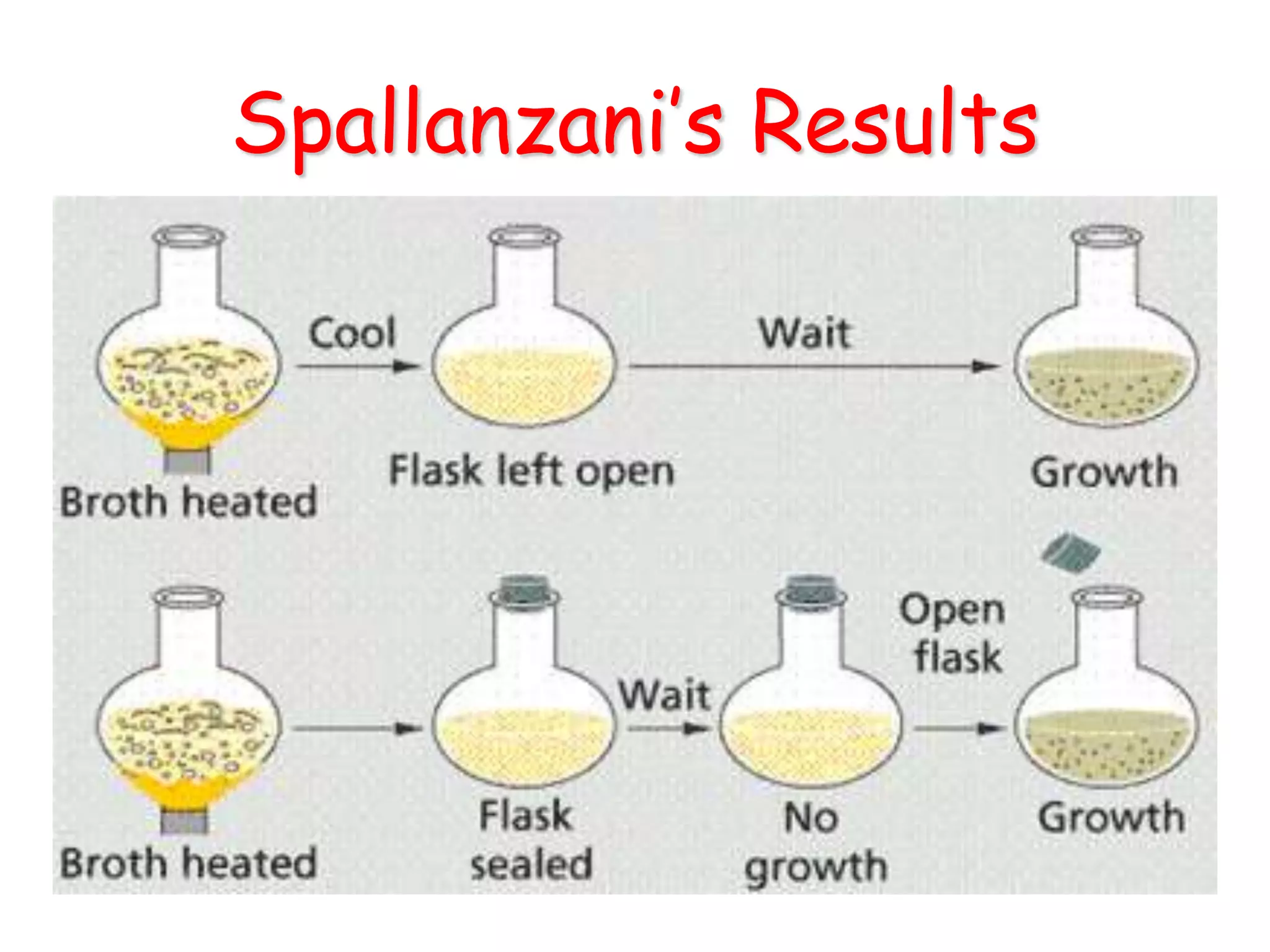
Lazzaro Spallanzani (1765)
•Boiled soups for almost an hour and
sealed containers by melting the slender
necks closed.
• The soups remained clear.
• Later, he broke the seals & the soups
became cloudy with microbes.
Conclusion
• Critics saidsealed vials did not allow enough air for
organisms to survive and that prolonged heating
destroyed “vital force”.
• “Vital force” needed to life to form.
• Therefore, spontaneous generation remained the
theory of the time
Pasteur's Experiment
• Hypothesis:Microbes come from
cells of organisms on dust particles
in the air; not the air itself.
• Pasteur put broth into several
special S-shaped flasks
• Each flask was boiled and placed
at various locations
15.
Pasteur's Experiment -Step 1
• S-shaped Flask
• Filled with broth
• The special shaped was
• intended to trap any dust
particles containing
• bacteria
Pasteur's Experiment -
Step3
• Flask left at various locations
• Did not turn cloudy
• Microbes not found
• Notice the dust that collected in
the neck of the flask
The Theory ofBiogenesis
1864
• Pasteur’s S-shaped flask kept
microbes out but let air in.
• Proved microbes only come from other
microbes (life from life) – biogenesis
Life come from life
Evidence Pro andCon
• 1668: Francisco Redi filled six jars
with decaying meat.
Conditions: Results:
3 jars covered with fine net - No maggots
3 open jars - Maggots appeared
From where did the maggots come?
What was the purpose of the sealed jars?
Spontaneous generation or biogenesis?
22.
Evidence Pro andCon
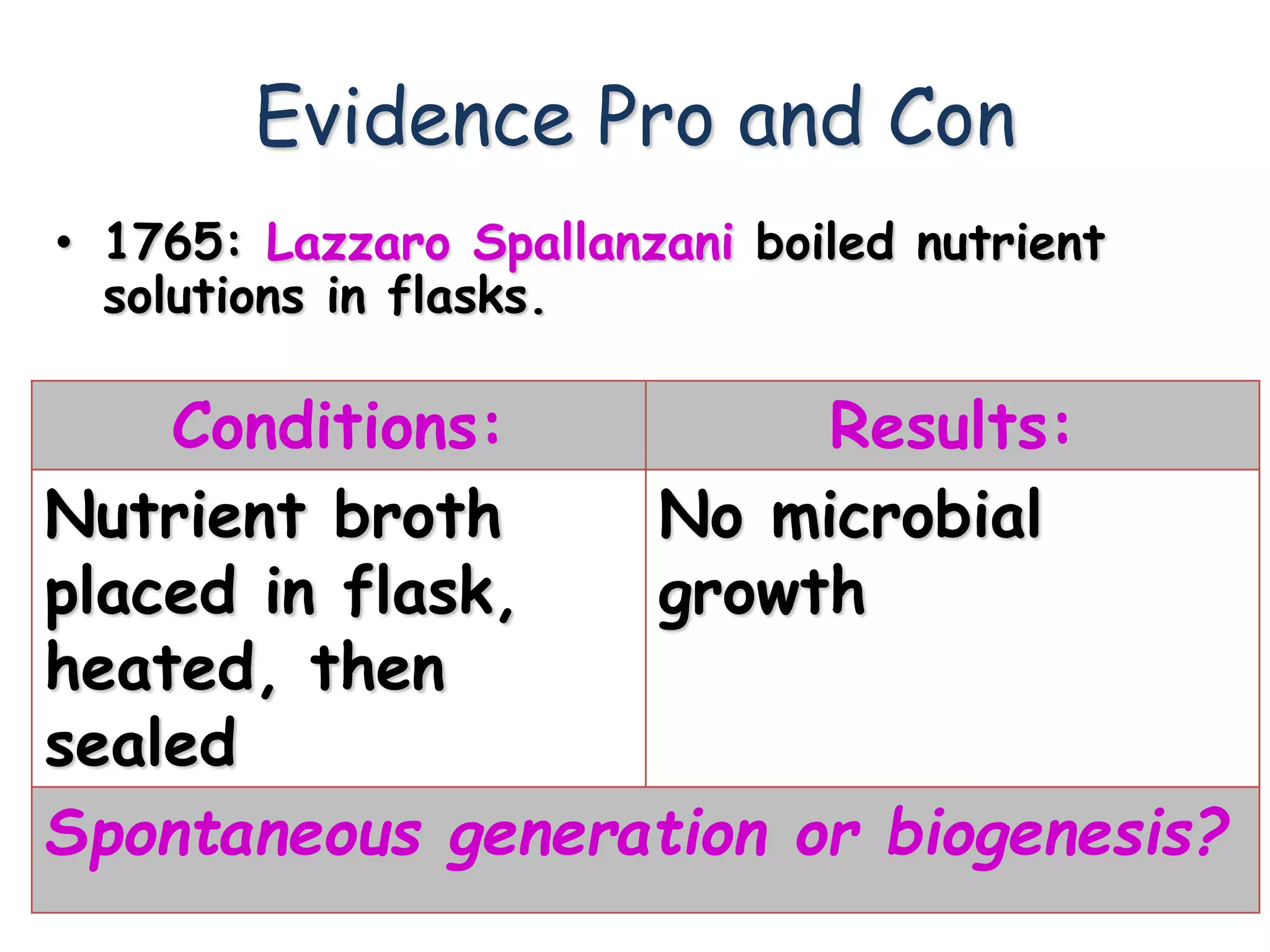
• 1765: Lazzaro Spallanzani boiled nutrient
solutions in flasks.
Conditions: Results:
Nutrient broth
placed in flask,
heated, then
sealed
No microbial
growth
Spontaneous generation or biogenesis?
23.
Evidence Pro andCon
• 1861: Louis Pasteur demonstrated
that microorganisms are present in
the air.
Conditions: Results:
Nutrient broth placed
in flask, heated, neck
broken
Microbial growth
Nutrient broth placed
in flask, heated, then
neck not broken.
No microbial growth
Spontaneous generation or biogenesis?