CONTRIBUTION OF
LEEUWENHOEK, LOUIS
PASTEUR, ROBERT KOCH,
JOSEPH LISTER,
ALEXANDER FLEMING,
EDWARD JENNER IN
SCIENCE. Toufeeq Mallick
ANTONIE VAN LEEUWENHOEK
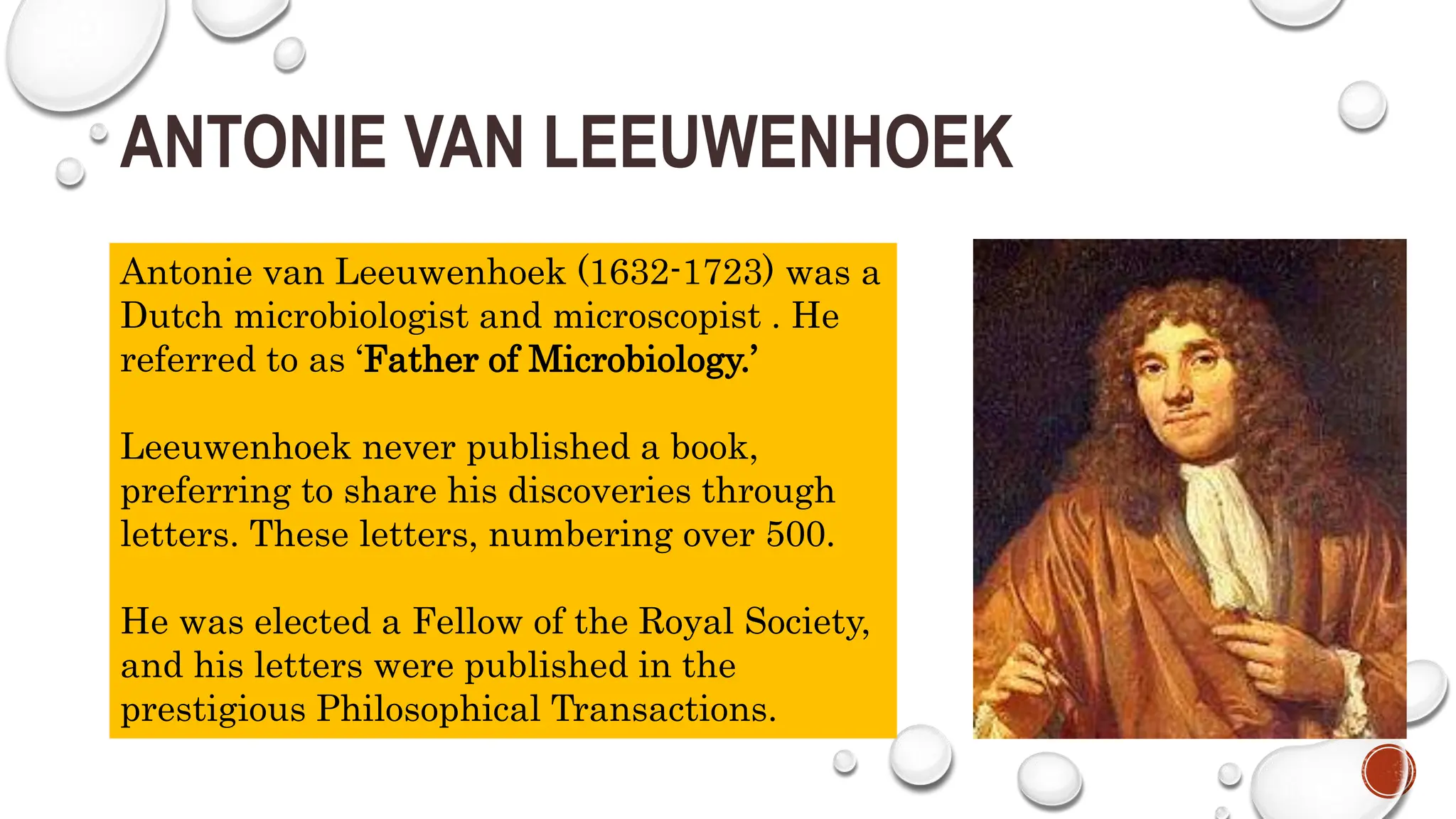
Antonie van Leeuwenhoek (1632-1723) was a
Dutch microbiologist and microscopist . He
referred to as ‘Father of Microbiology.’
Leeuwenhoek never published a book,
preferring to share his discoveries through
letters. These letters, numbering over 500.
He was elected a Fellow of the Royal Society,
and his letters were published in the
prestigious Philosophical Transactions.
CONTRIBUTION IN
SCIENCE
 First observation of bacteria:- He was the first person who observes
microorganisms in 1673 by his self made microscope.
 Discovery of Protozoa:- He discovered and describe Protozoa like
amoebas, paramecia
 Observation of blood cells and sperms:- He observed blood cells
including RBCs . He also identified sperm cells of various animals.
 Development of microscopy:- He created 100 of single lens microscope
upto 275x enabling to see the unseen world.
LOUIS PASTEUR
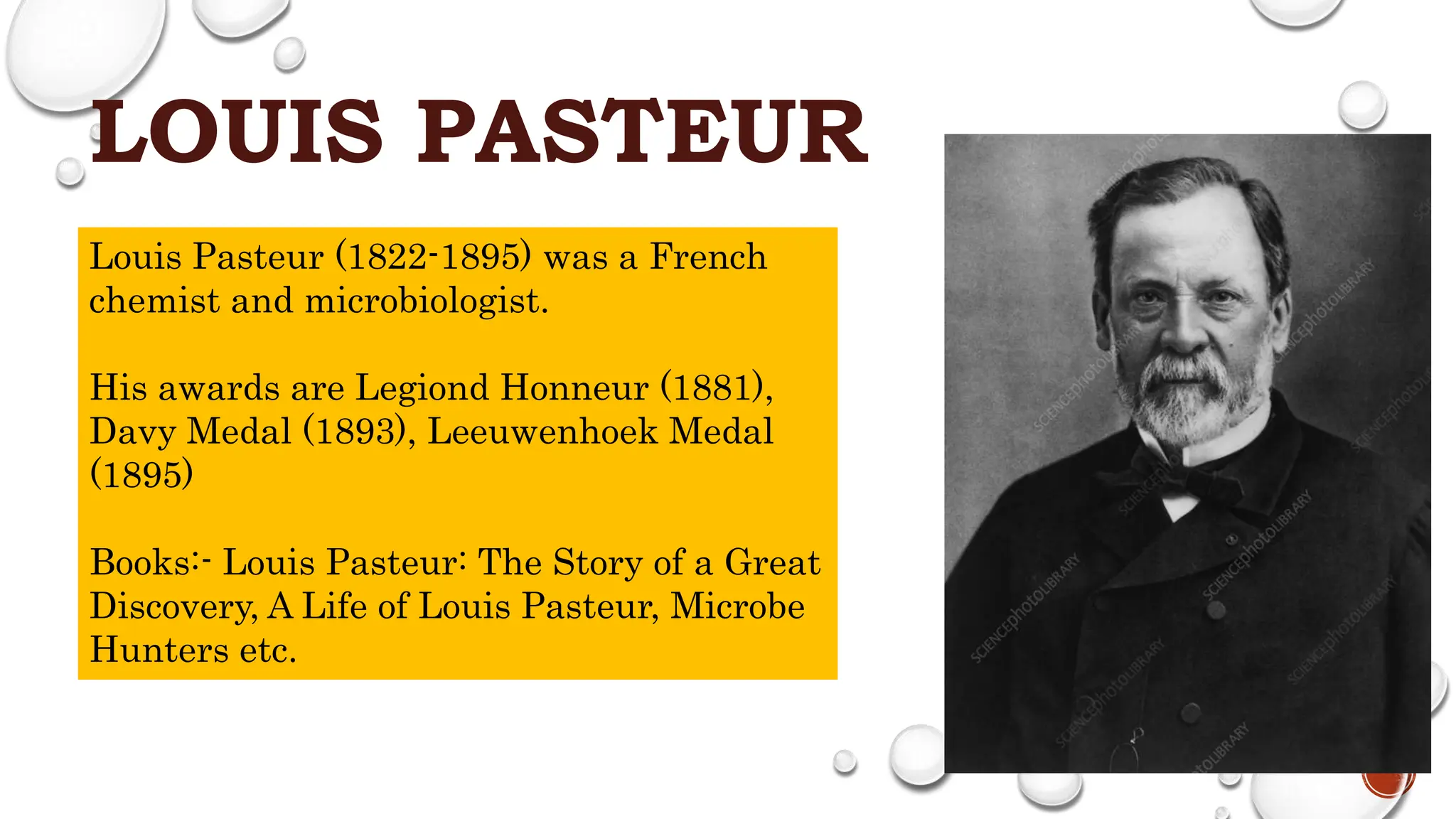
Louis Pasteur (1822-1895) was a French
chemist and microbiologist.
His awards are Legiond Honneur (1881),
Davy Medal (1893), Leeuwenhoek Medal
(1895)
Books:- Louis Pasteur: The Story of a Great
Discovery, A Life of Louis Pasteur, Microbe
Hunters etc.
CONTRIBUTION IN
SCIENCE
 Germ theory of disease:- He challenged the prevailing idea of
Spontaneous generation and proved that microorganisms causes
disease.
 Pasteurization:- Heats liquids to kill harmful bacteria. It improved
food safety and impacting industries.
 Vaccination:- He developed the first vaccine against several diseases
including chicken cholera, anthrax etc.
 Skillworm disease:- He identified the causes of disease and methods to
prevent the disease.
HEINRICH HERMANN
ROBERT KOCH
Heinrich Hermann Robert Koch (1843-1910) was
a German physician and microbiologist.
‘Father of Bacteriology’
Including Nobel Prize in Physiology or Medicine
(1905), Pour le Merite for Science and Art (1906),
Knight Grand Cross in the Prussian Order of the
Red Eagle (1890).
He also became the Foreign Member of Royal
Society .
CONTRIBUTION IN
SCIENCE
 Anthrax (1876):- He identified the bacterium Bacillus anthracis as the
causative agent of anthrax.
 Tuberculosis(1882):- He isolated Mycobacterium tuberculosis
bacterium, establishing it’s role in causing the widespread deadly
tuberculosis.
 Cholera(1883):- During an outbreak in Egypt he identified Vibrio
cholerae .
 Koch’s postulates:- He established a set of criteria to definitively link
to a specific microorganisms to a disease.
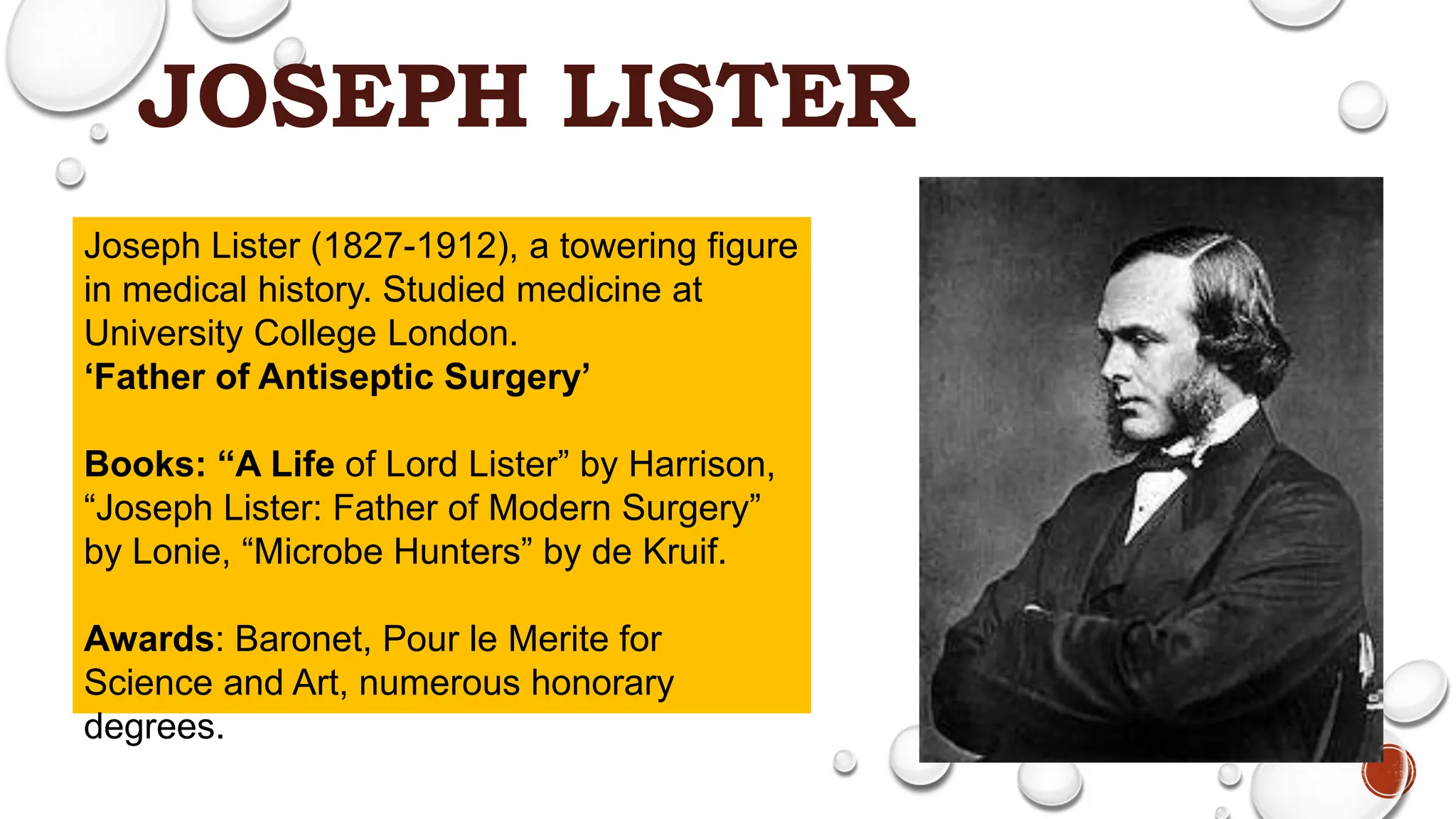
JOSEPH LISTER
Joseph Lister (1827-1912), a towering figure
in medical history. Studied medicine at
University College London.
‘Father of Antiseptic Surgery’
Books: “A Life of Lord Lister” by Harrison,
“Joseph Lister: Father of Modern Surgery”
by Lonie, “Microbe Hunters” by de Kruif.
Awards: Baronet, Pour le Merite for
Science and Art, numerous honorary
degrees.
CONTRIBUTION IN
SCIENCE
 Pioneered the use of antiseptics in surgery:- Inspired by Louis Pasteur’s
germ theory , facilities entified carbolic acid (phenol) as an effective
antiseptic and implemented a rigorous system of sterile practices in the
operating room.
 Development of sterile surgical techniques :- Lister’s antiseptic system
involved not just carbolic acid but also a comprehensive set of practices like
handwashing, instrument sterilization, and gowning.
 Identification of the importance of hygiene in healthcare:- This led to the
adoption of stricter sanitation practices in hospitals and healthcare facilities.
 Paving the way for modern surgery.
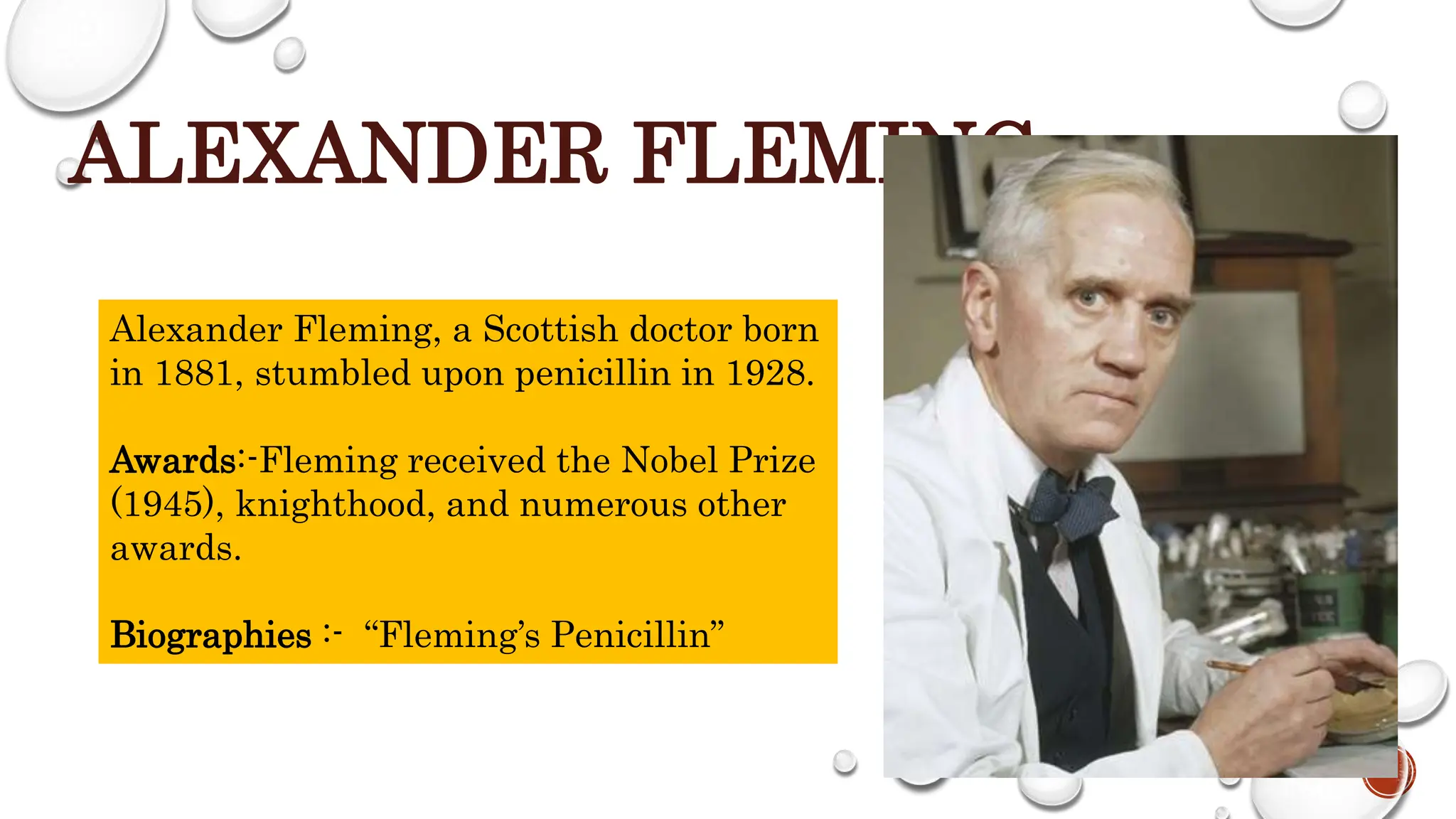
ALEXANDER FLEMING
Alexander Fleming, a Scottish doctor born
in 1881, stumbled upon penicillin in 1928.
Awards:-Fleming received the Nobel Prize
(1945), knighthood, and numerous other
awards.
Biographies :- “Fleming’s Penicillin”
CONTRIBUTION IN
SCIENCE
Unleashing the Antibiotic Era:- In 1928, his observation of
mold inhibiting bacterial growth led to penicillin,
revolutionizing treatment of infections.
Pioneering Research on Lysozyme:- He identified this
natural antibacterial enzyme,
Developing Innovative Techniques:- His work on identifying
different staphylococcal strains improved bacterial
differentiation.
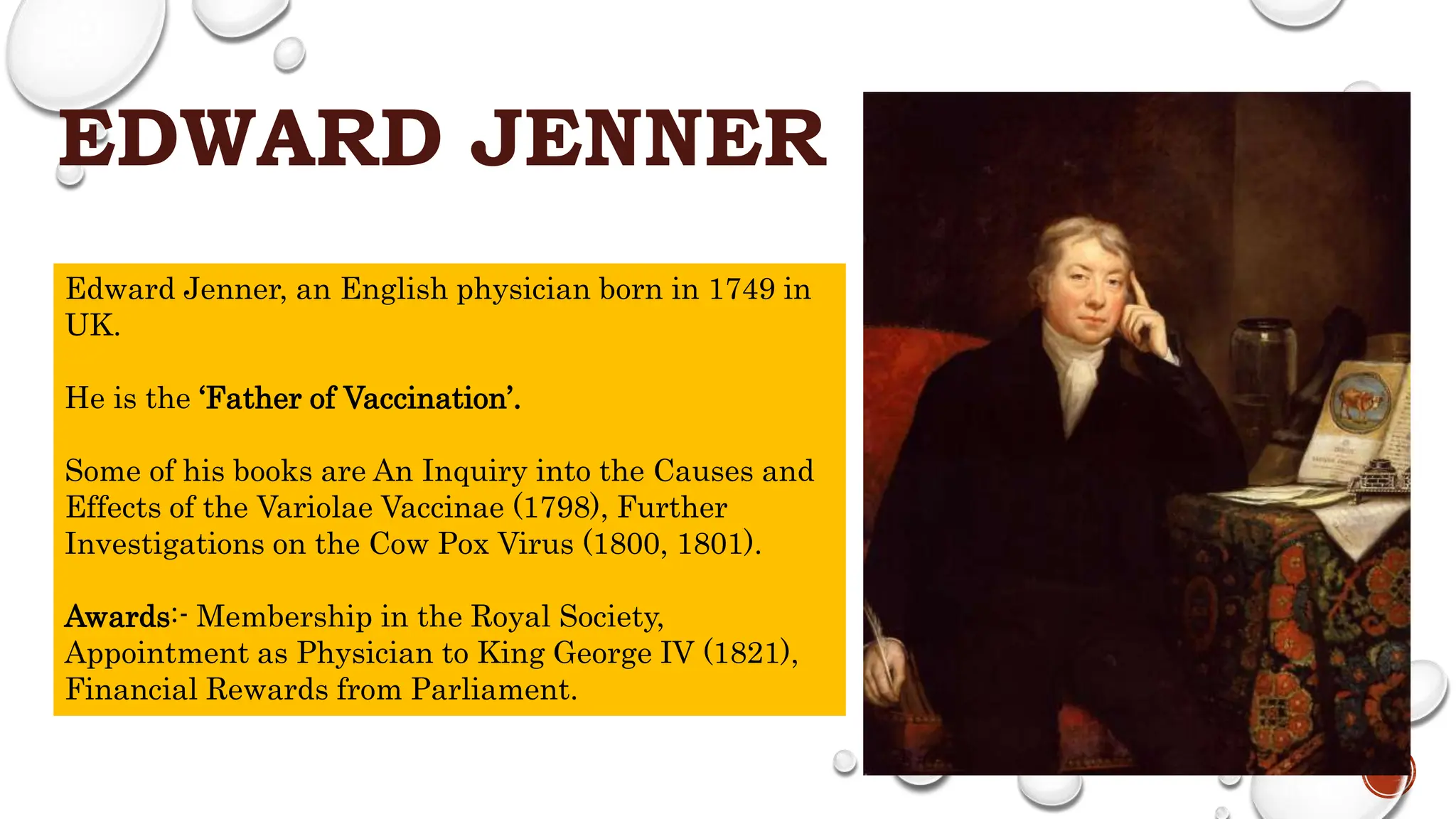
EDWARD JENNER
Edward Jenner, an English physician born in 1749 in
UK.
He is the ‘Father of Vaccination’.
Some of his books are An Inquiry into the Causes and
Effects of the Variolae Vaccinae (1798), Further
Investigations on the Cow Pox Virus (1800, 1801).
Awards:- Membership in the Royal Society,
Appointment as Physician to King George IV (1821),
Financial Rewards from Parliament.
CONTRIBUTION IN
SCIENCE
 Developing the smallpox vaccine:- He took the audacious step of
inoculating an eight-year-old boy with cowpox matter, successfully
demonstrating that it provided protection against smallpox.
 Introducing the term “vaccine”:- Jenner derived the term “vaccine”
from the Latin word “vacca,” meaning cow, in reference to the cowpox
virus used in his initial experiment.
 Paving the way for immunology:- Jenner’s work laid the groundwork
for the development of the science of immunology,
Contribution of Leeuwenhoek, Louis Pasteur, Robert Koch, Joseph Lister, Alexander Fleming, Edward Jenner in science..pptx

Contribution of Leeuwenhoek, Louis Pasteur, Robert Koch, Joseph Lister, Alexander Fleming, Edward Jenner in science..pptx

  • 1.
    CONTRIBUTION OF LEEUWENHOEK, LOUIS PASTEUR,ROBERT KOCH, JOSEPH LISTER, ALEXANDER FLEMING, EDWARD JENNER IN SCIENCE. Toufeeq Mallick
  • 2.
    ANTONIE VAN LEEUWENHOEK Antonievan Leeuwenhoek (1632-1723) was a Dutch microbiologist and microscopist . He referred to as ‘Father of Microbiology.’ Leeuwenhoek never published a book, preferring to share his discoveries through letters. These letters, numbering over 500. He was elected a Fellow of the Royal Society, and his letters were published in the prestigious Philosophical Transactions.
  • 3.
    CONTRIBUTION IN SCIENCE  Firstobservation of bacteria:- He was the first person who observes microorganisms in 1673 by his self made microscope.  Discovery of Protozoa:- He discovered and describe Protozoa like amoebas, paramecia  Observation of blood cells and sperms:- He observed blood cells including RBCs . He also identified sperm cells of various animals.  Development of microscopy:- He created 100 of single lens microscope upto 275x enabling to see the unseen world.
  • 4.
    LOUIS PASTEUR Louis Pasteur(1822-1895) was a French chemist and microbiologist. His awards are Legiond Honneur (1881), Davy Medal (1893), Leeuwenhoek Medal (1895) Books:- Louis Pasteur: The Story of a Great Discovery, A Life of Louis Pasteur, Microbe Hunters etc.
  • 5.
    CONTRIBUTION IN SCIENCE  Germtheory of disease:- He challenged the prevailing idea of Spontaneous generation and proved that microorganisms causes disease.  Pasteurization:- Heats liquids to kill harmful bacteria. It improved food safety and impacting industries.  Vaccination:- He developed the first vaccine against several diseases including chicken cholera, anthrax etc.  Skillworm disease:- He identified the causes of disease and methods to prevent the disease.
  • 6.
    HEINRICH HERMANN ROBERT KOCH HeinrichHermann Robert Koch (1843-1910) was a German physician and microbiologist. ‘Father of Bacteriology’ Including Nobel Prize in Physiology or Medicine (1905), Pour le Merite for Science and Art (1906), Knight Grand Cross in the Prussian Order of the Red Eagle (1890). He also became the Foreign Member of Royal Society .
  • 7.
    CONTRIBUTION IN SCIENCE  Anthrax(1876):- He identified the bacterium Bacillus anthracis as the causative agent of anthrax.  Tuberculosis(1882):- He isolated Mycobacterium tuberculosis bacterium, establishing it’s role in causing the widespread deadly tuberculosis.  Cholera(1883):- During an outbreak in Egypt he identified Vibrio cholerae .  Koch’s postulates:- He established a set of criteria to definitively link to a specific microorganisms to a disease.
  • 8.
    JOSEPH LISTER Joseph Lister(1827-1912), a towering figure in medical history. Studied medicine at University College London. ‘Father of Antiseptic Surgery’ Books: “A Life of Lord Lister” by Harrison, “Joseph Lister: Father of Modern Surgery” by Lonie, “Microbe Hunters” by de Kruif. Awards: Baronet, Pour le Merite for Science and Art, numerous honorary degrees.
  • 9.
    CONTRIBUTION IN SCIENCE  Pioneeredthe use of antiseptics in surgery:- Inspired by Louis Pasteur’s germ theory , facilities entified carbolic acid (phenol) as an effective antiseptic and implemented a rigorous system of sterile practices in the operating room.  Development of sterile surgical techniques :- Lister’s antiseptic system involved not just carbolic acid but also a comprehensive set of practices like handwashing, instrument sterilization, and gowning.  Identification of the importance of hygiene in healthcare:- This led to the adoption of stricter sanitation practices in hospitals and healthcare facilities.  Paving the way for modern surgery.  Paving the way for modern surgery.
  • 10.
    ALEXANDER FLEMING Alexander Fleming,a Scottish doctor born in 1881, stumbled upon penicillin in 1928. Awards:-Fleming received the Nobel Prize (1945), knighthood, and numerous other awards. Biographies :- “Fleming’s Penicillin”
  • 11.
    CONTRIBUTION IN SCIENCE Unleashing theAntibiotic Era:- In 1928, his observation of mold inhibiting bacterial growth led to penicillin, revolutionizing treatment of infections. Pioneering Research on Lysozyme:- He identified this natural antibacterial enzyme, Developing Innovative Techniques:- His work on identifying different staphylococcal strains improved bacterial differentiation.
  • 12.
    EDWARD JENNER Edward Jenner,an English physician born in 1749 in UK. He is the ‘Father of Vaccination’. Some of his books are An Inquiry into the Causes and Effects of the Variolae Vaccinae (1798), Further Investigations on the Cow Pox Virus (1800, 1801). Awards:- Membership in the Royal Society, Appointment as Physician to King George IV (1821), Financial Rewards from Parliament.
  • 13.
    CONTRIBUTION IN SCIENCE  Developingthe smallpox vaccine:- He took the audacious step of inoculating an eight-year-old boy with cowpox matter, successfully demonstrating that it provided protection against smallpox.  Introducing the term “vaccine”:- Jenner derived the term “vaccine” from the Latin word “vacca,” meaning cow, in reference to the cowpox virus used in his initial experiment.  Paving the way for immunology:- Jenner’s work laid the groundwork for the development of the science of immunology,