Spontaneous
generation
Learning competency
✗ explain the postulates of the cell
theory.
2
Arrange the jumbled words into meaningful words
3
1. ONEOUNTSPAS
2. CLEL
3. CLEL TEROHY
4. LNVINNOIG
5. IONSGABEEIS
6. PUNEMA
7. MOAGGTS
8. CMIOROCSPE
9. NCLEUUS
10. ESTXNIIG
Arrange the jumbled words into meaningful words
4
1. SPONTANEOUS
2. CELL
3. CELL THEORY
4. NONLIVING
5. ABIOGENESIS
6. PNEUMA
7. MAGGOTS
8. MICROSCOPE
9. NUCLEUS
10. EXISTING
!
A. Where does life come from?
B. In the past, what is the
people’s understanding about cell?
SPONATEOUS GENERATION
6
✗ For much of history, people believed that animals could
come from non-living sources. They thought:
✗ Frogs developed from falling drops of rain
✗ mice arose from sweaty underwear
✗ and flies arose from decaying meat.
✗ This is called abiogenesis
✗ Also known as spontaneous generation
SPONATEOUS GENERATION
7
Before 1860s many scientists believed in
Spontaneous generation, i.e.: That living
organisms could arise spontaneously from
nonliving matter:
✗ Mice come from rags in a basket.
✗ Maggots come from rotting meat.
✗ Ants come from honey.
✗ Microbes come from spoiled broth.
SPONATEOUS GENERATION
8
✗ In the past, people
believed what they were
told by “authorities” such
as the Church, or the
ancient Greek philosopher
Aristotle
✗ Questioning Aristotle was
like questioning the
Church..
SPONATEOUS GENERATION
9
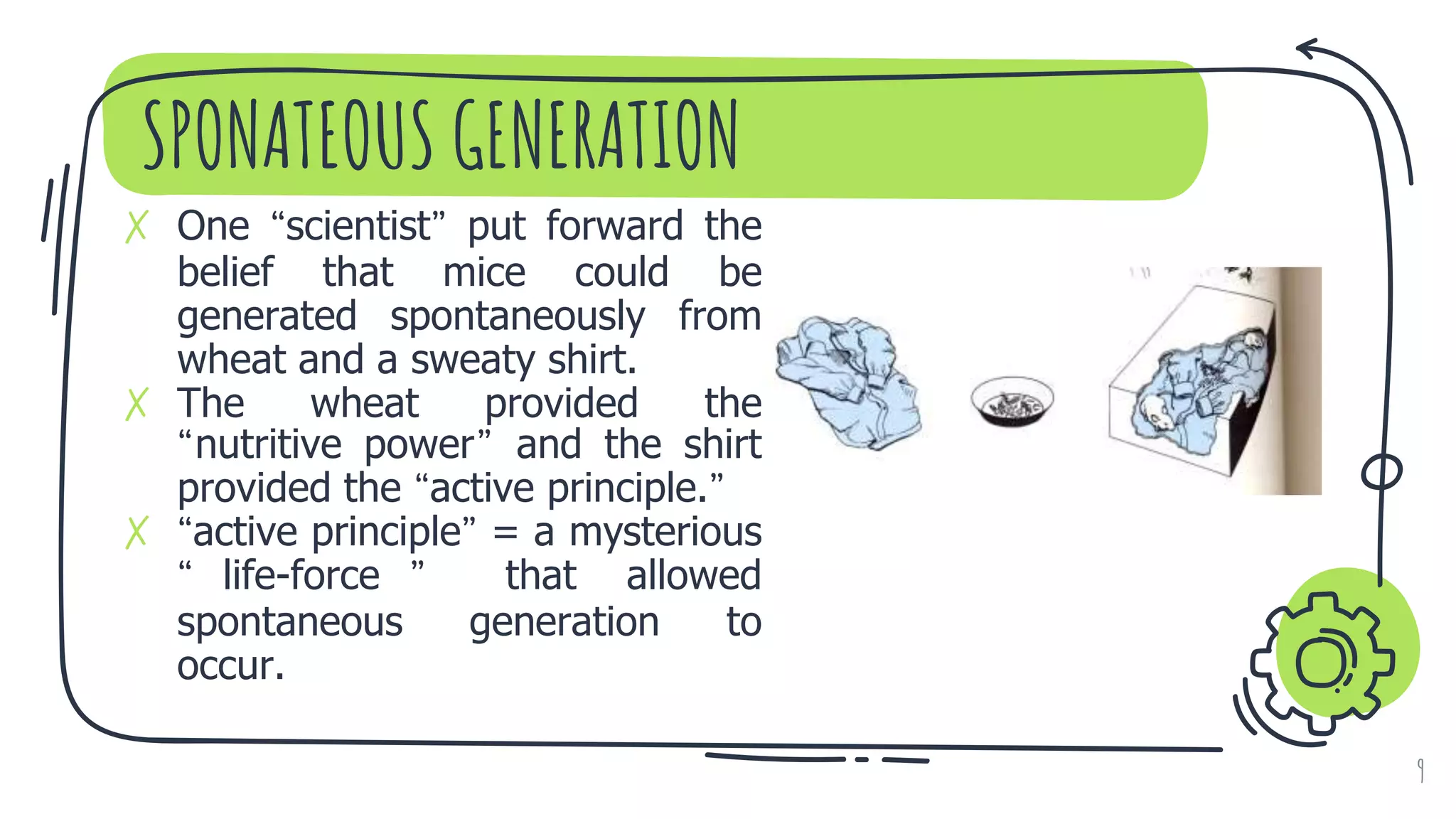
✗ One “scientist” put forward the
belief that mice could be
generated spontaneously from
wheat and a sweaty shirt.
✗ The wheat provided the
“nutritive power” and the shirt
provided the “active principle.”
✗ “active principle” = a mysterious
“ life-force ” that allowed
spontaneous generation to
occur.
SPONATEOUS GENERATION
10
The first serious attack on the idea of
spontaneous generation was made in 1668
by Francesco Redi, an Italian physician and
poet.
SPONATEOUS GENERATION
11
At that time, it was widely held that maggots
arose spontaneously in rotting meat. Redi
believed that maggots developed from eggs
laid by flies.
SPONATEOUS GENERATION
12
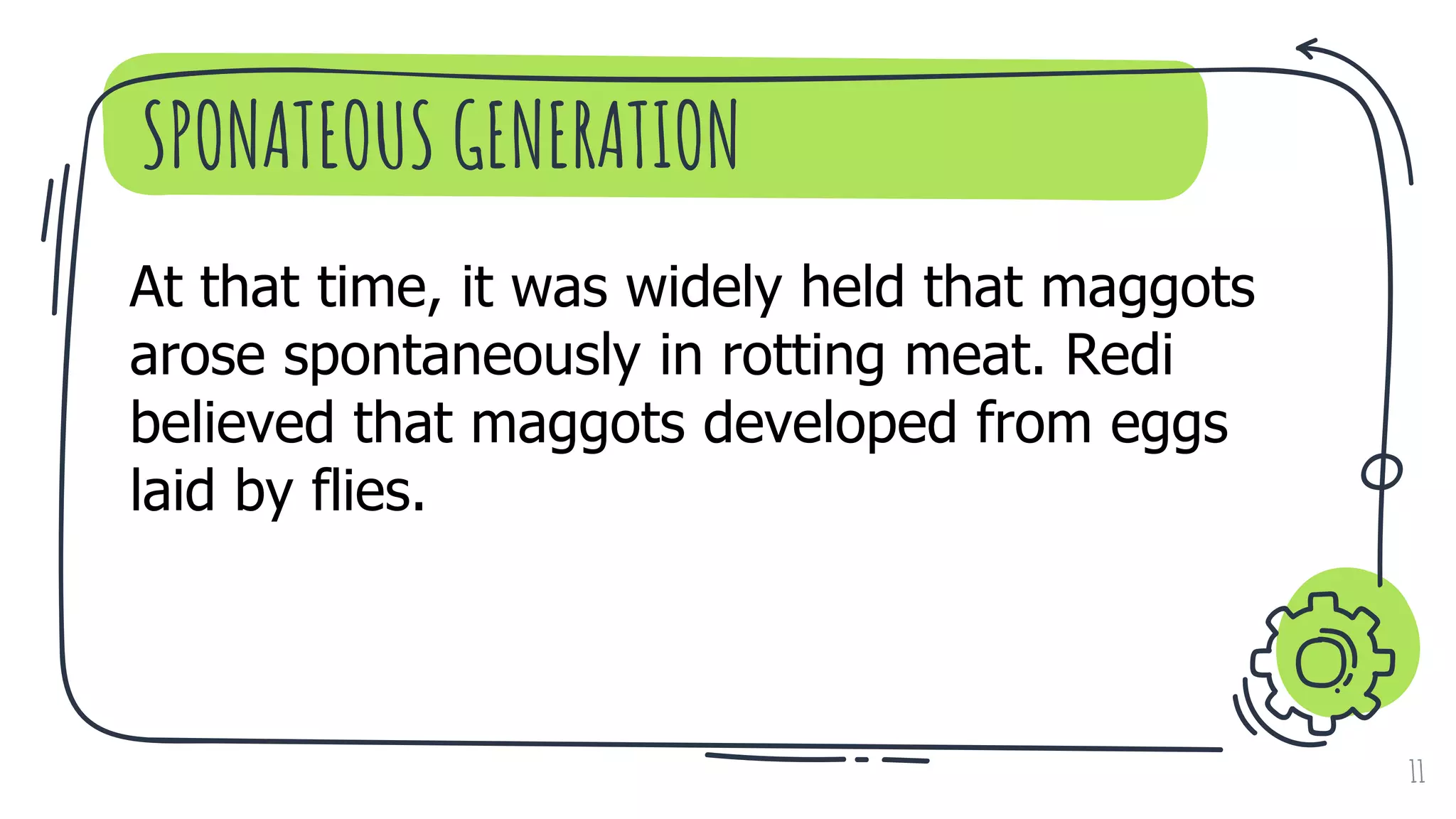
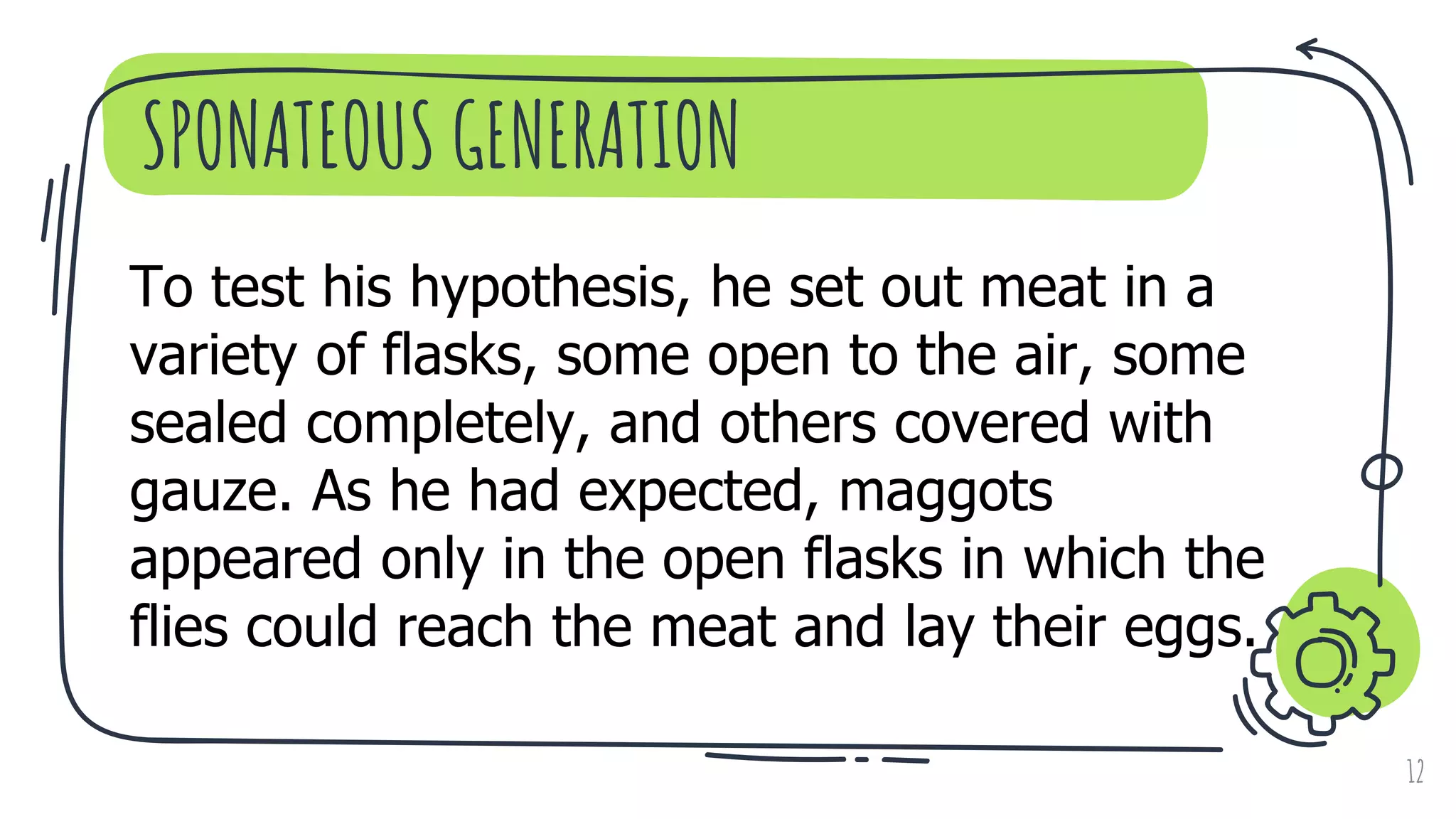
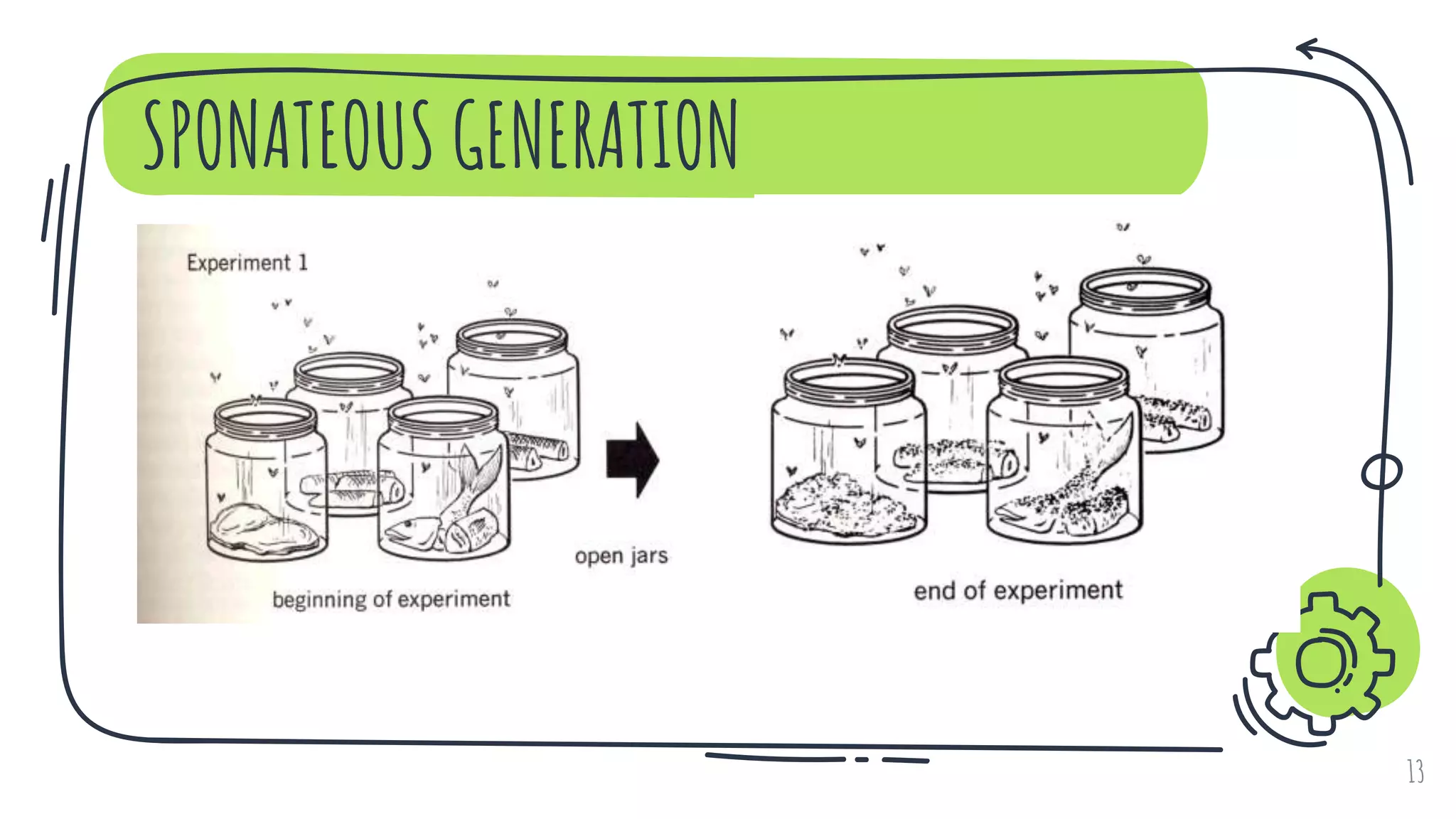
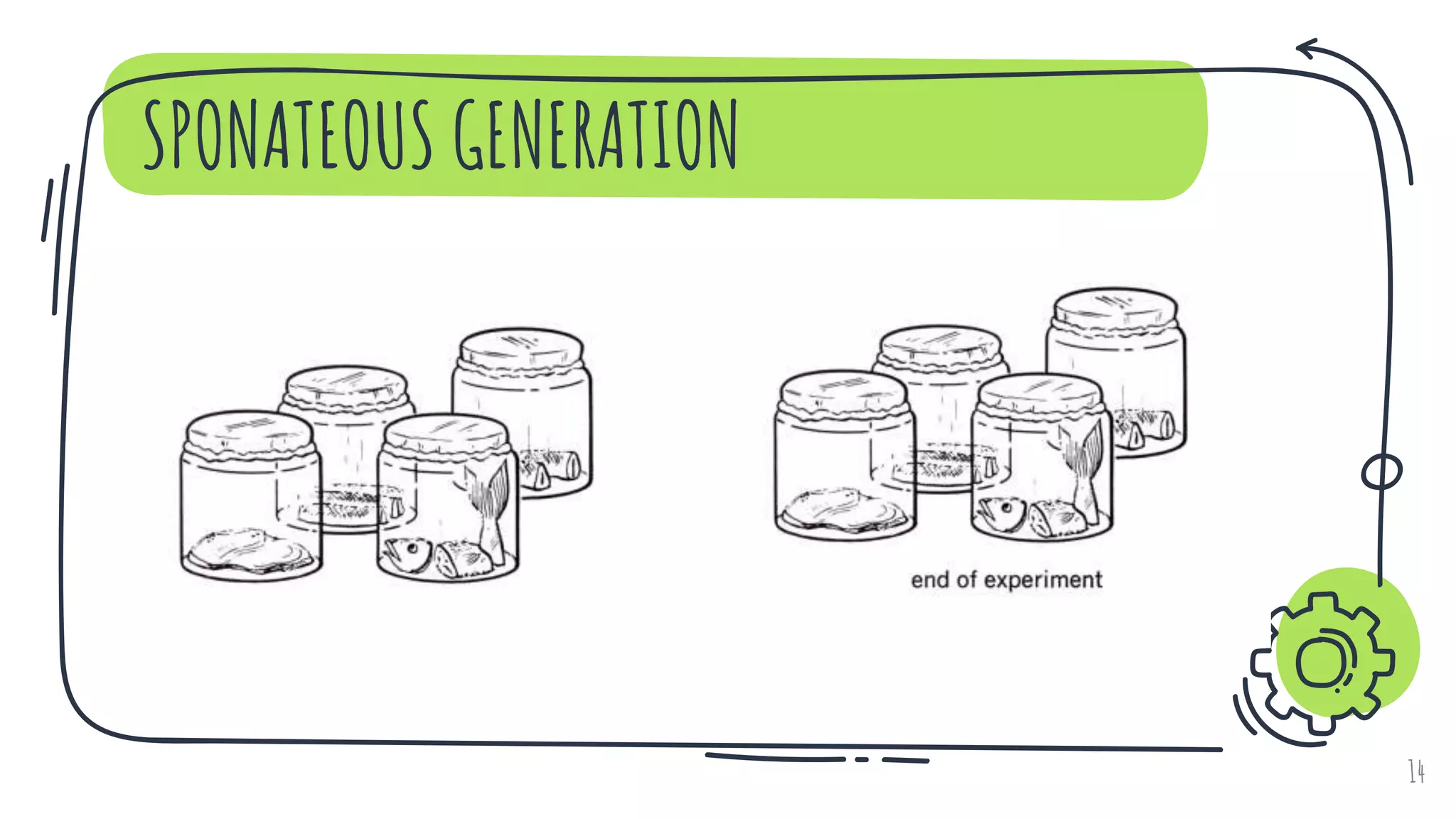
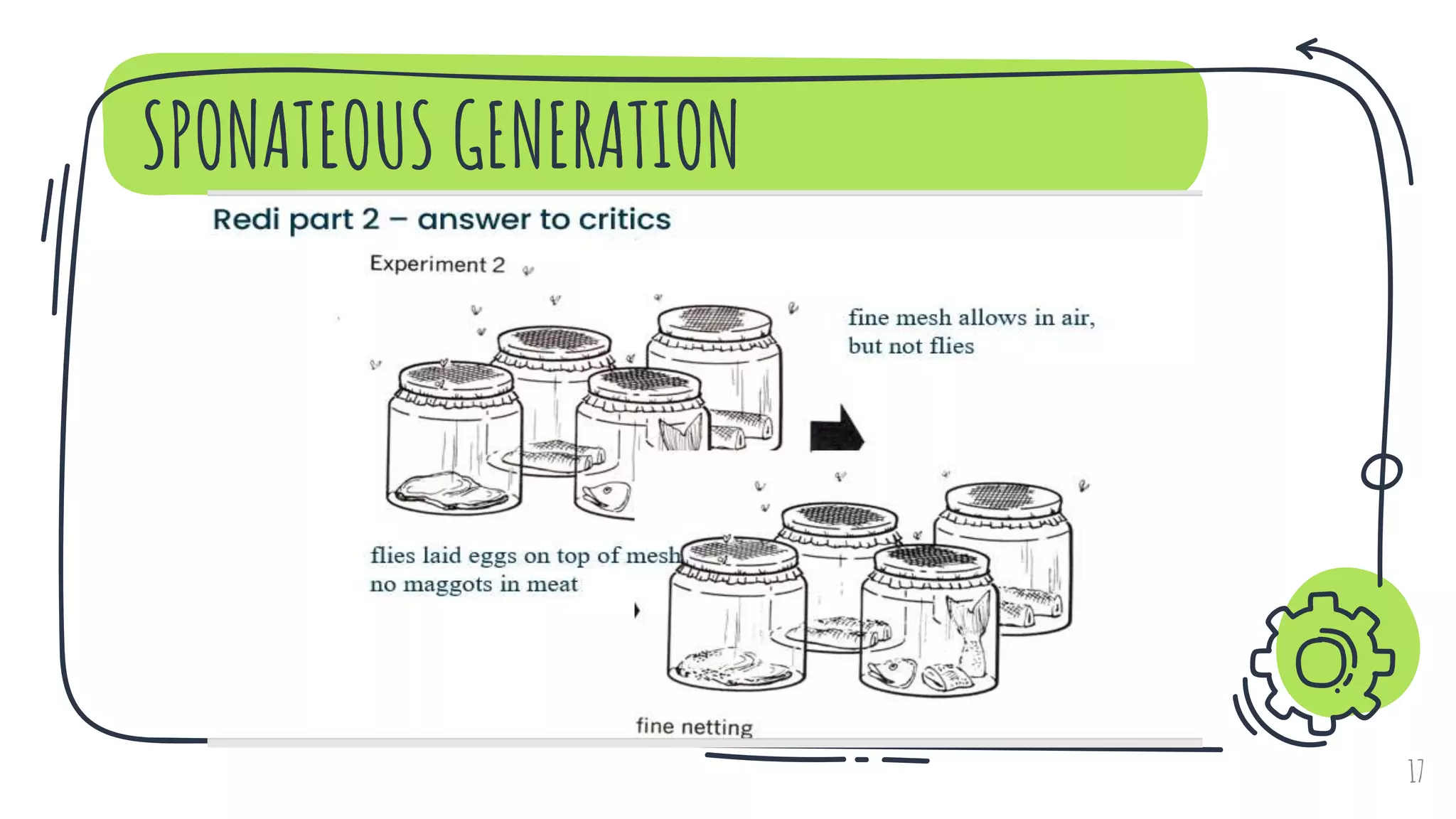
To test his hypothesis, he set out meat in a
variety of flasks, some open to the air, some
sealed completely, and others covered with
gauze. As he had expected, maggots
appeared only in the open flasks in which the
flies could reach the meat and lay their eggs.
SPONATEOUS GENERATION
13
SPONATEOUS GENERATION
14
SPONATEOUS GENERATION
15
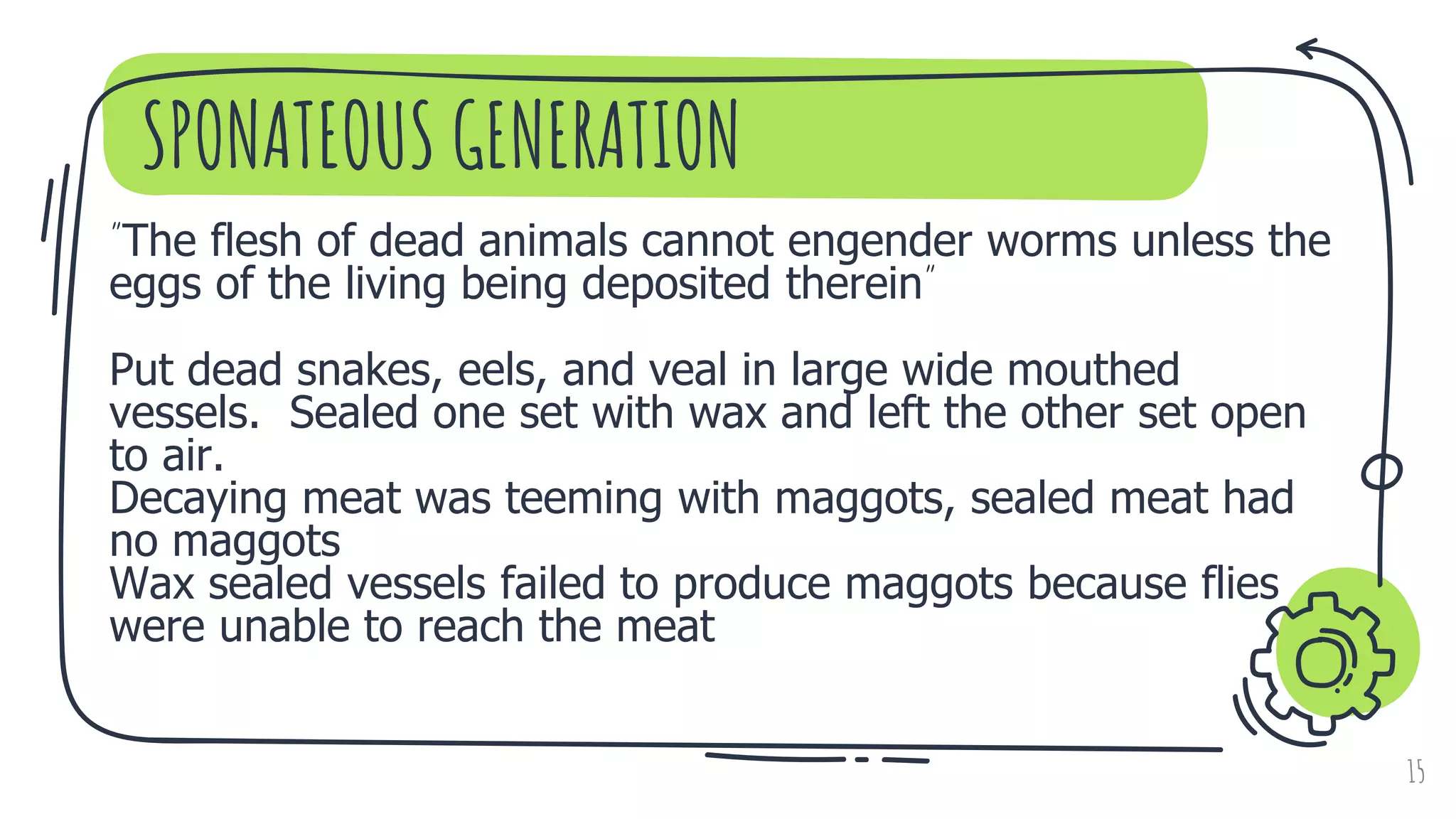
“The flesh of dead animals cannot engender worms unless the
eggs of the living being deposited therein”
Put dead snakes, eels, and veal in large wide mouthed
vessels. Sealed one set with wax and left the other set open
to air.
Decaying meat was teeming with maggots, sealed meat had
no maggots
Wax sealed vessels failed to produce maggots because flies
were unable to reach the meat
SPONATEOUS GENERATION
16
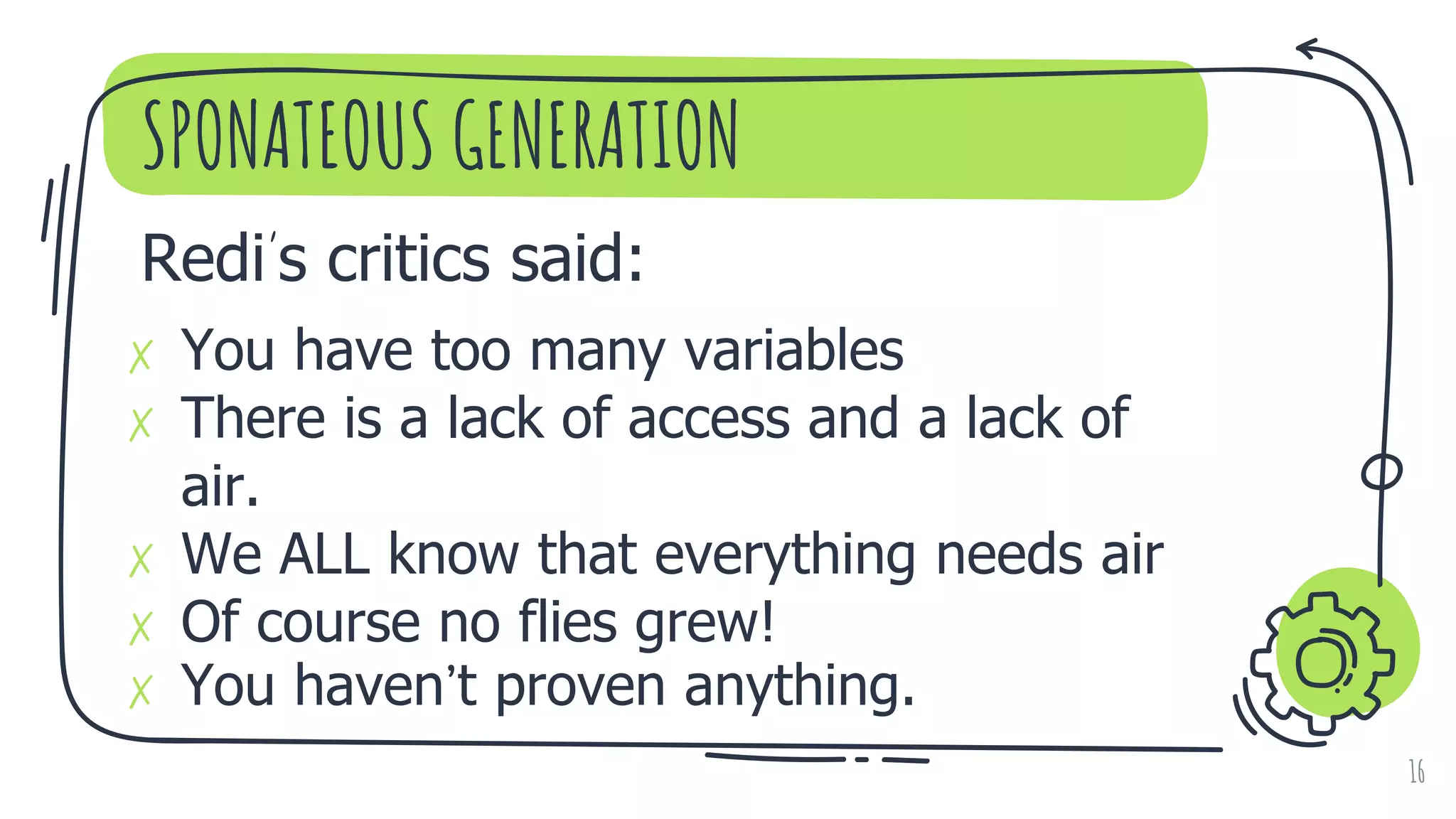
Redi’s critics said:
✗ You have too many variables
✗ There is a lack of access and a lack of
air.
✗ We ALL know that everything needs air
✗ Of course no flies grew!
✗ You haven’t proven anything.
SPONATEOUS GENERATION
17
SPONATEOUS GENERATION
18
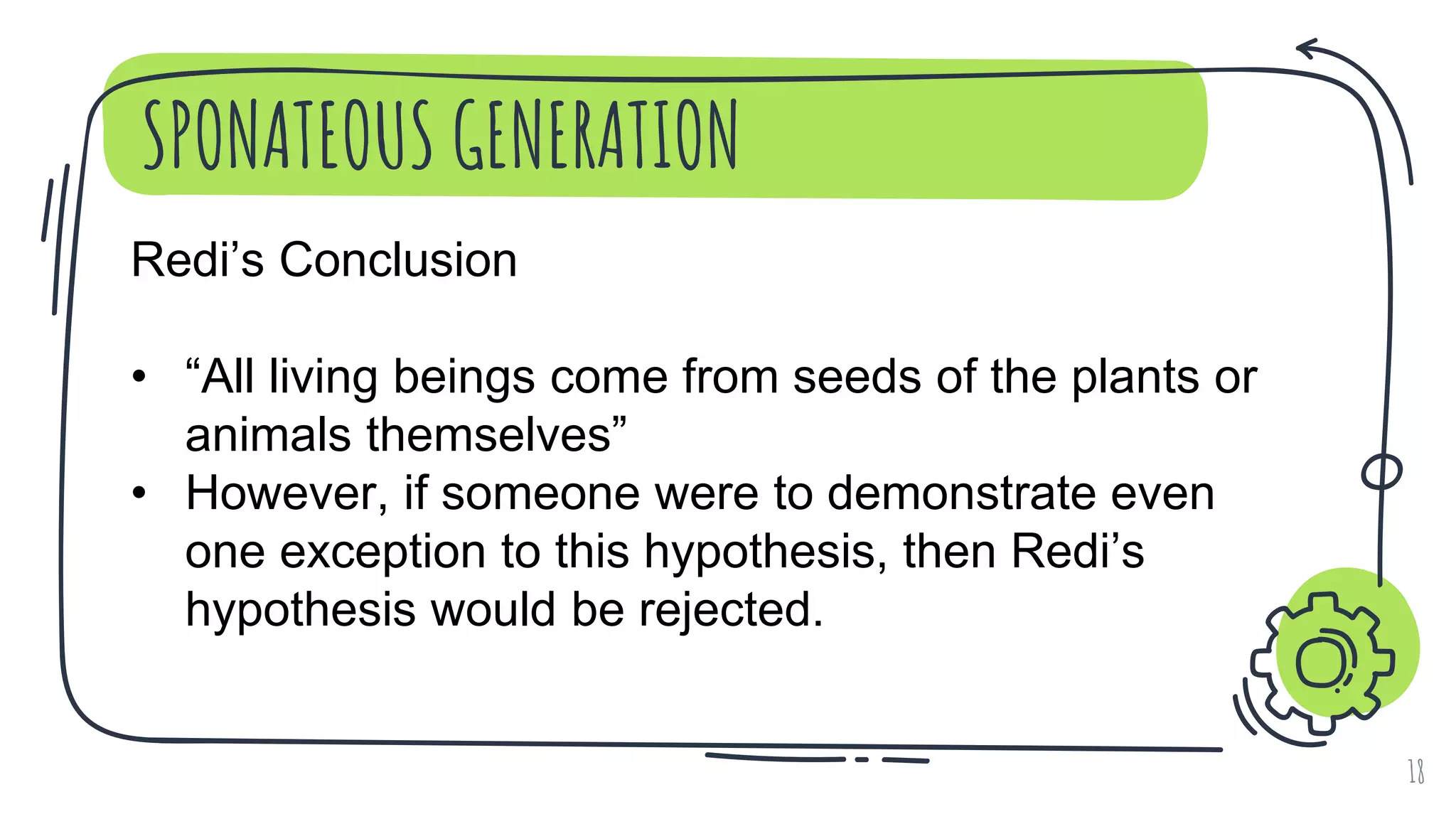
Redi’s Conclusion
• “All living beings come from seeds of the plants or
animals themselves”
• However, if someone were to demonstrate even
one exception to this hypothesis, then Redi’s
hypothesis would be rejected.
SPONATEOUS GENERATION
19
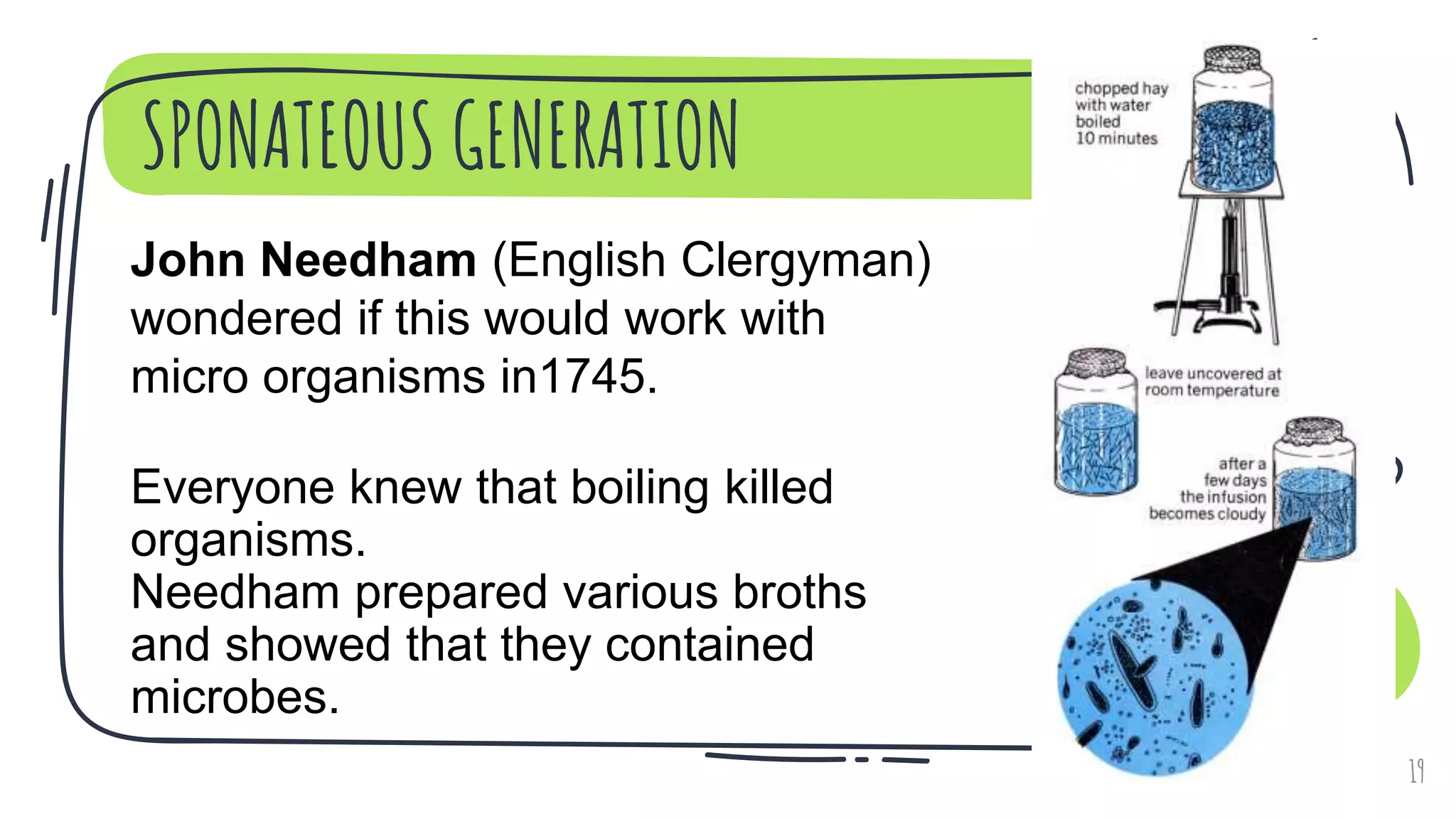
John Needham (English Clergyman)
wondered if this would work with
micro organisms in1745.
Everyone knew that boiling killed
organisms.
Needham prepared various broths
and showed that they contained
microbes.
SPONATEOUS GENERATION
20
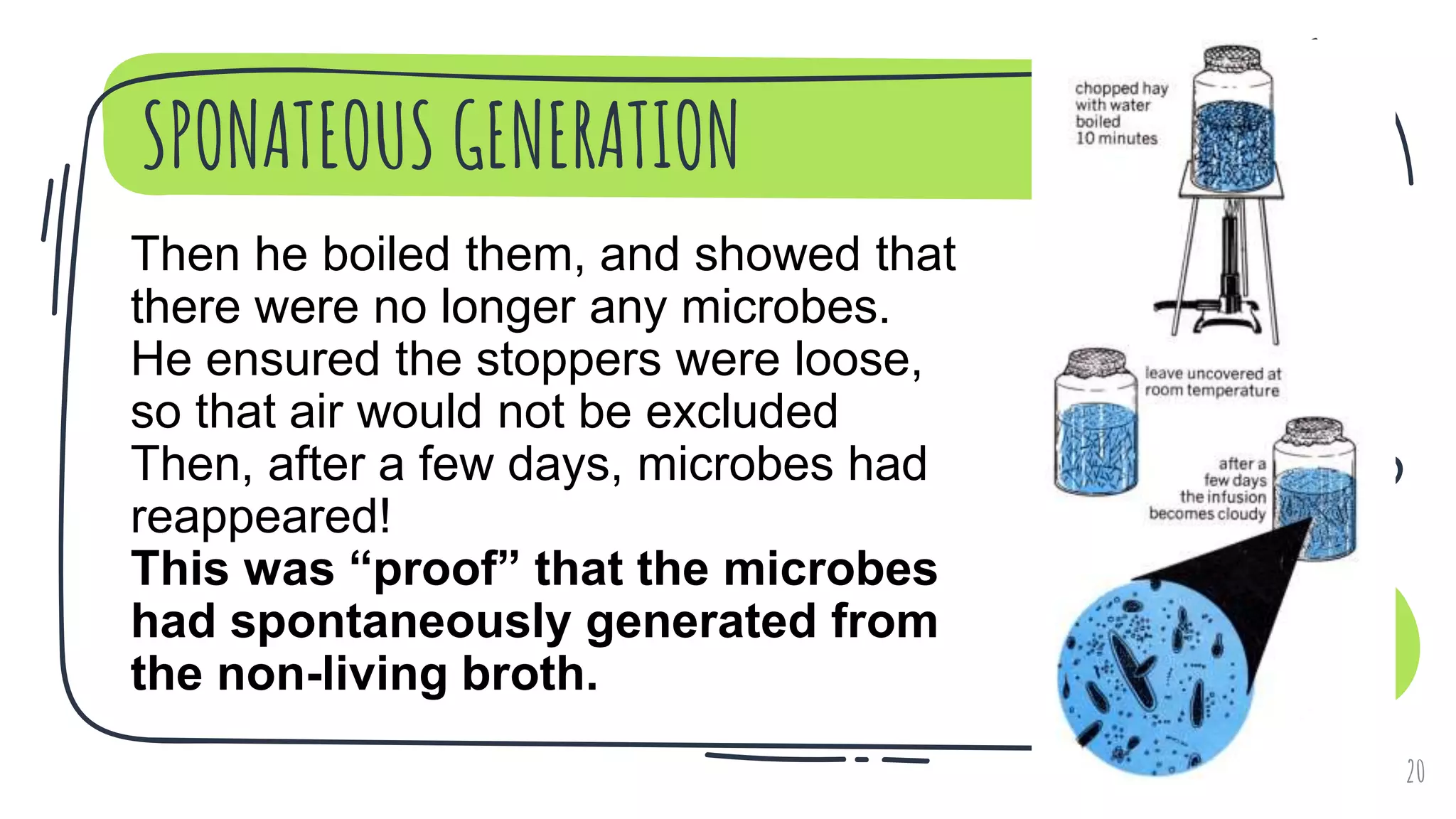
Then he boiled them, and showed that
there were no longer any microbes.
He ensured the stoppers were loose,
so that air would not be excluded
Then, after a few days, microbes had
reappeared!
This was “proof” that the microbes
had spontaneously generated from
the non-living broth.
SPONATEOUS GENERATION
21
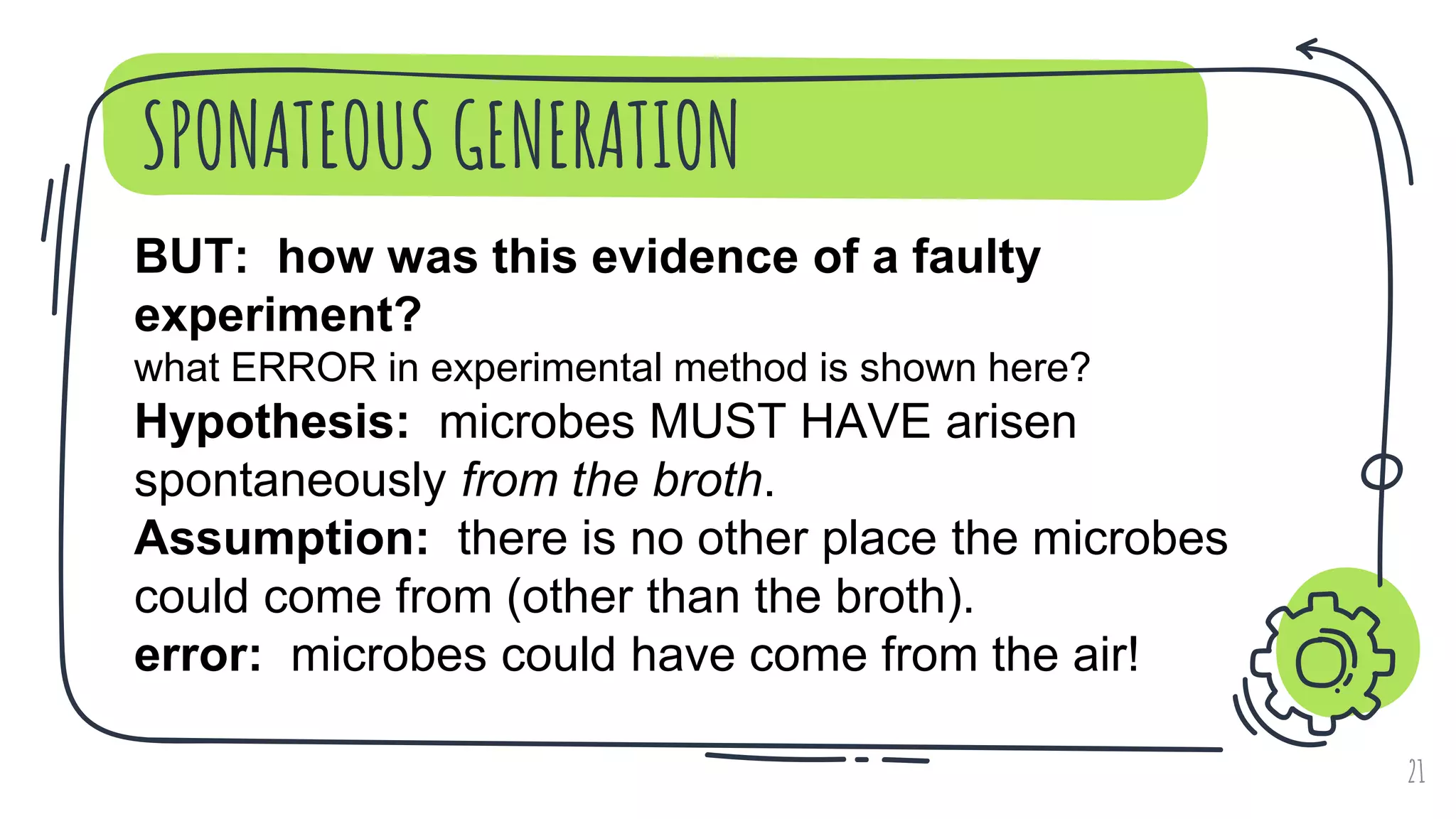
BUT: how was this evidence of a faulty
experiment?
what ERROR in experimental method is shown here?
Hypothesis: microbes MUST HAVE arisen
spontaneously from the broth.
Assumption: there is no other place the microbes
could come from (other than the broth).
error: microbes could have come from the air!
SPONATEOUS GENERATION
22
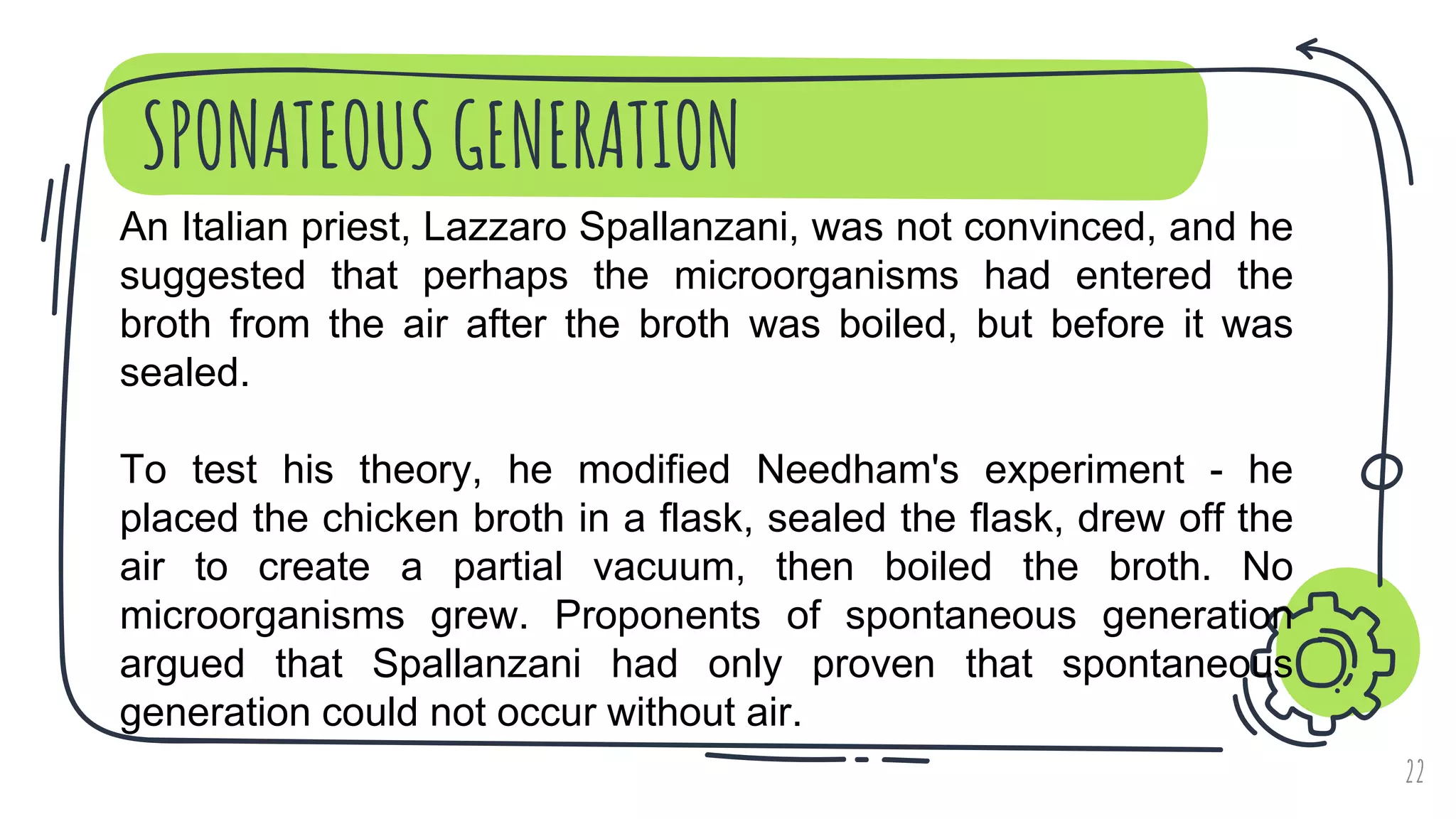
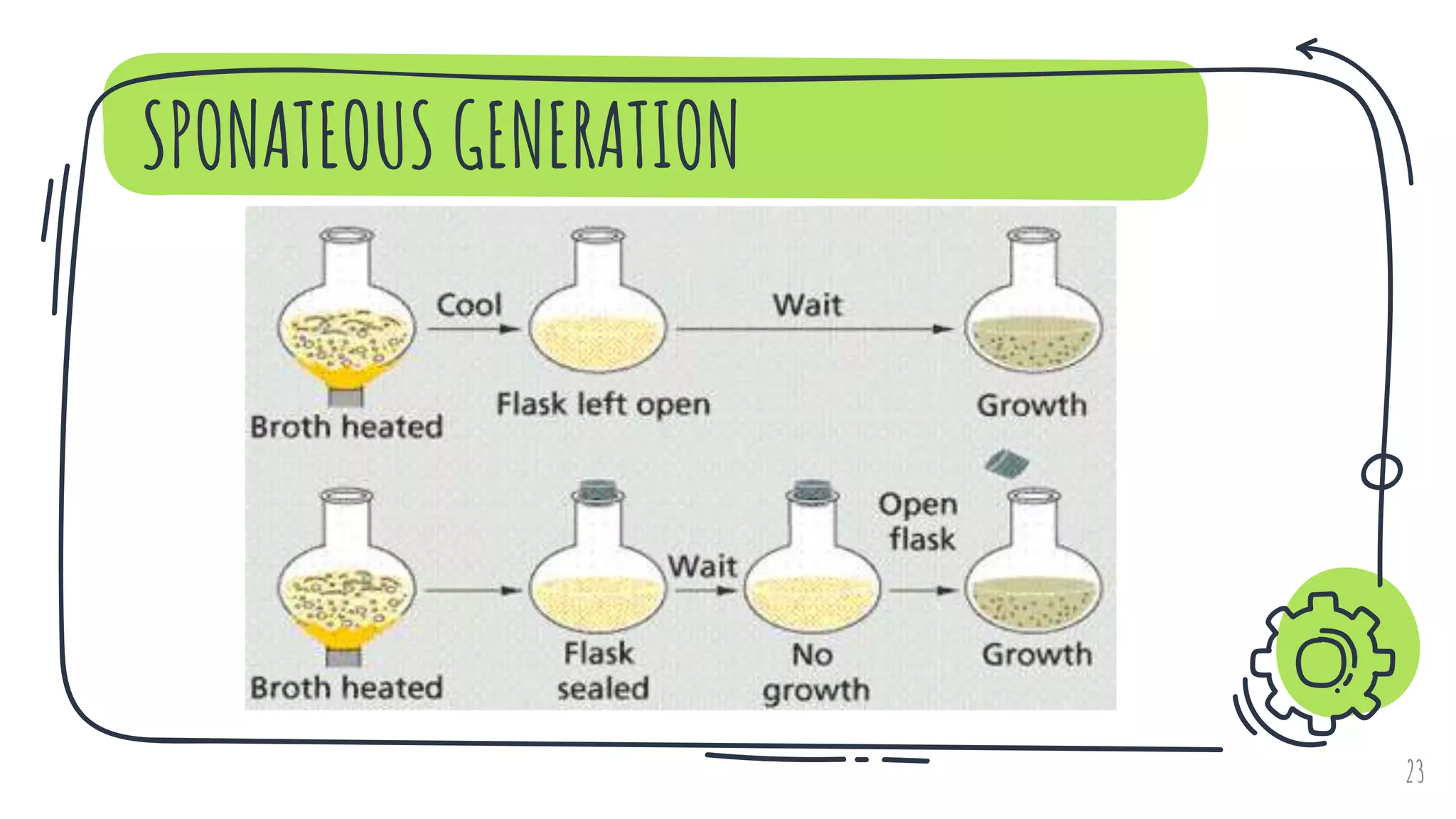
An Italian priest, Lazzaro Spallanzani, was not convinced, and he
suggested that perhaps the microorganisms had entered the
broth from the air after the broth was boiled, but before it was
sealed.
To test his theory, he modified Needham's experiment - he
placed the chicken broth in a flask, sealed the flask, drew off the
air to create a partial vacuum, then boiled the broth. No
microorganisms grew. Proponents of spontaneous generation
argued that Spallanzani had only proven that spontaneous
generation could not occur without air.
SPONATEOUS GENERATION
23
SPONATEOUS GENERATION
24
Needham criticizes Spallanzani’s first experiment
BUT Needham said: you boiled it TOO
LONG, and:
You spoiled the vegetative power by boiling.
You killed the ability of the broth to give life.
Life can still come from broth -- but the broth
must not be “damaged” by boiling.
SPONATEOUS GENERATION
25
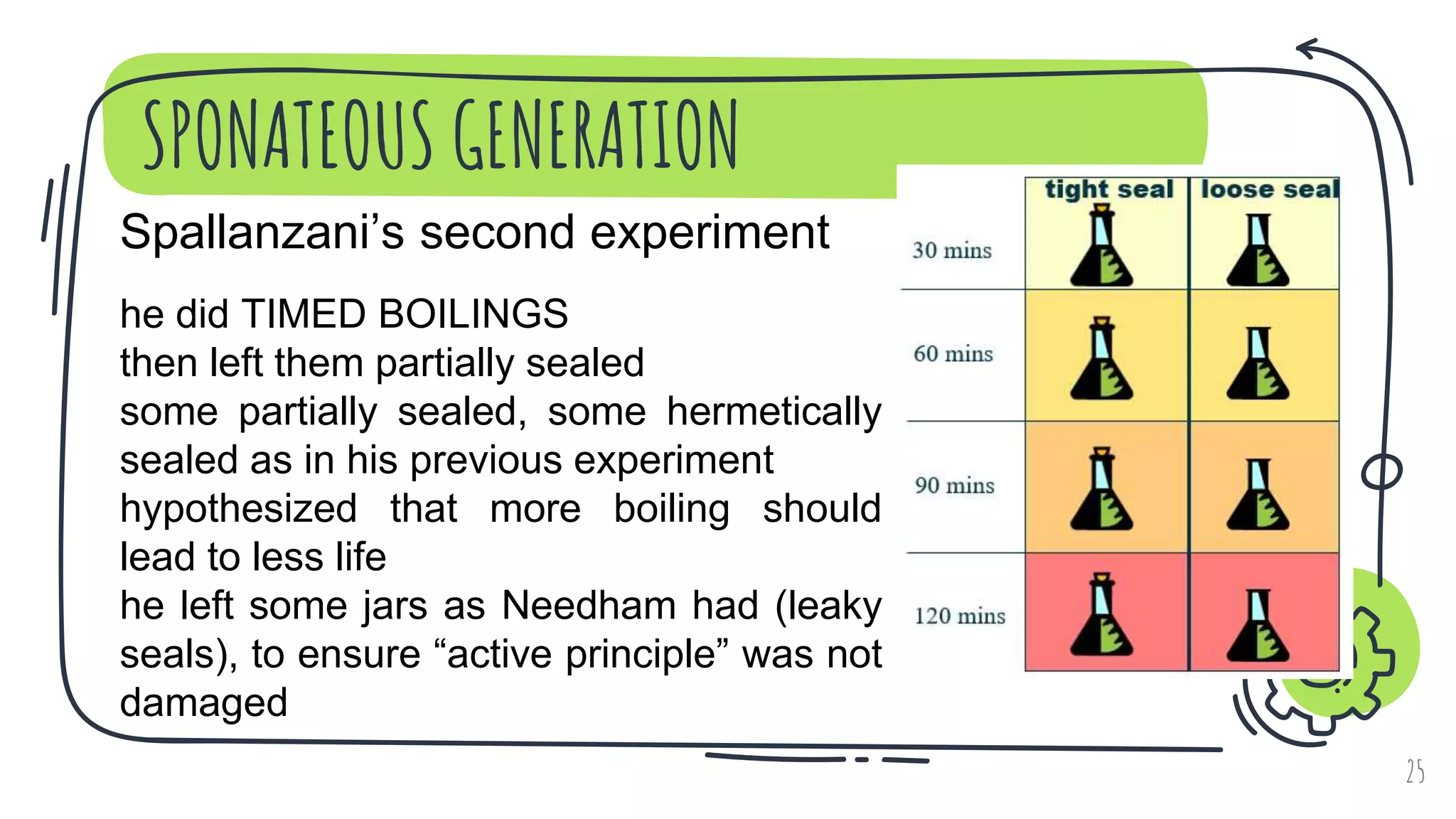
Spallanzani’s second experiment
he did TIMED BOILINGS
then left them partially sealed
some partially sealed, some hermetically
sealed as in his previous experiment
hypothesized that more boiling should
lead to less life
he left some jars as Needham had (leaky
seals), to ensure “active principle” was not
damaged
SPONATEOUS GENERATION
26
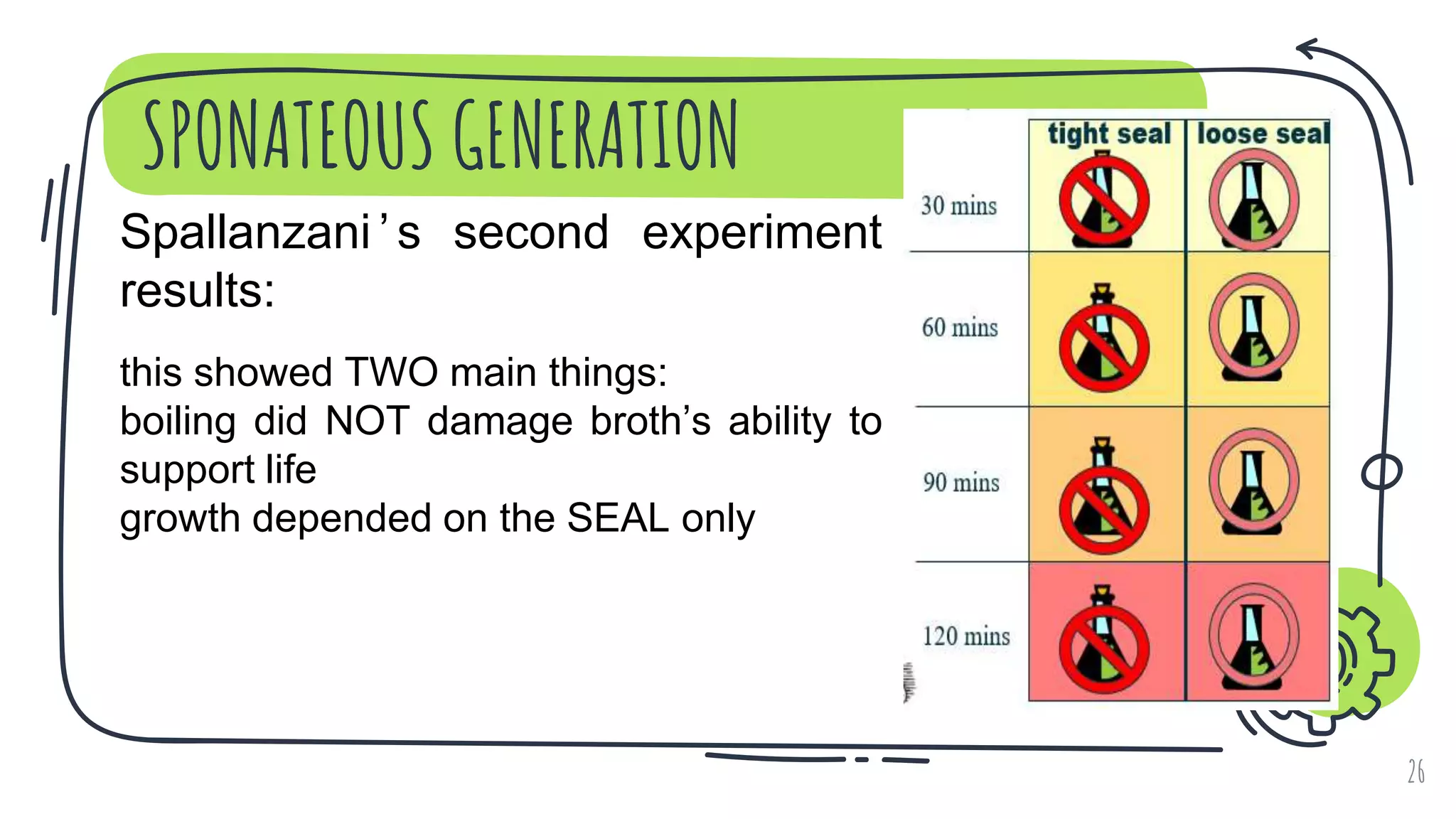
Spallanzani ’ s second experiment
results:
this showed TWO main things:
boiling did NOT damage broth’s ability to
support life
growth depended on the SEAL only
SPONATEOUS GENERATION
27
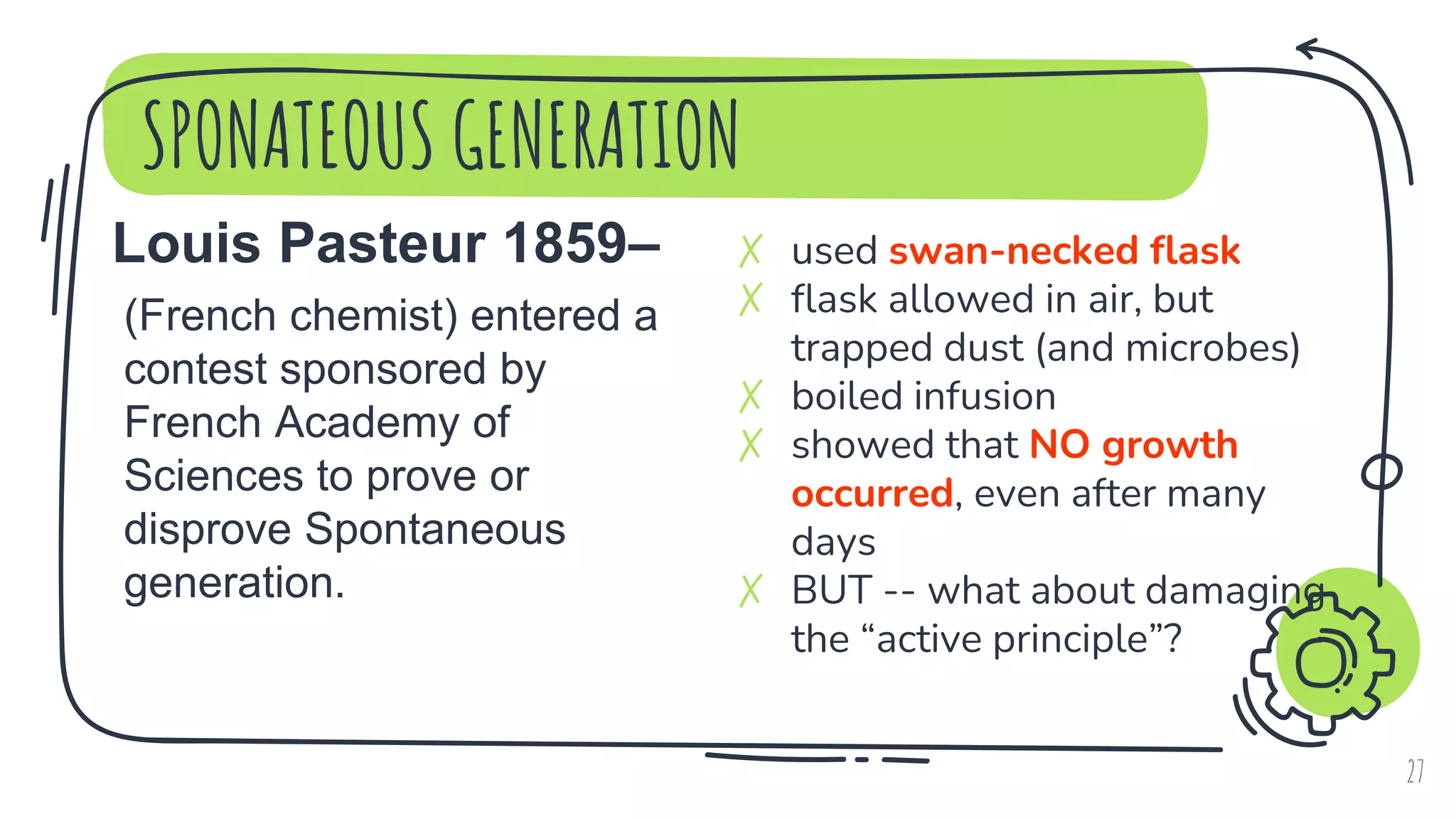
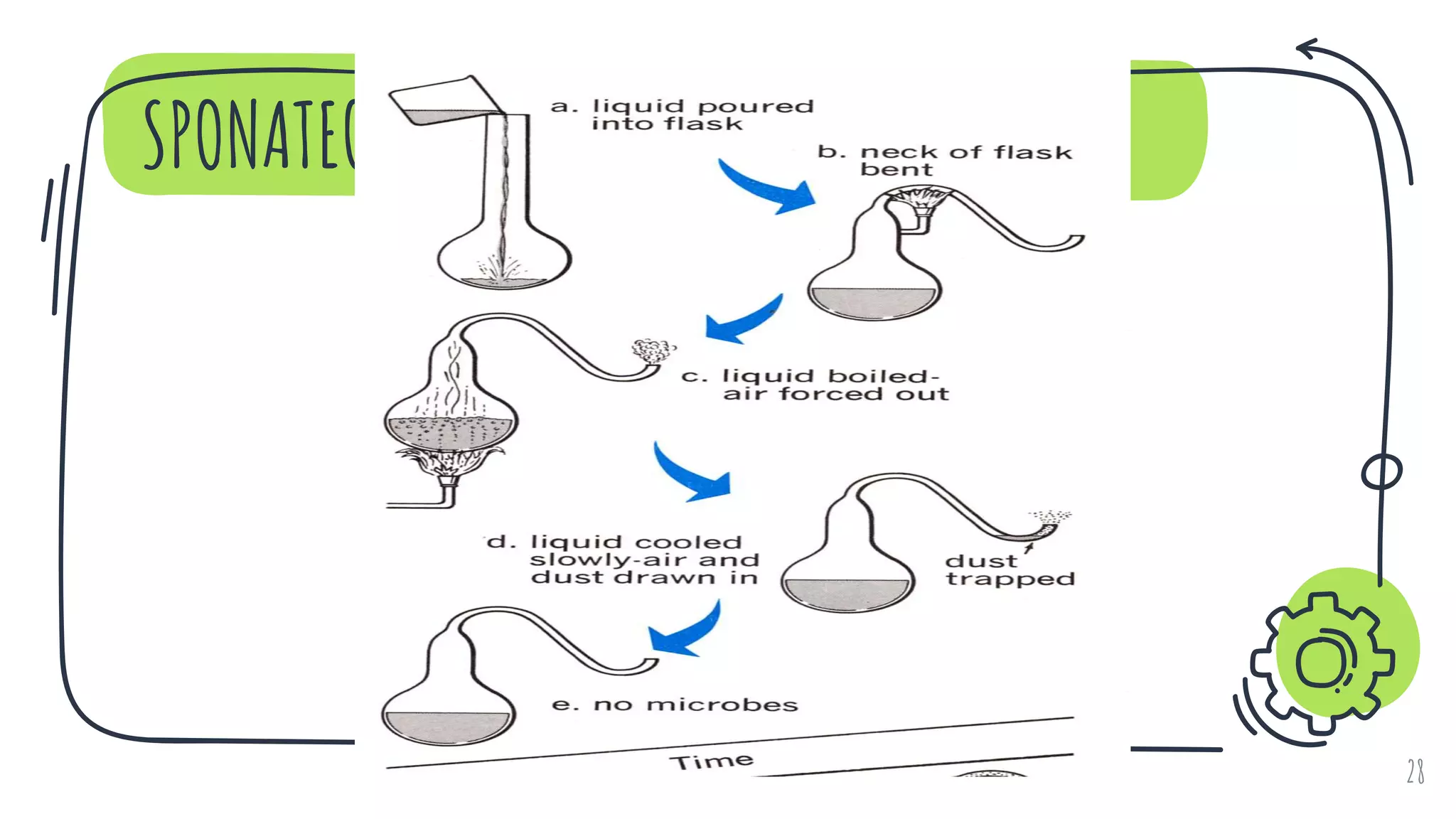
Louis Pasteur 1859– ✗ used swan-necked flask
✗ flask allowed in air, but
trapped dust (and microbes)
✗ boiled infusion
✗ showed that NO growth
occurred, even after many
days
✗ BUT -- what about damaging
the “active principle”?
(French chemist) entered a
contest sponsored by
French Academy of
Sciences to prove or
disprove Spontaneous
generation.
SPONATEOUS GENERATION
28
SPONATEOUS GENERATION
29
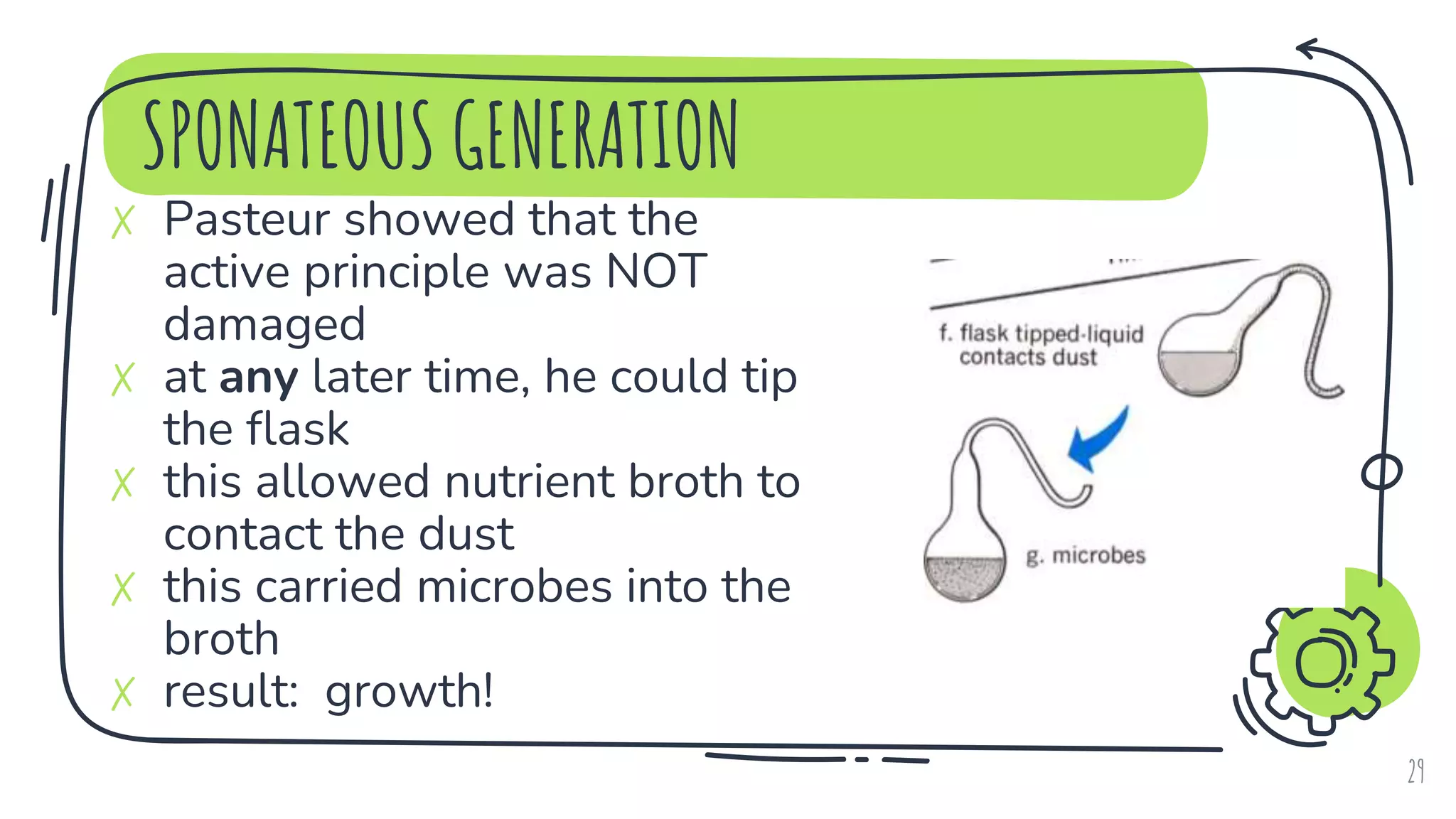
✗ Pasteur showed that the
active principle was NOT
damaged
✗ at any later time, he could tip
the flask
✗ this allowed nutrient broth to
contact the dust
✗ this carried microbes into the
broth
✗ result: growth!
SPONATEOUS GENERATION
30
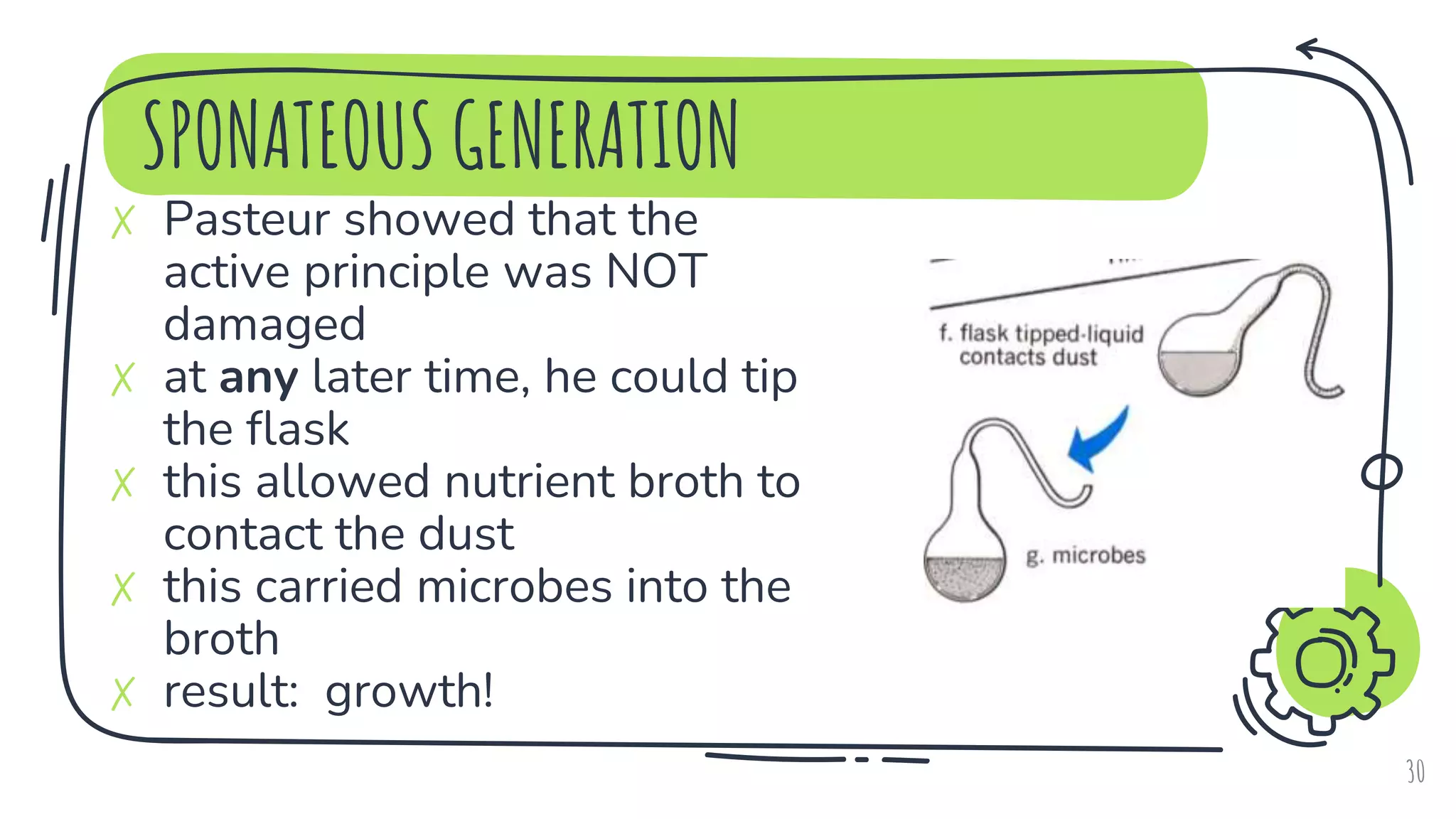
✗ Pasteur showed that the
active principle was NOT
damaged
✗ at any later time, he could tip
the flask
✗ this allowed nutrient broth to
contact the dust
✗ this carried microbes into the
broth
✗ result: growth!
Discovery
of the Cell
31
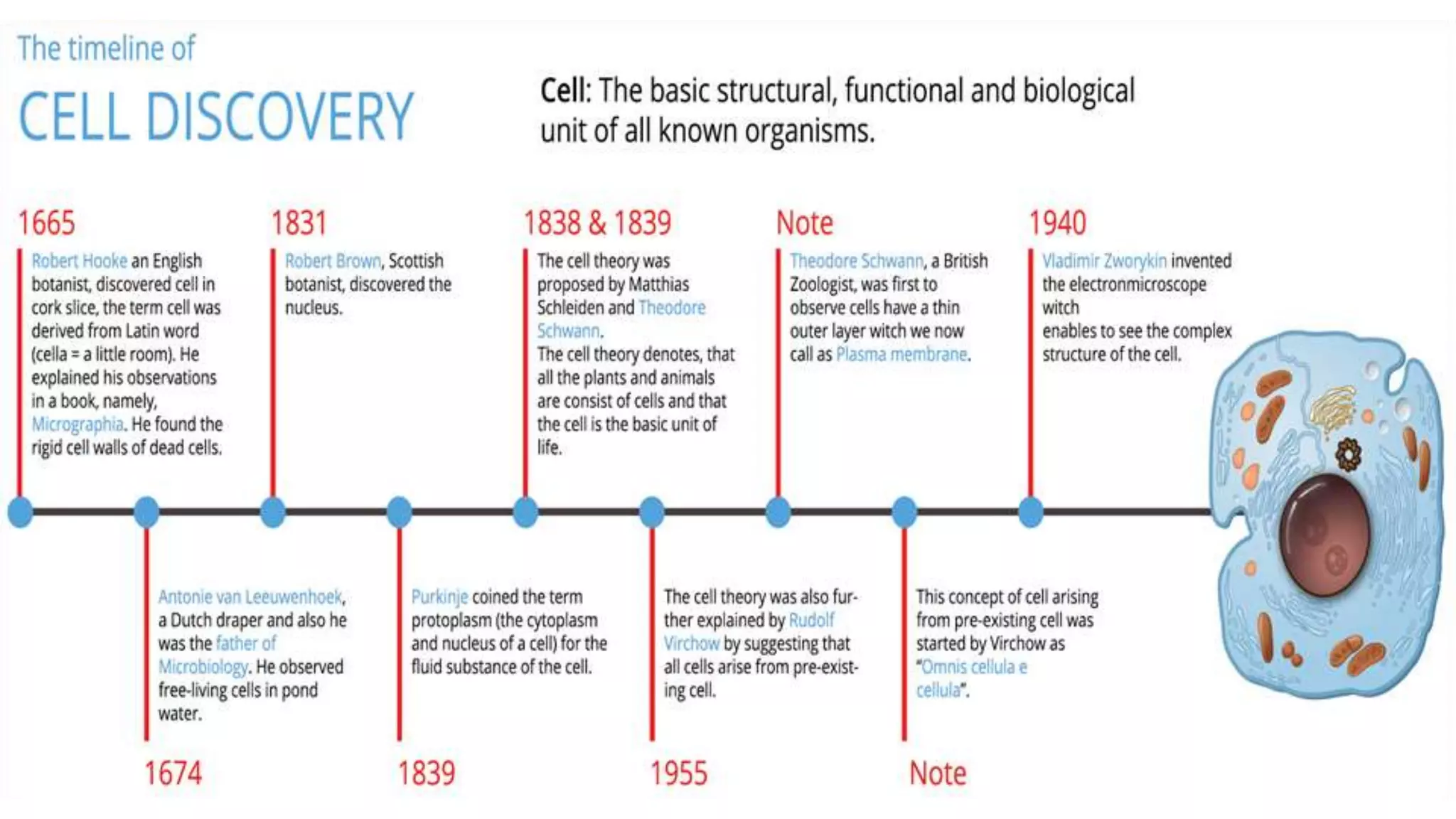
History of cell
32
Development of cell theory
33
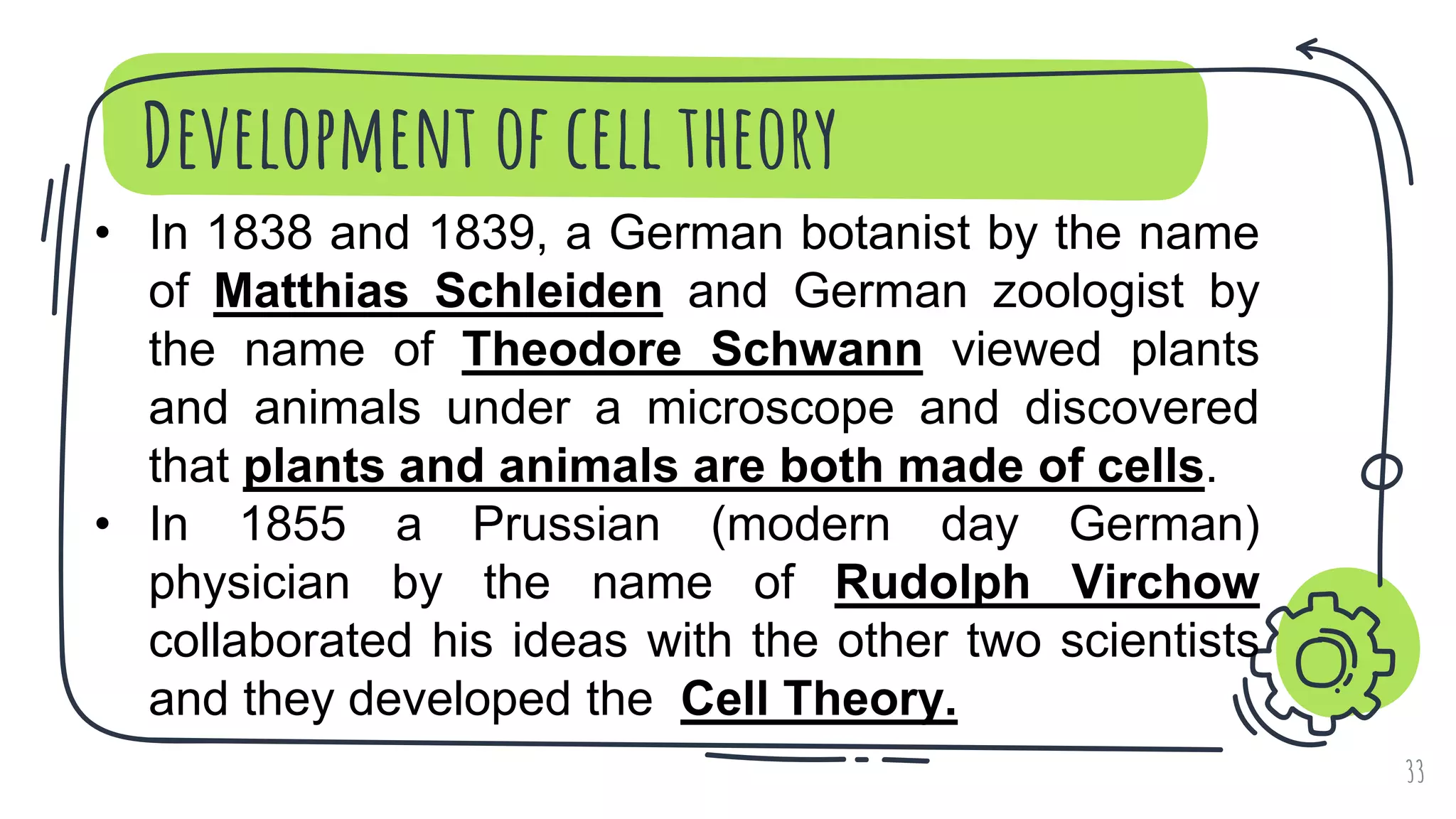
• In 1838 and 1839, a German botanist by the name
of Matthias Schleiden and German zoologist by
the name of Theodore Schwann viewed plants
and animals under a microscope and discovered
that plants and animals are both made of cells.
• In 1855 a Prussian (modern day German)
physician by the name of Rudolph Virchow
collaborated his ideas with the other two scientists
and they developed the Cell Theory.
cell theory
34
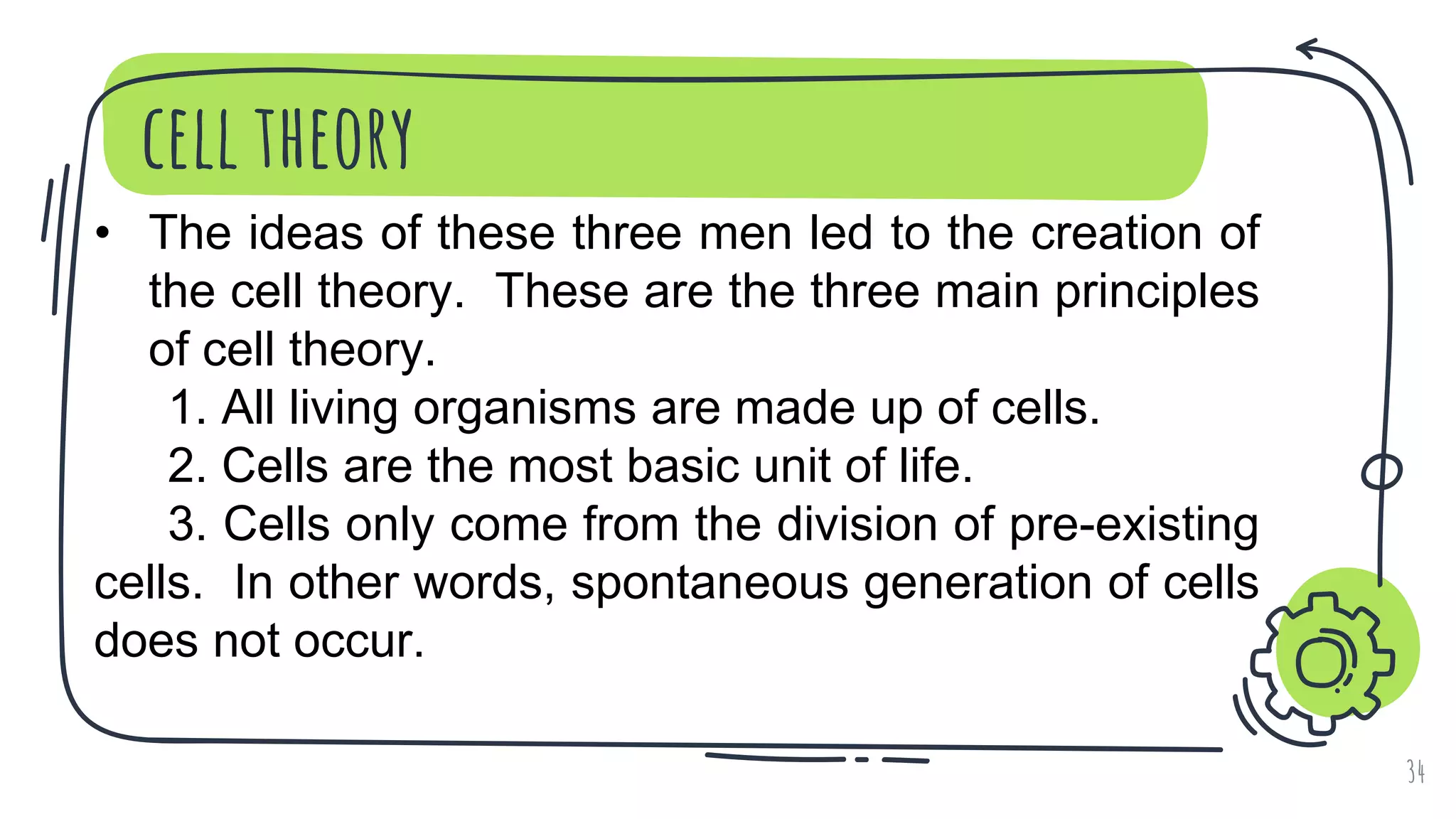
• The ideas of these three men led to the creation of
the cell theory. These are the three main principles
of cell theory.
1. All living organisms are made up of cells.
2. Cells are the most basic unit of life.
3. Cells only come from the division of pre-existing
cells. In other words, spontaneous generation of cells
does not occur.
Write a short paragraph discussing why
is it necessary for a student like you to
understand and to look back on the
history of the development of the cell
theory. Make your answer brief and
concise, express your answer using 5-10
sentences only.
35

1. WEEK 1-Spontaneous Generation.pptx

  • 1.
  • 2.
    Learning competency ✗ explainthe postulates of the cell theory. 2
  • 3.
    Arrange the jumbledwords into meaningful words 3 1. ONEOUNTSPAS 2. CLEL 3. CLEL TEROHY 4. LNVINNOIG 5. IONSGABEEIS 6. PUNEMA 7. MOAGGTS 8. CMIOROCSPE 9. NCLEUUS 10. ESTXNIIG
  • 4.
    Arrange the jumbledwords into meaningful words 4 1. SPONTANEOUS 2. CELL 3. CELL THEORY 4. NONLIVING 5. ABIOGENESIS 6. PNEUMA 7. MAGGOTS 8. MICROSCOPE 9. NUCLEUS 10. EXISTING
  • 5.
    ! A. Where doeslife come from? B. In the past, what is the people’s understanding about cell?
  • 6.
    SPONATEOUS GENERATION 6 ✗ Formuch of history, people believed that animals could come from non-living sources. They thought: ✗ Frogs developed from falling drops of rain ✗ mice arose from sweaty underwear ✗ and flies arose from decaying meat. ✗ This is called abiogenesis ✗ Also known as spontaneous generation
  • 7.
    SPONATEOUS GENERATION 7 Before 1860smany scientists believed in Spontaneous generation, i.e.: That living organisms could arise spontaneously from nonliving matter: ✗ Mice come from rags in a basket. ✗ Maggots come from rotting meat. ✗ Ants come from honey. ✗ Microbes come from spoiled broth.
  • 8.
    SPONATEOUS GENERATION 8 ✗ Inthe past, people believed what they were told by “authorities” such as the Church, or the ancient Greek philosopher Aristotle ✗ Questioning Aristotle was like questioning the Church..
  • 9.
    SPONATEOUS GENERATION 9 ✗ One“scientist” put forward the belief that mice could be generated spontaneously from wheat and a sweaty shirt. ✗ The wheat provided the “nutritive power” and the shirt provided the “active principle.” ✗ “active principle” = a mysterious “ life-force ” that allowed spontaneous generation to occur.
  • 10.
    SPONATEOUS GENERATION 10 The firstserious attack on the idea of spontaneous generation was made in 1668 by Francesco Redi, an Italian physician and poet.
  • 11.
    SPONATEOUS GENERATION 11 At thattime, it was widely held that maggots arose spontaneously in rotting meat. Redi believed that maggots developed from eggs laid by flies.
  • 12.
    SPONATEOUS GENERATION 12 To testhis hypothesis, he set out meat in a variety of flasks, some open to the air, some sealed completely, and others covered with gauze. As he had expected, maggots appeared only in the open flasks in which the flies could reach the meat and lay their eggs.
  • 13.
  • 14.
  • 15.
    SPONATEOUS GENERATION 15 “The fleshof dead animals cannot engender worms unless the eggs of the living being deposited therein” Put dead snakes, eels, and veal in large wide mouthed vessels. Sealed one set with wax and left the other set open to air. Decaying meat was teeming with maggots, sealed meat had no maggots Wax sealed vessels failed to produce maggots because flies were unable to reach the meat
  • 16.
    SPONATEOUS GENERATION 16 Redi’s criticssaid: ✗ You have too many variables ✗ There is a lack of access and a lack of air. ✗ We ALL know that everything needs air ✗ Of course no flies grew! ✗ You haven’t proven anything.
  • 17.
  • 18.
    SPONATEOUS GENERATION 18 Redi’s Conclusion •“All living beings come from seeds of the plants or animals themselves” • However, if someone were to demonstrate even one exception to this hypothesis, then Redi’s hypothesis would be rejected.
  • 19.
    SPONATEOUS GENERATION 19 John Needham(English Clergyman) wondered if this would work with micro organisms in1745. Everyone knew that boiling killed organisms. Needham prepared various broths and showed that they contained microbes.
  • 20.
    SPONATEOUS GENERATION 20 Then heboiled them, and showed that there were no longer any microbes. He ensured the stoppers were loose, so that air would not be excluded Then, after a few days, microbes had reappeared! This was “proof” that the microbes had spontaneously generated from the non-living broth.
  • 21.
    SPONATEOUS GENERATION 21 BUT: howwas this evidence of a faulty experiment? what ERROR in experimental method is shown here? Hypothesis: microbes MUST HAVE arisen spontaneously from the broth. Assumption: there is no other place the microbes could come from (other than the broth). error: microbes could have come from the air!
  • 22.
    SPONATEOUS GENERATION 22 An Italianpriest, Lazzaro Spallanzani, was not convinced, and he suggested that perhaps the microorganisms had entered the broth from the air after the broth was boiled, but before it was sealed. To test his theory, he modified Needham's experiment - he placed the chicken broth in a flask, sealed the flask, drew off the air to create a partial vacuum, then boiled the broth. No microorganisms grew. Proponents of spontaneous generation argued that Spallanzani had only proven that spontaneous generation could not occur without air.
  • 23.
  • 24.
    SPONATEOUS GENERATION 24 Needham criticizesSpallanzani’s first experiment BUT Needham said: you boiled it TOO LONG, and: You spoiled the vegetative power by boiling. You killed the ability of the broth to give life. Life can still come from broth -- but the broth must not be “damaged” by boiling.
  • 25.
    SPONATEOUS GENERATION 25 Spallanzani’s secondexperiment he did TIMED BOILINGS then left them partially sealed some partially sealed, some hermetically sealed as in his previous experiment hypothesized that more boiling should lead to less life he left some jars as Needham had (leaky seals), to ensure “active principle” was not damaged
  • 26.
    SPONATEOUS GENERATION 26 Spallanzani ’s second experiment results: this showed TWO main things: boiling did NOT damage broth’s ability to support life growth depended on the SEAL only
  • 27.
    SPONATEOUS GENERATION 27 Louis Pasteur1859– ✗ used swan-necked flask ✗ flask allowed in air, but trapped dust (and microbes) ✗ boiled infusion ✗ showed that NO growth occurred, even after many days ✗ BUT -- what about damaging the “active principle”? (French chemist) entered a contest sponsored by French Academy of Sciences to prove or disprove Spontaneous generation.
  • 28.
  • 29.
    SPONATEOUS GENERATION 29 ✗ Pasteurshowed that the active principle was NOT damaged ✗ at any later time, he could tip the flask ✗ this allowed nutrient broth to contact the dust ✗ this carried microbes into the broth ✗ result: growth!
  • 30.
    SPONATEOUS GENERATION 30 ✗ Pasteurshowed that the active principle was NOT damaged ✗ at any later time, he could tip the flask ✗ this allowed nutrient broth to contact the dust ✗ this carried microbes into the broth ✗ result: growth!
  • 31.
  • 32.
  • 33.
    Development of celltheory 33 • In 1838 and 1839, a German botanist by the name of Matthias Schleiden and German zoologist by the name of Theodore Schwann viewed plants and animals under a microscope and discovered that plants and animals are both made of cells. • In 1855 a Prussian (modern day German) physician by the name of Rudolph Virchow collaborated his ideas with the other two scientists and they developed the Cell Theory.
  • 34.
    cell theory 34 • Theideas of these three men led to the creation of the cell theory. These are the three main principles of cell theory. 1. All living organisms are made up of cells. 2. Cells are the most basic unit of life. 3. Cells only come from the division of pre-existing cells. In other words, spontaneous generation of cells does not occur.
  • 35.
    Write a shortparagraph discussing why is it necessary for a student like you to understand and to look back on the history of the development of the cell theory. Make your answer brief and concise, express your answer using 5-10 sentences only. 35