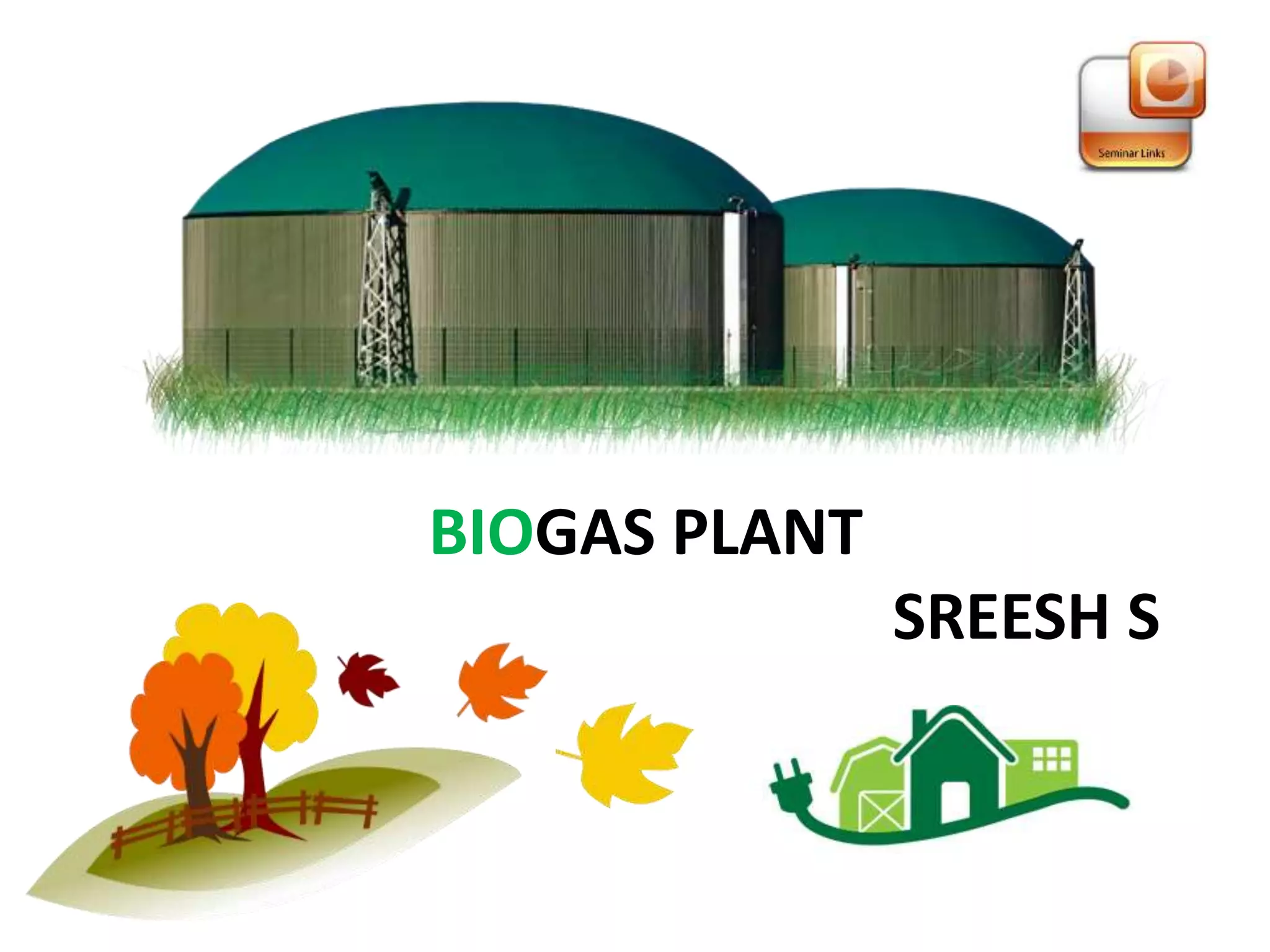
BIOGAS PLANT
SREESH S
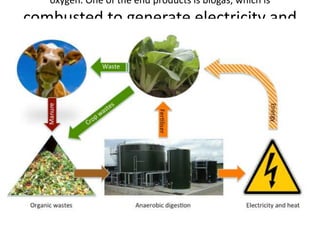
Anaerobic digestion
• Anaerobic digestion is a series of biological
processes in which microorganisms break
down biodegradable material in the absence
of oxygen. One of the end products is biogas,
which is combusted to generate electricity and
heat, or can be processed into renewable
natural gas and transportation fuels.
Biogas
• Biogas is a clean and efficient fuel.
• It is a mixture of:
– Methane (CH4)
– Carbon dioxide (CO2)
– Hydrogen (H2)
– Hydrogen sulphide (H2S)
• The chief constituent of biogas is methane (65%).
oxygen. One of the end products is biogas, which is
combusted to generate electricity and
heat, or can be processed into
renewable natural gas and
transportation fuels.
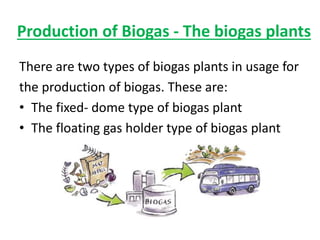
Production of Biogas - The biogas plants
There are two types of biogas plants in usage for
the production of biogas. These are:
• The fixed- dome type of biogas plant
• The floating gas holder type of biogas plant
Fixed dome type
of Biogas Plant
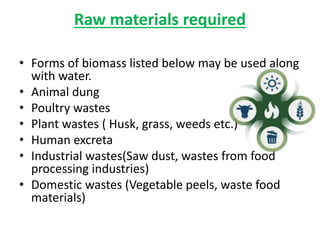
Raw materials required
• Forms of biomass listed below may be used along
with water.
• Animal dung
• Poultry wastes
• Plant wastes ( Husk, grass, weeds etc.)
• Human excreta
• Industrial wastes(Saw dust, wastes from food
processing industries)
• Domestic wastes (Vegetable peels, waste food
materials)
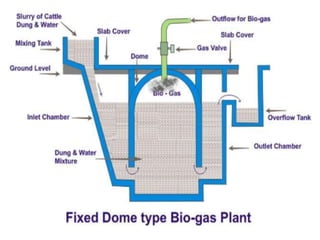
Construction
The biogas plant is a brick and cement structure having the
following five sections:
• Mixing tank present above the ground level.
• Inlet tank: The mixing tank opens underground into a
sloping inlet chamber.
• Digester: The inlet chamber opens from below into the
digester which is a huge tank with a dome like ceiling.
The ceiling of the digester has an outlet with a valve for
the supply of biogas.
• Outlet tank: The digester opens from below into an
outlet chamber.
• Overflow tank: The outlet chamber opens from the top
into a small over flow tank.
Working of Fixed Dome type Biogas Plant
• The various forms of biomass are mixed with an equal
quantity of water in the mixing tank. This forms the slurry.
• The slurry is fed into the digester through the inlet
chamber.
• When the digester is partially filled with the slurry, the
introduction of slurry is stopped and the plant is left
unused for about two months.
• During these two months, anaerobic bacteria present in
the slurry decomposes or ferments the biomass in the
presence of water.
• As a result of anaerobic fermentation, biogas is formed,
which starts collecting in the dome of the digester.
Cont..
• As more and more biogas starts collecting, the pressure
exerted by the biogas forces the spent slurry into the
outlet chamber.
• From the outlet chamber, the spent slurry overflows
into the overflow tank.
• The spent slurry is manually removed from the
overflow tank and used as manure for plants.
• The gas valve connected to a system of pipelines is
opened when a supply of biogas is required.
• To obtain a continuous supply of biogas, a functioning
plant can be fed continuously with the prepared slurry.
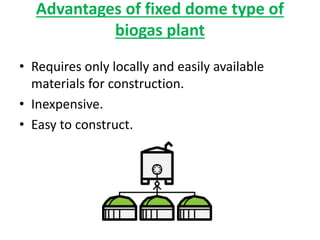
Advantages of fixed dome type of
biogas plant
• Requires only locally and easily available
materials for construction.
• Inexpensive.
• Easy to construct.
Floating gas holder
type of biogas
plant
Construction
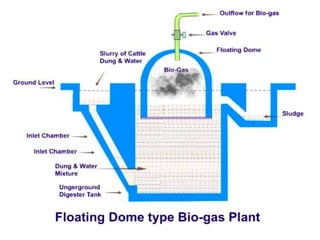
The floating gas holder type of biogas plant has the following
chambers/ sections:
• Mixing Tank - present above the ground level.
• Digester tank - Deep underground well-like structure. It is
divided into two chambers by a partition wall in between.
• It has two long cement pipes
i) Inlet pipe opening into the inlet chamber for introduction of
slurry.
ii) Outlet pipe opening into the overflow tank for removal of spent
slurry.
• Gas holder - an inverted steel drum resting above the
digester. The drum can move up and down i.e., float over
the digester. The gas holder has an outlet at the top which
could be connected to gas stoves.
• Over flow tank - Present above the ground level.
Working
• Slurry (mixture of equal quantities of biomass and
water) is prepared in the mixing tank.
• The prepared slurry is fed into the inlet chamber of the
digester through the inlet pipe.
• The plant is left unused for about two months and
introduction of more slurry is stopped.
• During this period, anaerobic fermentation of biomass
takes place in the presence of water and produces
biogas in the digester.
• Biogas being lighter rises up and starts collecting in the
gas holder. The gas holder now starts moving up.
Cont..
• The gas holder cannot rise up beyond a certain level. As
more and more gas starts collecting, more pressure begins
to be exerted on the slurry.
• The spent slurry is now forced into the outlet chamber
from the top of the inlet chamber.
• When the outlet chamber gets filled with the spent slurry,
the excess is forced out through the outlet pipe into the
overflow tank. This is later used as manure for plants.
• The gas valve of the gas outlet is opened to get a supply of
biogas.
• Once the production of biogas begins, a continuous supply
of gas can be ensured by regular removal of spent slurry
and introduction of fresh slurry.
Disadvantages of floating gas holder
type biogas plant
• Expensive
• Steel drum may rust
• Requires regular maintenance
Advantages of biogas as a fuel
• High calorific value
• Clean fuel
• No residue produced
• No smoke produced
• Non polluting
• Economical
• Can be supplied through pipe lines
• Burns readily - has a convenient ignition
temperature
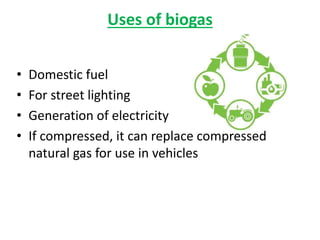
Uses of biogas
• Domestic fuel
• For street lighting
• Generation of electricity
• If compressed, it can replace compressed
natural gas for use in vehicles
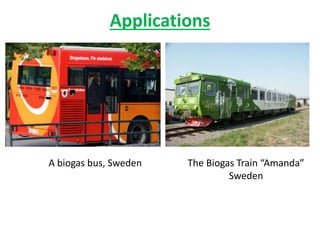
Applications
The Biogas Train “Amanda”
Sweden
A biogas bus, Sweden
Advantages of biogas plants
• Reduces burden on forests and fossil fuels
• Produces a clean fuel - helps in controlling air
pollution
• Provides nutrient rich (N & P) manure for
plants
• Controls water pollution by decomposing
sewage, animal dung and human excreta.
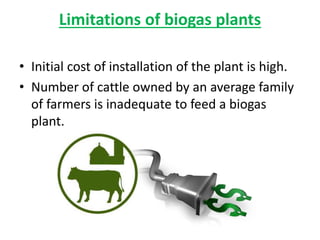
Limitations of biogas plants
• Initial cost of installation of the plant is high.
• Number of cattle owned by an average family
of farmers is inadequate to feed a biogas
plant.
Recent Developments
• With the many benefits of biogas, it is starting to become a
popular source of energy and is starting to be used in the
United States more.
• On 5 October 2010, biogas was injected into the UK gas grid
for the first time. As of September 2013, there are about 130
non-sewage biogas plants in the UK.
• Germany is Europe's biggest biogas producer and the market
leader in biogas technology.
• To create awareness and associate the people interested in
biogas, the Indian Biogas Association was formed. India's
Ministry of New and Renewable Energy offers some subsidy
per model constructed.
Conclusion
Biogas is a clean source of energy. Biogas
plants have been in operation for a long
period of time, especially in rural areas around
the globe. The research organizations should
focus on newer efficient low cost designs. The
governments can play important role by
introducing different legal frameworks,
education schemes and the availability of
technology and simultaneously creating more
awareness and providing more subsidies.
Thank You

Biogas .ppt

  • 1.
  • 2.
    Anaerobic digestion • Anaerobicdigestion is a series of biological processes in which microorganisms break down biodegradable material in the absence of oxygen. One of the end products is biogas, which is combusted to generate electricity and heat, or can be processed into renewable natural gas and transportation fuels.
  • 3.
    Biogas • Biogas isa clean and efficient fuel. • It is a mixture of: – Methane (CH4) – Carbon dioxide (CO2) – Hydrogen (H2) – Hydrogen sulphide (H2S) • The chief constituent of biogas is methane (65%).
  • 4.
    oxygen. One ofthe end products is biogas, which is combusted to generate electricity and heat, or can be processed into renewable natural gas and transportation fuels.
  • 5.
    Production of Biogas- The biogas plants There are two types of biogas plants in usage for the production of biogas. These are: • The fixed- dome type of biogas plant • The floating gas holder type of biogas plant
  • 6.
    Fixed dome type ofBiogas Plant
  • 7.
    Raw materials required •Forms of biomass listed below may be used along with water. • Animal dung • Poultry wastes • Plant wastes ( Husk, grass, weeds etc.) • Human excreta • Industrial wastes(Saw dust, wastes from food processing industries) • Domestic wastes (Vegetable peels, waste food materials)
  • 8.
    Construction The biogas plantis a brick and cement structure having the following five sections: • Mixing tank present above the ground level. • Inlet tank: The mixing tank opens underground into a sloping inlet chamber. • Digester: The inlet chamber opens from below into the digester which is a huge tank with a dome like ceiling. The ceiling of the digester has an outlet with a valve for the supply of biogas. • Outlet tank: The digester opens from below into an outlet chamber. • Overflow tank: The outlet chamber opens from the top into a small over flow tank.
  • 9.
    Working of FixedDome type Biogas Plant • The various forms of biomass are mixed with an equal quantity of water in the mixing tank. This forms the slurry. • The slurry is fed into the digester through the inlet chamber. • When the digester is partially filled with the slurry, the introduction of slurry is stopped and the plant is left unused for about two months. • During these two months, anaerobic bacteria present in the slurry decomposes or ferments the biomass in the presence of water. • As a result of anaerobic fermentation, biogas is formed, which starts collecting in the dome of the digester.
  • 10.
    Cont.. • As moreand more biogas starts collecting, the pressure exerted by the biogas forces the spent slurry into the outlet chamber. • From the outlet chamber, the spent slurry overflows into the overflow tank. • The spent slurry is manually removed from the overflow tank and used as manure for plants. • The gas valve connected to a system of pipelines is opened when a supply of biogas is required. • To obtain a continuous supply of biogas, a functioning plant can be fed continuously with the prepared slurry.
  • 12.
    Advantages of fixeddome type of biogas plant • Requires only locally and easily available materials for construction. • Inexpensive. • Easy to construct.
  • 13.
    Floating gas holder typeof biogas plant
  • 14.
    Construction The floating gasholder type of biogas plant has the following chambers/ sections: • Mixing Tank - present above the ground level. • Digester tank - Deep underground well-like structure. It is divided into two chambers by a partition wall in between. • It has two long cement pipes i) Inlet pipe opening into the inlet chamber for introduction of slurry. ii) Outlet pipe opening into the overflow tank for removal of spent slurry. • Gas holder - an inverted steel drum resting above the digester. The drum can move up and down i.e., float over the digester. The gas holder has an outlet at the top which could be connected to gas stoves. • Over flow tank - Present above the ground level.
  • 16.
    Working • Slurry (mixtureof equal quantities of biomass and water) is prepared in the mixing tank. • The prepared slurry is fed into the inlet chamber of the digester through the inlet pipe. • The plant is left unused for about two months and introduction of more slurry is stopped. • During this period, anaerobic fermentation of biomass takes place in the presence of water and produces biogas in the digester. • Biogas being lighter rises up and starts collecting in the gas holder. The gas holder now starts moving up.
  • 17.
    Cont.. • The gasholder cannot rise up beyond a certain level. As more and more gas starts collecting, more pressure begins to be exerted on the slurry. • The spent slurry is now forced into the outlet chamber from the top of the inlet chamber. • When the outlet chamber gets filled with the spent slurry, the excess is forced out through the outlet pipe into the overflow tank. This is later used as manure for plants. • The gas valve of the gas outlet is opened to get a supply of biogas. • Once the production of biogas begins, a continuous supply of gas can be ensured by regular removal of spent slurry and introduction of fresh slurry.
  • 18.
    Disadvantages of floatinggas holder type biogas plant • Expensive • Steel drum may rust • Requires regular maintenance
  • 19.
    Advantages of biogasas a fuel • High calorific value • Clean fuel • No residue produced • No smoke produced • Non polluting • Economical • Can be supplied through pipe lines • Burns readily - has a convenient ignition temperature
  • 20.
    Uses of biogas •Domestic fuel • For street lighting • Generation of electricity • If compressed, it can replace compressed natural gas for use in vehicles
  • 21.
    Applications The Biogas Train“Amanda” Sweden A biogas bus, Sweden
  • 22.
    Advantages of biogasplants • Reduces burden on forests and fossil fuels • Produces a clean fuel - helps in controlling air pollution • Provides nutrient rich (N & P) manure for plants • Controls water pollution by decomposing sewage, animal dung and human excreta.
  • 23.
    Limitations of biogasplants • Initial cost of installation of the plant is high. • Number of cattle owned by an average family of farmers is inadequate to feed a biogas plant.
  • 24.
    Recent Developments • Withthe many benefits of biogas, it is starting to become a popular source of energy and is starting to be used in the United States more. • On 5 October 2010, biogas was injected into the UK gas grid for the first time. As of September 2013, there are about 130 non-sewage biogas plants in the UK. • Germany is Europe's biggest biogas producer and the market leader in biogas technology. • To create awareness and associate the people interested in biogas, the Indian Biogas Association was formed. India's Ministry of New and Renewable Energy offers some subsidy per model constructed.
  • 25.
    Conclusion Biogas is aclean source of energy. Biogas plants have been in operation for a long period of time, especially in rural areas around the globe. The research organizations should focus on newer efficient low cost designs. The governments can play important role by introducing different legal frameworks, education schemes and the availability of technology and simultaneously creating more awareness and providing more subsidies.
  • 26.