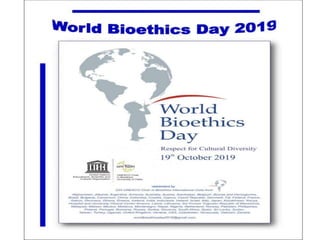
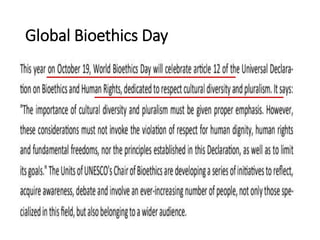
Global Bioethics Day
What is Bioethics?
•The term “Bioethics” was introduced in the 70’s by
Van Rensselaer Potter for a study aiming at
ensuring the preservation of the biosphere.
•It was later used to refer a study of the ethical
issues arising from health care, biological and
medical sciences.
•It is a major area in applied ethics.
•Study of ethical issues and decision
making associated with the use of living
organisms
•Learning how to balance different
benefits, risks and duties
Medical/ Nursing ethics
•The emergence of this new area of study has been
triggered by and a response to the new
scientific/technological developments in
biomedical and life sciences.
•Medical ethics and nursing ethics are more
concerned with the ethics of the health care
professionals and their relationship with the
patient.
•Bioethics has a broader scope.
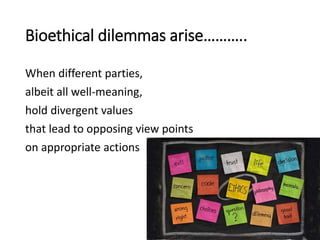
Bioethical dilemmas arise………..
When different parties,
albeit all well-meaning,
hold divergent values
that lead to opposing view points
on appropriate actions
Lets see ……………………
• V1
• V2
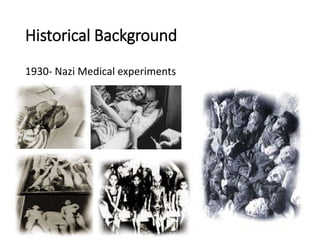
Historical Background
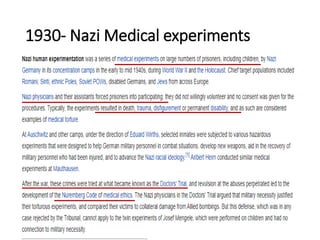
1930- Nazi Medical experiments
Historical Background
1930- Nazi Medical experiments
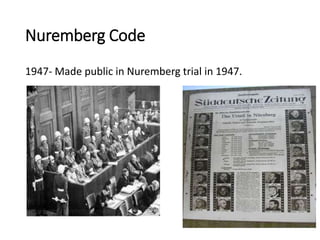
Nuremberg Code
1947- Made public in Nuremberg trial in 1947.
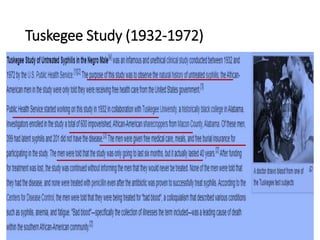
Tuskegee Study (1932-1972)
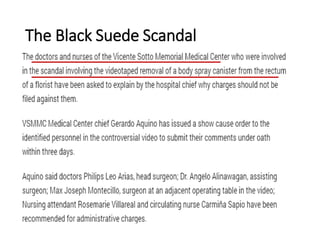
The Black Suede Scandal
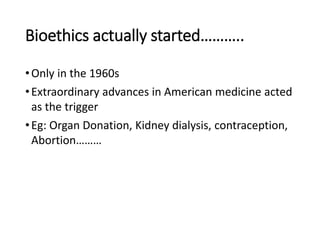
Bioethics actually started………..
•Only in the 1960s
•Extraordinary advances in American medicine acted
as the trigger
•Eg: Organ Donation, Kidney dialysis, contraception,
Abortion………
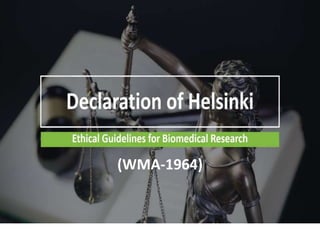
(WMA-1964)
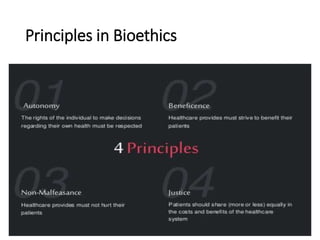
Principles in Bioethics
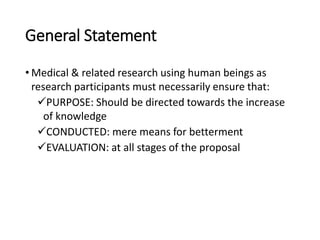
General Statement
• Medical & related research using human beings as
research participants must necessarily ensure that:
PURPOSE: Should be directed towards the increase
of knowledge
CONDUCTED: mere means for betterment
EVALUATION: at all stages of the proposal
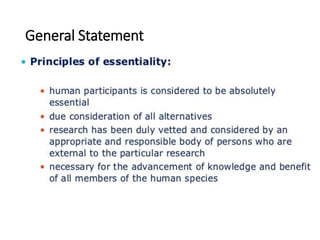
General Statement
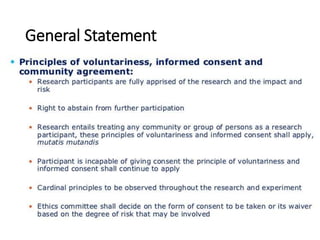
General Statement
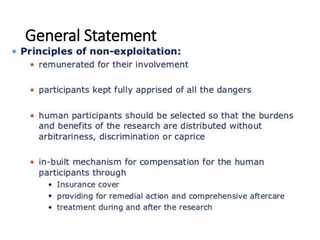
General Statement
General Statement
General Statement
General Statement
General Statement
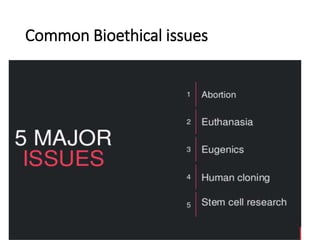
Common Bioethical issues
Some historical examples
• Abortion
• Contraception
• Kidney dialysis machine (Who had the priority?)
• Organ transplant, artificial ventilator, and brain death
• In virtro fertilization (IVF)
• Cloning and stem cell research
• Genetic engineering
Main topics in Bioethics
• Death and dying
• Pre-birth Issues
• Issues in human
reproduction
• Human cloning
• Stem cell research
• The new genetics
• Resources allocation
• Organ transplant
• Doctor-patient
relationships
• Experimentation with
human subjects & animals
(The above list is not
exhaustive)
Artificial Reproductive Technologies
(ART)
• Contraception: sex without procreation
• HRTs: procreation without sex
Bioethics in Different ARTs
• Artificial insemination by husband (AIH)
• Artificial insemination by donor (AID)
• In virtro fertilization (IVF)
• Egg donation
• Embryo donation
• Surrogacy
Ethical considerations in ART
• Procreation rights of infertile couples
• It is unnatural
• Inequality and exploitation
• Selling babies?
• The moral status of extra embryos left over from IVF
• Definition of parent-child relation
• Integrity of the family
• Best interests of the child
Human Cloning
• Two techniques:
Embryo splitting
Nuclear substitution
• Embryo splitting
The clone is usually used for tests of abnormality,
and will be destroyed subsequently.
Ethical Issues in Cloning
• Nuclear Substitution
What is the relationship between the nuclear donor
and the clone?
The same person?
(Technologically-aided and birth delayed) identical
twins?
Siblings?
Parent-child?
Should a homosexual be allowed to use the
technology to obtain his/her own child?
Ethical Issues in Cloning
• Is it moral alright for parents to clone their beloved
children who die young?
• Should it be used as an infertility treatment or gene
therapy if it is safe?
Stem Cell Research
• Stem cells: undifferentiated, multi-potent, precursor
cells, capable of developing into virtually any body
tissue.
• Three types of stem cells:
Embryonic stem cells (ESC)
Fetal stem cells
Adult stem cells
Stem Cell Research
• Three main sources:
Adult bone marrow
Miscarried or aborted embryos/fetus; extra embryos left
over from IVF
Embryos from therapeutic cloning
• Potential Treatments:
They may be used to replace damaged organ tissues (e.g.,
cardiac tissues), repair irreversible injuries (e.g., spinal cord
injuries), or cure diseases (e.g., Parkinson’s and Alzheimer’s
diseases).
Stem Cell Research
•ESC is most promising for treatment, and therapeutic
cloning can avoid the problem of immunological
incompatibility.
•Ethical issues:
Destroying an embryo to harvest ESC is equivalent to killing
a child to obtain his organs.
Left-over from IVF are already there.
Therapeutic cloning: The embryo is not created for
reproduction.
How about the wellbeing of many patients who may be
cured by ESC research?
The New Genetics
• Gene testing
Create unnecessary psychological distress
Discrimination by employers and insurance companies
Confidentiality and Privacy
Social stigmatization
Prenatal Screening
• Sex selection: Gender discrimination and imbalance
of sex ratio unless it is done solely for therapeutic
purpose
• Discrimination: Lives of the disable are not worth
living
Genetic Engineering
• Is it a form of eugenics?
• Germ-line changes, unlike somatic modification, can
pass onto the next generation and be with us forever.
So germ-line changes could be very risky.
• Is genetic enhancement moral?
Organ Transplant and Resources
Allocation
• On what criteria should organs be allocated to patients
for transplantation?
• What is a just distribution of healthcare resources?
Case Analysis
BIOETHICS.ppt
BIOETHICS.ppt

BIOETHICS.ppt

  • 3.
  • 4.
    What is Bioethics? •Theterm “Bioethics” was introduced in the 70’s by Van Rensselaer Potter for a study aiming at ensuring the preservation of the biosphere. •It was later used to refer a study of the ethical issues arising from health care, biological and medical sciences. •It is a major area in applied ethics.
  • 5.
    •Study of ethicalissues and decision making associated with the use of living organisms •Learning how to balance different benefits, risks and duties
  • 6.
    Medical/ Nursing ethics •Theemergence of this new area of study has been triggered by and a response to the new scientific/technological developments in biomedical and life sciences. •Medical ethics and nursing ethics are more concerned with the ethics of the health care professionals and their relationship with the patient. •Bioethics has a broader scope.
  • 7.
    Bioethical dilemmas arise……….. Whendifferent parties, albeit all well-meaning, hold divergent values that lead to opposing view points on appropriate actions
  • 8.
  • 9.
  • 10.
    1930- Nazi Medicalexperiments
  • 11.
  • 12.
    Nuremberg Code 1947- Madepublic in Nuremberg trial in 1947.
  • 13.
  • 14.
  • 15.
    Bioethics actually started……….. •Onlyin the 1960s •Extraordinary advances in American medicine acted as the trigger •Eg: Organ Donation, Kidney dialysis, contraception, Abortion………
  • 16.
  • 18.
  • 22.
    General Statement • Medical& related research using human beings as research participants must necessarily ensure that: PURPOSE: Should be directed towards the increase of knowledge CONDUCTED: mere means for betterment EVALUATION: at all stages of the proposal
  • 23.
  • 24.
  • 25.
  • 26.
  • 27.
  • 28.
  • 29.
  • 30.
  • 31.
    Some historical examples •Abortion • Contraception • Kidney dialysis machine (Who had the priority?) • Organ transplant, artificial ventilator, and brain death • In virtro fertilization (IVF) • Cloning and stem cell research • Genetic engineering
  • 32.
    Main topics inBioethics • Death and dying • Pre-birth Issues • Issues in human reproduction • Human cloning • Stem cell research • The new genetics • Resources allocation • Organ transplant • Doctor-patient relationships • Experimentation with human subjects & animals (The above list is not exhaustive)
  • 33.
    Artificial Reproductive Technologies (ART) •Contraception: sex without procreation • HRTs: procreation without sex
  • 34.
    Bioethics in DifferentARTs • Artificial insemination by husband (AIH) • Artificial insemination by donor (AID) • In virtro fertilization (IVF) • Egg donation • Embryo donation • Surrogacy
  • 35.
    Ethical considerations inART • Procreation rights of infertile couples • It is unnatural • Inequality and exploitation • Selling babies? • The moral status of extra embryos left over from IVF • Definition of parent-child relation • Integrity of the family • Best interests of the child
  • 36.
    Human Cloning • Twotechniques: Embryo splitting Nuclear substitution • Embryo splitting The clone is usually used for tests of abnormality, and will be destroyed subsequently.
  • 37.
    Ethical Issues inCloning • Nuclear Substitution What is the relationship between the nuclear donor and the clone? The same person? (Technologically-aided and birth delayed) identical twins? Siblings? Parent-child? Should a homosexual be allowed to use the technology to obtain his/her own child?
  • 38.
    Ethical Issues inCloning • Is it moral alright for parents to clone their beloved children who die young? • Should it be used as an infertility treatment or gene therapy if it is safe?
  • 39.
    Stem Cell Research •Stem cells: undifferentiated, multi-potent, precursor cells, capable of developing into virtually any body tissue. • Three types of stem cells: Embryonic stem cells (ESC) Fetal stem cells Adult stem cells
  • 40.
    Stem Cell Research •Three main sources: Adult bone marrow Miscarried or aborted embryos/fetus; extra embryos left over from IVF Embryos from therapeutic cloning • Potential Treatments: They may be used to replace damaged organ tissues (e.g., cardiac tissues), repair irreversible injuries (e.g., spinal cord injuries), or cure diseases (e.g., Parkinson’s and Alzheimer’s diseases).
  • 41.
    Stem Cell Research •ESCis most promising for treatment, and therapeutic cloning can avoid the problem of immunological incompatibility. •Ethical issues: Destroying an embryo to harvest ESC is equivalent to killing a child to obtain his organs. Left-over from IVF are already there. Therapeutic cloning: The embryo is not created for reproduction. How about the wellbeing of many patients who may be cured by ESC research?
  • 42.
    The New Genetics •Gene testing Create unnecessary psychological distress Discrimination by employers and insurance companies Confidentiality and Privacy Social stigmatization
  • 43.
    Prenatal Screening • Sexselection: Gender discrimination and imbalance of sex ratio unless it is done solely for therapeutic purpose • Discrimination: Lives of the disable are not worth living
  • 44.
    Genetic Engineering • Isit a form of eugenics? • Germ-line changes, unlike somatic modification, can pass onto the next generation and be with us forever. So germ-line changes could be very risky. • Is genetic enhancement moral?
  • 45.
    Organ Transplant andResources Allocation • On what criteria should organs be allocated to patients for transplantation? • What is a just distribution of healthcare resources?
  • 46.