
JAIPUR NATIONAL UNIVERSITY
SEEDLING SCHOOL OF NURSING
PREPARED BY-
(Prof.) Dr. Rahul Sharma
HOD of Mental Health Nursing
Ph.D. Coordinator
Seedling School of Nursing
India As A Megadiversity
Nation
Introduction
The United Nations has declared the year 2010 as the ‘International Year of
Biodiversity’ and the theme for this year’s environment day is “Biodiversity:
Connecting with Nature” and India is one of the 12 mega diversity nation in the
world
India is located in south Asia, between latitude 60 and 380 N and
longitudes 690 and 970 E
The Indian landmass extending over a total geographical area of about
3029 million hectares is bounded by Himalayas in the north, the Bay of
Bengal in east, the Arabian Sea in the west, and Indian Ocean in the south
Megadiverse India
The above figure
represents a species
wise endemic content
of the biodiversity in
India
Biodiversity is a
biogeographical area
with a large reservoir of
biodiversity that is
threatened with
destruction
The biodiversity
species diversity
genetic diversity
ecosystem diversity
Hotspot of biodiversity
Himalayas
Western
Ghats
Indo Burma
Region
Sundaland
Biodiversity
Hotspots in India -
Himalayas, Indo-
Burma, Western
Ghats &
Sundaland
Biodiversity is referred to as the variation of plant
and animal species in a particular habitat
India is known for its rich biodiversity and has around
24.46% of the geographical area covered by forests
and trees
Coined by Norman Myers, the term “Biodiversity
hotspots” can be defined as the regions which are
known for their high species richness and endemism
Biodiversity Hotspots – 2 Main Qualifying Criteria
The region should have
at least 1500 species of
vascular plants i.e., it
should have a high
degree of endemism
It must contain 30% of
its original habitat, i.e. it
must be threatened
The Himalayas
Indo-Burma Region The Western Ghats Sundaland
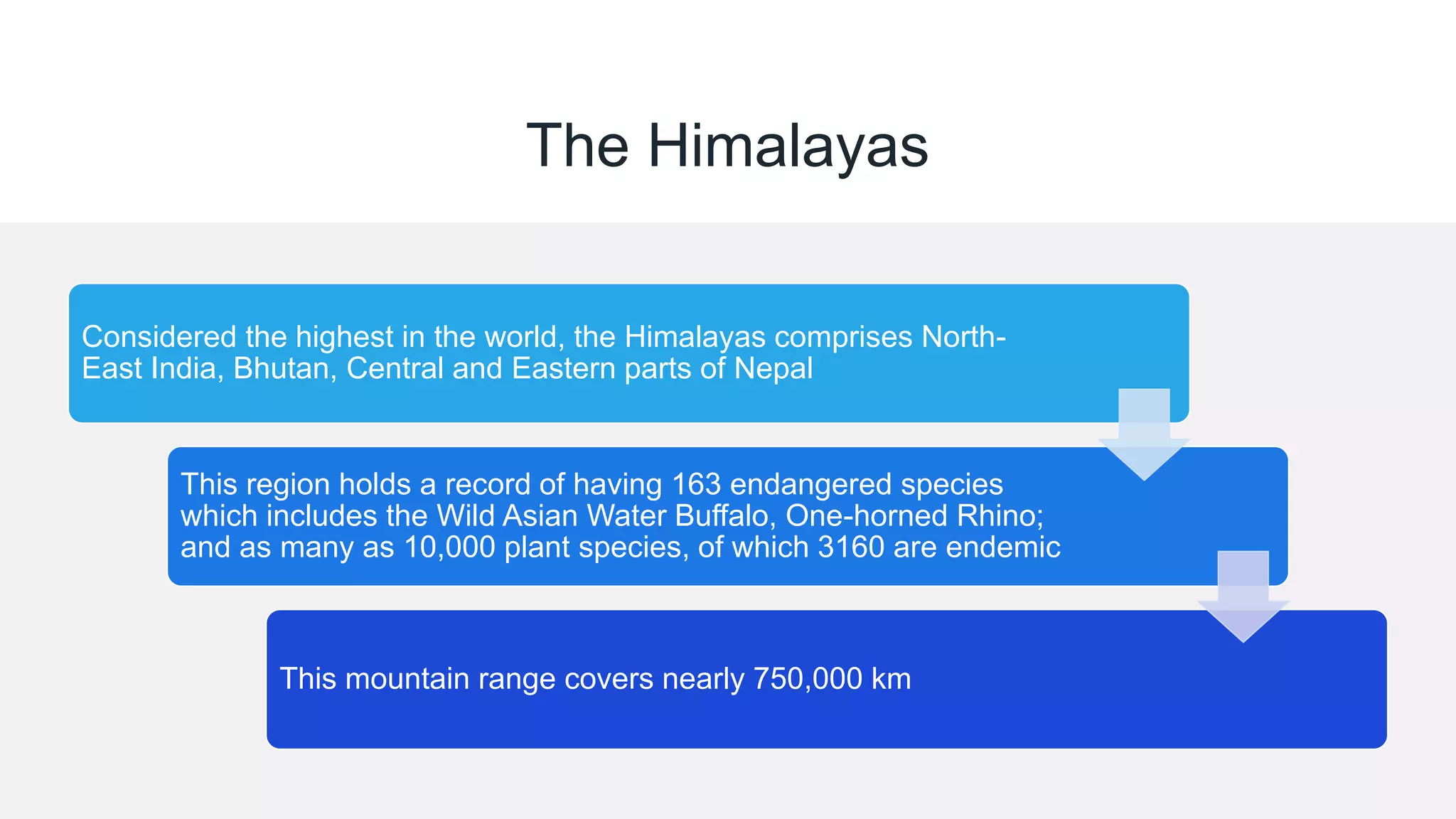
The Himalayas
Considered the highest in the world, the Himalayas comprises North-
East India, Bhutan, Central and Eastern parts of Nepal
This region holds a record of having 163 endangered species
which includes the Wild Asian Water Buffalo, One-horned Rhino;
and as many as 10,000 plant species, of which 3160 are endemic
This mountain range covers nearly 750,000 km
Indo – Burma Region
The Indo-Burma Region is stretched over a distance of 2,373,000 km²
In the last 12 years, 6 large mammal species have been discovered in this
region: the Large-antlered Muntjac, the Annamite Muntjac, the Grey-
shanked Douc, the Annamite Striped Rabbit, the Leaf Deer, and the Saola
This hotspot is also known for the endemic freshwater turtle species, most
of which are threatened with extinction, due to over-harvesting and
extensive habitat loss
The Western Ghats
The Western Ghats are present along the western edge of peninsular
India and covers most of the deciduous forests and rain forests
The region is also known for the globally threatened flora and fauna
represented by 229 plant species, 31 mammal species, 15 bird
species, 43 amphibian species, 5 reptile species and 1 fish species
UNESCO mentions that “Of the total 325 globally threatened species
in the Western Ghats, 129 are classified as Vulnerable, 145 as
Endangered and 51 as Critically Endangered.”
Sundaland
The Sundaland hotspot lies
in South-East Asia and
covers Singapore, Thailand,
Indonesia, Brunei, and
Malaysia
In the year 2013, the
Sundaland was declared as
a World Biosphere Reserve
by the United Nations
Sundaland is one of the
biologically richest hotspots
in the world which
comprises 25,000 species
of vascular plants, of which
15,000 are found only in
this region
Biodiversity in India – Flora, and Fauna
India houses over 500
species of mammals,
more than 200 species of
birds, and 30,000 different
species of insects
The Zoological Survey of
India which is
headquartered in Kolkata
is responsible for
surveying the faunal
resources of India
India has a diverse
climate, topology, and
habitat are known to have
the richest flora in the
world with over 18000
species of flowering plants
Endangered Species of India
According to the International
Union for Conservation of
Nature, “India accounts for 7-
8% of all recorded species,
including over 45,000 species
of plants and 91,000 species
of animals
The species that are at risk of
extinction due to the sudden
decrease in their population
and habitat are known as
endangered species
Biodiversity is in peril while
being one of the most crucial
and complicated traits without
which life would not exist
THREATS OF BIODIVERSITY
Biodiversity threats includes the
worldwide extinction of
different species, as well as the
local reduction or loss of species
in a certain habitat, resulting in a
loss of biological diversity
The latter phenomenon can be
temporary or permanent,
depending on whether
the environmental
degradation that leads to the loss
is reversible through ecological
restoration/ecological resilience or
effectively permanent
The current global extinction , has
resulted in a biodiversity
crisis being driven by human
activities which push beyond
the planetary boundaries and so
far has proven irreversible
The threats are
• Changes to how we use the land and waters - Both our lands
and our seas contain many different ecosystems, and these are
affected by business actions
Overexploitation and unsustainable use
Climate change
Increased pollution
Invasive species
Habitat loss
Overexploitation
and
unsustainable
use
• Habitat loss refers to the reduction in the
amount of space where a
particular species, or group of species can
survive and reproduce
2. Poaching of Wildlife
• poaching, in law, the illegal shooting, trapping, or taking of
game, fish, or plants from private property or from a place where
such practices are specially reserved or forbidden
Modern poaching
Poaching is now usually done for sport or commercial profit,
both in legal and black markets
Poaching can be a serious threat to many wild species,
particularly those protected in wildlife preserves or national
parks
Many animal species have been limited in range or depleted
in numbers, sometimes to the point of extinction, by the
depredations of market hunters and unregulated sportsmen
Efforts to reduce poaching
Game management and other conservation programs throughout the world
have been instituted to counteract the effects of poaching and other threats to
wildlife, reinforced by the patrolling of game wardens to restrain poaching for
commercial profit
Sometimes conflicts can be violent, and wardens, environmentalists, and
poachers have been killed in confrontations over especially valuable
animals and poaching operations
International agreements, such as the Convention on International Trade in
Endangered Species , seek to reduce poaching incentives by regulating
worldwide commercial trade in wild animal and plant species
Human wildlife
conflict
• Since human populations expand into wild
animal habitats, natural wildlife territory is
displaced
• Reduction in the availability of natural
prey/food sources leads to wild animals
seeking alternate sources
• Alternately, new resources created by
humans draw wildlife resulting in conflict
Man-Wildlife
Conflict
• Man-wildlife conflict refers to the interaction
between wild animals and people and the
consequential negative impact on both of them
• World Wide Fund for Nature defines this conflict
as “any interaction between humans and wildlife
that results in a negative impact on human social,
economic, or cultural life, on the conservation of
wildlife population, or on the environment.”
• Although man-wildlife conflict is as old as human
civilization, in modern times the degree of conflict
has been on the rise due to high rise in human
population in the past several centuries
Endemic Species
The concept of
endemic species is
related to the habitat
and geographical
location of species
Endemic species
are those that live in a
limited area, such as a
mountain range, lake or
island, among others
Endemism is linked to
historical and ecological
factors and is different
from the indigenous
species
List of Endemic Species In India
There are a number
of endemic species
of animals in India
Let's have a look at
endemic species and
their geographical
distribution within
India
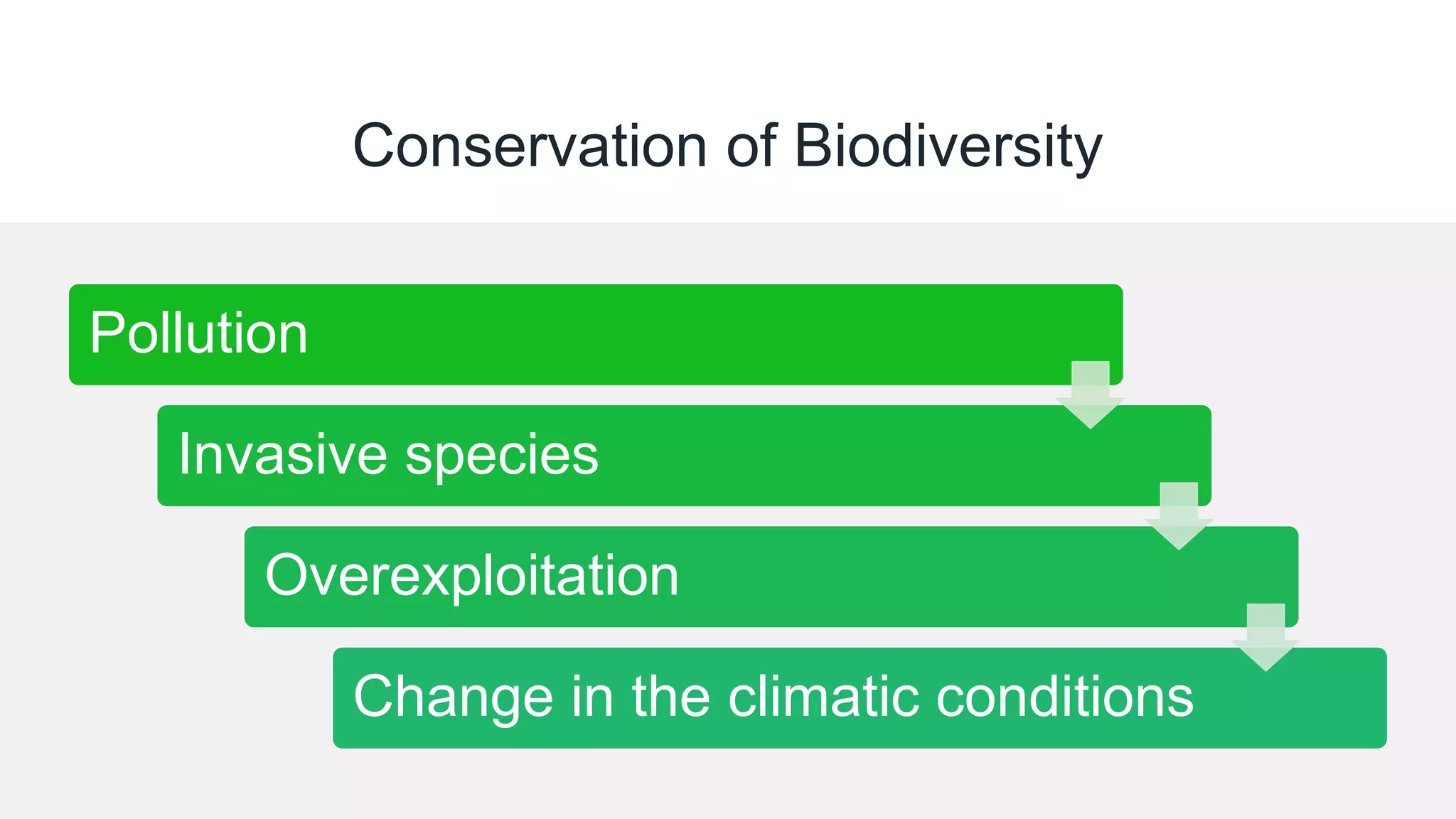
Conservation of Biodiversity
Pollution
Invasive species
Overexploitation
Change in the climatic conditions
In-situ Conservation
It is the methods of
conserving all the living
species, especially the wild
and endangered species in
their natural habitats and
environment
In-situ conservation of
Biodiversity includes
biosphere reserves,
national parks, wildlife
sanctuaries, etc
Ex-situ Conservation
• It is the methods of conserving all the
living species in the artful habitats that
reflect their natural living habitats
• Examples of ex-situ conservation of
biodiversity include aquariums,
botanical gardens, cryopreservation,
DNA banks, zoos, etc

India As A Megadiversity Nation.pptx

  • 1.
    JAIPUR NATIONAL UNIVERSITY SEEDLINGSCHOOL OF NURSING PREPARED BY- (Prof.) Dr. Rahul Sharma HOD of Mental Health Nursing Ph.D. Coordinator Seedling School of Nursing
  • 2.
    India As AMegadiversity Nation
  • 3.
    Introduction The United Nationshas declared the year 2010 as the ‘International Year of Biodiversity’ and the theme for this year’s environment day is “Biodiversity: Connecting with Nature” and India is one of the 12 mega diversity nation in the world India is located in south Asia, between latitude 60 and 380 N and longitudes 690 and 970 E The Indian landmass extending over a total geographical area of about 3029 million hectares is bounded by Himalayas in the north, the Bay of Bengal in east, the Arabian Sea in the west, and Indian Ocean in the south
  • 4.
    Megadiverse India The abovefigure represents a species wise endemic content of the biodiversity in India Biodiversity is a biogeographical area with a large reservoir of biodiversity that is threatened with destruction
  • 5.
    The biodiversity species diversity geneticdiversity ecosystem diversity
  • 6.
  • 7.
    Biodiversity Hotspots in India- Himalayas, Indo- Burma, Western Ghats & Sundaland Biodiversity is referred to as the variation of plant and animal species in a particular habitat India is known for its rich biodiversity and has around 24.46% of the geographical area covered by forests and trees Coined by Norman Myers, the term “Biodiversity hotspots” can be defined as the regions which are known for their high species richness and endemism
  • 8.
    Biodiversity Hotspots –2 Main Qualifying Criteria The region should have at least 1500 species of vascular plants i.e., it should have a high degree of endemism It must contain 30% of its original habitat, i.e. it must be threatened The Himalayas Indo-Burma Region The Western Ghats Sundaland
  • 9.
    The Himalayas Considered thehighest in the world, the Himalayas comprises North- East India, Bhutan, Central and Eastern parts of Nepal This region holds a record of having 163 endangered species which includes the Wild Asian Water Buffalo, One-horned Rhino; and as many as 10,000 plant species, of which 3160 are endemic This mountain range covers nearly 750,000 km
  • 10.
    Indo – BurmaRegion The Indo-Burma Region is stretched over a distance of 2,373,000 km² In the last 12 years, 6 large mammal species have been discovered in this region: the Large-antlered Muntjac, the Annamite Muntjac, the Grey- shanked Douc, the Annamite Striped Rabbit, the Leaf Deer, and the Saola This hotspot is also known for the endemic freshwater turtle species, most of which are threatened with extinction, due to over-harvesting and extensive habitat loss
  • 11.
    The Western Ghats TheWestern Ghats are present along the western edge of peninsular India and covers most of the deciduous forests and rain forests The region is also known for the globally threatened flora and fauna represented by 229 plant species, 31 mammal species, 15 bird species, 43 amphibian species, 5 reptile species and 1 fish species UNESCO mentions that “Of the total 325 globally threatened species in the Western Ghats, 129 are classified as Vulnerable, 145 as Endangered and 51 as Critically Endangered.”
  • 12.
    Sundaland The Sundaland hotspotlies in South-East Asia and covers Singapore, Thailand, Indonesia, Brunei, and Malaysia In the year 2013, the Sundaland was declared as a World Biosphere Reserve by the United Nations Sundaland is one of the biologically richest hotspots in the world which comprises 25,000 species of vascular plants, of which 15,000 are found only in this region
  • 13.
    Biodiversity in India– Flora, and Fauna India houses over 500 species of mammals, more than 200 species of birds, and 30,000 different species of insects The Zoological Survey of India which is headquartered in Kolkata is responsible for surveying the faunal resources of India India has a diverse climate, topology, and habitat are known to have the richest flora in the world with over 18000 species of flowering plants
  • 14.
    Endangered Species ofIndia According to the International Union for Conservation of Nature, “India accounts for 7- 8% of all recorded species, including over 45,000 species of plants and 91,000 species of animals The species that are at risk of extinction due to the sudden decrease in their population and habitat are known as endangered species Biodiversity is in peril while being one of the most crucial and complicated traits without which life would not exist
  • 15.
    THREATS OF BIODIVERSITY Biodiversitythreats includes the worldwide extinction of different species, as well as the local reduction or loss of species in a certain habitat, resulting in a loss of biological diversity The latter phenomenon can be temporary or permanent, depending on whether the environmental degradation that leads to the loss is reversible through ecological restoration/ecological resilience or effectively permanent The current global extinction , has resulted in a biodiversity crisis being driven by human activities which push beyond the planetary boundaries and so far has proven irreversible
  • 16.
    The threats are •Changes to how we use the land and waters - Both our lands and our seas contain many different ecosystems, and these are affected by business actions
  • 17.
    Overexploitation and unsustainableuse Climate change Increased pollution Invasive species Habitat loss
  • 18.
    Overexploitation and unsustainable use • Habitat lossrefers to the reduction in the amount of space where a particular species, or group of species can survive and reproduce
  • 19.
    2. Poaching ofWildlife • poaching, in law, the illegal shooting, trapping, or taking of game, fish, or plants from private property or from a place where such practices are specially reserved or forbidden
  • 20.
    Modern poaching Poaching isnow usually done for sport or commercial profit, both in legal and black markets Poaching can be a serious threat to many wild species, particularly those protected in wildlife preserves or national parks Many animal species have been limited in range or depleted in numbers, sometimes to the point of extinction, by the depredations of market hunters and unregulated sportsmen
  • 21.
    Efforts to reducepoaching Game management and other conservation programs throughout the world have been instituted to counteract the effects of poaching and other threats to wildlife, reinforced by the patrolling of game wardens to restrain poaching for commercial profit Sometimes conflicts can be violent, and wardens, environmentalists, and poachers have been killed in confrontations over especially valuable animals and poaching operations International agreements, such as the Convention on International Trade in Endangered Species , seek to reduce poaching incentives by regulating worldwide commercial trade in wild animal and plant species
  • 22.
    Human wildlife conflict • Sincehuman populations expand into wild animal habitats, natural wildlife territory is displaced • Reduction in the availability of natural prey/food sources leads to wild animals seeking alternate sources • Alternately, new resources created by humans draw wildlife resulting in conflict
  • 23.
    Man-Wildlife Conflict • Man-wildlife conflictrefers to the interaction between wild animals and people and the consequential negative impact on both of them • World Wide Fund for Nature defines this conflict as “any interaction between humans and wildlife that results in a negative impact on human social, economic, or cultural life, on the conservation of wildlife population, or on the environment.” • Although man-wildlife conflict is as old as human civilization, in modern times the degree of conflict has been on the rise due to high rise in human population in the past several centuries
  • 24.
    Endemic Species The conceptof endemic species is related to the habitat and geographical location of species Endemic species are those that live in a limited area, such as a mountain range, lake or island, among others Endemism is linked to historical and ecological factors and is different from the indigenous species
  • 25.
    List of EndemicSpecies In India There are a number of endemic species of animals in India Let's have a look at endemic species and their geographical distribution within India
  • 26.
    Conservation of Biodiversity Pollution Invasivespecies Overexploitation Change in the climatic conditions
  • 27.
    In-situ Conservation It isthe methods of conserving all the living species, especially the wild and endangered species in their natural habitats and environment In-situ conservation of Biodiversity includes biosphere reserves, national parks, wildlife sanctuaries, etc
  • 28.
    Ex-situ Conservation • Itis the methods of conserving all the living species in the artful habitats that reflect their natural living habitats • Examples of ex-situ conservation of biodiversity include aquariums, botanical gardens, cryopreservation, DNA banks, zoos, etc