www.dineshvns.com
what is FDI?

www.dineshvns.com
The commitment of money or
capital to purchase financial
instruments or assets in order to
gain profitable returns.

www.dineshvns.com
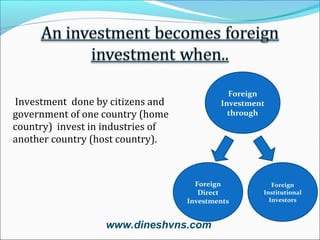
Foreign
Investment
through

Investment done by citizens and
government of one country (home
country) invest in industries of
another country (host country).

Foreign
Direct
Investments

www.dineshvns.com

Foreign
Institutional
Investors
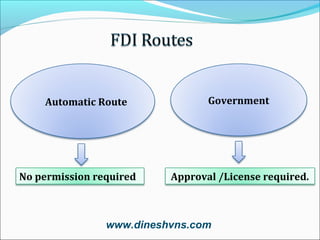
Automatic Route

No permission required

Government

Approval /License required.

www.dineshvns.com
• One of the world's largest industries exceeding US$ 9
trillion.
• Dominated by developed countries.
• 47 global fortune companies & 25 of Asia's top 200
companies are retailers.
• US, EU & Japan constitute 80% of world retail sales.

www.dineshvns.com
• Retail trade in Europe employs 15% of the European
workforce (3 million firms and 13 million workers).
• The world’s population is poised to expand 50% by 2050.
The world currently comprises of 78% poor, 11% middle
income and 11% rich.

www.dineshvns.com
www.dineshvns.com
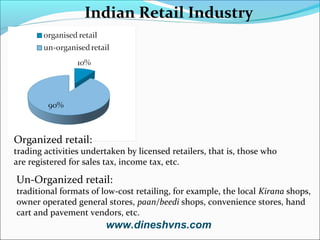
Indian Retail Industry

Organized retail:

trading activities undertaken by licensed retailers, that is, those who
are registered for sales tax, income tax, etc.

Un-Organized retail:

traditional formats of low-cost retailing, for example, the local Kirana shops,
owner operated general stores, paan/beedi shops, convenience stores, hand
cart and pavement vendors, etc.

www.dineshvns.com
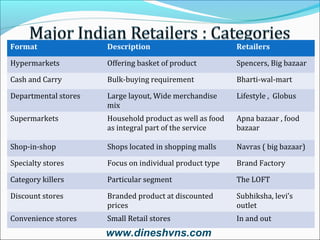
Format

Description

Retailers

Hypermarkets

Offering basket of product

Spencers, Big bazaar

Cash and Carry

Bulk-buying requirement

Bharti-wal-mart

Departmental stores

Large layout, Wide merchandise
mix

Lifestyle , Globus

Supermarkets

Household product as well as food
as integral part of the service

Apna bazaar , food
bazaar

Shop-in-shop

Shops located in shopping malls

Navras ( big bazaar)

Specialty stores

Focus on individual product type

Brand Factory

Category killers

Particular segment

The LOFT

Discount stores

Branded product at discounted
prices

Subhiksha, levi’s
outlet

Convenience stores

Small Retail stores

In and out

www.dineshvns.com
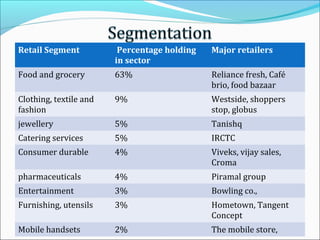
Retail Segment

Percentage holding
in sector

Major retailers

Food and grocery

63%

Reliance fresh, Café
brio, food bazaar

Clothing, textile and
fashion

9%

Westside, shoppers
stop, globus

jewellery

5%

Tanishq

Catering services

5%

IRCTC

Consumer durable

4%

Viveks, vijay sales,
Croma

pharmaceuticals

4%

Piramal group

Entertainment

3%

Bowling co.,

Furnishing, utensils

3%

Hometown, Tangent
Concept

Mobile handsets

2%

The mobile store,
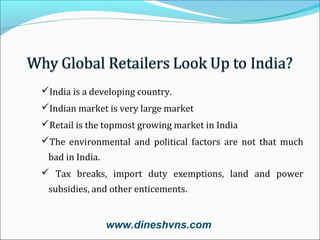
India is a developing country.
Indian market is very large market
Retail is the topmost growing market in India
The environmental and political factors are not that much
bad in India.
 Tax breaks, import duty exemptions, land and power
subsidies, and other enticements.

www.dineshvns.com
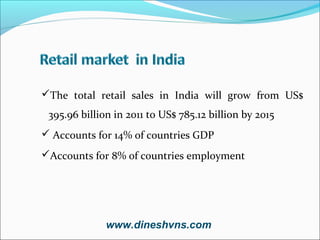
The total retail sales in India will grow from US$
395.96 billion in 2011 to US$ 785.12 billion by 2015
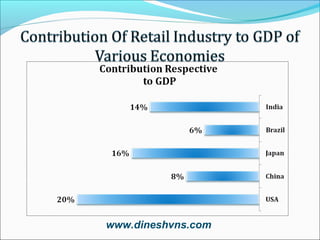
 Accounts for 14% of countries GDP
Accounts for 8% of countries employment

www.dineshvns.com
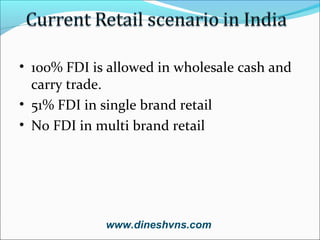
• 100% FDI is allowed in wholesale cash and
carry trade.
• 51% FDI in single brand retail
• No FDI in multi brand retail

www.dineshvns.com
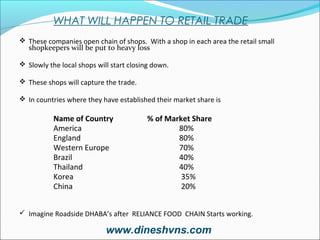
WHAT WILL HAPPEN TO RETAIL TRADE
 These companies open chain of shops. With a shop in each area the retail small
shopkeepers will be put to heavy loss
 Slowly the local shops will start closing down.
 These shops will capture the trade.
 In countries where they have established their market share is

Name of Country
America
England
Western Europe
Brazil
Thailand
Korea
China

% of Market Share
80%
80%
70%
40%
40%
35%
20%

 Imagine Roadside DHABA’s after RELIANCE FOOD CHAIN Starts working.

www.dineshvns.com
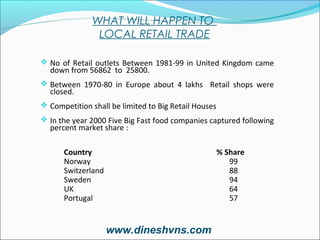
WHAT WILL HAPPEN TO
LOCAL RETAIL TRADE
 No of Retail outlets Between 1981-99 in United Kingdom came

down from 56862 to 25800.

 Between 1970-80 in Europe about 4 lakhs Retail shops were

closed.

 Competition shall be limited to Big Retail Houses
 In the year 2000 Five Big Fast food companies captured following

percent market share :
Country
Norway
Switzerland
Sweden
UK
Portugal

% Share
99
88
94
64
57

www.dineshvns.com
WHAT HAPPENED IN THAILAND
 In price war traditional shop keepers are facing problem of survival. Many

small shop keepers have closed down their shops.

 Big companies have seen growth of 40%
 There was adverse impact on 60000 small shopkeepers.
 The Prime Minister of Thailand agreed that there was adverse impact on

retail trade.

 The Govt. which had opened its door for FDI in retail trade with big bang

had to provide financial assistance to retail traders by establishing a special
fund.

www.dineshvns.com
Now its India’s turn
Threat on unorganized retail players
Threat on organized retail players
 Marginalize the domestic players
 Huge spread of retail chain stores
 Monopoly in the customer market and can be converted into cartel of

global players.
 Monopoly among suppliers

www.dineshvns.com
FDI in organized multi brand retail:
India not yet ready
Employment loss:
 There are about 35 towns in India with population exceeding 1 million.

There are at least 4, 32,000 people employed in these towns in India in
small-scale to medium-scale shops. With the entry of big chains, many of
them will lose jobs.

 In food retail, farmers (the producers right at the tip of the back end chain)

being left at the mercy of the foreign investors

Inflation cannot be checked:
The point is that inflation cannot be checked as consumers would still have
to bear the cost

www.dineshvns.com
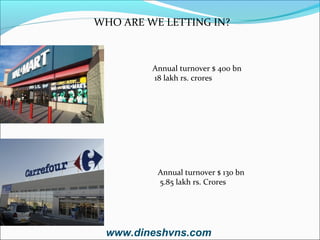
WHO ARE WE LETTING IN?

Annual turnover $ 400 bn
18 lakh rs. crores

Annual turnover $ 130 bn
5.85 lakh rs. Crores

www.dineshvns.com
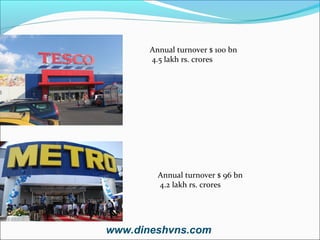
Annual turnover $ 100 bn
4.5 lakh rs. crores

Annual turnover $ 96 bn
4.2 lakh rs. crores

www.dineshvns.com
 Introduction Of

Brief Introduction Of IKEA

www.dineshvns.com
Cont….
 These are some of the ferocious, predatory companies in the world.
 Their practices in the market are ruthless and designed to wipe out

competition.

 Their resources are enormous. They can invest and lose money for

years till then lakh of local retailers will be wiped out.

www.dineshvns.com
Comparison between Wal-mart and Indian
retail industry
 The annual turnover of Wal-Mart (Sales in 2010 were $409 billion) is

higher than the size of Indian retail industry (estimated at about $370
billion) and almost 100times more than the turnover of HUL (India's
largest FMCG company).

 The size of any Wal-Mart store is much higher than the size of any

existing shopping mall in India.

 Wal-Mart has over 8500 stores (over 95 million square meters) where

as none of India's large format store (Shoppers' Stop, Westside,
Lifestyle) have more than 250.

www.dineshvns.com
Cont….
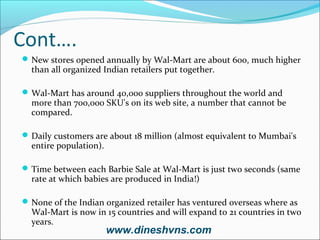
 New stores opened annually by Wal-Mart are about 600, much higher

than all organized Indian retailers put together.

 Wal-Mart has around 40,000 suppliers throughout the world and

more than 700,000 SKU's on its web site, a number that cannot be
compared.

 Daily customers are about 18 million (almost equivalent to Mumbai's

entire population).

 Time between each Barbie Sale at Wal-Mart is just two seconds (same

rate at which babies are produced in India!)

 None of the Indian organized retailer has ventured overseas where as

Wal-Mart is now in 15 countries and will expand to 21 countries in two
years.

www.dineshvns.com
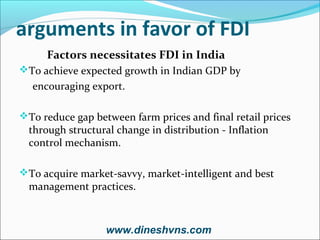
arguments in favor of FDI
Factors necessitates FDI in India
To achieve expected growth in Indian GDP by

encouraging export.
To reduce gap between farm prices and final retail prices

through structural change in distribution - Inflation
control mechanism.

To acquire market-savvy, market-intelligent and best

management practices.

www.dineshvns.com
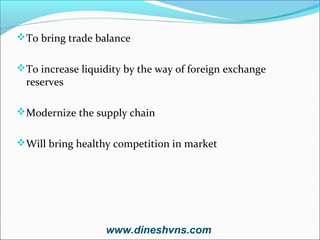
To bring trade balance
To increase liquidity by the way of foreign exchange

reserves

Modernize the supply chain
Will bring healthy competition in market

www.dineshvns.com
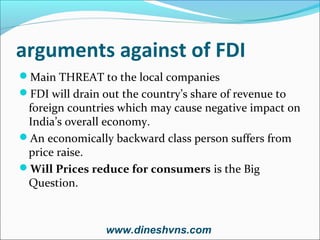
arguments against of FDI
Main THREAT to the local companies
FDI will drain out the country’s share of revenue to

foreign countries which may cause negative impact on
India’s overall economy.
An economically backward class person suffers from
price raise.
Will Prices reduce for consumers is the Big
Question.

www.dineshvns.com
Thank you
for Your Interest
Visit: www.dineshvns.com

Fdi's in retail

  • 1.
  • 2.
  • 3.
    The commitment ofmoney or capital to purchase financial instruments or assets in order to gain profitable returns. www.dineshvns.com
  • 4.
    Foreign Investment through Investment done bycitizens and government of one country (home country) invest in industries of another country (host country). Foreign Direct Investments www.dineshvns.com Foreign Institutional Investors
  • 5.
    Automatic Route No permissionrequired Government Approval /License required. www.dineshvns.com
  • 6.
    • One ofthe world's largest industries exceeding US$ 9 trillion. • Dominated by developed countries. • 47 global fortune companies & 25 of Asia's top 200 companies are retailers. • US, EU & Japan constitute 80% of world retail sales. www.dineshvns.com
  • 7.
    • Retail tradein Europe employs 15% of the European workforce (3 million firms and 13 million workers). • The world’s population is poised to expand 50% by 2050. The world currently comprises of 78% poor, 11% middle income and 11% rich. www.dineshvns.com
  • 8.
  • 9.
    Indian Retail Industry Organizedretail: trading activities undertaken by licensed retailers, that is, those who are registered for sales tax, income tax, etc. Un-Organized retail: traditional formats of low-cost retailing, for example, the local Kirana shops, owner operated general stores, paan/beedi shops, convenience stores, hand cart and pavement vendors, etc. www.dineshvns.com
  • 10.
    Format Description Retailers Hypermarkets Offering basket ofproduct Spencers, Big bazaar Cash and Carry Bulk-buying requirement Bharti-wal-mart Departmental stores Large layout, Wide merchandise mix Lifestyle , Globus Supermarkets Household product as well as food as integral part of the service Apna bazaar , food bazaar Shop-in-shop Shops located in shopping malls Navras ( big bazaar) Specialty stores Focus on individual product type Brand Factory Category killers Particular segment The LOFT Discount stores Branded product at discounted prices Subhiksha, levi’s outlet Convenience stores Small Retail stores In and out www.dineshvns.com
  • 11.
    Retail Segment Percentage holding insector Major retailers Food and grocery 63% Reliance fresh, Café brio, food bazaar Clothing, textile and fashion 9% Westside, shoppers stop, globus jewellery 5% Tanishq Catering services 5% IRCTC Consumer durable 4% Viveks, vijay sales, Croma pharmaceuticals 4% Piramal group Entertainment 3% Bowling co., Furnishing, utensils 3% Hometown, Tangent Concept Mobile handsets 2% The mobile store,
  • 12.
    India is adeveloping country. Indian market is very large market Retail is the topmost growing market in India The environmental and political factors are not that much bad in India.  Tax breaks, import duty exemptions, land and power subsidies, and other enticements. www.dineshvns.com
  • 13.
    The total retailsales in India will grow from US$ 395.96 billion in 2011 to US$ 785.12 billion by 2015  Accounts for 14% of countries GDP Accounts for 8% of countries employment www.dineshvns.com
  • 14.
    • 100% FDIis allowed in wholesale cash and carry trade. • 51% FDI in single brand retail • No FDI in multi brand retail www.dineshvns.com
  • 15.
    WHAT WILL HAPPENTO RETAIL TRADE  These companies open chain of shops. With a shop in each area the retail small shopkeepers will be put to heavy loss  Slowly the local shops will start closing down.  These shops will capture the trade.  In countries where they have established their market share is Name of Country America England Western Europe Brazil Thailand Korea China % of Market Share 80% 80% 70% 40% 40% 35% 20%  Imagine Roadside DHABA’s after RELIANCE FOOD CHAIN Starts working. www.dineshvns.com
  • 16.
    WHAT WILL HAPPENTO LOCAL RETAIL TRADE  No of Retail outlets Between 1981-99 in United Kingdom came down from 56862 to 25800.  Between 1970-80 in Europe about 4 lakhs Retail shops were closed.  Competition shall be limited to Big Retail Houses  In the year 2000 Five Big Fast food companies captured following percent market share : Country Norway Switzerland Sweden UK Portugal % Share 99 88 94 64 57 www.dineshvns.com
  • 17.
    WHAT HAPPENED INTHAILAND  In price war traditional shop keepers are facing problem of survival. Many small shop keepers have closed down their shops.  Big companies have seen growth of 40%  There was adverse impact on 60000 small shopkeepers.  The Prime Minister of Thailand agreed that there was adverse impact on retail trade.  The Govt. which had opened its door for FDI in retail trade with big bang had to provide financial assistance to retail traders by establishing a special fund. www.dineshvns.com
  • 18.
    Now its India’sturn Threat on unorganized retail players Threat on organized retail players  Marginalize the domestic players  Huge spread of retail chain stores  Monopoly in the customer market and can be converted into cartel of global players.  Monopoly among suppliers www.dineshvns.com
  • 19.
    FDI in organizedmulti brand retail: India not yet ready Employment loss:  There are about 35 towns in India with population exceeding 1 million. There are at least 4, 32,000 people employed in these towns in India in small-scale to medium-scale shops. With the entry of big chains, many of them will lose jobs.  In food retail, farmers (the producers right at the tip of the back end chain) being left at the mercy of the foreign investors Inflation cannot be checked: The point is that inflation cannot be checked as consumers would still have to bear the cost www.dineshvns.com
  • 20.
    WHO ARE WELETTING IN? Annual turnover $ 400 bn 18 lakh rs. crores Annual turnover $ 130 bn 5.85 lakh rs. Crores www.dineshvns.com
  • 21.
    Annual turnover $100 bn 4.5 lakh rs. crores Annual turnover $ 96 bn 4.2 lakh rs. crores www.dineshvns.com
  • 22.
     Introduction Of BriefIntroduction Of IKEA www.dineshvns.com
  • 23.
    Cont….  These aresome of the ferocious, predatory companies in the world.  Their practices in the market are ruthless and designed to wipe out competition.  Their resources are enormous. They can invest and lose money for years till then lakh of local retailers will be wiped out. www.dineshvns.com
  • 24.
    Comparison between Wal-martand Indian retail industry  The annual turnover of Wal-Mart (Sales in 2010 were $409 billion) is higher than the size of Indian retail industry (estimated at about $370 billion) and almost 100times more than the turnover of HUL (India's largest FMCG company).  The size of any Wal-Mart store is much higher than the size of any existing shopping mall in India.  Wal-Mart has over 8500 stores (over 95 million square meters) where as none of India's large format store (Shoppers' Stop, Westside, Lifestyle) have more than 250. www.dineshvns.com
  • 25.
    Cont….  New storesopened annually by Wal-Mart are about 600, much higher than all organized Indian retailers put together.  Wal-Mart has around 40,000 suppliers throughout the world and more than 700,000 SKU's on its web site, a number that cannot be compared.  Daily customers are about 18 million (almost equivalent to Mumbai's entire population).  Time between each Barbie Sale at Wal-Mart is just two seconds (same rate at which babies are produced in India!)  None of the Indian organized retailer has ventured overseas where as Wal-Mart is now in 15 countries and will expand to 21 countries in two years. www.dineshvns.com
  • 26.
    arguments in favorof FDI Factors necessitates FDI in India To achieve expected growth in Indian GDP by encouraging export. To reduce gap between farm prices and final retail prices through structural change in distribution - Inflation control mechanism. To acquire market-savvy, market-intelligent and best management practices. www.dineshvns.com
  • 27.
    To bring tradebalance To increase liquidity by the way of foreign exchange reserves Modernize the supply chain Will bring healthy competition in market www.dineshvns.com
  • 28.
    arguments against ofFDI Main THREAT to the local companies FDI will drain out the country’s share of revenue to foreign countries which may cause negative impact on India’s overall economy. An economically backward class person suffers from price raise. Will Prices reduce for consumers is the Big Question. www.dineshvns.com
  • 29.
    Thank you for YourInterest Visit: www.dineshvns.com