Lesson 6 – Biodiversity
P.B. Dharmasena
0777 613234, 0717 613234
dharmasenapb@ymail.com , dharmasenapb@gmail.com
https://independent.academia.edu/PunchiBandageDharmasena
https://www.researchgate.net/profile/Punchi_Bandage_Dharmasena/contributions
http://www.slideshare.net/DharmasenaPb
Foundation of Environmental Management
Course code: EMGT 2114
Friday from 8.30-11.30 a.m
Course Content
1.Concepts of Ecology and Environmental
Biology
2.Biogeochemical Cycles (C, N, P etc.)
3.Ecosystems and Energy Flow
4.Ecosystem Functions and Ecosystem
services
5.History of Environmental Science
6.Biodiversity
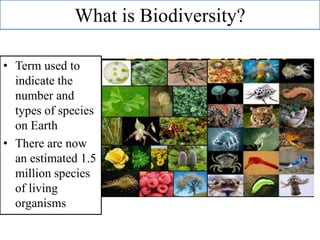
What is Biodiversity?
• Term used to
indicate the
number and
types of species
on Earth
• There are now
an estimated 1.5
million species
of living
organisms
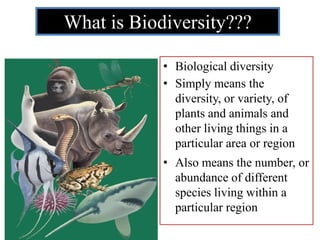
What is Biodiversity???
• Biological diversity
• Simply means the
diversity, or variety, of
plants and animals and
other living things in a
particular area or region
• Also means the number, or
abundance of different
species living within a
particular region
What is biodiversity?
• Biodiversity is the variability among living organisms from all
sources, including terrestrial, marine, and other
aquatic ecosystems and the ecological complexes of which
they are part; this includes diversity within species, between
species, and of ecosystems.
• Biodiversity forms the foundation of the vast array
of ecosystem services that critically contribute to human well-
being.
• Biodiversity is important in human-managed as well as natural
ecosystems.
• Decisions humans make that influence biodiversity affect the
well-being of themselves and others.
Biodiversity includes all ecosystems—managed
or unmanaged.
• Sometimes biodiversity is presumed to be a relevant
feature of only unmanaged ecosystems, such as wild
lands, nature preserves, or national parks. This is
incorrect. Managed systems—be they plantations, farms,
Croplands, aquaculture sites, rangelands, or even urban
parks and urban ecosystems—have their own
biodiversity.
• Given that cultivated systems alone now account for more
than 24% of Earth’s terrestrial surface, it is critical that
any decision concerning biodiversity or ecosystem
services address the maintenance of biodiversity in these
largely anthropogenic systems
Why is Biodiversity important?
• Earth’s greatest
natural resource
• Species of many kinds
have provided us
with:
– Food: beef,
chicken, salad
– Industrial
Products: paper,
rubber
– Medicines:
painkillers,
antibiotics,
anticancer drugs
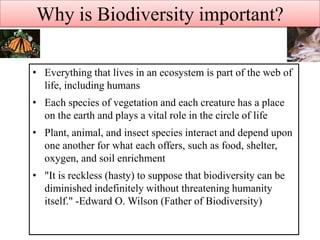
• Everything that lives in an ecosystem is part of the web of
life, including humans
• Each species of vegetation and each creature has a place
on the earth and plays a vital role in the circle of life
• Plant, animal, and insect species interact and depend upon
one another for what each offers, such as food, shelter,
oxygen, and soil enrichment
• "It is reckless (hasty) to suppose that biodiversity can be
diminished indefinitely without threatening humanity
itself." -Edward O. Wilson (Father of Biodiversity)
Why is Biodiversity important?
Why is biodiversity important?
 Human beings are dependent for
their health, well-being and
enjoyment of life on basic
biological systems and processes.
 People get food and many
medicines and industrial products
from the wild and domesticated
components of biological
diversity.
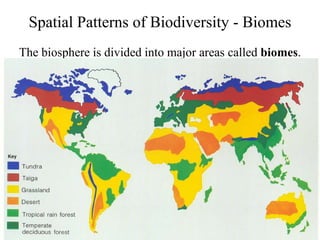
Spatial Patterns of Biodiversity - Biomes
The biosphere is divided into major areas called biomes.
Levels of Organizations
• Species
– Group of organisms so
similar to one another
that they can breed and
produce fertile offspring
• Population
– A group of individuals that
belong to the same
species and live in the
same area
• Community
– All the different populations that
live together in a defined area
• Ecosystem
– Collection of all the organisms
that live in a particular place,
together with their nonliving
environment
• Biome
– A group of ecosystems that have
the same climate and dominant
communities
• Biosphere
– Biosphere is the global ecological
system integrating all living beings
and their relationships.
BIOMES
• A biome is determined mainly by its climate-
like temperature and rainfall.
• Each biome has a different climate, which, in
turn, affects the soil.
• The earth’s land areas are divided into 6 major
biomes.
1. TUNDRA
• Bitterly cold and covered
with snow and ice.
• Ground remains
permanently frozen
(permafrost).
• Only certain small plants
such as mosses and
grasses can grow.
• Some animals like
reindeer and foxes move
in during the growing
season.
2. CONIFEROUS FOREST (TAIGA)
• Confers = cone-bearing
trees (pines, fir)
• Cold climate
• Dense forests (tree tops
block out a lot of sunlight)
• Grasses, small trees cannot
grow – only some shrubs,
ferns and mosses thrive.
• Animals such as squirrels,
moose (sambur), birds, and
insects live here.
3. DECIDUOUS (TEMPERATE) FOREST
• Maples and oaks –
shed leaves in Fall.
• Thrive in moderate
climates.
• Summers may be hot
and winters may be
cold.
• Receive a good supply
of water.
• Dense forests
• Provides habitats for
many animals.
4. TROPICAL RAIN FOREST
• Very warm and very
moist all the time.
• Receives plenty of
sunlight and rain.
• Excellent for plant
growth and soil
development.
• Plants grow thick and
tall.
• Found in areas near the
equator.
• Support more plant life
and animal species than
any other biome.
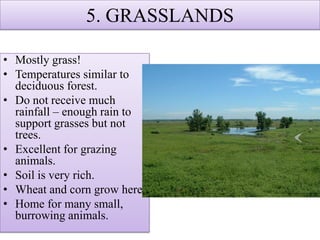
5. GRASSLANDS
• Mostly grass!
• Temperatures similar to
deciduous forest.
• Do not receive much
rainfall – enough rain to
support grasses but not
trees.
• Excellent for grazing
animals.
• Soil is very rich.
• Wheat and corn grow here.
• Home for many small,
burrowing animals.
6. DESERT
• Very dry; receives
very little rainfall.
• Very hot during the
day, cold at night.
• Soil is very dry and
poor.
• Only a few kinds of
plants grow in the
desert.
• Very few animals can
survive in the desert.
1. Genetic diversity
2. Species diversity
3. Ecosystem diversity
3 Types of Biodiversity
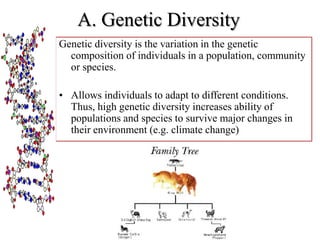
Genetic diversity is the variation in the genetic
composition of individuals in a population, community
or species.
• Allows individuals to adapt to different conditions.
Thus, high genetic diversity increases ability of
populations and species to survive major changes in
their environment (e.g. climate change)
A. Genetic Diversity
• Species diversity is the variety of species (group
of interbreeding organisms) in a particular
habitat or ecosystem.
• The diversity of the smaller organisms (e.g.
phytoplankton, the plants of sea) is less known
than the larger organisms (e.g. mammals such as
dolphins and whales).
B. Species Diversity
• Ecosystem diversity describes the variation in all living
and non-living things in a particular geographic or
ecological region. Ecosystems comprise unique
combinations of animals, plants, micro-organisms and
physical characteristics that define a location.
C. Ecosystem Diversity
Ecosystem diversity: it represents the collective
response of a community of species to different
environments.
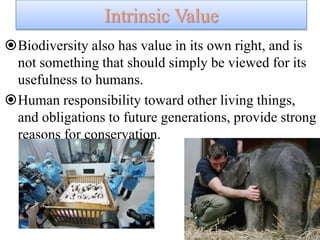
Intrinsic Value
Biodiversity also has value in its own right, and is
not something that should simply be viewed for its
usefulness to humans.
Human responsibility toward other living things,
and obligations to future generations, provide strong
reasons for conservation.
n purifying water
n fixing nitrogen
n recycling nutrients and waste
n pollinating crops
Plants and bacteria carry out photosynthesis, which
produces the oxygen we breathe. Trees absorb carbon
dioxide, the main greenhouse gas given off by human
activities.
Many species keep us alive! How?
Measuring Biodiversity: Species Richness
and Indicators
• In spite of many tools and data sources, biodiversity remains difficult to
quantify precisely.
• But precise answers are seldom needed to devise an effective
understanding of where biodiversity is, how it is changing over space
and time, the drivers responsible for such change, the consequences of
such change for ecosystem services and human well-being, and the
response options available.
• Ideally, to assess the conditions and trends of biodiversity either globally
or sub-globally, it is necessary to measure the abundance of all
organisms over space and time, using taxonomy (such as the number
of species), functional traits (for example, the ecological type such as
nitrogen-fixing plants like legumes versus non-nitrogen-fixing plants),
and the interactions among species that affect their dynamics and
function (predation, parasitism, compe­tition, and facilitation such as
pollination, for instance, and how strongly such interactions
affect ecosystems).
Measuring Biodiversity: Species Richness
and Indicators
• Even more important would be
to estimate turnover of
biodiversity, not just point
estimates in space or time.
• Currently, it is not possible to do
this with much accuracy because
the data are lacking.
• Even for the taxonomic
component of biodiversity,
where information is the best,
considerable uncertainty remains
about the true extent and
changes in Taxonomic diversity
Measuring Biodiversity: Species Richness
and Indicators
• There are many measures
of biodiversity; Species ric
hness (the number of
species in a given area)
represents a single but
important metric that is
valuable as the common
currency of the diversity of
life—but it must be
integrated with other
metrics to fully capture
biodiversity.
Measuring Biodiversity: Species Richness
and Indicators
• Ecological indicators are
scientific constructs that
use quantitative data to
measure aspects
of biodiversity, ecosystem
condition, services,
or drivers of change, but
no single ecological
indicator captures all the
dimensions of biodiversity
‘Academic’ ways of measuring biodiversity
Species level
• Richness: Total number of species in an area
(α diversity)
• Species turnover along a gradient (β diversity)
Ecosystem level
• Number of different habitats or ecosystems (γ
diversity)
Genetic level
• Genetic homology
• Cladistic (zoological) distance
‘Policy’ ways of measuring biodiversity
• ‘Extinction based’ (IUCN)
– Threatened species (Red Data Books)
• ‘Area based’ (Millennium goals)
– Area under protection
– Area of a key habitat (eg Forest cover)
• ‘Richness based’
– Indicator groups or species Ex. Rapid Biodiversity
Assessment
• Complementarity –based
– Various conservation optimisation tools
• Various spatial representations
– Hotspots, last wild places
Measuring Biodiversity
Lesson 6. biodiversity

Lesson 6. biodiversity

  • 1.
    Lesson 6 –Biodiversity P.B. Dharmasena 0777 613234, 0717 613234 dharmasenapb@ymail.com , dharmasenapb@gmail.com https://independent.academia.edu/PunchiBandageDharmasena https://www.researchgate.net/profile/Punchi_Bandage_Dharmasena/contributions http://www.slideshare.net/DharmasenaPb Foundation of Environmental Management Course code: EMGT 2114 Friday from 8.30-11.30 a.m
  • 2.
    Course Content 1.Concepts ofEcology and Environmental Biology 2.Biogeochemical Cycles (C, N, P etc.) 3.Ecosystems and Energy Flow 4.Ecosystem Functions and Ecosystem services 5.History of Environmental Science 6.Biodiversity
  • 3.
    What is Biodiversity? •Term used to indicate the number and types of species on Earth • There are now an estimated 1.5 million species of living organisms
  • 4.
    What is Biodiversity??? •Biological diversity • Simply means the diversity, or variety, of plants and animals and other living things in a particular area or region • Also means the number, or abundance of different species living within a particular region
  • 5.
    What is biodiversity? •Biodiversity is the variability among living organisms from all sources, including terrestrial, marine, and other aquatic ecosystems and the ecological complexes of which they are part; this includes diversity within species, between species, and of ecosystems. • Biodiversity forms the foundation of the vast array of ecosystem services that critically contribute to human well- being. • Biodiversity is important in human-managed as well as natural ecosystems. • Decisions humans make that influence biodiversity affect the well-being of themselves and others.
  • 6.
    Biodiversity includes allecosystems—managed or unmanaged. • Sometimes biodiversity is presumed to be a relevant feature of only unmanaged ecosystems, such as wild lands, nature preserves, or national parks. This is incorrect. Managed systems—be they plantations, farms, Croplands, aquaculture sites, rangelands, or even urban parks and urban ecosystems—have their own biodiversity. • Given that cultivated systems alone now account for more than 24% of Earth’s terrestrial surface, it is critical that any decision concerning biodiversity or ecosystem services address the maintenance of biodiversity in these largely anthropogenic systems
  • 7.
    Why is Biodiversityimportant? • Earth’s greatest natural resource • Species of many kinds have provided us with: – Food: beef, chicken, salad – Industrial Products: paper, rubber – Medicines: painkillers, antibiotics, anticancer drugs
  • 8.
    • Everything thatlives in an ecosystem is part of the web of life, including humans • Each species of vegetation and each creature has a place on the earth and plays a vital role in the circle of life • Plant, animal, and insect species interact and depend upon one another for what each offers, such as food, shelter, oxygen, and soil enrichment • "It is reckless (hasty) to suppose that biodiversity can be diminished indefinitely without threatening humanity itself." -Edward O. Wilson (Father of Biodiversity) Why is Biodiversity important?
  • 9.
    Why is biodiversityimportant?  Human beings are dependent for their health, well-being and enjoyment of life on basic biological systems and processes.  People get food and many medicines and industrial products from the wild and domesticated components of biological diversity.
  • 10.
    Spatial Patterns ofBiodiversity - Biomes The biosphere is divided into major areas called biomes.
  • 11.
    Levels of Organizations •Species – Group of organisms so similar to one another that they can breed and produce fertile offspring • Population – A group of individuals that belong to the same species and live in the same area
  • 12.
    • Community – Allthe different populations that live together in a defined area • Ecosystem – Collection of all the organisms that live in a particular place, together with their nonliving environment • Biome – A group of ecosystems that have the same climate and dominant communities • Biosphere – Biosphere is the global ecological system integrating all living beings and their relationships.
  • 13.
    BIOMES • A biomeis determined mainly by its climate- like temperature and rainfall. • Each biome has a different climate, which, in turn, affects the soil. • The earth’s land areas are divided into 6 major biomes.
  • 14.
    1. TUNDRA • Bitterlycold and covered with snow and ice. • Ground remains permanently frozen (permafrost). • Only certain small plants such as mosses and grasses can grow. • Some animals like reindeer and foxes move in during the growing season.
  • 15.
    2. CONIFEROUS FOREST(TAIGA) • Confers = cone-bearing trees (pines, fir) • Cold climate • Dense forests (tree tops block out a lot of sunlight) • Grasses, small trees cannot grow – only some shrubs, ferns and mosses thrive. • Animals such as squirrels, moose (sambur), birds, and insects live here.
  • 16.
    3. DECIDUOUS (TEMPERATE)FOREST • Maples and oaks – shed leaves in Fall. • Thrive in moderate climates. • Summers may be hot and winters may be cold. • Receive a good supply of water. • Dense forests • Provides habitats for many animals.
  • 17.
    4. TROPICAL RAINFOREST • Very warm and very moist all the time. • Receives plenty of sunlight and rain. • Excellent for plant growth and soil development. • Plants grow thick and tall. • Found in areas near the equator. • Support more plant life and animal species than any other biome.
  • 18.
    5. GRASSLANDS • Mostlygrass! • Temperatures similar to deciduous forest. • Do not receive much rainfall – enough rain to support grasses but not trees. • Excellent for grazing animals. • Soil is very rich. • Wheat and corn grow here. • Home for many small, burrowing animals.
  • 19.
    6. DESERT • Verydry; receives very little rainfall. • Very hot during the day, cold at night. • Soil is very dry and poor. • Only a few kinds of plants grow in the desert. • Very few animals can survive in the desert.
  • 20.
    1. Genetic diversity 2.Species diversity 3. Ecosystem diversity 3 Types of Biodiversity
  • 21.
    Genetic diversity isthe variation in the genetic composition of individuals in a population, community or species. • Allows individuals to adapt to different conditions. Thus, high genetic diversity increases ability of populations and species to survive major changes in their environment (e.g. climate change) A. Genetic Diversity
  • 23.
    • Species diversityis the variety of species (group of interbreeding organisms) in a particular habitat or ecosystem. • The diversity of the smaller organisms (e.g. phytoplankton, the plants of sea) is less known than the larger organisms (e.g. mammals such as dolphins and whales). B. Species Diversity
  • 25.
    • Ecosystem diversitydescribes the variation in all living and non-living things in a particular geographic or ecological region. Ecosystems comprise unique combinations of animals, plants, micro-organisms and physical characteristics that define a location. C. Ecosystem Diversity
  • 26.
    Ecosystem diversity: itrepresents the collective response of a community of species to different environments.
  • 27.
    Intrinsic Value Biodiversity alsohas value in its own right, and is not something that should simply be viewed for its usefulness to humans. Human responsibility toward other living things, and obligations to future generations, provide strong reasons for conservation.
  • 28.
    n purifying water nfixing nitrogen n recycling nutrients and waste n pollinating crops Plants and bacteria carry out photosynthesis, which produces the oxygen we breathe. Trees absorb carbon dioxide, the main greenhouse gas given off by human activities. Many species keep us alive! How?
  • 29.
    Measuring Biodiversity: SpeciesRichness and Indicators • In spite of many tools and data sources, biodiversity remains difficult to quantify precisely. • But precise answers are seldom needed to devise an effective understanding of where biodiversity is, how it is changing over space and time, the drivers responsible for such change, the consequences of such change for ecosystem services and human well-being, and the response options available. • Ideally, to assess the conditions and trends of biodiversity either globally or sub-globally, it is necessary to measure the abundance of all organisms over space and time, using taxonomy (such as the number of species), functional traits (for example, the ecological type such as nitrogen-fixing plants like legumes versus non-nitrogen-fixing plants), and the interactions among species that affect their dynamics and function (predation, parasitism, compe­tition, and facilitation such as pollination, for instance, and how strongly such interactions affect ecosystems).
  • 30.
    Measuring Biodiversity: SpeciesRichness and Indicators • Even more important would be to estimate turnover of biodiversity, not just point estimates in space or time. • Currently, it is not possible to do this with much accuracy because the data are lacking. • Even for the taxonomic component of biodiversity, where information is the best, considerable uncertainty remains about the true extent and changes in Taxonomic diversity
  • 31.
    Measuring Biodiversity: SpeciesRichness and Indicators • There are many measures of biodiversity; Species ric hness (the number of species in a given area) represents a single but important metric that is valuable as the common currency of the diversity of life—but it must be integrated with other metrics to fully capture biodiversity.
  • 32.
    Measuring Biodiversity: SpeciesRichness and Indicators • Ecological indicators are scientific constructs that use quantitative data to measure aspects of biodiversity, ecosystem condition, services, or drivers of change, but no single ecological indicator captures all the dimensions of biodiversity
  • 33.
    ‘Academic’ ways ofmeasuring biodiversity Species level • Richness: Total number of species in an area (α diversity) • Species turnover along a gradient (β diversity) Ecosystem level • Number of different habitats or ecosystems (γ diversity) Genetic level • Genetic homology • Cladistic (zoological) distance
  • 34.
    ‘Policy’ ways ofmeasuring biodiversity • ‘Extinction based’ (IUCN) – Threatened species (Red Data Books) • ‘Area based’ (Millennium goals) – Area under protection – Area of a key habitat (eg Forest cover) • ‘Richness based’ – Indicator groups or species Ex. Rapid Biodiversity Assessment • Complementarity –based – Various conservation optimisation tools • Various spatial representations – Hotspots, last wild places
  • 35.