Accounting information system (AIS)
An accounting information system (AIS) is a structure that a business
uses to collect, store, manage, process, retrieve, and report its
financial data so it can be used by accountants, consultants, business
analysts, managers, chief financial officers (CFOs), auditors, regulators,
and tax agencies.
An accounting information system is a way of tracking all accounting
and business activity for a company. Accounting information systems
generally consist of six primary components: people, procedures and
instructions, data, software, information technology infrastructure,
and internal controls.
AIS Data:
• An AIS must have a database structure to store
information, such as structured query language (SQL),
which is a computer language commonly used for
databases.
• SQL allows the data that's in the AIS to be manipulated
and retrieved for reporting purposes. The AIS will also
need various input screens for the different types of
system users and data entry, as well as different output
formats to meet the needs of different users and
various types of information.
• The data contained in an AIS is all of the financial
information pertinent to the organization's business
practices. Any business data that impacts the
company's finances should go into an AIS.
AIS Data:
Sales orders
Customer billing statements
Sales analysis reports
Purchase requisitions
Vendor invoices
Check registers
General ledger
Inventory data
Payroll information
Timekeeping
Tax information
The type of data included in an AIS depends on the nature of
the business, but it may consist of the following:
Advantages of Accounting Information System (AIS)
• Cost Effectiveness – In the era of digitalization and artificial intelligence, each
organization is moving towards cost cutting with the use of artificial
intelligence. AIS has helped to reduce manual efforts and can perform the
same operation more cost-effectively.
• Time Effectiveness – AIS has assisted business organizations to reduce the
amount of time involved in recording, classifying, reporting any financial
information. A large quantum of manual work can be completed by AIS with
much fewer efforts and time involved.
Advantages of Accounting Information System (AIS)
• Easy Access(Portability) – Data stored in AIS can be retrieved via information
system connected with internet anywhere and at any time. Where manually
prepared books of accounts cannot be carried easily, AIS data can be.
• Accuracy – With the involvement of AIS, the reliability of data is increased. As
we had discussed earlier in this article that an AIS follows a predefined set of
instructions, therefore chances of error-prone information are less and
therefore AIS have an added advantage of accurate data.
Benefits of Accounting Information Systems
• Interdepartmental Interfacing
An accounting information system strives to interface across
multiple departments. Within the system, the sales
department can upload the sales budget. This information is
used by the inventory management team to conduct
inventory counts and purchase materials. Upon the purchase
of inventory, the system can notify the accounts payable
department of the new invoice. An AIS can also share
information about a new order so that the manufacturing,
shipping, and customer service departments are aware of the
sale.
Benefits of Accounting
Information Systems
• Internal Controls
An integral part of accounting information systems relates to
internal controls. Policies and procedures can be placed
within the system to ensure that sensitive customer, vendor,
and business information is maintained within a company.
Through the use of physical access approvals, login
requirements, access logs, authorizations, and segregation of
duties, users can be limited to only the relevant information
necessary to perform their business function.
The Reliability of Accounting Information Systems
• The American Institute of CPAs (AICPA) and Canadian Institute of
Chartered Accountants (CICA) have identified five basic principles
important to AIS reliability:
1. Security – Access to the system and its data is controlled and limited
only to those authorized.
2. Confidentiality – The protection of sensitive information from
unauthorized disclosure.
3. Privacy – The collection, use, and disclosure of personal information
about customers is done in an appropriate manner.
The Reliability of Accounting Information Systems
4. Processing integrity – The accurate, complete, and timely processing of
data done with proper authorization.
5. Availability – The system is available to meet operational and
contractual obligations
The Use of Accounting
Information Systems in ZKB:
• ZKB is a private limited company registered in Lahore, Pakistan
that operate in construction industry, where the main activities
ranging from construction of infrastructure, building, power, road
construction to property development.
• The company used automated AIS known as ‘Contract Plus –
Financial & Project Accounting’ package in their Finance
Department, which was commercially developed by a private
company (ZYXW).
• Contract Plus is a fully integrated business solution designed
specifically for companies in the engineering and construction
industry. The software will generate financial data to be analyzed
by the accountants and subsequently used by top level of
management for strategic decision making, thus, these managers
could identify future opportunities and limitations face by the
company and industry
The Use of Accounting
Information Systems in ZKB
Findings
• ZKB is a company that operate in construction industry. The
industry was identified as one of the most difficult to
understand due to its complexity.
• However, these challenges are under control with the advent
of technology such as software development that allows
systematic data processing.
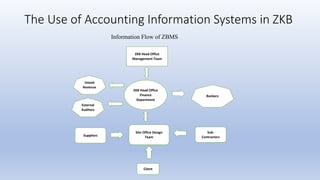
The Use of Accounting Information Systems in ZKB
Inland
Revenue
External
Auditors
Client
Suppliers
Site Office Design
Team
Sub-
Contractors
Bankers
ZKB Head Office
Finance
Department
ZKB Head Office
Management Team
Information Flow of ZBMS
The Use of Accounting Information Systems in
ZKB
Users of AIS
• Accountants) and head office such as the Financial Accountants, Management
Accountants and Finance Manager are the internal users of the system.
• Also, the management team that consists of Finance General Manager, Chief
Operating Officer, Managing Director and Board of Directors are among the
internal users of the system.
• On the other hand, the external users consist of government agency (i.e. Inland
Revenue), external auditors and creditors. Indeed, wide variety of people within
and outside the organization uses accounting information for decision-making
Conclusion
• The wide varieties of people that involve in the company’s operation
get the benefits from the implementation of AIS and the use of
Contract Plus software developed by ZYXW.
• The system assists the operational managers to come out with
monthly reports for the top managerial level (i.e. tactical and
strategic) plan, control and decide resources allocation. In addition,
the report showed that the AIS add value to information processed
within the company.
• The use of AIS indicate the growth of tacit and explicit knowledge,
where personnel were trained intensively and experience and trouble
shooting were recorded for future reference and training
Accounting

Accounting

  • 1.
    Accounting information system(AIS) An accounting information system (AIS) is a structure that a business uses to collect, store, manage, process, retrieve, and report its financial data so it can be used by accountants, consultants, business analysts, managers, chief financial officers (CFOs), auditors, regulators, and tax agencies. An accounting information system is a way of tracking all accounting and business activity for a company. Accounting information systems generally consist of six primary components: people, procedures and instructions, data, software, information technology infrastructure, and internal controls.
  • 2.
    AIS Data: • AnAIS must have a database structure to store information, such as structured query language (SQL), which is a computer language commonly used for databases. • SQL allows the data that's in the AIS to be manipulated and retrieved for reporting purposes. The AIS will also need various input screens for the different types of system users and data entry, as well as different output formats to meet the needs of different users and various types of information. • The data contained in an AIS is all of the financial information pertinent to the organization's business practices. Any business data that impacts the company's finances should go into an AIS.
  • 3.
    AIS Data: Sales orders Customerbilling statements Sales analysis reports Purchase requisitions Vendor invoices Check registers General ledger Inventory data Payroll information Timekeeping Tax information The type of data included in an AIS depends on the nature of the business, but it may consist of the following:
  • 4.
    Advantages of AccountingInformation System (AIS) • Cost Effectiveness – In the era of digitalization and artificial intelligence, each organization is moving towards cost cutting with the use of artificial intelligence. AIS has helped to reduce manual efforts and can perform the same operation more cost-effectively. • Time Effectiveness – AIS has assisted business organizations to reduce the amount of time involved in recording, classifying, reporting any financial information. A large quantum of manual work can be completed by AIS with much fewer efforts and time involved.
  • 5.
    Advantages of AccountingInformation System (AIS) • Easy Access(Portability) – Data stored in AIS can be retrieved via information system connected with internet anywhere and at any time. Where manually prepared books of accounts cannot be carried easily, AIS data can be. • Accuracy – With the involvement of AIS, the reliability of data is increased. As we had discussed earlier in this article that an AIS follows a predefined set of instructions, therefore chances of error-prone information are less and therefore AIS have an added advantage of accurate data.
  • 6.
    Benefits of AccountingInformation Systems • Interdepartmental Interfacing An accounting information system strives to interface across multiple departments. Within the system, the sales department can upload the sales budget. This information is used by the inventory management team to conduct inventory counts and purchase materials. Upon the purchase of inventory, the system can notify the accounts payable department of the new invoice. An AIS can also share information about a new order so that the manufacturing, shipping, and customer service departments are aware of the sale.
  • 7.
    Benefits of Accounting InformationSystems • Internal Controls An integral part of accounting information systems relates to internal controls. Policies and procedures can be placed within the system to ensure that sensitive customer, vendor, and business information is maintained within a company. Through the use of physical access approvals, login requirements, access logs, authorizations, and segregation of duties, users can be limited to only the relevant information necessary to perform their business function.
  • 8.
    The Reliability ofAccounting Information Systems • The American Institute of CPAs (AICPA) and Canadian Institute of Chartered Accountants (CICA) have identified five basic principles important to AIS reliability: 1. Security – Access to the system and its data is controlled and limited only to those authorized. 2. Confidentiality – The protection of sensitive information from unauthorized disclosure. 3. Privacy – The collection, use, and disclosure of personal information about customers is done in an appropriate manner.
  • 9.
    The Reliability ofAccounting Information Systems 4. Processing integrity – The accurate, complete, and timely processing of data done with proper authorization. 5. Availability – The system is available to meet operational and contractual obligations
  • 10.
    The Use ofAccounting Information Systems in ZKB: • ZKB is a private limited company registered in Lahore, Pakistan that operate in construction industry, where the main activities ranging from construction of infrastructure, building, power, road construction to property development. • The company used automated AIS known as ‘Contract Plus – Financial & Project Accounting’ package in their Finance Department, which was commercially developed by a private company (ZYXW). • Contract Plus is a fully integrated business solution designed specifically for companies in the engineering and construction industry. The software will generate financial data to be analyzed by the accountants and subsequently used by top level of management for strategic decision making, thus, these managers could identify future opportunities and limitations face by the company and industry
  • 11.
    The Use ofAccounting Information Systems in ZKB Findings • ZKB is a company that operate in construction industry. The industry was identified as one of the most difficult to understand due to its complexity. • However, these challenges are under control with the advent of technology such as software development that allows systematic data processing.
  • 12.
    The Use ofAccounting Information Systems in ZKB Inland Revenue External Auditors Client Suppliers Site Office Design Team Sub- Contractors Bankers ZKB Head Office Finance Department ZKB Head Office Management Team Information Flow of ZBMS
  • 13.
    The Use ofAccounting Information Systems in ZKB Users of AIS • Accountants) and head office such as the Financial Accountants, Management Accountants and Finance Manager are the internal users of the system. • Also, the management team that consists of Finance General Manager, Chief Operating Officer, Managing Director and Board of Directors are among the internal users of the system. • On the other hand, the external users consist of government agency (i.e. Inland Revenue), external auditors and creditors. Indeed, wide variety of people within and outside the organization uses accounting information for decision-making
  • 14.
    Conclusion • The widevarieties of people that involve in the company’s operation get the benefits from the implementation of AIS and the use of Contract Plus software developed by ZYXW. • The system assists the operational managers to come out with monthly reports for the top managerial level (i.e. tactical and strategic) plan, control and decide resources allocation. In addition, the report showed that the AIS add value to information processed within the company. • The use of AIS indicate the growth of tacit and explicit knowledge, where personnel were trained intensively and experience and trouble shooting were recorded for future reference and training