My presentation on topic
          BIO DIESEL


                   BY :
                   Naveen Sihag
                   B.Tech
INTRODUCTION
Bio diesel as the name suggests is a type of diesel that is being
   made from the bio products , and these products are a
   renewable sources of energy

Bio diesel can be used in pure form (B100) or may be blended with
petroleum diesel at any concentration in most modern diesel
engines. Bio diesel has different solvent properties than petroleum
diesel, and will degrade natural rubber gaskets and hoses in
vehicles
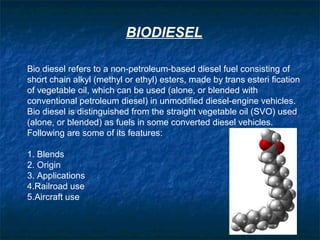
BIODIESEL

Bio diesel refers to a non-petroleum-based diesel fuel consisting of
short chain alkyl (methyl or ethyl) esters, made by trans esteri fication
of vegetable oil, which can be used (alone, or blended with
conventional petroleum diesel) in unmodified diesel-engine vehicles.
Bio diesel is distinguished from the straight vegetable oil (SVO) used
(alone, or blended) as fuels in some converted diesel vehicles.
Following are some of its features:

1. Blends
2. Origin
3. Applications
4.Railroad use
5.Aircraft use
6.Historical background
7.Availibility and prices
8.Production
9.Bio diesel manufacturing process
10. Production levels
11. Bio diesel feed stock
12. Quantity of feed stocks required
13. Main article: food v s fuel
14. Bio diesel manufacturing process
15. Camparisn of efficiency for different techniques
   Bio diesel molecules
Blends:


Blends of bio diesel and conventional hydrocarbon-based diesel
are products most commonly distributed for use in the retail diesel
fuel marketplace. Much of the world uses a system known as the
"B" factor to state the amount of bio diesel in any fuel mix: fuel
containing 20% bio diesel is labeled B20, while pure bio diesel is
referred to as B100. It is common to see B99, since 1% petroleum
diesel is sufficiently toxic to retard mold. Blends of 20 percent bio
diesel with 80 percent petroleum diesel (B20) can generally be
used in unmodified diesel engines.
Origin:


On August 31, 1937, G. Chavanne of the University of Brussels
(Belgium) was granted a patent for a 'Procedure for the
transformation of vegetable oils for their uses as fuels' Belgian
Patent 422,877. This patent described the alcoholysis of vegetable
oils using ethanol (and mentions methanol) in order to separate
the fatty acids from the glycerol by replacing the glycerol with short
linear alcohols.
Applications


Bio diesel can be used in pure form (B100) or may be blended with
petroleum diesel at any concentration in most modern diesel engines.
Bio diesel has been known to break down deposits of residue in the
fuel lines where petroleum diesel has been used. As a result, fuel
filters may become clogged with particulates if a quick transition to
pure bio diesel is made. Therefore, it is recommended to change the
fuel filters on engines and heaters shortly after first swi Distribution
Bio diesel use and production are increasing rapidly. Fueling stations
make bio diesel readily available to consumers across Europe, and
increasingly in the USA and Canada. Bio diesel is often more
expensive to purchase than petroleum diesel but this is expected to
diminish due to economies of scale and agricultural subsidies versus
the rising cost of petroleum as reserves are depleted.
Difference btw diesel and bio
            diesel
Railroad use:


The British businessman Richard Branson's Virgin
Voyager train, number 220007 Thames Voyager, billed
as the world's first "bio diesel train" was converted to run
on 80% petroleum diesel and only 20% bio diesel, and it
is claimed it will save 14% on direct emissions

Aircraft use:

The world's first bio fuel-powered commercial aircraft took off
from London's Heathrow Airport on February 24, 2008 and
touched down in Amsterdam on a demonstration flight hailed as
a first step towards "cleaner" flying
Historical background:

Trans esterification of a vegetable oil was conducted as early as 1853 by
scientists E. Duffy and J. Patrick, many years before the first diesel engine
became functional. Rudolf Diesel's prime model, a single 10 ft (3 m) iron
cylinder with a flywheel at its base, ran on its own power for the first time in
Augsburg, Germany, on August 10, 1893. In remembrance of this event,
August 10 has been declared "International Bio diesel Day".
Availability and prices:

In some countries bio diesel is less expensive than conventional
diesel.
For more details on this topic, see Bio diesel around the World.
Global bio diesel production reached 3.8 million tons in 2005.
Approximately 85% of bio diesel production came from the
European Union.
In the United States, average retail (at the pump) prices,
including Federal and state fuel taxes, of B2/B5 are lower than
petroleum diesel by about 12 cents, and B20 blends are the
same as petrodiesel.[23] B99 and B100 generally cost more
than petroleum diesel except where local governments provide a
subsidy.
Production:

Bio diesel is commonly produced by the trans ester ification of the
vegetable oil or animal fat feedstock. There are several methods for
carrying out this trans ester ification reaction including the common
batch process, supercritical processes, ultrasonic methods, and even
microwave methods
Bio diesel Manufacturing Process :


An oil mill is designed to efficiently, mechanically extract by full
pressing the oil from canola. The efficiency and performance of oil
extraction with screw presses is highly dependent on the condition of
the raw material
The whole canola seed is first cleaned and then pre-heated in a
conditioner to allow the seeds to be flaked in preparation for further
cooking. The flaking helps in the rupturing of the oil cells. It improves
the efficiencies in the next steps of the crushing process, and if
available, the solvent extraction.
OUR PLANET WITH BIO DIESEL STOCK
Production of bio diesel from olive oil
Production levels:


Bio diesel production capacity is growing rapidly, with an average
annual growth rate from 2002-2006 of over 40% [27]. For the year
2006, the latest for which actual production figures could be
obtained, total world bio diesel production was about 5-6 million
tonnes, with 4.9 million tonnes processed in Europe (of which 2.7
million tonnes was from Germany) and most of the rest from the
USA
Bio diesel feed stocks:
Soybeans are used as a source of bio diesel Plant oils
Olive oil

Types
Vegetable fats(list)
Essential oil (list)
Macerated     (list)

Uses
Drying oil - Oil paint
Cooking oil
Fuel – Bio diesel
Aromatherapy

Components
Saturated fat
Monounsaturated fat
Polyunsaturated fat
Trans fat
Quantity of feed stocks required:


            Worldwide production of vegetable oil and animal fat is
            not yet sufficient to replace liquid fossil fuel use
            The estimated transportation diesel fuel and home
            heating oil used in the United States is about 160 million
            ton n e s
            ]. In the United States, estimated production of
            vegetable oil for all uses is about 11 million ton n e s (24
            billion pounds) and estimated production of animal fat is
            5.3 million ton n e s
Main article: Food v s fuel:


Food quality vegetable oil has become so expensive there is
no longer a profit viability for its use. Food grade vegetable
oil pricing is on a similar upward ramp as food in general.
Accessing food stuffs in poor countries has always been
problematic for the inhabitants. Non food grade vegetable
oils are under use or consideration for use to make bio diesel
and have been so during the entire history of bio diesel
THANK YOU

Biodiesel

  • 1.
    My presentation ontopic BIO DIESEL BY : Naveen Sihag B.Tech
  • 2.
    INTRODUCTION Bio diesel asthe name suggests is a type of diesel that is being made from the bio products , and these products are a renewable sources of energy Bio diesel can be used in pure form (B100) or may be blended with petroleum diesel at any concentration in most modern diesel engines. Bio diesel has different solvent properties than petroleum diesel, and will degrade natural rubber gaskets and hoses in vehicles
  • 3.
    BIODIESEL Bio diesel refersto a non-petroleum-based diesel fuel consisting of short chain alkyl (methyl or ethyl) esters, made by trans esteri fication of vegetable oil, which can be used (alone, or blended with conventional petroleum diesel) in unmodified diesel-engine vehicles. Bio diesel is distinguished from the straight vegetable oil (SVO) used (alone, or blended) as fuels in some converted diesel vehicles. Following are some of its features: 1. Blends 2. Origin 3. Applications 4.Railroad use 5.Aircraft use
  • 4.
    6.Historical background 7.Availibility andprices 8.Production 9.Bio diesel manufacturing process 10. Production levels 11. Bio diesel feed stock 12. Quantity of feed stocks required 13. Main article: food v s fuel 14. Bio diesel manufacturing process 15. Camparisn of efficiency for different techniques
  • 5.
    Bio diesel molecules
  • 6.
    Blends: Blends of biodiesel and conventional hydrocarbon-based diesel are products most commonly distributed for use in the retail diesel fuel marketplace. Much of the world uses a system known as the "B" factor to state the amount of bio diesel in any fuel mix: fuel containing 20% bio diesel is labeled B20, while pure bio diesel is referred to as B100. It is common to see B99, since 1% petroleum diesel is sufficiently toxic to retard mold. Blends of 20 percent bio diesel with 80 percent petroleum diesel (B20) can generally be used in unmodified diesel engines.
  • 7.
    Origin: On August 31,1937, G. Chavanne of the University of Brussels (Belgium) was granted a patent for a 'Procedure for the transformation of vegetable oils for their uses as fuels' Belgian Patent 422,877. This patent described the alcoholysis of vegetable oils using ethanol (and mentions methanol) in order to separate the fatty acids from the glycerol by replacing the glycerol with short linear alcohols.
  • 8.
    Applications Bio diesel canbe used in pure form (B100) or may be blended with petroleum diesel at any concentration in most modern diesel engines. Bio diesel has been known to break down deposits of residue in the fuel lines where petroleum diesel has been used. As a result, fuel filters may become clogged with particulates if a quick transition to pure bio diesel is made. Therefore, it is recommended to change the fuel filters on engines and heaters shortly after first swi Distribution Bio diesel use and production are increasing rapidly. Fueling stations make bio diesel readily available to consumers across Europe, and increasingly in the USA and Canada. Bio diesel is often more expensive to purchase than petroleum diesel but this is expected to diminish due to economies of scale and agricultural subsidies versus the rising cost of petroleum as reserves are depleted.
  • 10.
    Difference btw dieseland bio diesel
  • 11.
    Railroad use: The Britishbusinessman Richard Branson's Virgin Voyager train, number 220007 Thames Voyager, billed as the world's first "bio diesel train" was converted to run on 80% petroleum diesel and only 20% bio diesel, and it is claimed it will save 14% on direct emissions Aircraft use: The world's first bio fuel-powered commercial aircraft took off from London's Heathrow Airport on February 24, 2008 and touched down in Amsterdam on a demonstration flight hailed as a first step towards "cleaner" flying
  • 12.
    Historical background: Trans esterificationof a vegetable oil was conducted as early as 1853 by scientists E. Duffy and J. Patrick, many years before the first diesel engine became functional. Rudolf Diesel's prime model, a single 10 ft (3 m) iron cylinder with a flywheel at its base, ran on its own power for the first time in Augsburg, Germany, on August 10, 1893. In remembrance of this event, August 10 has been declared "International Bio diesel Day".
  • 13.
    Availability and prices: Insome countries bio diesel is less expensive than conventional diesel. For more details on this topic, see Bio diesel around the World. Global bio diesel production reached 3.8 million tons in 2005. Approximately 85% of bio diesel production came from the European Union. In the United States, average retail (at the pump) prices, including Federal and state fuel taxes, of B2/B5 are lower than petroleum diesel by about 12 cents, and B20 blends are the same as petrodiesel.[23] B99 and B100 generally cost more than petroleum diesel except where local governments provide a subsidy.
  • 14.
    Production: Bio diesel iscommonly produced by the trans ester ification of the vegetable oil or animal fat feedstock. There are several methods for carrying out this trans ester ification reaction including the common batch process, supercritical processes, ultrasonic methods, and even microwave methods
  • 15.
    Bio diesel ManufacturingProcess : An oil mill is designed to efficiently, mechanically extract by full pressing the oil from canola. The efficiency and performance of oil extraction with screw presses is highly dependent on the condition of the raw material The whole canola seed is first cleaned and then pre-heated in a conditioner to allow the seeds to be flaked in preparation for further cooking. The flaking helps in the rupturing of the oil cells. It improves the efficiencies in the next steps of the crushing process, and if available, the solvent extraction.
  • 16.
    OUR PLANET WITHBIO DIESEL STOCK
  • 17.
    Production of biodiesel from olive oil
  • 18.
    Production levels: Bio dieselproduction capacity is growing rapidly, with an average annual growth rate from 2002-2006 of over 40% [27]. For the year 2006, the latest for which actual production figures could be obtained, total world bio diesel production was about 5-6 million tonnes, with 4.9 million tonnes processed in Europe (of which 2.7 million tonnes was from Germany) and most of the rest from the USA
  • 19.
    Bio diesel feedstocks: Soybeans are used as a source of bio diesel Plant oils Olive oil Types Vegetable fats(list) Essential oil (list) Macerated (list) Uses Drying oil - Oil paint Cooking oil Fuel – Bio diesel Aromatherapy Components Saturated fat Monounsaturated fat Polyunsaturated fat Trans fat
  • 20.
    Quantity of feedstocks required: Worldwide production of vegetable oil and animal fat is not yet sufficient to replace liquid fossil fuel use The estimated transportation diesel fuel and home heating oil used in the United States is about 160 million ton n e s ]. In the United States, estimated production of vegetable oil for all uses is about 11 million ton n e s (24 billion pounds) and estimated production of animal fat is 5.3 million ton n e s
  • 21.
    Main article: Foodv s fuel: Food quality vegetable oil has become so expensive there is no longer a profit viability for its use. Food grade vegetable oil pricing is on a similar upward ramp as food in general. Accessing food stuffs in poor countries has always been problematic for the inhabitants. Non food grade vegetable oils are under use or consideration for use to make bio diesel and have been so during the entire history of bio diesel
  • 24.