Content
 Introduction
 Biodiesel Production
 Fuel properties
 Biodiesel Emissions
 Storage and transportation
Introduction
What is Biodiesel?
 Alternative fuel for diesel engines
 Made from vegetable oil or animal fat
 Meets health effect testing (CAA)
 Lower emissions, High flash point (>300F), Safer
 Biodegradable, Essentially non-toxic.
Introduction
 Transesterification
 Most common production method
 Uses vegetable oils and animal fats as feed stocks
 The reaction of a fat or oil with an alcohol to form esters
(biodiesel) and glycerol
 Chemically, biodiesel molecules are mono-alkyl esters
produced usually from triglyceride esters
Introduction
Fatty Acid
Alcohol
Glycerin
FA
FA
FAFA
FA
FA
Vegetable Oil
Biodiesel
Introduction
Introduction
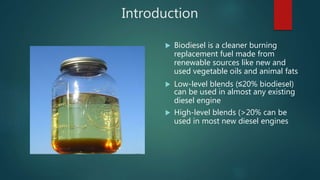
 Biodiesel is a cleaner burning
replacement fuel made from
renewable sources like new and
used vegetable oils and animal fats
 Low-level blends (≤20% biodiesel)
can be used in almost any existing
diesel engine
 High-level blends (>20% can be
used in most new diesel engines
Introduction
0 50 100
B2
B5
B10
B20
B100
Biodiesel Petroleum diesel
 Pure Biodiesel (B100) or blended with
petroleum diesel (B20, BXX).
 Rudolf Diesel: peanut oil.
 Little or no engine modifications.
 Use existing fuel distribution network.
Introduction
Biodiesel’s Closed
Carbon Cycle
Biodiesel production
Making of biodiesel fuel from waste
cooking oil
 Materials
1- Methanol commercial grade.
2- “ catalyst “.Potassium Hydroxide or
sodium hydroxide.
Making of biodiesel fuel from waste
cooking oil
 Mixing of Methanol and Catalyst
The purpose of mixing methanol and the catalyst (KOH), reaction of two
substances to form Methoxide. The amount of Methanol used ranges (20% -
50%) of the volume of the oil.
KOH does not readily dissolve into Methanol. It is best to turn on the mixer
to begin agitating the Methanol and slowly pour the KOH in. When particles
of KOH cannot be seen, the Methoxide is ready to be added to the oil. This
can usually be achieved in 20 –30 minutes.
Making of biodiesel fuel from waste
cooking oil
 Heating of Oil
In order to speed up the reaction,
the oil must be heated.
The ideal temperature range is
48 C to 60 C.
Making of biodiesel fuel from waste
cooking oil
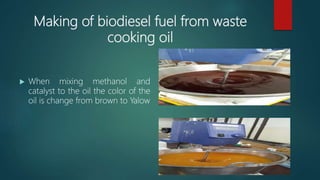
 When mixing methanol and
catalyst to the oil the color of the
oil is change from brown to Yalow
Making of biodiesel fuel from waste cooking
oil
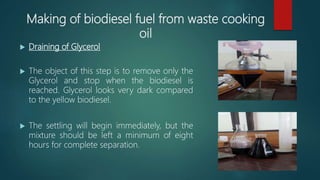
 Draining of Glycerol
 The object of this step is to remove only the
Glycerol and stop when the biodiesel is
reached. Glycerol looks very dark compared
to the yellow biodiesel.
 The settling will begin immediately, but the
mixture should be left a minimum of eight
hours for complete separation.
Making of biodiesel fuel from waste
cooking oil
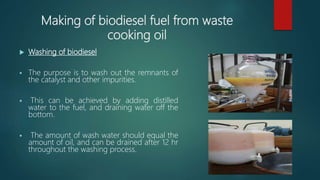
 Washing of biodiesel
 The purpose is to wash out the remnants of
the catalyst and other impurities.
 This can be achieved by adding distilled
water to the fuel, and draining water off the
bottom.
 The amount of wash water should equal the
amount of oil, and can be drained after 12 hr
throughout the washing process.
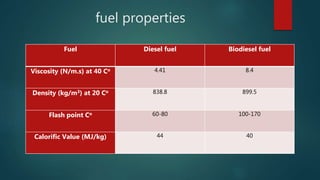
fuel properties
Fuel Diesel fuel Biodiesel fuel
Viscosity (N/m.s) at 40 Co 4.41 8.4
Density (kg/m3) at 20 Co 838.8 899.5
Flash point Co 60-80 100-170
Calorific Value (MJ/kg) 44 40
Output power
 due to the lower thermal efficiency and
calorific values of the biodiesel fuel, the
engine power parameters are lower than
those for diesel fuel.
 slight recovery in the power may be
covered by injection extra fuel in the
engine that will help reduce the
difference in performance.
Exhaust Emissions
This section explores two of the most dangerous emission generated in
combustion process of engine (NOx and CO2).
NOx is a very undesirable emission because it reacts in the atmosphere to form
ozone and is one of the major causes of photochemical smog.
Carbon monoxide occurs when insufficient oxygen is present to fully convert all
carbon to CO2 or when incomplete air-fuel mixing occurs due to very short engine
cycle time CO2 considered as a major greenhouse gas, and at higher
concentrations is a major contributor to global warming.
Exhaust Emissions
 An often mentioned incentive for
using biodiesel; is its capacity to
lower green house gas emissions
Biodiesel provides significantly
reduced emissions of carbon
monoxide, particulate matter,
unburned hydrocarbons, As shown
in the figure compared to diesel
fuel and that’s will improve air
quality, particularly in high smog &
population dense areas.
Storage And Transportation
 Biodiesel is a good solvent, Trucks or
tanks should be washed from
previous load to prevent mixing
biodiesel impurities or water.
 Another problem is that biodiesel has
a tendency to gel (freeze) at higher
temperatures than petro-diesel.
Therefore, storage and transportation
tanks must be designed to deal with
this tendency.
 Heat, sunlight, and oxygen will also
cause biodiesel to degrade more
rapidly, so storage should minimize
exposure to these conditions.
Any Questions

Biodiesel

  • 1.
    Content  Introduction  BiodieselProduction  Fuel properties  Biodiesel Emissions  Storage and transportation
  • 2.
    Introduction What is Biodiesel? Alternative fuel for diesel engines  Made from vegetable oil or animal fat  Meets health effect testing (CAA)  Lower emissions, High flash point (>300F), Safer  Biodegradable, Essentially non-toxic.
  • 3.
    Introduction  Transesterification  Mostcommon production method  Uses vegetable oils and animal fats as feed stocks  The reaction of a fat or oil with an alcohol to form esters (biodiesel) and glycerol  Chemically, biodiesel molecules are mono-alkyl esters produced usually from triglyceride esters
  • 4.
  • 5.
  • 6.
    Introduction  Biodiesel isa cleaner burning replacement fuel made from renewable sources like new and used vegetable oils and animal fats  Low-level blends (≤20% biodiesel) can be used in almost any existing diesel engine  High-level blends (>20% can be used in most new diesel engines
  • 7.
    Introduction 0 50 100 B2 B5 B10 B20 B100 BiodieselPetroleum diesel  Pure Biodiesel (B100) or blended with petroleum diesel (B20, BXX).  Rudolf Diesel: peanut oil.  Little or no engine modifications.  Use existing fuel distribution network.
  • 8.
  • 9.
  • 10.
  • 11.
    Making of biodieselfuel from waste cooking oil  Materials 1- Methanol commercial grade. 2- “ catalyst “.Potassium Hydroxide or sodium hydroxide.
  • 12.
    Making of biodieselfuel from waste cooking oil  Mixing of Methanol and Catalyst The purpose of mixing methanol and the catalyst (KOH), reaction of two substances to form Methoxide. The amount of Methanol used ranges (20% - 50%) of the volume of the oil. KOH does not readily dissolve into Methanol. It is best to turn on the mixer to begin agitating the Methanol and slowly pour the KOH in. When particles of KOH cannot be seen, the Methoxide is ready to be added to the oil. This can usually be achieved in 20 –30 minutes.
  • 13.
    Making of biodieselfuel from waste cooking oil  Heating of Oil In order to speed up the reaction, the oil must be heated. The ideal temperature range is 48 C to 60 C.
  • 14.
    Making of biodieselfuel from waste cooking oil  When mixing methanol and catalyst to the oil the color of the oil is change from brown to Yalow
  • 15.
    Making of biodieselfuel from waste cooking oil  Draining of Glycerol  The object of this step is to remove only the Glycerol and stop when the biodiesel is reached. Glycerol looks very dark compared to the yellow biodiesel.  The settling will begin immediately, but the mixture should be left a minimum of eight hours for complete separation.
  • 16.
    Making of biodieselfuel from waste cooking oil  Washing of biodiesel  The purpose is to wash out the remnants of the catalyst and other impurities.  This can be achieved by adding distilled water to the fuel, and draining water off the bottom.  The amount of wash water should equal the amount of oil, and can be drained after 12 hr throughout the washing process.
  • 17.
    fuel properties Fuel Dieselfuel Biodiesel fuel Viscosity (N/m.s) at 40 Co 4.41 8.4 Density (kg/m3) at 20 Co 838.8 899.5 Flash point Co 60-80 100-170 Calorific Value (MJ/kg) 44 40
  • 18.
    Output power  dueto the lower thermal efficiency and calorific values of the biodiesel fuel, the engine power parameters are lower than those for diesel fuel.  slight recovery in the power may be covered by injection extra fuel in the engine that will help reduce the difference in performance.
  • 19.
    Exhaust Emissions This sectionexplores two of the most dangerous emission generated in combustion process of engine (NOx and CO2). NOx is a very undesirable emission because it reacts in the atmosphere to form ozone and is one of the major causes of photochemical smog. Carbon monoxide occurs when insufficient oxygen is present to fully convert all carbon to CO2 or when incomplete air-fuel mixing occurs due to very short engine cycle time CO2 considered as a major greenhouse gas, and at higher concentrations is a major contributor to global warming.
  • 20.
    Exhaust Emissions  Anoften mentioned incentive for using biodiesel; is its capacity to lower green house gas emissions Biodiesel provides significantly reduced emissions of carbon monoxide, particulate matter, unburned hydrocarbons, As shown in the figure compared to diesel fuel and that’s will improve air quality, particularly in high smog & population dense areas.
  • 21.
    Storage And Transportation Biodiesel is a good solvent, Trucks or tanks should be washed from previous load to prevent mixing biodiesel impurities or water.  Another problem is that biodiesel has a tendency to gel (freeze) at higher temperatures than petro-diesel. Therefore, storage and transportation tanks must be designed to deal with this tendency.  Heat, sunlight, and oxygen will also cause biodiesel to degrade more rapidly, so storage should minimize exposure to these conditions.
  • 22.