Basic Chemistry  Understanding the Basics of BioChemistry
Why is an understanding of chemistry important to someone studying biology? All cells (and thus organisms)   are composed of  chemicals All life processes involve a variety of chemical reactions Reveals the complexity and elegance of life
What we will focus on in this presentation:  Matter and Atoms Compounds Molecules Chemical Bonds  Chemical Reactions The Unique Properties of Water Ions and Living Cells pH
Matter  is anything that has mass and takes up space… Atoms  are the basic building blocks of matter Our current model of atoms was first described by John Dalton in his work “The Atomic Theory” Living Things Are Made of Matter Made up of….
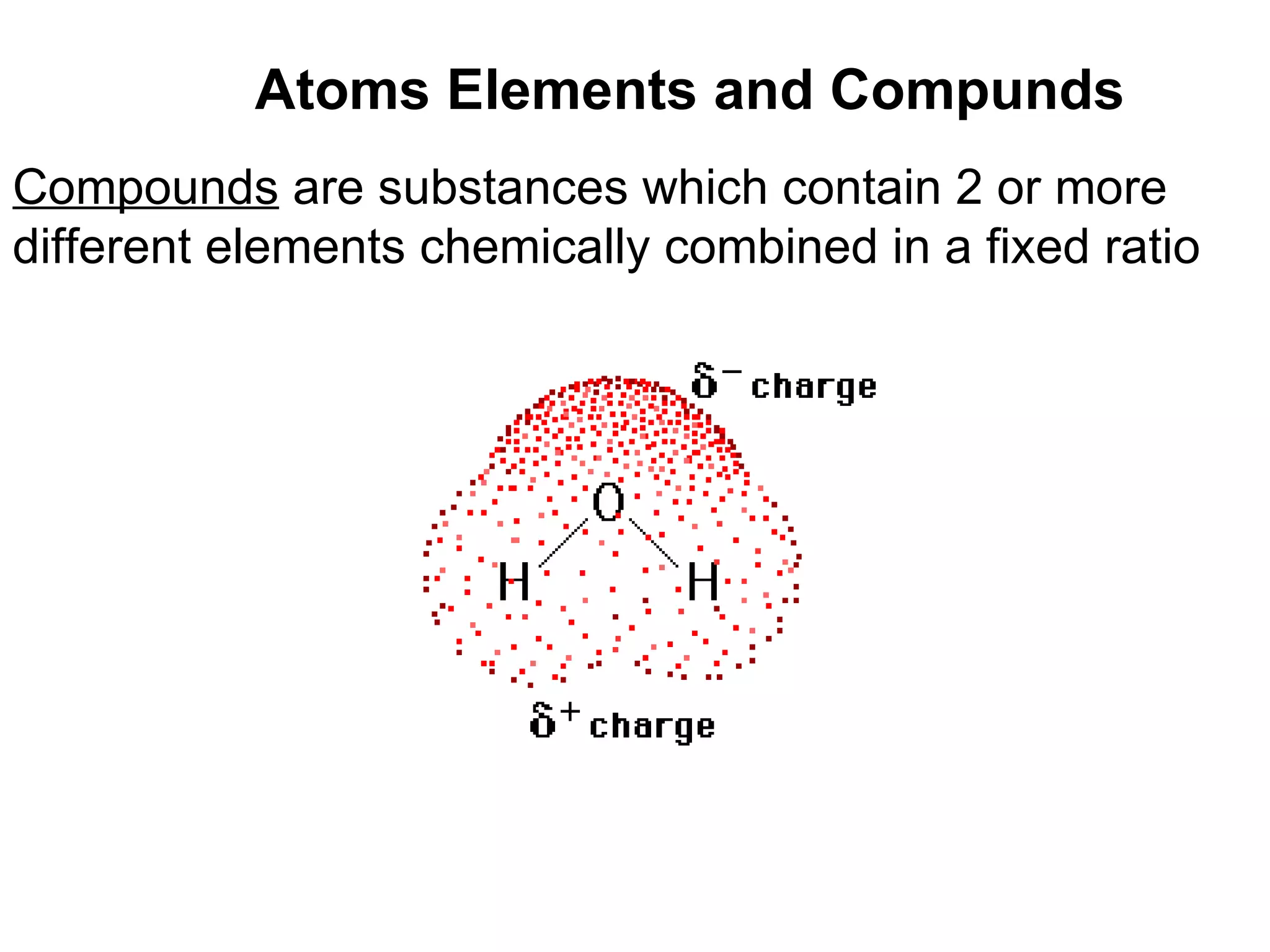
Compounds  are substances which contain 2 or more different elements chemically combined in a fixed ratio Atoms Elements and Compunds
Molecules  are substances which contain 2 or more atoms, and are the most basic unit of a substance Molecules  can contain atoms of the same element or different elements Molecules
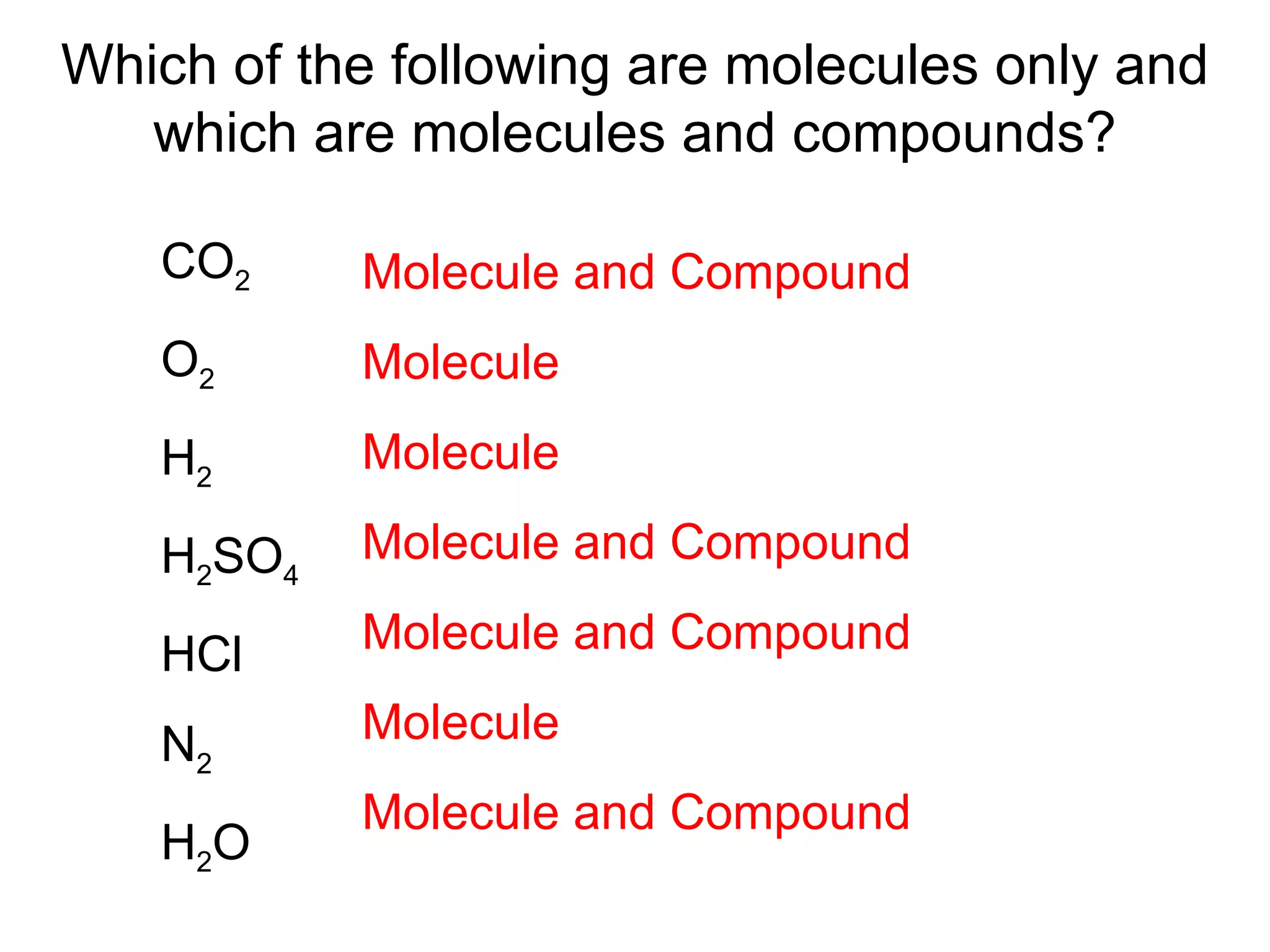
Which of the following are molecules only and which are molecules and compounds? CO 2 O 2 H 2 H 2 SO 4 HCl N 2 H 2 O Molecule and Compound Molecule Molecule Molecule and Compound Molecule and Compound Molecule Molecule and Compound
Elements!!! Elements  are substances made up of 1 kind of atom! 6 different elements  make up 97% of the compounds that are found in living things There are  more than 100  known elements today
Atoms Protons + charge, nucleus Neutrons 0 charge, nucleus Electrons - charge, orbit in the electron charge   The # of protons in an atom determines its identity!
Elements!!! One element differs from another by the number of protons in its nucleus An element’s atomic number equals its number of protons Element Number of Protons Hydrogen Carbon 8 7   1   6 Oxygen Nitrogen
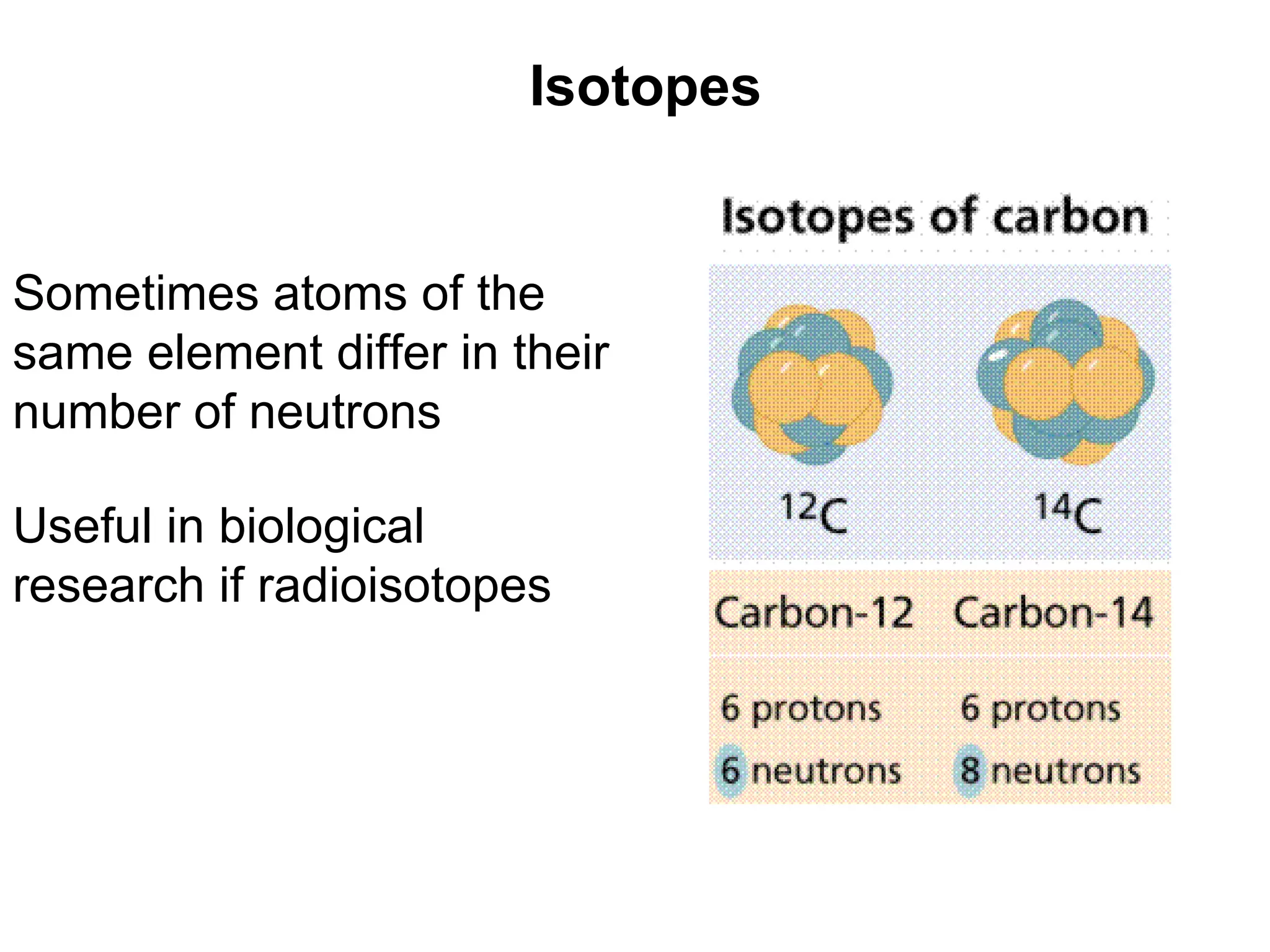
Sometimes atoms of the same element differ in their number of neutrons Isotopes Useful in biological research if radioisotopes
Review of Atoms Molecules and Compounds Use the web resources listed below to help you study the topics covered so far: http://csep10.phys. utk . edu / krogh _ instructorCD /biology/ch2/animations/mod02_1. swf http://www.phschool.com/science/biology_place/biocoach/biokit/chnops.html http://www.chemthink.com
Chemical Bonds and Reactions The Point of Reactions and Bonding is…. Energy!!! Why Bonds Form Types of Bonds Reactions and Equations
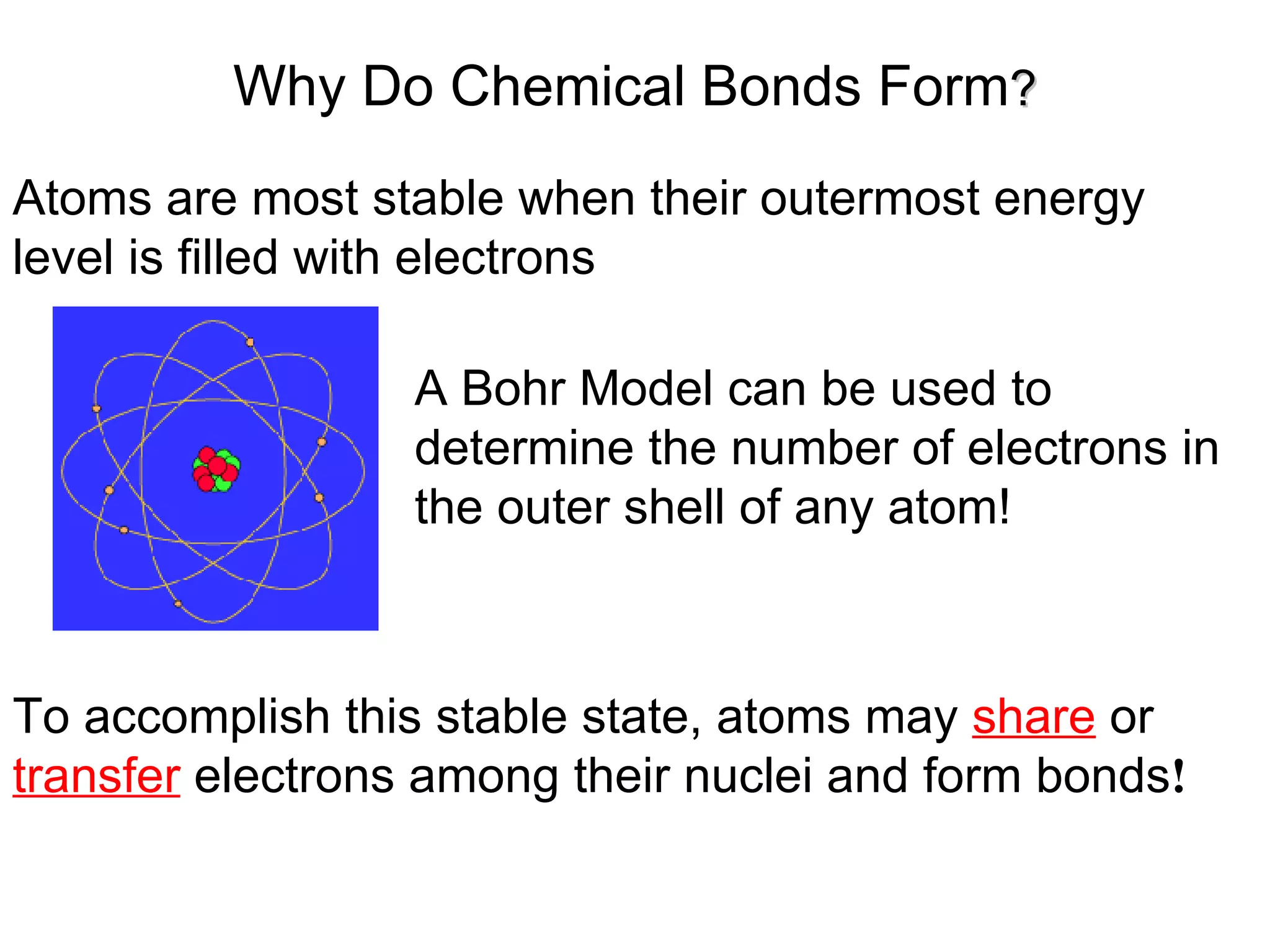
Why Do Chemical Bonds Form ? Atoms are most stable when their outermost energy level is filled with electrons To accomplish this stable state, atoms may  share  or  transfer  electrons among their nuclei and form bonds ! A Bohr Model can be used to determine the number of electrons in the outer shell of any atom!
Types of Bonds Chemical Bonds Form When Atoms Share or Transfer Electrons Ionic Bonds Covalent Bonds Forms when an electron (or electrons) is transferred from one atom to another   Forms when an electron (or electrons) is shared between atoms Type of bond formed is dependent on the electronegativity of atoms involved
Ionic Bonds Sodium wants to lose an electron to become most stable Draw a Bohr Model of Sodium (Na) and Chlorine (Cl) How does each atom become most stable with a full outer shell of electrons? Chlorine wants to gain an electron to become most stable The strong attraction between the positive sodium ion and the negative chloride ion creates an ionic bond NaCl is common table salt
Covalent  Bonds A hydrogen atom wants to share its electron. For example, it can share its electron with another hydrogen atom or two hydrogen atoms can share their electrons with an oxygen atom which wants to share a total of two electrons. Shared Pair of Electrons
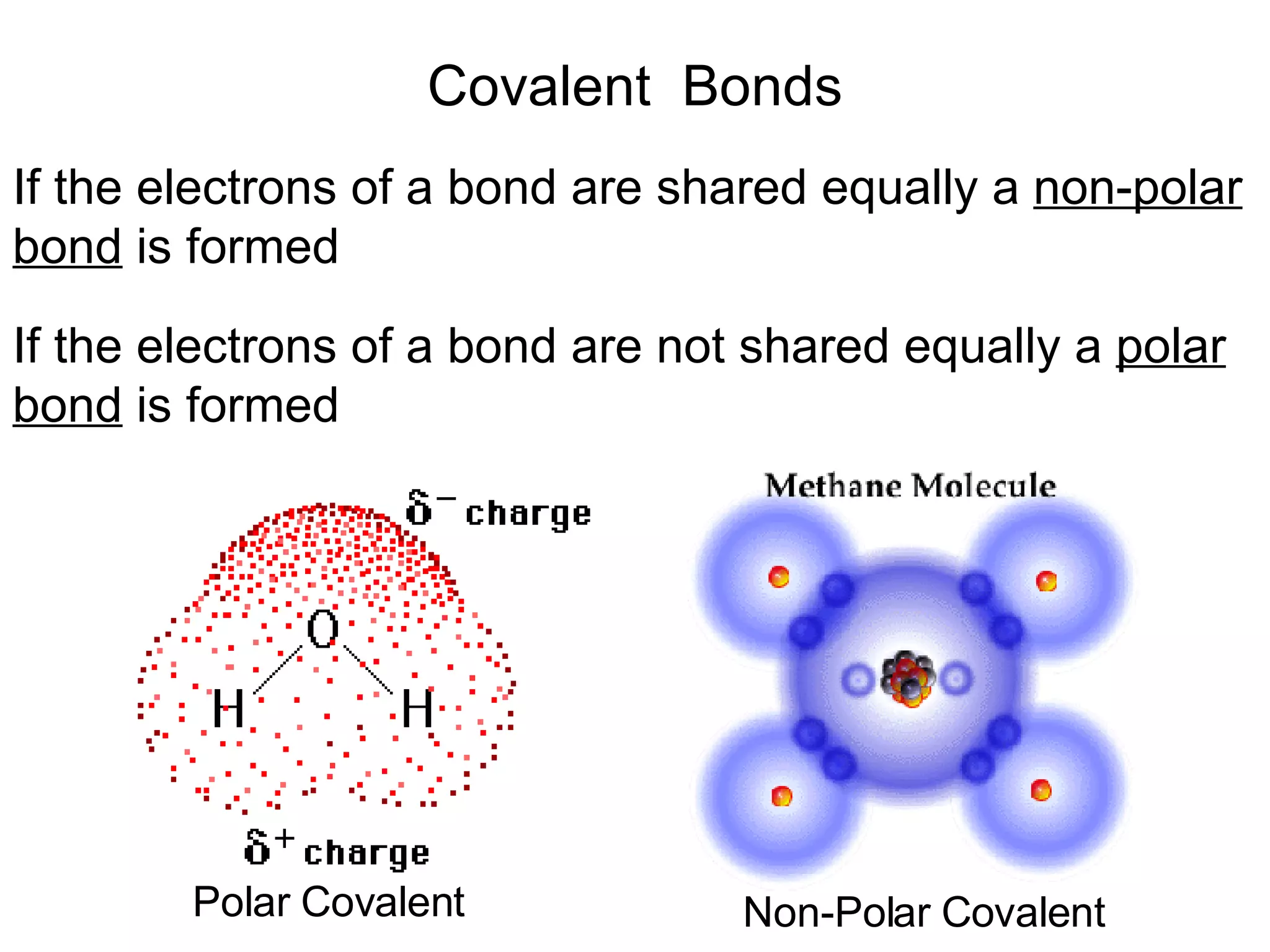
Covalent  Bonds If the electrons of a bond are shared equally a  non-polar bond  is formed If the electrons of a bond are not shared equally a  polar   bond  is formed Polar Covalent Non-Polar Covalent
Chemical Reactions and Equations A chemical reaction involves the  making  or  breaking  of chemical bonds (ionic or covalent) Chemical reactions are necessary for life: To establish stable atomic structures To form new molecules that cells need To manage cellular energy (energy release, usage, and storage)
Chemical Reactions and Equations Chemical equations describe a chemical reaction   Chemical equations provide the following information: The different elements involved in the reaction The number of atoms involved in the reaction The reactants and products of the reaction
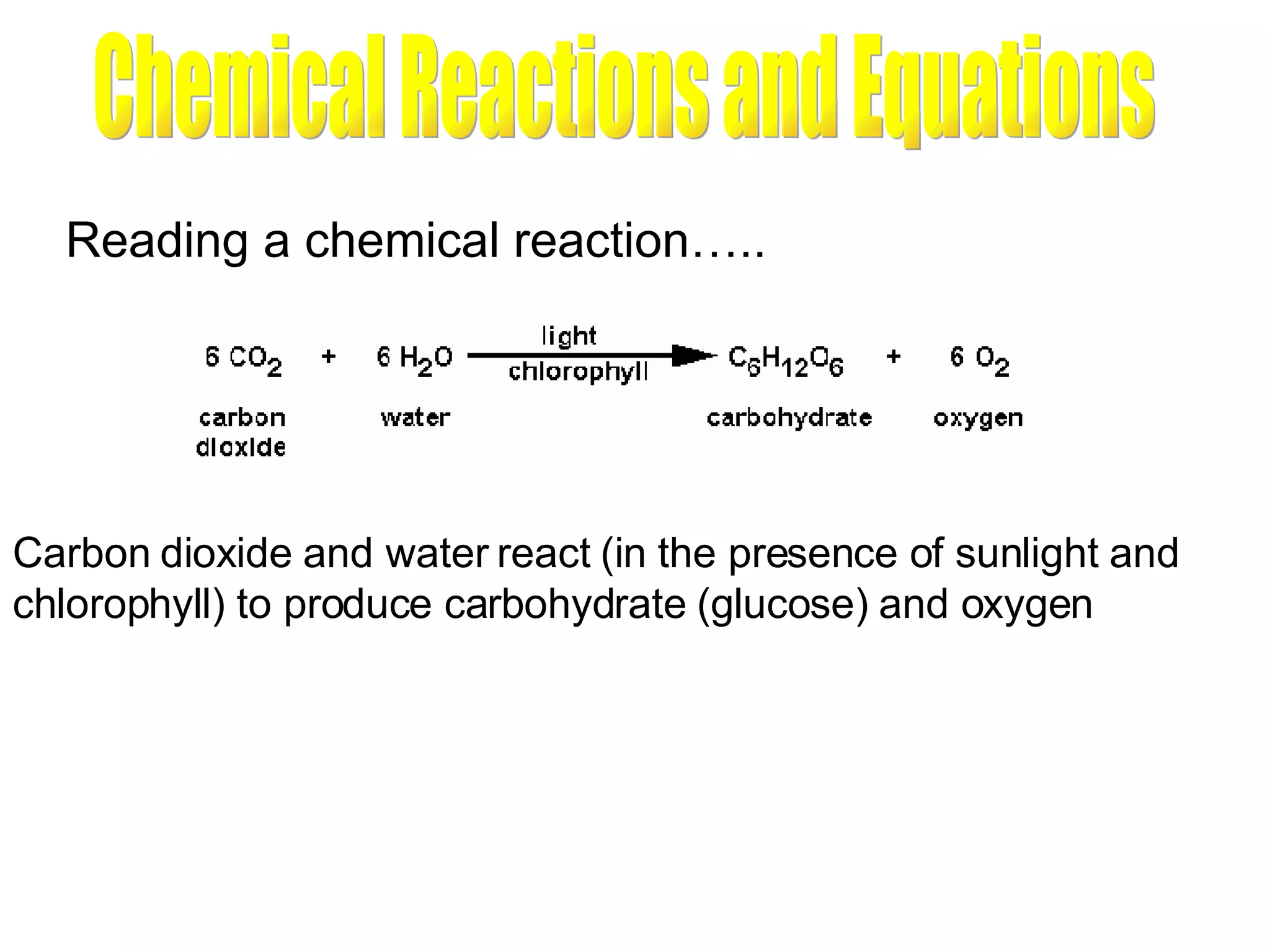
Chemical Reactions and Equations Reading a chemical reaction….. Carbon dioxide and water react (in the presence of sunlight and chlorophyll) to produce carbohydrate (glucose) and oxygen
Chemical Reactions and Equations Other information from the equation…. # of molecules of reactants and products: 6 CO 2 6 H 2 O 1 C 6 H 12 O 6 6 O 2
Chemical Reactions and Equations Other information from the equation…. The number of each kind of atom on each side of the equation Reactants C O H Products C O H 6 18 12 6 18 12
Review of Chemical Bonds and Reactions Use the web resources listed below to help you study the topics covered so far: http://csep10.phys.utk.edu/krogh_instructorCD/biology/ch2/animations/mod02_2.swf http://www2.nl.edu/jste/bonds.htm http://www.phschool.com/science/biology_place/biocoach/biokit/valence.html http://www.chemthink.com
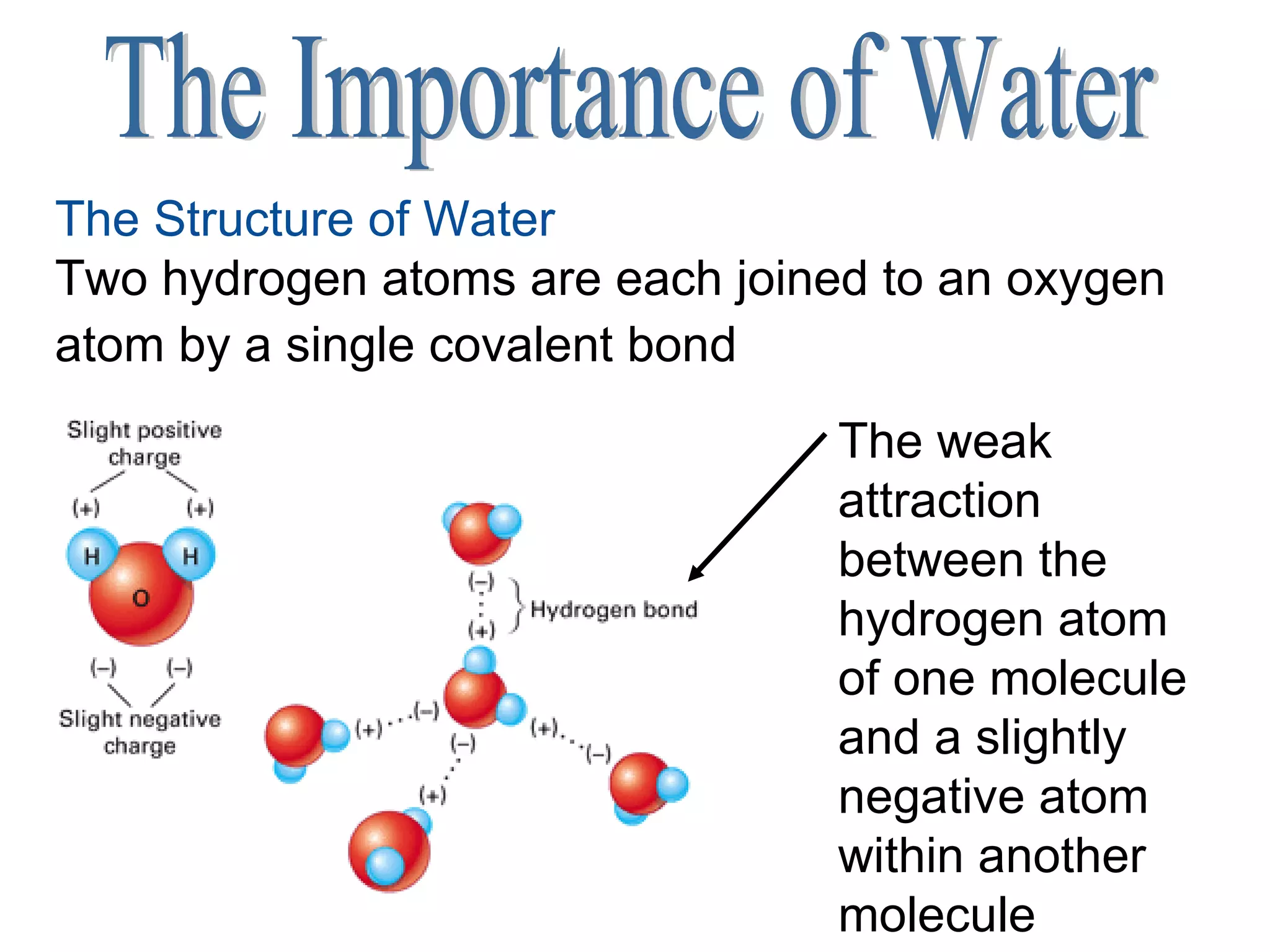
The Importance of Water The Structure of Water Two hydrogen atoms are each joined to an oxygen atom by a single covalent bond   The weak attraction between the hydrogen atom of one molecule and a slightly negative atom within another molecule                                                                                                              
The tendency of molecules of the same kind to stick to one another is called  cohesion . The type of attraction that occurs between unlike molecules is called  adhesion .
Temperature Moderation   Because of hydrogen bonding, water has a better ability to resist temperature change than most other substances Oceans and large lakes moderate the temperatures of nearby land areas Water also moderates temperature through evaporation, such as when you sweat
Low Density of Ice
Review of Chemical Bonds and Reactions Use the web resources listed below to help you study the topics covered so far: http://csep10.phys.utk.edu/krogh_instructorCD/biology/ch3/animations/mod03_1.swf http://www.phschool.com/science/biology_place/biocoach/biokit/polarity.html http://programs.northlandcollege.edu/biology/Biology1111/animations/hydrogenbonds.html
Ions and Living Cells When NaCl dissolves in water the ionic bonds are broken. The positive sodium ion is attracted to the slightly negative part of the water molecule and the negative chloride ion is attracted to the positive part of the water molecule.
Ions and Living Cells When a covalent compound such as water is converted to ions, there are H +  and OH -  ions in solution The presence and abundance of these ions is critical to the functioning of the cell in terms of its biochemistry   The level of H +  and OH -  ions in solution is measured by the…. pH Scale
Ions and Living Cells A pH of 7 indicates an equal number of H +  and OH -  ions in solution A pH less than 7 indicates a solution with excess H +  ions = acid A pH greater than 7 indicates a solution with excess OH -  ions = base
Ions and Living Cells The functioning of living cells can be affected by a change in pH Because the very reactions of life cause pH changes, there is a need for cells to be able to regulate the pH of the intracellular fluid
Review of Chemical Bonds and Reactions Use the web resources listed below to help you study the topics covered so far: http://programs.northlandcollege.edu/biology/Biology1111/animations/dissolve.html http://www.johnkyrk.com/pH.html http://www.mhhe.com/physsci/chemistry/essentialchemistry/flash/buffer12.swf

Biochemistry Honors

  • 1.
    Basic Chemistry Understanding the Basics of BioChemistry
  • 2.
    Why is anunderstanding of chemistry important to someone studying biology? All cells (and thus organisms) are composed of chemicals All life processes involve a variety of chemical reactions Reveals the complexity and elegance of life
  • 3.
    What we willfocus on in this presentation: Matter and Atoms Compounds Molecules Chemical Bonds Chemical Reactions The Unique Properties of Water Ions and Living Cells pH
  • 4.
    Matter isanything that has mass and takes up space… Atoms are the basic building blocks of matter Our current model of atoms was first described by John Dalton in his work “The Atomic Theory” Living Things Are Made of Matter Made up of….
  • 5.
    Compounds aresubstances which contain 2 or more different elements chemically combined in a fixed ratio Atoms Elements and Compunds
  • 6.
    Molecules aresubstances which contain 2 or more atoms, and are the most basic unit of a substance Molecules can contain atoms of the same element or different elements Molecules
  • 7.
    Which of thefollowing are molecules only and which are molecules and compounds? CO 2 O 2 H 2 H 2 SO 4 HCl N 2 H 2 O Molecule and Compound Molecule Molecule Molecule and Compound Molecule and Compound Molecule Molecule and Compound
  • 8.
    Elements!!! Elements are substances made up of 1 kind of atom! 6 different elements make up 97% of the compounds that are found in living things There are more than 100 known elements today
  • 9.
    Atoms Protons +charge, nucleus Neutrons 0 charge, nucleus Electrons - charge, orbit in the electron charge The # of protons in an atom determines its identity!
  • 10.
    Elements!!! One elementdiffers from another by the number of protons in its nucleus An element’s atomic number equals its number of protons Element Number of Protons Hydrogen Carbon 8 7 1 6 Oxygen Nitrogen
  • 11.
    Sometimes atoms ofthe same element differ in their number of neutrons Isotopes Useful in biological research if radioisotopes
  • 12.
    Review of AtomsMolecules and Compounds Use the web resources listed below to help you study the topics covered so far: http://csep10.phys. utk . edu / krogh _ instructorCD /biology/ch2/animations/mod02_1. swf http://www.phschool.com/science/biology_place/biocoach/biokit/chnops.html http://www.chemthink.com
  • 13.
    Chemical Bonds andReactions The Point of Reactions and Bonding is…. Energy!!! Why Bonds Form Types of Bonds Reactions and Equations
  • 14.
    Why Do ChemicalBonds Form ? Atoms are most stable when their outermost energy level is filled with electrons To accomplish this stable state, atoms may share or transfer electrons among their nuclei and form bonds ! A Bohr Model can be used to determine the number of electrons in the outer shell of any atom!
  • 15.
    Types of BondsChemical Bonds Form When Atoms Share or Transfer Electrons Ionic Bonds Covalent Bonds Forms when an electron (or electrons) is transferred from one atom to another Forms when an electron (or electrons) is shared between atoms Type of bond formed is dependent on the electronegativity of atoms involved
  • 16.
    Ionic Bonds Sodiumwants to lose an electron to become most stable Draw a Bohr Model of Sodium (Na) and Chlorine (Cl) How does each atom become most stable with a full outer shell of electrons? Chlorine wants to gain an electron to become most stable The strong attraction between the positive sodium ion and the negative chloride ion creates an ionic bond NaCl is common table salt
  • 17.
    Covalent BondsA hydrogen atom wants to share its electron. For example, it can share its electron with another hydrogen atom or two hydrogen atoms can share their electrons with an oxygen atom which wants to share a total of two electrons. Shared Pair of Electrons
  • 18.
    Covalent BondsIf the electrons of a bond are shared equally a non-polar bond is formed If the electrons of a bond are not shared equally a polar bond is formed Polar Covalent Non-Polar Covalent
  • 19.
    Chemical Reactions andEquations A chemical reaction involves the making or breaking of chemical bonds (ionic or covalent) Chemical reactions are necessary for life: To establish stable atomic structures To form new molecules that cells need To manage cellular energy (energy release, usage, and storage)
  • 20.
    Chemical Reactions andEquations Chemical equations describe a chemical reaction Chemical equations provide the following information: The different elements involved in the reaction The number of atoms involved in the reaction The reactants and products of the reaction
  • 21.
    Chemical Reactions andEquations Reading a chemical reaction….. Carbon dioxide and water react (in the presence of sunlight and chlorophyll) to produce carbohydrate (glucose) and oxygen
  • 22.
    Chemical Reactions andEquations Other information from the equation…. # of molecules of reactants and products: 6 CO 2 6 H 2 O 1 C 6 H 12 O 6 6 O 2
  • 23.
    Chemical Reactions andEquations Other information from the equation…. The number of each kind of atom on each side of the equation Reactants C O H Products C O H 6 18 12 6 18 12
  • 24.
    Review of ChemicalBonds and Reactions Use the web resources listed below to help you study the topics covered so far: http://csep10.phys.utk.edu/krogh_instructorCD/biology/ch2/animations/mod02_2.swf http://www2.nl.edu/jste/bonds.htm http://www.phschool.com/science/biology_place/biocoach/biokit/valence.html http://www.chemthink.com
  • 25.
    The Importance ofWater The Structure of Water Two hydrogen atoms are each joined to an oxygen atom by a single covalent bond The weak attraction between the hydrogen atom of one molecule and a slightly negative atom within another molecule                                                                                                              
  • 26.
    The tendency ofmolecules of the same kind to stick to one another is called cohesion . The type of attraction that occurs between unlike molecules is called adhesion .
  • 27.
    Temperature Moderation Because of hydrogen bonding, water has a better ability to resist temperature change than most other substances Oceans and large lakes moderate the temperatures of nearby land areas Water also moderates temperature through evaporation, such as when you sweat
  • 28.
  • 29.
    Review of ChemicalBonds and Reactions Use the web resources listed below to help you study the topics covered so far: http://csep10.phys.utk.edu/krogh_instructorCD/biology/ch3/animations/mod03_1.swf http://www.phschool.com/science/biology_place/biocoach/biokit/polarity.html http://programs.northlandcollege.edu/biology/Biology1111/animations/hydrogenbonds.html
  • 30.
    Ions and LivingCells When NaCl dissolves in water the ionic bonds are broken. The positive sodium ion is attracted to the slightly negative part of the water molecule and the negative chloride ion is attracted to the positive part of the water molecule.
  • 31.
    Ions and LivingCells When a covalent compound such as water is converted to ions, there are H + and OH - ions in solution The presence and abundance of these ions is critical to the functioning of the cell in terms of its biochemistry The level of H + and OH - ions in solution is measured by the…. pH Scale
  • 32.
    Ions and LivingCells A pH of 7 indicates an equal number of H + and OH - ions in solution A pH less than 7 indicates a solution with excess H + ions = acid A pH greater than 7 indicates a solution with excess OH - ions = base
  • 33.
    Ions and LivingCells The functioning of living cells can be affected by a change in pH Because the very reactions of life cause pH changes, there is a need for cells to be able to regulate the pH of the intracellular fluid
  • 34.
    Review of ChemicalBonds and Reactions Use the web resources listed below to help you study the topics covered so far: http://programs.northlandcollege.edu/biology/Biology1111/animations/dissolve.html http://www.johnkyrk.com/pH.html http://www.mhhe.com/physsci/chemistry/essentialchemistry/flash/buffer12.swf