D R C H R I S T I N E C O O M B E
H C T D U B A I , M E N ’ S C A M P U S
Research Methods: Conducting
Interviews
Using interviews in research
 There are many types of interviews
 The most common are:
 Unstructured
 Semi-structured
 Structured
Unstructured interviews
 The participant is free to talk about what he or she
feels is important.
 The researcher provides little or no directional
influence during the interview.
 Unstructured interviews are only used in qualitative
research.
 Some feel that this type of interview is the easiest to
conduct but this is not true.
 Why?
How to conduct an unstructured interview
 First, the researcher must create rapport with the
interviewee
 Interviewee must trust the researcher so he/she can reveal
information during the interview
 Anonymity & confidentiality
 During the interview, the researcher must
 remain quiet
 stay alert
 recognize important information
 probe for more detail
 get participants back on track if they go on topic
Semi-structured interviews
 This is the most common type of interview used in
qualitative research.
 In this type of interview, the researcher wants to
know specific information which can be compared
and contrasted with information gained in other
interviews.
 The same questions need to be asked in each
interview--structure.
 Flexibility is also important so new info can come
out—semi.
How to conduct a semi-structured interview
 Researcher must produce an interview schedule or
protocol
 A list of questions to ask or topics to discuss
 This is taken to each interview to ensure the same content is
discussed
Structured interviews
 Frequently used in market research
 Interviewer asks a set list of questions and ticks off
answers
 This type of interview is highly structured
 Structured interviews are used in quantitative
research
 They can be conducted:
 Online
 Face to face
 Over the telephone
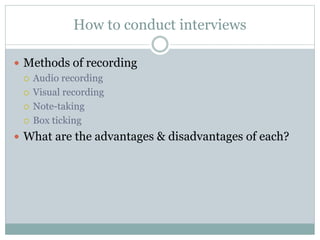
How to conduct interviews
 Methods of recording
 Audio recording
 Visual recording
 Note-taking
 Box ticking
 What are the advantages & disadvantages of each?
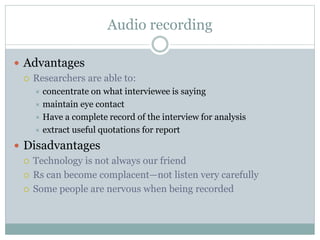
Audio recording
 Advantages
 Researchers are able to:
 concentrate on what interviewee is saying
 maintain eye contact
 Have a complete record of the interview for analysis
 extract useful quotations for report
 Disadvantages
 Technology is not always our friend
 Rs can become complacent—not listen very carefully
 Some people are nervous when being recorded
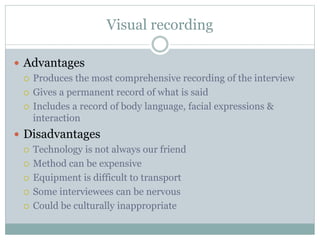
Visual recording
 Advantages
 Produces the most comprehensive recording of the interview
 Gives a permanent record of what is said
 Includes a record of body language, facial expressions &
interaction
 Disadvantages
 Technology is not always our friend
 Method can be expensive
 Equipment is difficult to transport
 Some interviewees can be nervous
 Could be culturally inappropriate
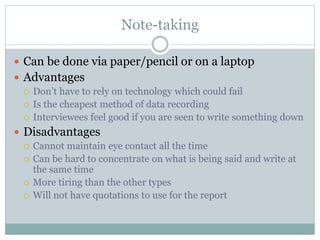
Note-taking
 Can be done via paper/pencil or on a laptop
 Advantages
 Don’t have to rely on technology which could fail
 Is the cheapest method of data recording
 Interviewees feel good if you are seen to write something down
 Disadvantages
 Cannot maintain eye contact all the time
 Can be hard to concentrate on what is being said and write at
the same time
 More tiring than the other types
 Will not have quotations to use for the report
Box-ticking
 Advantages
 Simple to use
 Easy to analyze
 Easy to compare information with that obtained from other
interviews
 Disadvantages
 Inflexible—no scope for additional info
 Forces interviewees to answer in a certain way
Tips for using recording equipment
 Make sure there is enough space (memory, disk or
tape) to record everything you need
 Check that equipment is fully charged & in working
condition
 Make sure the venue is free from background noise
 Make sure there is a place to hold the equipment
 Make sure the microphone is strong enough to pick
up all voices in an interview
 Make sure you are able to download files to your PC
 Always have a back up plan
Developing an interview schedule/protocol
 For most types of interviews you must develop an
interview schedule/protocol
 For structured interviews
 A list of Qs that are asked in the same order and format to each
participant
 For semi-structured interviews
 It can be in the form of a list of questions to ask or topics to
cover
 Questions or topics? Which is better?
 For new researchers, a list of Qs is preferable
 A list of topics to cover is seen as being more flexible.
How to develop an interview schedule/protocol
 Brainstorm your research topic
 Work through your list carefully, getting rid of
irrelevant topics and grouping similar topics together
 Order topics into a logical sequence
 Leave sensitive or controversial issues to the end
 Ask about experience and/or behavior first
 Ask about opinions and feelings after
 Move from general to specific
 Think of Qs relating to each area
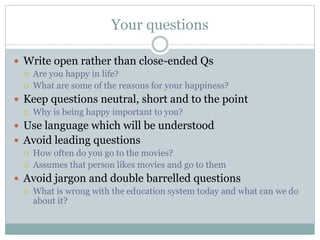
Your questions
 Write open rather than close-ended Qs
 Are you happy in life?
 What are some of the reasons for your happiness?
 Keep questions neutral, short and to the point
 Why is being happy important to you?
 Use language which will be understood
 Avoid leading questions
 How often do you go to the movies?
 Assumes that person likes movies and go to them
 Avoid jargon and double barrelled questions
 What is wrong with the education system today and what can we do
about it?
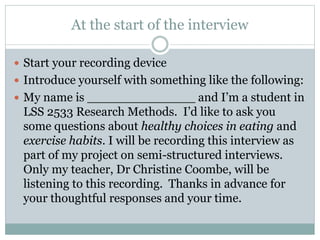
At the start of the interview
 Start your recording device
 Introduce yourself with something like the following:
 My name is ______________ and I’m a student in
LSS 2533 Research Methods. I’d like to ask you
some questions about healthy choices in eating and
exercise habits. I will be recording this interview as
part of my project on semi-structured interviews.
Only my teacher, Dr Christine Coombe, will be
listening to this recording. Thanks in advance for
your thoughtful responses and your time.
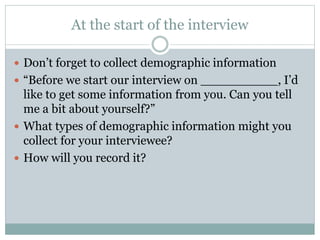
At the start of the interview
 Don’t forget to collect demographic information
 “Before we start our interview on __________, I’d
like to get some information from you. Can you tell
me a bit about yourself?”
 What types of demographic information might you
collect for your interviewee?
 How will you record it?
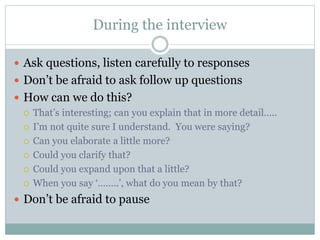
During the interview
 Ask questions, listen carefully to responses
 Don’t be afraid to ask follow up questions
 How can we do this?
 That’s interesting; can you explain that in more detail…..
 I’m not quite sure I understand. You were saying?
 Can you elaborate a little more?
 Could you clarify that?
 Could you expand upon that a little?
 When you say ‘……..’, what do you mean by that?
 Don’t be afraid to pause
During the interview
 Rs must establish rapport so participants will feel
comfortable sharing personal information
 How can this be done?
 Treat interviewees with respect
 Arrive on time
 Make small talk to decrease nervousness
 Accept tea/coffee
 Don’t rush into interview unless interviewee wants you to
 Think about your appearance and how you dress
 Think about your body language
 Make and maintain eye contact during the interview
 Don’t invade the space of the interviewee--proxemics
Completing the interview
 Make sure you stick to the time allocated unless the
interviewee wants to extend the time
 Thank your interviewee and leave your contact
details
 This concludes our interview. Thank you for lending
us your time, input and presence.

5. research methods interviews

  • 1.
    D R CH R I S T I N E C O O M B E H C T D U B A I , M E N ’ S C A M P U S Research Methods: Conducting Interviews
  • 2.
    Using interviews inresearch  There are many types of interviews  The most common are:  Unstructured  Semi-structured  Structured
  • 3.
    Unstructured interviews  Theparticipant is free to talk about what he or she feels is important.  The researcher provides little or no directional influence during the interview.  Unstructured interviews are only used in qualitative research.  Some feel that this type of interview is the easiest to conduct but this is not true.  Why?
  • 4.
    How to conductan unstructured interview  First, the researcher must create rapport with the interviewee  Interviewee must trust the researcher so he/she can reveal information during the interview  Anonymity & confidentiality  During the interview, the researcher must  remain quiet  stay alert  recognize important information  probe for more detail  get participants back on track if they go on topic
  • 5.
    Semi-structured interviews  Thisis the most common type of interview used in qualitative research.  In this type of interview, the researcher wants to know specific information which can be compared and contrasted with information gained in other interviews.  The same questions need to be asked in each interview--structure.  Flexibility is also important so new info can come out—semi.
  • 6.
    How to conducta semi-structured interview  Researcher must produce an interview schedule or protocol  A list of questions to ask or topics to discuss  This is taken to each interview to ensure the same content is discussed
  • 7.
    Structured interviews  Frequentlyused in market research  Interviewer asks a set list of questions and ticks off answers  This type of interview is highly structured  Structured interviews are used in quantitative research  They can be conducted:  Online  Face to face  Over the telephone
  • 8.
    How to conductinterviews  Methods of recording  Audio recording  Visual recording  Note-taking  Box ticking  What are the advantages & disadvantages of each?
  • 9.
    Audio recording  Advantages Researchers are able to:  concentrate on what interviewee is saying  maintain eye contact  Have a complete record of the interview for analysis  extract useful quotations for report  Disadvantages  Technology is not always our friend  Rs can become complacent—not listen very carefully  Some people are nervous when being recorded
  • 10.
    Visual recording  Advantages Produces the most comprehensive recording of the interview  Gives a permanent record of what is said  Includes a record of body language, facial expressions & interaction  Disadvantages  Technology is not always our friend  Method can be expensive  Equipment is difficult to transport  Some interviewees can be nervous  Could be culturally inappropriate
  • 11.
    Note-taking  Can bedone via paper/pencil or on a laptop  Advantages  Don’t have to rely on technology which could fail  Is the cheapest method of data recording  Interviewees feel good if you are seen to write something down  Disadvantages  Cannot maintain eye contact all the time  Can be hard to concentrate on what is being said and write at the same time  More tiring than the other types  Will not have quotations to use for the report
  • 12.
    Box-ticking  Advantages  Simpleto use  Easy to analyze  Easy to compare information with that obtained from other interviews  Disadvantages  Inflexible—no scope for additional info  Forces interviewees to answer in a certain way
  • 13.
    Tips for usingrecording equipment  Make sure there is enough space (memory, disk or tape) to record everything you need  Check that equipment is fully charged & in working condition  Make sure the venue is free from background noise  Make sure there is a place to hold the equipment  Make sure the microphone is strong enough to pick up all voices in an interview  Make sure you are able to download files to your PC  Always have a back up plan
  • 14.
    Developing an interviewschedule/protocol  For most types of interviews you must develop an interview schedule/protocol  For structured interviews  A list of Qs that are asked in the same order and format to each participant  For semi-structured interviews  It can be in the form of a list of questions to ask or topics to cover  Questions or topics? Which is better?  For new researchers, a list of Qs is preferable  A list of topics to cover is seen as being more flexible.
  • 15.
    How to developan interview schedule/protocol  Brainstorm your research topic  Work through your list carefully, getting rid of irrelevant topics and grouping similar topics together  Order topics into a logical sequence  Leave sensitive or controversial issues to the end  Ask about experience and/or behavior first  Ask about opinions and feelings after  Move from general to specific  Think of Qs relating to each area
  • 16.
    Your questions  Writeopen rather than close-ended Qs  Are you happy in life?  What are some of the reasons for your happiness?  Keep questions neutral, short and to the point  Why is being happy important to you?  Use language which will be understood  Avoid leading questions  How often do you go to the movies?  Assumes that person likes movies and go to them  Avoid jargon and double barrelled questions  What is wrong with the education system today and what can we do about it?
  • 17.
    At the startof the interview  Start your recording device  Introduce yourself with something like the following:  My name is ______________ and I’m a student in LSS 2533 Research Methods. I’d like to ask you some questions about healthy choices in eating and exercise habits. I will be recording this interview as part of my project on semi-structured interviews. Only my teacher, Dr Christine Coombe, will be listening to this recording. Thanks in advance for your thoughtful responses and your time.
  • 18.
    At the startof the interview  Don’t forget to collect demographic information  “Before we start our interview on __________, I’d like to get some information from you. Can you tell me a bit about yourself?”  What types of demographic information might you collect for your interviewee?  How will you record it?
  • 19.
    During the interview Ask questions, listen carefully to responses  Don’t be afraid to ask follow up questions  How can we do this?  That’s interesting; can you explain that in more detail…..  I’m not quite sure I understand. You were saying?  Can you elaborate a little more?  Could you clarify that?  Could you expand upon that a little?  When you say ‘……..’, what do you mean by that?  Don’t be afraid to pause
  • 20.
    During the interview Rs must establish rapport so participants will feel comfortable sharing personal information  How can this be done?  Treat interviewees with respect  Arrive on time  Make small talk to decrease nervousness  Accept tea/coffee  Don’t rush into interview unless interviewee wants you to  Think about your appearance and how you dress  Think about your body language  Make and maintain eye contact during the interview  Don’t invade the space of the interviewee--proxemics
  • 21.
    Completing the interview Make sure you stick to the time allocated unless the interviewee wants to extend the time  Thank your interviewee and leave your contact details  This concludes our interview. Thank you for lending us your time, input and presence.