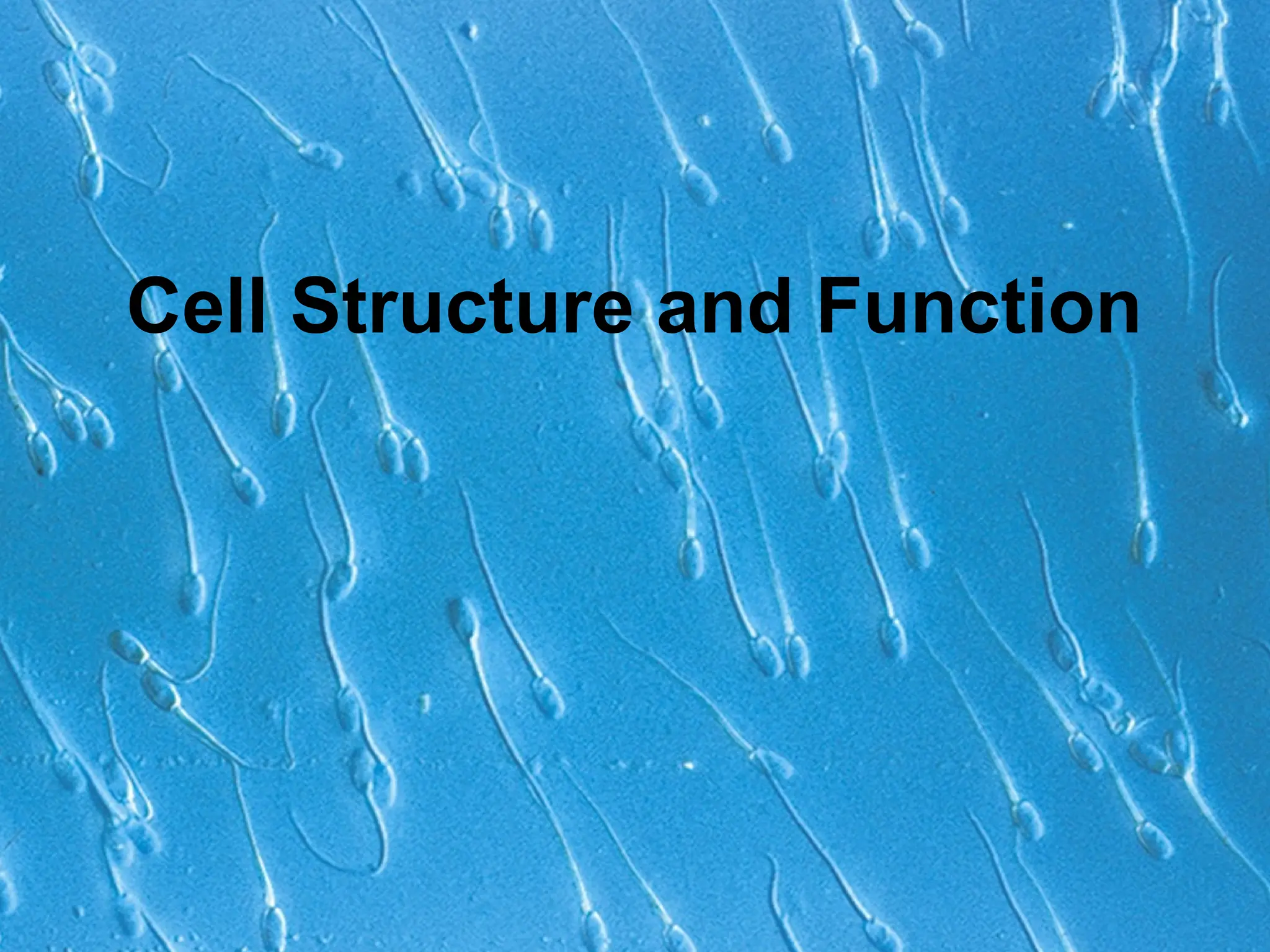
Cell Structure and Function
Outline
• Cell Structure and Organelles
• Cell Molecular Components
• Water and Chemical properties
• Cell Membrane
• Osmotic Properties of cells
• Cell molecule transportation
Brainstorming
• What is your idea of Cell Biology?
• Write at least 5 words that you can
associate with it.
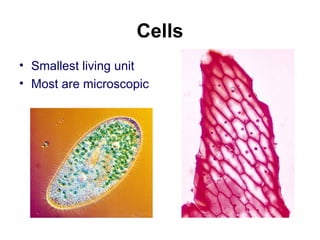
Cells
• Smallest living unit
• Most are microscopic
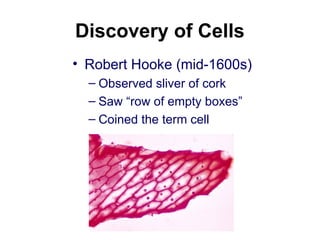
Discovery of Cells
• Robert Hooke (mid-1600s)
– Observed sliver of cork
– Saw “row of empty boxes”
– Coined the term cell
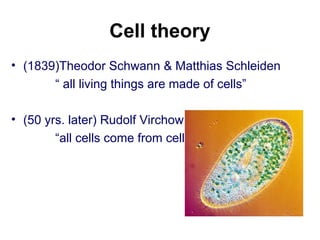
Cell theory
• (1839)Theodor Schwann & Matthias Schleiden
“ all living things are made of cells”
• (50 yrs. later) Rudolf Virchow
“all cells come from cells”
Principles of Cell Theory
• All living things are made of cells
• Smallest living unit of structure and
function of all organisms is the cell
• All cells arise from preexisting cells
(this principle discarded the idea of
spontaneous generation)
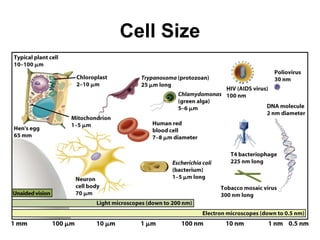
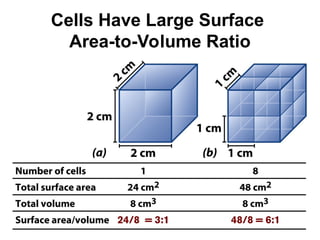
Cell Size
Cells Have Large Surface
Area-to-Volume Ratio
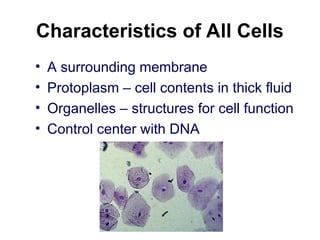
Characteristics of All Cells
• A surrounding membrane
• Protoplasm – cell contents in thick fluid
• Organelles – structures for cell function
• Control center with DNA
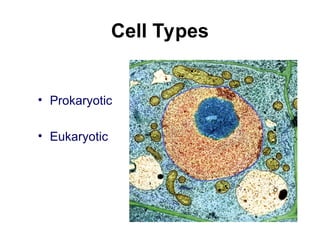
Cell Types
• Prokaryotic
• Eukaryotic
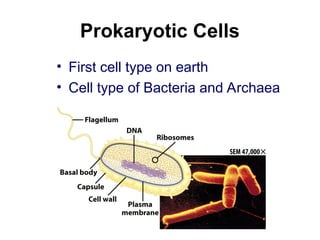
Prokaryotic Cells
• First cell type on earth
• Cell type of Bacteria and Archaea
Prokaryotic Cells
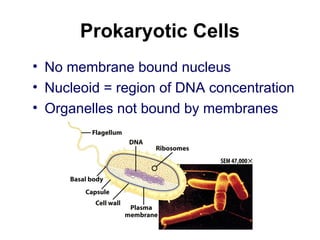
• No membrane bound nucleus
• Nucleoid = region of DNA concentration
• Organelles not bound by membranes
Eukaryotic Cells
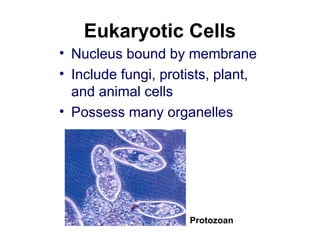
• Nucleus bound by membrane
• Include fungi, protists, plant,
and animal cells
• Possess many organelles
Protozoan
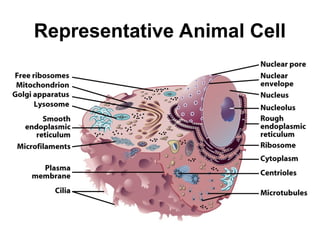
Representative Animal Cell
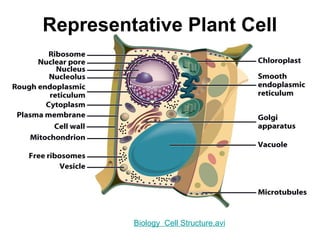
Representative Plant Cell
Biology Cell Structure.avi
Think-Pair-Share
• What is the role of cytosol in maintaining
balance?
• How do vesicles facilitate transport?
• How do cytoskeleton help maintain cellular
stability?
Organic Molecules of Cells
• Proteins
• Carbohydrates
• Lipids
• Nucleic acids
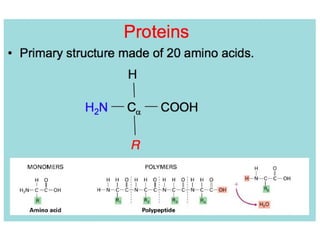
Proteins
• Most diverse and complex macromolecules
in the cell
• Used for structure, function and information
• Made of linearly arranged amino acid
residues
– “folded” up with “active” regions
Types of Proteins
– Enzymes – catalyzes covalent bond breakage or
formation
– Structural – collagen, elastin, keratin
– Motility – actin, myosin, tubulin
– Regulatory – bind to DNA to switch genes on or off
– Storage – albumin, casein
– Hormonal – insulin, nerve growth factor
– Receptors – hormone and neurotransmitter receptors
– Transport – carries small molecules or irons
– Special purpose proteins – green fluorescent protein
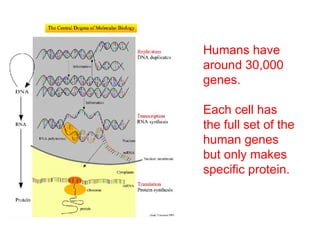
Humans have
around 30,000
genes.
Each cell has
the full set of the
human genes
but only makes
specific protein.
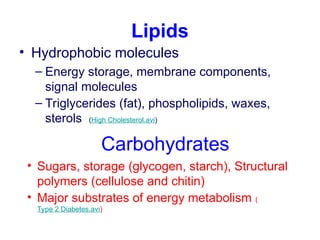
• Hydrophobic molecules
– Energy storage, membrane components,
signal molecules
– Triglycerides (fat), phospholipids, waxes,
sterols (High Cholesterol.avi)
Lipids
• Sugars, storage (glycogen, starch), Structural
polymers (cellulose and chitin)
• Major substrates of energy metabolism (
Type 2 Diabetes.avi)
Carbohydrates
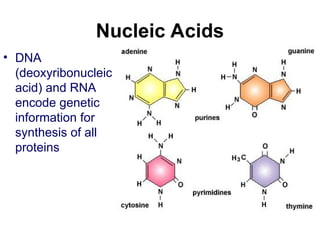
Nucleic Acids
• DNA
(deoxyribonucleic
acid) and RNA
encode genetic
information for
synthesis of all
proteins
Q-Chart
• Formulate 9 questions based from the
topics: Proteins, Lipids, Carbohydrates
and Nucleic Acids.
• Ask your classmates at least 2 questions
from the chart.
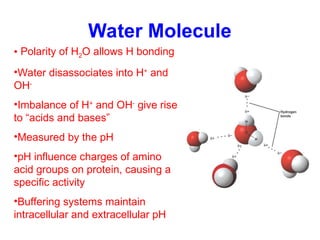
Water Molecule
• Polarity of H2O allows H bonding
•Water disassociates into H+
and
OH-
•Imbalance of H+
and OH-
give rise
to “acids and bases”
•Measured by the pH
•pH influence charges of amino
acid groups on protein, causing a
specific activity
•Buffering systems maintain
intracellular and extracellular pH
• Hydrophobic “Water-fearing”
– Molecule is not polar, cannot form H bonds
and is “repelled” from water
– Insoluble
• Hydrophillic “Water-loving”
– Molecule is polar, forms H bonds with water
– Soluble
Water Molecule
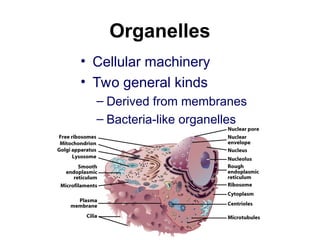
Organelles
• Cellular machinery
• Two general kinds
– Derived from membranes
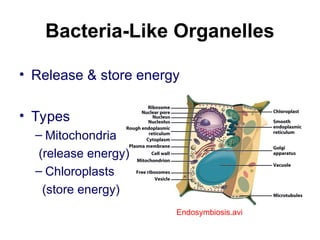
– Bacteria-like organelles
Bacteria-Like Organelles
• Derived from symbiotic bacteria
• Ancient association
• Endosymbiotic theory
– Evolution of modern cells from
cells & symbiotic bacteria
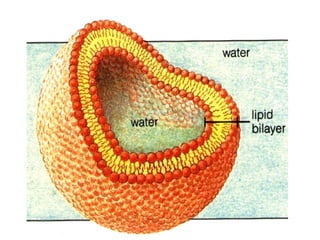
Plasma Membrane
• Contains cell contents
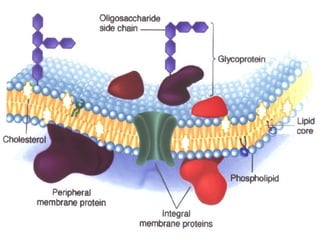
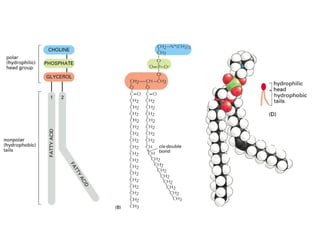
• Double layer of phospholipids & proteins
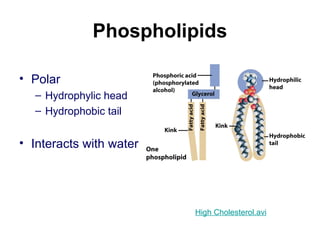
Phospholipids
• Polar
– Hydrophylic head
– Hydrophobic tail
• Interacts with water
High Cholesterol.avi
Movement Across the Plasma Membrane
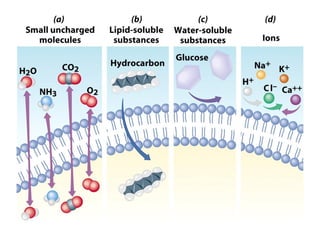
• A few molecules move freely
– Water, Carbon dioxide, Ammonia, Oxygen
• Carrier proteins transport some molecules
– Proteins embedded in lipid bilayer
– Fluid mosaic model – describes fluid nature of
a lipid bilayer with proteins
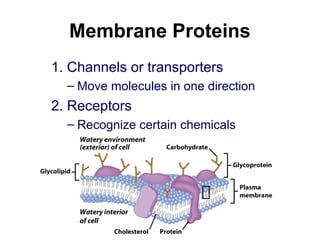
Membrane Proteins
1. Channels or transporters
– Move molecules in one direction
2. Receptors
– Recognize certain chemicals
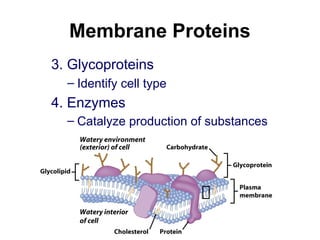
Membrane Proteins
3. Glycoproteins
– Identify cell type
4. Enzymes
– Catalyze production of substances
Reports
• New look at cell membrane ( Ms. M. Dawa)
• Protein, fatty molecules and cellular energy in
endocytosis (Ms. R. Madriaga)
• Ions (Ms. L. Balila)
• Creating Artificial Cell Membrane (Ms. Analiza
Suello)
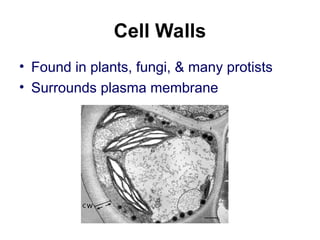
Cell Walls
• Found in plants, fungi, & many protists
• Surrounds plasma membrane
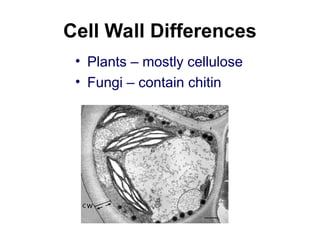
Cell Wall Differences
• Plants – mostly cellulose
• Fungi – contain chitin
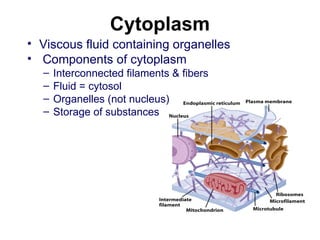
Cytoplasm
• Viscous fluid containing organelles
• Components of cytoplasm
– Interconnected filaments & fibers
– Fluid = cytosol
– Organelles (not nucleus)
– Storage of substances
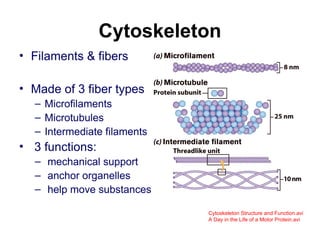
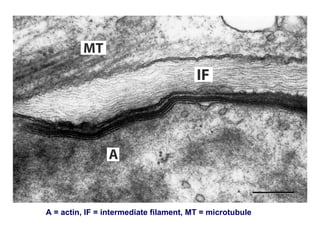
Cytoskeleton
• Filaments & fibers
• Made of 3 fiber types
– Microfilaments
– Microtubules
– Intermediate filaments
• 3 functions:
– mechanical support
– anchor organelles
– help move substances
Cytoskeleton Structure and Function.avi
A Day in the Life of a Motor Protein.avi
A = actin, IF = intermediate filament, MT = microtubule
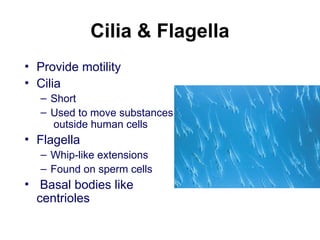
Cilia & Flagella
• Provide motility
• Cilia
– Short
– Used to move substances
outside human cells
• Flagella
– Whip-like extensions
– Found on sperm cells
• Basal bodies like
centrioles
Cilia & Flagella Structure
• Bundles of microtubules
• With plasma membrane
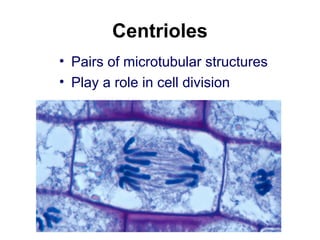
Centrioles
• Pairs of microtubular structures
• Play a role in cell division
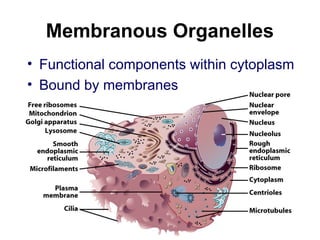
Membranous Organelles
• Functional components within cytoplasm
• Bound by membranes
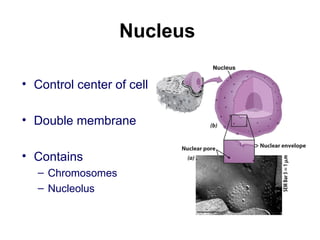
Nucleus
• Control center of cell
• Double membrane
• Contains
– Chromosomes
– Nucleolus
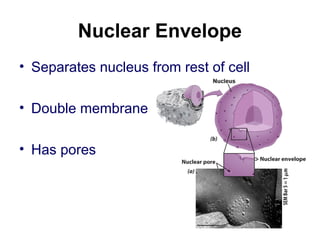
Nuclear Envelope
• Separates nucleus from rest of cell
• Double membrane
• Has pores
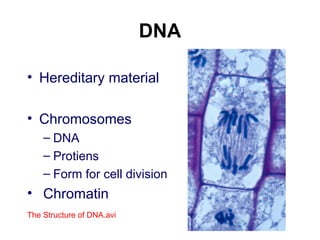
DNA
• Hereditary material
• Chromosomes
– DNA
– Protiens
– Form for cell division
• Chromatin
The Structure of DNA.avi
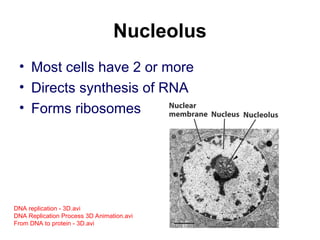
Nucleolus
• Most cells have 2 or more
• Directs synthesis of RNA
• Forms ribosomes
DNA replication - 3D.avi
DNA Replication Process 3D Animation.avi
From DNA to protein - 3D.avi
Central Dogma in Summary
• The central dogma of molecular biology
explains the flow of genetic information,
from DNA to RNA to make a functional
product, a protein
• DNA contains the information needed to
make all of our proteins, and that RNA is a
messenger that carries this information to
the ribosomes
• Ribosomes serve as factories in the cell
where the information is ‘translated’ from a
code into the functional product.
• The process by which the DNA instructions
are converted into the functional product is
called gene expression
• Gene expression has two key stages
- transcription and translation
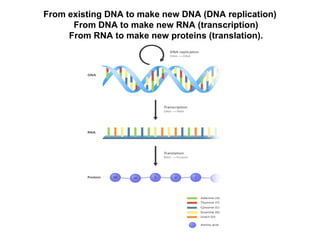
From existing DNA to make new DNA (DNA replication)
From DNA to make new RNA (transcription)
From RNA to make new proteins (translation).
• In transcription, the information in the DNA
of every cell is converted into small,
portable RNA messages.
• In translation, these messages travel from
where the DNA is in the cell nucleus to the
ribosomes where they are ‘read’ to make
specific proteins.
Reports
• Nuclear Envelope (Ms. K. Tiñas)
• Nuclear Pore (Mr. J. Tiongco)
Endoplasmic Reticulum
• Helps move substances within cells
• Network of interconnected membranes
• Two types
– Rough endoplasmic reticulum
– Smooth endoplasmic reticulum
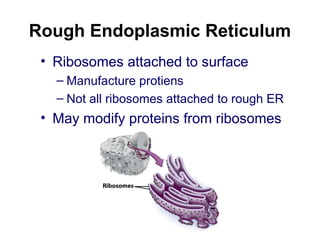
Rough Endoplasmic Reticulum
• Ribosomes attached to surface
– Manufacture protiens
– Not all ribosomes attached to rough ER
• May modify proteins from ribosomes
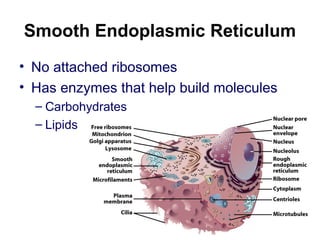
Smooth Endoplasmic Reticulum
• No attached ribosomes
• Has enzymes that help build molecules
– Carbohydrates
– Lipids
Reports
• ER stress (Mr. R. Alonzo and Ms. S.
Franial)
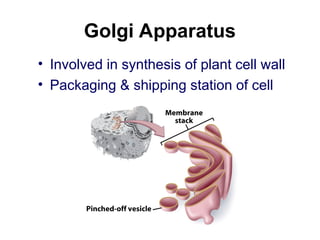
Golgi Apparatus
• Involved in synthesis of plant cell wall
• Packaging & shipping station of cell
Golgi Apparatus Function
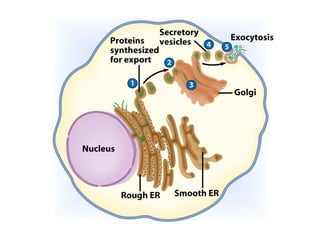
1. Molecules come in vesicles
2. Vesicles fuse with Golgi membrane
3. Molecules may be modified by Golgi
Golgi Apparatus Function
(Continued)
4. Molecules pinched-off in separate vesicle
5. Vesicle leaves Golgi apparatus
6. Vesicles may combine with plasma
membrane to secrete contents
Report
• Golgi appratus by Cryo-electron
Tomography (Mr. A. Pandoma)
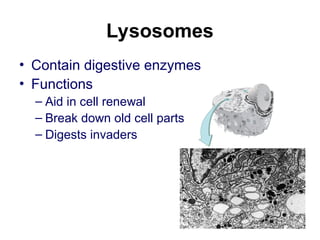
Lysosomes
• Contain digestive enzymes
• Functions
– Aid in cell renewal
– Break down old cell parts
– Digests invaders
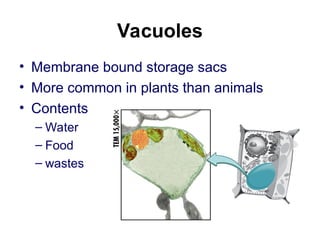
Vacuoles
• Membrane bound storage sacs
• More common in plants than animals
• Contents
– Water
– Food
– wastes
Making Connections
• Choose 3 statements from your notes that
you consider significant
• Connect them to Yourself, Other Texts
and the World
Bacteria-Like Organelles
• Release & store energy
• Types
– Mitochondria
(release energy)
– Chloroplasts
(store energy)
Endosymbiosis.avi
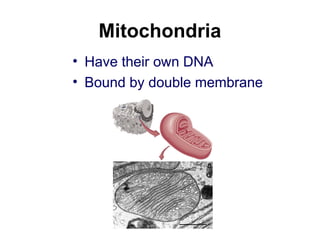
Mitochondria
• Have their own DNA
• Bound by double membrane
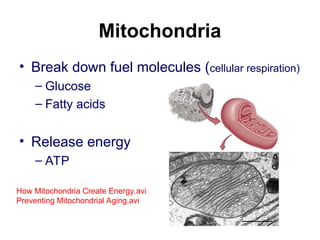
Mitochondria
• Break down fuel molecules (cellular respiration)
– Glucose
– Fatty acids
• Release energy
– ATP
How Mitochondria Create Energy.avi
Preventing Mitochondrial Aging.avi
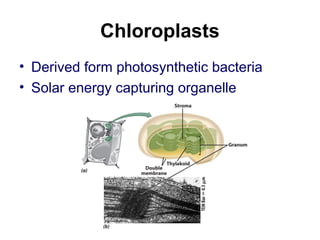
Chloroplasts
• Derived form photosynthetic bacteria
• Solar energy capturing organelle
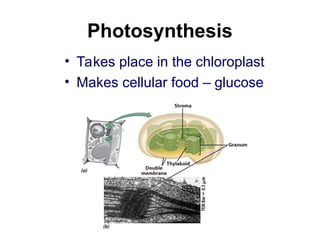
Photosynthesis
• Takes place in the chloroplast
• Makes cellular food – glucose
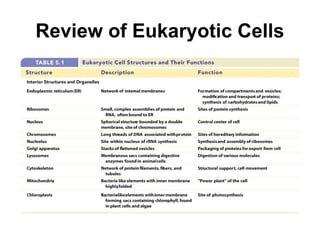
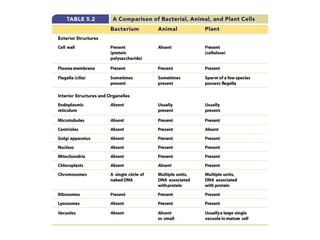
Review of Eukaryotic Cells
Molecule Movement & Cells
• Passive Transport
• Active Transport
• Endocytosis
(phagocytosis & pinocytosis)
• Exocytosis
Passive Transport
• No energy required
• Move due to gradient
– differences in concentration, pressure, charge
• Move to equalize gradient
– High moves toward low
Types of Passive Transport
1. Diffusion
2. Osmosis
3. Facilitated diffusion
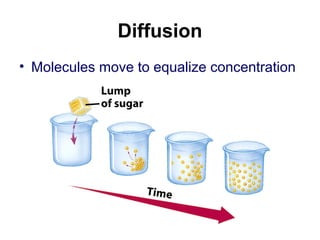
Diffusion
• Molecules move to equalize concentration
Osmosis
• Special form of diffusion
• Fluid flows from lower solute concentration
• Often involves movement of water
– Into cell
– Out of cell
Solution Differences & Cells
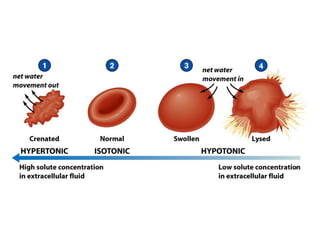
• solvent + solute = solution
• Hypotonic
– Solutes in cell more than outside
– Outside solvent will flow into cell
• Isotonic
– Solutes equal inside & out of cell
• Hypertonic
– Solutes greater outside cell
– Fluid will flow out of cell
Facilitated Diffusion
• Differentially permeable membrane
• Channels (are specific) help molecule
or ions enter or leave the cell
• Channels usually are transport proteins
(aquaporins facilitate the movement of
water)
• No energy is used
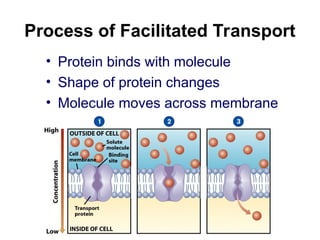
Process of Facilitated Transport
• Protein binds with molecule
• Shape of protein changes
• Molecule moves across membrane
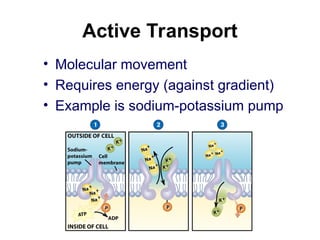
Active Transport
• Molecular movement
• Requires energy (against gradient)
• Example is sodium-potassium pump
Endocytosis
• Movement of large material
– Particles
– Organisms
– Large molecules
• Movement is into cells
• Types of endocytosis
– bulk-phase (nonspecific)
– receptor-mediated (specific)
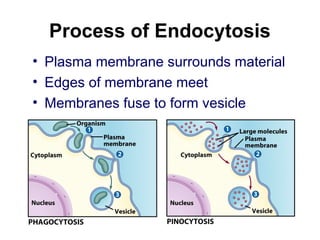
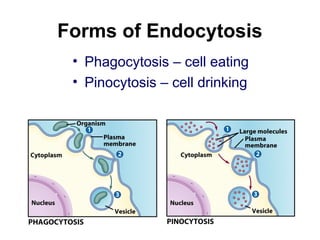
Process of Endocytosis
• Plasma membrane surrounds material
• Edges of membrane meet
• Membranes fuse to form vesicle
Forms of Endocytosis
• Phagocytosis – cell eating
• Pinocytosis – cell drinking
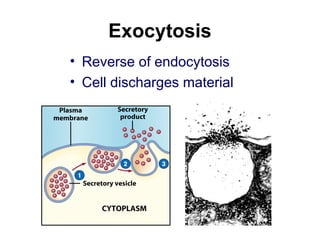
Exocytosis
• Reverse of endocytosis
• Cell discharges material
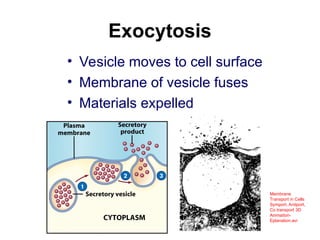
Exocytosis
• Vesicle moves to cell surface
• Membrane of vesicle fuses
• Materials expelled
Membrane
Transport in Cells
Symport, Antiport,
Co transport 3D
Animation-
Eplanation.avi
Concept Mapping
• Osmotic Properties
• Cells
• Hydrostatic Pressure
• Equilibrium
• Semi-permeable
membrane
• Tonicity
• Lysis
• Permeability
• Isotonic
• Hypotonic
• Hypertonic
• Passive Diffusion
• Passive Transport
• Facilitated Transport
• Active Transport
• Crenation

Cell Biology Presentation.ppt 55555555555

  • 1.
  • 2.
    Outline • Cell Structureand Organelles • Cell Molecular Components • Water and Chemical properties • Cell Membrane • Osmotic Properties of cells • Cell molecule transportation
  • 3.
    Brainstorming • What isyour idea of Cell Biology? • Write at least 5 words that you can associate with it.
  • 4.
    Cells • Smallest livingunit • Most are microscopic
  • 5.
    Discovery of Cells •Robert Hooke (mid-1600s) – Observed sliver of cork – Saw “row of empty boxes” – Coined the term cell
  • 6.
    Cell theory • (1839)TheodorSchwann & Matthias Schleiden “ all living things are made of cells” • (50 yrs. later) Rudolf Virchow “all cells come from cells”
  • 7.
    Principles of CellTheory • All living things are made of cells • Smallest living unit of structure and function of all organisms is the cell • All cells arise from preexisting cells (this principle discarded the idea of spontaneous generation)
  • 8.
  • 9.
    Cells Have LargeSurface Area-to-Volume Ratio
  • 10.
    Characteristics of AllCells • A surrounding membrane • Protoplasm – cell contents in thick fluid • Organelles – structures for cell function • Control center with DNA
  • 11.
  • 12.
    Prokaryotic Cells • Firstcell type on earth • Cell type of Bacteria and Archaea
  • 13.
    Prokaryotic Cells • Nomembrane bound nucleus • Nucleoid = region of DNA concentration • Organelles not bound by membranes
  • 14.
    Eukaryotic Cells • Nucleusbound by membrane • Include fungi, protists, plant, and animal cells • Possess many organelles Protozoan
  • 15.
  • 16.
  • 17.
    Think-Pair-Share • What isthe role of cytosol in maintaining balance? • How do vesicles facilitate transport? • How do cytoskeleton help maintain cellular stability?
  • 18.
    Organic Molecules ofCells • Proteins • Carbohydrates • Lipids • Nucleic acids
  • 19.
    Proteins • Most diverseand complex macromolecules in the cell • Used for structure, function and information • Made of linearly arranged amino acid residues – “folded” up with “active” regions
  • 20.
    Types of Proteins –Enzymes – catalyzes covalent bond breakage or formation – Structural – collagen, elastin, keratin – Motility – actin, myosin, tubulin – Regulatory – bind to DNA to switch genes on or off – Storage – albumin, casein – Hormonal – insulin, nerve growth factor – Receptors – hormone and neurotransmitter receptors – Transport – carries small molecules or irons – Special purpose proteins – green fluorescent protein
  • 22.
    Humans have around 30,000 genes. Eachcell has the full set of the human genes but only makes specific protein.
  • 23.
    • Hydrophobic molecules –Energy storage, membrane components, signal molecules – Triglycerides (fat), phospholipids, waxes, sterols (High Cholesterol.avi) Lipids • Sugars, storage (glycogen, starch), Structural polymers (cellulose and chitin) • Major substrates of energy metabolism ( Type 2 Diabetes.avi) Carbohydrates
  • 24.
    Nucleic Acids • DNA (deoxyribonucleic acid)and RNA encode genetic information for synthesis of all proteins
  • 25.
    Q-Chart • Formulate 9questions based from the topics: Proteins, Lipids, Carbohydrates and Nucleic Acids. • Ask your classmates at least 2 questions from the chart.
  • 26.
    Water Molecule • Polarityof H2O allows H bonding •Water disassociates into H+ and OH- •Imbalance of H+ and OH- give rise to “acids and bases” •Measured by the pH •pH influence charges of amino acid groups on protein, causing a specific activity •Buffering systems maintain intracellular and extracellular pH
  • 27.
    • Hydrophobic “Water-fearing” –Molecule is not polar, cannot form H bonds and is “repelled” from water – Insoluble • Hydrophillic “Water-loving” – Molecule is polar, forms H bonds with water – Soluble Water Molecule
  • 28.
    Organelles • Cellular machinery •Two general kinds – Derived from membranes – Bacteria-like organelles
  • 29.
    Bacteria-Like Organelles • Derivedfrom symbiotic bacteria • Ancient association • Endosymbiotic theory – Evolution of modern cells from cells & symbiotic bacteria
  • 30.
    Plasma Membrane • Containscell contents • Double layer of phospholipids & proteins
  • 33.
    Phospholipids • Polar – Hydrophylichead – Hydrophobic tail • Interacts with water High Cholesterol.avi
  • 35.
    Movement Across thePlasma Membrane • A few molecules move freely – Water, Carbon dioxide, Ammonia, Oxygen • Carrier proteins transport some molecules – Proteins embedded in lipid bilayer – Fluid mosaic model – describes fluid nature of a lipid bilayer with proteins
  • 37.
    Membrane Proteins 1. Channelsor transporters – Move molecules in one direction 2. Receptors – Recognize certain chemicals
  • 38.
    Membrane Proteins 3. Glycoproteins –Identify cell type 4. Enzymes – Catalyze production of substances
  • 39.
    Reports • New lookat cell membrane ( Ms. M. Dawa) • Protein, fatty molecules and cellular energy in endocytosis (Ms. R. Madriaga) • Ions (Ms. L. Balila) • Creating Artificial Cell Membrane (Ms. Analiza Suello)
  • 40.
    Cell Walls • Foundin plants, fungi, & many protists • Surrounds plasma membrane
  • 41.
    Cell Wall Differences •Plants – mostly cellulose • Fungi – contain chitin
  • 42.
    Cytoplasm • Viscous fluidcontaining organelles • Components of cytoplasm – Interconnected filaments & fibers – Fluid = cytosol – Organelles (not nucleus) – Storage of substances
  • 43.
    Cytoskeleton • Filaments &fibers • Made of 3 fiber types – Microfilaments – Microtubules – Intermediate filaments • 3 functions: – mechanical support – anchor organelles – help move substances Cytoskeleton Structure and Function.avi A Day in the Life of a Motor Protein.avi
  • 44.
    A = actin,IF = intermediate filament, MT = microtubule
  • 45.
    Cilia & Flagella •Provide motility • Cilia – Short – Used to move substances outside human cells • Flagella – Whip-like extensions – Found on sperm cells • Basal bodies like centrioles
  • 46.
    Cilia & FlagellaStructure • Bundles of microtubules • With plasma membrane
  • 47.
    Centrioles • Pairs ofmicrotubular structures • Play a role in cell division
  • 48.
    Membranous Organelles • Functionalcomponents within cytoplasm • Bound by membranes
  • 49.
    Nucleus • Control centerof cell • Double membrane • Contains – Chromosomes – Nucleolus
  • 50.
    Nuclear Envelope • Separatesnucleus from rest of cell • Double membrane • Has pores
  • 51.
    DNA • Hereditary material •Chromosomes – DNA – Protiens – Form for cell division • Chromatin The Structure of DNA.avi
  • 52.
    Nucleolus • Most cellshave 2 or more • Directs synthesis of RNA • Forms ribosomes DNA replication - 3D.avi DNA Replication Process 3D Animation.avi From DNA to protein - 3D.avi
  • 53.
    Central Dogma inSummary • The central dogma of molecular biology explains the flow of genetic information, from DNA to RNA to make a functional product, a protein • DNA contains the information needed to make all of our proteins, and that RNA is a messenger that carries this information to the ribosomes
  • 54.
    • Ribosomes serveas factories in the cell where the information is ‘translated’ from a code into the functional product. • The process by which the DNA instructions are converted into the functional product is called gene expression • Gene expression has two key stages - transcription and translation
  • 55.
    From existing DNAto make new DNA (DNA replication) From DNA to make new RNA (transcription) From RNA to make new proteins (translation).
  • 56.
    • In transcription,the information in the DNA of every cell is converted into small, portable RNA messages. • In translation, these messages travel from where the DNA is in the cell nucleus to the ribosomes where they are ‘read’ to make specific proteins.
  • 57.
    Reports • Nuclear Envelope(Ms. K. Tiñas) • Nuclear Pore (Mr. J. Tiongco)
  • 58.
    Endoplasmic Reticulum • Helpsmove substances within cells • Network of interconnected membranes • Two types – Rough endoplasmic reticulum – Smooth endoplasmic reticulum
  • 59.
    Rough Endoplasmic Reticulum •Ribosomes attached to surface – Manufacture protiens – Not all ribosomes attached to rough ER • May modify proteins from ribosomes
  • 60.
    Smooth Endoplasmic Reticulum •No attached ribosomes • Has enzymes that help build molecules – Carbohydrates – Lipids
  • 61.
    Reports • ER stress(Mr. R. Alonzo and Ms. S. Franial)
  • 62.
    Golgi Apparatus • Involvedin synthesis of plant cell wall • Packaging & shipping station of cell
  • 63.
    Golgi Apparatus Function 1.Molecules come in vesicles 2. Vesicles fuse with Golgi membrane 3. Molecules may be modified by Golgi
  • 64.
    Golgi Apparatus Function (Continued) 4.Molecules pinched-off in separate vesicle 5. Vesicle leaves Golgi apparatus 6. Vesicles may combine with plasma membrane to secrete contents
  • 66.
    Report • Golgi appratusby Cryo-electron Tomography (Mr. A. Pandoma)
  • 67.
    Lysosomes • Contain digestiveenzymes • Functions – Aid in cell renewal – Break down old cell parts – Digests invaders
  • 68.
    Vacuoles • Membrane boundstorage sacs • More common in plants than animals • Contents – Water – Food – wastes
  • 69.
    Making Connections • Choose3 statements from your notes that you consider significant • Connect them to Yourself, Other Texts and the World
  • 70.
    Bacteria-Like Organelles • Release& store energy • Types – Mitochondria (release energy) – Chloroplasts (store energy) Endosymbiosis.avi
  • 71.
    Mitochondria • Have theirown DNA • Bound by double membrane
  • 72.
    Mitochondria • Break downfuel molecules (cellular respiration) – Glucose – Fatty acids • Release energy – ATP How Mitochondria Create Energy.avi Preventing Mitochondrial Aging.avi
  • 73.
    Chloroplasts • Derived formphotosynthetic bacteria • Solar energy capturing organelle
  • 74.
    Photosynthesis • Takes placein the chloroplast • Makes cellular food – glucose
  • 75.
  • 76.
  • 78.
    Molecule Movement &Cells • Passive Transport • Active Transport • Endocytosis (phagocytosis & pinocytosis) • Exocytosis
  • 79.
    Passive Transport • Noenergy required • Move due to gradient – differences in concentration, pressure, charge • Move to equalize gradient – High moves toward low
  • 80.
    Types of PassiveTransport 1. Diffusion 2. Osmosis 3. Facilitated diffusion
  • 81.
    Diffusion • Molecules moveto equalize concentration
  • 82.
    Osmosis • Special formof diffusion • Fluid flows from lower solute concentration • Often involves movement of water – Into cell – Out of cell
  • 83.
    Solution Differences &Cells • solvent + solute = solution • Hypotonic – Solutes in cell more than outside – Outside solvent will flow into cell • Isotonic – Solutes equal inside & out of cell • Hypertonic – Solutes greater outside cell – Fluid will flow out of cell
  • 85.
    Facilitated Diffusion • Differentiallypermeable membrane • Channels (are specific) help molecule or ions enter or leave the cell • Channels usually are transport proteins (aquaporins facilitate the movement of water) • No energy is used
  • 86.
    Process of FacilitatedTransport • Protein binds with molecule • Shape of protein changes • Molecule moves across membrane
  • 87.
    Active Transport • Molecularmovement • Requires energy (against gradient) • Example is sodium-potassium pump
  • 88.
    Endocytosis • Movement oflarge material – Particles – Organisms – Large molecules • Movement is into cells • Types of endocytosis – bulk-phase (nonspecific) – receptor-mediated (specific)
  • 89.
    Process of Endocytosis •Plasma membrane surrounds material • Edges of membrane meet • Membranes fuse to form vesicle
  • 90.
    Forms of Endocytosis •Phagocytosis – cell eating • Pinocytosis – cell drinking
  • 91.
    Exocytosis • Reverse ofendocytosis • Cell discharges material
  • 92.
    Exocytosis • Vesicle movesto cell surface • Membrane of vesicle fuses • Materials expelled Membrane Transport in Cells Symport, Antiport, Co transport 3D Animation- Eplanation.avi
  • 93.
    Concept Mapping • OsmoticProperties • Cells • Hydrostatic Pressure • Equilibrium • Semi-permeable membrane • Tonicity • Lysis • Permeability • Isotonic • Hypotonic • Hypertonic • Passive Diffusion • Passive Transport • Facilitated Transport • Active Transport • Crenation