Bio availability
Its clinical significance &
Factors affecting bioavailability
Dr. Ghulam Saqulain
M.B.B.S., D.L.O., F.C.P.S
Head of Department of ENT
Capital Hospital, Islamabad
Bio availability
“Bioavailability is a measurement
of the extent of a therapeutically active medicine that reaches
the systemic circulation and is therefore available at the site
of action”.
2
 The therapeutic effectiveness of a drug depends
upon the ability of the dosage form to deliver the
medication to its site of action at a rate & amount
sufficient to elicit the desired Pharmacological
response.
 This attribute of the dosage form is referred to as
physiologic availability or bioavailability.
Bioavailability example:-
A hypothetical drug given orally has a
bioavailability of 50%
(or 0.5), this is due to:
1. incomplete absorption in the GI tract so that
only 70% of the initial dose is absorbed.
2. subsequent metabolism of a further 20% before
it reaches the systemic circulation (e.g. first pass
through the liver).
Therefore only 50% of the original oral dose
reaches the systemic circulation.
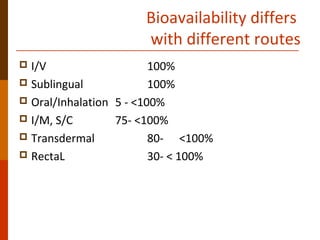
Bioavailability differs
with different routes
 I/V 100%
 Sublingual 100%
 Oral/Inhalation 5 - <100%
 I/M, S/C 75- <100%
 Transdermal 80- <100%
 RectaL 30- < 100%
 The influence of route of administration on drug’s
bioavailability is generally in the following order:
parenteral > oral > rectal > topical
 Most drugs are administered orally, for reason of stability and
convenience.
6
The dose available to patient
for therapeutic Effect
Bioavailable dose
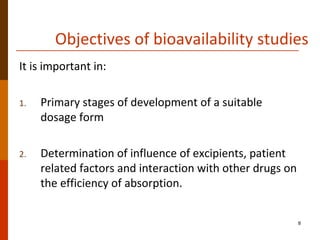
Objectives of bioavailability studies
It is important in:
1. Primary stages of development of a suitable
dosage form
2. Determination of influence of excipients, patient
related factors and interaction with other drugs on
the efficiency of absorption.
8
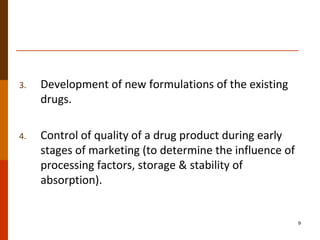
3. Development of new formulations of the existing
drugs.
4. Control of quality of a drug product during early
stages of marketing (to determine the influence of
processing factors, storage & stability of
absorption).
9
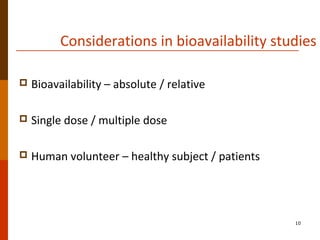
Considerations in bioavailability studies
 Bioavailability – absolute / relative
 Single dose / multiple dose
 Human volunteer – healthy subject / patients
10
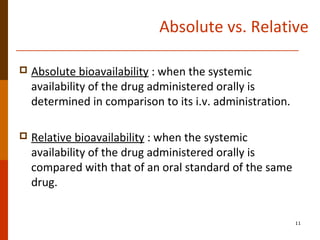
Absolute vs. Relative
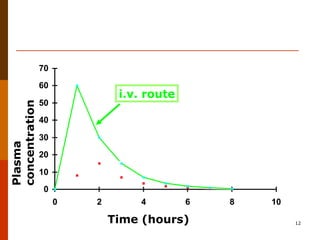
 Absolute bioavailability : when the systemic
availability of the drug administered orally is
determined in comparison to its i.v. administration.
 Relative bioavailability : when the systemic
availability of the drug administered orally is
compared with that of an oral standard of the same
drug.
11
Plasma concentration vs. time profile of a drug ingested
orally & intravenously.
0
10
20
30
40
50
60
70
0 2 4 6 8 10
Plasma
concentration
Time (hours)
i.v. route
oral route
12
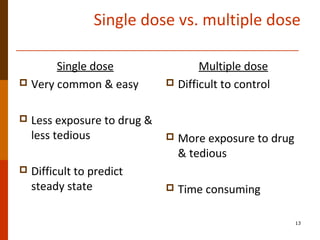
Single dose vs. multiple dose
Single dose
 Very common & easy
 Less exposure to drug &
less tedious
 Difficult to predict
steady state
Multiple dose
 Difficult to control
 More exposure to drug
& tedious
 Time consuming
13
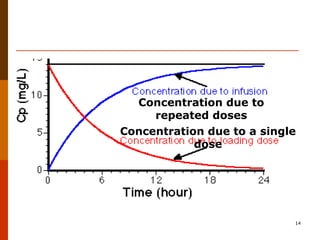
Concentration due to
repeated doses
Time to reach steady state
Concentration due to a single
dose
14
Multiple dose study has several advantages like:
1. More accurately reflects the manner in which the drug
should be used.
2. Drugs levels are higher due to cumulative effect which
makes its determination possible even by less sensitive
analytical methods.
15
Single dose vs. multiple dose
3. Better evaluation of the performance of controlled
release formulation is possible.
4. Small intersubject variability is observed which
allows use of fewer subjects.
5. Nonlinearity in pharmacokinetics, if present, can be
easily detected.
16
Human volunteer – healthy subject vs. patients
 Ideally, the bioavailability study should be carried
out in patients for whom the drug is intended to be
used.
 Advantages :
1. Patient is benefited from the study.
2. Reflects better therapeutic efficacy of drug.
17
3. Drug absorption pattern in disease state can be
evaluated.
4. Avoids the ethical quandary of administering drug
to healthy subjects.
18
 There are some drawbacks of using patients as
volunteers.
 Stringent conditions such as fasting state required is
difficult to be followed by the patients.
 Studies are therefore performed in young (20-40
yrs.), healthy males adult volunteers.
19
 Female volunteers are used only when drugs such as
oral contraceptives are to be tested.
 They must be informed about the importance of:
 Study
 conditions to be followed
 Possible hazards if any.
20
 Medical examination should be performed.
 Drug washout period for min. of ten biological half
lives must be allowed for between two studies in
same subject.
21
Measurement of bioavailability
 Pharmacokinetic methods ( indirect )
1. Blood analysis
2. Urinary excretion data
 Pharmacodynamic methods ( direct )
1. Acute pharmacological response
2. Therapeutic response
22
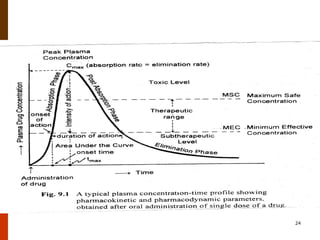
 Plasma level time studies or The plasma concentration – time
curve or blood level curve.
 A direct relationship exists b/w concentration of drug at the
site of action & concentration of drug in the plasma.
 Serial blood samples are taken after drug administration &
analyzed for drug concentration.
 A typical blood level curve obtained after oral administration of
drug.
23
Blood Analysis:
24
Acute pharmacological response
 Bioavailability can be determined from the acute
pharmacologic effect – time curve
 DISADVANTAGE is that pharmacological response tends to more
variable & accurate correlation between the measured response &
drug available from the formulation is difficult.
25
Therapeutic response
 This method is based on the observing the clinical response to a
drug formulation given to a patients suffering from disease for
which it is intended to be used.
 Ex …for anti inflammatory drugs, the reduction in the inflammation
is determined.
 The major DRAWBACK is …quantification of observed response
is too improper to allow for reasonable assessment of relative
bioavailability between two dosage forms of a same drug.
26
“Bioequivalence” used to
compare generic drugs to
patented
Bioequivalence
Clinical importance of bioequivalence studies
 Bioequivalence of different formulations of the same drug
substance involves equivalence with respect to the rate and
extent of systemic absorption.
 Generally two formulations whose rate and extent of
absorption differ by 20% or less are considered bioequivalent
28
 When a therapeutic objectives of the drug are considered, an
equivalent clinical response should be obtained from the
comparison dosage form if the plasma drug concentration
remain above MEC for appropriate interval and don’t reach
the MTC.
 Bioequivalence studies should be conducted for the
comparison of two medicinal products containing the same
active substance.
 Two products marketed by different licensees, containing
same active ingredient(s), must be shown to be
therapeutically equivalent to one another in order to be
considered interchangeable.
30
Clinical Significance
 Change in Bioavailability may lead to under/ over
medication
 Under Medication – Therapeutic failure
 Hazardous specially for drugs like Antimicrobials, anticonvulsants
and oral antidiabetic agents
 Over medication – Toxicity
 Indiscriminate change of preparation from other
companies must be avoided. (change of drug brand
may lead to Non-bioequivalence)
 Use of Alternate routes:
 Drugs with high hepatic first pass metabolism should be
given by routes other than oral. ie., sublingual,
transdermal eg., Nitroglycerine
 High oral doses: Some drugs have high hepatic
extraction ratio.
 Less dose in hepatic Disease: In severe hepatic
cirrhosis/ portal systemic shunts, the dose of the
drugs with large extraction ration and hepatic first
pass effect should be reduced otherwise toxicity
Physiologic factors
1. pH Stomach ~ 1 and intestine ~ 6
2. Surface area of the of the intestine – microvilli
3. Presence of carrier proteins for absorption
4. Enzymes: endogenous and bacterial
5. GI blood flow
6. Gastric Emptying & intestinal transit
Factors Affecting Bioavailability
Physicochemical Properties of the Drug
 Water & lipid solubility
 Molecular size
 Stability in GI environment (pH)
 Specificity for carrier proteins and enzymes
Food & Drug
 Food can affect both rate and extent of absorption.
 Effect depends on the drug
 and the nature of the meal.
 Food can increase / decrease or have no effect on either rate or
extent
 FOOD Affects pH, Blood flow, Gastric emptying & Interactions with
enzymes
 DRUGS Affect Blood flow, Gastric emptying & Interactions with
enzymes

Lectures 11 Bioavailability

  • 1.
    Bio availability Its clinicalsignificance & Factors affecting bioavailability Dr. Ghulam Saqulain M.B.B.S., D.L.O., F.C.P.S Head of Department of ENT Capital Hospital, Islamabad
  • 2.
    Bio availability “Bioavailability isa measurement of the extent of a therapeutically active medicine that reaches the systemic circulation and is therefore available at the site of action”. 2
  • 3.
     The therapeuticeffectiveness of a drug depends upon the ability of the dosage form to deliver the medication to its site of action at a rate & amount sufficient to elicit the desired Pharmacological response.  This attribute of the dosage form is referred to as physiologic availability or bioavailability.
  • 4.
    Bioavailability example:- A hypotheticaldrug given orally has a bioavailability of 50% (or 0.5), this is due to: 1. incomplete absorption in the GI tract so that only 70% of the initial dose is absorbed. 2. subsequent metabolism of a further 20% before it reaches the systemic circulation (e.g. first pass through the liver). Therefore only 50% of the original oral dose reaches the systemic circulation.
  • 5.
    Bioavailability differs with differentroutes  I/V 100%  Sublingual 100%  Oral/Inhalation 5 - <100%  I/M, S/C 75- <100%  Transdermal 80- <100%  RectaL 30- < 100%
  • 6.
     The influenceof route of administration on drug’s bioavailability is generally in the following order: parenteral > oral > rectal > topical  Most drugs are administered orally, for reason of stability and convenience. 6
  • 7.
    The dose availableto patient for therapeutic Effect Bioavailable dose
  • 8.
    Objectives of bioavailabilitystudies It is important in: 1. Primary stages of development of a suitable dosage form 2. Determination of influence of excipients, patient related factors and interaction with other drugs on the efficiency of absorption. 8
  • 9.
    3. Development ofnew formulations of the existing drugs. 4. Control of quality of a drug product during early stages of marketing (to determine the influence of processing factors, storage & stability of absorption). 9
  • 10.
    Considerations in bioavailabilitystudies  Bioavailability – absolute / relative  Single dose / multiple dose  Human volunteer – healthy subject / patients 10
  • 11.
    Absolute vs. Relative Absolute bioavailability : when the systemic availability of the drug administered orally is determined in comparison to its i.v. administration.  Relative bioavailability : when the systemic availability of the drug administered orally is compared with that of an oral standard of the same drug. 11
  • 12.
    Plasma concentration vs.time profile of a drug ingested orally & intravenously. 0 10 20 30 40 50 60 70 0 2 4 6 8 10 Plasma concentration Time (hours) i.v. route oral route 12
  • 13.
    Single dose vs.multiple dose Single dose  Very common & easy  Less exposure to drug & less tedious  Difficult to predict steady state Multiple dose  Difficult to control  More exposure to drug & tedious  Time consuming 13
  • 14.
    Concentration due to repeateddoses Time to reach steady state Concentration due to a single dose 14
  • 15.
    Multiple dose studyhas several advantages like: 1. More accurately reflects the manner in which the drug should be used. 2. Drugs levels are higher due to cumulative effect which makes its determination possible even by less sensitive analytical methods. 15 Single dose vs. multiple dose
  • 16.
    3. Better evaluationof the performance of controlled release formulation is possible. 4. Small intersubject variability is observed which allows use of fewer subjects. 5. Nonlinearity in pharmacokinetics, if present, can be easily detected. 16
  • 17.
    Human volunteer –healthy subject vs. patients  Ideally, the bioavailability study should be carried out in patients for whom the drug is intended to be used.  Advantages : 1. Patient is benefited from the study. 2. Reflects better therapeutic efficacy of drug. 17
  • 18.
    3. Drug absorptionpattern in disease state can be evaluated. 4. Avoids the ethical quandary of administering drug to healthy subjects. 18
  • 19.
     There aresome drawbacks of using patients as volunteers.  Stringent conditions such as fasting state required is difficult to be followed by the patients.  Studies are therefore performed in young (20-40 yrs.), healthy males adult volunteers. 19
  • 20.
     Female volunteersare used only when drugs such as oral contraceptives are to be tested.  They must be informed about the importance of:  Study  conditions to be followed  Possible hazards if any. 20
  • 21.
     Medical examinationshould be performed.  Drug washout period for min. of ten biological half lives must be allowed for between two studies in same subject. 21
  • 22.
    Measurement of bioavailability Pharmacokinetic methods ( indirect ) 1. Blood analysis 2. Urinary excretion data  Pharmacodynamic methods ( direct ) 1. Acute pharmacological response 2. Therapeutic response 22
  • 23.
     Plasma leveltime studies or The plasma concentration – time curve or blood level curve.  A direct relationship exists b/w concentration of drug at the site of action & concentration of drug in the plasma.  Serial blood samples are taken after drug administration & analyzed for drug concentration.  A typical blood level curve obtained after oral administration of drug. 23 Blood Analysis:
  • 24.
  • 25.
    Acute pharmacological response Bioavailability can be determined from the acute pharmacologic effect – time curve  DISADVANTAGE is that pharmacological response tends to more variable & accurate correlation between the measured response & drug available from the formulation is difficult. 25
  • 26.
    Therapeutic response  Thismethod is based on the observing the clinical response to a drug formulation given to a patients suffering from disease for which it is intended to be used.  Ex …for anti inflammatory drugs, the reduction in the inflammation is determined.  The major DRAWBACK is …quantification of observed response is too improper to allow for reasonable assessment of relative bioavailability between two dosage forms of a same drug. 26
  • 27.
    “Bioequivalence” used to comparegeneric drugs to patented Bioequivalence
  • 28.
    Clinical importance ofbioequivalence studies  Bioequivalence of different formulations of the same drug substance involves equivalence with respect to the rate and extent of systemic absorption.  Generally two formulations whose rate and extent of absorption differ by 20% or less are considered bioequivalent 28
  • 29.
     When atherapeutic objectives of the drug are considered, an equivalent clinical response should be obtained from the comparison dosage form if the plasma drug concentration remain above MEC for appropriate interval and don’t reach the MTC.
  • 30.
     Bioequivalence studiesshould be conducted for the comparison of two medicinal products containing the same active substance.  Two products marketed by different licensees, containing same active ingredient(s), must be shown to be therapeutically equivalent to one another in order to be considered interchangeable. 30
  • 31.
    Clinical Significance  Changein Bioavailability may lead to under/ over medication  Under Medication – Therapeutic failure  Hazardous specially for drugs like Antimicrobials, anticonvulsants and oral antidiabetic agents  Over medication – Toxicity
  • 32.
     Indiscriminate changeof preparation from other companies must be avoided. (change of drug brand may lead to Non-bioequivalence)  Use of Alternate routes:  Drugs with high hepatic first pass metabolism should be given by routes other than oral. ie., sublingual, transdermal eg., Nitroglycerine
  • 33.
     High oraldoses: Some drugs have high hepatic extraction ratio.  Less dose in hepatic Disease: In severe hepatic cirrhosis/ portal systemic shunts, the dose of the drugs with large extraction ration and hepatic first pass effect should be reduced otherwise toxicity
  • 34.
    Physiologic factors 1. pHStomach ~ 1 and intestine ~ 6 2. Surface area of the of the intestine – microvilli 3. Presence of carrier proteins for absorption 4. Enzymes: endogenous and bacterial 5. GI blood flow 6. Gastric Emptying & intestinal transit Factors Affecting Bioavailability
  • 35.
    Physicochemical Properties ofthe Drug  Water & lipid solubility  Molecular size  Stability in GI environment (pH)  Specificity for carrier proteins and enzymes
  • 36.
    Food & Drug Food can affect both rate and extent of absorption.  Effect depends on the drug  and the nature of the meal.  Food can increase / decrease or have no effect on either rate or extent  FOOD Affects pH, Blood flow, Gastric emptying & Interactions with enzymes  DRUGS Affect Blood flow, Gastric emptying & Interactions with enzymes