BIOAUGMENTATION
SUBMITTED BY :-
NAME : Archita Bhattacharjee
ROLL NO.: LS-61
PAPER : LS551- Biotechnology
INTRODUCTION
• Bioremediation is a branch of biotechnology that employs the
use of living organisms, like microbes and bacteria to
decontaminate affected areas.
• Bioaugmentation is an in-situ bioremediation process that
involves the addition of microorganisms that have the ability
to biodegrade recalcitrant molecules in the polluted
environment.
• Addition of some microorganisms improves the genetic
diversity in the terms of gene pool and genetic capacity of the
contaminated sites.
WORKING PRINCIPLES
• Bioaugmentation works by increasing the level of active microbes and
microorganisms within the treatment environment.
• The process relies on the unique metabolic capabilities of microbes to
target specific contaminants such as hydrocarbon, heavy metals or
pesticides.
• At first, scientists isolate naturally occurring microorganisms. These
microbes are then cultured and concentrated into a bioaugmentation
product.
• Upon application to the contaminated site, the introduced microbes
establish themselves and proliferate, utilizing the pollutants as a food
source.
• As they metabolize the contaminants, they break them down into less
harmful byproducts, effectively remedying the pollution.
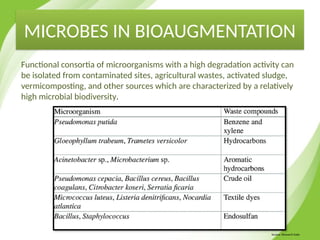
MICROBES IN BIOAUGMENTATION
Functional consortia of microorganisms with a high degradation activity can
be isolated from contaminated sites, agricultural wastes, activated sludge,
vermicomposting, and other sources which are characterized by a relatively
high microbial biodiversity.
Source: Research Gate
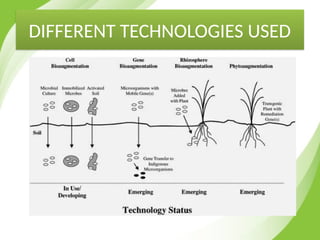
DIFFERENT TECHNOLOGIES USED
APPLICATIONS:
WASTEWATER TREATMENT
• In the biological wastewater treatment method,
bioaugmentation can improve the overall treatment effect by
introducing specific strains into the biological reactors
increasing the pollutant removal efficiency.
• The introduced strains can directly degrade the target toxic
pollutants, and protect other microorganisms in the system
from toxicity inhibition so as to restore the system treatment
activity.
• The special resistant microorganisms like
Acinetobacter tandoii could effectively remove Cd2+
and Zn2+
in
wastewater containing heavy metal ions and aromatic
hydrocarbons.
APPLICATIONS:
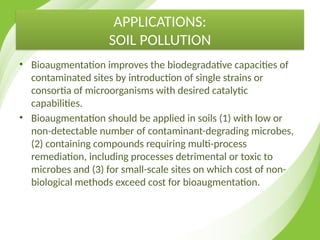
SOIL POLLUTION
• Bioaugmentation improves the biodegradative capacities of
contaminated sites by introduction of single strains or
consortia of microorganisms with desired catalytic
capabilities.
• Bioaugmentation should be applied in soils (1) with low or
non-detectable number of contaminant-degrading microbes,
(2) containing compounds requiring multi-process
remediation, including processes detrimental or toxic to
microbes and (3) for small-scale sites on which cost of non-
biological methods exceed cost for bioaugmentation.
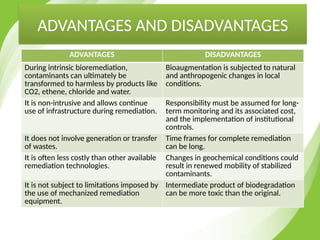
ADVANTAGES AND DISADVANTAGES
ADVANTAGES DISADVANTAGES
During intrinsic bioremediation,
contaminants can ultimately be
transformed to harmless by products like
CO2, ethene, chloride and water.
Bioaugmentation is subjected to natural
and anthropogenic changes in local
conditions.
It is non-intrusive and allows continue
use of infrastructure during remediation.
Responsibility must be assumed for long-
term monitoring and its associated cost,
and the implementation of institutional
controls.
It does not involve generation or transfer
of wastes.
Time frames for complete remediation
can be long.
It is often less costly than other available
remediation technologies.
Changes in geochemical conditions could
result in renewed mobility of stabilized
contaminants.
It is not subject to limitations imposed by
the use of mechanized remediation
equipment.
Intermediate product of biodegradation
can be more toxic than the original.
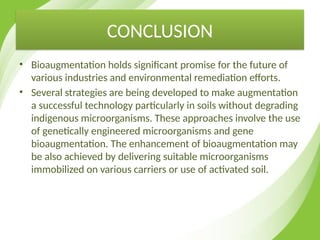
CONCLUSION
• Bioaugmentation holds significant promise for the future of
various industries and environmental remediation efforts.
• Several strategies are being developed to make augmentation
a successful technology particularly in soils without degrading
indigenous microorganisms. These approaches involve the use
of genetically engineered microorganisms and gene
bioaugmentation. The enhancement of bioaugmentation may
be also achieved by delivering suitable microorganisms
immobilized on various carriers or use of activated soil.
THANK YOU

BIOAUGMENTATION : A Bioremediation process

  • 1.
    BIOAUGMENTATION SUBMITTED BY :- NAME: Archita Bhattacharjee ROLL NO.: LS-61 PAPER : LS551- Biotechnology
  • 2.
    INTRODUCTION • Bioremediation isa branch of biotechnology that employs the use of living organisms, like microbes and bacteria to decontaminate affected areas. • Bioaugmentation is an in-situ bioremediation process that involves the addition of microorganisms that have the ability to biodegrade recalcitrant molecules in the polluted environment. • Addition of some microorganisms improves the genetic diversity in the terms of gene pool and genetic capacity of the contaminated sites.
  • 3.
    WORKING PRINCIPLES • Bioaugmentationworks by increasing the level of active microbes and microorganisms within the treatment environment. • The process relies on the unique metabolic capabilities of microbes to target specific contaminants such as hydrocarbon, heavy metals or pesticides. • At first, scientists isolate naturally occurring microorganisms. These microbes are then cultured and concentrated into a bioaugmentation product. • Upon application to the contaminated site, the introduced microbes establish themselves and proliferate, utilizing the pollutants as a food source. • As they metabolize the contaminants, they break them down into less harmful byproducts, effectively remedying the pollution.
  • 4.
    MICROBES IN BIOAUGMENTATION Functionalconsortia of microorganisms with a high degradation activity can be isolated from contaminated sites, agricultural wastes, activated sludge, vermicomposting, and other sources which are characterized by a relatively high microbial biodiversity. Source: Research Gate
  • 5.
  • 6.
    APPLICATIONS: WASTEWATER TREATMENT • Inthe biological wastewater treatment method, bioaugmentation can improve the overall treatment effect by introducing specific strains into the biological reactors increasing the pollutant removal efficiency. • The introduced strains can directly degrade the target toxic pollutants, and protect other microorganisms in the system from toxicity inhibition so as to restore the system treatment activity. • The special resistant microorganisms like Acinetobacter tandoii could effectively remove Cd2+ and Zn2+ in wastewater containing heavy metal ions and aromatic hydrocarbons.
  • 7.
    APPLICATIONS: SOIL POLLUTION • Bioaugmentationimproves the biodegradative capacities of contaminated sites by introduction of single strains or consortia of microorganisms with desired catalytic capabilities. • Bioaugmentation should be applied in soils (1) with low or non-detectable number of contaminant-degrading microbes, (2) containing compounds requiring multi-process remediation, including processes detrimental or toxic to microbes and (3) for small-scale sites on which cost of non- biological methods exceed cost for bioaugmentation.
  • 8.
    ADVANTAGES AND DISADVANTAGES ADVANTAGESDISADVANTAGES During intrinsic bioremediation, contaminants can ultimately be transformed to harmless by products like CO2, ethene, chloride and water. Bioaugmentation is subjected to natural and anthropogenic changes in local conditions. It is non-intrusive and allows continue use of infrastructure during remediation. Responsibility must be assumed for long- term monitoring and its associated cost, and the implementation of institutional controls. It does not involve generation or transfer of wastes. Time frames for complete remediation can be long. It is often less costly than other available remediation technologies. Changes in geochemical conditions could result in renewed mobility of stabilized contaminants. It is not subject to limitations imposed by the use of mechanized remediation equipment. Intermediate product of biodegradation can be more toxic than the original.
  • 9.
    CONCLUSION • Bioaugmentation holdssignificant promise for the future of various industries and environmental remediation efforts. • Several strategies are being developed to make augmentation a successful technology particularly in soils without degrading indigenous microorganisms. These approaches involve the use of genetically engineered microorganisms and gene bioaugmentation. The enhancement of bioaugmentation may be also achieved by delivering suitable microorganisms immobilized on various carriers or use of activated soil.
  • 10.