



What is bio magnification?? 
 It is also known 
as bioamplification or biological magnification, 
is the increase in concentration of a substance, 
such as the pesticide DDT, that occurs in 
a food chain as a consequence of: 
 Persistence ( Can't be broken down by environmental 
processes) 
 Food chain energetics 
 Low rate of internal degradation/excretion of 
the substance.
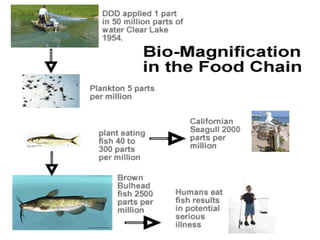
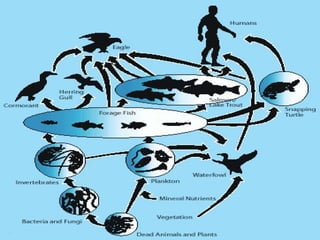
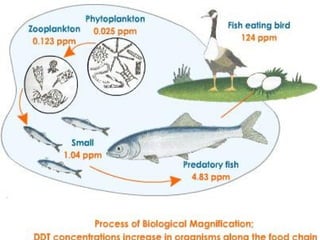
 It also refers to the process whereby certain 
substances such as pesticides or heavy 
metals move up the food chain, work their 
way into rivers or lakes, and are eaten by 
aquatic organisms such as fish, which in 
turn are eaten by large birds, animals or 
humans. The substances become 
concentrated in tissues or internal organs 
as they move up the chain.
 Sometimes biomagnification is also used 
interchangeably with 'bioaccumulation,' an 
important distinction is drawn between 
the two, and with bioconcentration 
 Bioaccumulation occurs within a trophic 
level, and is the increase in concentration 
of a substance in certain tissues of 
organisms' bodies due to absorption from 
food and the environment.
 Bioconcentration is defined as occurring 
when uptake from the water is greater 
than excretion . 
 Thus bioconcentration and 
bioaccumulation occur within an organism, 
and biomagnification occurs across trophic 
(food chain) levels.
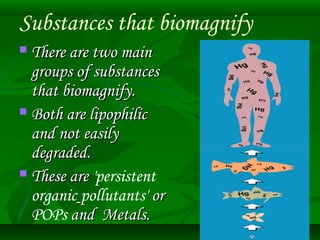
Substances that biomagnify 
 TThheerree aarree ttwwoo mmaaiinn 
ggrroouuppss ooff ssuubbssttaanncceess 
tthhaatt bbiioommaaggnniiffyy.. 
 BBootthh aarree lliippoopphhiilliicc 
aanndd nnoott eeaassiillyy 
ddeeggrraaddeedd.. 
 TThheessee aarree 'persistent 
organic pollutants'' oorr 
POPs aanndd MMeettaallss..
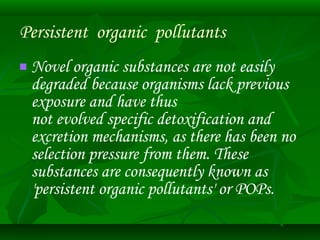
Persistent organic pollutants 
 Novel organic substances are not easily 
degraded because organisms lack previous 
exposure and have thus 
not evolved specific detoxification and 
excretion mechanisms, as there has been no 
selection pressure from them. These 
substances are consequently known as 
'persistent organic pollutants' or POPs.
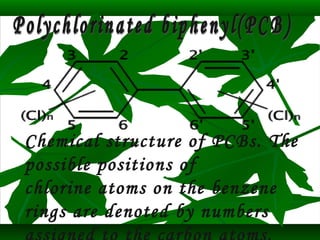
Chemical structure of PCBs. The 
possible positions of 
chlorine atoms on the benzene 
rings are denoted by numbers 
assigned to the carbon atoms.
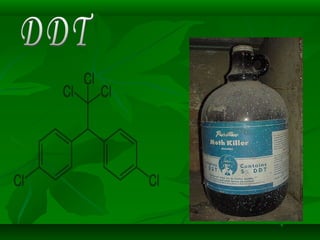
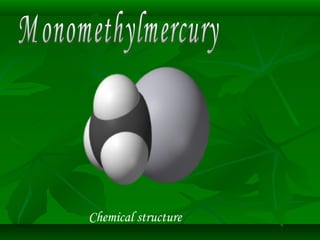
Chemical structure
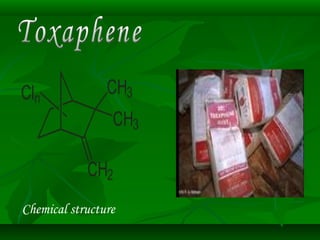
Chemical structure
Metals 
 MMeettaallss aarree nnoott ddeeggrraaddaabbllee bbeeccaauussee tthheeyy aarree 
eelleemmeennttss.. OOrrggaanniissmmss,, ppaarrttiiccuullaarrllyy tthhoossee ssuubbjjeecctt 
ttoo nnaattuurraallllyy hhiigghh lleevveellss ooff eexxppoossuurree ttoo mmeettaallss,, 
hhaavvee mmeecchhaanniissmmss ttoo sseeqquueesstteerr aanndd eexxccrreettee 
mmeettaallss.. PPrroobblleemmss aarriissee wwhheenn oorrggaanniissmmss aarree 
eexxppoosseedd ttoo hhiigghheerr ccoonncceennttrraattiioonnss tthhaann uussuuaall,, 
wwhhiicchh tthheeyy ccaannnnoott eexxccrreettee rraappiiddllyy eennoouugghh ttoo 
pprreevveenntt ddaammaaggee.. TThheessee mmeettaallss aarree ttrraannssffeerrrreedd 
iinn aann oorrggaanniicc ffoorrmm..
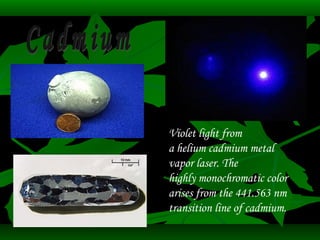
Violet light from 
a helium cadmium metal 
vapor laser. The 
highly monochromatic color 
arises from the 441.563 nm 
transition line of cadmium.
 Biomagnification has serious consequences 
for all species. 
 It is particularly dangerous 
for predator species especially if they are at 
the top of long food webs. 
 Predators are usually at or near the top of 
their food web. This puts them at risk 
because the degree of biomagnification is 
high by the time it reaches their trophic 
level.
 Also, top predators usually consume large 
quantities of meat which has lots of fatty 
tissue and contaminants. 
 Polar bears, humans, eagles, 
and dolphins are examples of top 
predators, and all of these organisms are 
vulnerable to the effects of 
biomagnification.
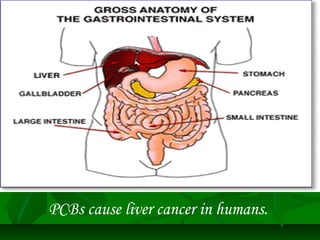
PCBs cause liver cancer in humans.
 Predators that consume large amounts of 
fish also have a high degree of risk because 
persistent hydrophobics are widely 
dispersed in aquatic food webs and are 
biomagnified in fish. 
Biomagnified 
substances causes 
persistent 
hydrophobia.
TThhaannkk yyoouu……

Bio ppt ananya jain

  • 2.
    What is biomagnification??  It is also known as bioamplification or biological magnification, is the increase in concentration of a substance, such as the pesticide DDT, that occurs in a food chain as a consequence of:  Persistence ( Can't be broken down by environmental processes)  Food chain energetics  Low rate of internal degradation/excretion of the substance.
  • 5.
     It alsorefers to the process whereby certain substances such as pesticides or heavy metals move up the food chain, work their way into rivers or lakes, and are eaten by aquatic organisms such as fish, which in turn are eaten by large birds, animals or humans. The substances become concentrated in tissues or internal organs as they move up the chain.
  • 6.
     Sometimes biomagnificationis also used interchangeably with 'bioaccumulation,' an important distinction is drawn between the two, and with bioconcentration  Bioaccumulation occurs within a trophic level, and is the increase in concentration of a substance in certain tissues of organisms' bodies due to absorption from food and the environment.
  • 8.
     Bioconcentration isdefined as occurring when uptake from the water is greater than excretion .  Thus bioconcentration and bioaccumulation occur within an organism, and biomagnification occurs across trophic (food chain) levels.
  • 9.
    Substances that biomagnify  TThheerree aarree ttwwoo mmaaiinn ggrroouuppss ooff ssuubbssttaanncceess tthhaatt bbiioommaaggnniiffyy..  BBootthh aarree lliippoopphhiilliicc aanndd nnoott eeaassiillyy ddeeggrraaddeedd..  TThheessee aarree 'persistent organic pollutants'' oorr POPs aanndd MMeettaallss..
  • 10.
    Persistent organic pollutants  Novel organic substances are not easily degraded because organisms lack previous exposure and have thus not evolved specific detoxification and excretion mechanisms, as there has been no selection pressure from them. These substances are consequently known as 'persistent organic pollutants' or POPs.
  • 12.
    Chemical structure ofPCBs. The possible positions of chlorine atoms on the benzene rings are denoted by numbers assigned to the carbon atoms.
  • 14.
  • 15.
  • 16.
    Metals  MMeettaallssaarree nnoott ddeeggrraaddaabbllee bbeeccaauussee tthheeyy aarree eelleemmeennttss.. OOrrggaanniissmmss,, ppaarrttiiccuullaarrllyy tthhoossee ssuubbjjeecctt ttoo nnaattuurraallllyy hhiigghh lleevveellss ooff eexxppoossuurree ttoo mmeettaallss,, hhaavvee mmeecchhaanniissmmss ttoo sseeqquueesstteerr aanndd eexxccrreettee mmeettaallss.. PPrroobblleemmss aarriissee wwhheenn oorrggaanniissmmss aarree eexxppoosseedd ttoo hhiigghheerr ccoonncceennttrraattiioonnss tthhaann uussuuaall,, wwhhiicchh tthheeyy ccaannnnoott eexxccrreettee rraappiiddllyy eennoouugghh ttoo pprreevveenntt ddaammaaggee.. TThheessee mmeettaallss aarree ttrraannssffeerrrreedd iinn aann oorrggaanniicc ffoorrmm..
  • 19.
    Violet light from a helium cadmium metal vapor laser. The highly monochromatic color arises from the 441.563 nm transition line of cadmium.
  • 23.
     Biomagnification hasserious consequences for all species.  It is particularly dangerous for predator species especially if they are at the top of long food webs.  Predators are usually at or near the top of their food web. This puts them at risk because the degree of biomagnification is high by the time it reaches their trophic level.
  • 25.
     Also, toppredators usually consume large quantities of meat which has lots of fatty tissue and contaminants.  Polar bears, humans, eagles, and dolphins are examples of top predators, and all of these organisms are vulnerable to the effects of biomagnification.
  • 26.
    PCBs cause livercancer in humans.
  • 27.
     Predators thatconsume large amounts of fish also have a high degree of risk because persistent hydrophobics are widely dispersed in aquatic food webs and are biomagnified in fish. Biomagnified substances causes persistent hydrophobia.
  • 28.