BIOMAGNIFI
CATION
&
BIOACCUMA
LATION
Biological Amplification
What is it?
 Toxic pollutants enter the
ecosystem that are absorbed or
ingested by organisms. Some
substances accumulate in
organism’s tissue over time.
Bioaccumulation
 An increase in the concentration of a pollutant
in a biological organism compared to its
concentration in the environment
 It is how pollutants enter a food chain
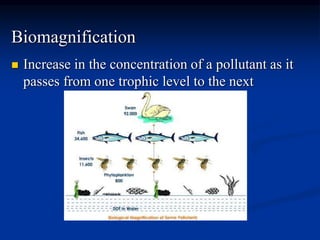
Biomagnification
 Increase in the concentration of a pollutant as it
passes from one trophic level to the next
Biomagnification
 Small amount in environment → Large
concentration at top of food chain
Why should we care?
 Because the two processes
together mean that when we
release even small amounts
of pollutants into the
environment, eventually
they build-up in organisms
to toxic dosages
Where do pollutants come from?
 Coal burning power plants
 Factories
 Farms, lawns, and gardens.
Characteristics of pollutants:
 In order for biomagnification to happen,
substance must be:
 Long lived
 Soluble in fat
 Mobile
 Biologically active
Characteristics of pollutants:
Putting it into perspective:
 Only some substances biomagnify
 Most substances are water soluble and are
excreted into the water
 Many breakdown quickly
 Many are not biologically active
Ex. Biomagnification
 Water
 Phytoplankton
 Zooplankton
 Small fish
 Large fish
 Top Predator:
 Human, osprey, eagle, otter – highest
amount of toxic chemical
Pollutants that undergo biomagnification
 Mercury
 Persistent organic pollutants (POPs)
Mercury
 Source: Emissions from coal-burning power
plants, metal processing, medical and other
waste
 Made bioavailable by bacteria
 Inorganic mercury → Organic form of
mercury that is biologically active
Mercury
 Elementary Mercury (Hg)
 Methylmercury (CH3Hg) – most toxic form
 Form ingested by consuming fish
 Concentrated in muscle tissue
More in older fish than younger fish
 Note – changed from Hg to this form by
bacteria
Impacts of Wildlife
 Loons – diet of fish
 Decrease in chicks in areas of high mercury
 Large concentration of mercury in eggs
 Great Egrets – study in Everglades indicates
behavior of juveniles is effected
 Deformities in developing animals
Risk to People
 Exposed by eating contaminated fish
 Pregnant women and children most at risk
 60,000 children born annually suffering
from neuro developmental problems due to
in utero exposure to mercury
Fish Advisories
 13 states have state wide advisories for fish
from rivers and lakes
 40 states have advisories on selected bodies of
water
 Parts of Eastern Coast and Gulf of Mexico
have advisories
Persistent Organic Pollutants (POPs)
 Also called organochlorines
 Synthetic organic chemicals that persist in the
environment and biomagnify through the food web
 Poses a risk to human health and the environment
Sources:
 Pesticides, some plastics, paints, industrial chemicals,
bleaching, burning garbage
 Examples: DDT, PCBs, dioxin
Ban on POPs
 1995 UN estimated 20,000+ substances with
properties of POPs
 Stockholm Convention 2004, banned 12 worst
 “The Dirty Dozen”
 U.S. signatory in 2001
 Congress has not ratified
 Signed by
Stockholm Convention Treaty
1. DDT - pesticide
2. PCBs - Industrial
3. Dioxin - waste
4. Furans - waste
5. Aldrin - pesticide
6. Chlordane - pesticide
7. Dieldrin - pesticide
8. Endrin - pesticide
9. HCB – pest/ waste
10. Heptachlor - pesticide
11. Mirex - pesticide
12. Toxaphane - pesticide
The Dirty Dozen
Exposure
 Environmental exposure – many will stay in
soil or water for decades
 Slow to breakdown
 Humans consume toxins via fish, meat and
dairy
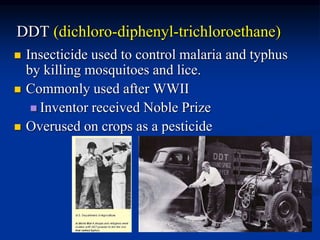
DDT (dichloro-diphenyl-trichloroethane)
 Insecticide used to control malaria and typhus
by killing mosquitoes and lice.
 Commonly used after WWII
 Inventor received Noble Prize
 Overused on crops as a pesticide
Ex. DDT
 Concentration of
DDT increased 10
million times!
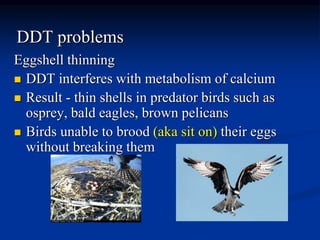
DDT problems
Eggshell thinning
 DDT interferes with metabolism of calcium
 Result - thin shells in predator birds such as
osprey, bald eagles, brown pelicans
 Birds unable to brood (aka sit on) their eggs
without breaking them
DDT problems (cont’d)
Feminization
 Acts as a hormone disrupter, mimics estrogen
 Has impacted sex ratio in some birds
DDT - it’s a long term problem
 It has a half life of 15
year; it takes 15yrs for
its quantity to be ½ its
original
DDT - it’s a long term problem
 It has a half life of 15
year; it takes 15yrs for
its quantity to be ½ its
original
 Ex. If we start with
100 kg, we will still
have ~ 1 kg after 100
yrs
Year
Amount
Remaining
0 100 kg
15 50 kg
30 25 kg
45 12.5 kg
60 6.25 kg
75 3.13 kg
90 1.56 kg
105 0.78 kg
DDT current use
 Banned in US in 1972
 Still used overseas to prevent malaria
 Estimated it save millions of lives annually
in Africa
Health Impact of POPs
 Some cause cancer, damage nervous system
 Some act like hormones (estrogens) leads to:
 Developmental changes, birth defects
 Reproductive and Behavioral problems
 Toxins can be passed to young
Thought to ponder
 Even pollutants in small quantities can build
up to toxic/lethal doses
Solutions to Toxic Pollution
 Worst ones are banned or no longer used in
U.S.
 Still need to eliminate/reduce the processes
that create toxins (i.e. burning coal)
Biological amplification

Biological amplification

  • 1.
  • 2.
    Biological Amplification What isit?  Toxic pollutants enter the ecosystem that are absorbed or ingested by organisms. Some substances accumulate in organism’s tissue over time.
  • 3.
    Bioaccumulation  An increasein the concentration of a pollutant in a biological organism compared to its concentration in the environment  It is how pollutants enter a food chain
  • 4.
    Biomagnification  Increase inthe concentration of a pollutant as it passes from one trophic level to the next
  • 5.
    Biomagnification  Small amountin environment → Large concentration at top of food chain
  • 6.
    Why should wecare?  Because the two processes together mean that when we release even small amounts of pollutants into the environment, eventually they build-up in organisms to toxic dosages
  • 7.
    Where do pollutantscome from?  Coal burning power plants  Factories  Farms, lawns, and gardens.
  • 8.
    Characteristics of pollutants: In order for biomagnification to happen, substance must be:  Long lived  Soluble in fat  Mobile  Biologically active
  • 9.
    Characteristics of pollutants: Puttingit into perspective:  Only some substances biomagnify  Most substances are water soluble and are excreted into the water  Many breakdown quickly  Many are not biologically active
  • 10.
    Ex. Biomagnification  Water Phytoplankton  Zooplankton  Small fish  Large fish  Top Predator:  Human, osprey, eagle, otter – highest amount of toxic chemical
  • 11.
    Pollutants that undergobiomagnification  Mercury  Persistent organic pollutants (POPs)
  • 12.
    Mercury  Source: Emissionsfrom coal-burning power plants, metal processing, medical and other waste  Made bioavailable by bacteria  Inorganic mercury → Organic form of mercury that is biologically active
  • 13.
    Mercury  Elementary Mercury(Hg)  Methylmercury (CH3Hg) – most toxic form  Form ingested by consuming fish  Concentrated in muscle tissue More in older fish than younger fish  Note – changed from Hg to this form by bacteria
  • 14.
    Impacts of Wildlife Loons – diet of fish  Decrease in chicks in areas of high mercury  Large concentration of mercury in eggs  Great Egrets – study in Everglades indicates behavior of juveniles is effected  Deformities in developing animals
  • 15.
    Risk to People Exposed by eating contaminated fish  Pregnant women and children most at risk  60,000 children born annually suffering from neuro developmental problems due to in utero exposure to mercury
  • 16.
    Fish Advisories  13states have state wide advisories for fish from rivers and lakes  40 states have advisories on selected bodies of water  Parts of Eastern Coast and Gulf of Mexico have advisories
  • 17.
    Persistent Organic Pollutants(POPs)  Also called organochlorines  Synthetic organic chemicals that persist in the environment and biomagnify through the food web  Poses a risk to human health and the environment Sources:  Pesticides, some plastics, paints, industrial chemicals, bleaching, burning garbage  Examples: DDT, PCBs, dioxin
  • 18.
    Ban on POPs 1995 UN estimated 20,000+ substances with properties of POPs  Stockholm Convention 2004, banned 12 worst  “The Dirty Dozen”  U.S. signatory in 2001  Congress has not ratified  Signed by
  • 19.
    Stockholm Convention Treaty 1.DDT - pesticide 2. PCBs - Industrial 3. Dioxin - waste 4. Furans - waste 5. Aldrin - pesticide 6. Chlordane - pesticide 7. Dieldrin - pesticide 8. Endrin - pesticide 9. HCB – pest/ waste 10. Heptachlor - pesticide 11. Mirex - pesticide 12. Toxaphane - pesticide The Dirty Dozen
  • 20.
    Exposure  Environmental exposure– many will stay in soil or water for decades  Slow to breakdown  Humans consume toxins via fish, meat and dairy
  • 21.
    DDT (dichloro-diphenyl-trichloroethane)  Insecticideused to control malaria and typhus by killing mosquitoes and lice.  Commonly used after WWII  Inventor received Noble Prize  Overused on crops as a pesticide
  • 22.
    Ex. DDT  Concentrationof DDT increased 10 million times!
  • 23.
    DDT problems Eggshell thinning DDT interferes with metabolism of calcium  Result - thin shells in predator birds such as osprey, bald eagles, brown pelicans  Birds unable to brood (aka sit on) their eggs without breaking them
  • 24.
    DDT problems (cont’d) Feminization Acts as a hormone disrupter, mimics estrogen  Has impacted sex ratio in some birds
  • 25.
    DDT - it’sa long term problem  It has a half life of 15 year; it takes 15yrs for its quantity to be ½ its original
  • 26.
    DDT - it’sa long term problem  It has a half life of 15 year; it takes 15yrs for its quantity to be ½ its original  Ex. If we start with 100 kg, we will still have ~ 1 kg after 100 yrs Year Amount Remaining 0 100 kg 15 50 kg 30 25 kg 45 12.5 kg 60 6.25 kg 75 3.13 kg 90 1.56 kg 105 0.78 kg
  • 27.
    DDT current use Banned in US in 1972  Still used overseas to prevent malaria  Estimated it save millions of lives annually in Africa
  • 28.
    Health Impact ofPOPs  Some cause cancer, damage nervous system  Some act like hormones (estrogens) leads to:  Developmental changes, birth defects  Reproductive and Behavioral problems  Toxins can be passed to young
  • 29.
    Thought to ponder Even pollutants in small quantities can build up to toxic/lethal doses
  • 30.
    Solutions to ToxicPollution  Worst ones are banned or no longer used in U.S.  Still need to eliminate/reduce the processes that create toxins (i.e. burning coal)