An ecosystem is defined as a unit consisting of living and non-living components that interact in a defined area. It includes biotic components like producers, consumers, and decomposers, as well as abiotic factors like climate and soil. Producers like plants harness energy from the sun through photosynthesis. Consumers feed on producers or other consumers, and decomposers break down dead organic matter. Ecosystems provide functions like nutrient cycling, food production, and evolution, and services such as food, fuel, soil formation, and pollution control. Ecosystems are classified as terrestrial or aquatic and come in different types depending on location and components.
An Introduction to
•The term ‘ecosystem’ was coined by Sir A.G. Tansley, an English botanist,
in 1935.
• Ecosystem: It may be defined as a unit of Biosphere consisting of
communities in a given geographical area tuned in a machine like
organization and driven by the energy received From solar radiation.
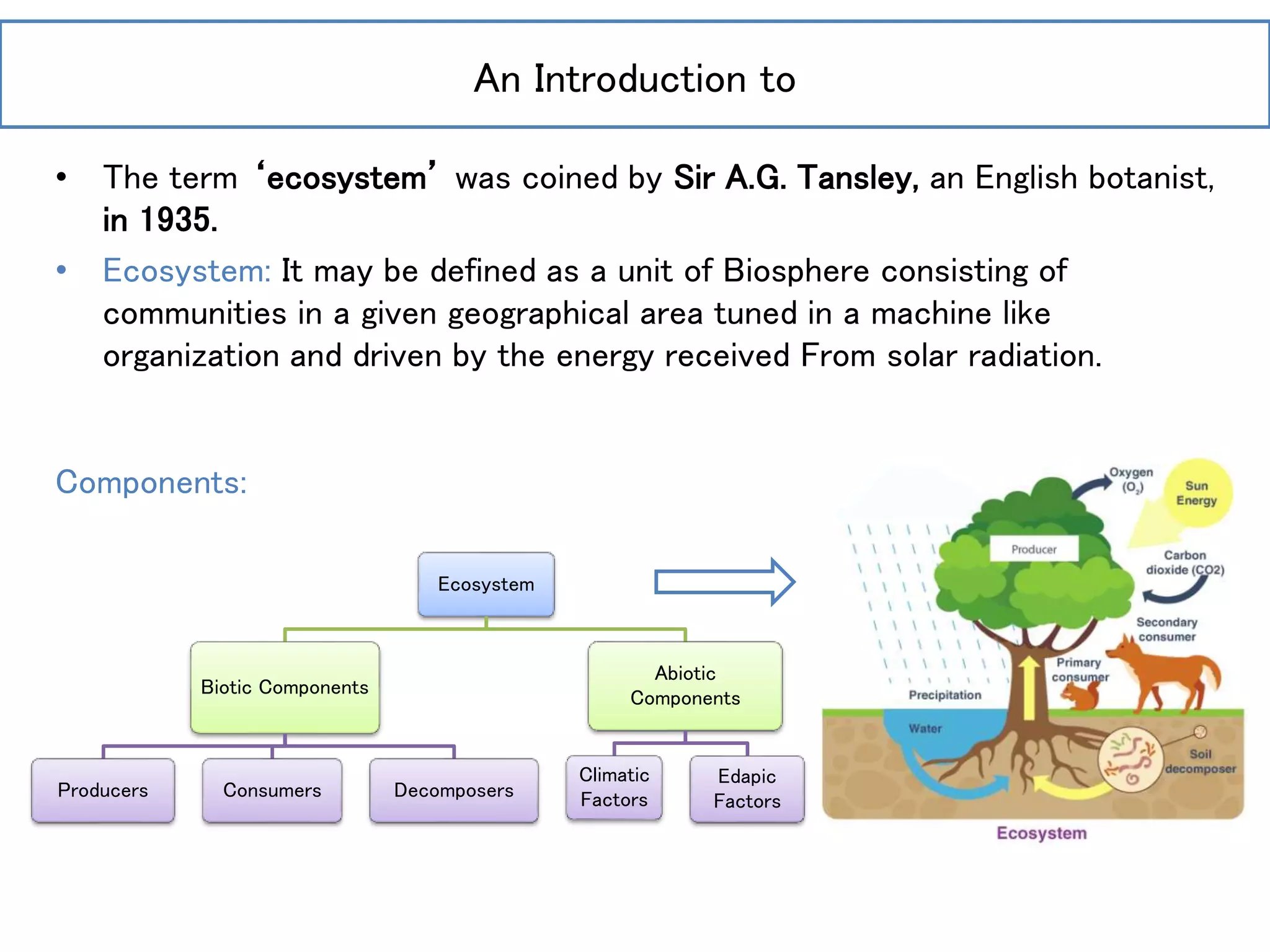
Components:
Ecosystem
Biotic Components
Producers Consumers Decomposers
Abiotic
Components
Climatic
Factors
Edapic
Factors
4.
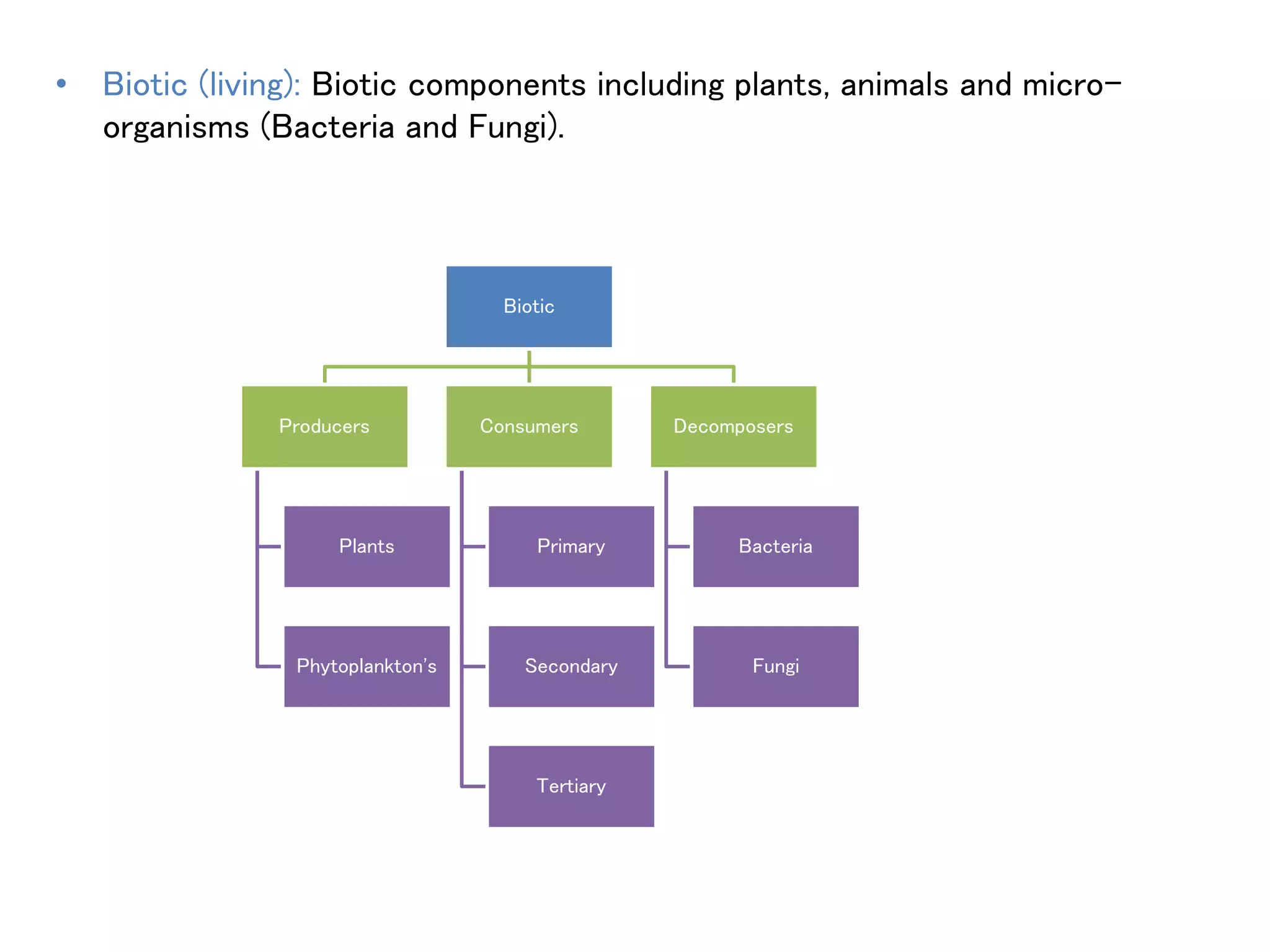
• Biotic (living):Biotic components including plants, animals and micro-
organisms (Bacteria and Fungi).
Biotic
Producers
Plants
Phytoplankton's
Consumers
Primary
Secondary
Tertiary
Decomposers
Bacteria
Fungi
5.
• (a) Producers:Autotrophs (i.e. auto = self, trophos = feeder). The green plants and
phytoplankton's are called the producers, they have chlorophyll with the help of
which they trap solar energy and change it into chemical energy of carbohydrates
using simple inorganic compounds namely water and carbon dioxide.
• (b) Consumers: Heterotrophs (i.e. heteros = other, trophos = feeder). The animals
lack chlorophyll and are unable to synthesize their own food. Therefore, they depend
on the producers for their food. They consume autotrophs and their products as
food. further classified as:
(i) Primary Consumers or Herbivores: These are the animals which feed on plants.
Examples are rabbit, deer, goat, cattle etc.
(ii) Secondary Consumers or Carnivores: The animals which feed on the herbivores.
Examples are Lion, Foxes, Snake etc.
(iii) Tertiary Consumers: These are the large carnivores which feed on the secondary
consumers. Example is Tigers, Bears, eagles.
• (c) Decomposers: Saprotrophs (i.e., sapros = rotten, trophos = feeder). They
breakdown the dead organic materials of producers (plants) and consumers (animals)
for their food and release to the environment in the form of simple inorganic and
organic substances produced as by products of their metabolisms. . Example Bacteria
and fungi.
6.
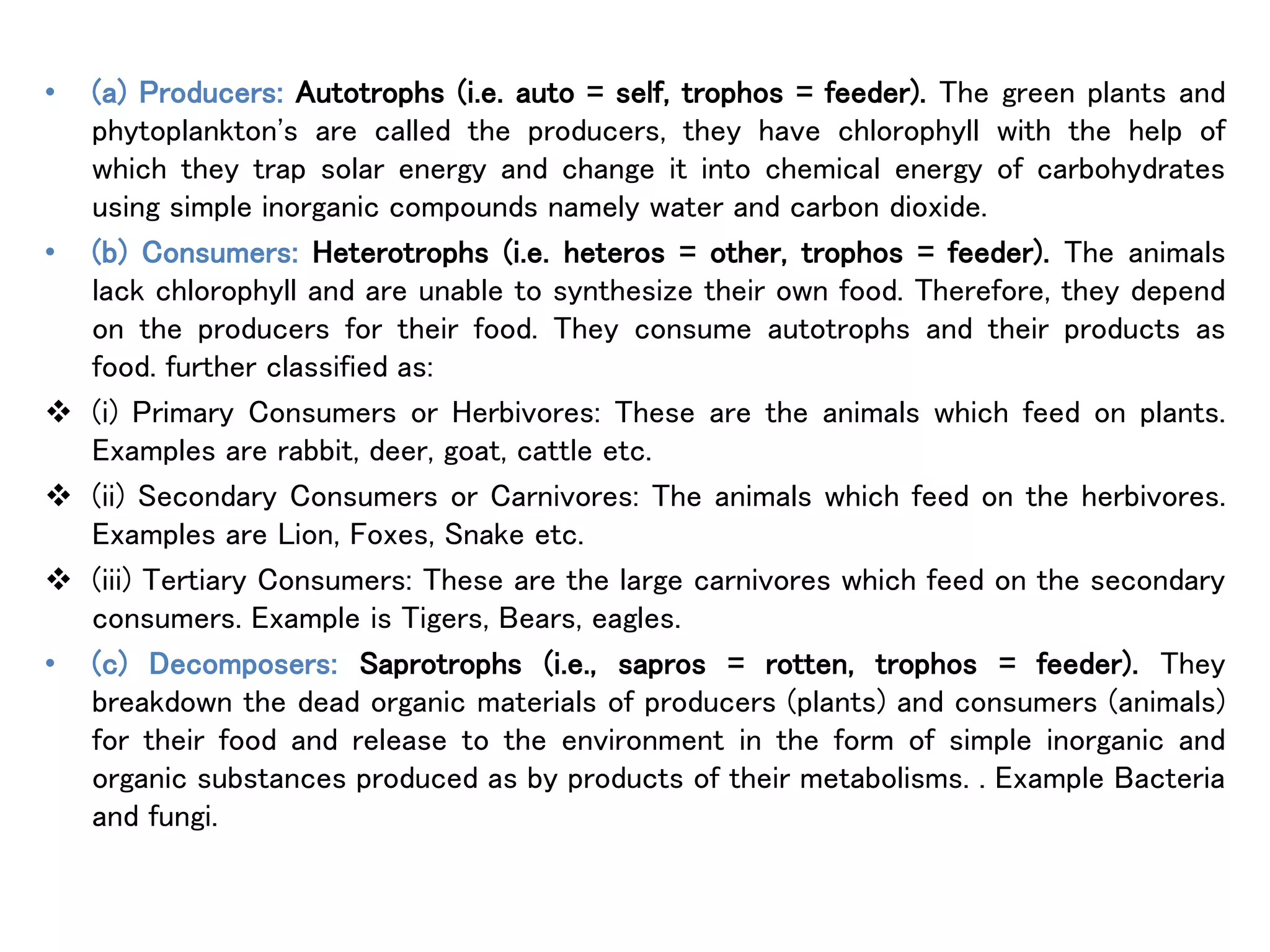
Types: The ecosystemis mainly divided in two groups terrestrial and
aquatic
Ecosystem
Terrestrial Ecosystems
Forest
Grassland
Deserts
Mountains
Island
Aquatic Ecosystems
freshwater
Lake
Pond
River
Wetland
Marine
Ocean
Estuaries
Delta
Types of Ecosystem
7.
Functions
• Ecosystem functionsare “the capacity of natural processes and
components to provide goods and services that satisfy human needs,
directly or in directly” (de Groot et al., 2010).
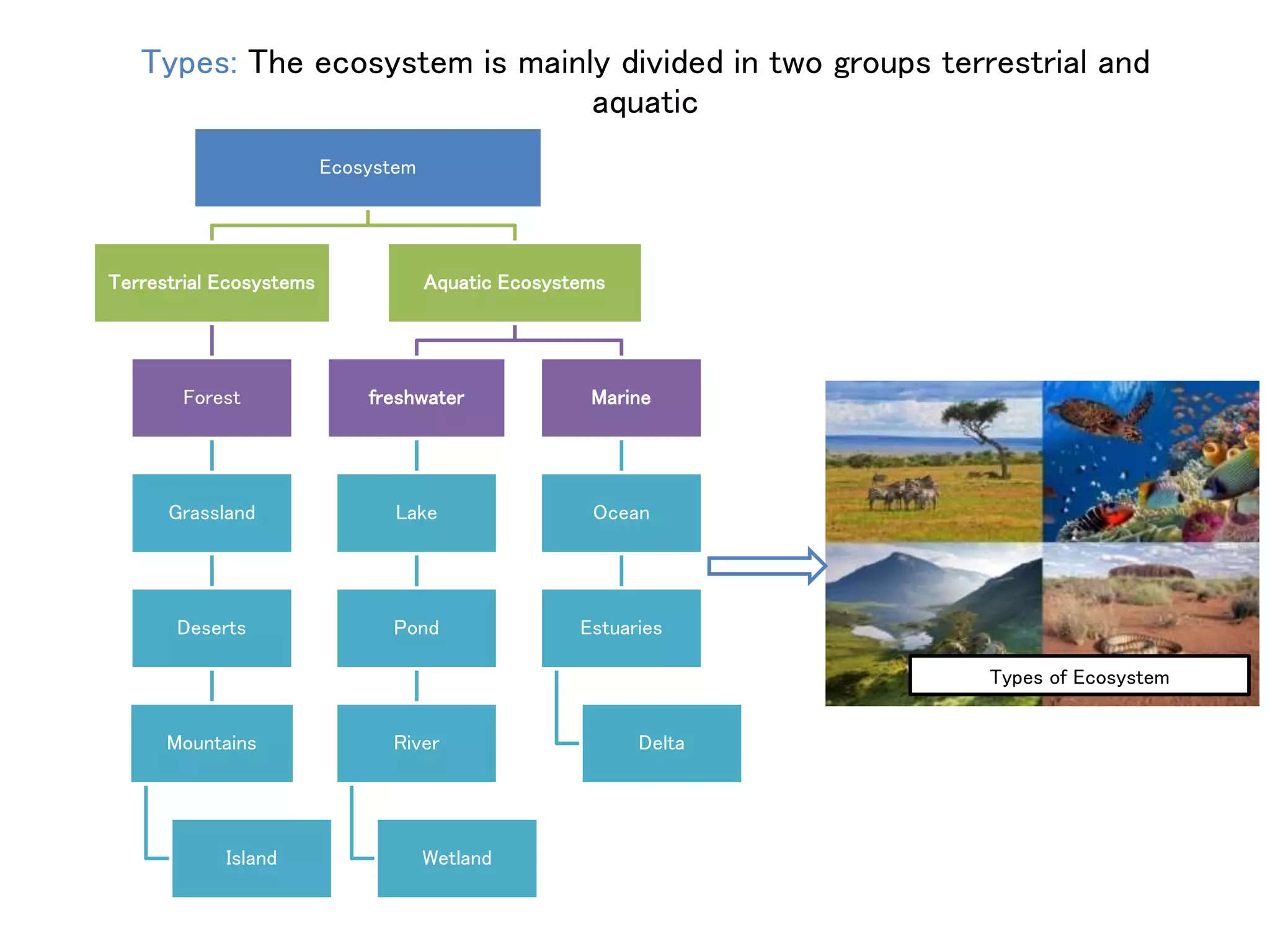
• (i). Production and transfer of food, energy: the autotrophs produces food by
photosynthesis and it is made available to other consumers, the flow of food
and energy continues from one organism to others by the means of food
chain and food web.
8.
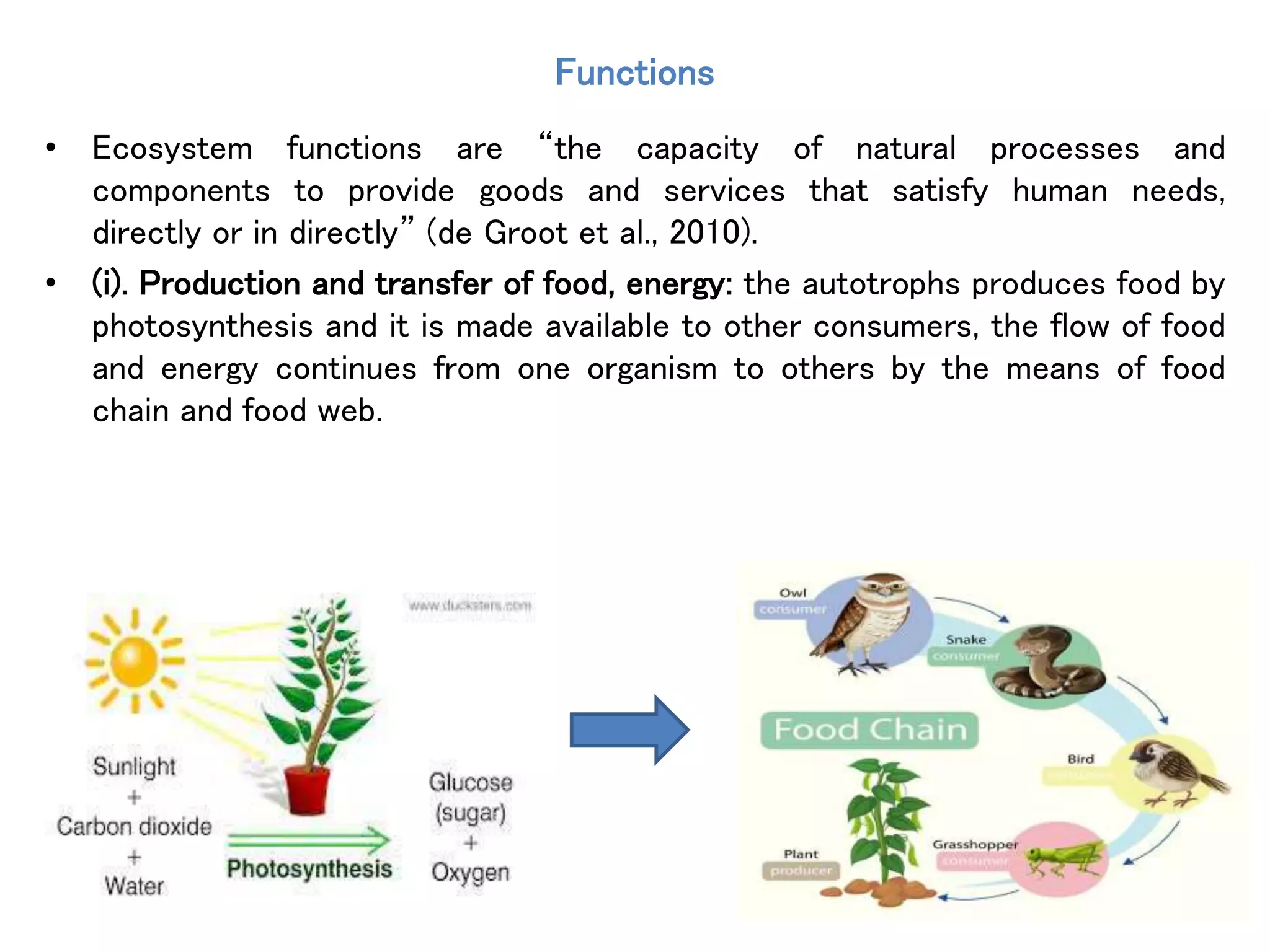
• (ii). Biogeochemicalcycling processes: the flow of energy and nutrients in the
form of food from different trophic levels helps in the cycling of various
elements and nutrients such as water, air, carbon, sulphur, nitrogen etc.
Figure: Carbon, oxygen and water cycle.
9.
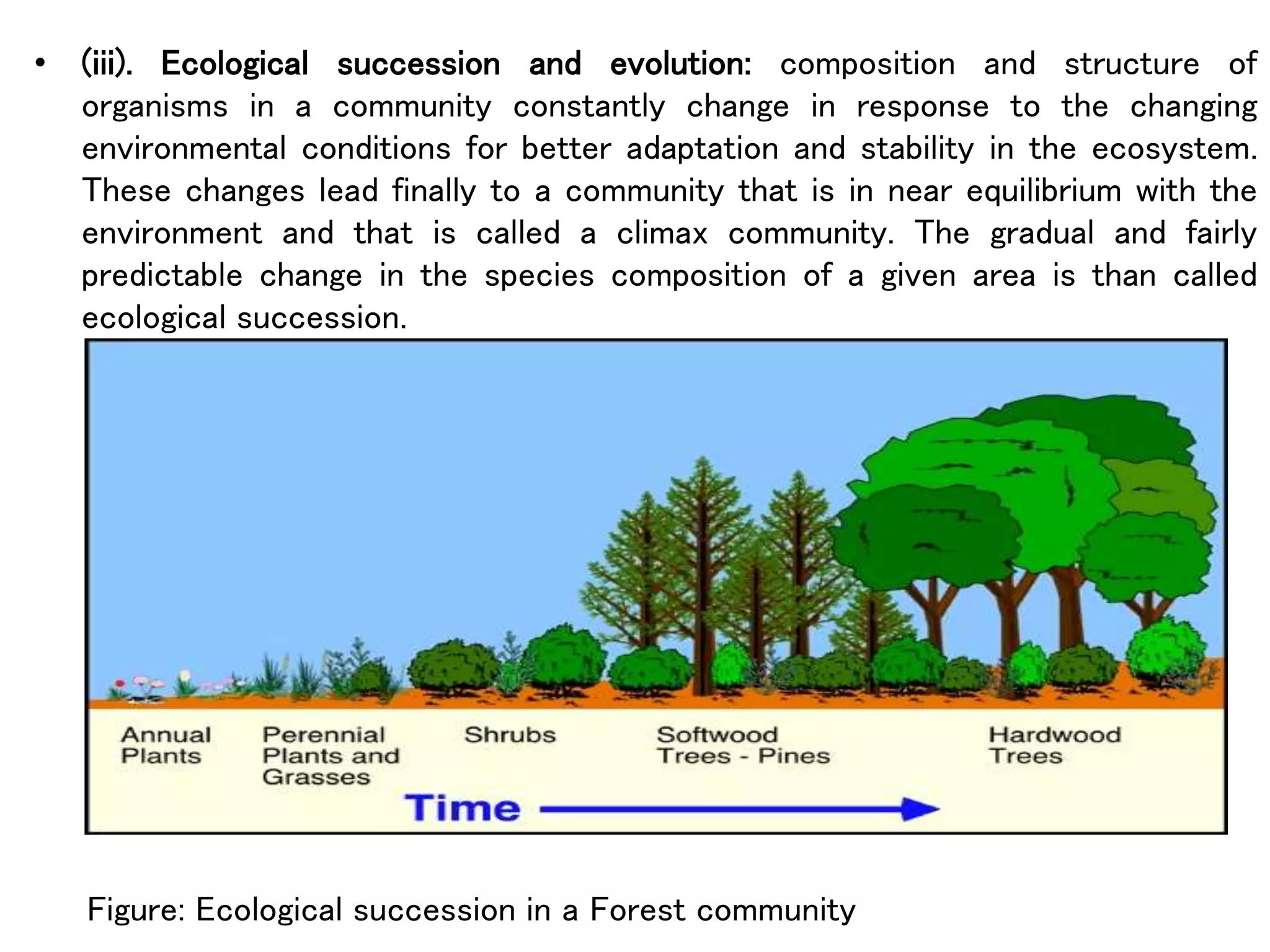
• (iii). Ecologicalsuccession and evolution: composition and structure of
organisms in a community constantly change in response to the changing
environmental conditions for better adaptation and stability in the ecosystem.
These changes lead finally to a community that is in near equilibrium with the
environment and that is called a climax community. The gradual and fairly
predictable change in the species composition of a given area is than called
ecological succession.
Figure: Ecological succession in a Forest community
10.
Ecosystem services
• Ecosystemservices are the benefits that we obtain from ecosystems (Kremen,
2005).
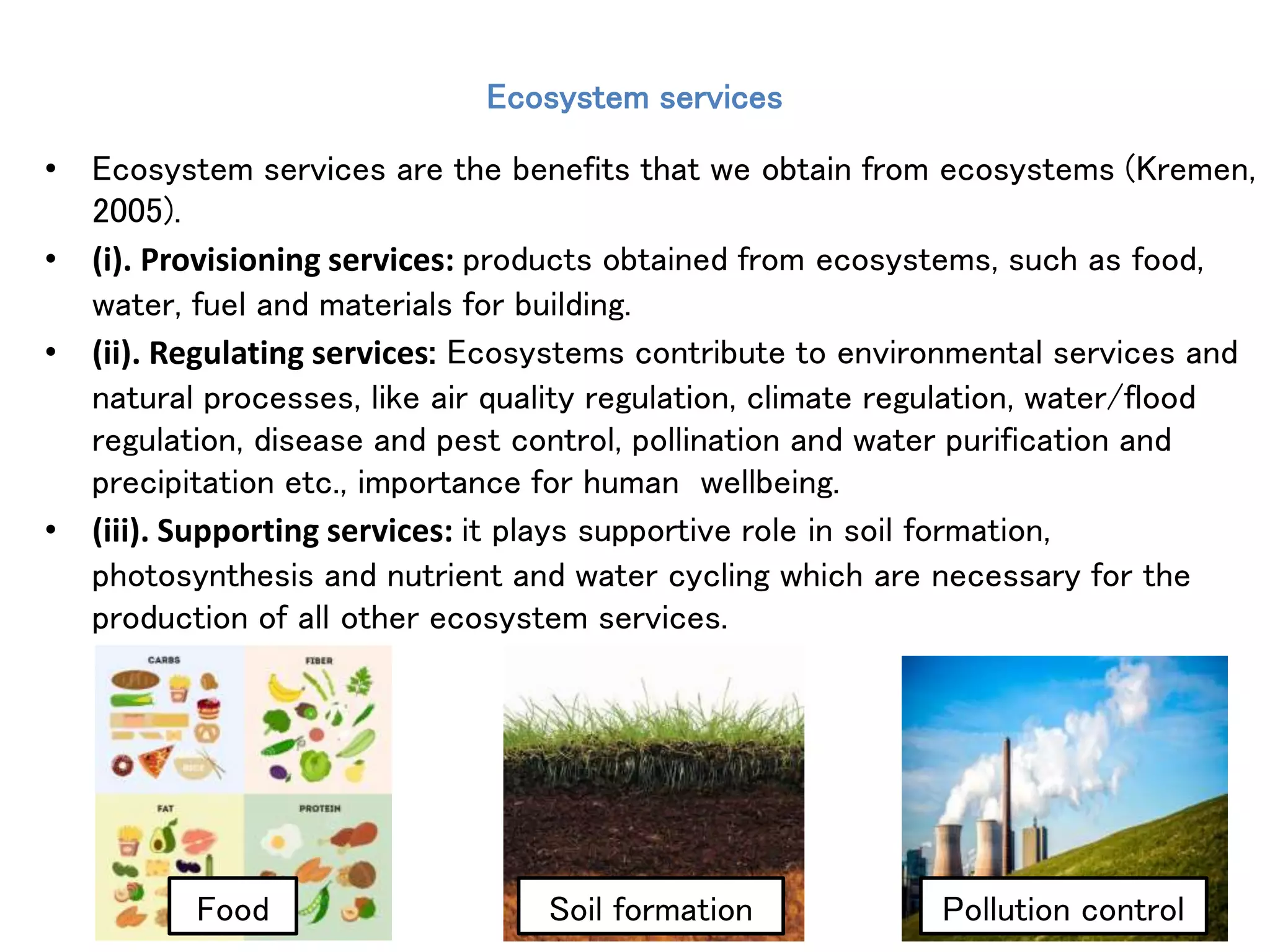
• (i). Provisioning services: products obtained from ecosystems, such as food,
water, fuel and materials for building.
• (ii). Regulating services: Ecosystems contribute to environmental services and
natural processes, like air quality regulation, climate regulation, water/flood
regulation, disease and pest control, pollination and water purification and
precipitation etc., importance for human wellbeing.
• (iii). Supporting services: it plays supportive role in soil formation,
photosynthesis and nutrient and water cycling which are necessary for the
production of all other ecosystem services.
Food Soil formation Pollution control
11.
Conclusion
An Ecosystem doessupport a variety of floral and faunal species to remain
in functional state. Not even a single species of an ecosystem can
survive its own in isolation. Interdependency among species is so intricate
that one can’t think of their survival away from ecosystem for long. One
species influence other species present in the surroundings and get
influenced from others those are surrounding it. All species function on
the principle of “division of labor” in the ecosystem. Every species has
its own ability, potential and adaptability to perform a specific role in the
ecosystem. Extinction or extermination or insufficient number of individual
species will affect “quantum of service” being rendered by the species to
the ecosystem. Ecosystem is the provider of various ecological services
from the birth of an organism to its death such as food, habitat and other
essentials we can think of. It also plays major roles in biogeochemical
cycle of abiotic elements and processes of succession and evolution.
Thus we conclude that Ecosystem is the basic unit of life on Earth.


![Ecology_Chapt_5[1].pptx](https://cdn.slidesharecdn.com/ss_thumbnails/ecologychapt51-220827093138-ae3aa5ac-thumbnail.jpg?width=640&height=640&fit=bounds)


![Pollution.ppt [Autosaved].ppt yogesh kumbhar](https://cdn.slidesharecdn.com/ss_thumbnails/pollution-251205194856-d30cfee8-thumbnail.jpg?width=640&height=640&fit=bounds)


