Training Programme on Regional Ocean Governance for the 30th November 2016
Mediterranean, Black, Baltic and Caspian Seas
By Kristina Edwards
Introduction
Introduction
Plastic material = “plastikos” (Greek),
“plasticus” (Latin) – fit for molding.
Mixture of (semi-)synthetic polymers
obtained through industrial process of
polycondensation (thermosetting plastics1)
or polymerization (thermoplastics2)
1 it hardens when heated
2 it gets pasty when heated
Aubry, 2004
Bellis, 2011
PlasticsEurope, 2016
Introduction
Light
&
Practical
Resistant
& Slowly
degraded
Aesthetic
Waterproof,
insulating
Asepticised
Limit CO2
emissions
Cheaper
5
« CHANGE IS POSSIBLE »
« Plastic everywhere »
« plastics […]
are also in our food chain »
« Only a fraction of the plastic
that we produce is recycled»
« 276 pieces of plastic
inside a 190 day-old chick »
Introduction
www.plasticoceans.org/film/
Introduction
6
« CHANGE IS POSSIBLE »
« Plastic everywhere »
« plastics […]
are also in our food chain »
« Only a fraction of the plastic
that we produce is recycled»
« 276 pieces of plastic
inside a 190 day-old chick »
7
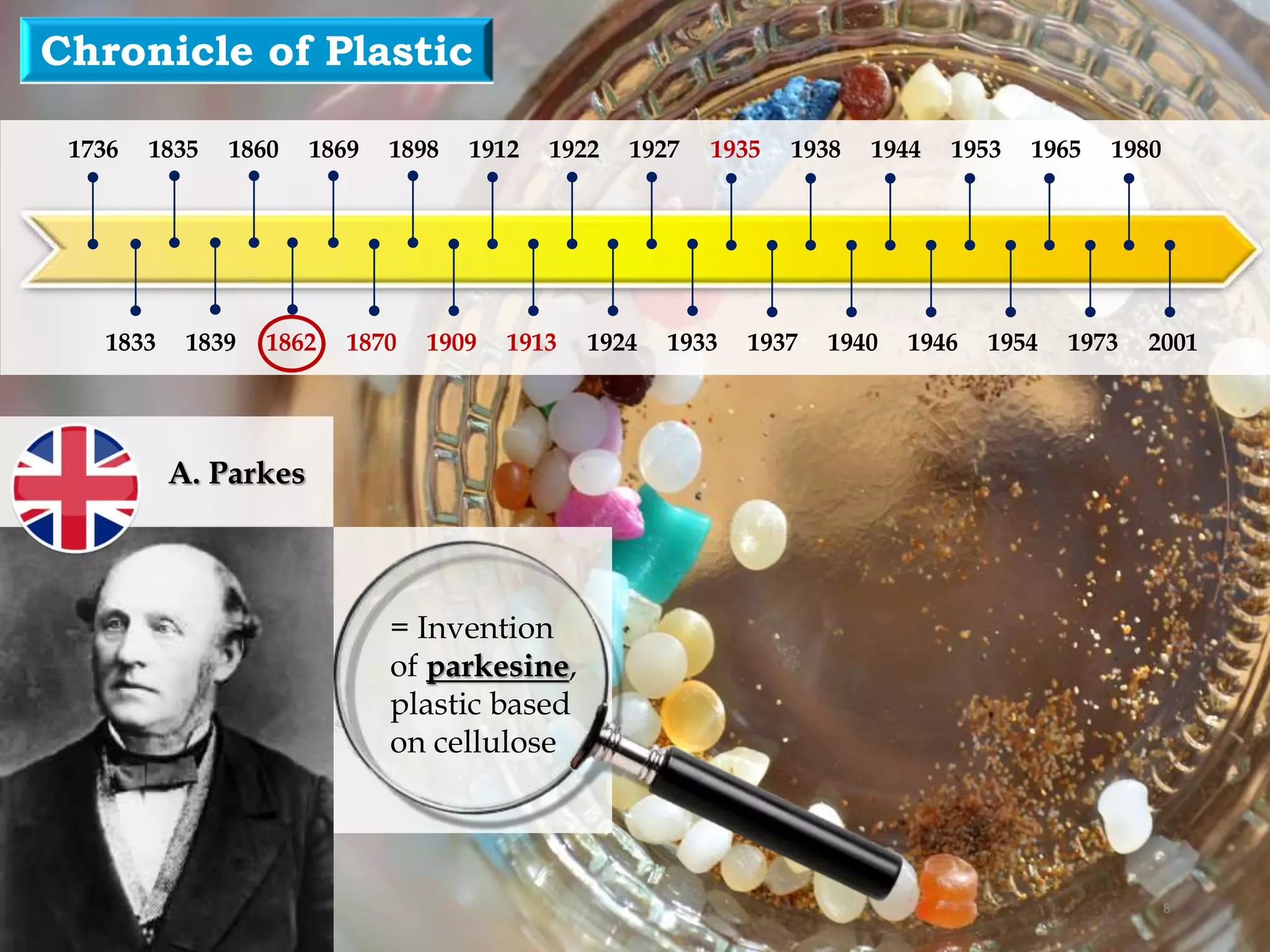
Chronicle of Plastic
1736 1835 1860 1869 1898 1912 1922 1927 1935 1938 1944 1953 1965 1980
1833 1839 1862 1870 1909 1913 1924 1933 1937 1940 1946 1954 1973 2001
8
Chronicle of Plastic
1736 1835 1860 1869 1898 1912 1922 1927 1935 1938 1944 1953 1965 1980
1833 1839 1862 1870 1909 1913 1924 1933 1937 1940 1946 1954 1973 2001
= Invention
of parkesine,
plastic based
on cellulose
A. Parkes
9
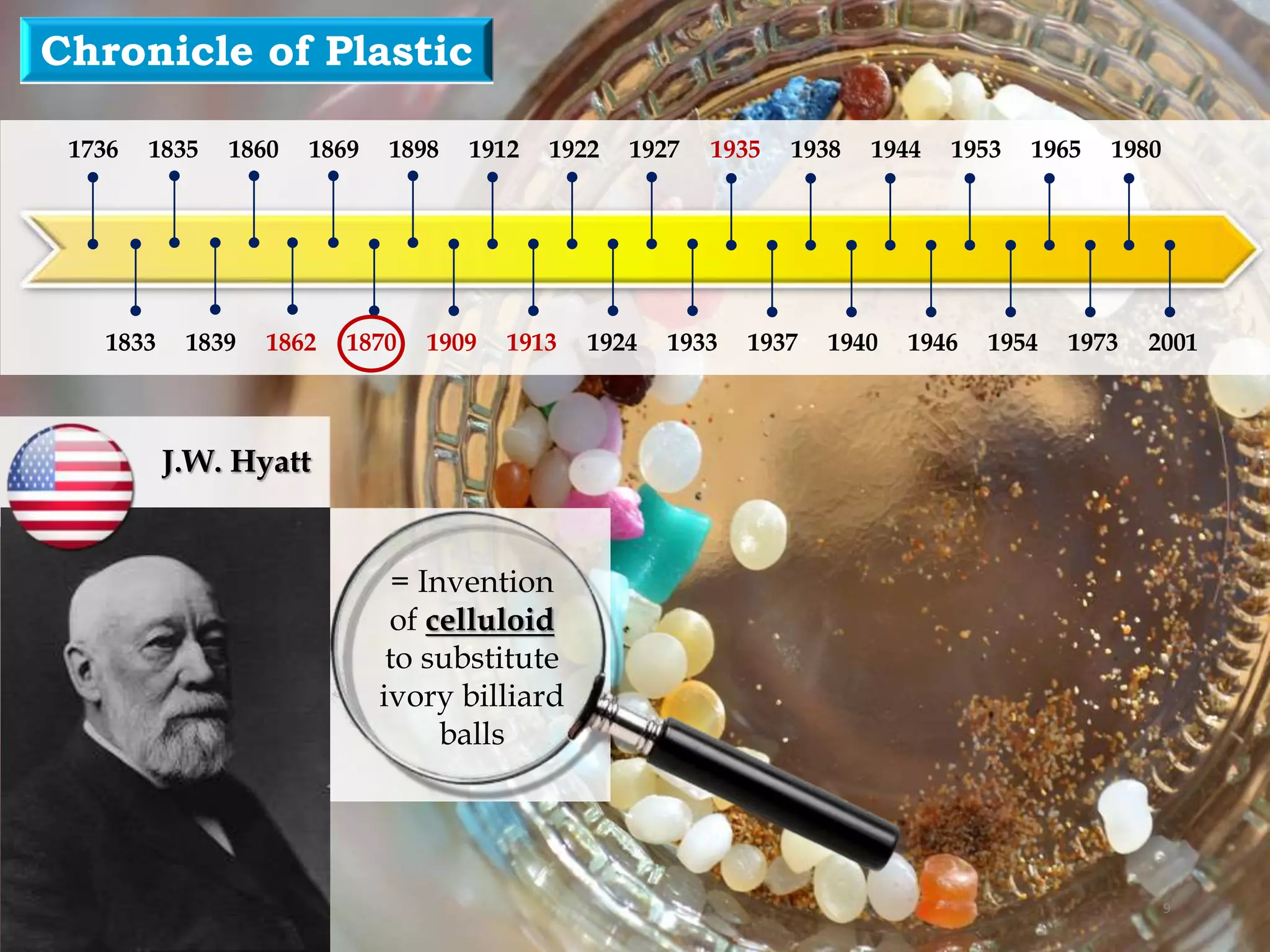
Chronicle of Plastic
1736 1835 1860 1869 1898 1912 1922 1927 1935 1938 1944 1953 1965 1980
1833 1839 1862 1870 1909 1913 1924 1933 1937 1940 1946 1954 1973 2001
1
= Invention
of celluloid
to substitute
ivory billiard
balls
J.W. Hyatt
10
Chronicle of Plastic
1736 1835 1860 1869 1898 1912 1922 1927 1935 1938 1944 1953 1965 1980
1833 1839 1862 1870 1909 1913 1924 1933 1937 1940 1946 1954 1973 2001
1
= Invention
of bakelite,
first plastic
totally
man-made
L.H.
Baekeland
11
Chronicle of Plastic
1736 1835 1860 1869 1898 1912 1922 1927 1935 1938 1944 1953 1965 1980
1833 1839 1862 1870 1909 1913 1924 1933 1937 1940 1946 1954 1973 2001
1
= Innovation for
manufacturing
process of PVC
F. Klatte
12
Chronicle of Plastic
1736 1835 1860 1869 1898 1912 1922 1927 1935 1938 1944 1953 1965 1980
1833 1839 1862 1870 1909 1913 1924 1933 1937 1940 1946 1954 1973 2001
1
= Invention of
6,6 Polyamid
(nylon)
W.H.
Carothers
13
Chronicle of Plastic
1736 1835 1860 1869 1898 1912 1922 1927 1935 1938 1944 1953 1965 1980
1833 1839 1862 1870 1909 1913 1924 1933 1937 1940 1946 1954 1973 2001
Creation of new
plastic materials
e.g. PS, nylon, LDPE, PU, Teflon, PET
14
Chronicle of Plastic
1736 1835 1860 1869 1898 1912 1922 1927 1935 1938 1944 1953 1965 1980
1833 1839 1862 1870 1909 1913 1924 1933 1937 1940 1946 1954 1973 2001
Constant increase of plastic
production & consumption
i.e. Plastic present in most professional
sectors as well as day-to-day basis
15
Chronicle of Plastic
1736 1835 1860 1869 1898 1912 1922 1927 1935 1938 1944 1953 1965 1980
1833 1839 1862 1870 1909 1913 1924 1933 1937 1940 1946 1954 1973 2001
Plastic era
i.e. Plastic products are almost
everywhere all over the world
16
Origins of Plastic
GALALITH
(« milk stone »)
POLYPROPYLENE
POLYSTYRENE,
POLYPROPYLENE,
PVC…
Casein
Origins of Plastic
385°C
30°C
180°C
C6-C10
Furnace Distillation Tower
Naphtha +
(mixture of hydrocarbons)
DISTILLATION
STEAM CRACKING
Monomers
e.g. propylene, ethylene
POLYCONDENSATION/
POLYMERISATION
(e.g. polyaddition)
TRANSFORMATION
Crude oil
(e.g. extrusion techniques)
Polymers
e.g. polypropylene,
polyethylene
99%
 They present numerous advantages, though with major
disadvantage which is very slow degradation and leaching.
 Since 1960’s, constant growth in the global production has been
observed, leading to “plastic-dependent societies”.
 Mainly issued from petrochemical industry (99%)
 Plastic materials can mainly get harder (thermosetting
plastics) or pasty (thermoplastics) when heated.
19
Marine pollution
“Any persistent manufactured or processed solid material (deliberately),
directly or indirectly discarded, disposed of or abandoned in the marine and
coastal environment […]
(adapted from UNEP, 2009)
NORTH AMERICA
EUROPE
ASIA
AFRICA
SOUTH AMERICA OCEANIA
Marine pollution
This is one of the major environmental concern worldwide
and various studies have been conducted since 1950’s.
ANTARCTICA
ARCTICA?
NORTH AMERICA
EUROPE
ASIA
AFRICA
SOUTH AMERICA OCEANIA
Marine pollution
This is one of the major environmental concern worldwide
and various studies have been conducted since 1950’s.
ANTARCTICA
ARCTICA?
NORTH AMERICA
EUROPE
ASIA
AFRICA
SOUTH AMERICA OCEANIA
Marine pollution
This is one of the major environmental concern worldwide
and various studies have been conducted since 1950’s.
ANTARCTICA
ARCTICA?
NORTH AMERICA
EUROPE
ASIA
AFRICA
SOUTH AMERICA OCEANIA
Marine pollution
This is one of the major environmental concern worldwide
and various studies have been conducted since 1950’s.
ANTARCTICA
ARCTICA?
NORTH AMERICA
EUROPE
ASIA
AFRICA
SOUTH AMERICA OCEANIA
Marine pollution
This is one of the major environmental concern worldwide
and various studies have been conducted since 1950’s.
ANTARCTICA
ARCTICA?
NORTH AMERICA
EUROPE
ASIA
AFRICA
SOUTH AMERICA OCEANIA
Marine pollution
This is one of the major environmental concern worldwide
and various studies have been conducted since 1950’s.
ANTARCTICA
ARCTICA?
NORTH AMERICA
EUROPE
ASIA
AFRICA
SOUTH AMERICA OCEANIA
Marine pollution
This is one of the major environmental concern worldwide
and various studies have been conducted since 1950’s.
ANTARCTICA
ARCTICA?
NORTH AMERICA
EUROPE
ASIA
AFRICA
SOUTH AMERICA OCEANIA
Marine pollution
This is one of the major environmental concern worldwide
and various studies have been conducted since 1950’s.
ANTARCTICA
ARCTICA?
28
Marine pollution The Mediterranean Sea has been highlighted as
one of the most polluted seas in the world, mainly due to
significant loss of plastic materials. (Deudero et Alomar, 2015)
Eriksen et al., 2014
Lebreton et al., 2012
Cózar et al., 2015
Suaria et al., 2016
Marine Strategy Framework Directive (MSFD)
Good Environmental Status
(GES)
« Properties and quantities of
marine litter do not cause harm
to the coastal and marine
environment »
(European Parliament, 2008)
Microplastics (MPs)
= Any plastic
materials which
measure less than
5 mm in diameter
= Basic form to
create any
plastic products
= Slowly
degraded by the
environment
Microplastics (MPs)
Arthur et al., 2009
Cole et al., 2011
Corcoran et al., 2009
Fendall et Sewell, 2009
Galgani et al., 2013
Hartl et al., 2015
Van Cauwenberghe et al., 2015
Wright et al., 2013
LMPs = 1-5 mm
SMPs = 1μm (20μm)-1mm
31
Physical
Chemical
Biological
Wave action
Temperature
UVs
Oxidation
Hydrolysis
Micro-organisms
Microplastics (MPs) Degradation processes
32
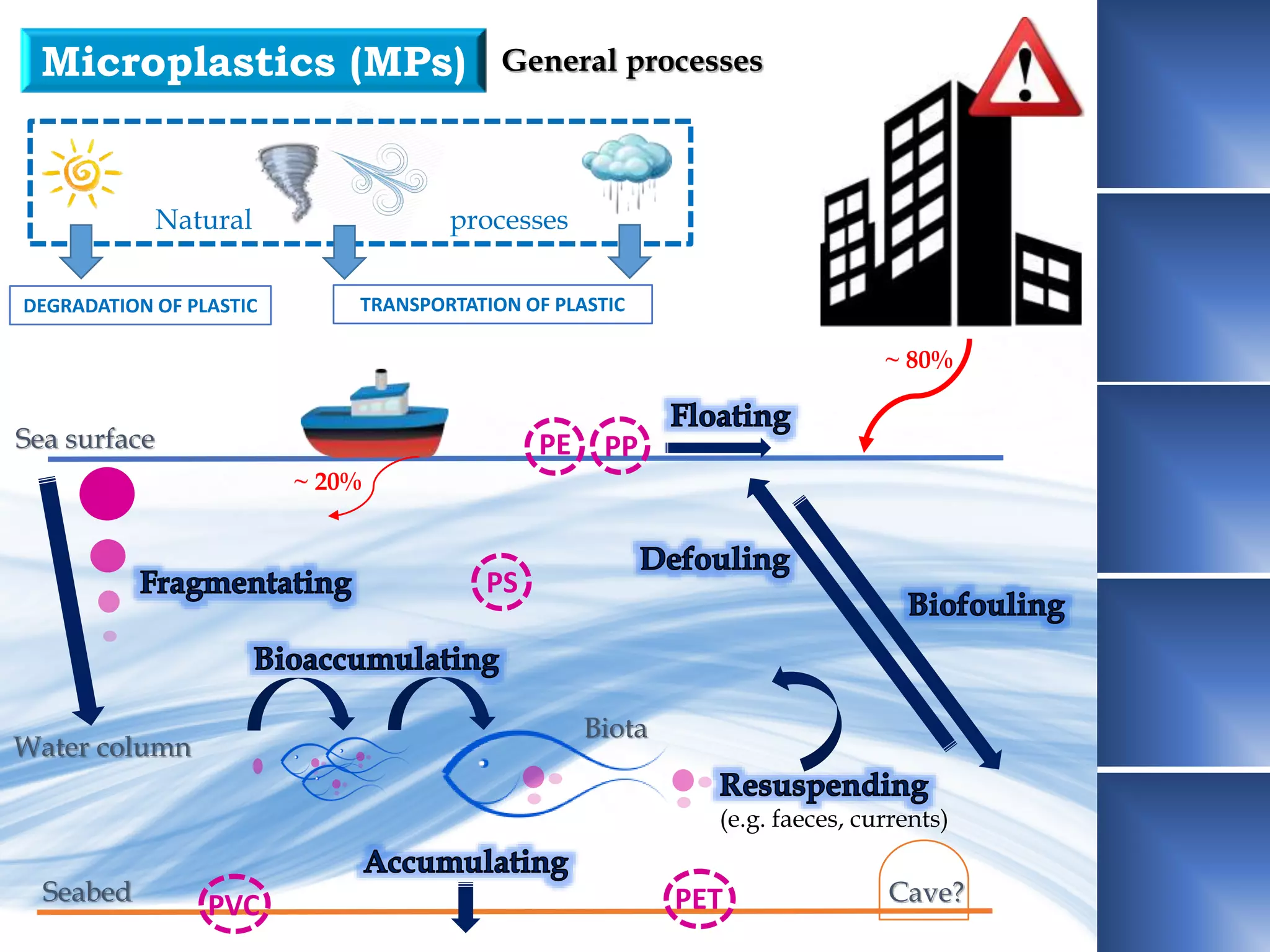
Microplastics (MPs) General processes
PE PP
PS
PVC PET Cave?
~ 20%
(e.g. faeces, currents)
Sea surface
Water column
Seabed
~ 80%
Biota
Natural processes
DEGRADATION OF PLASTIC TRANSPORTATION OF PLASTIC
Microplastics (MPs)
 Most Microplastics come from slow degradation processes and
they are pervasive.
 Marine pollution is a major environmental issue worldwide.
 There is no clear definition for Microplastics but most studies
refers to particles < 5 mm in diameter.
- PhD. in Marine Science -
« Assessing levels of Microplastics in
Maltese waters (Central Mediterranean) and
their impacts on selected marine species in
compliance with the European Marine
Strategy Framework Directive (MSFD)
obligations »
36
The Maltese Islands
37
The Maltese Islands
+ Within the heart of
the Mediterranean Sea
+ Valuing and unique
landscapes, habitats,
and wildlife
- The 1st highest
population density
in Europe (2016)
- Surrounded by
the most polluted sea
38
Study areas
Bezzina, 2016
Golden Bay
Għajn Tuffieħa Bay
Għadira Bay
St George’s Bay
Pretty Bay
39
Study areas
Bezzina, 2016
Golden Bay*
GPS Coordinates (WGS84): 35°56’01.93’’ N; 14°20’40.06’’ E
*Marine Protected Area (MPA)
40
Study areas
Bezzina, 2016
Għajn Tuffieħa Bay*
41
Study areas
Bezzina, 2016
Għadira Bay*
42
Study areas
Bezzina, 2016
St George’s Bay*
43
Study areas
Bezzina, 2016
Pretty Bay
44
Beach profile
Sea conditions
Biology
Topography
Sedimentology
Meteorological
conditions
Demography &
Socio-economy
45
z
Beach profile
TOPOGRAPHY
Name GB-Mt
Shape Type Polygon
Number of Points 33
Area (m²) 8 813
Perimeter (m) 522
Max. length (m) 189
Max. width (m) 91,70
Degree of slope On site
Aperture angle On map
46
z
Beach profile
TOPOGRAPHY
Name GB-Mt
Shape Type Polygon
Number of Points 33
Area (m²) 8 813
Perimeter (m) 522
Max. length (m) 189
Max. width (m) 91,70
Degree of slope On site
Aperture angle On map
GIS
(e.g. Google Earth, MapInfo, ArcGIS))
47
z
Beach profile
TOPOGRAPHY
Name GB-Mt
Shape Type Polygon
Number of Points 33
Area (m²) 8 813
Perimeter (m) 522
Max. length (m) 189
Max. width (m) 91,70
Degree of slope On site
Aperture angle On map
Measurements
(e.g. Clinometer, Iphone)
48
z
Beach profile
TOPOGRAPHY
Name GB-Mt
Shape Type Polygon
Number of Points 33
Area (m²) 8 813
Perimeter (m) 522
Max. length (m) 189
Max. width (m) 91,70
Degree of slope On site
Aperture angle On map
(e.g. Google Earth, Protractor)
49
Beach profile
SEA CONDITIONS
Wave Exposure Index (EI) pH
Wave Heights (m) Sea Surface Temperature (SST) (°C)
Tides & Currents (e.g. sea-level variability, coastal seiches)
Physical degradation of plastic materials
+ Transport
50
Beach profile
Ocean acidification – oils & polymers are leaching from plastic materials
SEA CONDITIONS
Wave Exposure Index (EI) pH
Wave Heights (m) Sea Surface Temperature (SST) (°C)
Tides & Currents (e.g. sea-level variability, coastal seiches)
51
Beach profile
Physical degradation of plastic materials
SEA CONDITIONS
Wave Exposure Index (EI) pH
Wave Heights (m) Sea Surface Temperature (SST) (°C)
Tides & Currents (e.g. sea-level variability, coastal seiches)
52
Beach profile
Physical degradation of plastic materials
+ Transport
SEA CONDITIONS
Wave Exposure Index (EI) pH
Wave Heights (m) Sea Surface Temperature (SST) (°C)
Tides & Currents (e.g. sea-level variability, coastal seiches)
53
z
Beach profile
Wind speed (m/s) & direction Prevailing
Weather -
Humidity (%) -
UV Index Physical degradation of plastic
Precipitations (mm/3hrs) Run-off(s)
Sunrise/Sunset time Sun exposure
METEOROLOGICAL CONDITIONS
54
z
Beach profile
SEDIMENTOLOGY
Grain-size Sieving conventional Technique
Permeability (cm/s) Ability of fluid to pass through sediment
Porosity Soil having interstices through which liquid/air may pass
Dissolved Oxygen (DO) Infauna, Chemical degradation
pH Infauna, Acidification
55
z
Beach profile
SEDIMENTOLOGY
Grain-size Sieving conventional Technique
Permeability (cm/s) Ability of fluid to pass through sediment
Porosity Soil having interstices through which liquid/air may pass
Dissolved Oxygen (DO) Infauna, Chemical degradation
pH Infauna, Acidification
56
z
Beach profile
SEDIMENTOLOGY
Grain-size Sieving conventional Technique
Permeability (cm/s) Ability of fluid to pass through sediment
Porosity Soil having interstices through which liquid/air may pass
Dissolved Oxygen (DO) Infauna, Chemical degradation
pH Infauna, Acidification
500 ml
dry sediment
500 ml
water
57
Beach profile
Identification of species Identification key
Abundance Number of individuals within species
Specific richness Number of species
Shannon diversity index Number of species & abundance
Pielou Equitability Distribution of individuals within species
BIOLOGY / ECOLOGY
58
z
Beach profile
Permanent residents -
Inbound tourism Per month, Per year
Avg. number of bathers Per day, Per month
Marine Protected Area (MPA) Yes/No (date)
Blue Flag Yes/No (date)
Presence of macro-litter Yes/No (when sampling)
Number of bins -
Number of activities Among 21
Clean-ups Frequency, technique(s)
DEMOGRAPHY / SOCIO-ECONOMY
Sampling Beach sediment – in Malta
10 m
0 m
50 cm
Strandline
T1 T2 T3 T4 T5
Q2 Q4 Q6 Q8 Q10
Q1 Q3 Q5 Q7 Q9
Sampling Beach sediment – in Malta
10 m
0 m
50 cm
Strandline
Strandline
Landmark
Bin
Sampling Beach sediment – in Malta
 The risk of contamination is considered but still
ubiquitous.
 The main variations in the sampling phase depend on:
* Number of line transects (e.g. 3, 5) and direction (along or
perpendicular to the strandline);
* Dimensions of quadrats (e.g. 1x1 m; 50x50 cm; 25x25 cm; 5x5 cm);
* Superficial layer of sediment (e.g. 0-5 cm; 0-15 cm; 5-10 cm).
Galgani et al., 2013
Hidalgo-Ruz et al., 2012
Kunz et al., 2016
Laglbauer et al., 2014
Lippiatt et al., 2013
McKinley, 2014
Wessel et al., 2016
Yu et al., 2016
Sampling Marine sediment – in Malta
Strandline
T1
// //
0 m x
« Biological zero »
3 m depth x
7 m depth x
Sampling Marine sediment – in general
 Shallow waters (0-60 m)
 Van Veen Grab
 Ekman Grab
 Smith-McIntyre Grab
 Hammon Grab
 Multisampler
 Beeker sampler
 Metal cores
Hidalgo-Ruz et al., 2012
Claessens et al., 2011
Löder et Gerdts, 2015
Sampling Marine sediment – in general
 Deep waters (> 60 m)
 Van Veen Grab
 Ekman Grab
 Smith-McIntyre Grab
Hidalgo-Ruz et al., 2012
Claessens et al., 2011
Löder et Gerdts, 2015
 Hammon grab
 The risk of contamination is considered but still
ubiquitous.
 The main variations/limitations in the sampling phase depend on:
* Volume and height sampled (grab or equipment capacity);
* Diving generates more disturbance of the sediment but
it is much cheaper;
* Substrate (soft or coarse sediment).
67
Sampling Water column (sea surface) – in general
Net tow - Speed and Time
Sampling Water column (sea surface) – in general
Net type
Mesh size
(μm)
Dimensions
(cm)
Tow speed
(knots)
Tow time
(minutes)
Depth
(cm)
References
Bongo - - - - - -
Ring 120 Ø 50 1-2 5-7 0-25 Castillo et al., 2016
Manta
333
300
333
330
333
333
505
500
333
333
505
60 x 20
50 x 15
61 x 16
60 x 15
90 x 15
61 x 16
-
-
60 x 25
60 x 20
86 x 15.5
~ 2.5
4
~ 1-3
~ 2.7
~ 1-3
~ 1-3
~ 1-1.5
~ 2
~ 3.13
~ 2.5
1.5-2
60
30
-
45-90
-
60
15
20
15-30
20
15
0-10
-
0-25
-
-
-
-
0-50
-
0-10
-
Pedrotti et al., 2016
Sadri et Thompson, 2014
Setälä et al., 2016
Faure et al., 2015
Moore et al., 2001
Eriksen et al., 2013
Gilfillan et al., 2009
De Lucia et al., 2014
Ruiz-Orejόn et al., 2016
Collignon et al., 2012
Doyle et al., 2011
Neuston
200
330
200
1000
-
330
505
50
50 x 50
-
200
-
-
50 x 30
2-3
2
1.5
100
-
~ 1-4
1.5-2
~ 15
10
20
1-2
-
15-60
10
-
-
-
-
-
-
0-10 (15)
Cόzar et al., 2015
Yamashita et Tanimura, 2007
Fossi et al., 2016
Van Cauwenberghe et al., 2013
Goldstein et al., 2012
Eriksen et al., 2014
Doyle et al., 2011
WP2
200
200
200
60 x 25
Ø 57
Ø 57
~ 1.35
1
~ 1.5
20
15
20
0-20
-
-
Collignon et al., 2014
Fossi et al., 2012
Panti et al., 2015
Sampling Water column – in general
Specific
depths
or
Tows at selected depths
(e.g. 15 m or 212 m)
Vertical
distribution(s)
Doyle et al., 2011 Fossi et al., 2012
Hansen, 2016 Santos, 2015
William et Zimmermann, 2014
 The risk of contamination is considered but still
ubiquitous.
 There are no standard methodologies yet.
 The main variations in the sampling phase depend on:
* Characteristics of the net (e.g. type, mesh size);
* Time and speed of the net tow;
* Conservation of samples on boat.
- PhD. in Marine Science -
« Assessing levels of Microplastics in
Maltese waters (Central Mediterranean) and
their impacts on selected marine species in
compliance with the European Marine
Strategy Framework Directive (MSFD)
obligations »
Sampling Marine biota – in general
More than 700 species have been recorded ingesting
plastic materials!
 COLLECTION IN THE WILD
(e.g. trawl surveys, [skin] biopsies or faeces, dives, part of nests)
 FINDING OF DEAD OR DYING INDIVIDUALS AT SEA OR ON LAND
 FISH MARKET OR OTHER PURCHASE
Caron et al., 2016 Bellas et al., 2016
Browne et al., 2013 Cole et al., 2013
De Witte et al., 2014 Fossi et al., 2016
Devriese et al., 2015 Galgani et al., 2013
Rebolledo et Van Franeker, 2015
 WATER OR SEDIMENT SAMPLES
(i.e. micro-organisms, infauna)
Preservation treatment:
 Formalin solution
 Ethanol
 Isopropyl alcohol
 Numerous marine organisms are under threat of
ingesting microplastics.
 There are no standard methodologies yet even though some
protocols purpose guidelines.
 The main variations in the sampling phase depend on:
* The number of individuals collected;
* Conservation of the samples.
Analysing
Analysing Beach sediment or Water samples
PHASE 1
Record wet weight
of sediment
DRYING SAMPLE
Record dry weight
of sediment
How?
Which temperature?
How long?
• Oven
• Drying cabinet
• 1-2 days
• Min. 24 hrs
• 250°C
• 75°C
• 65,5°C
Mc. Kinley, 2014
Mathalon et Hill, 2014
Masura et al., 2015
Analysing Beach sediment or Water samples
PHASE 2
DENSITY
SEPARATING
At 25°C:
• NaCl = 1,20 g/ml
• CaCl2 = 1,47 g/ml
• ZnCl2 = 2,14 g/ml
• NaI = 1,84 g/ml
• Na2WO4 = 0,74 g/ml
Which?
Claessens et al., 2013
Cole et al., 2014
Hidalgo-Ruz et al., 2012
Masura et al., 2015
Stolte, 2014
Stirring 2’
500 ml CaCl2 solution
(1,47 g/ml)
Settlement
min. 30’
Supernatant
Analysing Beach sediment or Water samples
PHASE 3
COLLECTING
Filter Paper 300 μm
(FP)Vacuum
Filtration
System
Supernatant
+ large visible MPs
+ large visible MPs
Analysing Beach sediment or Water samples
PHASE 4
OBSERVING
or
32x-80x
Drying FP
How?
Which temperature?
How long?
• Oven
• Drying cabinet
• Min. 12 hrs
• 24 hrs
• 100°C
• 60°C
• 40°C
Cover when not in use!
Gomes de Carvalho, 2016
Massos, 2015
Davison et al., 2015
Analysing Beach sediment or Water samples
PHASE 5
ISOLATING
32x-80x
Cover when not in use!
Fibre(s)
MPs
D(I)W
D(I)W
(dried at air T°C) - Covered for protection
Cleaning
Storage
D(I)W drop
ABUNDANCE OF FIBERS
ABUNDANCE OF MPs
Cózar et Martí, 2016
Analysing Beach sediment or Water samples
PHASE 6
CHARACTERIZING
Cover when not in use!
Image J SIZE
MEASUREMENTS
COLOUR
SHAPE
TYPE
32x-80x
or/and




FTIR or RAMAN Spectroscopy
or « hot needle » test
POLYMER
COMPOSITION

Analysing Biota samples
PHASE 1
DEFROST
DISSECTING
Digestive system
(i.e. oeasophagus, stomach, and/or intestine)
Characterisation of individual
• Species
• Sex
• Age/ Maturity stage
• IUCN Conservation status
• Cause of death
• Location
• Origin
• Morphometric measurements (e.g. lengths, widths)
• Health state
etc…
Galgani et al., 2013
Duis et Coors, 2016
Matusiewicz, 2014
Analysing Biota samples
PHASE 2
Record wet weight
of tissue (0,01 g)
Digestive system
(i.e. oeasophagus, stomach, intestine)
WEIGHING
Galgani et al., 2013
Duis et Coors, 2016
Matusiewicz, 2014
COLLECTING THE
CONTENT
(if possible)
Analysing Biota samples
PHASE 3
Highly reactive
Digestive system or
content
(i.e. oeasophagus, stomach, intestine)
WET DIGESTING
Galgani et al., 2013
Duis et Coors, 2016
Matusiewicz, 2014
Cole et al., 2014
Which?
Acid digestion
• HNO3 • H2SO4
• HCl • H2PO4
• HF • H2O2
• HClO4 • KOH
Alkaline digestion
• NaOH
Enzymatic digestion
• Proteinase K
Acid, alkaline or
enzymatic solution
DENSITY
SEPARATING
(if needed)
Analysing Biota samples
PHASE 4
CLEANING + FILTERING
Galgani et al., 2013
Duis et Coors, 2016
Matusiewicz, 2014
D(I)W (and 70% Ethanol)
Vacuum
Filtration
System
1 or 5 mm mesh size
Digested preparation
Analysing Biota samples
PHASE 5
OBSERVING
32x-80x
Drying FP
How?
Which temperature?
How long?
• Oven
• Drying cabinet
• Min. 12 hrs
• 24 hrs
• 100°C
• 60°C
• 40°C
Cover when not in use!
Gomes de Carvalho, 2016
Massos, 2015
Davison et al., 2015
Analysing Biota samples
PHASE 6
ISOLATING
32x-80x
Cover when not in use!
Fibre(s)
MPs
D(I)W
D(I)W
(dried at air T°C) - Covered for protection
Cleaning
Storage
D(I)W drop
ABUNDANCE OF FIBERS
ABUNDANCE OF MPs
Cózar et Martí, 2016
Analysing Biota samples
PHASE 6
CHARACTERIZING
Cover when not in use!
Image J SIZE
MEASUREMENTS
COLOUR
SHAPE
TYPE
32x-80x
or/and




FTIR or RAMAN Spectroscopy
or « hot needle » test
POLYMER
COMPOSITION

Conclusions
• Through decades, plastic has become a crucial component of global human society
as it provides various advantages. However, it has also generated marine litter
(lack of knowledge, inefficient management and insufficient legal framework).
• Microplastics are ubiquitous worldwide and many studies have highlighted the
(potential) negative impacts on marine life, thus human kind.
• At this stage, most studies involve: (i) abundance (ii) spatio-temporal
distribution (iii) characterization of microplastics. Beside, standard
definitions and harmonized methodologies still need to be improved to:
- enable comparisons between countries;
- provide coherent recommendations to policy-makers and other stakeholders;
- enhance a sustainable protection of the marine ecosystem.
Conclusions
What I think I do
STUDYING MICROPLASTICS IN THE SEA
What I actually do
0
2
4
6
REFERENCES
• ARTHUR C., BAKER J., BAMFORD H., (2009). Proceedings of the International Research Workshop on the Occurrence, Effects and Fate of Microplastic Marine
Debris. NOAA Technical Memorandum NOS-OR&R-30. 49 pp.
• AUBRY J., (2004). Les matières plastiques. 18 pp.
• BELLAS J., MARTÍNEZ-ARMENTAL J., MARTÍNEZ-CÁMARA A., BESADA V., MARTÍNEZ-GÓMEZ C., (2016). Ingestion of microplastics by demersal fish
from the Spanish Atlantic and Mediterranean coasts. Mar. Poll. Bull. 109. pp. 55-60.
• BELLIS M., (2011). The history of plastics – Timeline of plastics. 2 pp.
• BEZZINA M., (2016). Monitoring of microplastics on local sandy beaches. A dissertation presented to the Faculty of Science in part fulfilment of the requirements of
the Degree of Bachelor of Science (Honours) at the University of Malta. Department of Biology, University of Malta. 72 pp.
• BROWNE M.A., NIVEN S.J., GALLOWAY T.S., ROWLAND S.J., THOMPSON R.C., (2013). Microplastic moves pollutants and additives to worms, reducing
functions linked to health and biodiversity. Current Biology. 23. pp. 2388-2392.
• CARON A.G.M., THOMAS C.R., ARIEL E., BERRY K.L.E., BOYLE S., MOTTI C.A., RODIE J.E., (2016). Extraction and identification of microplastics from sea
turtles: method development and preliminary results. Report No. 15/52 24 pp.
• CASTILLO A.B., AL-MASLAMANI I., OBBARD J-P., (2016). Prevalence of microplastics in the marine waters of Qatar. Mar. Poll. Bull. 111. pp. 260-267.
• CLAESSENS M., DE MEESTER S., VAN LANDUYT L., DE CLERCK K., JANSSEN C.R., (2011). Occurrence and distribution of microplastics in marine sediments
along the Belgian coast. Mar. Poll. Bull. 62. pp. 2199-2204.
• CLAESSENS M., VAN CAUWENBERGHE L., VANDEGEHUCHTE M.B., JANSSEN C.R., (2013). New techniques for the detection of microplastics in sediments
and field collected organisms. Mar. Poll. Bull. 70. pp. 227-233.
• COLE M., LINDEQUE P., HALSBAND C., GALLOWAY T.S., (2011). Microplastics as contaminants in the marine environment: A review. Mar. Poll. Bull. 62. pp.
2588-2597.
• COLE M., LINDEQUE P., FILEMAN E., HALSBAND C., GOODHEAD R., MOGER J., GALLOWAY T.S., (2013). Microplastic ingestion by zooplankton. Environ.
Sc. & Techno. 11 pp.
• COLE M., WEBB H., LINDEQUE P.K., FILEMAN E.S., HALSBAND C., GALLOWAY T.S., (2014). Isolation of microplastics in biota-rich seawater samples and
marine organisms. Scientific reports. 8 pp.
• COLLIGNON A., HECQ J-H., GALGANI F., VOISIN P., COLLARD F., GOFFART A., (2012). Neustonic microplastic and zooplankton in the North Western
Mediterranean Sea. Mar. Poll. Bull. 64. pp. 861-864.
REFERENCES
• COLLIGNON A., HECQ J-H., GALGANI F., COLLARD F., GOFFART A., (2014). Annual variation in neustonic micro- and meso-plastic particles and zooplankton
in the Bay of Calvi (Mediterranean-Corsica). Mar. Poll. Bull. 79. pp. 293-298.
• CORCORAN P.L., BIESINGER M.C., GRIFI M., (2009). Plastics and beaches: A degrading relationship. Mar. Poll. Bull. 58. pp.80-84.
• CÓZAR A., SANZ-MARTÍN M., MARTÍ E., GONZÁLEZ-GORDILLO J.I., UBEDA B., GÁLVEZ J.A., IRIGOIEN X., DUARTE C.M., (2015). Plastic accumulation
in the Mediterranean Sea. PLoS ONE 10(4): e0121762. Doi 10.1371/journal.pone.0121762. 13 pp.
• DAVIDSON E., HASTINGS C., WATERFIELD H., YOKOTA K., (2015). Development of methods to characterize & extract plastic microparticles from personal
cleansing products. 7 pp.
• DE LUCIA G.A., CALIANI I., MARRA S., CAMEDDA A., COPPA S., ALCARO L., CAMPANI T., GIANNETTI M., COPPOLA D., CICERO A-M., PANTI C.,
BAINI M., GUERRANTI C., MARSILI L., MASSARO G., FOSSI M-C., MATIDDI M., (2014). Amount and distribution of neustonic micro-plastic off the Western
Sardinian coast (Central-Western Mediterranean Sea). Mar. Environ. Research. 26 pp.
• DE WITTE B., DEVRIESE L., BEKAERT K., HOFFMAN S., VANDERMEERSCH G., COOREMAN K., ROBBENS J., (2014). Quality assessment of the blue
mussel (Mytilus edulis): Comparison between commercial and wild types. Mar. Poll. Bull. 85. pp. 146-155.
• DEUDERO S., ALOMAR C., (2015). Mediterranean marine biodiversity under threat: Reviewing influence of marine litter on species. Mar. Poll. Bull. 98. pp.58-68.
• DEVRIESE L., VAN DER MEULEN M.D., MAES T., BEKAERT K., PAUL-PONT I., FRERE L., ROBBENS J., VETHAAK A.D., (2015). Microplastic
contamination in brown shrimp (Crangon crangon, Linnaeus 1758) from coastal waters of the Southern North Sea and Channel area. Mar. Poll. Bull. 98. pp. 179-187.
• DOYLE M.J., WATSON W., BOWLIN N.M., SHEAVLY S.B., (2011). Plastic particles in coastal pelagic ecosystems of the Northeast Pacific Ocean. Mar. Environ.
Research 71. pp. 41-52.
• DUI K., COORS A., (2016). Microplastics in the aquatic and terrestrial environment: source (with a specific focus on personal care products), fate and effects. Environ.
Sci. Eur. 25 pp.
• ERIKSEN M., MAXIMENKO N., THIEL M., CUMMINS A., LATTIN G., WILSON S., HAFNER J., ZELLERS A., RIFMAN S., (2013). Plastic pollution in the South
Pacific subtropical gyre. Mar. Poll. Bull. 68. pp. 71-76.
• ERISKSEN M., LEBRETON L.C.M., CARSON H.S., THIEL M., MOORE C.J., BORERRO J.C., GALGANI F., RYAN P.G., REISSER J., (2014). Plastic pollution in
the World’s Oceans: More than 5 trillion plastic pieces weighing over 250.000 tons afloat at sea. PLoS ONE 9(12): e111913; DOI/10.1371/journal. Pone.0111913. 15
pp.
• EUROPEAN PARLIAMENT., (2008). Directive 2008/56/EC of the European Parliament and of the Council of 17 June 2008 establishing a framework for community
action in the field of marine environmental policy (Marine Strategy Framework Directive). Official Journal of the European Union, 22 pp.
REFERENCES
• FAURE F., SAINI C., POTTER G., GALGANI F., DE ALENCASTRO L-F., HAGMANN P., (2015). An evaluation of surface micro- and mesoplastic pollution in
pelagic ecosystems of the Western Mediterranean Sea. 17 pp.
• FENDALL L.S., SEWELL M.A., (2009). Contributing to marine pollution by washing your face: Microplastics in facial cleansers. Mar. Poll. Bull. 58. pp. 1225-1228.
• FOSSI M-C., PANTI C., GUERRANTI C., COPPOLA D., GIANNETTI M., MARSILI L., MINUTOLI R., (2012). Are baleen whales exposed to the threat of
microplastics? A case study of the Mediterranean fin whale (Balaenoptera physalus). Mar. Poll. Bull. 64. pp. 2374-2379.
• FOSSI M-C., MARSILI L., BAINI M., GIANNETTI M., COPPOLA D., GUERRANTI C., CALIANI I., MINUTOLI R., LAURIANO G., FINOIA M-G., RUBEGNI
F., PANIGADA S., BÉRUBÉ M., RAMÍREZ J-U., PANTI C., (2016). Fin whales and microplastics: The Mediterranean Sea and the Sea of Cortez scenarios. Environ.
Poll. 209. pp. 68-78.
• GALGANI F., HANKE G., WERNER S., OOSTERBAAN L., NILSSON P., FLEET D., KINSEY S., THOMPSON R.C., VAN FRANEKER J., VLACHOGIANNI T.,
SCOULLOS M., MIRA VEIGA J., PALATINUS A., MATIDDI M., MAES T., KORPINEN S., BUDZIAK A., LESLIE H., GAGO J., LIEBEZEIT G., (2013).
Monitoring guidance for Marine litter in European seas – Draft report. European Marine Strategy Framework Directive Working Group on Good Environmental Status
(WG-GES). 120 pp.
• GILFILLAN L.R., DOYLE M.J., OHMAN M.D., WATSON W., (2009). Occurrence of plastic micro-debris in the Southern California current system. CalCOFI Rep.,
Vol 50. 11 pp.
• GOLDSTEIN M.C., ROSENBERG M., CHENG L., (2012). Increased oceanic microplastic debris enhances oviposition in an endemic pelagic insect. Biol. Lett. 8. pp.
817-820.
• GOMES DE CARVALHO D., BAPTISTA NETO J.A., (2016). Microplastic pollution of the beaches of Guanabara Bay, Southeast Brazil. Ocean & Coastal
Management 128. pp. 10-17.
• HANSEN L., (2016). Macro and micro plastics in an urbanized and non-urbanized fjord estuary in the Northeast Pacific Ocean. University of Washington, School of
Oceanography, Seattle. 19 pp.
• HARTL M.G.J., GUBBINS E., GUTIERREZ T., FERNANDES T.F., (2015). Review of existing knowledge – Emerging contaminants: Focus on nanomaterials and
microplastics. Scotland’s centre of expertise for waters. 20 pp.
• HIDALGO-RUZ V., GUTOW L., THOMPSON R.C., THIEL M., (2012). Microplastics in the marine environment: A review of the methods used for identification and
quantification. Environ. Science & Techno. 16 pp.
• KUNZ A., WALTHER B.A., LÖWEMARK L., LEE Y-C., (2016). Distribution and quantity of microplastic on sandy beaches along the northern coast of Taiwan. Mar.
Poll. Bull. 111. pp. 126-135.
• LAGLBAUER B.J.L., FRANCO-SANTOS R.M., ANDREU-CAZENAVE M., BRUNELLI L., PAPADATOU M., PALATINUS A., GREGO M., DEPREZ T., (2014).
Macrodebris and microplastics from beaches in Slovenia. Mar. Poll. Bull. 89. pp. 356-366.
REFERENCES
• LEBRETON L.C.M., GREER S.D., BORRERO J.C., (2012). Numerical modelling of floating debris in the world’s oceans. Mar. Poll. 64. pp. 653-661.
• LIPPIATT S., OPFER S., ARTHUR C., (2013). Marine Debris monitoring and Assessment – Recommendations for monitoring debris trends in the marine environment.
NOAA, U.S Department of Commerce, Technical Memorandum NOS-OR&R-46. 88 pp.
• LÖDER M.G.J., GERDTS G., (2015). Methodology used for the detection and identification of microplastics – a critical appraisal. 27 pp.
• MASSOS A., (2015). The identification of microplastic fibres on North Devon Beaches. University of Plymouth. 73 pp.
• MASURA J., BAKER J., FOSTER G., ARTHUR C., (2015). Laboratory methods for the analysis of microplastics in the marine environment – Recommendations for
quantifying synthetic particles in waters and sediments. NOAA Technical Memorandum NOS-OR&R-48. 39 pp.
• MATHALON A., HILL P., (2014). Microplastic fibers in the intertidal ecosystem surrounding Halifax Harbor, Nova Scotia. Mar. Poll. Bull. 12 pp.
• MATUSIEWICZ H., (2014). Wet digestion methods. Politechnika Poznańska, Department of Analytical Chemistry, 60-965 Poznań, Poland. 36 pp.
• McKINLEY D., (2014). An investigation on plastic pollution in New Haven Harbor. Marine Biology Program – Department of Biology and Environmental Science. 4
pp.
• MOORE C.J., MOORE S.L., LEECASTER M.K., WEISBERG S.B., (2001). A comparison of plastic and plankton in the North Pacific central gyre. 5 pp.
• PANTI C., GIANNETTI M., BAINI M., RUBEGNI F., MINUTOLI R., FOSSI M-C., (2015). Occurrence, relative abundance and spatial distribution of microplastics
and zooplankton NW of Sardinia in the Pelagos Sanctuary Protected Area, Mediterranean Sea. Environ. Chem. 9 pp.
• PEDROTTI M-L., PETIT S., ELINEAU A., BRUZAUD S., CREBASSA J-C., DUMONTET B., MARTÍ E., GORSKY G., CÓZAR A., (2016). Changes in the floating
plastic pollution of the Mediterranean Sea in relation to the distance to land. PLoS one 1158): e0161581. doi:10.1371/journal.pone.0161581. 14 pp.
• PLASTICSEUROPE., (2016). What is plastic. Available at [www.plasticseurope.org/what-is-plastic/history.aspx]
• REBOLLEDO E.L.B., VAN FRANEKER J.A., (2015). Impact of marine debris on Antarctic fur seals Arctocephalus gazella at Cape Shirreff: diet dependent ingestion
and entanglement – Preliminary results. 7 pp.
• RUIZ-OREJÓN L.F., SARDÁ R., RAMIS-PUJOL J., (2016). Floating plastic debris in the Central and Western Mediterranean Sea. Mar. Environ. Research 120. pp.
136-144.
• SADRI S.S., THOMPSON R.C., (2014). On the quantity and composition of floating plastic debris entering and leaving the Tamar Estuary, Southwest England. Mar.
Poll. Bull. 81. pp. 55-60.
• SANTOS A.M.P., (2015). Cruise report – Cruise: 02030915 (BIOMETORE2), Vessel: RV Noruega. Project BIOMETORE-Biodiversity in seamounts: The Madeira-
Tore and Great Meteor (EEA Grants PT02_Aviso2_0001). Deliverable D1.2. 19 pp.
REFERENCES
• SETÄLÄ O., MAGNUSSON K., LEHTINIEMI M., NORÉN F., (2016). Distribution and abundance of surface water microlitter in the Baltic Sea: A comparison of two
sampling methods. Mar. Poll. Bull. 110. pp. 177-183.
• STOLTE A., (2014). The detection of microplastics in beach sediments – Extraction methods, biases, and results from samples along the German Baltic coast.
Universität Rostock. 144 pp.
• SUARIA G., AVIO C.G., MINEO A., LATTIN G.L., MAGALDI M.G., BELMONTE G., MOORE C.J., REGOLI F., ALIANI S., (2016). The Mediterranean plastic
soup: synthetic polymers in Mediterranean surface waters. Scientific reports. 10 pp.
• UNEP., (2009). Marine litter: A global challenge. Nairobi: UNEP. 232 pp.
• VAN CAUWENBERGHE L., VANREUSEL A., MEES J., JANSSEN C.R., (2013). Microplastic pollution in deep-sea sediments. Environ. Poll. 182. pp. 495-499.
• VAN CAUWENBERGHE L., CLAESSENS M., VANDEGEHUCHTE M.B., MEES J., JANSSEN C.R., (2013). Assessment of marine debris on the Belgian
Continental Shelf. Mar. Poll. Bull 73. pp. 161-169.
• VAN CAUWENBERGHE L., DEVRIESE L., GALGANI F., ROBBENS J., JANSSEN C.R., (2015). Microplastics in sediments: A review of techniques, occurrence
and effects. Mar. Environ. Research. pp. 1-13.
• WESSEL C.C., LOCKRIDGE G.R., BATTISTE D., CEBRIAN J., (2016). Abundance and characteristics of microplastics in beach sediments: Insights into
microplastics accumulation in northern Gulf of Mexico estuaries. Mar. Poll. Bull. 6 pp.
• WILLIAM B., ZIMMERMANN S., (2014). Report on the Oceanographic Research conducted aboard the CCGS Louis S. St-Laurent, September 21 to October 17, 2014
– IOS Cruise ID 2014-11. Joint Ocean Ice Study (JOIS) 2014 Cruise report. Fisheries and Oceans Canada, Institute of Ocean Sciences Sidney, B.C. 94 pp.
• WRIGHT S.L., THOMPSON R.C., GALLOWAY T.S., (2013). The physical impacts of microplastics on marine organisms: A review. Environ. Poll. 178. pp. 483-492.
• YAMASHITA R., TANIMURA A., (2007). Floating plastic in the Kuroshio Current area, western North Pacific Ocean. Mar. Poll. Bull 54. pp. 485-488.
• YU X., PENG J., WANG J., WANG K., BAO S., (2016). Occurrence of microplastics in the beach sand of the Chinese inner sea: the Bohai Sea. Environ. Poll. 214. pp.
722-730.
WEBSITES
• www.ncbi.nlm.nih.gov/pubmed/26752114
• www.robinsonlibrary.com/technology/technology/biography/graphics/parkes.jpg
• https://achurchforstarvingartists.files.wordpress.com/2012/06/save_the_world.png
• www.pngall.com/united-kingdom-flag-png
• www.pngall.com/germany-flag-png
• www.veryicon.com/icons/flag/not-patriot/usa-flag.html
• www.mrchain.com/blog/plastic-how/
• www.freeflagicons.com/country/belgium/round_icon/
• www.kern.de/de/geschichte-der-kunststoffe
• www.azquotes.com/author/29126-Wallace_Carothers
• www.freeflagicons.com/country/switzerland/round_icon/
• http://artssciences.lamar.edu/_files/images/soc-sw-cj/sociology/social-team.png
• www.myus.com/no/
• https://adventrlp.files.wordpress.com/2012/02/seminar_icon.png
• www.freeiconspng.com/free-images/french-flag-png-29331
• www.pelkmanslab.org/?page_id=1964
• www.freeiconspng.com/free-images/window-png-23861
• http://pngimg.com/download/2931
• http://theglutenfreeassistant.blogspot.com.mt/2008/10/casein-free-milk-and-butter.html
• http://www.polentaladelizia.com/en
• https://fr.wikipedia.org/wiki/Fichier:Oil_Barrel_graphic.png
• www.iconfinder.com/icons/559153/aqua_drop_droplet_oil_petroleum_rain_water_icon
• www.plutoniummuffins.com/water-molecules-and-a-broken-tooth/
• www.fostercomp.com/services/dry-blending/dry-blending
WEBSITES
• www.sunshineproducts.in/tubs.php
• www.primaplastics.com/plastic-moulded-chairs-5.html
• http://henkeladhesivesna.com/blog/evolution-from-metal-to-plastic-and-composites/
• www.syke.fi/en-US/Research__Development/Sustainable_management_of_the_Baltic_Sea_and_freshwater_resources/Baltic_Sea_ecosystem_wheel_presents_elev(35474)
• http://f--f.info/?p=22142
• http://blog.rtve.es/estrenos/ciencia/
• www.oceanmediainstitute.org/explore-bermuda
• www.ezilon.com/maps/europe/malta-road-maps.html
• http://pngimg.com/img/nature/sun
• http://pngimg.com/search
• www.iconfinder.com/icons/642438/forecast_gust_gust_of_wind_summer_warm_wind_weather_windy_icon
• www.gif-maniac.com/theme-gyrophare.php
• www.worldatlas.com/webimage/countrys/polar/arctic.htm
• www.worldatlas.com/webimage/countrys/an.htm
• http://halofanon.wikia.com/wiki/File:Earth_Continents.png
• www.equipcoservices.com/images/products/rentals/models/wildco_standard_grab_sampler_large.jpg
• http://woodshole.er.usgs.gov/openfile/of2005-1001/htmldocs/samplers/grab/smgrab.htm
• www.coastalwiki.org/wiki/File:Hammon_grab.jpg
• www.envcoglobal.com/files/MO-FS-GOFM-L.jpg
• www.directindustry.com/prod/essa-australia/product-33731-213262.html
• http://pngimg.com/download/6614
• http://cliparts.co/beaker-image
• www.indiantradebird.com/laboratory-glassware?cn=MTM1OA==
• http://sciencesphysiquescollegemozart.over-blog.com/article-la-filtration-d-une-eau-boueuse-88002019.html
• www.researchgate.net/figure/261719490_fig1_Figure-1-The-commonly-used-samplers-for-deep-seawater-sampling-a-Niskin-sampler
• www.marinebio.net/marinescience/01intro/tosamp.htm
PHOTO CREDITS
• Mr. Owen Attard
• Mr. Sergio Arenas
• Mr. Nicolas Cimiterra
• Mr. Peter Clarke
• Mr Andy Murch
• Wild Wonders of Europe
• Mr. Chris Gomersall
• Mr. Jean-Paul Ferrero
• Mr. John Cancalosi
• Ms. Lynn M. Stone
• Mr. Richard Hermann
• Mr & Ms. Sailer
• Ms. Lisa Steiner
• Mr. Peter Hodum
• Mr. Michael P. O’Neill
• Mr. Mark Conlin
• Mr. Charlie Phillips
Kristina.edwards.15@um.edu.mt
or Nash74@hotmail.fr

Microplastics - my experience as a PhD student

  • 1.
    Training Programme onRegional Ocean Governance for the 30th November 2016 Mediterranean, Black, Baltic and Caspian Seas By Kristina Edwards
  • 2.
  • 3.
    Introduction Plastic material =“plastikos” (Greek), “plasticus” (Latin) – fit for molding. Mixture of (semi-)synthetic polymers obtained through industrial process of polycondensation (thermosetting plastics1) or polymerization (thermoplastics2) 1 it hardens when heated 2 it gets pasty when heated Aubry, 2004 Bellis, 2011 PlasticsEurope, 2016
  • 4.
  • 5.
    5 « CHANGE ISPOSSIBLE » « Plastic everywhere » « plastics […] are also in our food chain » « Only a fraction of the plastic that we produce is recycled» « 276 pieces of plastic inside a 190 day-old chick » Introduction www.plasticoceans.org/film/
  • 6.
    Introduction 6 « CHANGE ISPOSSIBLE » « Plastic everywhere » « plastics […] are also in our food chain » « Only a fraction of the plastic that we produce is recycled» « 276 pieces of plastic inside a 190 day-old chick »
  • 7.
    7 Chronicle of Plastic 17361835 1860 1869 1898 1912 1922 1927 1935 1938 1944 1953 1965 1980 1833 1839 1862 1870 1909 1913 1924 1933 1937 1940 1946 1954 1973 2001
  • 8.
    8 Chronicle of Plastic 17361835 1860 1869 1898 1912 1922 1927 1935 1938 1944 1953 1965 1980 1833 1839 1862 1870 1909 1913 1924 1933 1937 1940 1946 1954 1973 2001 = Invention of parkesine, plastic based on cellulose A. Parkes
  • 9.
    9 Chronicle of Plastic 17361835 1860 1869 1898 1912 1922 1927 1935 1938 1944 1953 1965 1980 1833 1839 1862 1870 1909 1913 1924 1933 1937 1940 1946 1954 1973 2001 1 = Invention of celluloid to substitute ivory billiard balls J.W. Hyatt
  • 10.
    10 Chronicle of Plastic 17361835 1860 1869 1898 1912 1922 1927 1935 1938 1944 1953 1965 1980 1833 1839 1862 1870 1909 1913 1924 1933 1937 1940 1946 1954 1973 2001 1 = Invention of bakelite, first plastic totally man-made L.H. Baekeland
  • 11.
    11 Chronicle of Plastic 17361835 1860 1869 1898 1912 1922 1927 1935 1938 1944 1953 1965 1980 1833 1839 1862 1870 1909 1913 1924 1933 1937 1940 1946 1954 1973 2001 1 = Innovation for manufacturing process of PVC F. Klatte
  • 12.
    12 Chronicle of Plastic 17361835 1860 1869 1898 1912 1922 1927 1935 1938 1944 1953 1965 1980 1833 1839 1862 1870 1909 1913 1924 1933 1937 1940 1946 1954 1973 2001 1 = Invention of 6,6 Polyamid (nylon) W.H. Carothers
  • 13.
    13 Chronicle of Plastic 17361835 1860 1869 1898 1912 1922 1927 1935 1938 1944 1953 1965 1980 1833 1839 1862 1870 1909 1913 1924 1933 1937 1940 1946 1954 1973 2001 Creation of new plastic materials e.g. PS, nylon, LDPE, PU, Teflon, PET
  • 14.
    14 Chronicle of Plastic 17361835 1860 1869 1898 1912 1922 1927 1935 1938 1944 1953 1965 1980 1833 1839 1862 1870 1909 1913 1924 1933 1937 1940 1946 1954 1973 2001 Constant increase of plastic production & consumption i.e. Plastic present in most professional sectors as well as day-to-day basis
  • 15.
    15 Chronicle of Plastic 17361835 1860 1869 1898 1912 1922 1927 1935 1938 1944 1953 1965 1980 1833 1839 1862 1870 1909 1913 1924 1933 1937 1940 1946 1954 1973 2001 Plastic era i.e. Plastic products are almost everywhere all over the world
  • 16.
    16 Origins of Plastic GALALITH («milk stone ») POLYPROPYLENE POLYSTYRENE, POLYPROPYLENE, PVC… Casein
  • 17.
    Origins of Plastic 385°C 30°C 180°C C6-C10 FurnaceDistillation Tower Naphtha + (mixture of hydrocarbons) DISTILLATION STEAM CRACKING Monomers e.g. propylene, ethylene POLYCONDENSATION/ POLYMERISATION (e.g. polyaddition) TRANSFORMATION Crude oil (e.g. extrusion techniques) Polymers e.g. polypropylene, polyethylene 99%
  • 18.
     They presentnumerous advantages, though with major disadvantage which is very slow degradation and leaching.  Since 1960’s, constant growth in the global production has been observed, leading to “plastic-dependent societies”.  Mainly issued from petrochemical industry (99%)  Plastic materials can mainly get harder (thermosetting plastics) or pasty (thermoplastics) when heated.
  • 19.
    19 Marine pollution “Any persistentmanufactured or processed solid material (deliberately), directly or indirectly discarded, disposed of or abandoned in the marine and coastal environment […] (adapted from UNEP, 2009)
  • 20.
    NORTH AMERICA EUROPE ASIA AFRICA SOUTH AMERICAOCEANIA Marine pollution This is one of the major environmental concern worldwide and various studies have been conducted since 1950’s. ANTARCTICA ARCTICA?
  • 21.
    NORTH AMERICA EUROPE ASIA AFRICA SOUTH AMERICAOCEANIA Marine pollution This is one of the major environmental concern worldwide and various studies have been conducted since 1950’s. ANTARCTICA ARCTICA?
  • 22.
    NORTH AMERICA EUROPE ASIA AFRICA SOUTH AMERICAOCEANIA Marine pollution This is one of the major environmental concern worldwide and various studies have been conducted since 1950’s. ANTARCTICA ARCTICA?
  • 23.
    NORTH AMERICA EUROPE ASIA AFRICA SOUTH AMERICAOCEANIA Marine pollution This is one of the major environmental concern worldwide and various studies have been conducted since 1950’s. ANTARCTICA ARCTICA?
  • 24.
    NORTH AMERICA EUROPE ASIA AFRICA SOUTH AMERICAOCEANIA Marine pollution This is one of the major environmental concern worldwide and various studies have been conducted since 1950’s. ANTARCTICA ARCTICA?
  • 25.
    NORTH AMERICA EUROPE ASIA AFRICA SOUTH AMERICAOCEANIA Marine pollution This is one of the major environmental concern worldwide and various studies have been conducted since 1950’s. ANTARCTICA ARCTICA?
  • 26.
    NORTH AMERICA EUROPE ASIA AFRICA SOUTH AMERICAOCEANIA Marine pollution This is one of the major environmental concern worldwide and various studies have been conducted since 1950’s. ANTARCTICA ARCTICA?
  • 27.
    NORTH AMERICA EUROPE ASIA AFRICA SOUTH AMERICAOCEANIA Marine pollution This is one of the major environmental concern worldwide and various studies have been conducted since 1950’s. ANTARCTICA ARCTICA?
  • 28.
    28 Marine pollution TheMediterranean Sea has been highlighted as one of the most polluted seas in the world, mainly due to significant loss of plastic materials. (Deudero et Alomar, 2015) Eriksen et al., 2014 Lebreton et al., 2012 Cózar et al., 2015 Suaria et al., 2016
  • 29.
    Marine Strategy FrameworkDirective (MSFD) Good Environmental Status (GES) « Properties and quantities of marine litter do not cause harm to the coastal and marine environment » (European Parliament, 2008) Microplastics (MPs)
  • 30.
    = Any plastic materialswhich measure less than 5 mm in diameter = Basic form to create any plastic products = Slowly degraded by the environment Microplastics (MPs) Arthur et al., 2009 Cole et al., 2011 Corcoran et al., 2009 Fendall et Sewell, 2009 Galgani et al., 2013 Hartl et al., 2015 Van Cauwenberghe et al., 2015 Wright et al., 2013 LMPs = 1-5 mm SMPs = 1μm (20μm)-1mm
  • 31.
  • 32.
    32 Microplastics (MPs) Generalprocesses PE PP PS PVC PET Cave? ~ 20% (e.g. faeces, currents) Sea surface Water column Seabed ~ 80% Biota Natural processes DEGRADATION OF PLASTIC TRANSPORTATION OF PLASTIC
  • 33.
  • 34.
     Most Microplasticscome from slow degradation processes and they are pervasive.  Marine pollution is a major environmental issue worldwide.  There is no clear definition for Microplastics but most studies refers to particles < 5 mm in diameter.
  • 35.
    - PhD. inMarine Science - « Assessing levels of Microplastics in Maltese waters (Central Mediterranean) and their impacts on selected marine species in compliance with the European Marine Strategy Framework Directive (MSFD) obligations »
  • 36.
  • 37.
    37 The Maltese Islands +Within the heart of the Mediterranean Sea + Valuing and unique landscapes, habitats, and wildlife - The 1st highest population density in Europe (2016) - Surrounded by the most polluted sea
  • 38.
    38 Study areas Bezzina, 2016 GoldenBay Għajn Tuffieħa Bay Għadira Bay St George’s Bay Pretty Bay
  • 39.
    39 Study areas Bezzina, 2016 GoldenBay* GPS Coordinates (WGS84): 35°56’01.93’’ N; 14°20’40.06’’ E *Marine Protected Area (MPA)
  • 40.
  • 41.
  • 42.
  • 43.
  • 44.
  • 45.
    45 z Beach profile TOPOGRAPHY Name GB-Mt ShapeType Polygon Number of Points 33 Area (m²) 8 813 Perimeter (m) 522 Max. length (m) 189 Max. width (m) 91,70 Degree of slope On site Aperture angle On map
  • 46.
    46 z Beach profile TOPOGRAPHY Name GB-Mt ShapeType Polygon Number of Points 33 Area (m²) 8 813 Perimeter (m) 522 Max. length (m) 189 Max. width (m) 91,70 Degree of slope On site Aperture angle On map GIS (e.g. Google Earth, MapInfo, ArcGIS))
  • 47.
    47 z Beach profile TOPOGRAPHY Name GB-Mt ShapeType Polygon Number of Points 33 Area (m²) 8 813 Perimeter (m) 522 Max. length (m) 189 Max. width (m) 91,70 Degree of slope On site Aperture angle On map Measurements (e.g. Clinometer, Iphone)
  • 48.
    48 z Beach profile TOPOGRAPHY Name GB-Mt ShapeType Polygon Number of Points 33 Area (m²) 8 813 Perimeter (m) 522 Max. length (m) 189 Max. width (m) 91,70 Degree of slope On site Aperture angle On map (e.g. Google Earth, Protractor)
  • 49.
    49 Beach profile SEA CONDITIONS WaveExposure Index (EI) pH Wave Heights (m) Sea Surface Temperature (SST) (°C) Tides & Currents (e.g. sea-level variability, coastal seiches) Physical degradation of plastic materials + Transport
  • 50.
    50 Beach profile Ocean acidification– oils & polymers are leaching from plastic materials SEA CONDITIONS Wave Exposure Index (EI) pH Wave Heights (m) Sea Surface Temperature (SST) (°C) Tides & Currents (e.g. sea-level variability, coastal seiches)
  • 51.
    51 Beach profile Physical degradationof plastic materials SEA CONDITIONS Wave Exposure Index (EI) pH Wave Heights (m) Sea Surface Temperature (SST) (°C) Tides & Currents (e.g. sea-level variability, coastal seiches)
  • 52.
    52 Beach profile Physical degradationof plastic materials + Transport SEA CONDITIONS Wave Exposure Index (EI) pH Wave Heights (m) Sea Surface Temperature (SST) (°C) Tides & Currents (e.g. sea-level variability, coastal seiches)
  • 53.
    53 z Beach profile Wind speed(m/s) & direction Prevailing Weather - Humidity (%) - UV Index Physical degradation of plastic Precipitations (mm/3hrs) Run-off(s) Sunrise/Sunset time Sun exposure METEOROLOGICAL CONDITIONS
  • 54.
    54 z Beach profile SEDIMENTOLOGY Grain-size Sievingconventional Technique Permeability (cm/s) Ability of fluid to pass through sediment Porosity Soil having interstices through which liquid/air may pass Dissolved Oxygen (DO) Infauna, Chemical degradation pH Infauna, Acidification
  • 55.
    55 z Beach profile SEDIMENTOLOGY Grain-size Sievingconventional Technique Permeability (cm/s) Ability of fluid to pass through sediment Porosity Soil having interstices through which liquid/air may pass Dissolved Oxygen (DO) Infauna, Chemical degradation pH Infauna, Acidification
  • 56.
    56 z Beach profile SEDIMENTOLOGY Grain-size Sievingconventional Technique Permeability (cm/s) Ability of fluid to pass through sediment Porosity Soil having interstices through which liquid/air may pass Dissolved Oxygen (DO) Infauna, Chemical degradation pH Infauna, Acidification 500 ml dry sediment 500 ml water
  • 57.
    57 Beach profile Identification ofspecies Identification key Abundance Number of individuals within species Specific richness Number of species Shannon diversity index Number of species & abundance Pielou Equitability Distribution of individuals within species BIOLOGY / ECOLOGY
  • 58.
    58 z Beach profile Permanent residents- Inbound tourism Per month, Per year Avg. number of bathers Per day, Per month Marine Protected Area (MPA) Yes/No (date) Blue Flag Yes/No (date) Presence of macro-litter Yes/No (when sampling) Number of bins - Number of activities Among 21 Clean-ups Frequency, technique(s) DEMOGRAPHY / SOCIO-ECONOMY
  • 59.
    Sampling Beach sediment– in Malta 10 m 0 m 50 cm Strandline T1 T2 T3 T4 T5 Q2 Q4 Q6 Q8 Q10 Q1 Q3 Q5 Q7 Q9
  • 60.
    Sampling Beach sediment– in Malta 10 m 0 m 50 cm Strandline Strandline Landmark Bin
  • 61.
  • 62.
     The riskof contamination is considered but still ubiquitous.  The main variations in the sampling phase depend on: * Number of line transects (e.g. 3, 5) and direction (along or perpendicular to the strandline); * Dimensions of quadrats (e.g. 1x1 m; 50x50 cm; 25x25 cm; 5x5 cm); * Superficial layer of sediment (e.g. 0-5 cm; 0-15 cm; 5-10 cm). Galgani et al., 2013 Hidalgo-Ruz et al., 2012 Kunz et al., 2016 Laglbauer et al., 2014 Lippiatt et al., 2013 McKinley, 2014 Wessel et al., 2016 Yu et al., 2016
  • 63.
    Sampling Marine sediment– in Malta Strandline T1 // // 0 m x « Biological zero » 3 m depth x 7 m depth x
  • 64.
    Sampling Marine sediment– in general  Shallow waters (0-60 m)  Van Veen Grab  Ekman Grab  Smith-McIntyre Grab  Hammon Grab  Multisampler  Beeker sampler  Metal cores Hidalgo-Ruz et al., 2012 Claessens et al., 2011 Löder et Gerdts, 2015
  • 65.
    Sampling Marine sediment– in general  Deep waters (> 60 m)  Van Veen Grab  Ekman Grab  Smith-McIntyre Grab Hidalgo-Ruz et al., 2012 Claessens et al., 2011 Löder et Gerdts, 2015  Hammon grab
  • 66.
     The riskof contamination is considered but still ubiquitous.  The main variations/limitations in the sampling phase depend on: * Volume and height sampled (grab or equipment capacity); * Diving generates more disturbance of the sediment but it is much cheaper; * Substrate (soft or coarse sediment).
  • 67.
    67 Sampling Water column(sea surface) – in general
  • 68.
    Sampling Water column(sea surface) – in general Net tow - Speed and Time
  • 69.
    Sampling Water column(sea surface) – in general Net type Mesh size (μm) Dimensions (cm) Tow speed (knots) Tow time (minutes) Depth (cm) References Bongo - - - - - - Ring 120 Ø 50 1-2 5-7 0-25 Castillo et al., 2016 Manta 333 300 333 330 333 333 505 500 333 333 505 60 x 20 50 x 15 61 x 16 60 x 15 90 x 15 61 x 16 - - 60 x 25 60 x 20 86 x 15.5 ~ 2.5 4 ~ 1-3 ~ 2.7 ~ 1-3 ~ 1-3 ~ 1-1.5 ~ 2 ~ 3.13 ~ 2.5 1.5-2 60 30 - 45-90 - 60 15 20 15-30 20 15 0-10 - 0-25 - - - - 0-50 - 0-10 - Pedrotti et al., 2016 Sadri et Thompson, 2014 Setälä et al., 2016 Faure et al., 2015 Moore et al., 2001 Eriksen et al., 2013 Gilfillan et al., 2009 De Lucia et al., 2014 Ruiz-Orejόn et al., 2016 Collignon et al., 2012 Doyle et al., 2011 Neuston 200 330 200 1000 - 330 505 50 50 x 50 - 200 - - 50 x 30 2-3 2 1.5 100 - ~ 1-4 1.5-2 ~ 15 10 20 1-2 - 15-60 10 - - - - - - 0-10 (15) Cόzar et al., 2015 Yamashita et Tanimura, 2007 Fossi et al., 2016 Van Cauwenberghe et al., 2013 Goldstein et al., 2012 Eriksen et al., 2014 Doyle et al., 2011 WP2 200 200 200 60 x 25 Ø 57 Ø 57 ~ 1.35 1 ~ 1.5 20 15 20 0-20 - - Collignon et al., 2014 Fossi et al., 2012 Panti et al., 2015
  • 70.
    Sampling Water column– in general Specific depths or Tows at selected depths (e.g. 15 m or 212 m) Vertical distribution(s) Doyle et al., 2011 Fossi et al., 2012 Hansen, 2016 Santos, 2015 William et Zimmermann, 2014
  • 71.
     The riskof contamination is considered but still ubiquitous.  There are no standard methodologies yet.  The main variations in the sampling phase depend on: * Characteristics of the net (e.g. type, mesh size); * Time and speed of the net tow; * Conservation of samples on boat.
  • 72.
    - PhD. inMarine Science - « Assessing levels of Microplastics in Maltese waters (Central Mediterranean) and their impacts on selected marine species in compliance with the European Marine Strategy Framework Directive (MSFD) obligations »
  • 74.
    Sampling Marine biota– in general More than 700 species have been recorded ingesting plastic materials!  COLLECTION IN THE WILD (e.g. trawl surveys, [skin] biopsies or faeces, dives, part of nests)  FINDING OF DEAD OR DYING INDIVIDUALS AT SEA OR ON LAND  FISH MARKET OR OTHER PURCHASE Caron et al., 2016 Bellas et al., 2016 Browne et al., 2013 Cole et al., 2013 De Witte et al., 2014 Fossi et al., 2016 Devriese et al., 2015 Galgani et al., 2013 Rebolledo et Van Franeker, 2015  WATER OR SEDIMENT SAMPLES (i.e. micro-organisms, infauna) Preservation treatment:  Formalin solution  Ethanol  Isopropyl alcohol
  • 75.
     Numerous marineorganisms are under threat of ingesting microplastics.  There are no standard methodologies yet even though some protocols purpose guidelines.  The main variations in the sampling phase depend on: * The number of individuals collected; * Conservation of the samples.
  • 76.
  • 77.
    Analysing Beach sedimentor Water samples PHASE 1 Record wet weight of sediment DRYING SAMPLE Record dry weight of sediment How? Which temperature? How long? • Oven • Drying cabinet • 1-2 days • Min. 24 hrs • 250°C • 75°C • 65,5°C Mc. Kinley, 2014 Mathalon et Hill, 2014 Masura et al., 2015
  • 78.
    Analysing Beach sedimentor Water samples PHASE 2 DENSITY SEPARATING At 25°C: • NaCl = 1,20 g/ml • CaCl2 = 1,47 g/ml • ZnCl2 = 2,14 g/ml • NaI = 1,84 g/ml • Na2WO4 = 0,74 g/ml Which? Claessens et al., 2013 Cole et al., 2014 Hidalgo-Ruz et al., 2012 Masura et al., 2015 Stolte, 2014 Stirring 2’ 500 ml CaCl2 solution (1,47 g/ml) Settlement min. 30’ Supernatant
  • 79.
    Analysing Beach sedimentor Water samples PHASE 3 COLLECTING Filter Paper 300 μm (FP)Vacuum Filtration System Supernatant + large visible MPs + large visible MPs
  • 80.
    Analysing Beach sedimentor Water samples PHASE 4 OBSERVING or 32x-80x Drying FP How? Which temperature? How long? • Oven • Drying cabinet • Min. 12 hrs • 24 hrs • 100°C • 60°C • 40°C Cover when not in use! Gomes de Carvalho, 2016 Massos, 2015 Davison et al., 2015
  • 81.
    Analysing Beach sedimentor Water samples PHASE 5 ISOLATING 32x-80x Cover when not in use! Fibre(s) MPs D(I)W D(I)W (dried at air T°C) - Covered for protection Cleaning Storage D(I)W drop ABUNDANCE OF FIBERS ABUNDANCE OF MPs Cózar et Martí, 2016
  • 82.
    Analysing Beach sedimentor Water samples PHASE 6 CHARACTERIZING Cover when not in use! Image J SIZE MEASUREMENTS COLOUR SHAPE TYPE 32x-80x or/and     FTIR or RAMAN Spectroscopy or « hot needle » test POLYMER COMPOSITION 
  • 83.
    Analysing Biota samples PHASE1 DEFROST DISSECTING Digestive system (i.e. oeasophagus, stomach, and/or intestine) Characterisation of individual • Species • Sex • Age/ Maturity stage • IUCN Conservation status • Cause of death • Location • Origin • Morphometric measurements (e.g. lengths, widths) • Health state etc… Galgani et al., 2013 Duis et Coors, 2016 Matusiewicz, 2014
  • 84.
    Analysing Biota samples PHASE2 Record wet weight of tissue (0,01 g) Digestive system (i.e. oeasophagus, stomach, intestine) WEIGHING Galgani et al., 2013 Duis et Coors, 2016 Matusiewicz, 2014 COLLECTING THE CONTENT (if possible)
  • 85.
    Analysing Biota samples PHASE3 Highly reactive Digestive system or content (i.e. oeasophagus, stomach, intestine) WET DIGESTING Galgani et al., 2013 Duis et Coors, 2016 Matusiewicz, 2014 Cole et al., 2014 Which? Acid digestion • HNO3 • H2SO4 • HCl • H2PO4 • HF • H2O2 • HClO4 • KOH Alkaline digestion • NaOH Enzymatic digestion • Proteinase K Acid, alkaline or enzymatic solution DENSITY SEPARATING (if needed)
  • 86.
    Analysing Biota samples PHASE4 CLEANING + FILTERING Galgani et al., 2013 Duis et Coors, 2016 Matusiewicz, 2014 D(I)W (and 70% Ethanol) Vacuum Filtration System 1 or 5 mm mesh size Digested preparation
  • 87.
    Analysing Biota samples PHASE5 OBSERVING 32x-80x Drying FP How? Which temperature? How long? • Oven • Drying cabinet • Min. 12 hrs • 24 hrs • 100°C • 60°C • 40°C Cover when not in use! Gomes de Carvalho, 2016 Massos, 2015 Davison et al., 2015
  • 88.
    Analysing Biota samples PHASE6 ISOLATING 32x-80x Cover when not in use! Fibre(s) MPs D(I)W D(I)W (dried at air T°C) - Covered for protection Cleaning Storage D(I)W drop ABUNDANCE OF FIBERS ABUNDANCE OF MPs Cózar et Martí, 2016
  • 89.
    Analysing Biota samples PHASE6 CHARACTERIZING Cover when not in use! Image J SIZE MEASUREMENTS COLOUR SHAPE TYPE 32x-80x or/and     FTIR or RAMAN Spectroscopy or « hot needle » test POLYMER COMPOSITION 
  • 90.
    Conclusions • Through decades,plastic has become a crucial component of global human society as it provides various advantages. However, it has also generated marine litter (lack of knowledge, inefficient management and insufficient legal framework). • Microplastics are ubiquitous worldwide and many studies have highlighted the (potential) negative impacts on marine life, thus human kind. • At this stage, most studies involve: (i) abundance (ii) spatio-temporal distribution (iii) characterization of microplastics. Beside, standard definitions and harmonized methodologies still need to be improved to: - enable comparisons between countries; - provide coherent recommendations to policy-makers and other stakeholders; - enhance a sustainable protection of the marine ecosystem.
  • 91.
    Conclusions What I thinkI do STUDYING MICROPLASTICS IN THE SEA What I actually do 0 2 4 6
  • 92.
    REFERENCES • ARTHUR C.,BAKER J., BAMFORD H., (2009). Proceedings of the International Research Workshop on the Occurrence, Effects and Fate of Microplastic Marine Debris. NOAA Technical Memorandum NOS-OR&R-30. 49 pp. • AUBRY J., (2004). Les matières plastiques. 18 pp. • BELLAS J., MARTÍNEZ-ARMENTAL J., MARTÍNEZ-CÁMARA A., BESADA V., MARTÍNEZ-GÓMEZ C., (2016). Ingestion of microplastics by demersal fish from the Spanish Atlantic and Mediterranean coasts. Mar. Poll. Bull. 109. pp. 55-60. • BELLIS M., (2011). The history of plastics – Timeline of plastics. 2 pp. • BEZZINA M., (2016). Monitoring of microplastics on local sandy beaches. A dissertation presented to the Faculty of Science in part fulfilment of the requirements of the Degree of Bachelor of Science (Honours) at the University of Malta. Department of Biology, University of Malta. 72 pp. • BROWNE M.A., NIVEN S.J., GALLOWAY T.S., ROWLAND S.J., THOMPSON R.C., (2013). Microplastic moves pollutants and additives to worms, reducing functions linked to health and biodiversity. Current Biology. 23. pp. 2388-2392. • CARON A.G.M., THOMAS C.R., ARIEL E., BERRY K.L.E., BOYLE S., MOTTI C.A., RODIE J.E., (2016). Extraction and identification of microplastics from sea turtles: method development and preliminary results. Report No. 15/52 24 pp. • CASTILLO A.B., AL-MASLAMANI I., OBBARD J-P., (2016). Prevalence of microplastics in the marine waters of Qatar. Mar. Poll. Bull. 111. pp. 260-267. • CLAESSENS M., DE MEESTER S., VAN LANDUYT L., DE CLERCK K., JANSSEN C.R., (2011). Occurrence and distribution of microplastics in marine sediments along the Belgian coast. Mar. Poll. Bull. 62. pp. 2199-2204. • CLAESSENS M., VAN CAUWENBERGHE L., VANDEGEHUCHTE M.B., JANSSEN C.R., (2013). New techniques for the detection of microplastics in sediments and field collected organisms. Mar. Poll. Bull. 70. pp. 227-233. • COLE M., LINDEQUE P., HALSBAND C., GALLOWAY T.S., (2011). Microplastics as contaminants in the marine environment: A review. Mar. Poll. Bull. 62. pp. 2588-2597. • COLE M., LINDEQUE P., FILEMAN E., HALSBAND C., GOODHEAD R., MOGER J., GALLOWAY T.S., (2013). Microplastic ingestion by zooplankton. Environ. Sc. & Techno. 11 pp. • COLE M., WEBB H., LINDEQUE P.K., FILEMAN E.S., HALSBAND C., GALLOWAY T.S., (2014). Isolation of microplastics in biota-rich seawater samples and marine organisms. Scientific reports. 8 pp. • COLLIGNON A., HECQ J-H., GALGANI F., VOISIN P., COLLARD F., GOFFART A., (2012). Neustonic microplastic and zooplankton in the North Western Mediterranean Sea. Mar. Poll. Bull. 64. pp. 861-864.
  • 93.
    REFERENCES • COLLIGNON A.,HECQ J-H., GALGANI F., COLLARD F., GOFFART A., (2014). Annual variation in neustonic micro- and meso-plastic particles and zooplankton in the Bay of Calvi (Mediterranean-Corsica). Mar. Poll. Bull. 79. pp. 293-298. • CORCORAN P.L., BIESINGER M.C., GRIFI M., (2009). Plastics and beaches: A degrading relationship. Mar. Poll. Bull. 58. pp.80-84. • CÓZAR A., SANZ-MARTÍN M., MARTÍ E., GONZÁLEZ-GORDILLO J.I., UBEDA B., GÁLVEZ J.A., IRIGOIEN X., DUARTE C.M., (2015). Plastic accumulation in the Mediterranean Sea. PLoS ONE 10(4): e0121762. Doi 10.1371/journal.pone.0121762. 13 pp. • DAVIDSON E., HASTINGS C., WATERFIELD H., YOKOTA K., (2015). Development of methods to characterize & extract plastic microparticles from personal cleansing products. 7 pp. • DE LUCIA G.A., CALIANI I., MARRA S., CAMEDDA A., COPPA S., ALCARO L., CAMPANI T., GIANNETTI M., COPPOLA D., CICERO A-M., PANTI C., BAINI M., GUERRANTI C., MARSILI L., MASSARO G., FOSSI M-C., MATIDDI M., (2014). Amount and distribution of neustonic micro-plastic off the Western Sardinian coast (Central-Western Mediterranean Sea). Mar. Environ. Research. 26 pp. • DE WITTE B., DEVRIESE L., BEKAERT K., HOFFMAN S., VANDERMEERSCH G., COOREMAN K., ROBBENS J., (2014). Quality assessment of the blue mussel (Mytilus edulis): Comparison between commercial and wild types. Mar. Poll. Bull. 85. pp. 146-155. • DEUDERO S., ALOMAR C., (2015). Mediterranean marine biodiversity under threat: Reviewing influence of marine litter on species. Mar. Poll. Bull. 98. pp.58-68. • DEVRIESE L., VAN DER MEULEN M.D., MAES T., BEKAERT K., PAUL-PONT I., FRERE L., ROBBENS J., VETHAAK A.D., (2015). Microplastic contamination in brown shrimp (Crangon crangon, Linnaeus 1758) from coastal waters of the Southern North Sea and Channel area. Mar. Poll. Bull. 98. pp. 179-187. • DOYLE M.J., WATSON W., BOWLIN N.M., SHEAVLY S.B., (2011). Plastic particles in coastal pelagic ecosystems of the Northeast Pacific Ocean. Mar. Environ. Research 71. pp. 41-52. • DUI K., COORS A., (2016). Microplastics in the aquatic and terrestrial environment: source (with a specific focus on personal care products), fate and effects. Environ. Sci. Eur. 25 pp. • ERIKSEN M., MAXIMENKO N., THIEL M., CUMMINS A., LATTIN G., WILSON S., HAFNER J., ZELLERS A., RIFMAN S., (2013). Plastic pollution in the South Pacific subtropical gyre. Mar. Poll. Bull. 68. pp. 71-76. • ERISKSEN M., LEBRETON L.C.M., CARSON H.S., THIEL M., MOORE C.J., BORERRO J.C., GALGANI F., RYAN P.G., REISSER J., (2014). Plastic pollution in the World’s Oceans: More than 5 trillion plastic pieces weighing over 250.000 tons afloat at sea. PLoS ONE 9(12): e111913; DOI/10.1371/journal. Pone.0111913. 15 pp. • EUROPEAN PARLIAMENT., (2008). Directive 2008/56/EC of the European Parliament and of the Council of 17 June 2008 establishing a framework for community action in the field of marine environmental policy (Marine Strategy Framework Directive). Official Journal of the European Union, 22 pp.
  • 94.
    REFERENCES • FAURE F.,SAINI C., POTTER G., GALGANI F., DE ALENCASTRO L-F., HAGMANN P., (2015). An evaluation of surface micro- and mesoplastic pollution in pelagic ecosystems of the Western Mediterranean Sea. 17 pp. • FENDALL L.S., SEWELL M.A., (2009). Contributing to marine pollution by washing your face: Microplastics in facial cleansers. Mar. Poll. Bull. 58. pp. 1225-1228. • FOSSI M-C., PANTI C., GUERRANTI C., COPPOLA D., GIANNETTI M., MARSILI L., MINUTOLI R., (2012). Are baleen whales exposed to the threat of microplastics? A case study of the Mediterranean fin whale (Balaenoptera physalus). Mar. Poll. Bull. 64. pp. 2374-2379. • FOSSI M-C., MARSILI L., BAINI M., GIANNETTI M., COPPOLA D., GUERRANTI C., CALIANI I., MINUTOLI R., LAURIANO G., FINOIA M-G., RUBEGNI F., PANIGADA S., BÉRUBÉ M., RAMÍREZ J-U., PANTI C., (2016). Fin whales and microplastics: The Mediterranean Sea and the Sea of Cortez scenarios. Environ. Poll. 209. pp. 68-78. • GALGANI F., HANKE G., WERNER S., OOSTERBAAN L., NILSSON P., FLEET D., KINSEY S., THOMPSON R.C., VAN FRANEKER J., VLACHOGIANNI T., SCOULLOS M., MIRA VEIGA J., PALATINUS A., MATIDDI M., MAES T., KORPINEN S., BUDZIAK A., LESLIE H., GAGO J., LIEBEZEIT G., (2013). Monitoring guidance for Marine litter in European seas – Draft report. European Marine Strategy Framework Directive Working Group on Good Environmental Status (WG-GES). 120 pp. • GILFILLAN L.R., DOYLE M.J., OHMAN M.D., WATSON W., (2009). Occurrence of plastic micro-debris in the Southern California current system. CalCOFI Rep., Vol 50. 11 pp. • GOLDSTEIN M.C., ROSENBERG M., CHENG L., (2012). Increased oceanic microplastic debris enhances oviposition in an endemic pelagic insect. Biol. Lett. 8. pp. 817-820. • GOMES DE CARVALHO D., BAPTISTA NETO J.A., (2016). Microplastic pollution of the beaches of Guanabara Bay, Southeast Brazil. Ocean & Coastal Management 128. pp. 10-17. • HANSEN L., (2016). Macro and micro plastics in an urbanized and non-urbanized fjord estuary in the Northeast Pacific Ocean. University of Washington, School of Oceanography, Seattle. 19 pp. • HARTL M.G.J., GUBBINS E., GUTIERREZ T., FERNANDES T.F., (2015). Review of existing knowledge – Emerging contaminants: Focus on nanomaterials and microplastics. Scotland’s centre of expertise for waters. 20 pp. • HIDALGO-RUZ V., GUTOW L., THOMPSON R.C., THIEL M., (2012). Microplastics in the marine environment: A review of the methods used for identification and quantification. Environ. Science & Techno. 16 pp. • KUNZ A., WALTHER B.A., LÖWEMARK L., LEE Y-C., (2016). Distribution and quantity of microplastic on sandy beaches along the northern coast of Taiwan. Mar. Poll. Bull. 111. pp. 126-135. • LAGLBAUER B.J.L., FRANCO-SANTOS R.M., ANDREU-CAZENAVE M., BRUNELLI L., PAPADATOU M., PALATINUS A., GREGO M., DEPREZ T., (2014). Macrodebris and microplastics from beaches in Slovenia. Mar. Poll. Bull. 89. pp. 356-366.
  • 95.
    REFERENCES • LEBRETON L.C.M.,GREER S.D., BORRERO J.C., (2012). Numerical modelling of floating debris in the world’s oceans. Mar. Poll. 64. pp. 653-661. • LIPPIATT S., OPFER S., ARTHUR C., (2013). Marine Debris monitoring and Assessment – Recommendations for monitoring debris trends in the marine environment. NOAA, U.S Department of Commerce, Technical Memorandum NOS-OR&R-46. 88 pp. • LÖDER M.G.J., GERDTS G., (2015). Methodology used for the detection and identification of microplastics – a critical appraisal. 27 pp. • MASSOS A., (2015). The identification of microplastic fibres on North Devon Beaches. University of Plymouth. 73 pp. • MASURA J., BAKER J., FOSTER G., ARTHUR C., (2015). Laboratory methods for the analysis of microplastics in the marine environment – Recommendations for quantifying synthetic particles in waters and sediments. NOAA Technical Memorandum NOS-OR&R-48. 39 pp. • MATHALON A., HILL P., (2014). Microplastic fibers in the intertidal ecosystem surrounding Halifax Harbor, Nova Scotia. Mar. Poll. Bull. 12 pp. • MATUSIEWICZ H., (2014). Wet digestion methods. Politechnika Poznańska, Department of Analytical Chemistry, 60-965 Poznań, Poland. 36 pp. • McKINLEY D., (2014). An investigation on plastic pollution in New Haven Harbor. Marine Biology Program – Department of Biology and Environmental Science. 4 pp. • MOORE C.J., MOORE S.L., LEECASTER M.K., WEISBERG S.B., (2001). A comparison of plastic and plankton in the North Pacific central gyre. 5 pp. • PANTI C., GIANNETTI M., BAINI M., RUBEGNI F., MINUTOLI R., FOSSI M-C., (2015). Occurrence, relative abundance and spatial distribution of microplastics and zooplankton NW of Sardinia in the Pelagos Sanctuary Protected Area, Mediterranean Sea. Environ. Chem. 9 pp. • PEDROTTI M-L., PETIT S., ELINEAU A., BRUZAUD S., CREBASSA J-C., DUMONTET B., MARTÍ E., GORSKY G., CÓZAR A., (2016). Changes in the floating plastic pollution of the Mediterranean Sea in relation to the distance to land. PLoS one 1158): e0161581. doi:10.1371/journal.pone.0161581. 14 pp. • PLASTICSEUROPE., (2016). What is plastic. Available at [www.plasticseurope.org/what-is-plastic/history.aspx] • REBOLLEDO E.L.B., VAN FRANEKER J.A., (2015). Impact of marine debris on Antarctic fur seals Arctocephalus gazella at Cape Shirreff: diet dependent ingestion and entanglement – Preliminary results. 7 pp. • RUIZ-OREJÓN L.F., SARDÁ R., RAMIS-PUJOL J., (2016). Floating plastic debris in the Central and Western Mediterranean Sea. Mar. Environ. Research 120. pp. 136-144. • SADRI S.S., THOMPSON R.C., (2014). On the quantity and composition of floating plastic debris entering and leaving the Tamar Estuary, Southwest England. Mar. Poll. Bull. 81. pp. 55-60. • SANTOS A.M.P., (2015). Cruise report – Cruise: 02030915 (BIOMETORE2), Vessel: RV Noruega. Project BIOMETORE-Biodiversity in seamounts: The Madeira- Tore and Great Meteor (EEA Grants PT02_Aviso2_0001). Deliverable D1.2. 19 pp.
  • 96.
    REFERENCES • SETÄLÄ O.,MAGNUSSON K., LEHTINIEMI M., NORÉN F., (2016). Distribution and abundance of surface water microlitter in the Baltic Sea: A comparison of two sampling methods. Mar. Poll. Bull. 110. pp. 177-183. • STOLTE A., (2014). The detection of microplastics in beach sediments – Extraction methods, biases, and results from samples along the German Baltic coast. Universität Rostock. 144 pp. • SUARIA G., AVIO C.G., MINEO A., LATTIN G.L., MAGALDI M.G., BELMONTE G., MOORE C.J., REGOLI F., ALIANI S., (2016). The Mediterranean plastic soup: synthetic polymers in Mediterranean surface waters. Scientific reports. 10 pp. • UNEP., (2009). Marine litter: A global challenge. Nairobi: UNEP. 232 pp. • VAN CAUWENBERGHE L., VANREUSEL A., MEES J., JANSSEN C.R., (2013). Microplastic pollution in deep-sea sediments. Environ. Poll. 182. pp. 495-499. • VAN CAUWENBERGHE L., CLAESSENS M., VANDEGEHUCHTE M.B., MEES J., JANSSEN C.R., (2013). Assessment of marine debris on the Belgian Continental Shelf. Mar. Poll. Bull 73. pp. 161-169. • VAN CAUWENBERGHE L., DEVRIESE L., GALGANI F., ROBBENS J., JANSSEN C.R., (2015). Microplastics in sediments: A review of techniques, occurrence and effects. Mar. Environ. Research. pp. 1-13. • WESSEL C.C., LOCKRIDGE G.R., BATTISTE D., CEBRIAN J., (2016). Abundance and characteristics of microplastics in beach sediments: Insights into microplastics accumulation in northern Gulf of Mexico estuaries. Mar. Poll. Bull. 6 pp. • WILLIAM B., ZIMMERMANN S., (2014). Report on the Oceanographic Research conducted aboard the CCGS Louis S. St-Laurent, September 21 to October 17, 2014 – IOS Cruise ID 2014-11. Joint Ocean Ice Study (JOIS) 2014 Cruise report. Fisheries and Oceans Canada, Institute of Ocean Sciences Sidney, B.C. 94 pp. • WRIGHT S.L., THOMPSON R.C., GALLOWAY T.S., (2013). The physical impacts of microplastics on marine organisms: A review. Environ. Poll. 178. pp. 483-492. • YAMASHITA R., TANIMURA A., (2007). Floating plastic in the Kuroshio Current area, western North Pacific Ocean. Mar. Poll. Bull 54. pp. 485-488. • YU X., PENG J., WANG J., WANG K., BAO S., (2016). Occurrence of microplastics in the beach sand of the Chinese inner sea: the Bohai Sea. Environ. Poll. 214. pp. 722-730.
  • 97.
    WEBSITES • www.ncbi.nlm.nih.gov/pubmed/26752114 • www.robinsonlibrary.com/technology/technology/biography/graphics/parkes.jpg •https://achurchforstarvingartists.files.wordpress.com/2012/06/save_the_world.png • www.pngall.com/united-kingdom-flag-png • www.pngall.com/germany-flag-png • www.veryicon.com/icons/flag/not-patriot/usa-flag.html • www.mrchain.com/blog/plastic-how/ • www.freeflagicons.com/country/belgium/round_icon/ • www.kern.de/de/geschichte-der-kunststoffe • www.azquotes.com/author/29126-Wallace_Carothers • www.freeflagicons.com/country/switzerland/round_icon/ • http://artssciences.lamar.edu/_files/images/soc-sw-cj/sociology/social-team.png • www.myus.com/no/ • https://adventrlp.files.wordpress.com/2012/02/seminar_icon.png • www.freeiconspng.com/free-images/french-flag-png-29331 • www.pelkmanslab.org/?page_id=1964 • www.freeiconspng.com/free-images/window-png-23861 • http://pngimg.com/download/2931 • http://theglutenfreeassistant.blogspot.com.mt/2008/10/casein-free-milk-and-butter.html • http://www.polentaladelizia.com/en • https://fr.wikipedia.org/wiki/Fichier:Oil_Barrel_graphic.png • www.iconfinder.com/icons/559153/aqua_drop_droplet_oil_petroleum_rain_water_icon • www.plutoniummuffins.com/water-molecules-and-a-broken-tooth/ • www.fostercomp.com/services/dry-blending/dry-blending
  • 98.
    WEBSITES • www.sunshineproducts.in/tubs.php • www.primaplastics.com/plastic-moulded-chairs-5.html •http://henkeladhesivesna.com/blog/evolution-from-metal-to-plastic-and-composites/ • www.syke.fi/en-US/Research__Development/Sustainable_management_of_the_Baltic_Sea_and_freshwater_resources/Baltic_Sea_ecosystem_wheel_presents_elev(35474) • http://f--f.info/?p=22142 • http://blog.rtve.es/estrenos/ciencia/ • www.oceanmediainstitute.org/explore-bermuda • www.ezilon.com/maps/europe/malta-road-maps.html • http://pngimg.com/img/nature/sun • http://pngimg.com/search • www.iconfinder.com/icons/642438/forecast_gust_gust_of_wind_summer_warm_wind_weather_windy_icon • www.gif-maniac.com/theme-gyrophare.php • www.worldatlas.com/webimage/countrys/polar/arctic.htm • www.worldatlas.com/webimage/countrys/an.htm • http://halofanon.wikia.com/wiki/File:Earth_Continents.png • www.equipcoservices.com/images/products/rentals/models/wildco_standard_grab_sampler_large.jpg • http://woodshole.er.usgs.gov/openfile/of2005-1001/htmldocs/samplers/grab/smgrab.htm • www.coastalwiki.org/wiki/File:Hammon_grab.jpg • www.envcoglobal.com/files/MO-FS-GOFM-L.jpg • www.directindustry.com/prod/essa-australia/product-33731-213262.html • http://pngimg.com/download/6614 • http://cliparts.co/beaker-image • www.indiantradebird.com/laboratory-glassware?cn=MTM1OA== • http://sciencesphysiquescollegemozart.over-blog.com/article-la-filtration-d-une-eau-boueuse-88002019.html • www.researchgate.net/figure/261719490_fig1_Figure-1-The-commonly-used-samplers-for-deep-seawater-sampling-a-Niskin-sampler • www.marinebio.net/marinescience/01intro/tosamp.htm
  • 99.
    PHOTO CREDITS • Mr.Owen Attard • Mr. Sergio Arenas • Mr. Nicolas Cimiterra • Mr. Peter Clarke • Mr Andy Murch • Wild Wonders of Europe • Mr. Chris Gomersall • Mr. Jean-Paul Ferrero • Mr. John Cancalosi • Ms. Lynn M. Stone • Mr. Richard Hermann • Mr & Ms. Sailer • Ms. Lisa Steiner • Mr. Peter Hodum • Mr. Michael P. O’Neill • Mr. Mark Conlin • Mr. Charlie Phillips
  • 100.

Editor's Notes

  • #18 99% of plastic materials from petrochemical industry. Only 4% of global oil production issued for plastics.