BiogasBiogas
As an alternative fuel
What is a bio gas?What is a bio gas?
Mixture of methane and other gases produced from
the decompossion of organic materials.
Biogas is mainly a mixture of methane(50%-60%),
carbon di-oxide and hydrogen sulphide.
It is produced from bio mass from nature.
It is renewable source.
2
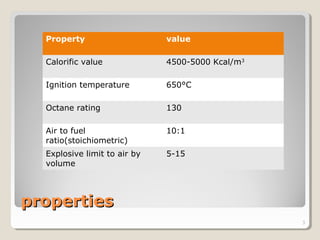
propertiesproperties
Property value
Calorific value 4500-5000 Kcal/m3
Ignition temperature 650°C
Octane rating 130
Air to fuel
ratio(stoichiometric)
10:1
Explosive limit to air by
volume
5-15
3
How it produces?How it produces?
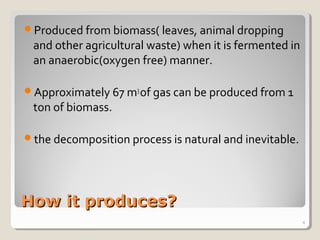
Produced from biomass( leaves, animal dropping
and other agricultural waste) when it is fermented in
an anaerobic(oxygen free) manner.
Approximately 67 m3
of gas can be produced from 1
ton of biomass.
the decomposition process is natural and inevitable.
4
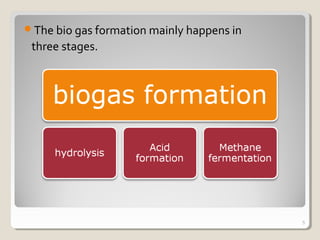
The bio gas formation mainly happens in
three stages.
5
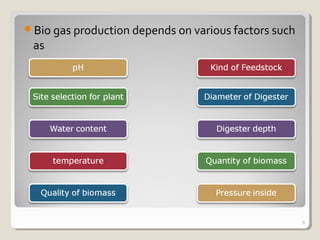
Bio gas production depends on various factors such
as
6
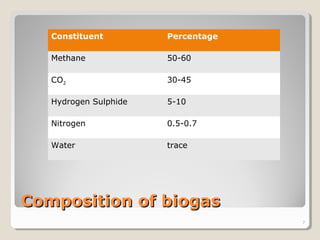
Composition of biogasComposition of biogas
7
Constituent Percentage
Methane 50-60
CO2 30-45
Hydrogen Sulphide 5-10
Nitrogen 0.5-0.7
Water trace
Biogas plant(BGP)Biogas plant(BGP)
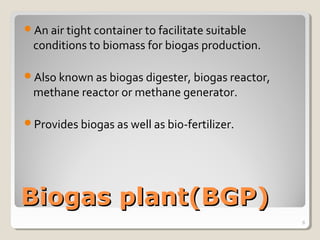
An air tight container to facilitate suitable
conditions to biomass for biogas production.
Also known as biogas digester, biogas reactor,
methane reactor or methane generator.
Provides biogas as well as bio-fertilizer.
8
9
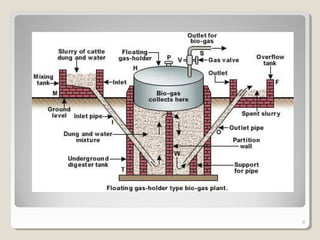
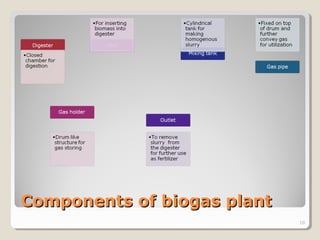
Components of biogas plantComponents of biogas plant
10
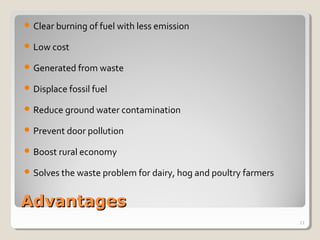
AdvantagesAdvantages
 Clear burning of fuel with less emission
 Low cost
 Generated from waste
 Displace fossil fuel
 Reduce ground water contamination
 Prevent door pollution
 Boost rural economy
 Solves the waste problem for dairy, hog and poultry farmers
11
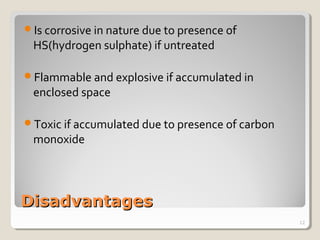
DisadvantagesDisadvantages
Is corrosive in nature due to presence of
HS(hydrogen sulphate) if untreated
Flammable and explosive if accumulated in
enclosed space
Toxic if accumulated due to presence of carbon
monoxide
12
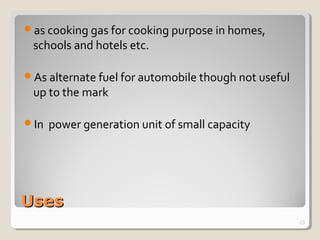
UsesUses
as cooking gas for cooking purpose in homes,
schools and hotels etc.
As alternate fuel for automobile though not useful
up to the mark
In power generation unit of small capacity
13
Thank you
Thank you
14

Bio gas

  • 1.
  • 2.
    What is abio gas?What is a bio gas? Mixture of methane and other gases produced from the decompossion of organic materials. Biogas is mainly a mixture of methane(50%-60%), carbon di-oxide and hydrogen sulphide. It is produced from bio mass from nature. It is renewable source. 2
  • 3.
    propertiesproperties Property value Calorific value4500-5000 Kcal/m3 Ignition temperature 650°C Octane rating 130 Air to fuel ratio(stoichiometric) 10:1 Explosive limit to air by volume 5-15 3
  • 4.
    How it produces?Howit produces? Produced from biomass( leaves, animal dropping and other agricultural waste) when it is fermented in an anaerobic(oxygen free) manner. Approximately 67 m3 of gas can be produced from 1 ton of biomass. the decomposition process is natural and inevitable. 4
  • 5.
    The bio gasformation mainly happens in three stages. 5
  • 6.
    Bio gas productiondepends on various factors such as 6
  • 7.
    Composition of biogasCompositionof biogas 7 Constituent Percentage Methane 50-60 CO2 30-45 Hydrogen Sulphide 5-10 Nitrogen 0.5-0.7 Water trace
  • 8.
    Biogas plant(BGP)Biogas plant(BGP) Anair tight container to facilitate suitable conditions to biomass for biogas production. Also known as biogas digester, biogas reactor, methane reactor or methane generator. Provides biogas as well as bio-fertilizer. 8
  • 9.
  • 10.
    Components of biogasplantComponents of biogas plant 10
  • 11.
    AdvantagesAdvantages  Clear burningof fuel with less emission  Low cost  Generated from waste  Displace fossil fuel  Reduce ground water contamination  Prevent door pollution  Boost rural economy  Solves the waste problem for dairy, hog and poultry farmers 11
  • 12.
    DisadvantagesDisadvantages Is corrosive innature due to presence of HS(hydrogen sulphate) if untreated Flammable and explosive if accumulated in enclosed space Toxic if accumulated due to presence of carbon monoxide 12
  • 13.
    UsesUses as cooking gasfor cooking purpose in homes, schools and hotels etc. As alternate fuel for automobile though not useful up to the mark In power generation unit of small capacity 13
  • 14.