CLOSED LOOP RECYCLING
 Closed Loop Recycling’, suggests that we should only use materials to
manufacture products, that can be continually recycled and reused
(100%). Potentially this could ensure future supply of our valuable
resources and also protect the environment.
 For this to work, there needs to be a change in the way products are
designed and manufactured. Designers should select materials, that
can be recycle an infinite number of times and be used again and
again. The materials are regarded as borrowed, for the length of the
products useful working life. When the product is no longer usable /
working, every component / part is recycled back into raw materials,
ready for the manufacture of a new product.
 Closed Loop Recycling normally means, that a company manufactures
a product, customers buy the product and then return it at the end of
its useful life. The company then recycles all the materials back into the
same product, ready for resale. No new raw materials are used in this
process. This is a closed system.
EXAPMLE OF PTE
 The stages below show the 'Closed Loop Recycling' of a
PET soft drinks bottle

1. Recycled PET (polyethylene
terephthalate), is prepared for use in an
injection moulding / blow moulding
machine. This material comes in a range
of colours and is completely recyclable.
When recycled it does not degrade into
a lower quality form. In theory, it can be
recycled again and again, without a
drop in quality.
2. PET bottles are
manufactured in an
injection moulding / blow
moulding machine. When
formed into a bottle, it is
lightweight and quite
strong, capable of
withstanding drops and
knocks.
When washed, PET is
hygienic and used to
contain a variety of
consumable liquids.
 3. The soft drink is
added, lids / tops are
pressed into position
and a label stamped on
to the container. The
product is ready for
distribution to shops and
other retail outlets.
 4. The thirsty consumer
buys the drink, takes it
home and drinks the
contents.
 5. The customer discards
the empty drinks
container, placing it in a
small recycling bin, in
the kitchen. This should
be done after washing.
Dirty bottles will be
separated from clean
bottles later, at the
recycling factory. This
holds up the process and
adds cost.
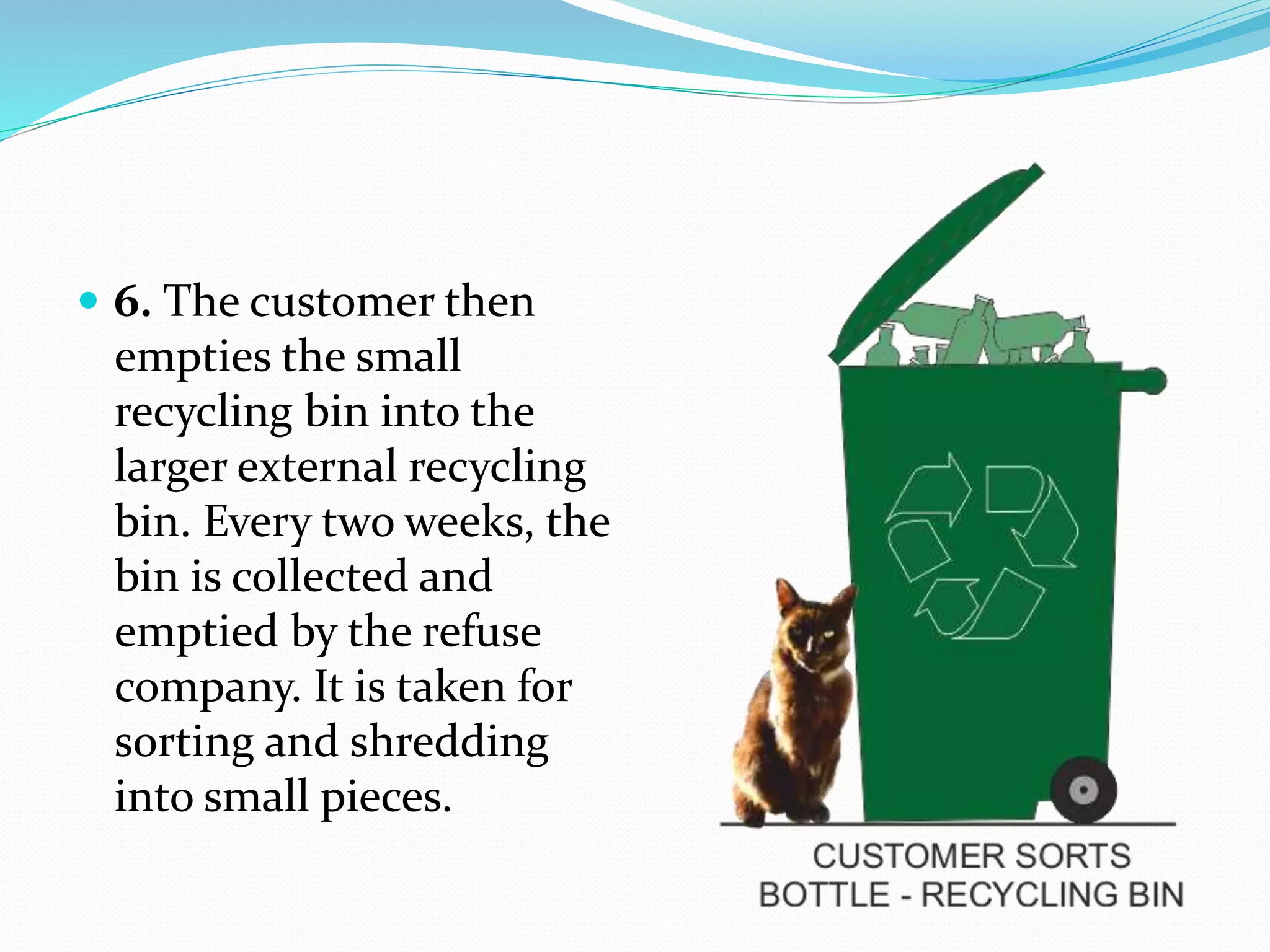
 6. The customer then
empties the small
recycling bin into the
larger external recycling
bin. Every two weeks, the
bin is collected and
emptied by the refuse
company. It is taken for
sorting and shredding
into small pieces.
 7. The ‘Bottle Company’
purchases the PET
bottles. At it’s factory,
the PET bottles are
shredded, ready for reuse
in the injection / blow
moulding machine.
Definition
 Upcycling is a type of recycling. When a product
comes to the end of its life cycle, it is dismantled and
its components / parts are reused to produce high
quality products, often a higher quality than the
original product. For example, reclaimed plastic
drainage tubing can be reworked to produce ‘funky’
storage units. Upcycling a component, means that it is
upgraded into a higher quality product, adding value.
Upcycling of metals
 Usually when recycling a product and its parts, the
quality of the recycled products or materials is lower
than when first used. This is sometimes referred to as
‘downcycling’. For example, recycling metals usually
involves melting down reclaimed metals, so that they
can be used again. Remelting metals often results in
lower quality metals. For this reason, scrap metals are
usually added to new molten metal. This happens in
most steel mills.
 Upcycling is environmentally friendly, as it means that whole
products or dismantled products, are not ‘dumped’ in landfill
sites and that reclaimed components and materials can be
continually reused, producing high quality products.
 Normal recycling, often means components and materials are
reused producing lower quality products, until they can be
reused no more, and eventually end up in landfill sites.
 Another example of upcycling is seen with the use of glass
bottles. Instead of recycling the glass, which requires high levels
of energy, the coloured translucent bottles have been formed
into window for a wall. The wall is like stained glass, creating
coloured light for the interior of a house / flat.
EXPLAINATION
 Recycling of paper, card, tin cans and household plastic
packaging is now common. People also recycle old,
damaged and disused products, ranging from TVs and
computers to furniture.
 During the recycling and sorting process, products that can
be reused, are utilised by people who need them. Some
products will be dismantled / disassembled and their
component parts recycled for further use. Some products
will be crushed and their materials extracted and sent to be
recycled into new products.
 However, recycling often leads to ‘downcycling’. This means
that the materials and components that are reclaimed from
discarded products, are recycled into lower quality
products.
DOWNCYCLING OF PLASTIC
 Downcycling applies to most plastics. When ‘plastic’
bottles and other ’plastic’ products are collected for
recycling, they are frequently recycled into lower
quality products such as doormats.
DOWNCYCLING OF PAPER
 Paper is another example. When paper is recycled and
reprocessed, it loses some of its original quality.
Recycled writing paper often ends up as lower quality
card board and manilla folders. Sometimes recycled
writing paper is processed with new paper pulp and
then it can be used for writing paper again. Quality
writing paper can be downcycled only four / five times.
ADVANTAGES OF RECYCLING /
DOWNCYCLING
 Recycling / downcycling means that we need to
process less new raw materials. This saves on energy
consumption, as processing can have high energy
costs. This also reduces pollution, helping to protect
the environment. In social and moral terms, people
generally like to support the recycling process, as this
helps protect our planet, for generations to come.
DOES RECYCLING ALWAYS LEAD TO
DOWNCYCLING
 Some materials can be continually recycled, without a
loss of quality. Glass, steel and PET (Polyethylene
terephthalate) are examples. In fact PET bottles can be
‘upcycled’ into higher quality products such as textiles.

Types of recycling

  • 2.
    CLOSED LOOP RECYCLING Closed Loop Recycling’, suggests that we should only use materials to manufacture products, that can be continually recycled and reused (100%). Potentially this could ensure future supply of our valuable resources and also protect the environment.  For this to work, there needs to be a change in the way products are designed and manufactured. Designers should select materials, that can be recycle an infinite number of times and be used again and again. The materials are regarded as borrowed, for the length of the products useful working life. When the product is no longer usable / working, every component / part is recycled back into raw materials, ready for the manufacture of a new product.  Closed Loop Recycling normally means, that a company manufactures a product, customers buy the product and then return it at the end of its useful life. The company then recycles all the materials back into the same product, ready for resale. No new raw materials are used in this process. This is a closed system.
  • 3.
    EXAPMLE OF PTE The stages below show the 'Closed Loop Recycling' of a PET soft drinks bottle
  • 4.
     1. Recycled PET(polyethylene terephthalate), is prepared for use in an injection moulding / blow moulding machine. This material comes in a range of colours and is completely recyclable. When recycled it does not degrade into a lower quality form. In theory, it can be recycled again and again, without a drop in quality.
  • 5.
    2. PET bottlesare manufactured in an injection moulding / blow moulding machine. When formed into a bottle, it is lightweight and quite strong, capable of withstanding drops and knocks. When washed, PET is hygienic and used to contain a variety of consumable liquids.
  • 6.
     3. Thesoft drink is added, lids / tops are pressed into position and a label stamped on to the container. The product is ready for distribution to shops and other retail outlets.
  • 7.
     4. Thethirsty consumer buys the drink, takes it home and drinks the contents.
  • 8.
     5. Thecustomer discards the empty drinks container, placing it in a small recycling bin, in the kitchen. This should be done after washing. Dirty bottles will be separated from clean bottles later, at the recycling factory. This holds up the process and adds cost.
  • 9.
     6. Thecustomer then empties the small recycling bin into the larger external recycling bin. Every two weeks, the bin is collected and emptied by the refuse company. It is taken for sorting and shredding into small pieces.
  • 10.
     7. The‘Bottle Company’ purchases the PET bottles. At it’s factory, the PET bottles are shredded, ready for reuse in the injection / blow moulding machine.
  • 12.
    Definition  Upcycling isa type of recycling. When a product comes to the end of its life cycle, it is dismantled and its components / parts are reused to produce high quality products, often a higher quality than the original product. For example, reclaimed plastic drainage tubing can be reworked to produce ‘funky’ storage units. Upcycling a component, means that it is upgraded into a higher quality product, adding value.
  • 14.
    Upcycling of metals Usually when recycling a product and its parts, the quality of the recycled products or materials is lower than when first used. This is sometimes referred to as ‘downcycling’. For example, recycling metals usually involves melting down reclaimed metals, so that they can be used again. Remelting metals often results in lower quality metals. For this reason, scrap metals are usually added to new molten metal. This happens in most steel mills.
  • 15.
     Upcycling isenvironmentally friendly, as it means that whole products or dismantled products, are not ‘dumped’ in landfill sites and that reclaimed components and materials can be continually reused, producing high quality products.  Normal recycling, often means components and materials are reused producing lower quality products, until they can be reused no more, and eventually end up in landfill sites.  Another example of upcycling is seen with the use of glass bottles. Instead of recycling the glass, which requires high levels of energy, the coloured translucent bottles have been formed into window for a wall. The wall is like stained glass, creating coloured light for the interior of a house / flat.
  • 18.
    EXPLAINATION  Recycling ofpaper, card, tin cans and household plastic packaging is now common. People also recycle old, damaged and disused products, ranging from TVs and computers to furniture.  During the recycling and sorting process, products that can be reused, are utilised by people who need them. Some products will be dismantled / disassembled and their component parts recycled for further use. Some products will be crushed and their materials extracted and sent to be recycled into new products.  However, recycling often leads to ‘downcycling’. This means that the materials and components that are reclaimed from discarded products, are recycled into lower quality products.
  • 19.
    DOWNCYCLING OF PLASTIC Downcycling applies to most plastics. When ‘plastic’ bottles and other ’plastic’ products are collected for recycling, they are frequently recycled into lower quality products such as doormats.
  • 20.
    DOWNCYCLING OF PAPER Paper is another example. When paper is recycled and reprocessed, it loses some of its original quality. Recycled writing paper often ends up as lower quality card board and manilla folders. Sometimes recycled writing paper is processed with new paper pulp and then it can be used for writing paper again. Quality writing paper can be downcycled only four / five times.
  • 22.
    ADVANTAGES OF RECYCLING/ DOWNCYCLING  Recycling / downcycling means that we need to process less new raw materials. This saves on energy consumption, as processing can have high energy costs. This also reduces pollution, helping to protect the environment. In social and moral terms, people generally like to support the recycling process, as this helps protect our planet, for generations to come.
  • 23.
    DOES RECYCLING ALWAYSLEAD TO DOWNCYCLING  Some materials can be continually recycled, without a loss of quality. Glass, steel and PET (Polyethylene terephthalate) are examples. In fact PET bottles can be ‘upcycled’ into higher quality products such as textiles.