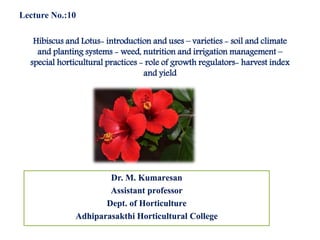
Hibiscus and Lotus- introduction and uses – varieties - soil and climate
and planting systems - weed, nutrition and irrigation management –
special horticultural practices - role of growth regulators- harvest index
and yield
Dr. M. Kumaresan
Assistant professor
Dept. of Horticulture
Adhiparasakthi Horticultural College
Lecture No.:10
• Hibiscus rosa-sinensis
• Malvaceae
• Tropical Asia
• X= 7,11,12,15,16,17,18,19,20
• Hibiscus derived from the Greek word hibiskos
Common names:
• China hibiscus, Hawaiian hibiscus, Rose of China ,China rose, Blacking plant,
shoe flower
Hibiscus
Uses
• Used as a landscape plant
• Grown as a Flowering potted plant
• Also popular as large patio specimens
• Flower are used to make a popular drink in Egypt called Karkade
• Dried calyces of H.sabdariffa are used for making a beverage called as Zobo
• H. cannabinus and H. sabdariffa leaves are consumed as vegetables
• It is also a pH indicator.
• China rose indicator turns acidic solutions to magenta / dark pink and basic
solutions to green
Karkade Zobo
4
Species
Hibiscus rosa- sinensis:
• Large evergreen shrub
• Originated in Asia
• Large bell shaped flower in various colors
• Double Flowered varieties are also
Hibiscus syriacus
• Native of China
• Rose of Sharon, Tree hollyhock and althea shrub
• Thrives best in hills
• Produces single or double flowers in white, blue or mauve colors
• Solitary flowers are borne in axils of leaves
Hibiscus schizopetalus
• It is known as coral hibiscus
• Native to Africa
• Bears red and orange red flowers, drooping with fringed petals
Hibiscus mutabilis
• It is called as changeable rose or persian rose
• It is native to China
• Single or double flowers
• Pure white flower in morning and gradually turning pale pink to deep pink
in evenings
Varieties developed at TNAU
• Co-1 (Thilagam) with red flowers
• Co-2 (Punnangai) with yellow flowers
• Apricot colored interclonal hybrid between bright yellow and red gold
cultivars
Climate
• It thrives in dry climate and can withstand heavy rainfall
• A warm humid climate is ideal for its growth
• flowers throughout the year, while in the subtropics flowering ceases
during severe winter
• Under temperate conditions, it flowers during summer
• The majority of the cultivars flower through out the year under
Bangalore conditions
• Peak flowering is observed during June-October
Propagation
Cutting:
• Soft tip cutting of hibiscus are reported to show very good rooting with
93.3%
• Cuttings treated with IBA @ 4000ppm rooted better
• Sand has been found to be the best rooting media sphagnum moss can
also be used
• High temperature and light intensity is favourable
PGRS
• Cycocel: dwarf, bushy and ideal for pots - Soil drench with 2500 to
5000 ppm
• B-9 spray resulted in increase in shoot growth
• Uniconazole : suppressing stem growth and number, length of lateral
shoots. delay in flowering was also seen
• MH increased the no. of branches but with no effect on flowering
Pinching and Disbudding
 A soft pinch is required to maximize branching
 Done 5-6 weeks
 Multiple pinches may be given every 3-4 weeks
Aphids: (Aphis gossypii)
• Young and adults colonize around the growing shoots and leaves and suck
the sap. Attacked plant looses vigour and wilts while leaves malform
• neem/pongamia oil 1% Or malathion (0.1%) or dimethoate or oxydemeton
methyl @ 0.05%
Two spotted spider mite (Tetranychus urticae)
• Mite colonies on lower surface of leaves which are covered with webs
• Feeding results in discolored patches, browning, drying and leaf drop.
• Growth retarded and flowering stops
• Cutting and burning of infested parts ,spray of triazophos(0.06%) or
dichofol or profenofos @0.05% followed by spray of pongamiaoil 1%
Mealy bug (Rasstrococcus iceryoides, Ferrisia virgata)
• Adult females and nymphs suck sap from leaves and terminal shoots and
cause reduced vigor, deformation, wilting, sooty mold
• Spray with acephate 0.1%
Scales (Cerococcus hibisci, Coccus hesperidium)
• Severe during Aug-Nov
• young and adults cover the branches and suck the sap results in
stunted growth and leaf drop
• Coccus sps infests the lower side of the leaf
• Application of carbofeuron @ 10g/plant and spray of
chloropyriphos or methyl parathion @ 0.05% in combination with
Pongamia oil 0.05%
Diseases
• Hibiscus is hardy and free from serious diseases
Witches broom diseases
• The plant exhibits excessive axillary branching, small leaves and deformed
flowers
Phytoplasma
• Hibiscus also exhibits virus like symptoms
• Suspected plants have to be first treated for micro nutrient disorders.
• If the symptoms persist, then the vectors which spread the disease have to
be controlled by insecticidal sprays
• The diseased plants can be destroyed and further spread of disease can be
controlled

HIBISCUS.pptx

  • 1.
    Hibiscus and Lotus-introduction and uses – varieties - soil and climate and planting systems - weed, nutrition and irrigation management – special horticultural practices - role of growth regulators- harvest index and yield Dr. M. Kumaresan Assistant professor Dept. of Horticulture Adhiparasakthi Horticultural College Lecture No.:10
  • 2.
    • Hibiscus rosa-sinensis •Malvaceae • Tropical Asia • X= 7,11,12,15,16,17,18,19,20 • Hibiscus derived from the Greek word hibiskos Common names: • China hibiscus, Hawaiian hibiscus, Rose of China ,China rose, Blacking plant, shoe flower Hibiscus
  • 3.
    Uses • Used asa landscape plant • Grown as a Flowering potted plant • Also popular as large patio specimens • Flower are used to make a popular drink in Egypt called Karkade • Dried calyces of H.sabdariffa are used for making a beverage called as Zobo • H. cannabinus and H. sabdariffa leaves are consumed as vegetables • It is also a pH indicator. • China rose indicator turns acidic solutions to magenta / dark pink and basic solutions to green
  • 4.
  • 5.
    Species Hibiscus rosa- sinensis: •Large evergreen shrub • Originated in Asia • Large bell shaped flower in various colors • Double Flowered varieties are also
  • 6.
    Hibiscus syriacus • Nativeof China • Rose of Sharon, Tree hollyhock and althea shrub • Thrives best in hills • Produces single or double flowers in white, blue or mauve colors • Solitary flowers are borne in axils of leaves
  • 7.
    Hibiscus schizopetalus • Itis known as coral hibiscus • Native to Africa • Bears red and orange red flowers, drooping with fringed petals
  • 8.
    Hibiscus mutabilis • Itis called as changeable rose or persian rose • It is native to China • Single or double flowers • Pure white flower in morning and gradually turning pale pink to deep pink in evenings
  • 9.
    Varieties developed atTNAU • Co-1 (Thilagam) with red flowers • Co-2 (Punnangai) with yellow flowers • Apricot colored interclonal hybrid between bright yellow and red gold cultivars
  • 10.
    Climate • It thrivesin dry climate and can withstand heavy rainfall • A warm humid climate is ideal for its growth • flowers throughout the year, while in the subtropics flowering ceases during severe winter • Under temperate conditions, it flowers during summer • The majority of the cultivars flower through out the year under Bangalore conditions • Peak flowering is observed during June-October
  • 11.
    Propagation Cutting: • Soft tipcutting of hibiscus are reported to show very good rooting with 93.3% • Cuttings treated with IBA @ 4000ppm rooted better • Sand has been found to be the best rooting media sphagnum moss can also be used • High temperature and light intensity is favourable
  • 12.
    PGRS • Cycocel: dwarf,bushy and ideal for pots - Soil drench with 2500 to 5000 ppm • B-9 spray resulted in increase in shoot growth • Uniconazole : suppressing stem growth and number, length of lateral shoots. delay in flowering was also seen • MH increased the no. of branches but with no effect on flowering
  • 13.
    Pinching and Disbudding A soft pinch is required to maximize branching  Done 5-6 weeks  Multiple pinches may be given every 3-4 weeks
  • 14.
    Aphids: (Aphis gossypii) •Young and adults colonize around the growing shoots and leaves and suck the sap. Attacked plant looses vigour and wilts while leaves malform • neem/pongamia oil 1% Or malathion (0.1%) or dimethoate or oxydemeton methyl @ 0.05%
  • 15.
    Two spotted spidermite (Tetranychus urticae) • Mite colonies on lower surface of leaves which are covered with webs • Feeding results in discolored patches, browning, drying and leaf drop. • Growth retarded and flowering stops • Cutting and burning of infested parts ,spray of triazophos(0.06%) or dichofol or profenofos @0.05% followed by spray of pongamiaoil 1%
  • 16.
    Mealy bug (Rasstrococcusiceryoides, Ferrisia virgata) • Adult females and nymphs suck sap from leaves and terminal shoots and cause reduced vigor, deformation, wilting, sooty mold • Spray with acephate 0.1%
  • 17.
    Scales (Cerococcus hibisci,Coccus hesperidium) • Severe during Aug-Nov • young and adults cover the branches and suck the sap results in stunted growth and leaf drop • Coccus sps infests the lower side of the leaf • Application of carbofeuron @ 10g/plant and spray of chloropyriphos or methyl parathion @ 0.05% in combination with Pongamia oil 0.05%
  • 18.
    Diseases • Hibiscus ishardy and free from serious diseases Witches broom diseases • The plant exhibits excessive axillary branching, small leaves and deformed flowers Phytoplasma • Hibiscus also exhibits virus like symptoms • Suspected plants have to be first treated for micro nutrient disorders. • If the symptoms persist, then the vectors which spread the disease have to be controlled by insecticidal sprays • The diseased plants can be destroyed and further spread of disease can be controlled