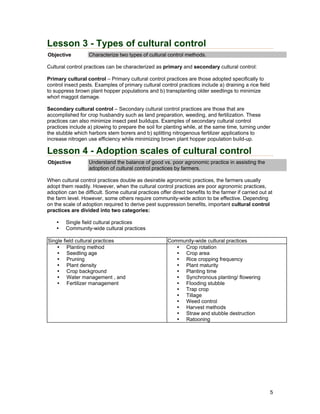
This document provides an overview of cultural control practices for managing rice insect pests. It discusses the basics of cultural control, including defining it as the modification of production practices to make the environment less suitable for pests. The document outlines advantages like low cost and lack of pollution, and disadvantages like possible yield decreases. It differentiates between primary cultural control practices specifically aimed at pests and secondary controls that are also crop husbandry practices. Finally, it explains that practices can be adopted by individual fields or may require community-wide coordination to be effective.





![[Challenge:Future] pest problem in china](https://cdn.slidesharecdn.com/ss_thumbnails/challengefuture-pest-problem-in-china2231-111030151857-phpapp02-thumbnail.jpg?width=640&height=640&fit=bounds)


