THE BIG THEOREM PART II
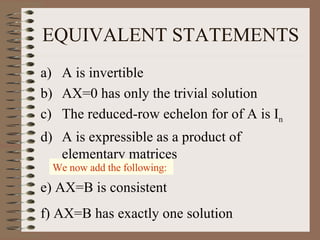
EQUIVALENT STATEMENTS A is invertible AX=0 has only the trivial solution The reduced-row echelon for of A is I n A is expressible as a product of elementary matrices We now add the following:  e) AX=B is consistent f) AX=B has exactly one solution
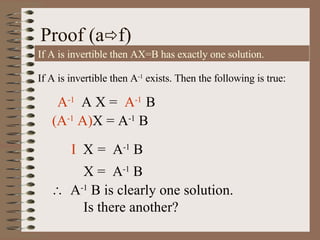
A X =  B  A -1   A -1 X =  A -1  B If A is invertible then AX=B has exactly one solution. Proof (a  f) If A is invertible then A -1  exists. Then the following is true: I  X   =  A -1  B (A -1  A) X = A -1  B A -1  B is clearly one solution.    Is there another?
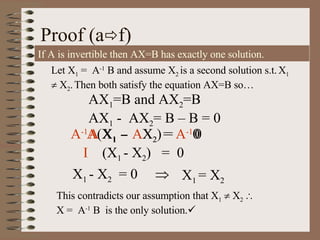
If A is invertible then AX=B has exactly one solution. Proof (a  f) Let X 1  =  A -1  B and assume X 2  is a second solution s.t.   X 1     X 2 .   Then both satisfy the equation AX=B so… AX 1 =B and AX 2 =B AX 1  -  AX 2 = B – B = 0 A  X 1  -  A X 2  =  0 A (X 1   -  X 2 ) =  0 A -1  A -1   I  (X 1  - X 2 )  =  0 X 1  - X 2   = 0 This contradicts our assumption that X 1     X 2     X =  A -1  B  is the only solution.   X 1  = X 2
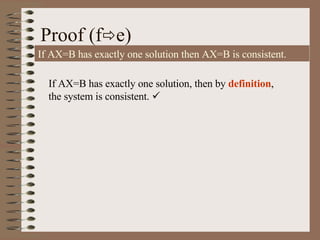
Proof (f  e) If AX=B has exactly one solution then AX=B is consistent. If AX=B has exactly one solution, then by  definition , the system is consistent.  
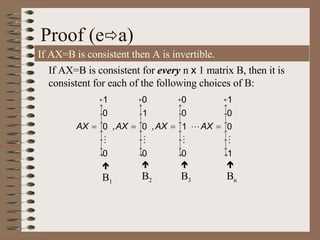
Proof (e  a) If AX=B is consistent then A is invertible. If AX=B is consistent for  every  n  x  1 matrix B, then it is consistent for each of the following choices of B:     B 1    B 2    B 3    B n
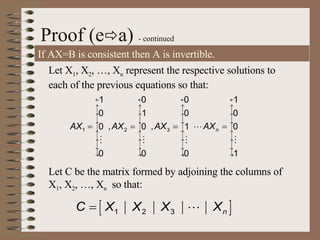
Proof (e  a)  - continued If AX=B is consistent then A is invertible. Let X 1 , X 2 , …, X n  represent the respective solutions to each of the previous equations so that:  Let C be the matrix formed by adjoining the columns of X 1 , X 2 , …, X n   so that:
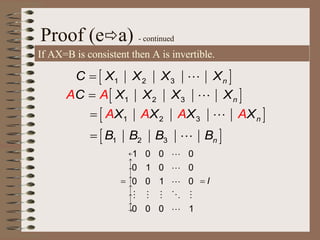
Proof (e  a)  - continued If AX=B is consistent then A is invertible.
Proof (e  a)  - continued Thus the matrix C exists s.t. AC = I. This implies that C = A -1 .    A is invertible  If AX=B is consistent then A is invertible. q.e.d.

Big Thm2

  • 1.
  • 2.
    EQUIVALENT STATEMENTS Ais invertible AX=0 has only the trivial solution The reduced-row echelon for of A is I n A is expressible as a product of elementary matrices We now add the following: e) AX=B is consistent f) AX=B has exactly one solution
  • 3.
    A X = B A -1 A -1 X = A -1 B If A is invertible then AX=B has exactly one solution. Proof (a  f) If A is invertible then A -1 exists. Then the following is true: I X = A -1 B (A -1 A) X = A -1 B A -1 B is clearly one solution. Is there another?
  • 4.
    If A isinvertible then AX=B has exactly one solution. Proof (a  f) Let X 1 = A -1 B and assume X 2 is a second solution s.t. X 1  X 2 . Then both satisfy the equation AX=B so… AX 1 =B and AX 2 =B AX 1 - AX 2 = B – B = 0 A X 1 - A X 2 = 0 A (X 1 - X 2 ) = 0 A -1 A -1 I (X 1 - X 2 ) = 0 X 1 - X 2 = 0 This contradicts our assumption that X 1  X 2  X = A -1 B is the only solution.   X 1 = X 2
  • 5.
    Proof (f e) If AX=B has exactly one solution then AX=B is consistent. If AX=B has exactly one solution, then by definition , the system is consistent. 
  • 6.
    Proof (e a) If AX=B is consistent then A is invertible. If AX=B is consistent for every n x 1 matrix B, then it is consistent for each of the following choices of B:  B 1  B 2  B 3  B n
  • 7.
    Proof (e a) - continued If AX=B is consistent then A is invertible. Let X 1 , X 2 , …, X n represent the respective solutions to each of the previous equations so that: Let C be the matrix formed by adjoining the columns of X 1 , X 2 , …, X n so that:
  • 8.
    Proof (e a) - continued If AX=B is consistent then A is invertible.
  • 9.
    Proof (e a) - continued Thus the matrix C exists s.t. AC = I. This implies that C = A -1 .  A is invertible  If AX=B is consistent then A is invertible. q.e.d.

Editor's Notes