Direct Variation Lesson 5.3
Direct Variation Linear function y=kx k  cannot be = to 0 Always goes through the origin (0,0) If a line does not go through the origin, it is not direct variation.
Constant of Variation The k in the  y=kx y/x Rate of change slope
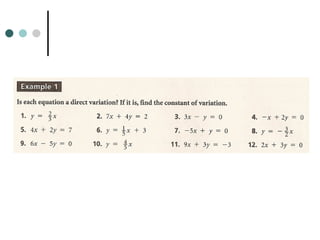
Example 1 Is the Equation Direct Variation? Use inverse operations to isolate y. If y=kx, then it is direct variation. If y= anything else, then it is NOT.
 
Example 2  Solve Word Problems Define the independent and dependent variables. Decide how they relate like we did yesterday. Write the equation. Answer the question if there is one.
 
Ex 3 Is the Table Direct Variation? Put each y in a ratio over each x. (y/x) Does each y/x form the same ratio? If yes, substitute the reduced ratio for the k in the equation  y=kx .
 
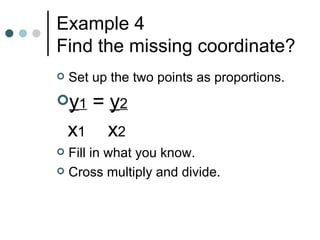
Example 4  Find the missing coordinate? Set up the two points as proportions. y 1  =  y 2 x 1   x 2 Fill in what you know. Cross multiply and divide.
Review Direct Variation is written in what form? What point does Direct Variation aways go through? How do you know if the equation for a line is direct variation? What steps will you take to solve word problems?
Review How do you know if data in a table is direct variation? How do you find a missing coordinate?

5 3 Direct Variation

  • 1.
  • 2.
    Direct Variation Linearfunction y=kx k cannot be = to 0 Always goes through the origin (0,0) If a line does not go through the origin, it is not direct variation.
  • 3.
    Constant of VariationThe k in the y=kx y/x Rate of change slope
  • 4.
    Example 1 Isthe Equation Direct Variation? Use inverse operations to isolate y. If y=kx, then it is direct variation. If y= anything else, then it is NOT.
  • 5.
  • 6.
    Example 2 Solve Word Problems Define the independent and dependent variables. Decide how they relate like we did yesterday. Write the equation. Answer the question if there is one.
  • 7.
  • 8.
    Ex 3 Isthe Table Direct Variation? Put each y in a ratio over each x. (y/x) Does each y/x form the same ratio? If yes, substitute the reduced ratio for the k in the equation y=kx .
  • 9.
  • 10.
    Example 4 Find the missing coordinate? Set up the two points as proportions. y 1 = y 2 x 1 x 2 Fill in what you know. Cross multiply and divide.
  • 11.
    Review Direct Variationis written in what form? What point does Direct Variation aways go through? How do you know if the equation for a line is direct variation? What steps will you take to solve word problems?
  • 12.
    Review How doyou know if data in a table is direct variation? How do you find a missing coordinate?