
Uploaded byMikołaj Hajduk
Permutation theorem and its use to proving inequalities.
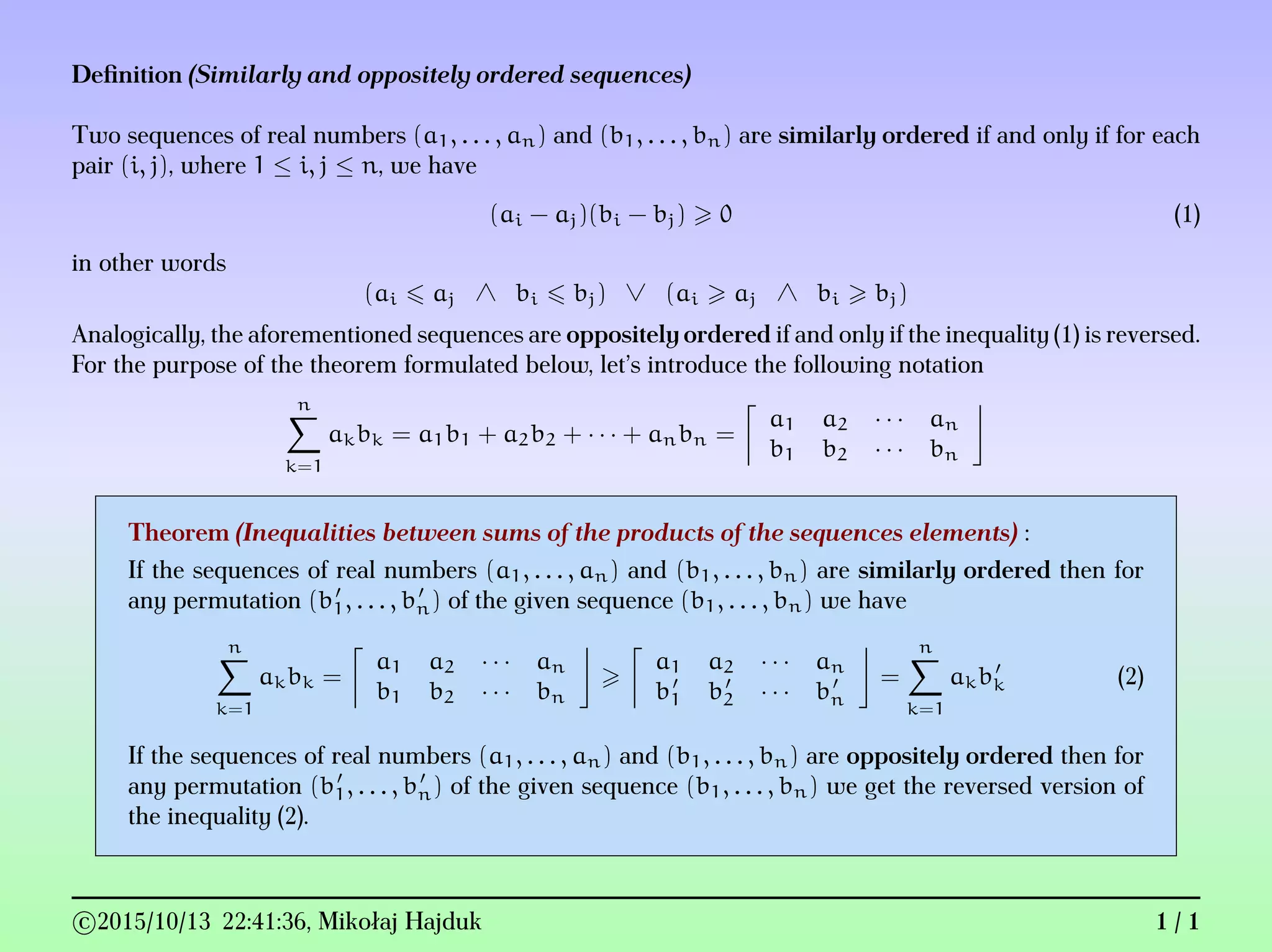
The document defines similarly and oppositely ordered sequences of real numbers and presents a theorem regarding the inequalities between sums of the products of their elements. It states that for similarly ordered sequences, the sum remains equal across permutations, while for oppositely ordered sequences, the inequality reverses. This provides a mathematical framework for comparing the relationships between two sequences.
More Related Content


Permutation theorem and its use to proving inequalities.
- 1. Definition (Similarly andoppositely ordered sequences) Two sequences of real numbers (a1, . . . , an) and (b1, . . . , bn) are similarly ordered if and only if for each pair (i, j), where 1 ≤ i, j ≤ n, we have (ai − aj)(bi − bj) 0 (1) in other words (ai aj ∧ bi bj) ∨ (ai aj ∧ bi bj) Analogically, the aforementioned sequences are oppositely ordered if and only if the inequality (1) is reversed. For the purpose of the theorem formulated below, let’s introduce the following notation n k=1 akbk = a1b1 + a2b2 + · · · + anbn = a1 a2 · · · an b1 b2 · · · bn Theorem (Inequalities between sums of the products of the sequences elements) : If the sequences of real numbers (a1, . . . , an) and (b1, . . . , bn) are similarly ordered then for any permutation (b1, . . . , bn) of the given sequence (b1, . . . , bn) we have n k=1 akbk = a1 a2 · · · an b1 b2 · · · bn a1 a2 · · · an b1 b2 · · · bn = n k=1 akbk (2) If the sequences of real numbers (a1, . . . , an) and (b1, . . . , bn) are oppositely ordered then for any permutation (b1, . . . , bn) of the given sequence (b1, . . . , bn) we get the reversed version of the inequality (2). c 2015/10/13 22:41:36, Mikołaj Hajduk 1 / 1