Introducing The Big 6 Presented by Scherie Fields
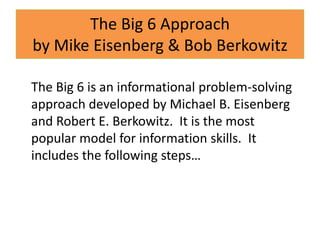
The Big 6 Approachby Mike Eisenberg & Bob BerkowitzThe Big 6 is an informational problem-solving approach developed by Michael B. Eisenberg and Robert E. Berkowitz.  It is the most popular model for information skills.  It includes the following steps…
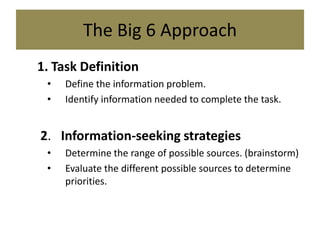
The Big 6 Approach1.	Task DefinitionDefine the information problem.Identify information needed to complete the task. 2.   Information-seeking strategiesDetermine the range of possible sources. (brainstorm)Evaluate the different possible sources to determine priorities.
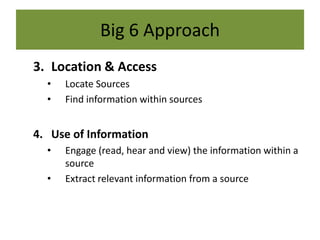
Big 6 Approach Location & AccessLocate Sources Find information within sourcesUse of InformationEngage (read, hear and view) the information within a sourceExtract relevant information from a source
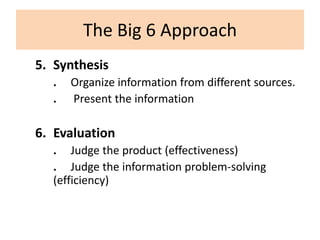
The Big 6 ApproachSynthesis.     Organize information from different sources..      Present the informationEvaluation.     Judge the product (effectiveness).     Judge the information problem-solving             (efficiency)
The Big 6 ApproachEvaluation of a Lesson 	Theme Friendship: Pairing the Big 6 with an Elementary Reading Unit for 3rd Graders	-	This lesson allows students to experience small group work as they learn about other countries, interview, immigrants who live in the area.	-	The students evaluate their own efforts as well as the efforts of their classmates.
Objectives:	-	Students will place themselves in the role of a newcomer.	-	Students individually will record their initial thoughts about friendship.	-	Describe your idea of friendship
Task DefinitionIdentify the information needed:	-	Your family has just moved to a new city, and you are attending a new school next week.  The people in the stores talk differently than you do, and you are very nervous about starting school.  However, you are lonely, and very much want to built new friendships right away  How can you do this?
Information Seeking StrategiesDetermine all Possible Sources:	-	As a large group, students brainstorm potential sources of information on friendship, as well as where to go to learn about their interviewee’s home country.
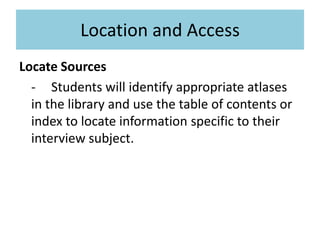
Location and AccessLocate Sources	-	Students will identify appropriate atlases in the library and use the table of contents or index to locate information specific to their interview subject.
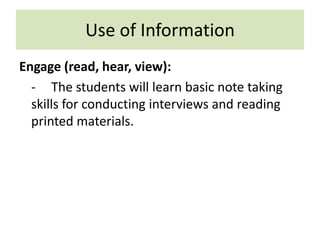
Use of InformationEngage (read, hear, view):-	The students will learn basic note taking skills for conducting interviews and reading printed materials.
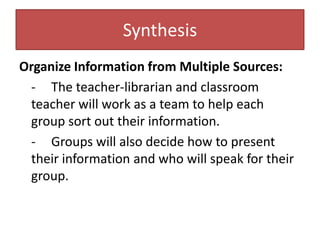
SynthesisOrganize Information from Multiple Sources:-	The teacher-librarian and classroom teacher will work as a team to help each group sort out their information.-	Groups will also decide how to present their information and who will speak for their group.
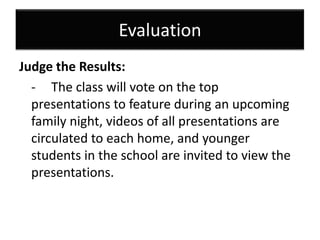
EvaluationJudge the Results:	-	The class will vote on the top presentations to feature during an upcoming family night, videos of all presentations are circulated to each home, and younger students in the school are invited to view the presentations.
The Big    Bibliography"Big 6 Search." Ashburnham Westminster Regional School District. Web. 19 Oct. 2010. <http://www.awrsd.org/oms/big_6_search.htm>. "Know How 7-12 « Big6 Kids." Buy Cheap Software - Download and Buy Software for Windows & Macintosh at Our Online Software Store. Web. 19 Oct. 2010. <http://www.big6.com/kids/site/?cat=816>. TwitterButtons.com, By. Buy Cheap Software - Download and Buy Software for Windows & Macintosh at Our Online Software Store. Web. 19 Oct. 2010. <http://www.big6.com/>.

Big 6 approach

  • 1.
    Introducing The Big6 Presented by Scherie Fields
  • 3.
    The Big 6Approachby Mike Eisenberg & Bob BerkowitzThe Big 6 is an informational problem-solving approach developed by Michael B. Eisenberg and Robert E. Berkowitz. It is the most popular model for information skills. It includes the following steps…
  • 4.
    The Big 6Approach1. Task DefinitionDefine the information problem.Identify information needed to complete the task. 2. Information-seeking strategiesDetermine the range of possible sources. (brainstorm)Evaluate the different possible sources to determine priorities.
  • 5.
    Big 6 ApproachLocation & AccessLocate Sources Find information within sourcesUse of InformationEngage (read, hear and view) the information within a sourceExtract relevant information from a source
  • 6.
    The Big 6ApproachSynthesis. Organize information from different sources.. Present the informationEvaluation. Judge the product (effectiveness). Judge the information problem-solving (efficiency)
  • 7.
    The Big 6ApproachEvaluation of a Lesson Theme Friendship: Pairing the Big 6 with an Elementary Reading Unit for 3rd Graders - This lesson allows students to experience small group work as they learn about other countries, interview, immigrants who live in the area. - The students evaluate their own efforts as well as the efforts of their classmates.
  • 8.
    Objectives: - Students will placethemselves in the role of a newcomer. - Students individually will record their initial thoughts about friendship. - Describe your idea of friendship
  • 9.
    Task DefinitionIdentify theinformation needed: - Your family has just moved to a new city, and you are attending a new school next week. The people in the stores talk differently than you do, and you are very nervous about starting school. However, you are lonely, and very much want to built new friendships right away How can you do this?
  • 10.
    Information Seeking StrategiesDetermineall Possible Sources: - As a large group, students brainstorm potential sources of information on friendship, as well as where to go to learn about their interviewee’s home country.
  • 11.
    Location and AccessLocateSources - Students will identify appropriate atlases in the library and use the table of contents or index to locate information specific to their interview subject.
  • 12.
    Use of InformationEngage(read, hear, view):- The students will learn basic note taking skills for conducting interviews and reading printed materials.
  • 13.
    SynthesisOrganize Information fromMultiple Sources:- The teacher-librarian and classroom teacher will work as a team to help each group sort out their information.- Groups will also decide how to present their information and who will speak for their group.
  • 14.
    EvaluationJudge the Results: - Theclass will vote on the top presentations to feature during an upcoming family night, videos of all presentations are circulated to each home, and younger students in the school are invited to view the presentations.
  • 15.
    The Big Bibliography"Big 6 Search." Ashburnham Westminster Regional School District. Web. 19 Oct. 2010. <http://www.awrsd.org/oms/big_6_search.htm>. "Know How 7-12 « Big6 Kids." Buy Cheap Software - Download and Buy Software for Windows & Macintosh at Our Online Software Store. Web. 19 Oct. 2010. <http://www.big6.com/kids/site/?cat=816>. TwitterButtons.com, By. Buy Cheap Software - Download and Buy Software for Windows & Macintosh at Our Online Software Store. Web. 19 Oct. 2010. <http://www.big6.com/>.