BIG SIX INFORMATION
LITERACY MODEL
Presented by
Sangeeta Kalai
MLIS 1st Sem
Dept. Library & Information Science.
Tripura University.
What is Information Literacy?
 The term ‘information literacy’ was
coined by Paul Zurkowski in the year
1974.
 Information literacy are set of abilities
which are:-
 a) To recognize the need of the
information for problem solving.
 b) Find and locate the information.
 c) Evaluate the information.
 d) Use of information.
 e) Communication of information.
BIG SIX MODEL
 Developed by Mike Eisenberg, Professor of
Information Science at Syracuse University
and Bob Berkowitz, a practicing library media
professional in Syracuse, New York in the
year 2000.
 Big6 is extensively known and generally used
to teach ICT skills used in thousands of K-12
schools, higher education institutions, and
corporate and adult training programs, the
Big6 information problem-solving model is
applicable whenever people need and use
information. The Big6 incorporates
information search and use in a systematic
process to find, use, apply, and evaluate
information for specific needs.
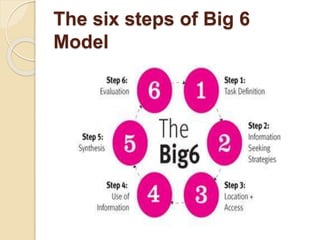
The six steps of Big 6
Model
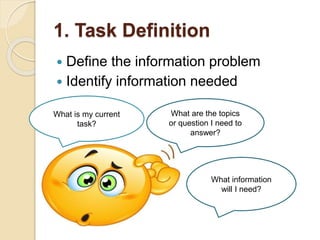
1. Task Definition
 Define the information problem
 Identify information needed
What is my current
task?
What are the topics
or question I need to
answer?
What information
will I need?
2. Information Seeking
Strategies
 Determine all possible sources
 Select the best sources
What are the possible sources to check?
What are the best sources of information to
this task?
3. Location and Access
 Locate sources (intellectually and
physically)
 Find information within sources
Where can I find the sources?
Where can I find the information in the
sources?
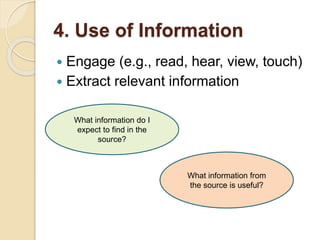
4. Use of Information
 Engage (e.g., read, hear, view, touch)
 Extract relevant information
What information do I
expect to find in the
source?
What information from
the source is useful?
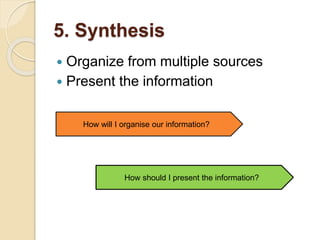
5. Synthesis
 Organize from multiple sources
 Present the information
How will I organise our information?
How should I present the information?
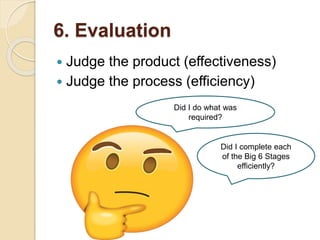
6. Evaluation
 Judge the product (effectiveness)
 Judge the process (efficiency)
Did I do what was
required?
Did I complete each
of the Big 6 Stages
efficiently?
CONCLUSION
The Big 6 Model stage has two sub
stages, and all the stages compliment
each other in a linear way and each
stage doesn’t waste the time of the
information seeker. The model is
adaptable and flexible; it can be
applied to any information situation.
REFERENCES
 www.epgpathsala.com
 www.big6.com
 https://vguilibguide.wordpress.com/inf
o-literacy-skills/big6-model/
 https://www.slideshare.net/mobile/kim
mywoz/information-literacy-big-6
THANK YOU

BIG 6 Information Literacy Model

  • 1.
    BIG SIX INFORMATION LITERACYMODEL Presented by Sangeeta Kalai MLIS 1st Sem Dept. Library & Information Science. Tripura University.
  • 2.
    What is InformationLiteracy?  The term ‘information literacy’ was coined by Paul Zurkowski in the year 1974.  Information literacy are set of abilities which are:-  a) To recognize the need of the information for problem solving.  b) Find and locate the information.  c) Evaluate the information.  d) Use of information.  e) Communication of information.
  • 3.
    BIG SIX MODEL Developed by Mike Eisenberg, Professor of Information Science at Syracuse University and Bob Berkowitz, a practicing library media professional in Syracuse, New York in the year 2000.  Big6 is extensively known and generally used to teach ICT skills used in thousands of K-12 schools, higher education institutions, and corporate and adult training programs, the Big6 information problem-solving model is applicable whenever people need and use information. The Big6 incorporates information search and use in a systematic process to find, use, apply, and evaluate information for specific needs.
  • 4.
    The six stepsof Big 6 Model
  • 5.
    1. Task Definition Define the information problem  Identify information needed What is my current task? What are the topics or question I need to answer? What information will I need?
  • 6.
    2. Information Seeking Strategies Determine all possible sources  Select the best sources What are the possible sources to check? What are the best sources of information to this task?
  • 7.
    3. Location andAccess  Locate sources (intellectually and physically)  Find information within sources Where can I find the sources? Where can I find the information in the sources?
  • 8.
    4. Use ofInformation  Engage (e.g., read, hear, view, touch)  Extract relevant information What information do I expect to find in the source? What information from the source is useful?
  • 9.
    5. Synthesis  Organizefrom multiple sources  Present the information How will I organise our information? How should I present the information?
  • 10.
    6. Evaluation  Judgethe product (effectiveness)  Judge the process (efficiency) Did I do what was required? Did I complete each of the Big 6 Stages efficiently?
  • 11.
    CONCLUSION The Big 6Model stage has two sub stages, and all the stages compliment each other in a linear way and each stage doesn’t waste the time of the information seeker. The model is adaptable and flexible; it can be applied to any information situation.
  • 12.
    REFERENCES  www.epgpathsala.com  www.big6.com https://vguilibguide.wordpress.com/inf o-literacy-skills/big6-model/  https://www.slideshare.net/mobile/kim mywoz/information-literacy-big-6
  • 13.