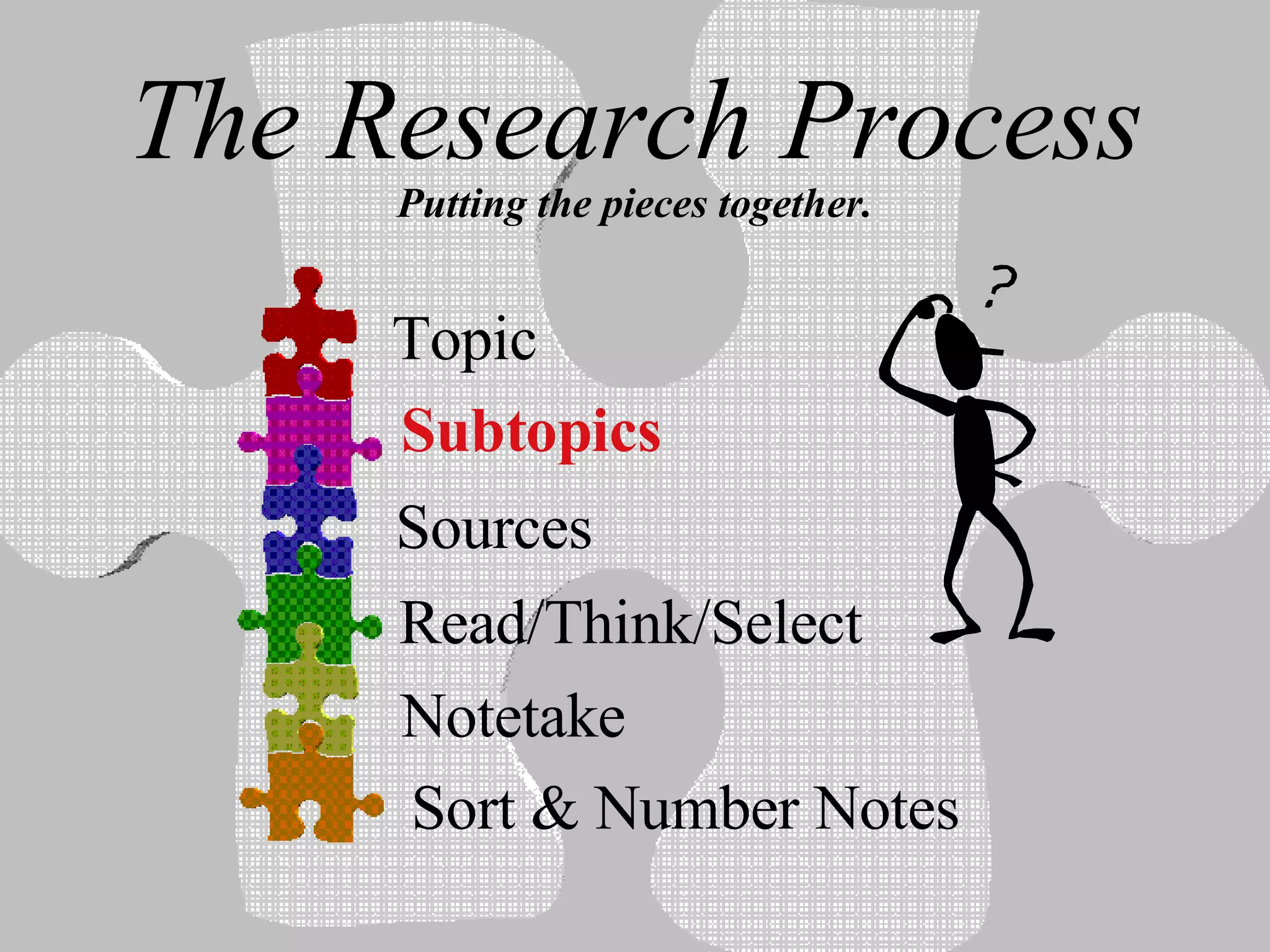
The Research Process Putting the pieces together. Topic Subtopics Sources Read/Think/Select Notetake Sort & Number Notes
Copyright 2002  Deborah B. Stanley All rights reserved No part of this CD-ROM may be reproduced, stored in a retrieval system, or transmitted in any form or by any means, electronic, mechanical, photocopying, recording, or otherwise, without the prior written consent of the author. Each copy of this CD-ROM is a single user copy to be used by that person for student instruction and/or staff presentation. Made and distributed by Deborah B. Stanley [email_address] All images are from MS PowerPoint Clip Art Gallery and from the Microsoft Office “Design Gallery Live” at  http://dgl.microsoft.com/?CAG=1
Let’s focus on: Selecting Subtopics Subtopics
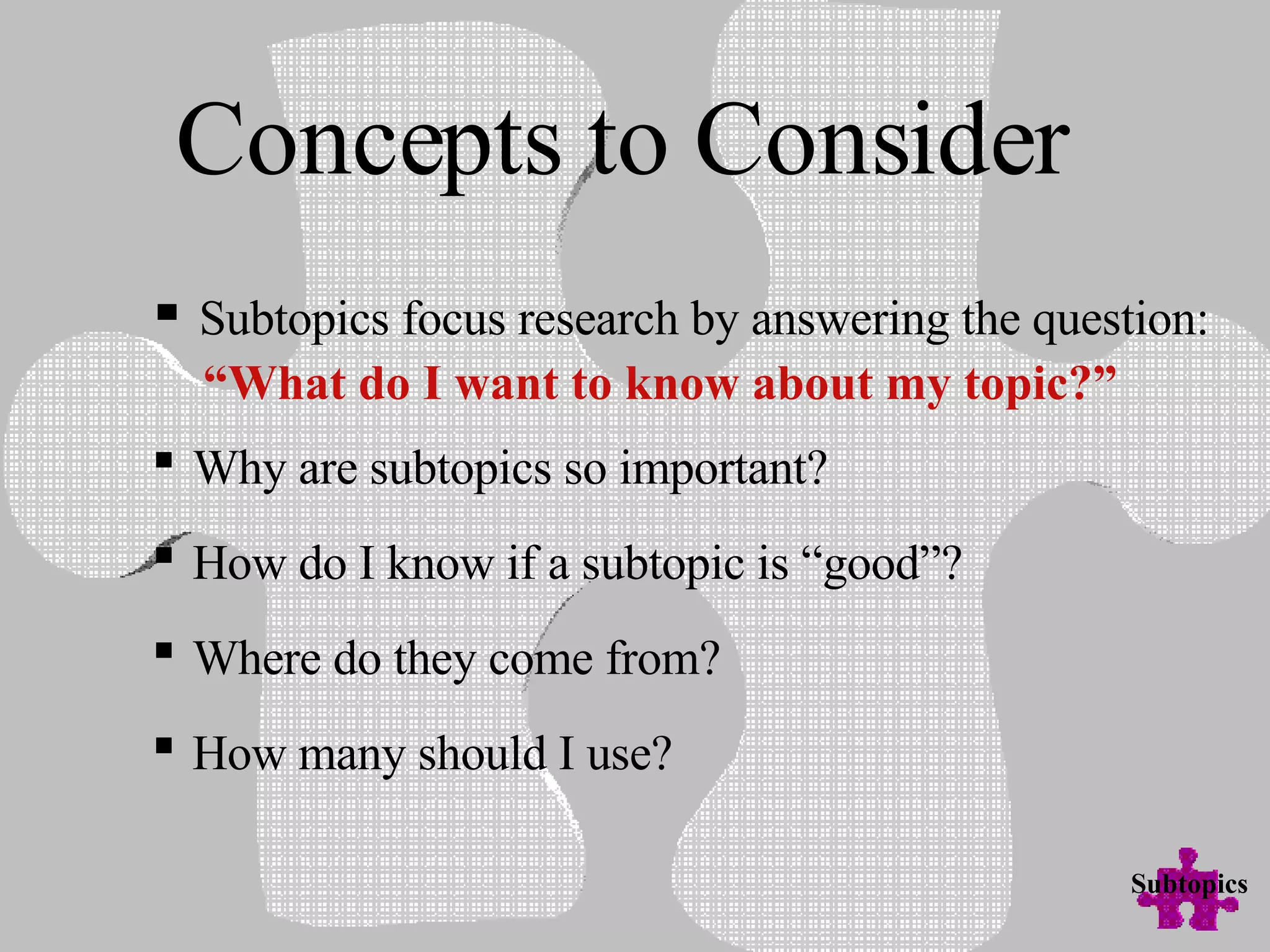
Concepts to Consider  “ What do I want to know about my topic?” Where do they come from? Why are subtopics so important? How do I know if a subtopic is “good”? Subtopics focus research by answering the question: How many should I use? Subtopics
Subtopics focus your research: “ WHAT  do I want to know about   (my topic)?” Subtopics “ HOW  do I create a plan to   explore (my topic)?”
Why are subtopics so important? “ You have absolutely Because if you don’t have subtopics, NO idea what you are doing!” Subtopics
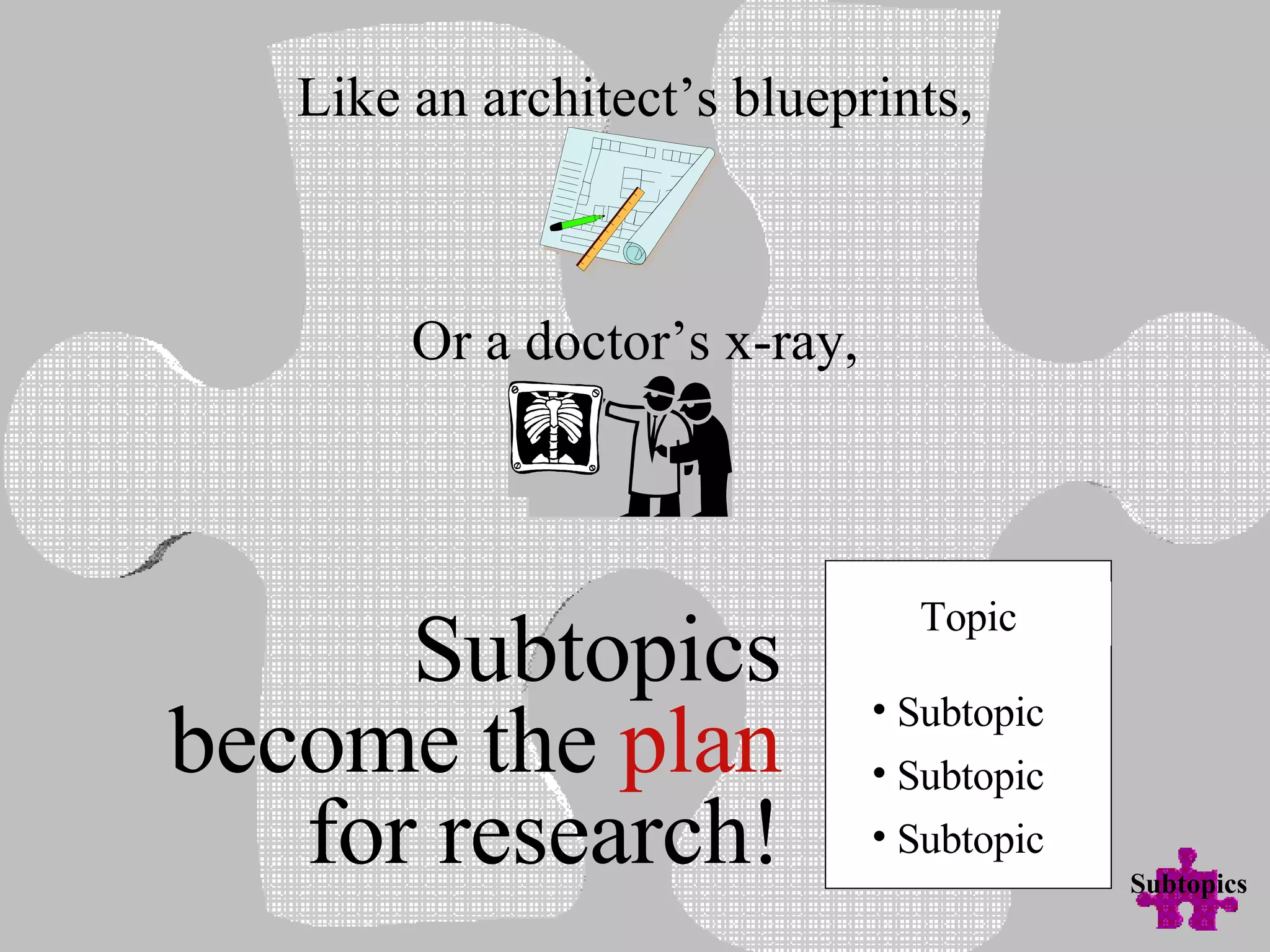
Subtopics become the  plan for research! Like an architect’s blueprints, Or a doctor’s x-ray, Subtopic Subtopic Subtopic Subtopics Topic
How do I know if a subtopic is “good”? Information Subtopics
Where do subtopics come from? General subtopics Specific subtopics can be brainstormed. must be pre-searched. subtopics subtopics subtopics subtopics subtopics subtopics Subtopics
General subtopics  examples: Person: Early life, Education, Accomplishments, Later life Place: Origin, History, Leaders, Economy, Culture, etc. Thing: Who, What, When, Where, Why, How Subtopics
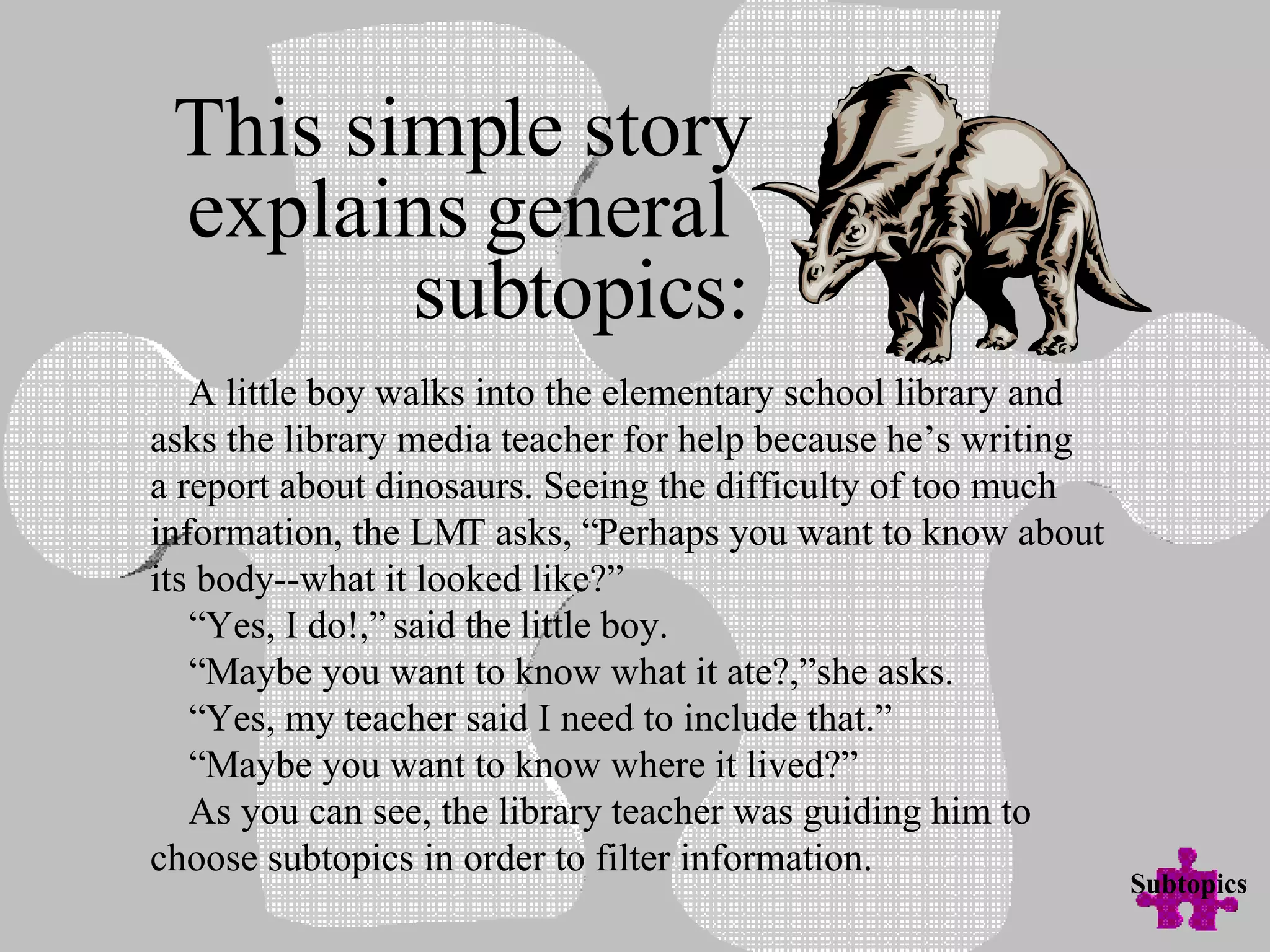
This simple story explains general  subtopics: A little boy walks into the elementary school library and asks the library media teacher for help because he’s writing  a report about dinosaurs. Seeing the difficulty of too much information, the LMT asks, “Perhaps you want to know about its body--what it looked like?” “ Yes, I do!,” said the little boy. “ Maybe you want to know what it ate?,” she asks. “ Yes, my teacher said I need to include that.” “ Maybe you want to know where it lived?” As you can see, the library teacher was guiding him to choose subtopics in order to filter information.  Subtopics
Specific subtopics examples: Early life, Surveyor, Soldier, General, President Gallo-Roman, Medieval, Renaissance, Enlightenment Inventor, Uses, Improvements Paris: Photovoltaic cell: George Washington: “ I need to search for specific ways to tackle this topic.” Subtopics
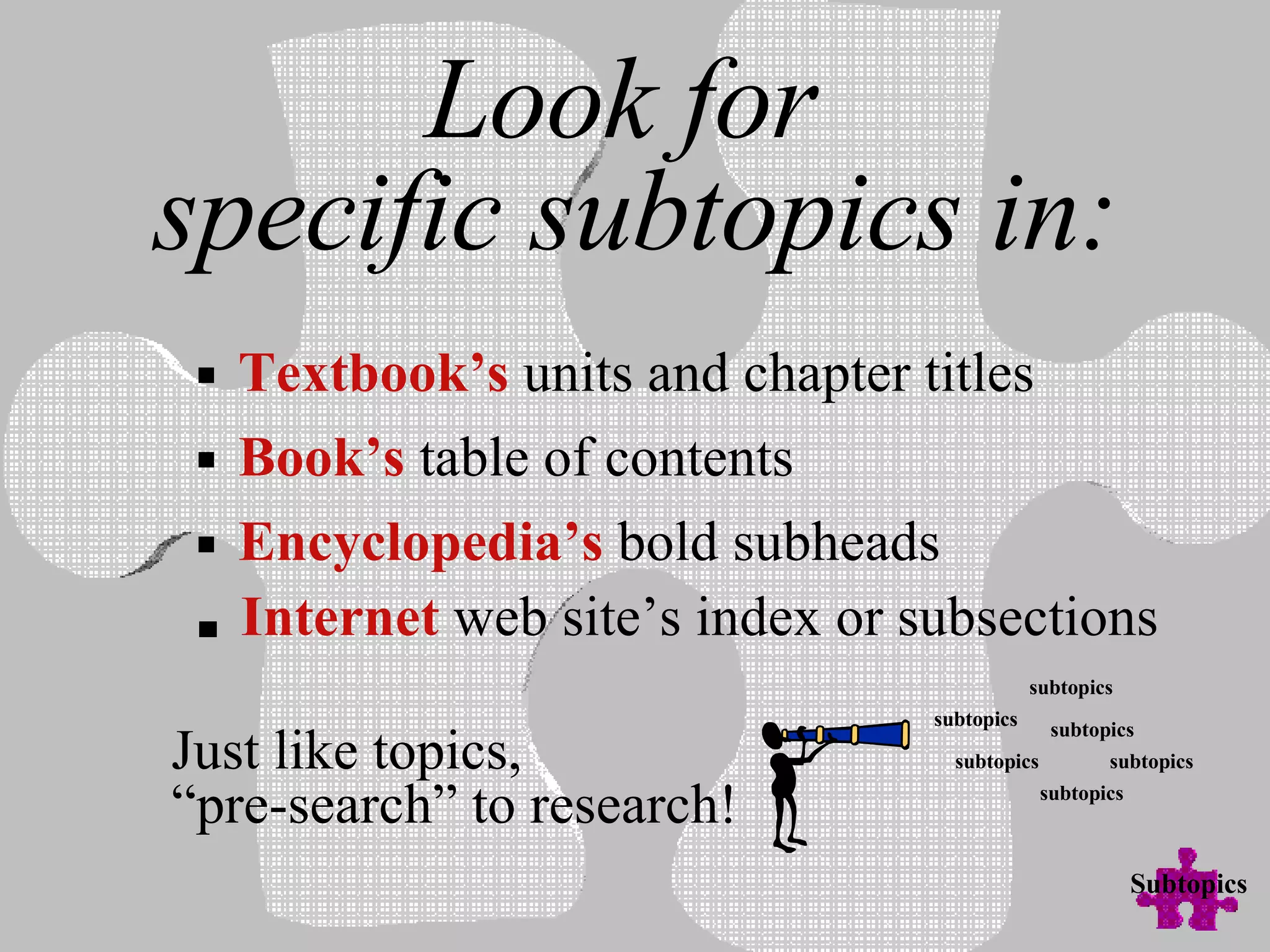
Look for  specific subtopics in: Just like topics,  “ pre-search” to research!  subtopics subtopics subtopics subtopics subtopics subtopics Book’s   table of contents Encyclopedia’s   bold subheads Textbook’s   units and chapter titles Internet   web site’s index or subsections Subtopics
How many subtopics should I use? How do I start? How can I adjust? Budget your time according to when your project is due. You or your teacher can judge your ability to access, evaluate, and use information,  Fewer days of research = fewer subtopics “ So in a week, can I do ten subtopics?” Well, can you?   and your motivation to  complete tasks! Subtopics
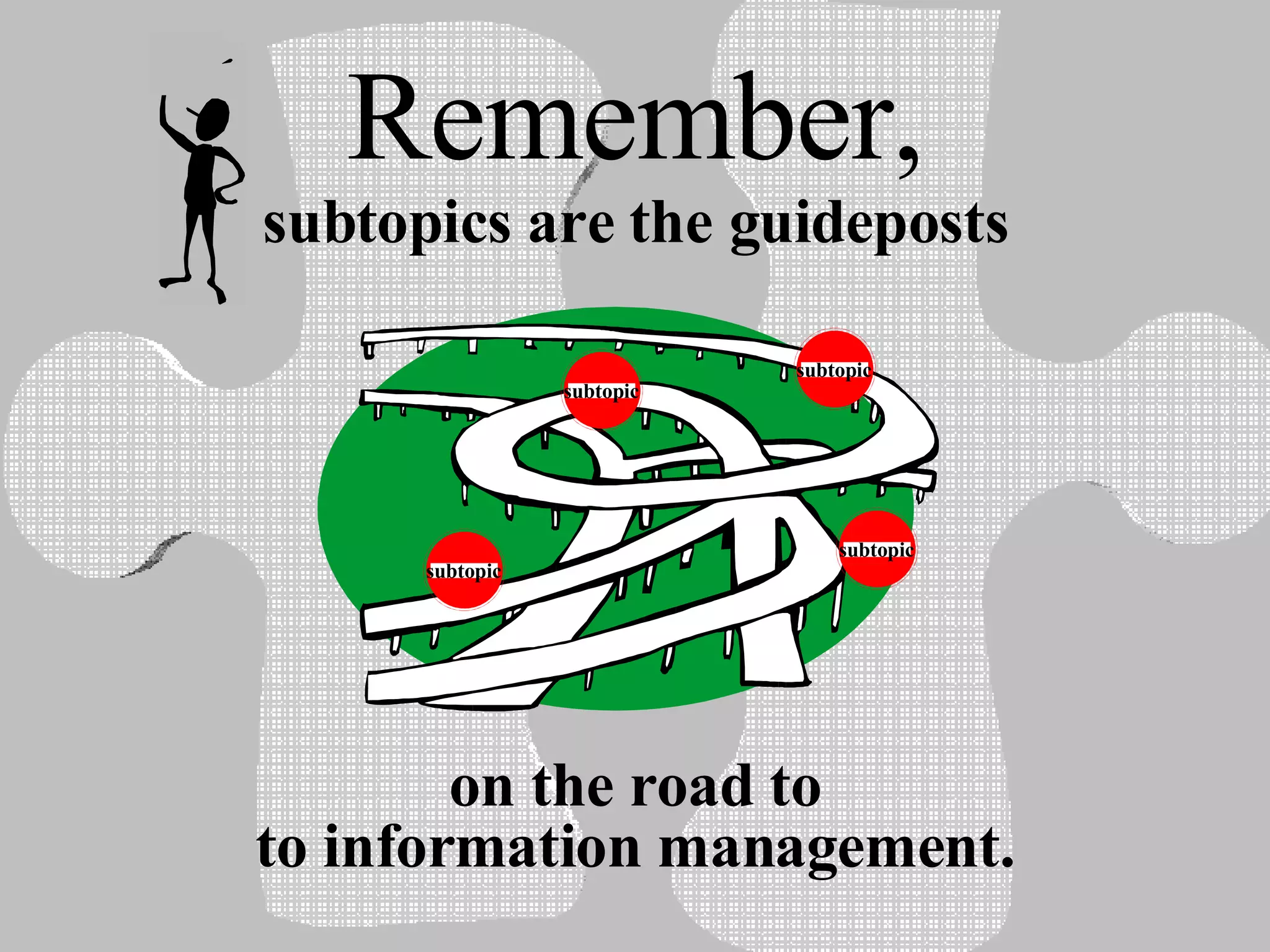
Remember, subtopics are the guideposts on the road to to information management. subtopic subtopic subtopic subtopic

3 Hs[1].Subtopics

  • 1.
    The Research ProcessPutting the pieces together. Topic Subtopics Sources Read/Think/Select Notetake Sort & Number Notes
  • 2.
    Copyright 2002 Deborah B. Stanley All rights reserved No part of this CD-ROM may be reproduced, stored in a retrieval system, or transmitted in any form or by any means, electronic, mechanical, photocopying, recording, or otherwise, without the prior written consent of the author. Each copy of this CD-ROM is a single user copy to be used by that person for student instruction and/or staff presentation. Made and distributed by Deborah B. Stanley [email_address] All images are from MS PowerPoint Clip Art Gallery and from the Microsoft Office “Design Gallery Live” at http://dgl.microsoft.com/?CAG=1
  • 3.
    Let’s focus on:Selecting Subtopics Subtopics
  • 4.
    Concepts to Consider “ What do I want to know about my topic?” Where do they come from? Why are subtopics so important? How do I know if a subtopic is “good”? Subtopics focus research by answering the question: How many should I use? Subtopics
  • 5.
    Subtopics focus yourresearch: “ WHAT do I want to know about (my topic)?” Subtopics “ HOW do I create a plan to explore (my topic)?”
  • 6.
    Why are subtopicsso important? “ You have absolutely Because if you don’t have subtopics, NO idea what you are doing!” Subtopics
  • 7.
    Subtopics become the plan for research! Like an architect’s blueprints, Or a doctor’s x-ray, Subtopic Subtopic Subtopic Subtopics Topic
  • 8.
    How do Iknow if a subtopic is “good”? Information Subtopics
  • 9.
    Where do subtopicscome from? General subtopics Specific subtopics can be brainstormed. must be pre-searched. subtopics subtopics subtopics subtopics subtopics subtopics Subtopics
  • 10.
    General subtopics examples: Person: Early life, Education, Accomplishments, Later life Place: Origin, History, Leaders, Economy, Culture, etc. Thing: Who, What, When, Where, Why, How Subtopics
  • 11.
    This simple storyexplains general subtopics: A little boy walks into the elementary school library and asks the library media teacher for help because he’s writing a report about dinosaurs. Seeing the difficulty of too much information, the LMT asks, “Perhaps you want to know about its body--what it looked like?” “ Yes, I do!,” said the little boy. “ Maybe you want to know what it ate?,” she asks. “ Yes, my teacher said I need to include that.” “ Maybe you want to know where it lived?” As you can see, the library teacher was guiding him to choose subtopics in order to filter information. Subtopics
  • 12.
    Specific subtopics examples:Early life, Surveyor, Soldier, General, President Gallo-Roman, Medieval, Renaissance, Enlightenment Inventor, Uses, Improvements Paris: Photovoltaic cell: George Washington: “ I need to search for specific ways to tackle this topic.” Subtopics
  • 13.
    Look for specific subtopics in: Just like topics, “ pre-search” to research! subtopics subtopics subtopics subtopics subtopics subtopics Book’s table of contents Encyclopedia’s bold subheads Textbook’s units and chapter titles Internet web site’s index or subsections Subtopics
  • 14.
    How many subtopicsshould I use? How do I start? How can I adjust? Budget your time according to when your project is due. You or your teacher can judge your ability to access, evaluate, and use information, Fewer days of research = fewer subtopics “ So in a week, can I do ten subtopics?” Well, can you? and your motivation to complete tasks! Subtopics
  • 15.
    Remember, subtopics arethe guideposts on the road to to information management. subtopic subtopic subtopic subtopic