A Presentation for Middle school teachersBy Sheila DeLattre-Carter Sherry WoolamInquiry-Based Learning Processand The Big6Image Source: Microsoft PowerPoint Clip Gallery
Crucial Skills for the 21st Century LearnerInquiry-Based Learning ProcessWhat is inquiry-based learning?What are the benefits of the inquiry-based process?How do you apply inquiry-based learning?
What is inquiry-based learning?A process that teaches research skills in any subject or content areaPromotes critical thinking skillsInformation gathering process related to lifeStudents work cooperatively in groups to solve problems and answer questions(Carnesi and DiGiorgio 32)
The Benefits of Inquiry LearningEncourages cooperative learningTakes one project through major content areasCaters to different learning stylesMultiple-intelligence friendly(Carnesi and DiGiorgio 32)
Applying Inquiry-Based LearningThe Six Step Inquiry ProcessQuestioningPlanningCollecting and CreditingOrganizingSynthesizingCommunicating(Carnesi and DiGiorgio 32-36)
Step 1: QuestioningWord Splash by Wordle.net
Step 2: PlanningStudents devise a plan or schedule Students gather resources for projectReview and revise planImage Source: Microsoft PowerPoint Clip Gallery
Step 3: Collecting and CreditingStudents collect informationDocument informationCite their sourcesImage Source: Microsoft PowerPoint Clip Gallery
Step 4: OrganizingGraphic organizers are a mustImage Source: Microsoft PowerPoint Clip Gallery
Step 5: SynthesizingCompleting the final productImage Source: Microsoft PowerPoint Clip Gallery
Step 6: CommunicatingThe art of presentingAddressing your audienceImage Source: Microsoft PowerPoint Clip Gallery
The Inquiry ProcessImage Source: Carnesi and DiGiorgio 32
Six Step Inquiry Process in Action, Part 1Image Source: Carnesi and DiGiorgio 35
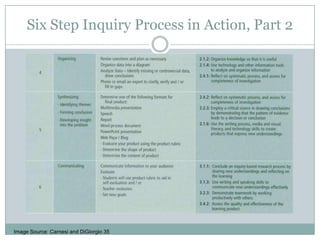
Six Step Inquiry Process in Action, Part 2Image Source: Carnesi and DiGiorgio 35
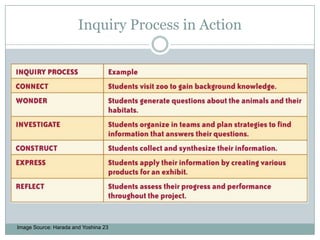
Inquiry Process in Action Image Source: Harada and Yoshina 23
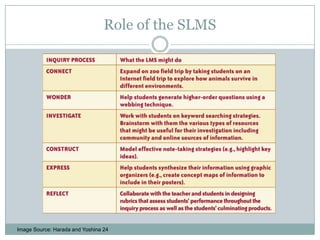
Role of the SLMSImage Source: Harada and Yoshina 24
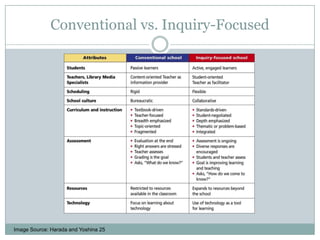
Conventional vs. Inquiry-FocusedImage Source: Harada and Yoshina 25
The Big6 Research ModelWhat is the Big6 Research Model?What is the Big6 process?What are the benefits of the Big6?How does the Big6 align with Texas Standards?What resources are available?www.big6.comThe “Big6™” is copyright © (1987) Michael B. Eisenberg and Robert E. Berkowitz. For more information, visit: www.big6.com
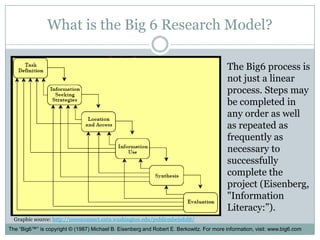
What is the Big 6 Research Model?“The Big6 is a proven approach to information problem-solving. It helps you succeed in school and life. Use the Big6 to find, use, apply, and evaluate information for specific needs and tasks” (Graphic Source: www.big6.com/kids/7-12.htm).The “Big6™” is copyright © (1987) Michael B. Eisenberg and Robert E. Berkowitz. For more information, visit: www.big6.com
Combines critical thinking, problem solving and manipulation of information for a meaningful solutionProvides a systematic approach to information problem-solving relying on critical thinking skillsProvides a basic framework for teaching and promoting information literacyTried and true method to answer a question, complete an assignment or create a unique productThe information problem-solving process steps are not necessarily sequential and may be repeated as neededWhat is the Big 6 Research Model?(London)
What is the Big 6 Research Model?Task Definition1.1 Define the information problem1.2 Identify information neededInformation Seeking Strategies 2.1 Determine all possible sources2.2 Select the best sourcesLocation and Access3.1 Locate sources (intellectually and physically)3.2 Find information within sourcesHandout created by: Barbara J. Shoemaker, School Media Specialist, Mill Road Elementary, K-2 Red Hook Central School District, Red Hook, NY
What is the Big 6 Research Model?4. Use of Information4.1 Engage (e.g., read, hear, view, touch)4.2 Extract relevant information5. Synthesis5.1 Organize from multiple sources5.2 Present the information6. Evaluation6.1 Judge the product (effectiveness)6.2 Judge the process (efficiency)Handout created by: Barbara J. Shoemaker, School Media Specialist, Mill Road Elementary, K-2 Red Hook Central School District, Red Hook, NY
What is the Big 6 Research Model?The Big6 process is not just a linear process. Steps may be completed in any order as well as repeated as frequently as necessary to successfully complete the project (Eisenberg, "Information Literacy:”).Graphic source: http://uweoconnect.extn.washington.edu/publicmbeinfolit/The “Big6™” is copyright © (1987) Michael B. Eisenberg and Robert E. Berkowitz. For more information, visit: www.big6.com
Step 1: Task DefinitionFacilitates information problem solving process by helping students focus on specific elements Promotes a preliminary understanding of the topic and the expected outcome or end resultStarts the resource identification process. (Lowe, 2008)AASL Standards for the21st-Century Learner  in Action1.1.3 Develop and refine a range of questions to frame the search for new understanding (13).1.2.1 Display initiative and engagement by posing questions and investigating the answers beyond the collection of superficial facts (13).The “Big6™” is copyright © (1987) Michael B. Eisenberg and Robert E. Berkowitz. For more information, visit: www.big6.com
Step 2: Information Seeking StrategiesTeaches students to become discretionary users of internet resourcesAASL Standards for the 21st-Century Learner in Action1.1.4 Find, evaluate, and select appropriate sources to answer questions (13).1.1.5 Evaluate information found in selected sources on the basis of accuracy, validity, appropriateness for needs, importance, and social and cultural context (13).The “Big6™” is copyright © (1987) Michael B. Eisenberg and Robert E. Berkowitz. For more information, visit: www.big6.com
Step 3: Location and AccessGuides students through the process of finding, sorting and applying relevant, credible information Facilitates understanding of benefits of both print and non-print resourcesDevelops information search and retrieval skills(Eisenberg, "Big6™ Skills Overview“)AASL Standards for the 21st-Century Learner in Action1.1.8 Demonstrate mastery of technology tools for accessing information and pursuing inquiry (13).1.3.2 Seek divergent perspectives during information gathering and assessment (13).The “Big6™” is copyright © (1987) Michael B. Eisenberg and Robert E. Berkowitz. For more information, visit: www.big6.com
Step 4: Use of InformationIdentify the main idea, key facts and quotes Differentiate between fact and fiction Understand requirements and importance of citing resources(Eisenberg, "Big6™ Skills Overview“)AASL Standards for  the 21stCentury Learner in Action1.1.7 Make sense of information gathered from diverse sources by identifying misconceptions, main and supporting ideas, conflicting information, and point of view or bias (13).2.1.1 Apply critical thinking skills (analysis, synthesis, evaluation, organization) to information and knowledge (14).1.3.3 Follow ethical and legal guidelines in gathering and using information (13).The “Big6™” is copyright © (1987) Michael B. Eisenberg and Robert E. Berkowitz. For more information, visit: www.big6.com
Step 5: SynthesisStudents learn how to organize and prioritize information from multiple sources Facilitates interpretation, analysis and evaluation of informationBuilds presentation skills and expertiseAASL Standards for the21st-Century Learner in Action2.1.4 Use technology and other information tools to analyze and organize information (14).3.1.4 Use technology and other information tools to organize and display knowledge and understanding in ways that others can view, use, and assess (15).The “Big6™” is copyright © (1987) Michael B. Eisenberg and Robert E. Berkowitz. For more information, visit: www.big6.com
Step 6: EvaluationAASL Standards for the 21st-Century Learnerin Action3.4.1 Assess the processes by which learning was achieved in order to revise strategies and learn more effectively in the future (15).3.4.2 Assess the quality and effectiveness of the learning product (15).Self-assessment of not only the completed project to defined criteria but also during each phase of the processThe “Big6™” is copyright © (1987) Michael B. Eisenberg and Robert E. Berkowitz. For more information, visit: www.big6.com
Advantages of the Big 6 Research ModelIntegrates information needs, search strategies, presentation skills, and evaluation skills, along with technology tools. A successful, tested approach that incorporates information and technology skills to strengthen your curriculum.Helps students to evaluate information, track their own progress during assignments and reflect on their completed work before it’s graded.Big6 stages allow students to develop information problem-solving skills as well as become organized, proficient users of information technologies.Ensures that students learn the fundamental approach for success in an overwhelming information and communication age.Develops the problem solving capacity of learners, including students who do not fit a traditional image of "successful learners.”(Big6 Associates, LLC)
Big6 Benefit to StudentsLearn transferable planning and organizing skills they will be able to apply for a lifetime School: homework, tests, decision-making, writing, research, projects Life: workplace, selecting entertainment, pursuing hobbies, friendship issues, making reservations, job hunting, apartment huntingFind, sort, and apply relevant, credible information to creatively solve a problem.Prepare a solution based on reliable information, and give proper credit to information sources.Achieve results using any individual learning style. Students will consider if their current style and approach works well for problem solving.Understand general problem-solving concepts and then refine each skill to learn and perfect specific details. (Big6 Staff, Benefit to Students)
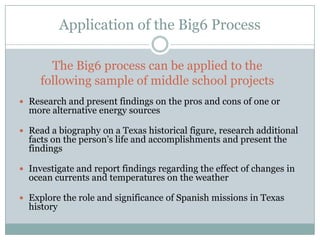
Benefit to EducatorsAdaptable:Current units and lessons can be framed within the Big6 context. Big6 compliments standards-based curriculum, and has terminology to fit student learning in grades K-12 and beyond.Flexible: Emphasize one Big6 skill or all Big6 skills throughout a school year, based on needs in school, time and resources available, and library/classroom partnership.Collaboration: Big6 facilitates communication among administrators, classroom teachers, and teacher-librarians. The Big6 is useful when you need to coordinate cross-curricular projects.(Big6 Staff, “How Will Educators Benefit”)
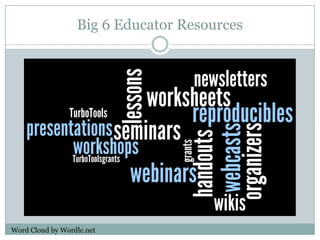
Big 6 Educator ResourcesWord Cloud by Wordle.net
Big 6 Alignment to TEKS ELAR Curriculum(19.b.22)  Research/Research Plan. Students ask open-ended research questions and develop a plan for answering them. Students are expected to:(A)  brainstorm, consult with others, decide upon a topic, and formulate a major research question to address the major research topic; and(B)  apply steps for obtaining and evaluating information from a wide variety of sources and create a written plan after preliminary research in reference works and additional text searches.(19.b.23)  Research/Gathering Sources. Students determine, locate, and explore the full range of relevant sources addressing a research question and systematically record the information they gather. Students are expected to:(A)  follow the research plan to collect data from a range of print and electronic resources;(B)  differentiate between primary and secondary sources;(C)  record data, utilizing available technology in order to see the relationships between ideas, and convert graphic/visual data;(D)  identify the source of notes and record bibliographic information concerning those sources according to a standard format; and(E)  differentiate between paraphrasing and plagiarism and identify the importance of citing valid and reliable sources.Task    Definition
 Information   Seeking
 Location   and Access
 Use of   Information
 Synthesis
 Evaluation(Division of Policy Coordination, “Chapter 110”)
Big 6 Alignment to TEKS ELAR Curriculum(19.b.24)  Research/Synthesizing Information. Students clarify research questions and evaluate and synthesize collected information. Students are expected to:(A)  refine the major research question, if necessary, guided by the answers to a secondary set of questions; (B)  evaluate the relevance and reliability of sources(19.b.25)  Research/Organizing and Presenting Ideas. Students organize and present their ideas and information according to the purpose of the research and their audience. Students are expected to synthesize the research into a written or an oral presentation that:(A)  compiles important information from multiple sources;(B)  develops a topic sentence, summarizes findings, and uses evidence to support conclusions;(C)  presents the findings in a consistent format; and(D)  uses quotations to support ideas and an appropriate form of documentation to acknowledgeTask    Definition
 Information   Seeking
 Location   and Access
 Use of   Information
 Synthesis
 Evaluation(Division of Policy Coordination, “Chapter 110”)

Inquiry Learning and the Big6

  • 1.
    A Presentation forMiddle school teachersBy Sheila DeLattre-Carter Sherry WoolamInquiry-Based Learning Processand The Big6Image Source: Microsoft PowerPoint Clip Gallery
  • 2.
    Crucial Skills forthe 21st Century LearnerInquiry-Based Learning ProcessWhat is inquiry-based learning?What are the benefits of the inquiry-based process?How do you apply inquiry-based learning?
  • 3.
    What is inquiry-basedlearning?A process that teaches research skills in any subject or content areaPromotes critical thinking skillsInformation gathering process related to lifeStudents work cooperatively in groups to solve problems and answer questions(Carnesi and DiGiorgio 32)
  • 4.
    The Benefits ofInquiry LearningEncourages cooperative learningTakes one project through major content areasCaters to different learning stylesMultiple-intelligence friendly(Carnesi and DiGiorgio 32)
  • 5.
    Applying Inquiry-Based LearningTheSix Step Inquiry ProcessQuestioningPlanningCollecting and CreditingOrganizingSynthesizingCommunicating(Carnesi and DiGiorgio 32-36)
  • 6.
    Step 1: QuestioningWordSplash by Wordle.net
  • 7.
    Step 2: PlanningStudentsdevise a plan or schedule Students gather resources for projectReview and revise planImage Source: Microsoft PowerPoint Clip Gallery
  • 8.
    Step 3: Collectingand CreditingStudents collect informationDocument informationCite their sourcesImage Source: Microsoft PowerPoint Clip Gallery
  • 9.
    Step 4: OrganizingGraphicorganizers are a mustImage Source: Microsoft PowerPoint Clip Gallery
  • 10.
    Step 5: SynthesizingCompletingthe final productImage Source: Microsoft PowerPoint Clip Gallery
  • 11.
    Step 6: CommunicatingTheart of presentingAddressing your audienceImage Source: Microsoft PowerPoint Clip Gallery
  • 12.
    The Inquiry ProcessImageSource: Carnesi and DiGiorgio 32
  • 13.
    Six Step InquiryProcess in Action, Part 1Image Source: Carnesi and DiGiorgio 35
  • 14.
    Six Step InquiryProcess in Action, Part 2Image Source: Carnesi and DiGiorgio 35
  • 15.
    Inquiry Process inAction Image Source: Harada and Yoshina 23
  • 16.
    Role of theSLMSImage Source: Harada and Yoshina 24
  • 17.
    Conventional vs. Inquiry-FocusedImageSource: Harada and Yoshina 25
  • 18.
    The Big6 ResearchModelWhat is the Big6 Research Model?What is the Big6 process?What are the benefits of the Big6?How does the Big6 align with Texas Standards?What resources are available?www.big6.comThe “Big6™” is copyright © (1987) Michael B. Eisenberg and Robert E. Berkowitz. For more information, visit: www.big6.com
  • 19.
    What is theBig 6 Research Model?“The Big6 is a proven approach to information problem-solving. It helps you succeed in school and life. Use the Big6 to find, use, apply, and evaluate information for specific needs and tasks” (Graphic Source: www.big6.com/kids/7-12.htm).The “Big6™” is copyright © (1987) Michael B. Eisenberg and Robert E. Berkowitz. For more information, visit: www.big6.com
  • 20.
    Combines critical thinking,problem solving and manipulation of information for a meaningful solutionProvides a systematic approach to information problem-solving relying on critical thinking skillsProvides a basic framework for teaching and promoting information literacyTried and true method to answer a question, complete an assignment or create a unique productThe information problem-solving process steps are not necessarily sequential and may be repeated as neededWhat is the Big 6 Research Model?(London)
  • 21.
    What is theBig 6 Research Model?Task Definition1.1 Define the information problem1.2 Identify information neededInformation Seeking Strategies 2.1 Determine all possible sources2.2 Select the best sourcesLocation and Access3.1 Locate sources (intellectually and physically)3.2 Find information within sourcesHandout created by: Barbara J. Shoemaker, School Media Specialist, Mill Road Elementary, K-2 Red Hook Central School District, Red Hook, NY
  • 22.
    What is theBig 6 Research Model?4. Use of Information4.1 Engage (e.g., read, hear, view, touch)4.2 Extract relevant information5. Synthesis5.1 Organize from multiple sources5.2 Present the information6. Evaluation6.1 Judge the product (effectiveness)6.2 Judge the process (efficiency)Handout created by: Barbara J. Shoemaker, School Media Specialist, Mill Road Elementary, K-2 Red Hook Central School District, Red Hook, NY
  • 23.
    What is theBig 6 Research Model?The Big6 process is not just a linear process. Steps may be completed in any order as well as repeated as frequently as necessary to successfully complete the project (Eisenberg, "Information Literacy:”).Graphic source: http://uweoconnect.extn.washington.edu/publicmbeinfolit/The “Big6™” is copyright © (1987) Michael B. Eisenberg and Robert E. Berkowitz. For more information, visit: www.big6.com
  • 24.
    Step 1: TaskDefinitionFacilitates information problem solving process by helping students focus on specific elements Promotes a preliminary understanding of the topic and the expected outcome or end resultStarts the resource identification process. (Lowe, 2008)AASL Standards for the21st-Century Learner in Action1.1.3 Develop and refine a range of questions to frame the search for new understanding (13).1.2.1 Display initiative and engagement by posing questions and investigating the answers beyond the collection of superficial facts (13).The “Big6™” is copyright © (1987) Michael B. Eisenberg and Robert E. Berkowitz. For more information, visit: www.big6.com
  • 25.
    Step 2: InformationSeeking StrategiesTeaches students to become discretionary users of internet resourcesAASL Standards for the 21st-Century Learner in Action1.1.4 Find, evaluate, and select appropriate sources to answer questions (13).1.1.5 Evaluate information found in selected sources on the basis of accuracy, validity, appropriateness for needs, importance, and social and cultural context (13).The “Big6™” is copyright © (1987) Michael B. Eisenberg and Robert E. Berkowitz. For more information, visit: www.big6.com
  • 26.
    Step 3: Locationand AccessGuides students through the process of finding, sorting and applying relevant, credible information Facilitates understanding of benefits of both print and non-print resourcesDevelops information search and retrieval skills(Eisenberg, "Big6™ Skills Overview“)AASL Standards for the 21st-Century Learner in Action1.1.8 Demonstrate mastery of technology tools for accessing information and pursuing inquiry (13).1.3.2 Seek divergent perspectives during information gathering and assessment (13).The “Big6™” is copyright © (1987) Michael B. Eisenberg and Robert E. Berkowitz. For more information, visit: www.big6.com
  • 27.
    Step 4: Useof InformationIdentify the main idea, key facts and quotes Differentiate between fact and fiction Understand requirements and importance of citing resources(Eisenberg, "Big6™ Skills Overview“)AASL Standards for the 21stCentury Learner in Action1.1.7 Make sense of information gathered from diverse sources by identifying misconceptions, main and supporting ideas, conflicting information, and point of view or bias (13).2.1.1 Apply critical thinking skills (analysis, synthesis, evaluation, organization) to information and knowledge (14).1.3.3 Follow ethical and legal guidelines in gathering and using information (13).The “Big6™” is copyright © (1987) Michael B. Eisenberg and Robert E. Berkowitz. For more information, visit: www.big6.com
  • 28.
    Step 5: SynthesisStudentslearn how to organize and prioritize information from multiple sources Facilitates interpretation, analysis and evaluation of informationBuilds presentation skills and expertiseAASL Standards for the21st-Century Learner in Action2.1.4 Use technology and other information tools to analyze and organize information (14).3.1.4 Use technology and other information tools to organize and display knowledge and understanding in ways that others can view, use, and assess (15).The “Big6™” is copyright © (1987) Michael B. Eisenberg and Robert E. Berkowitz. For more information, visit: www.big6.com
  • 29.
    Step 6: EvaluationAASLStandards for the 21st-Century Learnerin Action3.4.1 Assess the processes by which learning was achieved in order to revise strategies and learn more effectively in the future (15).3.4.2 Assess the quality and effectiveness of the learning product (15).Self-assessment of not only the completed project to defined criteria but also during each phase of the processThe “Big6™” is copyright © (1987) Michael B. Eisenberg and Robert E. Berkowitz. For more information, visit: www.big6.com
  • 30.
    Advantages of theBig 6 Research ModelIntegrates information needs, search strategies, presentation skills, and evaluation skills, along with technology tools. A successful, tested approach that incorporates information and technology skills to strengthen your curriculum.Helps students to evaluate information, track their own progress during assignments and reflect on their completed work before it’s graded.Big6 stages allow students to develop information problem-solving skills as well as become organized, proficient users of information technologies.Ensures that students learn the fundamental approach for success in an overwhelming information and communication age.Develops the problem solving capacity of learners, including students who do not fit a traditional image of "successful learners.”(Big6 Associates, LLC)
  • 31.
    Big6 Benefit toStudentsLearn transferable planning and organizing skills they will be able to apply for a lifetime School: homework, tests, decision-making, writing, research, projects Life: workplace, selecting entertainment, pursuing hobbies, friendship issues, making reservations, job hunting, apartment huntingFind, sort, and apply relevant, credible information to creatively solve a problem.Prepare a solution based on reliable information, and give proper credit to information sources.Achieve results using any individual learning style. Students will consider if their current style and approach works well for problem solving.Understand general problem-solving concepts and then refine each skill to learn and perfect specific details. (Big6 Staff, Benefit to Students)
  • 32.
    Benefit to EducatorsAdaptable:Currentunits and lessons can be framed within the Big6 context. Big6 compliments standards-based curriculum, and has terminology to fit student learning in grades K-12 and beyond.Flexible: Emphasize one Big6 skill or all Big6 skills throughout a school year, based on needs in school, time and resources available, and library/classroom partnership.Collaboration: Big6 facilitates communication among administrators, classroom teachers, and teacher-librarians. The Big6 is useful when you need to coordinate cross-curricular projects.(Big6 Staff, “How Will Educators Benefit”)
  • 33.
    Big 6 EducatorResourcesWord Cloud by Wordle.net
  • 34.
    Big 6 Alignmentto TEKS ELAR Curriculum(19.b.22)  Research/Research Plan. Students ask open-ended research questions and develop a plan for answering them. Students are expected to:(A)  brainstorm, consult with others, decide upon a topic, and formulate a major research question to address the major research topic; and(B)  apply steps for obtaining and evaluating information from a wide variety of sources and create a written plan after preliminary research in reference works and additional text searches.(19.b.23)  Research/Gathering Sources. Students determine, locate, and explore the full range of relevant sources addressing a research question and systematically record the information they gather. Students are expected to:(A)  follow the research plan to collect data from a range of print and electronic resources;(B)  differentiate between primary and secondary sources;(C)  record data, utilizing available technology in order to see the relationships between ideas, and convert graphic/visual data;(D)  identify the source of notes and record bibliographic information concerning those sources according to a standard format; and(E)  differentiate between paraphrasing and plagiarism and identify the importance of citing valid and reliable sources.Task Definition
  • 35.
  • 36.
    Location and Access
  • 37.
    Use of Information
  • 38.
  • 39.
    Evaluation(Division ofPolicy Coordination, “Chapter 110”)
  • 40.
    Big 6 Alignmentto TEKS ELAR Curriculum(19.b.24)  Research/Synthesizing Information. Students clarify research questions and evaluate and synthesize collected information. Students are expected to:(A)  refine the major research question, if necessary, guided by the answers to a secondary set of questions; (B)  evaluate the relevance and reliability of sources(19.b.25)  Research/Organizing and Presenting Ideas. Students organize and present their ideas and information according to the purpose of the research and their audience. Students are expected to synthesize the research into a written or an oral presentation that:(A)  compiles important information from multiple sources;(B)  develops a topic sentence, summarizes findings, and uses evidence to support conclusions;(C)  presents the findings in a consistent format; and(D)  uses quotations to support ideas and an appropriate form of documentation to acknowledgeTask Definition
  • 41.
  • 42.
    Location and Access
  • 43.
    Use of Information
  • 44.
  • 45.
    Evaluation(Division ofPolicy Coordination, “Chapter 110”)

Editor's Notes

  • #20 The Big6 is an information and technology literacy model and curriculum, implemented in thousands of schools – K through higher education. Some people call the Big6 an information problem-solving strategy because with the Big6, students are able to handle any problem, assignment, decision or task.Eisenberg, Mike. "Big6™ Skills Overview." Big6. 19 Nov. 2001. Web. 14 Oct. 2009. <http://www.big6.com/2001/11/19/a-big6%e2%84%a2-skills-overview/>.
  • #21 London, Ellen. "The International Baccalaureate Program in International Schools and Big6: A Wonderful Partnership." Web log post. Big6 Blog Archive. The Big6, 9 Sept. 2006. Web. 16 Oct. 2009. <http://www.big6.com/2006/09/06/the-international-baccalaureate-program-in-international-schools-and-big6-a-wonderful-partnership/>.
  • #24 Eisenberg, Mike. "Information Literacy: The Most Basic of Basics." Mike Eisenberg on Information Literacy. June 2009. Web. 6 Oct. 2009. http://uweoconnect.extn.washington.edu/publicmbeinfolit/.
  • #25 Lowe, Carrie. "» Blog Archive » Rethinking Task Definition: Saving the World in Five Minutes (eNews 9.4, 3)." Big6. 12 Dec. 2008. Web. 15 Oct. 2009. <http://www.big6.com/2008/12/12/rethinking-task-definition-saving-the-world-in-five-minutes-enews-94-3/>.Focusing on Task Definition accomplishes a few different things. First, it makes the information problem solving process much more efficient, since the learner won’t waste a lot of time searching for things he or she doesn’t end up needing. Second, it forces the learner to develop some preliminary understanding of the topic and what kind of final product is expected. Finally, it requires the learner to think – at least preliminarily – about what kinds of resources might be best.
  • #27 http://www.big6.com/2005/07/18/big6-student-benefits/http://www.big6.com/files/Big6_aligned_with_ICT_Literacy_Standards.pdf
  • #31 Integrates information needs, search strategies, presentation skills, and evaluation skills, along with technology tools. This systematic process helps students define information needs, find, engage, organize, present, and evaluate information for specific needs and tasks.
  • #32 So far this slide is just a cut and paste of some info I found on the Big 6 website – you may want to use some of the information for why Big 6 is better.http://www.big6.com/2005/07/18/big6-student-benefits/http://www.big6.com/2005/07/18/how-will-educators-benefit-by-using-the-big6-skills/
  • #33 So far this slide is just a cut and paste of some info I found on the Big 6 website – you may want to use some of the information for why Big 6 is better.http://www.big6.com/2005/07/18/big6-student-benefits/http://www.big6.com/2005/07/18/how-will-educators-benefit-by-using-the-big6-skills/
  • #35 Division of Policy Coordination. "Chapter 110. Texas Essential Knowledge and Skills for English Language Arts and Reading." 19 TAC Chapter 110 Subchapter B. Middle School. Texas Education Agency, 4 Sept. 2008. Web. 16 Oct. 2009. <http://ritter.tea.state.tx.us/rules/tac/chapter110/ch110b.html>.
  • #36 Division of Policy Coordination. "Chapter 110. Texas Essential Knowledge and Skills for English Language Arts and Reading." 19 TAC Chapter 110 Subchapter B. Middle School. Texas Education Agency, 4 Sept. 2008. Web. 16 Oct. 2009. <http://ritter.tea.state.tx.us/rules/tac/chapter110/ch110b.html>.
  • #37 "Chapter 113. Texas Essential Knowledge and Skills for Social Studies." TAC 19 Subchapter B. Middle School. Texas Education Agency. Web. 16 Oct. 2009. <http://ritter.tea.state.tx.us/rules/tac/chapter113/ch113b.html>.