Writing for Information Doon Academy Library
Which type of essay? Discursive/Argumentative Both sides of argument Informative/Persuasive Explaining a topic
Planning 1 Before you start Think about possible topics  Avoid the obvious ones – too boring Watch the news Do background reading
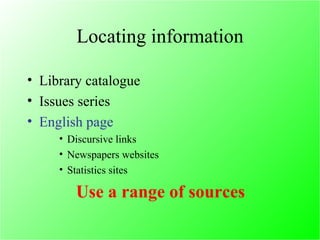
Locating information Library catalogue Issues series  English page  Discursive links Newspapers websites Statistics sites Use a range of sources
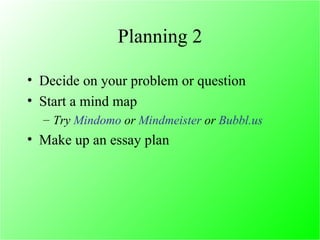
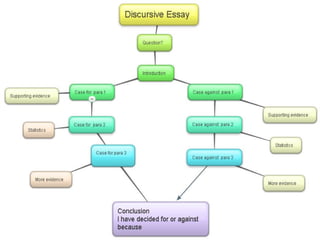
Planning 2 Decide on your problem or question Start a mind map Try  Mindomo  or  Mindmeister  or  Bubbl.us Make up an essay plan
 
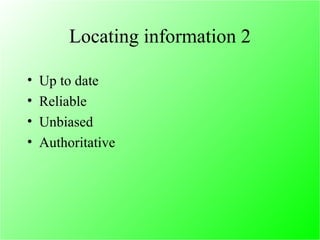
Locating information 2 Up to date Reliable Unbiased Authoritative
Note-taking Skim and scan for facts to back up your argument Record them In your jotter  In a visual way, making a timeline, a web or a diagram  By making lists, columns, or outlines  By highlighting text  Do not copy and paste
Note-taking  2 How does this fit with what I have already read?  What doesn’t make sense?  Which side does this evidence support?  What are the characteristics of this source?  What do I still need to find out?
Getting organised You work hard to find information so  look after it! Only print what you need Keep your notes on a mind-map or word doc. Keep your work in a folder or inside your jotter. Note your sources as you go along.
Getting organised 2 Note details of resources you use: URL, Author, title, date, publisher, page numbers. The work will be copyright. This applies to web pages and CD-ROMs as well as books
Academic honesty Copyright  means you must not copy! Copy and pasting is passing of other people’s work as your own SQA can cancel all your exam entries Universities expel students caught copying
What is Plagiarism? Using a choice phrase or sentence that you have come across.  C opying word-for-word directly from a text.  Paraphrasing the words from a text very closely.  Using text downloaded from the internet.  Borrowing statistics or assembled facts from another person or source.  Copying or downloading figures, photographs, pictures or diagrams without acknowledging your sources.  Source: Open University  What constitutes plagiarism or cheating?
Self-evaluation 1 Review your information Support your argument with evidence Give your own opinion Finish with a summary and a conclusion
Self-evaluation 2 Make sure you are happy with how your work looks. Use the spelling and grammar checker Ask someone else to read it over Hand it in on time! Have a look at  Check your sources   for more help

Discursive essay writing

  • 1.
    Writing for InformationDoon Academy Library
  • 2.
    Which type ofessay? Discursive/Argumentative Both sides of argument Informative/Persuasive Explaining a topic
  • 3.
    Planning 1 Beforeyou start Think about possible topics Avoid the obvious ones – too boring Watch the news Do background reading
  • 4.
    Locating information Librarycatalogue Issues series English page Discursive links Newspapers websites Statistics sites Use a range of sources
  • 5.
    Planning 2 Decideon your problem or question Start a mind map Try Mindomo or Mindmeister or Bubbl.us Make up an essay plan
  • 6.
  • 7.
    Locating information 2Up to date Reliable Unbiased Authoritative
  • 8.
    Note-taking Skim andscan for facts to back up your argument Record them In your jotter In a visual way, making a timeline, a web or a diagram By making lists, columns, or outlines By highlighting text Do not copy and paste
  • 9.
    Note-taking 2How does this fit with what I have already read? What doesn’t make sense? Which side does this evidence support? What are the characteristics of this source? What do I still need to find out?
  • 10.
    Getting organised Youwork hard to find information so look after it! Only print what you need Keep your notes on a mind-map or word doc. Keep your work in a folder or inside your jotter. Note your sources as you go along.
  • 11.
    Getting organised 2Note details of resources you use: URL, Author, title, date, publisher, page numbers. The work will be copyright. This applies to web pages and CD-ROMs as well as books
  • 12.
    Academic honesty Copyright means you must not copy! Copy and pasting is passing of other people’s work as your own SQA can cancel all your exam entries Universities expel students caught copying
  • 13.
    What is Plagiarism?Using a choice phrase or sentence that you have come across. C opying word-for-word directly from a text. Paraphrasing the words from a text very closely. Using text downloaded from the internet. Borrowing statistics or assembled facts from another person or source. Copying or downloading figures, photographs, pictures or diagrams without acknowledging your sources. Source: Open University What constitutes plagiarism or cheating?
  • 14.
    Self-evaluation 1 Reviewyour information Support your argument with evidence Give your own opinion Finish with a summary and a conclusion
  • 15.
    Self-evaluation 2 Makesure you are happy with how your work looks. Use the spelling and grammar checker Ask someone else to read it over Hand it in on time! Have a look at Check your sources for more help