INFORMATION LITERACY
The Big 6 – a six stage model to help anyone solve
problems or make decisions using information
literacy.
WHAT IS THE BIG 6?
 Developed by Michael Eisenberg and David
  Berkowitz in 2000, Big6 is a six-stage model to help
  anyone solve problems or make decisions by using
  available information.
 Using the Big6 process, you will identify your
  problems or research goals, seek, use, and put
  together relevant, authoritative information, then
  reflect and evaluate whether the final product is
  effective and was my process efficient.
TASK DEFINITION
 Define the problem
 Identify the information needed


    Where do I find the information?


                                       What is my task?


                What am I supposed to do?
INFORMATION SEEKING STRATEGIES
 Determine all possible sources
 Select the best sources


    What are all the possible sources?


                  What is the best source in this particular situation?


            What is the best source in this particular context?
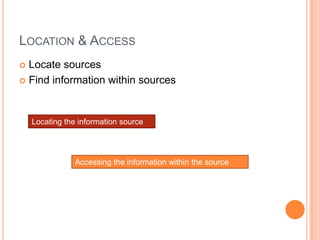
LOCATION & ACCESS
 Locate sources
 Find information within sources


    Locating the information source


                Accessing the information within the source
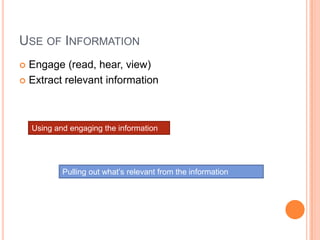
USE OF INFORMATION
 Engage (read, hear, view)
 Extract relevant information


    Using and engaging the information


            Pulling out what’s relevant from the information
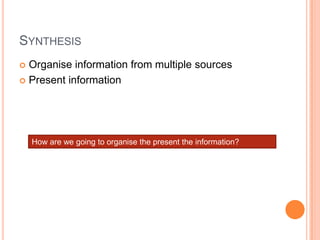
SYNTHESIS
 Organise information from multiple sources
 Present information


    How are we going to organise the present the information?
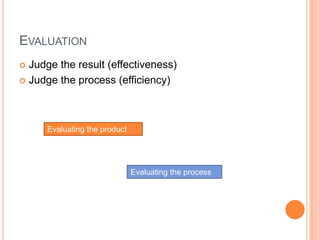
EVALUATION
 Judge the result (effectiveness)
 Judge the process (efficiency)


      Evaluating the product


                               Evaluating the process

Information literacy big 6

  • 1.
    INFORMATION LITERACY The Big6 – a six stage model to help anyone solve problems or make decisions using information literacy.
  • 2.
    WHAT IS THEBIG 6?  Developed by Michael Eisenberg and David Berkowitz in 2000, Big6 is a six-stage model to help anyone solve problems or make decisions by using available information.  Using the Big6 process, you will identify your problems or research goals, seek, use, and put together relevant, authoritative information, then reflect and evaluate whether the final product is effective and was my process efficient.
  • 3.
    TASK DEFINITION  Definethe problem  Identify the information needed Where do I find the information? What is my task? What am I supposed to do?
  • 4.
    INFORMATION SEEKING STRATEGIES Determine all possible sources  Select the best sources What are all the possible sources? What is the best source in this particular situation? What is the best source in this particular context?
  • 5.
    LOCATION & ACCESS Locate sources  Find information within sources Locating the information source Accessing the information within the source
  • 6.
    USE OF INFORMATION Engage (read, hear, view)  Extract relevant information Using and engaging the information Pulling out what’s relevant from the information
  • 7.
    SYNTHESIS  Organise informationfrom multiple sources  Present information How are we going to organise the present the information?
  • 8.
    EVALUATION  Judge theresult (effectiveness)  Judge the process (efficiency) Evaluating the product Evaluating the process