The Big6 Research Process By  Mrs. Milis
There are 6 steps that can make your life easier when searching for information! If you learn these 6 steps, you can apply them to any question or problem that you need to solve! The Big 6 Inquiry Process
Step One: Task Definition First, clearly  identify the requirements of the assignment  by carefully reading and rereading the directions and by looking the rubric if provided —What is the assignment asking you to do? Then… Formulate researchable questions  to fill the need for information on a particular topic— What do I want to find out?
Step 2: Develop Information Seeking Strategies Create a research plan Where will you find answers to your questions? List the best resources available to you. Consider all possible resources including interviews, surveys, journals, on-line databases
Step 3: Locate and Access Resources Follow your research plan to gather information Go to the library Interview experts Use the Internet Conduct a survey Ask a friend, parent, or teacher
Step 4: Use Information Record information relating to your information needs and questions by: Taking notes using index cards Taking notes using notebook paper Taking notes using a word processor Taking notes using a graphic organizer Using a tape recorder, video, or digital camera Other:  Consider how you will give credit to your sources by citing your source each time you take notes
Step 5: Synthesis Combine information from various sources in the form of: A written paper An oral presentation A multimedia presentation A performance This is where you formulate your conclusions, arguments, commentary, and supporting details.
Step 6: Evaluation Before turning in an assignment ask yourself the following : Did I follow the requirements of the assignment stated in the directions? Does the information gathered in step 4 and 5 meet the questions asked in step 1? Is credit given to my sources? (MLA format) Is my work neat and presentable? Would I be proud for anyone to view this work?
How the Big6 Research Process can Help You in Life We are always seeking information: what car should I buy? Which college should I choose? How can I sell this idea to my boss? What stores sell the brand I like? Etc; School research is a training ground for real life. The Steps in the Big6 Research process will never fail you.
You Need to Become Information Literate to Survive the 21 st  Century Information Literacy Is an ability to recognize when information is needed, and have the ability to locate, evaluate, and use it effectively. INFORMATION HELPS US REACH CONCLUSIONS, MAKE OUR OWN CHOICES, AND COMMUNICATE MORE EFFECTIVELY. SO... WE NEED TO CONTINUE TO IMPROVE OUR SEARCHING AND EVALUATING SKILLS IN A CHANGING INFORMATION ENVIRONMENT.
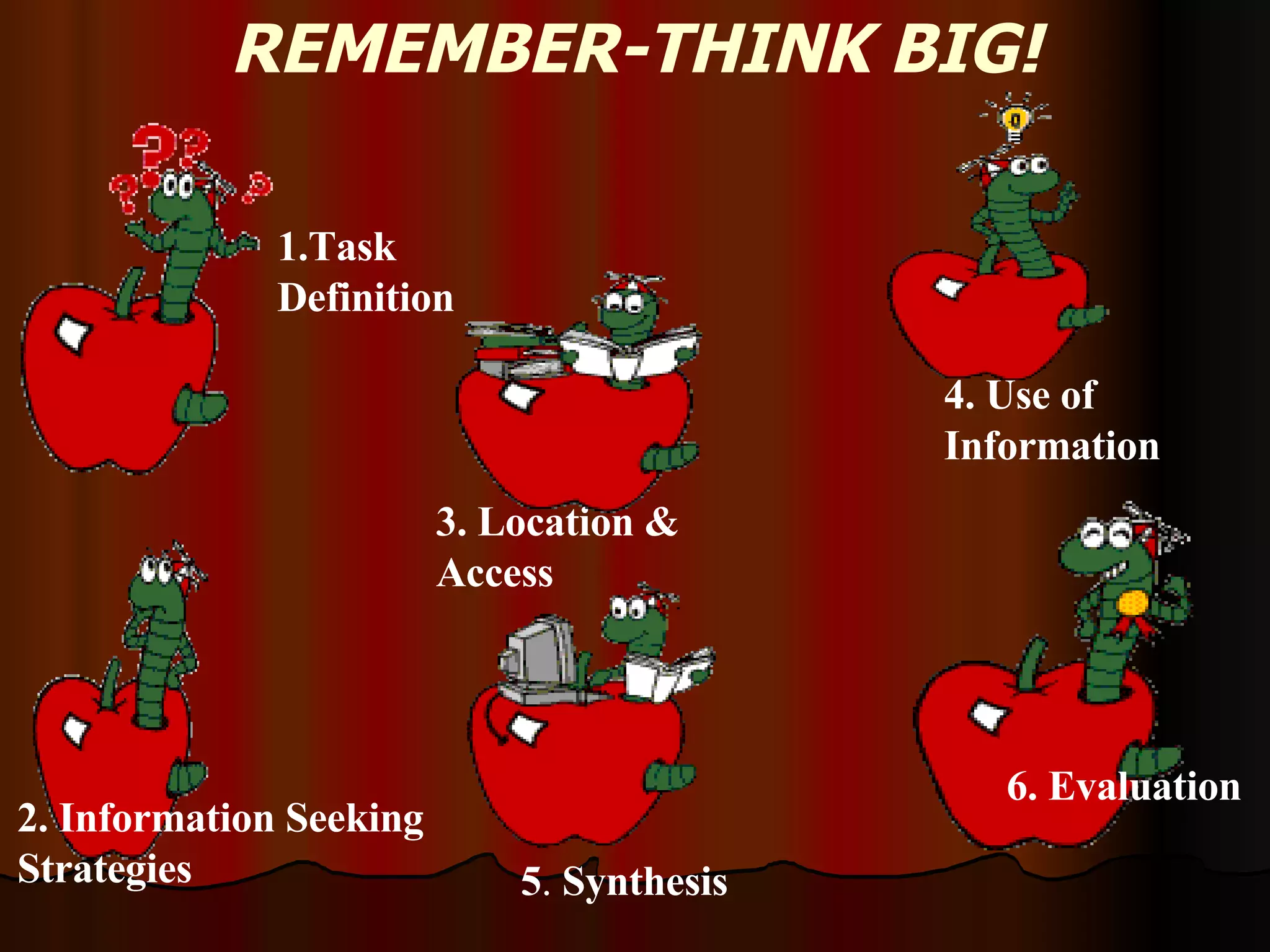
REMEMBER-THINK BIG! 1.Task Definition 2. Information Seeking Strategies 3. Location & Access 4. Use of Information 5 .  Synthesis 6. Evaluation
Review TASK DEFINITION -   Define the problem and Identify the information needed. INFORMATION SEEKING STRATEGIES -   Determine all possible sources, and select the best ones. LOCATION & ACCESS -   Locate selected sources,  and find the information you need within them. USE OF INFORMATION -   Read, hear, view, etc. the information,  and extract relevant information. SYNTHESIS -  Organize information from multiple sources, and present the result. EVALUATION -   Judge the effectiveness of your product and judge the efficiency of your process.

My Research Process

  • 1.
    The Big6 ResearchProcess By Mrs. Milis
  • 2.
    There are 6steps that can make your life easier when searching for information! If you learn these 6 steps, you can apply them to any question or problem that you need to solve! The Big 6 Inquiry Process
  • 3.
    Step One: TaskDefinition First, clearly identify the requirements of the assignment by carefully reading and rereading the directions and by looking the rubric if provided —What is the assignment asking you to do? Then… Formulate researchable questions to fill the need for information on a particular topic— What do I want to find out?
  • 4.
    Step 2: DevelopInformation Seeking Strategies Create a research plan Where will you find answers to your questions? List the best resources available to you. Consider all possible resources including interviews, surveys, journals, on-line databases
  • 5.
    Step 3: Locateand Access Resources Follow your research plan to gather information Go to the library Interview experts Use the Internet Conduct a survey Ask a friend, parent, or teacher
  • 6.
    Step 4: UseInformation Record information relating to your information needs and questions by: Taking notes using index cards Taking notes using notebook paper Taking notes using a word processor Taking notes using a graphic organizer Using a tape recorder, video, or digital camera Other: Consider how you will give credit to your sources by citing your source each time you take notes
  • 7.
    Step 5: SynthesisCombine information from various sources in the form of: A written paper An oral presentation A multimedia presentation A performance This is where you formulate your conclusions, arguments, commentary, and supporting details.
  • 8.
    Step 6: EvaluationBefore turning in an assignment ask yourself the following : Did I follow the requirements of the assignment stated in the directions? Does the information gathered in step 4 and 5 meet the questions asked in step 1? Is credit given to my sources? (MLA format) Is my work neat and presentable? Would I be proud for anyone to view this work?
  • 9.
    How the Big6Research Process can Help You in Life We are always seeking information: what car should I buy? Which college should I choose? How can I sell this idea to my boss? What stores sell the brand I like? Etc; School research is a training ground for real life. The Steps in the Big6 Research process will never fail you.
  • 10.
    You Need toBecome Information Literate to Survive the 21 st Century Information Literacy Is an ability to recognize when information is needed, and have the ability to locate, evaluate, and use it effectively. INFORMATION HELPS US REACH CONCLUSIONS, MAKE OUR OWN CHOICES, AND COMMUNICATE MORE EFFECTIVELY. SO... WE NEED TO CONTINUE TO IMPROVE OUR SEARCHING AND EVALUATING SKILLS IN A CHANGING INFORMATION ENVIRONMENT.
  • 11.
    REMEMBER-THINK BIG! 1.TaskDefinition 2. Information Seeking Strategies 3. Location & Access 4. Use of Information 5 . Synthesis 6. Evaluation
  • 12.
    Review TASK DEFINITION- Define the problem and Identify the information needed. INFORMATION SEEKING STRATEGIES - Determine all possible sources, and select the best ones. LOCATION & ACCESS - Locate selected sources, and find the information you need within them. USE OF INFORMATION - Read, hear, view, etc. the information, and extract relevant information. SYNTHESIS - Organize information from multiple sources, and present the result. EVALUATION - Judge the effectiveness of your product and judge the efficiency of your process.