Introducing


Approach to Information
   Problem-Solving
                          © M. Eisenberg 2010
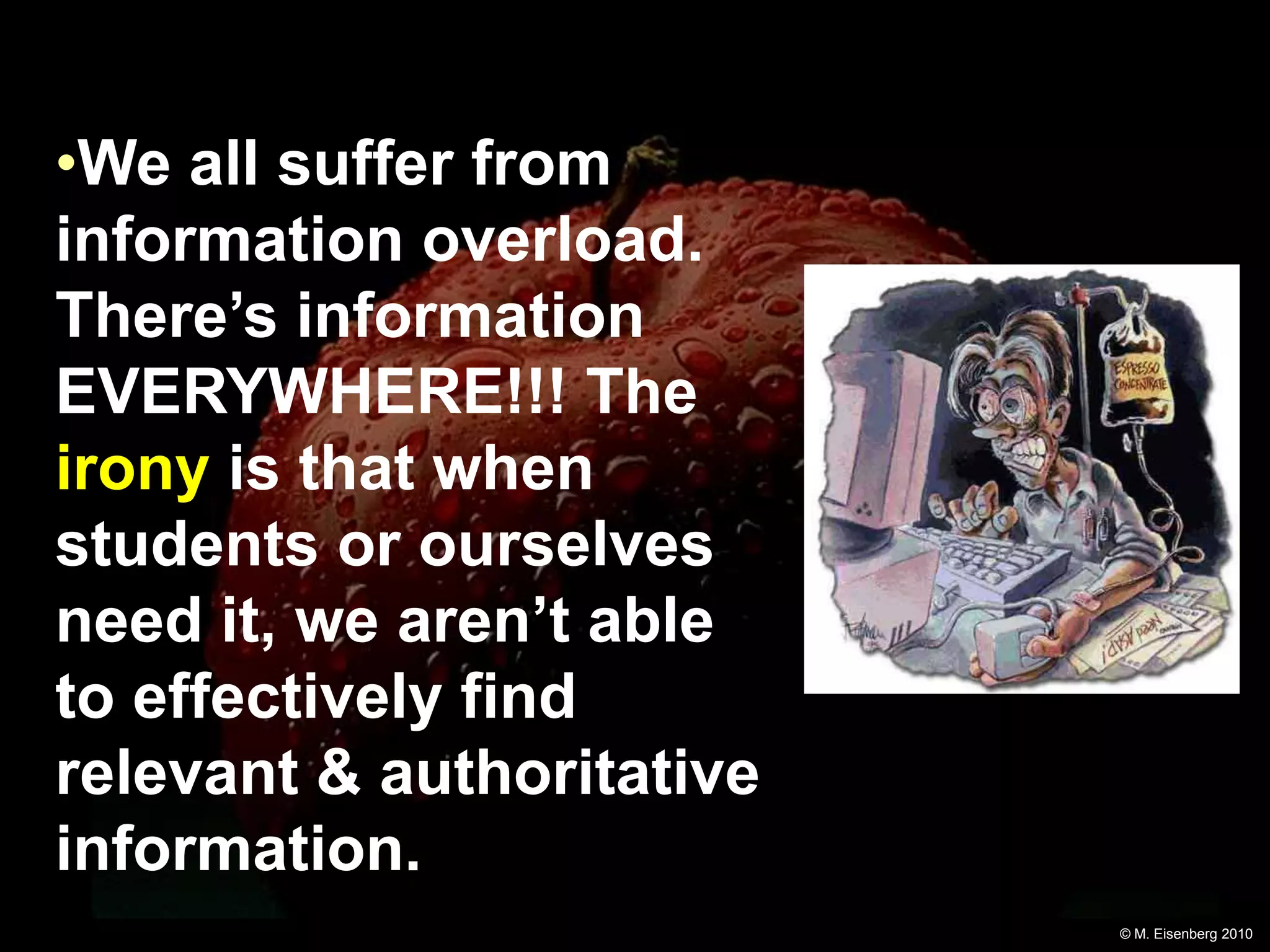
•We all suffer from
information overload.
There’s information
EVERYWHERE!!! The
irony is that when
students or ourselves
need it, we aren’t able
to effectively find
relevant & authoritative
information.
                           © M. Eisenberg 2010
Information Literacy

“To be information literate, a person
   must be able to recognize when
 information is needed and have the
  ability to locate, evaluate, and use
 effectively the needed information.”
                   American Library Association, 1989


                                                © M. Eisenberg 2010
THE BIG6 and the
                  Common Core
CCSS.ELA-Literacy.W.8.1 Write arguments to support claims with clear
reasons and relevant evidence
CCSS.ELA-Literacy.W.8.2 Write informative/explanatory texts to
examine a topic and convey ideas, concepts, and information through
the selection, organization, and analysis of relevant content
CCSS.ELA-Literacy.W.8.7 Conduct short research projects to answer a
question (including a self-generated question), drawing on several
sources and generating additional related, focused questions that allow
for multiple avenues of exploration
CCSS.ELA-Literacy.SL.8.1a Come to discussions prepared, having
read or researched material under study; explicitly draw on that
preparation by referring to evidence on the topic, text, or issue to probe
and reflect on ideas under discussion.


                                                                       © M. Eisenberg 2010
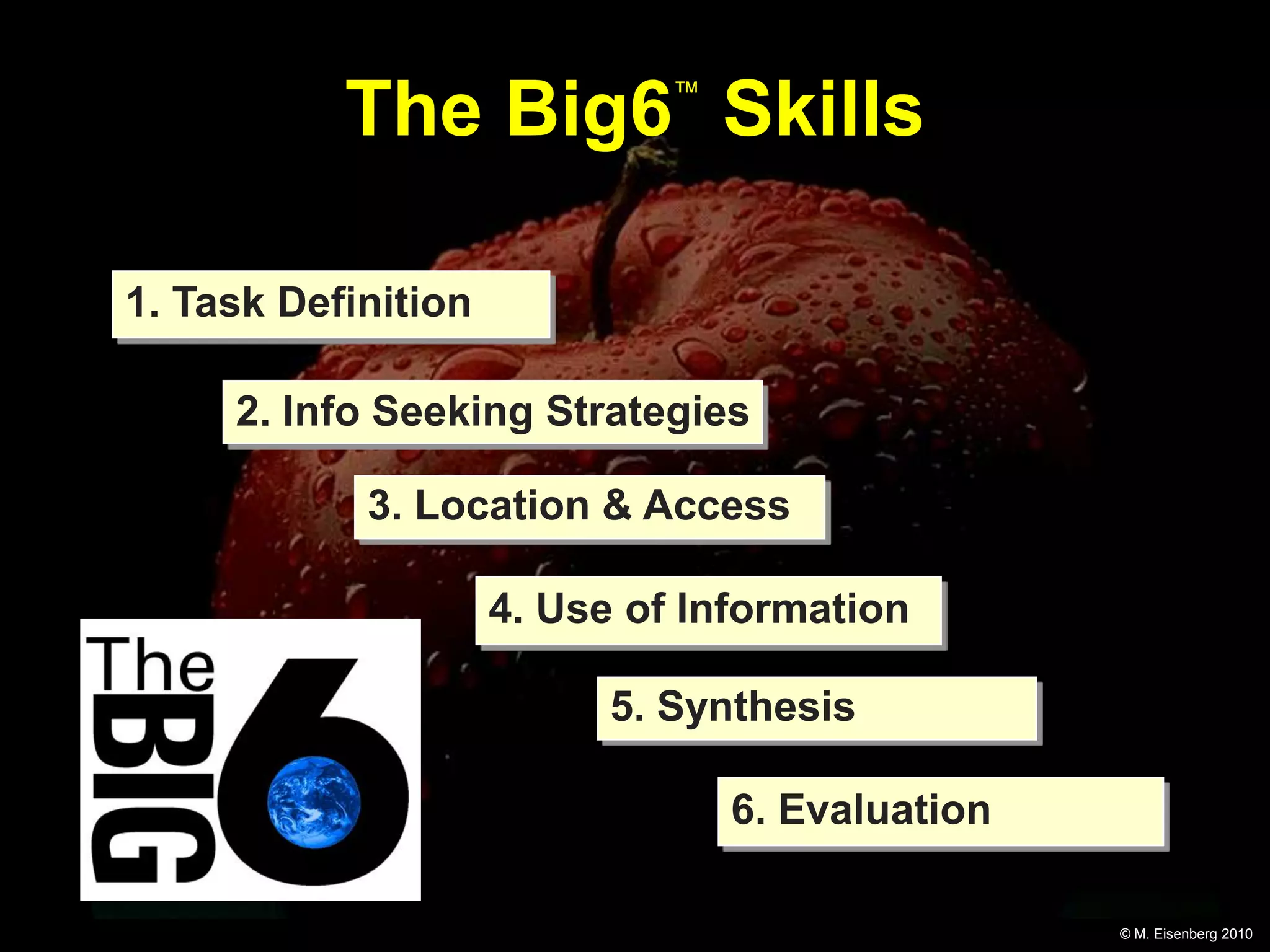
™
           The Big6 Skills

1. Task Definition

     2. Info Seeking Strategies

            3. Location & Access

                     4. Use of Information

                           5. Synthesis

                                  6. Evaluation

                                                  © M. Eisenberg 2010
Usage of the BIG 6
             Examples:
• Science & Math Fair – The research
  component
• Argumentative Essays – Finding facts to
  support a claim
• Short papers and oral presentation -on
  the problems and solutions of proposed
  inquiry based questions.
• Life-long learning interest – the ability to
  answer questions and inform ourselves
                                          © M. Eisenberg 2010
Task Definition

1.1 Define the problem
1.2 Identify the information
    needed
  TYPES OF INFORMATION,
   BRAIN STORMING, AND
    THESIS GENERATING
                               © M. Eisenberg 2010
Information Seeking
         Strategies
2.1 Determine all possible
    sources
2.2 Select the best sources
 Continue brainstorming and
  use Internet skills to seek
         information

                              © M. Eisenberg 2010
Location & Access
3.1 Locate sources
3.2 Find information within
    sources
 Where is the most relevant
  accurate information ?
WBOL, DESTINY, NC WISE,
         ETC.                 © M. Eisenberg 2010
Use of Information

4.1 Engage (read, hear, view)
4.2 Extract relevant, quality
    information
How do I make sense of the
         information?

                                © M. Eisenberg 2010
Synthesis

5.1 Organize
5.2 Present


How will I present the
 information I learned?
                          © M. Eisenberg 2010
Evaluation

6.1 Judge the result
6.2 Judge the process
   Am I effective and
  efficient in presenting
         my ideas?
                            © M. Eisenberg 2010
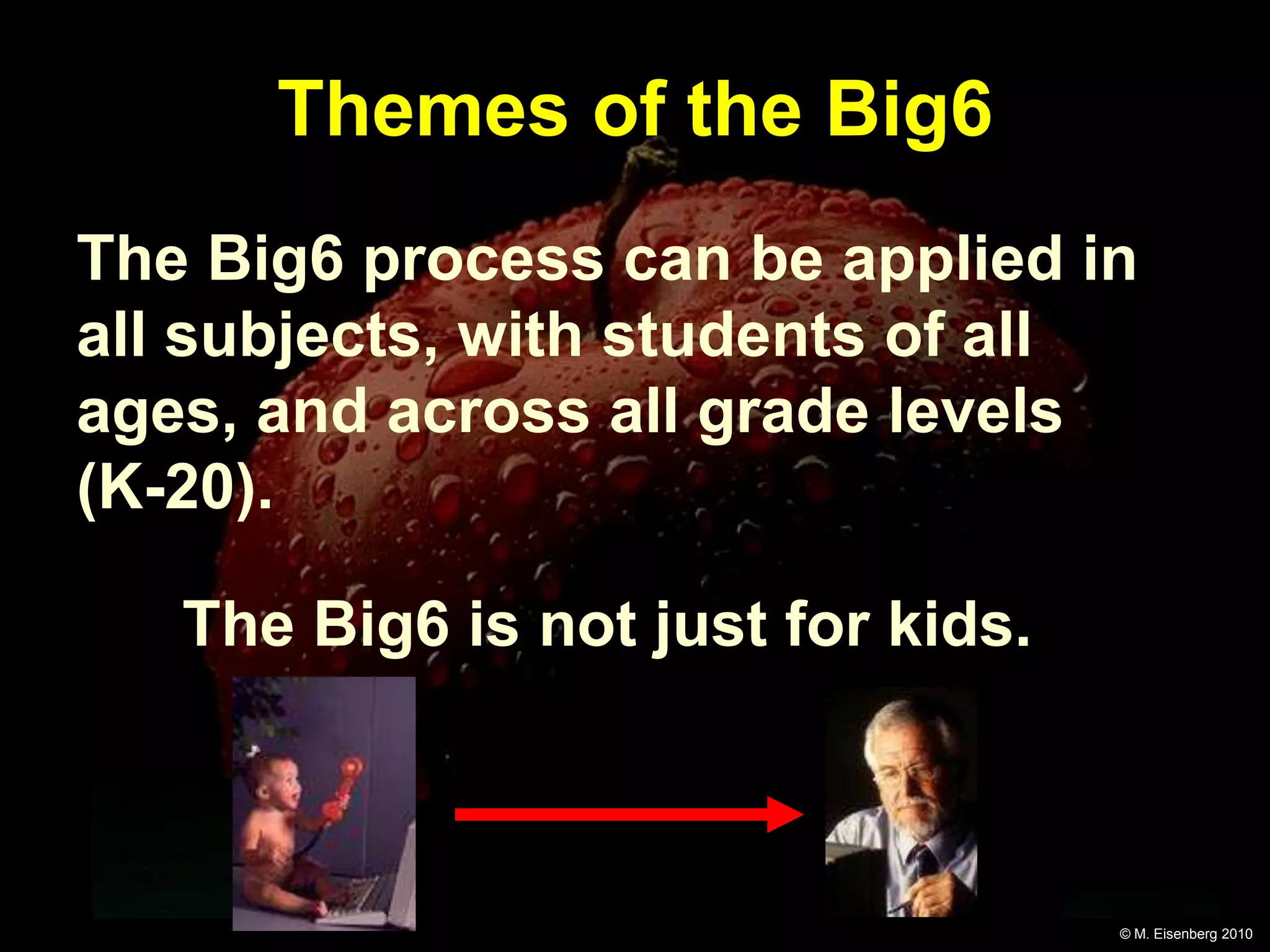
Themes of the Big6
The Big6 process can be applied in
all subjects, with students of all
ages, and across all grade levels
(K-20).

   The Big6 is not just for kids.


                                    © M. Eisenberg 2010
www.big6.org

•Access
 Code:
  BIG6


                    www.big6.com
 •Eisenberg, M. (2010). The Big6 Skills. [Powerpoint slides] Retrieved from The
 Big6 www.pdtogo.com/files/BIG%206%20PP.ppt.

                                                                                  © M. Eisenberg 2010

Introducing the big6

  • 1.
    Introducing Approach to Information Problem-Solving © M. Eisenberg 2010
  • 2.
    •We all sufferfrom information overload. There’s information EVERYWHERE!!! The irony is that when students or ourselves need it, we aren’t able to effectively find relevant & authoritative information. © M. Eisenberg 2010
  • 3.
    Information Literacy “To beinformation literate, a person must be able to recognize when information is needed and have the ability to locate, evaluate, and use effectively the needed information.” American Library Association, 1989 © M. Eisenberg 2010
  • 4.
    THE BIG6 andthe Common Core CCSS.ELA-Literacy.W.8.1 Write arguments to support claims with clear reasons and relevant evidence CCSS.ELA-Literacy.W.8.2 Write informative/explanatory texts to examine a topic and convey ideas, concepts, and information through the selection, organization, and analysis of relevant content CCSS.ELA-Literacy.W.8.7 Conduct short research projects to answer a question (including a self-generated question), drawing on several sources and generating additional related, focused questions that allow for multiple avenues of exploration CCSS.ELA-Literacy.SL.8.1a Come to discussions prepared, having read or researched material under study; explicitly draw on that preparation by referring to evidence on the topic, text, or issue to probe and reflect on ideas under discussion. © M. Eisenberg 2010
  • 5.
    The Big6 Skills 1. Task Definition 2. Info Seeking Strategies 3. Location & Access 4. Use of Information 5. Synthesis 6. Evaluation © M. Eisenberg 2010
  • 6.
    Usage of theBIG 6 Examples: • Science & Math Fair – The research component • Argumentative Essays – Finding facts to support a claim • Short papers and oral presentation -on the problems and solutions of proposed inquiry based questions. • Life-long learning interest – the ability to answer questions and inform ourselves © M. Eisenberg 2010
  • 7.
    Task Definition 1.1 Definethe problem 1.2 Identify the information needed TYPES OF INFORMATION, BRAIN STORMING, AND THESIS GENERATING © M. Eisenberg 2010
  • 8.
    Information Seeking Strategies 2.1 Determine all possible sources 2.2 Select the best sources Continue brainstorming and use Internet skills to seek information © M. Eisenberg 2010
  • 9.
    Location & Access 3.1Locate sources 3.2 Find information within sources Where is the most relevant accurate information ? WBOL, DESTINY, NC WISE, ETC. © M. Eisenberg 2010
  • 10.
    Use of Information 4.1Engage (read, hear, view) 4.2 Extract relevant, quality information How do I make sense of the information? © M. Eisenberg 2010
  • 11.
    Synthesis 5.1 Organize 5.2 Present Howwill I present the information I learned? © M. Eisenberg 2010
  • 12.
    Evaluation 6.1 Judge theresult 6.2 Judge the process Am I effective and efficient in presenting my ideas? © M. Eisenberg 2010
  • 13.
    Themes of theBig6 The Big6 process can be applied in all subjects, with students of all ages, and across all grade levels (K-20). The Big6 is not just for kids. © M. Eisenberg 2010
  • 14.
    www.big6.org •Access Code: BIG6 www.big6.com •Eisenberg, M. (2010). The Big6 Skills. [Powerpoint slides] Retrieved from The Big6 www.pdtogo.com/files/BIG%206%20PP.ppt. © M. Eisenberg 2010