BUILDING INFORMATION MODELING (BIM)
Group Member
SHAIKH MD AQUIB ARMIET/CL 18 SA 276
MANSHAUL REHMAN ARMIET/CL 18 MR 254
GADKARI FAIZAN ARMIET/CL 18 GF 226
CHOWKI ZAID EJAZ ARMIET/CL 18 CZ 219
PROJECT GUIDE
PROF. VIKASH SINGH
Department of Civil Engineering
Alamuri Ratnamala Institute of Engineering & Technology , Shahapur
2020 -2021
Table of contents
 Introduction
 What is BIM?
 BIM Process
 BIM Application
 BIM Advantages
 BIM Workflow
 Construction Industry with BIM
Problems in Construction Industry Lot of
Challenges
- Poorly Coordinated Design
Documents
- Change Orders & Rework
- Delays & Cost Overruns
- Claims & Litigation
- Greater Risk
- Poor Turnover Documents
- Frustrated Owners
- Tight Profit Margins
- 25% of world solid waste.
- Buildings consume 30% of raw
materials.
- Buildings consume 42% world’s
energy
Introduction
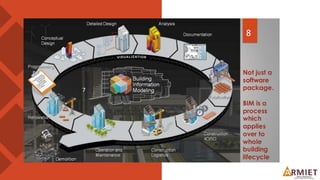
What is BIM? Building Information Modeling (BIM) is
a process that begins with the creation of an
intelligent 3D model and enables document
management, coordination and simulation during
the entire lifecycle of a project (plan, design, build,
operation and maintenance).
OR
Building Information Modeling, or BIM is a
parametric, 3D model that is used to generate plans,
sections, elevations, perspectives, details, schedules-
all of the necessary components to document the
design of a building.” Mastering Autodesk Revit
Architecture 2011
“ A Building Information Model serves as a shared
knowledge resource for information about a facility
forming a reliable basis for decisions during its life
cycle from inception onward.”
What is BIM?
Building Information Modeling (BIM) is a process focused on
the development, use, and transfer of a digital information
model of a building project to improve the design,
construction, and operations of a project or portfolio of
facilities. The National Building Information Modeling
Standards (NBIMS) Committee defines BIM as:
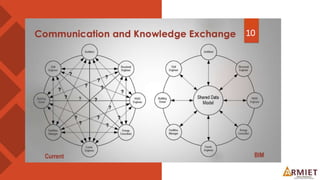
“ A digital representation of physical and functional
characteristics of a facility. A BIM is a shared knowledge
resource for information about a facility forming a reliable
basis for decisions during its life-cycle; defined as existing
from earliest conception to demolition. A basic premise of
BIM is the collaboration by different stakeholders at
different phases of the life cycle of a facility to insert,
extract, update or modify information in the BIM to support
and reflect the roles of that stakeholder.
BIM Process
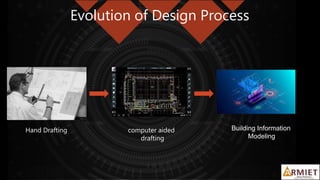
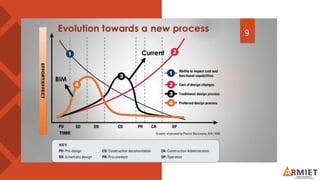
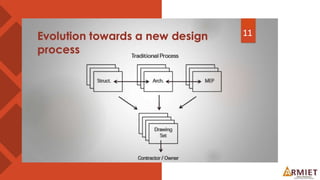
Evolution of Design Process
Hand Drafting computer aided
drafting
Building Information
Modeling
7
7
8
9
10
11
12
13
14
15
16
17
18
19
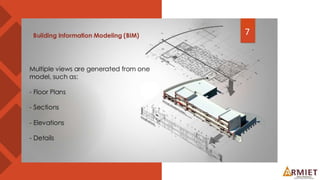
Building information modeling (bim)

Building information modeling (bim)

  • 1.
    BUILDING INFORMATION MODELING(BIM) Group Member SHAIKH MD AQUIB ARMIET/CL 18 SA 276 MANSHAUL REHMAN ARMIET/CL 18 MR 254 GADKARI FAIZAN ARMIET/CL 18 GF 226 CHOWKI ZAID EJAZ ARMIET/CL 18 CZ 219 PROJECT GUIDE PROF. VIKASH SINGH Department of Civil Engineering Alamuri Ratnamala Institute of Engineering & Technology , Shahapur 2020 -2021
  • 2.
    Table of contents Introduction  What is BIM?  BIM Process  BIM Application  BIM Advantages  BIM Workflow  Construction Industry with BIM
  • 3.
    Problems in ConstructionIndustry Lot of Challenges - Poorly Coordinated Design Documents - Change Orders & Rework - Delays & Cost Overruns - Claims & Litigation - Greater Risk - Poor Turnover Documents - Frustrated Owners - Tight Profit Margins - 25% of world solid waste. - Buildings consume 30% of raw materials. - Buildings consume 42% world’s energy Introduction
  • 4.
    What is BIM?Building Information Modeling (BIM) is a process that begins with the creation of an intelligent 3D model and enables document management, coordination and simulation during the entire lifecycle of a project (plan, design, build, operation and maintenance). OR Building Information Modeling, or BIM is a parametric, 3D model that is used to generate plans, sections, elevations, perspectives, details, schedules- all of the necessary components to document the design of a building.” Mastering Autodesk Revit Architecture 2011 “ A Building Information Model serves as a shared knowledge resource for information about a facility forming a reliable basis for decisions during its life cycle from inception onward.” What is BIM?
  • 5.
    Building Information Modeling(BIM) is a process focused on the development, use, and transfer of a digital information model of a building project to improve the design, construction, and operations of a project or portfolio of facilities. The National Building Information Modeling Standards (NBIMS) Committee defines BIM as: “ A digital representation of physical and functional characteristics of a facility. A BIM is a shared knowledge resource for information about a facility forming a reliable basis for decisions during its life-cycle; defined as existing from earliest conception to demolition. A basic premise of BIM is the collaboration by different stakeholders at different phases of the life cycle of a facility to insert, extract, update or modify information in the BIM to support and reflect the roles of that stakeholder. BIM Process
  • 6.
    Evolution of DesignProcess Hand Drafting computer aided drafting Building Information Modeling
  • 7.
  • 8.
  • 9.
  • 10.
  • 11.
  • 12.
  • 13.
  • 14.
  • 15.
  • 16.
  • 17.
  • 18.
  • 19.