BUILDING INFORMATION MODELING
19-201-0713 SEMINAR
Submitted by
NIRMAL JOHNSON
20119065
ROLL NO 8
CIVIL B
2019-2023
1
BUILDING
INFORMATION
MODELING
2
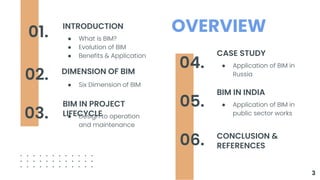
INTRODUCTION
● What is BIM?
● Evolution of BIM
● Benefits & Application
04.
05.
06.
01.
02.
03.
DIMENSION OF BIM
● Six Dimension of BIM
BIM IN PROJECT
LIFECYCLE
● Design to operation
and maintenance
CASE STUDY
● Application of BIM in
Russia
BIM IN INDIA
● Application of BIM in
public sector works
CONCLUSION &
REFERENCES
OVERVIEW
3
01
INTRODUCTION
4
WHAT IS BIM ?
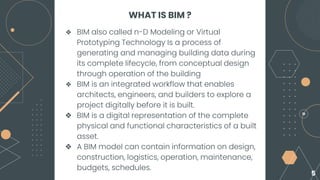
❖ BIM also called n-D Modeling or Virtual
Prototyping Technology Is a process of
generating and managing building data during
its complete lifecycle, from conceptual design
through operation of the building
❖ BIM is an integrated workflow that enables
architects, engineers, and builders to explore a
project digitally before it is built.
❖ BIM is a digital representation of the complete
physical and functional characteristics of a built
asset.
❖ A BIM model can contain information on design,
construction, logistics, operation, maintenance,
budgets, schedules.
5
INTEROPERABILITY MODEL
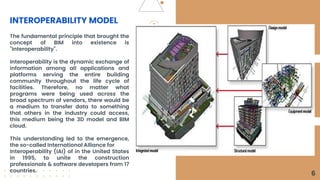
The fundamental principle that brought the
concept of BIM into existence is
"Interoperability".
Interoperability is the dynamic exchange of
information among all applications and
platforms serving the entire building
community throughout the life cycle of
facilities. Therefore, no matter what
programs were being used across the
broad spectrum of vendors, there would be
a medium to transfer data to something
that others in the industry could access,
this medium being the 3D model and BIM
cloud.
This understanding led to the emergence,
the so-called International Alliance for
Interoperability (IAI) of in the United States
in 1995, to unite the construction
professionals & software developers from 17
countries.
6
EVOLUTION OF BIM
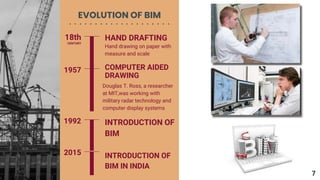
HAND DRAFTING
Hand drawing on paper with
measure and scale
18th
CENTURY
COMPUTER AIDED
DRAWING
Douglas T. Ross, a researcher
at MIT,was working with
military radar technology and
computer display systems
1957
INTRODUCTION OF
BIM
1992
INTRODUCTION OF
BIM IN INDIA
2015
7
APPLICATION OF BIM
4
8
5
7
3
1
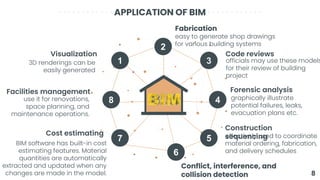
Visualization
3D renderings can be
easily generated
Code reviews
officials may use these models
for their review of building
project
Facilities management
use it for renovations,
space planning, and
maintenance operations.
Cost estimating
BIM software has built-in cost
estimating features. Material
quantities are automatically
extracted and updated when any
changes are made in the model.
Forensic analysis
graphically illustrate
potential failures, leaks,
evacuation plans etc.
Construction
sequencing
effectively used to coordinate
material ordering, fabrication,
and delivery schedules
2
6
Fabrication
easy to generate shop drawings
for various building systems
Conflict, interference, and
collision detection 8
DIMENSIONS
OF BIM
02
9
DIMENSIONS OF BIM
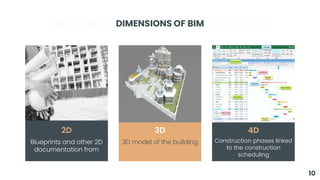
2D
Blueprints and other 2D
documentation from
3D
3D model of the building
4D
Construction phases linked
to the construction
scheduling
10
DIMENSIONS OF BIM
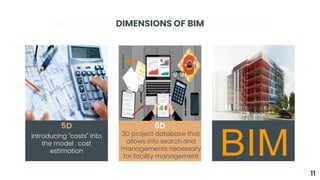
5D
Introducing "costs" into
the model : cost
estimation
6D
3D project database that
allows info search and
managements necessary
for facility management
11
03
BIM IN PROJECT
LIFECYCLE
12
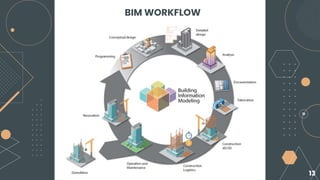
BIM WORKFLOW
13
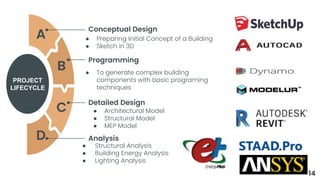
PROJECT
LIFECYCLE
A
B
C
D
Conceptual Design
Programming
Detailed Design
● Preparing Initial Concept of a Building
● Sketch in 3D
● To generate complex building
components with basic programing
techniques
● Architectural Model
● Structural Model
● MEP Model
Analysis
● Structural Analysis
● Building Energy Analysis
● Lighting Analysis
14
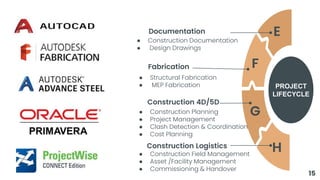
PROJECT
LIFECYCLE
H
G
F
E
Construction Logistics
Construction 4D/5D
Fabrication
● Construction Planning
● Project Management
● Clash Detection & Coordination
● Cost Planning
● Structural Fabrication
● MEP Fabrication
● Construction Documentation
● Design Drawings
Documentation
● Construction Field Management
● Asset /Facility Management
● Commissioning & Handover
15
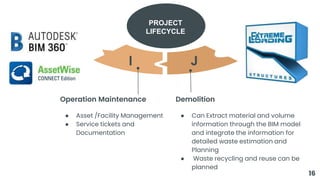
J
I
Demolition
● Can Extract material and volume
information through the BIM model
and integrate the information for
detailed waste estimation and
Planning
● Waste recycling and reuse can be
planned
Operation Maintenance
● Asset /Facility Management
● Service tickets and
Documentation
PROJECT
LIFECYCLE
16
CASE STUDY
BIM IN RUSSIA
04
17
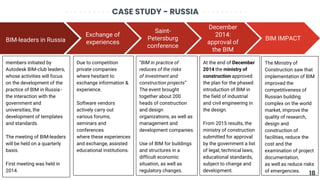
CASE STUDY - RUSSIA
BIM-leaders in Russia
members initiated by
Autodesk BIM-club leaders,
whose activities will focus
on the development of the
practice of BIM in Russia -
the interaction with the
government and
universities, the
development of templates
and standards.
The meeting of BIM-leaders
will be held on a quarterly
basis.
First meeting was held in
2014.
Exchange of
experiences
Due to competition
private companies
where hesitant to
exchange information &
experience.
Software vendors
actively carry out
various forums,
seminars and
conferences
where these experiences
and exchange, assisted
educational institutions.
Saint-
Petersburg
conference
“BIM in practice of
reduces of the risks
of investment and
construction projects”
The event brought
together about 200
heads of construction
and design
organizations, as well as
management and
development companies.
Use of BIM for buildings
and structures in a
difficult economic
situation, as well as
regulatory changes.
BIM IMPACT
The Ministry of
Construction saw that
implementation of BIM
improved the
competitiveness of
Russian building
complex on the world
market, improve the
quality of research,
design and
construction of
facilities, reduce the
cost and the
examination of project
documentation,
as well as reduce risks
of emergencies.
December
2014:
approval of
the BIM
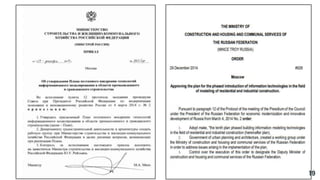
At the end of December
2014 the ministry of
construction approved
the plan for the phased
introduction of BIM in
the field of industrial
and civil engineering in
the design.
From 2015 results, the
ministry of construction
submitted for approval
by the government a list
of legal, technical laws,
educational standards,
subject to change and
development.
18
19
BIM IN INDIA
05
20
BIM IN INDIAN PUBLIC SECTOR
❖ Currently there is no mandate or legal regulation
for BIM in India
❖ If BIM was mandated by law,
➢ Enhance quality & saves time
➢ Reduces human errors and clerical errors
➢ Public transparency
➢ Reduce corruption in public sector works
➢ Easy to pay taxes and get legal sanctions.
➢ Easy to find law defaulters.
➢ Easy to carry out renovation
21
06
CONCLUSION &
REFERENCES
22
01.
02.
03.
WHAT IS BIM?
Brief introduction on Building
Information Modeling
BIM IN PROJECT LIFECYCLE
Design to operation and
maintenance
CASE STUDY
Application of BIM in
Russia
04. BIM IN PUBLIC SECTOR
Application of BIM in
public sector works
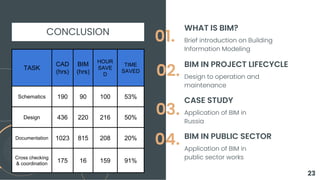
CONCLUSION
TASK
CAD
(hrs)
BIM
(hrs)
HOUR
SAVE
D
TIME
SAVED
Schematics 190 90 100 53%
Design 436 220 216 50%
Documentation 1023 815 208 20%
Cross checking
& coordination 175 16 159 91%
23
REFERENCES
1. Rebekka Volk, Julian Stengel, Frank Schultmann; [2014]; “Building Information Modeling (BIM) for existing buildings —
Literature review and future needs”; Automation in Construction; Volume 43; Pages 204.
1. Salman Azhar; Malik Khalfan; Tayyab Maqsood; [2012]; “Building Information Modeling (BIM): Now and beyond”;
Australasian Journal of Construction Economics and Building; Vol. 12; Pages 15-28.
1. Salman Azhar; [2009]; “Building Information Modeling (BIM): Trends, Benefits, Risks, and Challenges for the AEC Industry”;
Leadership and Management in Engineering; Vol. 11, Issue 3.
1. Karen Kensek; [2014]; “Building Information Modeling” ; First Edition.
1. Sebastiano Maltesea, Lavinia C. Tagliabueb, Fulvio Re Cecconia, Daniela Pasinia, Massimiliano Manfrenc, Angelo L.C.
Ciribinib; [2016]; “Sustainability assessment through green BIM for environmental,social and economic efficiency”;
International High- Performance Built Environment Conference – A Sustainable Built Environment Conference 2016 Series.
1. Rafael Sacks, Charles Eastman, Ghang Lee, Paul Teicholz; [2018]; “BIM Handbook”; Third Edition.
1. Nikolay Shubin; [2015]; “Possibilities of BIM in Russia”; Saimaa University of Applied Sciences, Lappeenranta.
1. Sai Yerrapathruni, John I. Messner, Anthony J. Baratta and Michael J. Horman; [2002]; “Using 4D CAD and Immersive Virtual
Environments to Improve Construction Planning”; Google Scholar.
24
THANK
YOU
25

BIM PPT - NIRMAL JOHNSON.pptx

  • 1.
    BUILDING INFORMATION MODELING 19-201-0713SEMINAR Submitted by NIRMAL JOHNSON 20119065 ROLL NO 8 CIVIL B 2019-2023 1
  • 2.
  • 3.
    INTRODUCTION ● What isBIM? ● Evolution of BIM ● Benefits & Application 04. 05. 06. 01. 02. 03. DIMENSION OF BIM ● Six Dimension of BIM BIM IN PROJECT LIFECYCLE ● Design to operation and maintenance CASE STUDY ● Application of BIM in Russia BIM IN INDIA ● Application of BIM in public sector works CONCLUSION & REFERENCES OVERVIEW 3
  • 4.
  • 5.
    WHAT IS BIM? ❖ BIM also called n-D Modeling or Virtual Prototyping Technology Is a process of generating and managing building data during its complete lifecycle, from conceptual design through operation of the building ❖ BIM is an integrated workflow that enables architects, engineers, and builders to explore a project digitally before it is built. ❖ BIM is a digital representation of the complete physical and functional characteristics of a built asset. ❖ A BIM model can contain information on design, construction, logistics, operation, maintenance, budgets, schedules. 5
  • 6.
    INTEROPERABILITY MODEL The fundamentalprinciple that brought the concept of BIM into existence is "Interoperability". Interoperability is the dynamic exchange of information among all applications and platforms serving the entire building community throughout the life cycle of facilities. Therefore, no matter what programs were being used across the broad spectrum of vendors, there would be a medium to transfer data to something that others in the industry could access, this medium being the 3D model and BIM cloud. This understanding led to the emergence, the so-called International Alliance for Interoperability (IAI) of in the United States in 1995, to unite the construction professionals & software developers from 17 countries. 6
  • 7.
    EVOLUTION OF BIM HANDDRAFTING Hand drawing on paper with measure and scale 18th CENTURY COMPUTER AIDED DRAWING Douglas T. Ross, a researcher at MIT,was working with military radar technology and computer display systems 1957 INTRODUCTION OF BIM 1992 INTRODUCTION OF BIM IN INDIA 2015 7
  • 8.
    APPLICATION OF BIM 4 8 5 7 3 1 Visualization 3Drenderings can be easily generated Code reviews officials may use these models for their review of building project Facilities management use it for renovations, space planning, and maintenance operations. Cost estimating BIM software has built-in cost estimating features. Material quantities are automatically extracted and updated when any changes are made in the model. Forensic analysis graphically illustrate potential failures, leaks, evacuation plans etc. Construction sequencing effectively used to coordinate material ordering, fabrication, and delivery schedules 2 6 Fabrication easy to generate shop drawings for various building systems Conflict, interference, and collision detection 8
  • 9.
  • 10.
    DIMENSIONS OF BIM 2D Blueprintsand other 2D documentation from 3D 3D model of the building 4D Construction phases linked to the construction scheduling 10
  • 11.
    DIMENSIONS OF BIM 5D Introducing"costs" into the model : cost estimation 6D 3D project database that allows info search and managements necessary for facility management 11
  • 12.
  • 13.
  • 14.
    PROJECT LIFECYCLE A B C D Conceptual Design Programming Detailed Design ●Preparing Initial Concept of a Building ● Sketch in 3D ● To generate complex building components with basic programing techniques ● Architectural Model ● Structural Model ● MEP Model Analysis ● Structural Analysis ● Building Energy Analysis ● Lighting Analysis 14
  • 15.
    PROJECT LIFECYCLE H G F E Construction Logistics Construction 4D/5D Fabrication ●Construction Planning ● Project Management ● Clash Detection & Coordination ● Cost Planning ● Structural Fabrication ● MEP Fabrication ● Construction Documentation ● Design Drawings Documentation ● Construction Field Management ● Asset /Facility Management ● Commissioning & Handover 15
  • 16.
    J I Demolition ● Can Extractmaterial and volume information through the BIM model and integrate the information for detailed waste estimation and Planning ● Waste recycling and reuse can be planned Operation Maintenance ● Asset /Facility Management ● Service tickets and Documentation PROJECT LIFECYCLE 16
  • 17.
    CASE STUDY BIM INRUSSIA 04 17
  • 18.
    CASE STUDY -RUSSIA BIM-leaders in Russia members initiated by Autodesk BIM-club leaders, whose activities will focus on the development of the practice of BIM in Russia - the interaction with the government and universities, the development of templates and standards. The meeting of BIM-leaders will be held on a quarterly basis. First meeting was held in 2014. Exchange of experiences Due to competition private companies where hesitant to exchange information & experience. Software vendors actively carry out various forums, seminars and conferences where these experiences and exchange, assisted educational institutions. Saint- Petersburg conference “BIM in practice of reduces of the risks of investment and construction projects” The event brought together about 200 heads of construction and design organizations, as well as management and development companies. Use of BIM for buildings and structures in a difficult economic situation, as well as regulatory changes. BIM IMPACT The Ministry of Construction saw that implementation of BIM improved the competitiveness of Russian building complex on the world market, improve the quality of research, design and construction of facilities, reduce the cost and the examination of project documentation, as well as reduce risks of emergencies. December 2014: approval of the BIM At the end of December 2014 the ministry of construction approved the plan for the phased introduction of BIM in the field of industrial and civil engineering in the design. From 2015 results, the ministry of construction submitted for approval by the government a list of legal, technical laws, educational standards, subject to change and development. 18
  • 19.
  • 20.
  • 21.
    BIM IN INDIANPUBLIC SECTOR ❖ Currently there is no mandate or legal regulation for BIM in India ❖ If BIM was mandated by law, ➢ Enhance quality & saves time ➢ Reduces human errors and clerical errors ➢ Public transparency ➢ Reduce corruption in public sector works ➢ Easy to pay taxes and get legal sanctions. ➢ Easy to find law defaulters. ➢ Easy to carry out renovation 21
  • 22.
  • 23.
    01. 02. 03. WHAT IS BIM? Briefintroduction on Building Information Modeling BIM IN PROJECT LIFECYCLE Design to operation and maintenance CASE STUDY Application of BIM in Russia 04. BIM IN PUBLIC SECTOR Application of BIM in public sector works CONCLUSION TASK CAD (hrs) BIM (hrs) HOUR SAVE D TIME SAVED Schematics 190 90 100 53% Design 436 220 216 50% Documentation 1023 815 208 20% Cross checking & coordination 175 16 159 91% 23
  • 24.
    REFERENCES 1. Rebekka Volk,Julian Stengel, Frank Schultmann; [2014]; “Building Information Modeling (BIM) for existing buildings — Literature review and future needs”; Automation in Construction; Volume 43; Pages 204. 1. Salman Azhar; Malik Khalfan; Tayyab Maqsood; [2012]; “Building Information Modeling (BIM): Now and beyond”; Australasian Journal of Construction Economics and Building; Vol. 12; Pages 15-28. 1. Salman Azhar; [2009]; “Building Information Modeling (BIM): Trends, Benefits, Risks, and Challenges for the AEC Industry”; Leadership and Management in Engineering; Vol. 11, Issue 3. 1. Karen Kensek; [2014]; “Building Information Modeling” ; First Edition. 1. Sebastiano Maltesea, Lavinia C. Tagliabueb, Fulvio Re Cecconia, Daniela Pasinia, Massimiliano Manfrenc, Angelo L.C. Ciribinib; [2016]; “Sustainability assessment through green BIM for environmental,social and economic efficiency”; International High- Performance Built Environment Conference – A Sustainable Built Environment Conference 2016 Series. 1. Rafael Sacks, Charles Eastman, Ghang Lee, Paul Teicholz; [2018]; “BIM Handbook”; Third Edition. 1. Nikolay Shubin; [2015]; “Possibilities of BIM in Russia”; Saimaa University of Applied Sciences, Lappeenranta. 1. Sai Yerrapathruni, John I. Messner, Anthony J. Baratta and Michael J. Horman; [2002]; “Using 4D CAD and Immersive Virtual Environments to Improve Construction Planning”; Google Scholar. 24
  • 25.