BeyondCorp: Closing the Adherence Gap
BeyondCorp Boston Meetup - Feb 13th 2018
Ivan Dwyer | @fortyfivan
The Adherence Gap: A Written Policy That Isn’t Enforceable In Practice
All Too Common Behaviors
● Sharing/committing passwords and keys
● Not revoking credentials when employees leave
● Giving contractors too much privileged access
● Connecting to resources using unpatched devices
● Not logging and/or monitoring user activity
● Not assigning role based access controls
Google Got it Right With BeyondCorp
1 Connecting from a particular network must not determine which services you can access
2 Access to services is granted based on what we know about you and your device
3 All access to services must be authenticated, authorized, and encrypted
Mission: To have every Google employee work successfully
from untrusted networks without the use of a VPN
A Zero Trust State of Mind
Redefine Corporate Identity
Is the user in good standing with the company?
Does the user belong to the Engineering org?
Is the user on Team A working on feature X?
Is the device in inventory?
Is the device’s disk encrypted?
Is the device’s OS up to date?
Identity = You + Your Device at a Point-in-Time
Make Smarter Decisions in Context
“You can’t submit source code from an
unpatched device”
“You can only reach the company wiki
from a managed device”
“Your disk must be encrypted to access
the confidential file repository”
“You can view the corporate phone
directory from any device”
Real-time trust attestation based on dynamic conditions
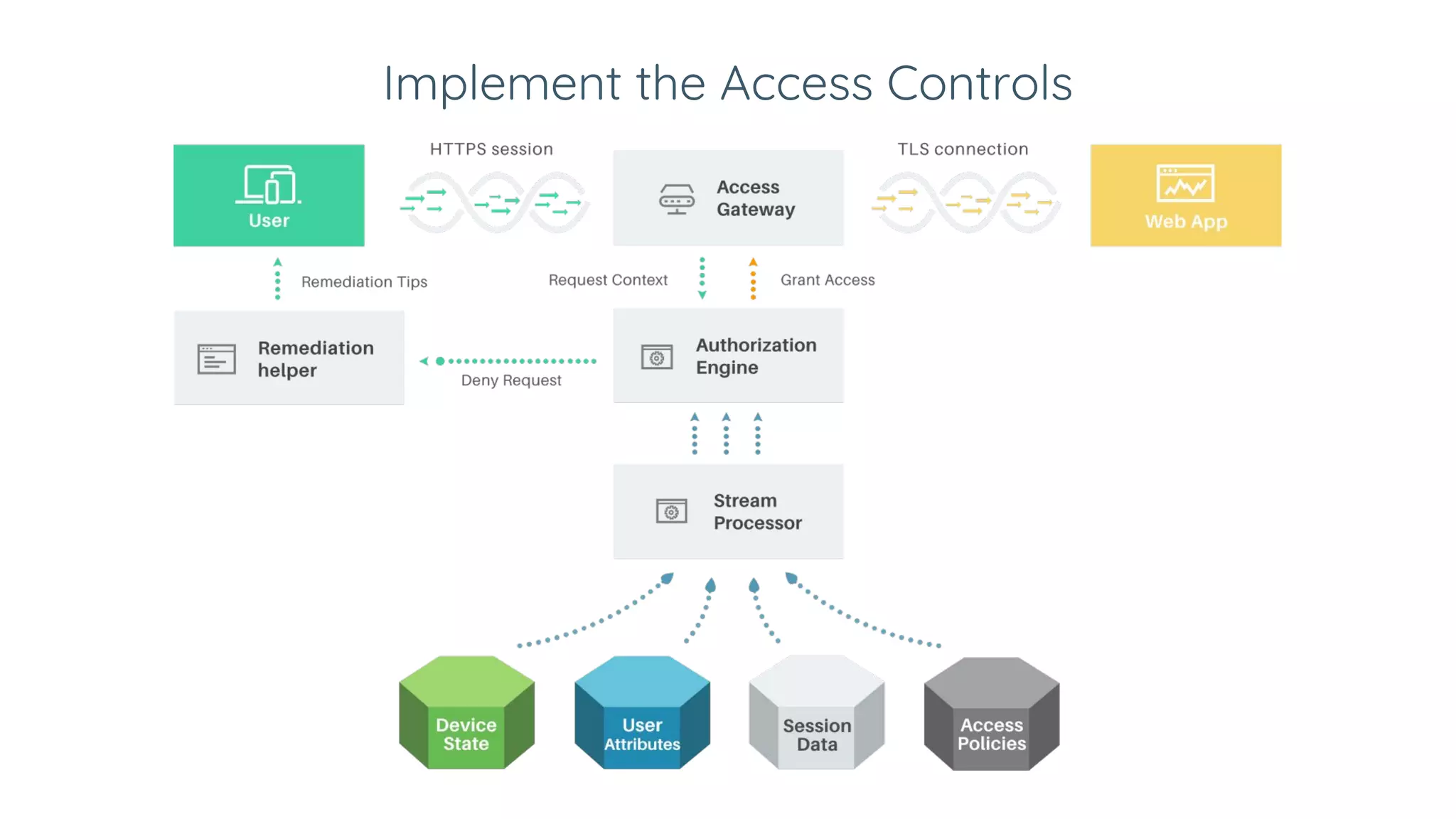
Remove Trust From the Network
Access
Controls
Why the request was denied
request context
NO
YES
Access
Policies
AuthN AuthZ
Centralize access controls at Layer 7 where policy can be enforced
Eliminate Static Credentials
➔ Issue short-lived client certificates or web
tokens to initiate secure sessions
➔ Inject metadata about the user and connecting
device into the credential
➔ Limit each credential in scope and time,
making it near impossible to hijack
Dynamic attestation needs a dynamic credential to match
Getting Started With BeyondCorp
The Discovery Phase
1 Take an inventory of all employee devices - workstations, laptops, tablets, and phones
2 Take an inventory of all company resources to protect - apps, databases, servers, etc.
3 Take an inventory of all static credentials - shared passwords, ssh keys, etc.
4 Diagram your system architecture and inspect traffic logs to understand behavior
5 Monitor device state - is the software up to date? Is the disk encrypted?
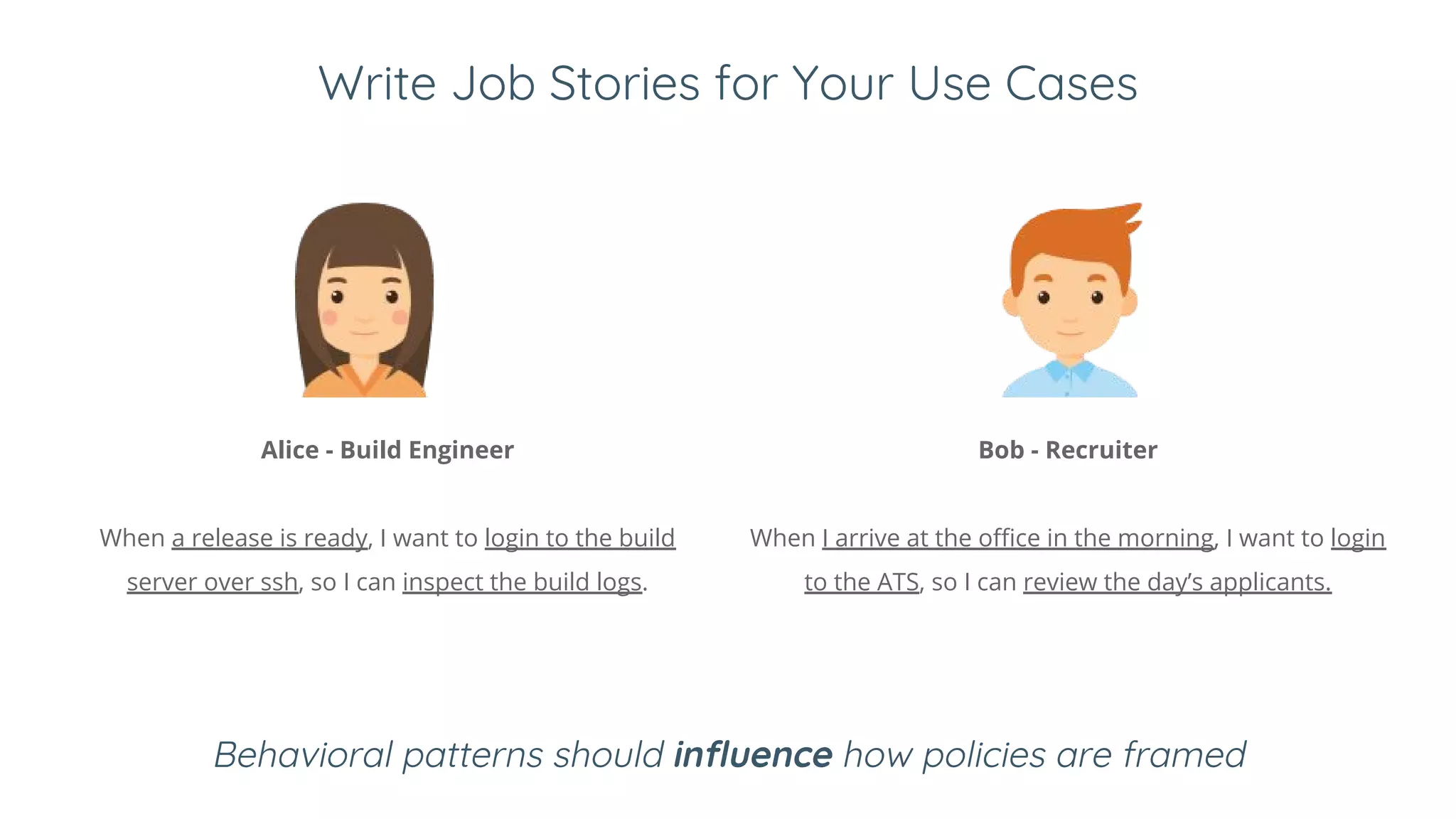
Write Job Stories for Your Use Cases
Alice - Build Engineer
When a release is ready, I want to login to the build
server over ssh, so I can inspect the build logs.
Bob - Recruiter
When I arrive at the office in the morning, I want to login
to the ATS, so I can review the day’s applicants.
Behavioral patterns should influence how policies are framed
Determine Your Policy Framework
➔ Role based access controls
➔ User attributes
➔ Device state
➔ Location-based rules
➔ Time-based controls
➔ Team federation
➔ Resource specific rules
Trust Tiers
User and device metrics are analyzed and placed in a tier
which must match the minimum tier associated with the
resource
Scoring System
User and device metrics are compiled and granted a
score which must match the minimum level associated
with the resource
Assertions
User and device attributes and state are individually
matched against an Access Policy where all assertions
must be true
Implement the Access Controls
THANKS!!
Get in touch: ivan.dwyer@scaleft.com | @fortyfivan
www.scaleft.com
www.beyondcorp.com

BeyondCorp Boston Meetup: Closing the Adherence Gap

  • 1.
    BeyondCorp: Closing theAdherence Gap BeyondCorp Boston Meetup - Feb 13th 2018 Ivan Dwyer | @fortyfivan
  • 2.
    The Adherence Gap:A Written Policy That Isn’t Enforceable In Practice
  • 3.
    All Too CommonBehaviors ● Sharing/committing passwords and keys ● Not revoking credentials when employees leave ● Giving contractors too much privileged access ● Connecting to resources using unpatched devices ● Not logging and/or monitoring user activity ● Not assigning role based access controls
  • 4.
    Google Got itRight With BeyondCorp 1 Connecting from a particular network must not determine which services you can access 2 Access to services is granted based on what we know about you and your device 3 All access to services must be authenticated, authorized, and encrypted Mission: To have every Google employee work successfully from untrusted networks without the use of a VPN
  • 5.
    A Zero TrustState of Mind
  • 6.
    Redefine Corporate Identity Isthe user in good standing with the company? Does the user belong to the Engineering org? Is the user on Team A working on feature X? Is the device in inventory? Is the device’s disk encrypted? Is the device’s OS up to date? Identity = You + Your Device at a Point-in-Time
  • 7.
    Make Smarter Decisionsin Context “You can’t submit source code from an unpatched device” “You can only reach the company wiki from a managed device” “Your disk must be encrypted to access the confidential file repository” “You can view the corporate phone directory from any device” Real-time trust attestation based on dynamic conditions
  • 8.
    Remove Trust Fromthe Network Access Controls Why the request was denied request context NO YES Access Policies AuthN AuthZ Centralize access controls at Layer 7 where policy can be enforced
  • 9.
    Eliminate Static Credentials ➔Issue short-lived client certificates or web tokens to initiate secure sessions ➔ Inject metadata about the user and connecting device into the credential ➔ Limit each credential in scope and time, making it near impossible to hijack Dynamic attestation needs a dynamic credential to match
  • 10.
  • 11.
    The Discovery Phase 1Take an inventory of all employee devices - workstations, laptops, tablets, and phones 2 Take an inventory of all company resources to protect - apps, databases, servers, etc. 3 Take an inventory of all static credentials - shared passwords, ssh keys, etc. 4 Diagram your system architecture and inspect traffic logs to understand behavior 5 Monitor device state - is the software up to date? Is the disk encrypted?
  • 12.
    Write Job Storiesfor Your Use Cases Alice - Build Engineer When a release is ready, I want to login to the build server over ssh, so I can inspect the build logs. Bob - Recruiter When I arrive at the office in the morning, I want to login to the ATS, so I can review the day’s applicants. Behavioral patterns should influence how policies are framed
  • 13.
    Determine Your PolicyFramework ➔ Role based access controls ➔ User attributes ➔ Device state ➔ Location-based rules ➔ Time-based controls ➔ Team federation ➔ Resource specific rules Trust Tiers User and device metrics are analyzed and placed in a tier which must match the minimum tier associated with the resource Scoring System User and device metrics are compiled and granted a score which must match the minimum level associated with the resource Assertions User and device attributes and state are individually matched against an Access Policy where all assertions must be true
  • 14.
  • 15.
    THANKS!! Get in touch:ivan.dwyer@scaleft.com | @fortyfivan www.scaleft.com www.beyondcorp.com