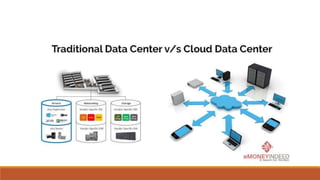
Traditional Data Center
Vs Cloud Based Data
Centers
Traditional Data Center
On-premises solutions, sometimes shortened to “on-prem,” are those that are deployed in
the traditional manner. Servers are acquired, operating systems are installed, other
hardware may be involved, but all of that lives within your four walls, or the walls of your
datacenter. You can reach out and touch on-prem solutions. You’re responsible for them, to
at least some degree. You might virtualize the servers, but the physical hosts are still there.
You might outsource management to a service integrator, but you still provide the physical
security, the electricity, and the balance sheet entries to carry the assets. You might have
the hardware in a cage within a shared datacenter or hosting facility, but they are still
tangible, physical assets for which you are responsible.
Cloud Based Data Center
Cloud computing promises more power, safer data, and easier access to the information and
tools needed for success in any industry or organization.
It provides a complete array of IT infrastructure and services for migrating smoothly and cost-
effectively into the era of cloud computing — end-to-end solutions that ensure efficiency agility
and openness for users, applications, and data.
The main difference between a cloud and a data center is that a cloud is an
off-premise form of computing that stores data on the Internet, whereas a
data center refers to on-premise hardware that stores data within an
organization's local network.
Cloud Offering- 1. Characteristics
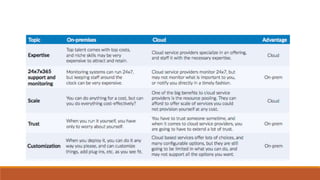
On-demand self-service: once services are established, the customer should be able to
provision new users, services, virtual machines, etc. without involving the cloud service
provider.
Broad network access: cloud services are typically accessed over the Internet, as opposed to
being on an internal network accessible only over private connections.
Resource pooling: there is some degree of shared resources from which services draw as
needed.
Rapid elasticity: customers’ needs may expand or contract, and the service will expand or
contract with those needs.
Measured service: customers are billed based on some measured consumption. That could be
licenses, or CPU cycles, or Gigabytes of storage consumed, or number of mailboxes; whatever
the thing measured, that is how customers are billed. You pay for what you use.
2. Service Models
Software as a Service (SaaS): Applications that could be email, CRM, cloud storage, etc.
Platform as a Service (PaaS): This includes web sites, web applications, etc.
Infrastructure as a Service (IaaS): Typically, virtual machines hosted in the cloud and made
available to the customer, who maintains the opera ng system on up.
3. Deployment Models
Private cloud: The private cloud is used exclusively by one user.
Community cloud: The cloud is used exclusively by a group of people or a community.
Public cloud: Used openly by the general public.
Hybrid cloud: It’s made up of two or more deployment models (private, community and public)
within the same organization.
Which is best?
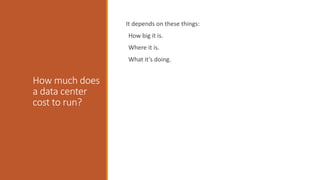
How much does
a data center
cost to run?
It depends on these things:
How big it is.
Where it is.
What it’s doing.
THE COST OF RUNNING A TRADITIONAL
DATA CENTER
Although each data center is a little different, the average cost per year to operate a large data
center is usually between $10 million to $25 million.
42 percent: Hardware, software, disaster recovery arrangements, uninterrupted power supplies,
and networking.
58 percent: Heating, air conditioning, property and sales taxes, and labor costs. (In fact, as much
as 40 percent of annual costs are labor alone.)
The reality of the traditional data center is further complicated because most of the costs
maintain existing (and sometimes aging) applications and infrastructure. Some estimates show
80 percent of spending on maintenance.
Most data centers run a lot of different applications and have a wide variety of workloads.
Many of the most important applications running in data centers are actually used by only a
relatively few employees.
Some applications that run on older systems are taken off the market (no longer sold) but are
still necessary for business.
Because of the nature of these applications, it probably wouldn’t be cost effective to move these
environments to the cloud.
THE COST OF RUNNING A CLOUD DATA
CENTER
In this case cloud data centers means data centers with 10,000 or more servers on site, all
devoted to running very few applications that are built with consistent infrastructure
components (such as racks, hardware, OS, networking, and so on).
Cloud data centers are
•Constructed for a different purpose.
•Created at a different time than the traditional data center.
•Built to a different scale.
•Not constrained by the same limitations.
•Perform different workloads than traditional data centers.
Estimates for how much it costs to build a cloud data center include three cost factors:
Labor costs are 6 percent of the total costs of operating the cloud data center.
Power distribution and cooling are 20 percent.
Computing costs are 48 percent.
Reference
http://wikibon.org/wiki/v/The_Data_Center:_Past,_Present_and_Future
http://e.huawei.com/in/solutions/business-needs/data-center/datacenter
http://www.datacenterjournal.com/cloud-datacenters-differ-traditional-datacenters-2/
http://www.dummies.com/programming/cloud-computing/comparing-traditional-data-center-
and-cloud-data-center-operating-costs/
https://www.gfi.com/whitepapers/Hybrid_Technology.pdf

Traditioanal vs-cloud based Data Centers

  • 1.
    Traditional Data Center VsCloud Based Data Centers
  • 2.
    Traditional Data Center On-premisessolutions, sometimes shortened to “on-prem,” are those that are deployed in the traditional manner. Servers are acquired, operating systems are installed, other hardware may be involved, but all of that lives within your four walls, or the walls of your datacenter. You can reach out and touch on-prem solutions. You’re responsible for them, to at least some degree. You might virtualize the servers, but the physical hosts are still there. You might outsource management to a service integrator, but you still provide the physical security, the electricity, and the balance sheet entries to carry the assets. You might have the hardware in a cage within a shared datacenter or hosting facility, but they are still tangible, physical assets for which you are responsible.
  • 3.
    Cloud Based DataCenter Cloud computing promises more power, safer data, and easier access to the information and tools needed for success in any industry or organization. It provides a complete array of IT infrastructure and services for migrating smoothly and cost- effectively into the era of cloud computing — end-to-end solutions that ensure efficiency agility and openness for users, applications, and data.
  • 5.
    The main differencebetween a cloud and a data center is that a cloud is an off-premise form of computing that stores data on the Internet, whereas a data center refers to on-premise hardware that stores data within an organization's local network.
  • 6.
    Cloud Offering- 1.Characteristics On-demand self-service: once services are established, the customer should be able to provision new users, services, virtual machines, etc. without involving the cloud service provider. Broad network access: cloud services are typically accessed over the Internet, as opposed to being on an internal network accessible only over private connections. Resource pooling: there is some degree of shared resources from which services draw as needed. Rapid elasticity: customers’ needs may expand or contract, and the service will expand or contract with those needs. Measured service: customers are billed based on some measured consumption. That could be licenses, or CPU cycles, or Gigabytes of storage consumed, or number of mailboxes; whatever the thing measured, that is how customers are billed. You pay for what you use.
  • 7.
    2. Service Models Softwareas a Service (SaaS): Applications that could be email, CRM, cloud storage, etc. Platform as a Service (PaaS): This includes web sites, web applications, etc. Infrastructure as a Service (IaaS): Typically, virtual machines hosted in the cloud and made available to the customer, who maintains the opera ng system on up.
  • 8.
    3. Deployment Models Privatecloud: The private cloud is used exclusively by one user. Community cloud: The cloud is used exclusively by a group of people or a community. Public cloud: Used openly by the general public. Hybrid cloud: It’s made up of two or more deployment models (private, community and public) within the same organization.
  • 9.
  • 12.
    How much does adata center cost to run? It depends on these things: How big it is. Where it is. What it’s doing.
  • 13.
    THE COST OFRUNNING A TRADITIONAL DATA CENTER Although each data center is a little different, the average cost per year to operate a large data center is usually between $10 million to $25 million. 42 percent: Hardware, software, disaster recovery arrangements, uninterrupted power supplies, and networking. 58 percent: Heating, air conditioning, property and sales taxes, and labor costs. (In fact, as much as 40 percent of annual costs are labor alone.) The reality of the traditional data center is further complicated because most of the costs maintain existing (and sometimes aging) applications and infrastructure. Some estimates show 80 percent of spending on maintenance.
  • 14.
    Most data centersrun a lot of different applications and have a wide variety of workloads. Many of the most important applications running in data centers are actually used by only a relatively few employees. Some applications that run on older systems are taken off the market (no longer sold) but are still necessary for business. Because of the nature of these applications, it probably wouldn’t be cost effective to move these environments to the cloud.
  • 15.
    THE COST OFRUNNING A CLOUD DATA CENTER In this case cloud data centers means data centers with 10,000 or more servers on site, all devoted to running very few applications that are built with consistent infrastructure components (such as racks, hardware, OS, networking, and so on). Cloud data centers are •Constructed for a different purpose. •Created at a different time than the traditional data center. •Built to a different scale. •Not constrained by the same limitations. •Perform different workloads than traditional data centers.
  • 16.
    Estimates for howmuch it costs to build a cloud data center include three cost factors: Labor costs are 6 percent of the total costs of operating the cloud data center. Power distribution and cooling are 20 percent. Computing costs are 48 percent.
  • 17.