BeyondCorp and Zero Trust
Bay Area Cyber Security Meetup - Sep 7th 2017
Ivan Dwyer | VP of Product Marketing | @fortyfivan
The BeyondCorp story begins with Operation Aurora
Google Got it Right With BeyondCorp
1 Connecting from a particular network must not determine which services you can access
2 Access to services is granted based on what we know about you and your device
3 All access to services must be authenticated, authorized, and encrypted
Mission: To have every Google employee work successfully
from untrusted networks without the use of a VPN
Google’s Reference Architecture
The Major Components
Identity Provider
The corporate system of record for employees and
contractors, with groups and roles
Device Inventory Service
A system that continuously collects and processes the
attributes and state of known devices
Trust Inferer
A system that continuously analyzes device attributes
and state to determine its trust tier
Access Policies
A programmatic representation of the resources, trust
tiers, and other rules that must be satisfied
Access Proxy
A reverse proxy service placed in front of every
resource that handles the requests
Access Control Engine
A centralized policy enforcement service that makes
authorization decisions in real time
Key Outcomes for Google
➔ Eliminated the use of perimeter-based
network security controls – VPNs
➔ Streamlined end user experience for all
Google employees across the globe
➔ More visibility into employee activity to
identify behavioral patterns
➔ A 30% reduction in IT Support tickets
through a better user experience
Zero Trust is BeyondCorp For Everyone Else
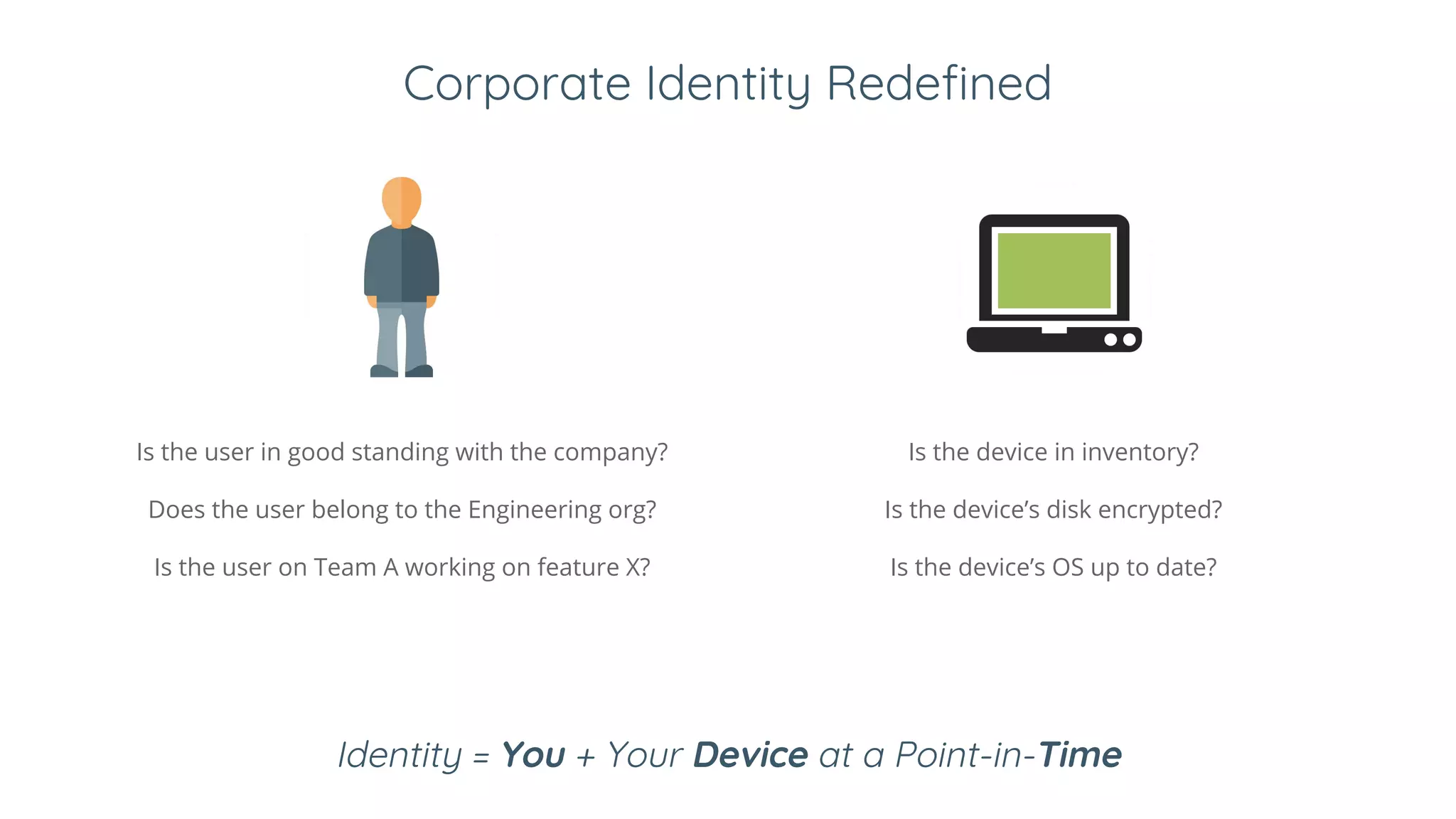
Corporate Identity Redefined
Is the user in good standing with the company?
Does the user belong to the Engineering org?
Is the user on Team A working on feature X?
Is the device in inventory?
Is the device’s disk encrypted?
Is the device’s OS up to date?
Identity = You + Your Device at a Point-in-Time
Smarter Decision Making
“You can’t submit source code from an
unpatched device”
“You can only reach the company wiki
from a managed device”
“Your disk must be encrypted to access
the confidential file repository”
“You can view the corporate phone
directory from any device”
Real-time trust attestation based on dynamic conditions
Better Security Posture
➔ Keeping devices up-to-date with the latest software
➔ Maintaining an inventory of employee devices
➔ Monitoring all endpoints & logging all traffic
➔ Only communicating over fully encrypted channels
➔ Incorporating multi-factor auth
➔ Eliminating the use of static credentials
When security is usable, people like it and keep up with it
How to Achieve Your Own Zero Trust Architecture
Collect Your Relevant Data
1 Take an inventory of all employee devices - workstations, laptops, tablets, and phones
2 Take an inventory of all company resources to protect - apps, databases, servers, etc.
3 Take an inventory of all static credentials - shared passwords, ssh keys, etc.
4 Diagram your system architecture and inspect traffic logs to understand behavior
5 Collect device state - is the software up to date? Is the disk encrypted?
Determine the Right Policy Framework
➔ User attributes
➔ Device state
➔ Location-based rules
➔ Time-based controls
➔ Groups and roles
➔ Team federation
➔ Resource specific rules
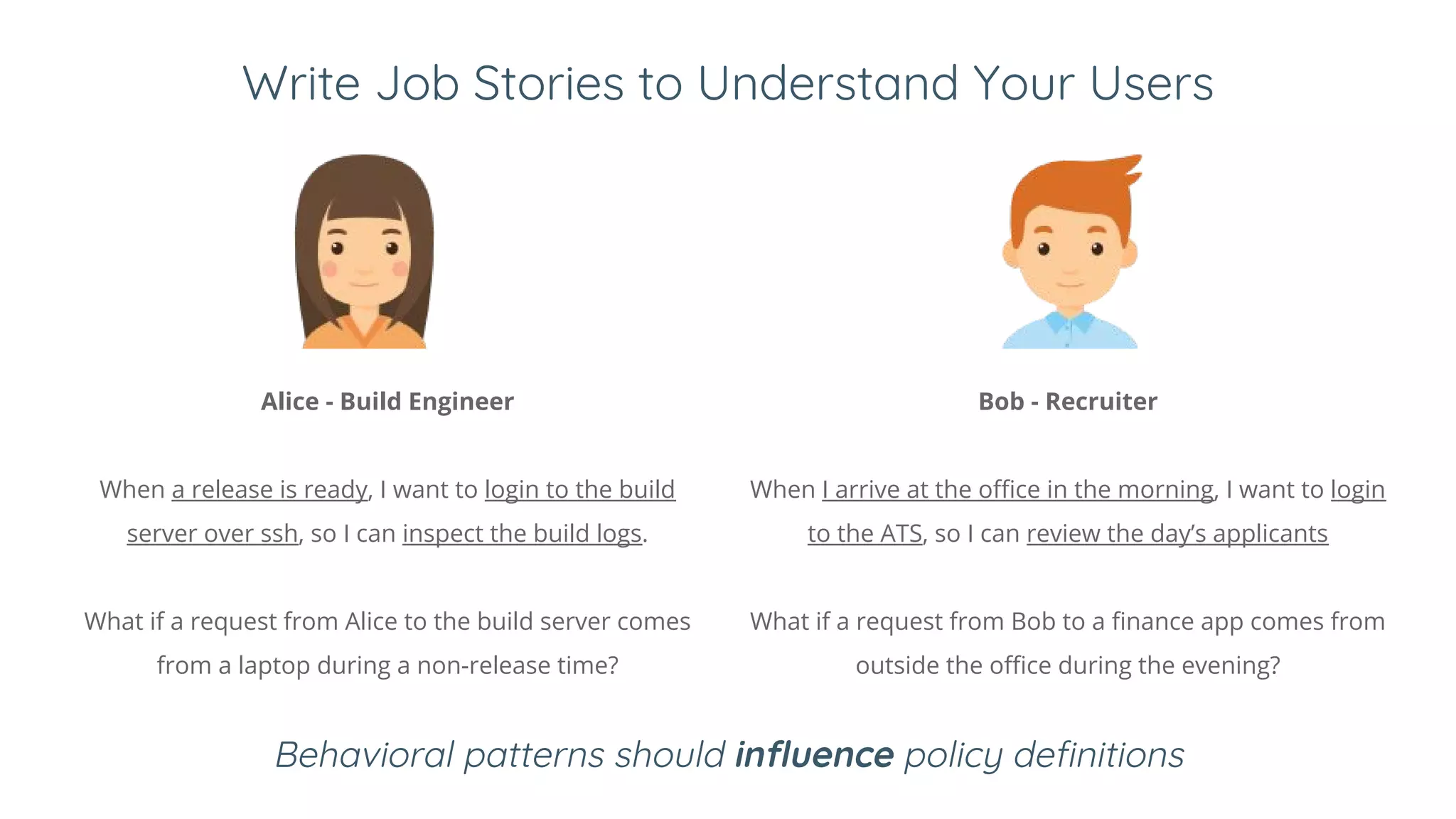
Write Job Stories to Understand Your Users
Behavioral patterns should influence policy definitions
Alice - Build Engineer
When a release is ready, I want to login to the build
server over ssh, so I can inspect the build logs.
What if a request from Alice to the build server comes
from a laptop during a non-release time?
Bob - Recruiter
When I arrive at the office in the morning, I want to login
to the ATS, so I can review the day’s applicants
What if a request from Bob to a finance app comes from
outside the office during the evening?
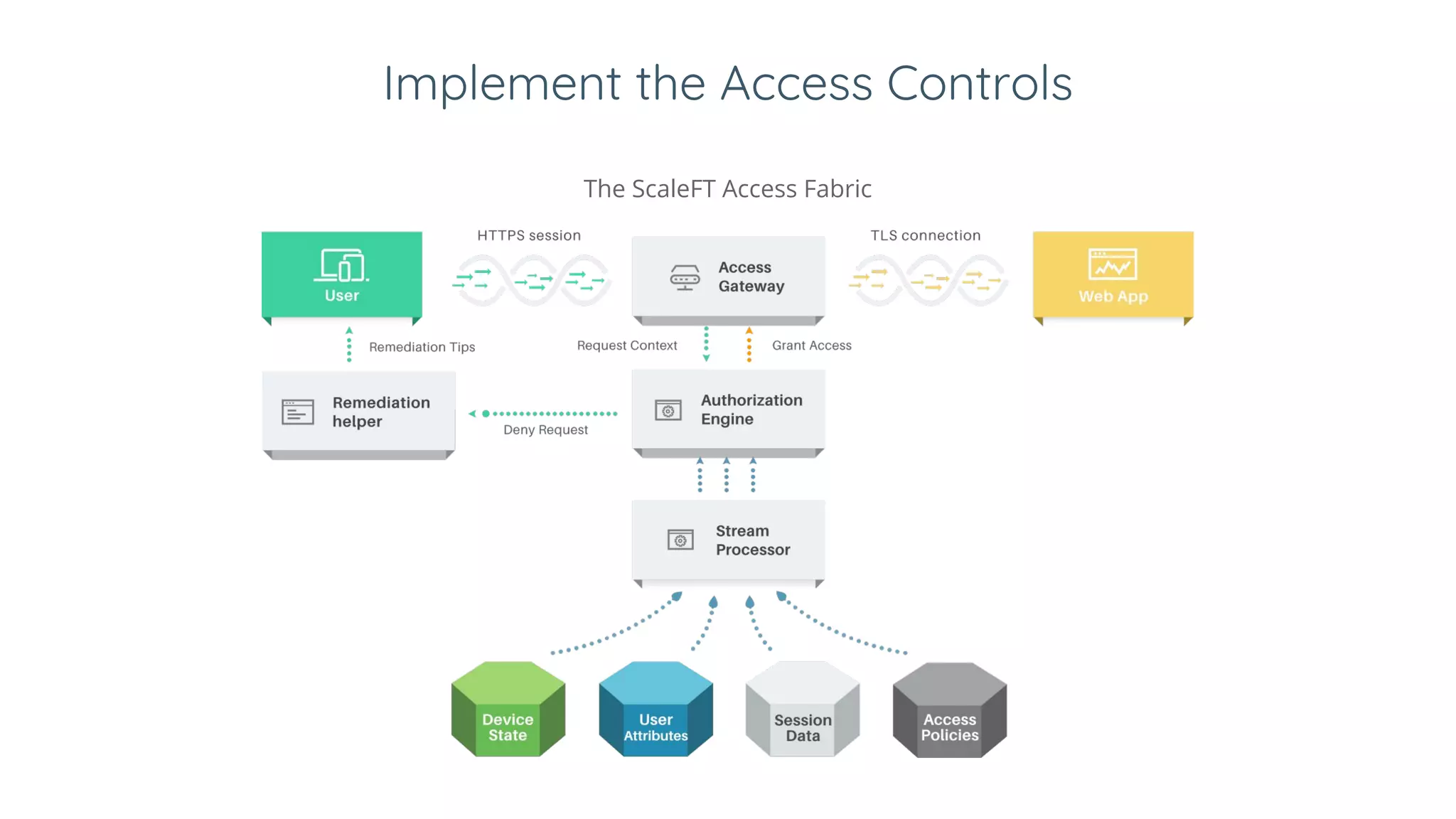
Implement the Access Controls
The ScaleFT Access Fabric
Recommendations
1 You don’t have to build the whole system yourself - leverage solutions for the hard parts
2 Be selective with the environments you support - operating systems, protocols, etc.
3 Start with simple global coarse-grained access policies before getting too fine-grained
4 Test your new system with simple apps that don’t contain sensitive data
5 Keep your network controls in place until absolutely confident the new system works
Companies Who Have Been Successful
THANKS!!
Get in touch: ivan.dwyer@scaleft.com | @fortyfivan
www.scaleft.com
www.beyondcorp.com

BeyondCorp and Zero Trust

  • 1.
    BeyondCorp and ZeroTrust Bay Area Cyber Security Meetup - Sep 7th 2017 Ivan Dwyer | VP of Product Marketing | @fortyfivan
  • 2.
    The BeyondCorp storybegins with Operation Aurora
  • 3.
    Google Got itRight With BeyondCorp 1 Connecting from a particular network must not determine which services you can access 2 Access to services is granted based on what we know about you and your device 3 All access to services must be authenticated, authorized, and encrypted Mission: To have every Google employee work successfully from untrusted networks without the use of a VPN
  • 4.
  • 5.
    The Major Components IdentityProvider The corporate system of record for employees and contractors, with groups and roles Device Inventory Service A system that continuously collects and processes the attributes and state of known devices Trust Inferer A system that continuously analyzes device attributes and state to determine its trust tier Access Policies A programmatic representation of the resources, trust tiers, and other rules that must be satisfied Access Proxy A reverse proxy service placed in front of every resource that handles the requests Access Control Engine A centralized policy enforcement service that makes authorization decisions in real time
  • 6.
    Key Outcomes forGoogle ➔ Eliminated the use of perimeter-based network security controls – VPNs ➔ Streamlined end user experience for all Google employees across the globe ➔ More visibility into employee activity to identify behavioral patterns ➔ A 30% reduction in IT Support tickets through a better user experience
  • 7.
    Zero Trust isBeyondCorp For Everyone Else
  • 8.
    Corporate Identity Redefined Isthe user in good standing with the company? Does the user belong to the Engineering org? Is the user on Team A working on feature X? Is the device in inventory? Is the device’s disk encrypted? Is the device’s OS up to date? Identity = You + Your Device at a Point-in-Time
  • 9.
    Smarter Decision Making “Youcan’t submit source code from an unpatched device” “You can only reach the company wiki from a managed device” “Your disk must be encrypted to access the confidential file repository” “You can view the corporate phone directory from any device” Real-time trust attestation based on dynamic conditions
  • 10.
    Better Security Posture ➔Keeping devices up-to-date with the latest software ➔ Maintaining an inventory of employee devices ➔ Monitoring all endpoints & logging all traffic ➔ Only communicating over fully encrypted channels ➔ Incorporating multi-factor auth ➔ Eliminating the use of static credentials When security is usable, people like it and keep up with it
  • 11.
    How to AchieveYour Own Zero Trust Architecture
  • 12.
    Collect Your RelevantData 1 Take an inventory of all employee devices - workstations, laptops, tablets, and phones 2 Take an inventory of all company resources to protect - apps, databases, servers, etc. 3 Take an inventory of all static credentials - shared passwords, ssh keys, etc. 4 Diagram your system architecture and inspect traffic logs to understand behavior 5 Collect device state - is the software up to date? Is the disk encrypted?
  • 13.
    Determine the RightPolicy Framework ➔ User attributes ➔ Device state ➔ Location-based rules ➔ Time-based controls ➔ Groups and roles ➔ Team federation ➔ Resource specific rules
  • 14.
    Write Job Storiesto Understand Your Users Behavioral patterns should influence policy definitions Alice - Build Engineer When a release is ready, I want to login to the build server over ssh, so I can inspect the build logs. What if a request from Alice to the build server comes from a laptop during a non-release time? Bob - Recruiter When I arrive at the office in the morning, I want to login to the ATS, so I can review the day’s applicants What if a request from Bob to a finance app comes from outside the office during the evening?
  • 15.
    Implement the AccessControls The ScaleFT Access Fabric
  • 16.
    Recommendations 1 You don’thave to build the whole system yourself - leverage solutions for the hard parts 2 Be selective with the environments you support - operating systems, protocols, etc. 3 Start with simple global coarse-grained access policies before getting too fine-grained 4 Test your new system with simple apps that don’t contain sensitive data 5 Keep your network controls in place until absolutely confident the new system works
  • 17.
    Companies Who HaveBeen Successful
  • 18.
    THANKS!! Get in touch:ivan.dwyer@scaleft.com | @fortyfivan www.scaleft.com www.beyondcorp.com