Submitted to:       Submitted by:
Dr.Sandhir Sharma   Arushi Gupta
                    Gaurav Jain
                    Komal Sharma
                    Ankush
                    (Group 7 )
                    Adaptors
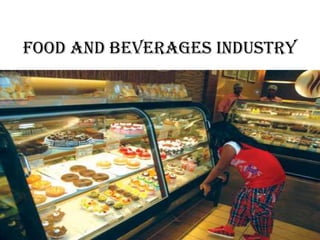
FOOD AND BEVERAGES INDUSTRY
Food  and Beverage Service is the service of Food
made in the Kitchen and Drinks prepared in the
bar to the Customers (Guest) at the Food
 Beverage premises, which can be:
        Restaurants, Bars, Hotels, Airlines, Cruise
Ships, Trains, Companies, Schools, Colleges,
Hospitals, Prisons, Takeaway etc
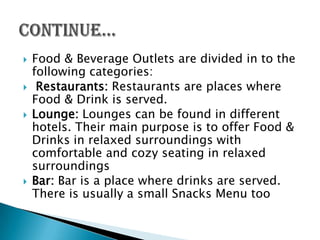
   Food & Beverage Outlets are divided in to the
    following categories:
    Restaurants: Restaurants are places where
    Food & Drink is served.
   Lounge: Lounges can be found in different
    hotels. Their main purpose is to offer Food &
    Drinks in relaxed surroundings with
    comfortable and cozy seating in relaxed
    surroundings
   Bar: Bar is a place where drinks are served.
    There is usually a small Snacks Menu too
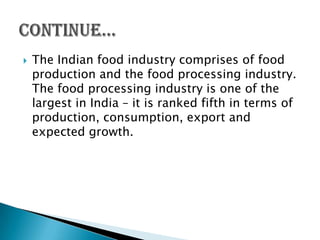
   The Indian food industry comprises of food
    production and the food processing industry.
    The food processing industry is one of the
    largest in India – it is ranked fifth in terms of
    production, consumption, export and
    expected growth.
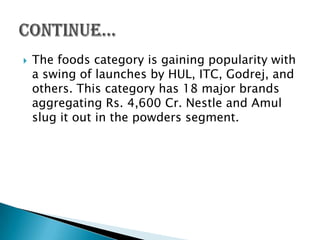
   The foods category is gaining popularity with
    a swing of launches by HUL, ITC, Godrej, and
    others. This category has 18 major brands
    aggregating Rs. 4,600 Cr. Nestle and Amul
    slug it out in the powders segment.
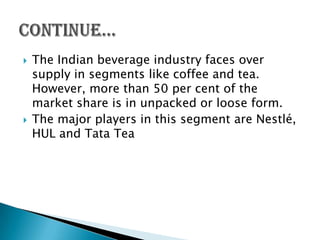
   The Indian beverage industry faces over
    supply in segments like coffee and tea.
    However, more than 50 per cent of the
    market share is in unpacked or loose form.
   The major players in this segment are Nestlé,
    HUL and Tata Tea
•India is second largest producer of food in
the world.
•Total food production is expected to
double in next 10 years
•Indian Food and Beverages market
expanding at CAGR of 9% during 2009-13
•Expected to reach $580 billion by 2013
   India is set to witness the next revolution in
    the food processing industry, as per Mr
    Subodh Kant Sahai, the Union Minister for
    Food Processing Industries.
   The Centre has set an investment target of Rs
    100, 000 crore (US$ 18.90 billion) by 2015 in
    the sector. The sector is expected to grow by
    20 per cent and value addition to increase by
    35 per cent by 2015.
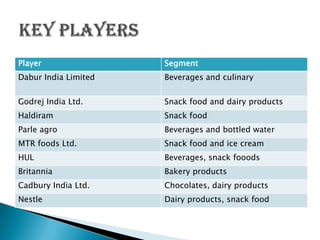
Player                Segment
Dabur India Limited   Beverages and culinary


Godrej India Ltd.     Snack food and dairy products
Haldiram              Snack food
Parle agro            Beverages and bottled water
MTR foods Ltd.        Snack food and ice cream
HUL                   Beverages, snack fooods
Britannia             Bakery products
Cadbury India Ltd.    Chocolates, dairy products
Nestle                Dairy products, snack food
   Frito Lays (subsidiary of Pepsi Foods) is the
    market leader in the organized potato wafers
    market
   United Breweries (UB) is the market leader of
    Indian brewery industry with around 40 %
    market share
   While Dabur's Real is the biggest player in the
    juices market with about half of the market
    share
   PepsiCo's Tropicana brand enjoys about 35%
    of this market.
   Other players include Parle Agro's Saint which
    has about 6-8 % besides a slew of regional
    players.
   Nestle has shown a rise of 0.5% with market
    share of 15.6%
 Due to strong growth fundamentals.
 Growing population, favorable demographics
  and rising income levels are key drivers of
  growth in developing countries.
 Rising health consciousness and increasing
  need for convenience foods are drivers of
  growth in developed countries.
 Food products continue to be essential to
  consumers in spite of the slowdown.
Rising food prices.
 Increasing transportation costs due to a rise
 in oil prices.
 Decline in consumer spending
   Large companies with abundant cash reserves
    were able to continue expanding as well as
    acquire middle market companies that were
    struggling to raise funds for expansion due to
    crisis.
   The economic slowdown led to consumers
    spending less on non-essential food items.
   Private Labels :Retailers increased manufacturing
    products internally that are marketed as their in-
    house brands.
   Frozen Food :Frozen food sales increased during
    the recession as most consumers choose eating
    at home over dining outside due to reduced
    household budgets.
   Climate change
   Global economic downturn
   Diet-related illnesses(Health issue)
   Food safety and consumer trust
   Simplicity trend
   Trends in low-cost foods
    Private Labels
    Labor issue
    Rising food prices
   Social issues
   PepsiCo
      PepsiCo was formed in 1965 with the merger of
    the pepsi-cola Company and Frito-Lay. Indra
    Krishnamurthy Nooyi h as been the chief executive
    of PepsiCo since 2006.
   STARBUCKS—Peter Gibbons
      Title: Executive vice president, Global Supply
    Chain Operations
   MCDONALDS— J.C. González – Méndez
       Title: Senior Vice President, North America
    Supply Chain Management
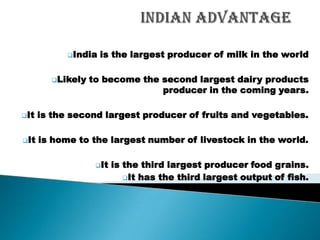
India   is the largest producer of milk in the world

        Likely   to become the second largest dairy products
                                producer in the coming years.

It   is the second largest producer of fruits and vegetables.

It   is home to the largest number of livestock in the world.

                   It   is the third largest producer food grains.
                            It has the third largest output of fish.

                                                                  ----
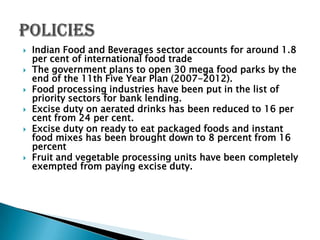
   Indian Food and Beverages sector accounts for around 1.8
    per cent of international food trade
   The government plans to open 30 mega food parks by the
    end of the 11th Five Year Plan (2007-2012).
   Food processing industries have been put in the list of
    priority sectors for bank lending.
   Excise duty on aerated drinks has been reduced to 16 per
    cent from 24 per cent.
   Excise duty on ready to eat packaged foods and instant
    food mixes has been brought down to 8 percent from 16
    percent
   Fruit and vegetable processing units have been completely
    exempted from paying excise duty.
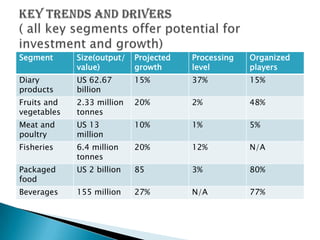
Segment      Size(output/   Projected   Processing   Organized
             value)         growth      level        players
Diary        US 62.67       15%         37%          15%
products     billion
Fruits and   2.33 million   20%         2%           48%
vegetables   tonnes
Meat and     US 13          10%         1%           5%
poultry      million
Fisheries    6.4 million    20%         12%          N/A
             tonnes
Packaged     US 2 billion   85          3%           80%
food
Beverages    155 million    27%         N/A          77%
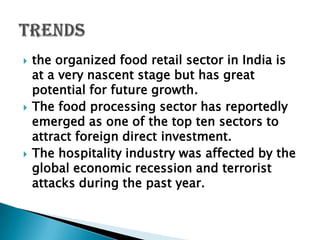
   the organized food retail sector in India is
    at a very nascent stage but has great
    potential for future growth.
   The food processing sector has reportedly
    emerged as one of the top ten sectors to
    attract foreign direct investment.
   The hospitality industry was affected by the
    global economic recession and terrorist
    attacks during the past year.
   The biggest competition for imported foods
    in the Indian retail market is the local food
    industry which has an advantage of low-
    cost labour and easy availability of raw
    material at reasonable prices.
   Indian retailers highly value in-store
    promotions to highlight international food
    products.
   By the year 2014, the retail sales in the
    packaged food market in India is expected
    to reach US$25.8 billion
Final ppt

Final ppt

  • 1.
    Submitted to: Submitted by: Dr.Sandhir Sharma Arushi Gupta Gaurav Jain Komal Sharma Ankush (Group 7 ) Adaptors
  • 3.
  • 4.
    Food andBeverage Service is the service of Food made in the Kitchen and Drinks prepared in the bar to the Customers (Guest) at the Food  Beverage premises, which can be: Restaurants, Bars, Hotels, Airlines, Cruise Ships, Trains, Companies, Schools, Colleges, Hospitals, Prisons, Takeaway etc
  • 5.
    Food & Beverage Outlets are divided in to the following categories:  Restaurants: Restaurants are places where Food & Drink is served.  Lounge: Lounges can be found in different hotels. Their main purpose is to offer Food & Drinks in relaxed surroundings with comfortable and cozy seating in relaxed surroundings  Bar: Bar is a place where drinks are served. There is usually a small Snacks Menu too
  • 6.
    The Indian food industry comprises of food production and the food processing industry. The food processing industry is one of the largest in India – it is ranked fifth in terms of production, consumption, export and expected growth.
  • 7.
    The foods category is gaining popularity with a swing of launches by HUL, ITC, Godrej, and others. This category has 18 major brands aggregating Rs. 4,600 Cr. Nestle and Amul slug it out in the powders segment.
  • 8.
    The Indian beverage industry faces over supply in segments like coffee and tea. However, more than 50 per cent of the market share is in unpacked or loose form.  The major players in this segment are Nestlé, HUL and Tata Tea
  • 9.
    •India is secondlargest producer of food in the world. •Total food production is expected to double in next 10 years •Indian Food and Beverages market expanding at CAGR of 9% during 2009-13 •Expected to reach $580 billion by 2013
  • 10.
    India is set to witness the next revolution in the food processing industry, as per Mr Subodh Kant Sahai, the Union Minister for Food Processing Industries.  The Centre has set an investment target of Rs 100, 000 crore (US$ 18.90 billion) by 2015 in the sector. The sector is expected to grow by 20 per cent and value addition to increase by 35 per cent by 2015.
  • 11.
    Player Segment Dabur India Limited Beverages and culinary Godrej India Ltd. Snack food and dairy products Haldiram Snack food Parle agro Beverages and bottled water MTR foods Ltd. Snack food and ice cream HUL Beverages, snack fooods Britannia Bakery products Cadbury India Ltd. Chocolates, dairy products Nestle Dairy products, snack food
  • 12.
    Frito Lays (subsidiary of Pepsi Foods) is the market leader in the organized potato wafers market  United Breweries (UB) is the market leader of Indian brewery industry with around 40 % market share  While Dabur's Real is the biggest player in the juices market with about half of the market share
  • 13.
    PepsiCo's Tropicana brand enjoys about 35% of this market.  Other players include Parle Agro's Saint which has about 6-8 % besides a slew of regional players.  Nestle has shown a rise of 0.5% with market share of 15.6%
  • 15.
     Due tostrong growth fundamentals.  Growing population, favorable demographics and rising income levels are key drivers of growth in developing countries.  Rising health consciousness and increasing need for convenience foods are drivers of growth in developed countries.  Food products continue to be essential to consumers in spite of the slowdown.
  • 16.
    Rising food prices. Increasing transportation costs due to a rise in oil prices.  Decline in consumer spending
  • 17.
    Large companies with abundant cash reserves were able to continue expanding as well as acquire middle market companies that were struggling to raise funds for expansion due to crisis.  The economic slowdown led to consumers spending less on non-essential food items.  Private Labels :Retailers increased manufacturing products internally that are marketed as their in- house brands.  Frozen Food :Frozen food sales increased during the recession as most consumers choose eating at home over dining outside due to reduced household budgets.
  • 18.
    Climate change  Global economic downturn  Diet-related illnesses(Health issue)  Food safety and consumer trust  Simplicity trend
  • 19.
    Trends in low-cost foods  Private Labels  Labor issue  Rising food prices  Social issues
  • 20.
    PepsiCo PepsiCo was formed in 1965 with the merger of the pepsi-cola Company and Frito-Lay. Indra Krishnamurthy Nooyi h as been the chief executive of PepsiCo since 2006.  STARBUCKS—Peter Gibbons Title: Executive vice president, Global Supply Chain Operations  MCDONALDS— J.C. González – Méndez Title: Senior Vice President, North America Supply Chain Management
  • 21.
    India is the largest producer of milk in the world Likely to become the second largest dairy products producer in the coming years. It is the second largest producer of fruits and vegetables. It is home to the largest number of livestock in the world. It is the third largest producer food grains. It has the third largest output of fish. ----
  • 22.
    Indian Food and Beverages sector accounts for around 1.8 per cent of international food trade  The government plans to open 30 mega food parks by the end of the 11th Five Year Plan (2007-2012).  Food processing industries have been put in the list of priority sectors for bank lending.  Excise duty on aerated drinks has been reduced to 16 per cent from 24 per cent.  Excise duty on ready to eat packaged foods and instant food mixes has been brought down to 8 percent from 16 percent  Fruit and vegetable processing units have been completely exempted from paying excise duty.
  • 23.
    Segment Size(output/ Projected Processing Organized value) growth level players Diary US 62.67 15% 37% 15% products billion Fruits and 2.33 million 20% 2% 48% vegetables tonnes Meat and US 13 10% 1% 5% poultry million Fisheries 6.4 million 20% 12% N/A tonnes Packaged US 2 billion 85 3% 80% food Beverages 155 million 27% N/A 77%
  • 24.
    the organized food retail sector in India is at a very nascent stage but has great potential for future growth.  The food processing sector has reportedly emerged as one of the top ten sectors to attract foreign direct investment.  The hospitality industry was affected by the global economic recession and terrorist attacks during the past year.
  • 25.
    The biggest competition for imported foods in the Indian retail market is the local food industry which has an advantage of low- cost labour and easy availability of raw material at reasonable prices.  Indian retailers highly value in-store promotions to highlight international food products.  By the year 2014, the retail sales in the packaged food market in India is expected to reach US$25.8 billion