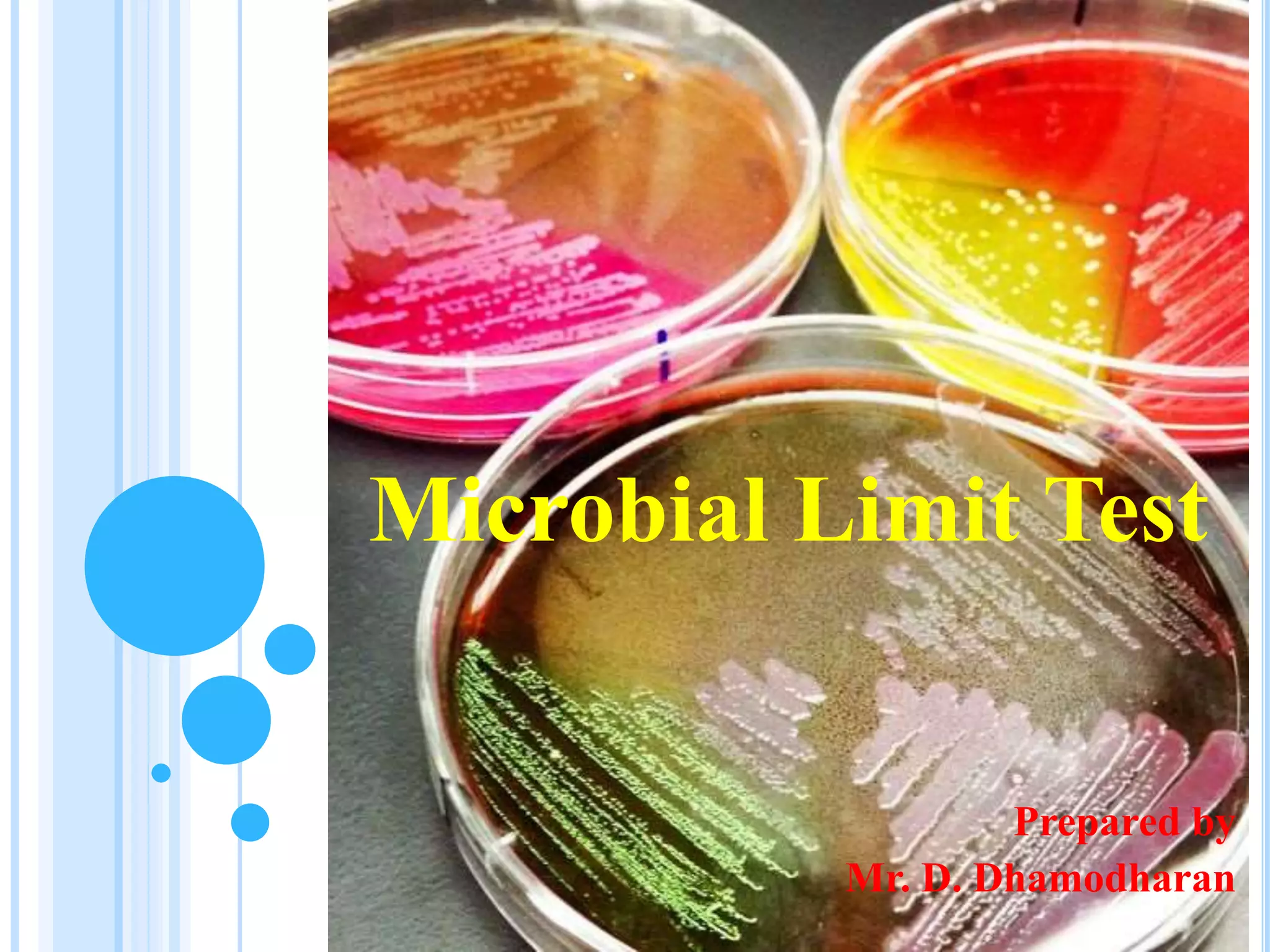
Microbial Limit Test
Prepared by
Mr. D. Dhamodharan
MLT (or) TVC
Microbial limit test or total viable count was
designed to perform quantitative or qualitative
estimation of number of viable aerobic micro-organism
present or detecting the presence of designated
microbial sp. in pharmaceutical product.
Critical issue due to un-identification during lab testing
Pseudomonas cepacia contamination of povidine iodine product
reported by a hospital in mausachusetts
Metaproterenol sulphate inhalation solution is contaminated with
Pseudomonas gladioli, the health hazard evaluation commented the risk
of pulmonary infection, especial serious and potential life treating
ailment.
In 1970, Dr. Dunnigan (Bureau of medicine) reported to the
FDA, “health hazard variety of infection have been traced due to the
gram negative contamination of topical product”.
Membrane filtration method
 This method is applied to the sample which contains antimicrobial
substance.
 Membrane filtration should be 0.45µm or less in pore size.
 The filter should not exceed 50mm dia.
 Dilute the pre-treated test fluid if the bacteria concentration is high, so
that 10-100 colonies per filter.
 These counts may be adopted for calculation of the viable count.
Pour plate method
 Transferring microbial from test fluid into solidify agar
 For bacteria not more than 300 colonies, for fungus not more than
100 colonies.
 If counts are considered to be viable in a shorter incubation time than
5days, these counts may be adopted.
Spread plate method
Same method will follow as like pour plate method.
Serial Dilution method
This is only applicable for bacteria.
Welcome
to
Staphylococcus sp.
section
Hi, I soil flora Staphylococcus sp.
 Gram positive with coccus shaped.
 In my family approximately 40 different species abundant.
 In my DNA 30-40 G+C content available.
 I am oxidase species, so I has coagulase nature.
 I can synthesize catalase, this is the best way to differentiate me and my
colleague Streptococcus sp.
2H2O 2H2 + O2
 I can reside on skin and mucous membrane of human and other organism.
 I can inflate immuno-supressor contacted with CNS, vaginal flora, genitourinary
tract
VOGEL-JHONSON AGAR MEDIUM
 It is rapid detection method with modified Tellurite
Glycine Agar.
 In glycine agar mannitol and pH indicator (phenol red)
were added. which indicate mannitol fermentation.
 Mannitol fermentation forms black colonies, due to the
reduction of tellurite. Selective agents were
incorporated into the medium (glycine and lithium
chloride), which inhibit the growth of most other
microorganisms.
Optimum temperature : 35-37ºC
Optimum pH : 7.2
Optimum duration : 24-48 h
Colour indication : Black colour
MANNITAL-SALT AGAR MEDIUM
7.5% NaCl (salt): Inhibits the microbes, except
Staphylococcus sp.
Phenol red: Red/pink under neutral/basic conditions, but
turns yellow under acidic conditions.
Mannitol: Fermentation in media. It decrease the pH after
fermentation, then turns red/pink media into yellow.
Optimum temperature : 35-37ºC
Optimum pH : 7.4
Optimum duration : 24-48 h
Colour indication : colourless to
pink colour
BAIRD-PARKER AGAR MEDIUM
 Casein enzymic hydrolysate, meat extract and yeast
extract provides nitrogen, carbon, sulphur and
vitamins.
 Pyruvate and Sodium pyruvate protects injured cells
and helps recover Staphylococcus sp.
 Lithium chloride and potassium tellurite acts as
inhibitor agent for other microbes.
Optimum temperature : 35-37ºC
Optimum pH : 7.0
Optimum duration : 24-48 h
Colour indication : Black shinny
colony
Welcome
to
Pseudomonas sp.
section
Hi, I fluorescence Pseudomonas sp.
 Gram negative with rod shaped.
 I, polar flagellated with gamma proteobacteria.
 In my family approximately 191 different species abundant.
 I am oxidase, catalase, citrate species.
 I can secrete pyoveridine, pyocynanin, thioquinolobactin enzyme, which makes
me fluorescence (yellow-green in colour).
 By the secretion of exopolysacchardie (alginate), which will form a surface-
colonising biofilm.
 I can reside on soil, water, plant.
 I especially inflate (hospitalized person) like bacterimia, pneumonia, hair
follicles, swimmer’s ear.
CENTRIMIDE AGAR
 Centrimide (cetyl trimethyl ammonium bromide) is
quaternary ammonium salt.
 In centrimide, cationic detergent contact with bacterial
cell and release of nitrogen and phosphorous, which
denatures bacterial cell.
 It produces a yellow-green or yellow-brown fluorescent
pigment due to pyoverdin
Optimum temperature : 30-35ºC
Optimum pH : 7.2
Optimum duration : 18-72 h
Colour indication : cream to yellow
homogenous
PSUEDOMONAS AGAR MEDIUM FOR DETECTION OF FLUORESCIN
 Dipotassium phosphate buffer and magnesium sulphate
provides necessary cations for the activation of
fluorescein production
Optimum temperature : 35-37ºC
Optimum pH : 7.2
Optimum duration : 18-24 h
Colour indication : yellow colour
clear to slight
opalescent gel
formation
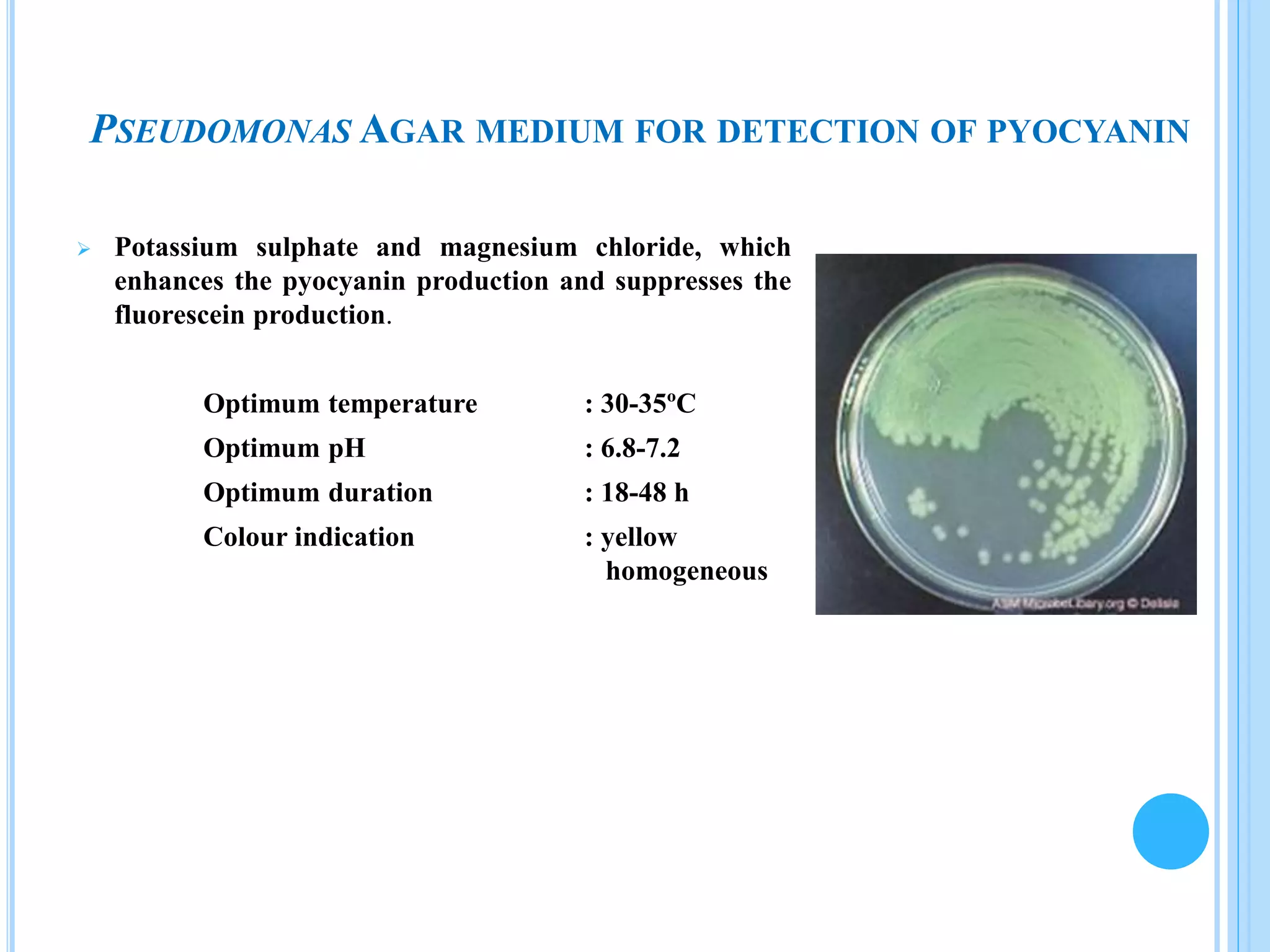
PSEUDOMONAS AGAR MEDIUM FOR DETECTION OF PYOCYANIN
 Potassium sulphate and magnesium chloride, which
enhances the pyocyanin production and suppresses the
fluorescein production.
Optimum temperature : 30-35ºC
Optimum pH : 6.8-7.2
Optimum duration : 18-48 h
Colour indication : yellow
homogeneous
Welcome
to
E.coli sp.
section
Hi, I normal flora E.coli
 Gram negative with rod shaped.
 I can survive upto 71◦C, I am favour at 37 ◦C
 Researcher are investigating more than70 years, because I has more special
characteristic apart from other microbes
 I am the host organism for the majority of work with recombinant DNA
 I can reproduce cell division as earlier than any other microbe ( >20 mins)
 I has flagella and motile, I can swim, walk, move etc
 In fermentation technology, I can play major role in lactate, succinate, ethanol, acetate,
co2, H2 gas production.
 I abundantly survive in digestive tract and water, milk (cow’s udder), raw fruits&
vegetables
 Mostly harmless but I can inflate bloody diarreha, anemia, kidney failure and urinary
tract
MAC-CONKEY BROTH
BCP: Sensitive in recording pH variation in the
medium.
Gelatin peptone: Essential growth nutrients. Lactose is the
fermentable carbohydrate.
Dehydrated bile: Inhibits gram-positive organism.
Bromocresol purple: pH indicator in the medium, which turns yellow
under acidic condition.
 MacConkey Broth is a modification of MacConkey Medium (Childs
and Allen)
 Instead of inhibitory effect (neutral red) substituted as bromocresol
purple dye.
 The color change will be observed, when pH falls down pH 8.
Optimum temperature : 43-45ºC
Optimum pH : 7.3 – 7.5
Optimum duration : 18- 48 h
Colour indication : Brick red
MAC-CONKEY AGAR
 Lactose: fermentable carbohydrate providing carbon and
energy.
 Bile Salts: selective agents and inhibit Gram positive
organisms.
 Crystal Violet: Use: Gram positive bacteria are generally
inhibited by crystal violet.
 Sodium Chloride: supplies essential electrolytes for
transport and osmotic balance.
 Neutral Red: pH indicator. which is red in color at pH’s
below 6.8.
Optimum temperature : 30-35ºC
Optimum pH : 7.3-7.5
Optimum duration : 18-48 h
Colour indication : Red to pink
LEVINE EOSIN-METHYLENE BLUE AGAR
This media is used to differentiate between E.coli and
Enterobacteria sp.
Eosin Y and methylene blue : pH indicator dyes, form a dark
purple at low pH, It also inhibit (Gram positive).
Sucrose and lactose: Fermentable carbohydrate (growth of fecal
coliforms)
 The growth of these organisms will appear dark purple to black.
 E. coli, a vigorous fermenter produces a green metallic sheen.
 Slow or weak fermenters will produce mucoid pink colonies.
Optimum temperature : 30-35ºC
Optimum pH : 7.2
Optimum duration : 18-72 h
Colour indication : Blue to black
Welcome
to
Salmonella sp.
section
Hi, I blood specified Salmonella sp.
 Gram negative with rod shaped.
 I, classified based on warm blood (Salmonella enterica) and cold
blooded (Salmonella bongari), and I, contain 2500 sero sub-species
 E.coli and Salmonella sp. are 60-70% identical at the DNA level.
 Most of Salmonella sp. produce H2S
 I, pursuit in contaminated water source.
 I, maximum survive in host-associated life style.
 I can inflate typhimurium, enteritidis and typhi
BRILLIANT GREEN AGAR MEDIUM
 Phenol red as the pH indicator and brilliant green as an
inhibitory agent for gram (+) and gram (-) bacilli.
 Organisms that ferment lactose exhibit yellow to yellow-green
colonies. Salmonella appears as red to pink-white colonies
Optimum temperature : 30-35ºC
Optimum pH : 6.9 -7.1
Optimum duration : 48 h
Colour indication :Small, Transparent,
Colorless or pink to
white opaque
XYLOSE-LYSINE- DESOXYCHOLATE AGAR MEDIUM
 Due to phenol red presence in a medium, it appear as bright pink
in color.
 Salmonella ferments sugar (changes to acid) and lower the pH, due
to low pH phenol red changes to yellow.
 Shigella colonies cannot do this and therefore remain red.
 Salmonellae metabolize thiosulfate to produce H2S, which leads to
the formation of colonies with black centers .
 Coliforms produce yellow to orange color colonies. Pseudomonas
produce pink color colony.
Optimum temperature : 35-37ºC
Optimum pH : 7.2 -7.6
Optimum duration : 18 -24h
Colour indication : Red, with or without black
centers
BISMUTH SULFITE AGAR MEDIUM
 Bismuth sulfite and brilliant green acts together and inhibits gram
(+) and lactose-sucrose fermenting gram (-) bacilli and Shigella sp.
 Sulfur compounds provide a substrate for hydrogen sulfide
production.
 Metallic salts formed in the medium in the presence of H2S, then
the colony and the surrounding medium will turn into black or
brown in color.
Optimum temperature : 35-37ºC
Optimum pH : 7.5 -7.7
Optimum duration : 24- 48h
Salmonella typhi and E.coli appear black in color. Pseudomonas
aeruginosa appear in green in color
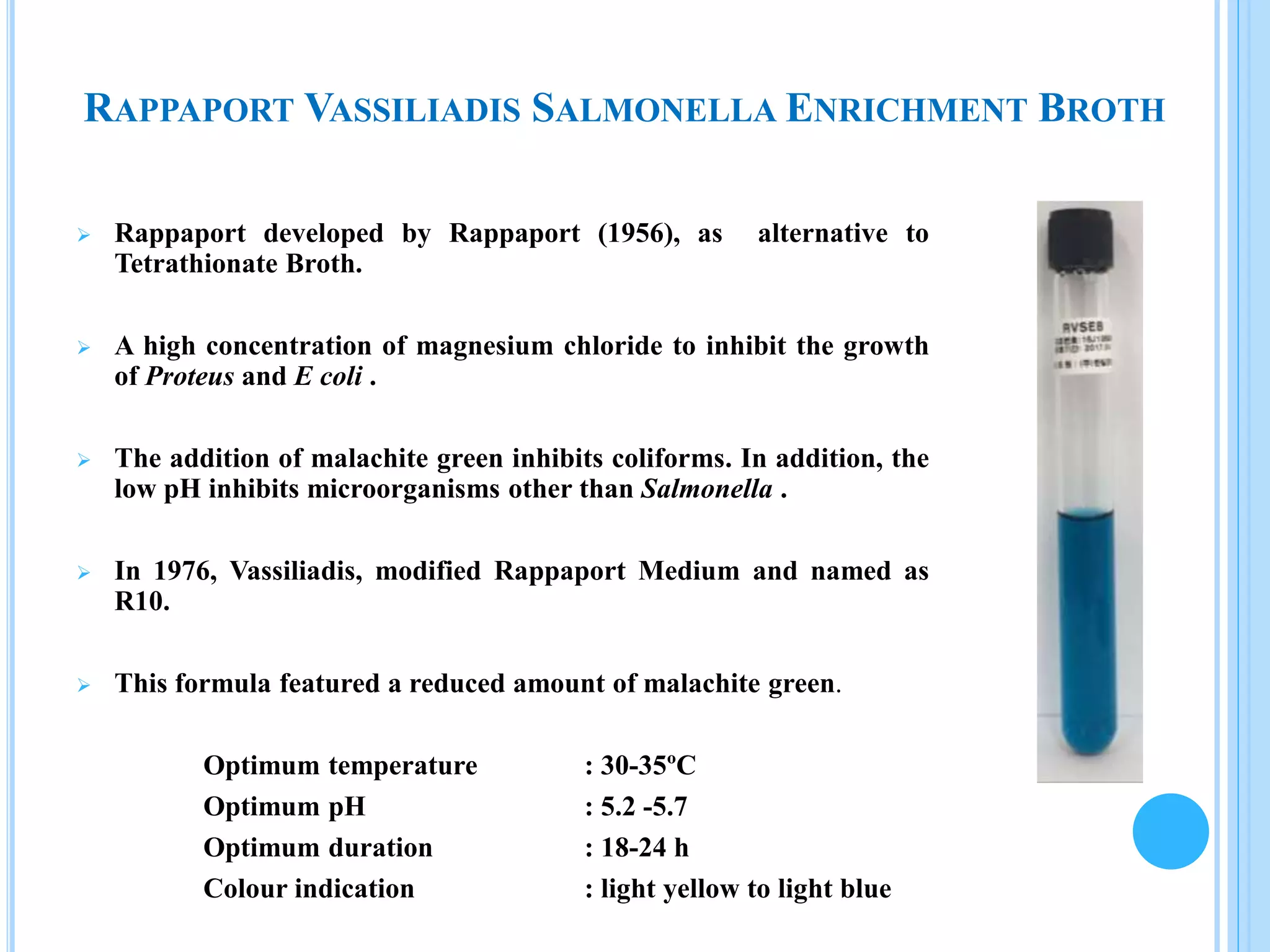
RAPPAPORT VASSILIADIS SALMONELLA ENRICHMENT BROTH
 Rappaport developed by Rappaport (1956), as alternative to
Tetrathionate Broth.
 A high concentration of magnesium chloride to inhibit the growth
of Proteus and E coli .
 The addition of malachite green inhibits coliforms. In addition, the
low pH inhibits microorganisms other than Salmonella .
 In 1976, Vassiliadis, modified Rappaport Medium and named as
R10.
 This formula featured a reduced amount of malachite green.
Optimum temperature : 30-35ºC
Optimum pH : 5.2 -5.7
Optimum duration : 18-24 h
Colour indication : light yellow to light blue
Simple way to understand Microbial Limit Test

Simple way to understand Microbial Limit Test

  • 1.
    Microbial Limit Test Preparedby Mr. D. Dhamodharan
  • 2.
    MLT (or) TVC Microbiallimit test or total viable count was designed to perform quantitative or qualitative estimation of number of viable aerobic micro-organism present or detecting the presence of designated microbial sp. in pharmaceutical product.
  • 3.
    Critical issue dueto un-identification during lab testing Pseudomonas cepacia contamination of povidine iodine product reported by a hospital in mausachusetts Metaproterenol sulphate inhalation solution is contaminated with Pseudomonas gladioli, the health hazard evaluation commented the risk of pulmonary infection, especial serious and potential life treating ailment. In 1970, Dr. Dunnigan (Bureau of medicine) reported to the FDA, “health hazard variety of infection have been traced due to the gram negative contamination of topical product”.
  • 4.
    Membrane filtration method This method is applied to the sample which contains antimicrobial substance.  Membrane filtration should be 0.45µm or less in pore size.  The filter should not exceed 50mm dia.  Dilute the pre-treated test fluid if the bacteria concentration is high, so that 10-100 colonies per filter.  These counts may be adopted for calculation of the viable count.
  • 5.
    Pour plate method Transferring microbial from test fluid into solidify agar  For bacteria not more than 300 colonies, for fungus not more than 100 colonies.  If counts are considered to be viable in a shorter incubation time than 5days, these counts may be adopted. Spread plate method Same method will follow as like pour plate method. Serial Dilution method This is only applicable for bacteria.
  • 6.
  • 7.
    Hi, I soilflora Staphylococcus sp.  Gram positive with coccus shaped.  In my family approximately 40 different species abundant.  In my DNA 30-40 G+C content available.  I am oxidase species, so I has coagulase nature.  I can synthesize catalase, this is the best way to differentiate me and my colleague Streptococcus sp. 2H2O 2H2 + O2  I can reside on skin and mucous membrane of human and other organism.  I can inflate immuno-supressor contacted with CNS, vaginal flora, genitourinary tract
  • 8.
    VOGEL-JHONSON AGAR MEDIUM It is rapid detection method with modified Tellurite Glycine Agar.  In glycine agar mannitol and pH indicator (phenol red) were added. which indicate mannitol fermentation.  Mannitol fermentation forms black colonies, due to the reduction of tellurite. Selective agents were incorporated into the medium (glycine and lithium chloride), which inhibit the growth of most other microorganisms. Optimum temperature : 35-37ºC Optimum pH : 7.2 Optimum duration : 24-48 h Colour indication : Black colour
  • 9.
    MANNITAL-SALT AGAR MEDIUM 7.5%NaCl (salt): Inhibits the microbes, except Staphylococcus sp. Phenol red: Red/pink under neutral/basic conditions, but turns yellow under acidic conditions. Mannitol: Fermentation in media. It decrease the pH after fermentation, then turns red/pink media into yellow. Optimum temperature : 35-37ºC Optimum pH : 7.4 Optimum duration : 24-48 h Colour indication : colourless to pink colour
  • 10.
    BAIRD-PARKER AGAR MEDIUM Casein enzymic hydrolysate, meat extract and yeast extract provides nitrogen, carbon, sulphur and vitamins.  Pyruvate and Sodium pyruvate protects injured cells and helps recover Staphylococcus sp.  Lithium chloride and potassium tellurite acts as inhibitor agent for other microbes. Optimum temperature : 35-37ºC Optimum pH : 7.0 Optimum duration : 24-48 h Colour indication : Black shinny colony
  • 11.
  • 12.
    Hi, I fluorescencePseudomonas sp.  Gram negative with rod shaped.  I, polar flagellated with gamma proteobacteria.  In my family approximately 191 different species abundant.  I am oxidase, catalase, citrate species.  I can secrete pyoveridine, pyocynanin, thioquinolobactin enzyme, which makes me fluorescence (yellow-green in colour).  By the secretion of exopolysacchardie (alginate), which will form a surface- colonising biofilm.  I can reside on soil, water, plant.  I especially inflate (hospitalized person) like bacterimia, pneumonia, hair follicles, swimmer’s ear.
  • 13.
    CENTRIMIDE AGAR  Centrimide(cetyl trimethyl ammonium bromide) is quaternary ammonium salt.  In centrimide, cationic detergent contact with bacterial cell and release of nitrogen and phosphorous, which denatures bacterial cell.  It produces a yellow-green or yellow-brown fluorescent pigment due to pyoverdin Optimum temperature : 30-35ºC Optimum pH : 7.2 Optimum duration : 18-72 h Colour indication : cream to yellow homogenous
  • 14.
    PSUEDOMONAS AGAR MEDIUMFOR DETECTION OF FLUORESCIN  Dipotassium phosphate buffer and magnesium sulphate provides necessary cations for the activation of fluorescein production Optimum temperature : 35-37ºC Optimum pH : 7.2 Optimum duration : 18-24 h Colour indication : yellow colour clear to slight opalescent gel formation
  • 15.
    PSEUDOMONAS AGAR MEDIUMFOR DETECTION OF PYOCYANIN  Potassium sulphate and magnesium chloride, which enhances the pyocyanin production and suppresses the fluorescein production. Optimum temperature : 30-35ºC Optimum pH : 6.8-7.2 Optimum duration : 18-48 h Colour indication : yellow homogeneous
  • 16.
  • 17.
    Hi, I normalflora E.coli  Gram negative with rod shaped.  I can survive upto 71◦C, I am favour at 37 ◦C  Researcher are investigating more than70 years, because I has more special characteristic apart from other microbes  I am the host organism for the majority of work with recombinant DNA  I can reproduce cell division as earlier than any other microbe ( >20 mins)  I has flagella and motile, I can swim, walk, move etc  In fermentation technology, I can play major role in lactate, succinate, ethanol, acetate, co2, H2 gas production.  I abundantly survive in digestive tract and water, milk (cow’s udder), raw fruits& vegetables  Mostly harmless but I can inflate bloody diarreha, anemia, kidney failure and urinary tract
  • 18.
    MAC-CONKEY BROTH BCP: Sensitivein recording pH variation in the medium. Gelatin peptone: Essential growth nutrients. Lactose is the fermentable carbohydrate. Dehydrated bile: Inhibits gram-positive organism. Bromocresol purple: pH indicator in the medium, which turns yellow under acidic condition.  MacConkey Broth is a modification of MacConkey Medium (Childs and Allen)  Instead of inhibitory effect (neutral red) substituted as bromocresol purple dye.  The color change will be observed, when pH falls down pH 8. Optimum temperature : 43-45ºC Optimum pH : 7.3 – 7.5 Optimum duration : 18- 48 h Colour indication : Brick red
  • 19.
    MAC-CONKEY AGAR  Lactose:fermentable carbohydrate providing carbon and energy.  Bile Salts: selective agents and inhibit Gram positive organisms.  Crystal Violet: Use: Gram positive bacteria are generally inhibited by crystal violet.  Sodium Chloride: supplies essential electrolytes for transport and osmotic balance.  Neutral Red: pH indicator. which is red in color at pH’s below 6.8. Optimum temperature : 30-35ºC Optimum pH : 7.3-7.5 Optimum duration : 18-48 h Colour indication : Red to pink
  • 20.
    LEVINE EOSIN-METHYLENE BLUEAGAR This media is used to differentiate between E.coli and Enterobacteria sp. Eosin Y and methylene blue : pH indicator dyes, form a dark purple at low pH, It also inhibit (Gram positive). Sucrose and lactose: Fermentable carbohydrate (growth of fecal coliforms)  The growth of these organisms will appear dark purple to black.  E. coli, a vigorous fermenter produces a green metallic sheen.  Slow or weak fermenters will produce mucoid pink colonies. Optimum temperature : 30-35ºC Optimum pH : 7.2 Optimum duration : 18-72 h Colour indication : Blue to black
  • 21.
  • 22.
    Hi, I bloodspecified Salmonella sp.  Gram negative with rod shaped.  I, classified based on warm blood (Salmonella enterica) and cold blooded (Salmonella bongari), and I, contain 2500 sero sub-species  E.coli and Salmonella sp. are 60-70% identical at the DNA level.  Most of Salmonella sp. produce H2S  I, pursuit in contaminated water source.  I, maximum survive in host-associated life style.  I can inflate typhimurium, enteritidis and typhi
  • 23.
    BRILLIANT GREEN AGARMEDIUM  Phenol red as the pH indicator and brilliant green as an inhibitory agent for gram (+) and gram (-) bacilli.  Organisms that ferment lactose exhibit yellow to yellow-green colonies. Salmonella appears as red to pink-white colonies Optimum temperature : 30-35ºC Optimum pH : 6.9 -7.1 Optimum duration : 48 h Colour indication :Small, Transparent, Colorless or pink to white opaque
  • 24.
    XYLOSE-LYSINE- DESOXYCHOLATE AGARMEDIUM  Due to phenol red presence in a medium, it appear as bright pink in color.  Salmonella ferments sugar (changes to acid) and lower the pH, due to low pH phenol red changes to yellow.  Shigella colonies cannot do this and therefore remain red.  Salmonellae metabolize thiosulfate to produce H2S, which leads to the formation of colonies with black centers .  Coliforms produce yellow to orange color colonies. Pseudomonas produce pink color colony. Optimum temperature : 35-37ºC Optimum pH : 7.2 -7.6 Optimum duration : 18 -24h Colour indication : Red, with or without black centers
  • 25.
    BISMUTH SULFITE AGARMEDIUM  Bismuth sulfite and brilliant green acts together and inhibits gram (+) and lactose-sucrose fermenting gram (-) bacilli and Shigella sp.  Sulfur compounds provide a substrate for hydrogen sulfide production.  Metallic salts formed in the medium in the presence of H2S, then the colony and the surrounding medium will turn into black or brown in color. Optimum temperature : 35-37ºC Optimum pH : 7.5 -7.7 Optimum duration : 24- 48h Salmonella typhi and E.coli appear black in color. Pseudomonas aeruginosa appear in green in color
  • 26.
    RAPPAPORT VASSILIADIS SALMONELLAENRICHMENT BROTH  Rappaport developed by Rappaport (1956), as alternative to Tetrathionate Broth.  A high concentration of magnesium chloride to inhibit the growth of Proteus and E coli .  The addition of malachite green inhibits coliforms. In addition, the low pH inhibits microorganisms other than Salmonella .  In 1976, Vassiliadis, modified Rappaport Medium and named as R10.  This formula featured a reduced amount of malachite green. Optimum temperature : 30-35ºC Optimum pH : 5.2 -5.7 Optimum duration : 18-24 h Colour indication : light yellow to light blue