Author: Netherlands Pharmacovigilance Centre Lareb
Version date: 14 Nov 2017
Content: This hand-out describes general aspects on
pharmacovigilance and provides background
information on the lecture ‘Introduction PV’, by
Prof. Dr. E.P. van Puijenbroek, The Netherlands.
This lecture can be used for teaching key aspect
1: Understanding the importance of PV.
Introduction on
Pharmacovigilance
• Introduction of pharmacovigilance
• Drug safety in practice
• Need for monitoring the safety of drugs
• Organisation of pharmacovigilance
Outline
• Have knowledge of the definition of pharmacovigilance
• What is a “serious” side effect, according to the formal
definition.
• Peruse the history of pharmacovigilance and a number of
side effects that have played a role.
• Knowledge on how safety of medicines in the Netherlands
and Europe are organised
Learning objectives ‘Introduction’
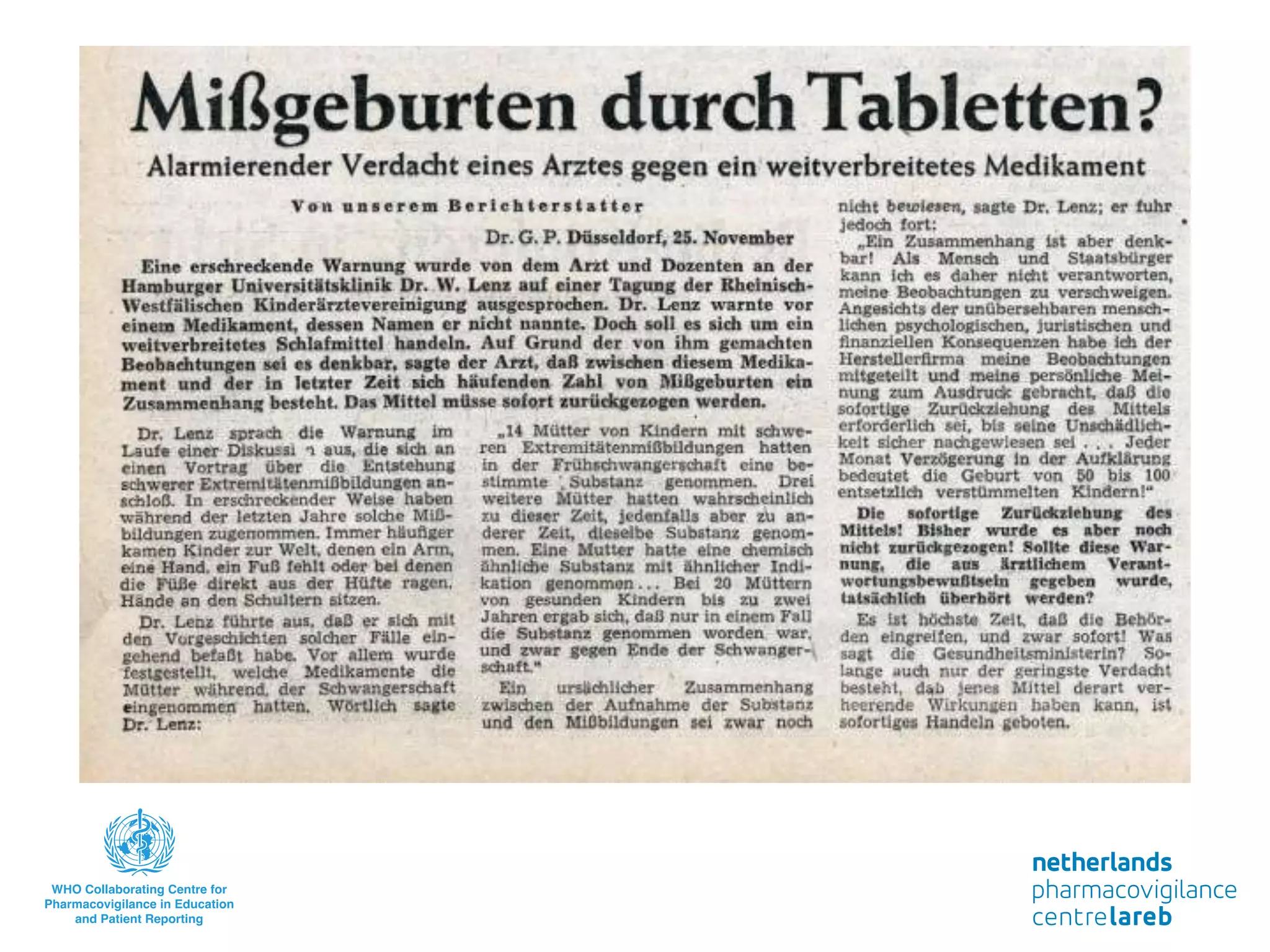
IS YOUR
MEDICINE
LETHAL?
SAFETY OF DRUGS LEAVES
MUCH TO BE DESIRED
Translation:
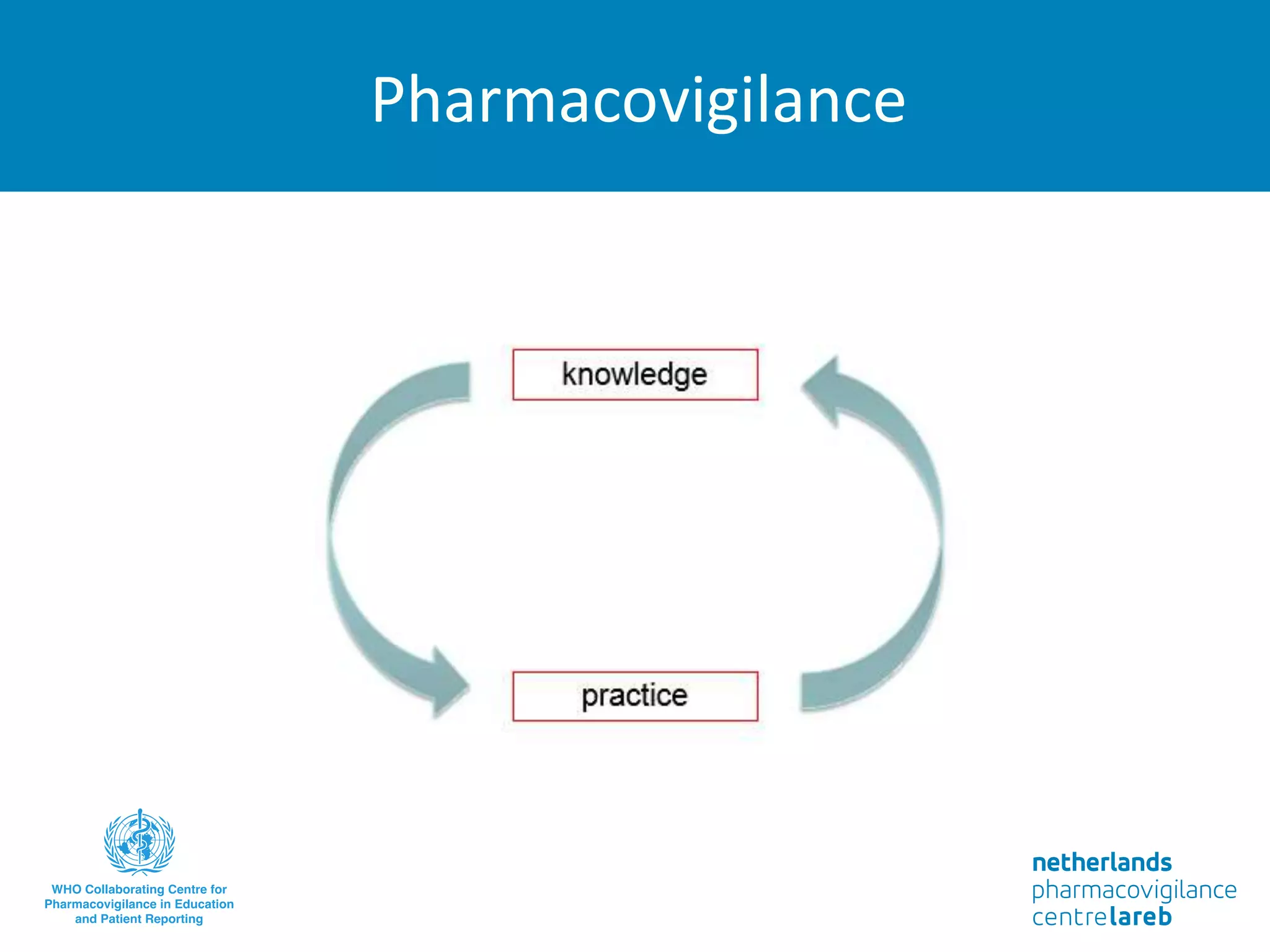
Pharmacovigilance
WHO:
‘The science and activities relating to the detection, assessment,
understanding and prevention of adverse drug effects or any other
drug related problem’
The Importance of Pharmacovigilance, WHO 2002
Pharmacovigilance
A response to a drug which is noxious and unintended, and
which occurs at doses normally used in man for
prophylaxis, diagnosis, therapy or for the modifications
of physiological function
Definition WHO
Adverse Drug Reaction
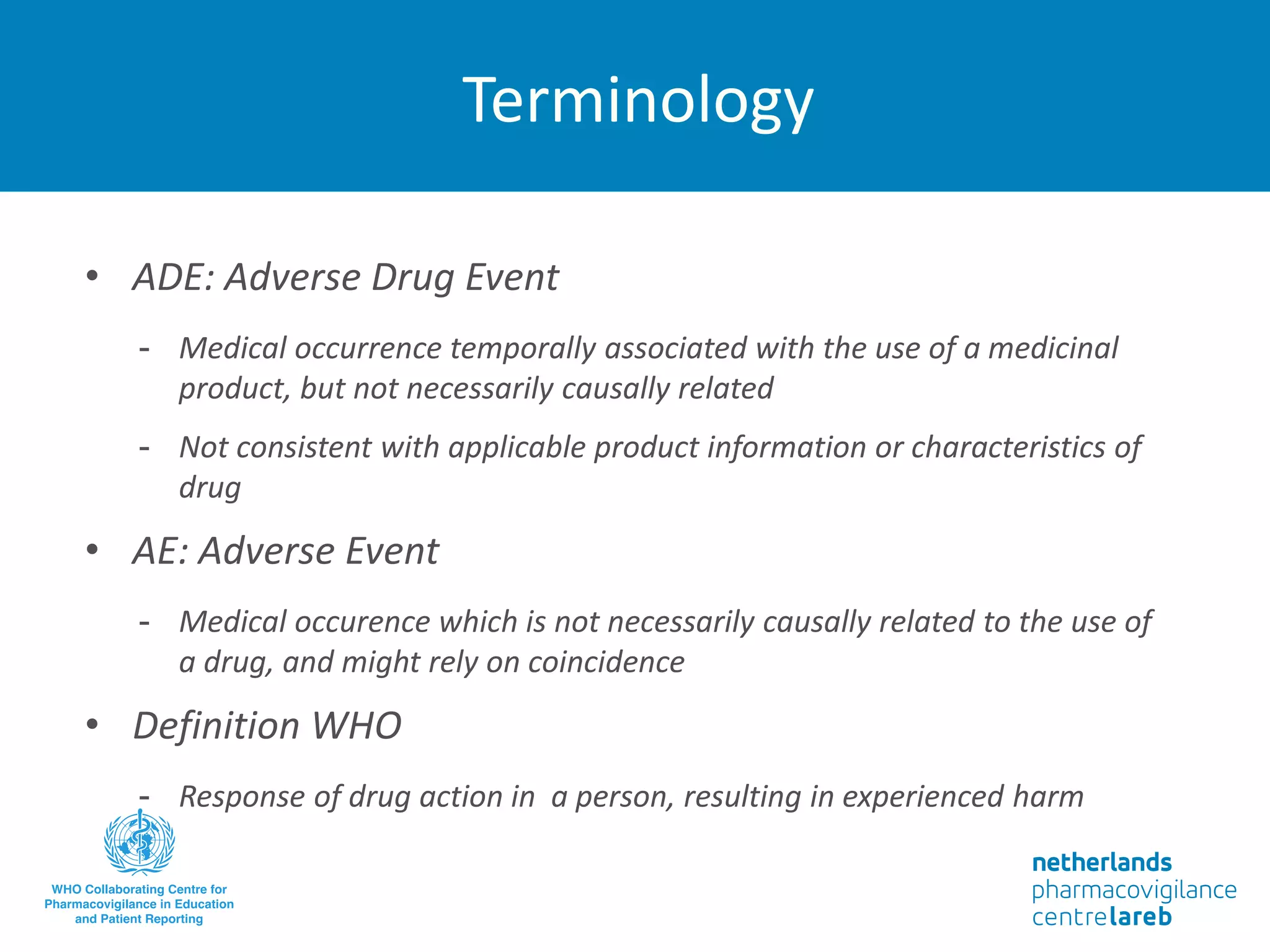
Terminology
• ADE: Adverse Drug Event
- Medical occurrence temporally associated with the use of a medicinal
product, but not necessarily causally related
- Not consistent with applicable product information or characteristics of
drug
• AE: Adverse Event
- Medical occurence which is not necessarily causally related to the use of
a drug, and might rely on coincidence
• Definition WHO
- Response of drug action in a person, resulting in experienced harm
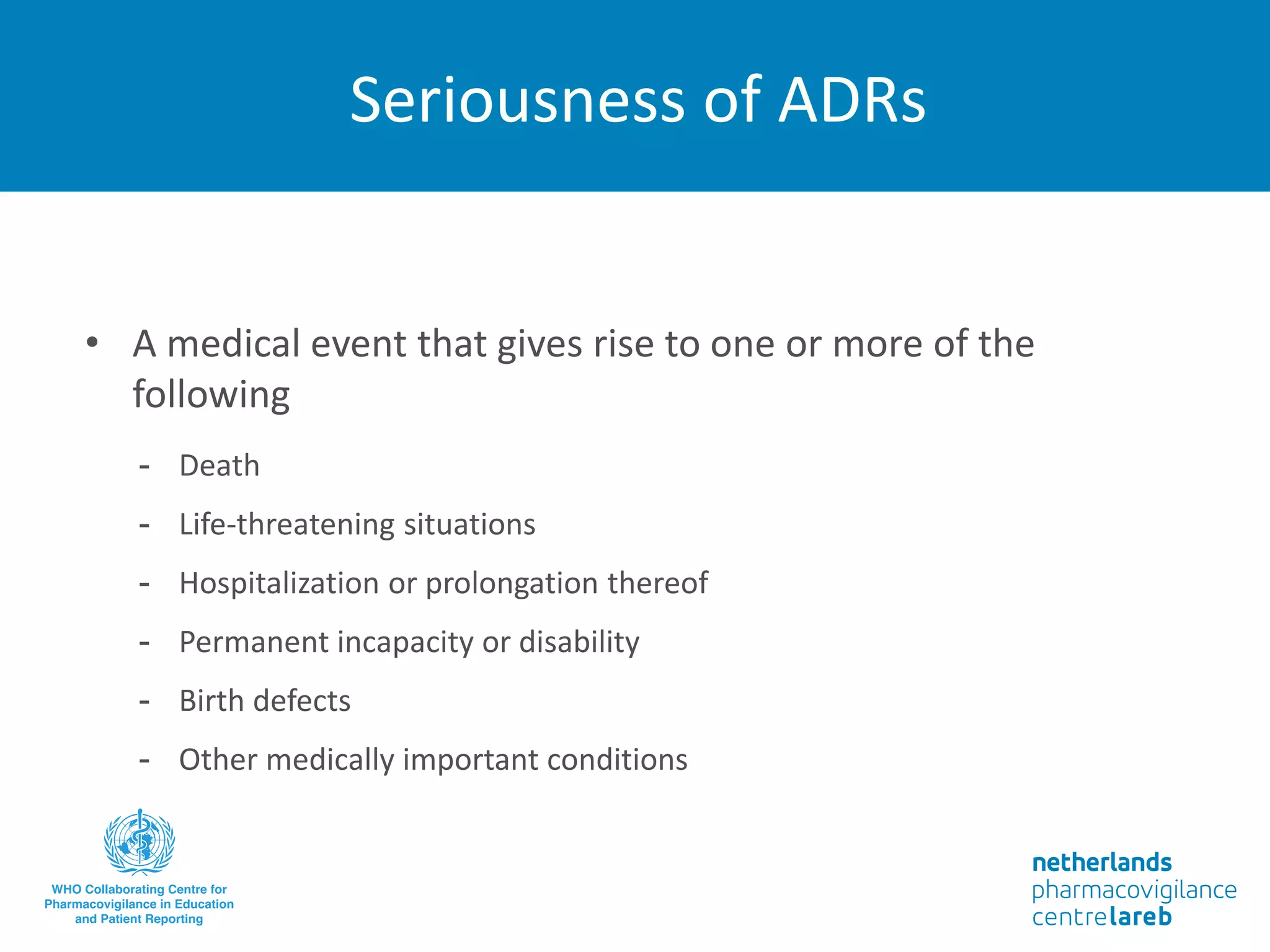
Seriousness of ADRs
• A medical event that gives rise to one or more of the
following
- Death
- Life-threatening situations
- Hospitalization or prolongation thereof
- Permanent incapacity or disability
- Birth defects
- Other medically important conditions
• Introduction pharmacovigilance
• Drug safety in Practice
• Need for monitoring the safety of drugs
• Organisation of pharmacovigilance
Outline
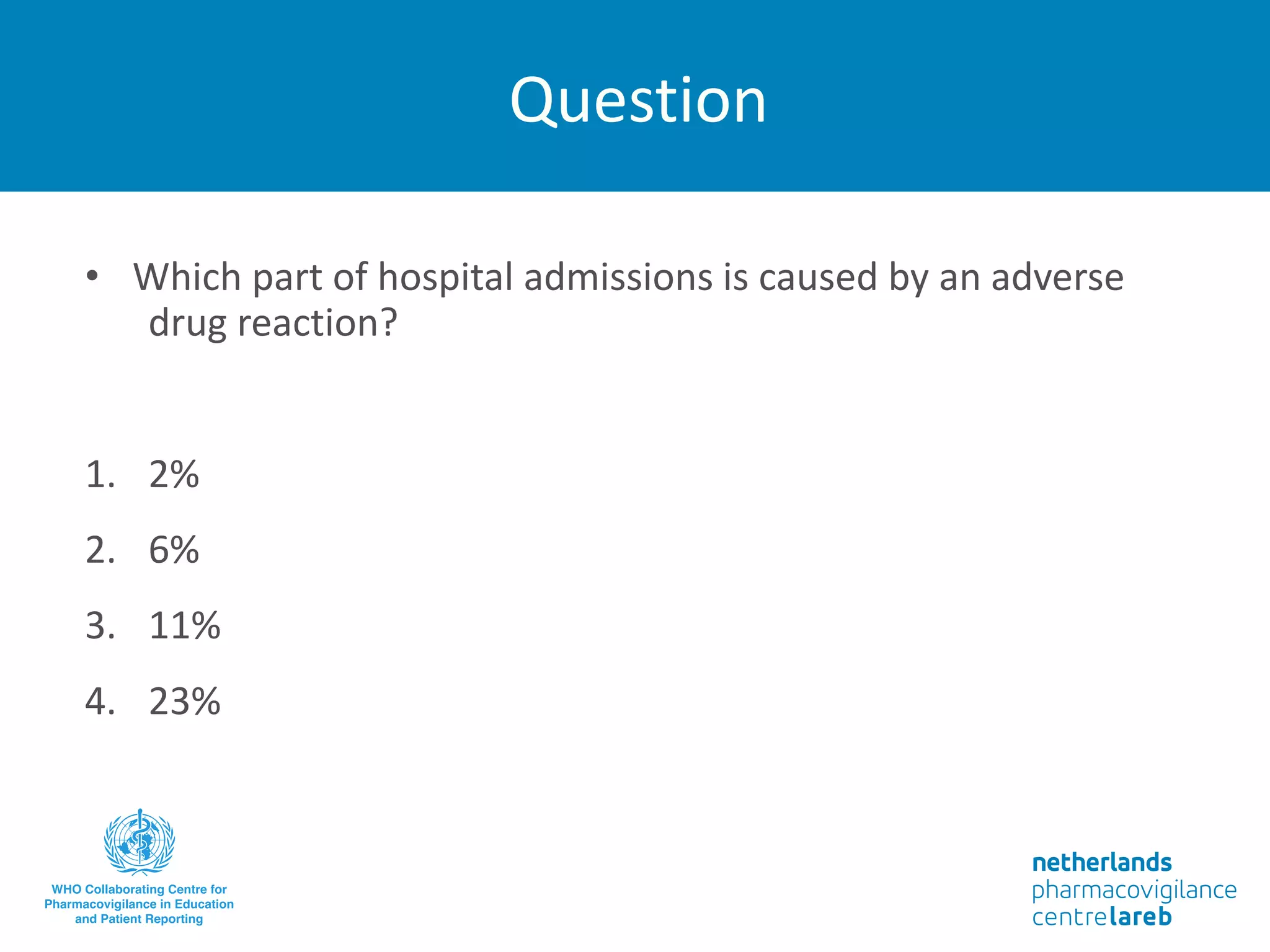
Question
• Which part of hospital admissions is caused by an adverse
drug reaction?
1. 2%
2. 6%
3. 11%
4. 23%
• 22 hospitals throughout the Netherlands
• 40 days all hospital admissions were screened and
classified as drug-related or non-drug-related
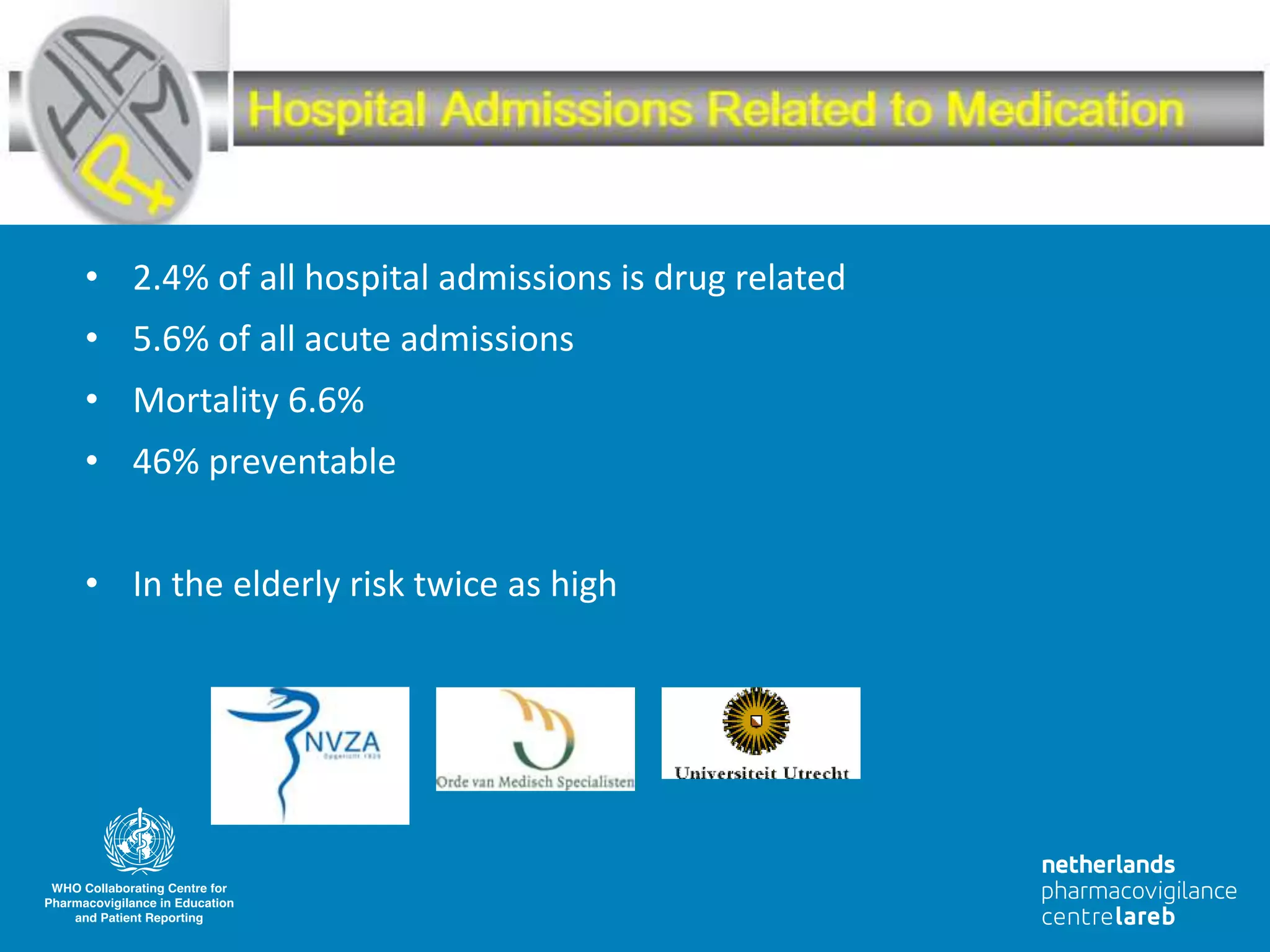
• 2.4% of all hospital admissions is drug related
• 5.6% of all acute admissions
• Mortality 6.6%
• 46% preventable
• In the elderly risk twice as high
Successive study on medication
safety
Final report:
• Following previous studies on possibly avoidable hospital related
admissions to medication
• Evaluating recommendations to reduce possible harm
• Updating data on HARM related admissions
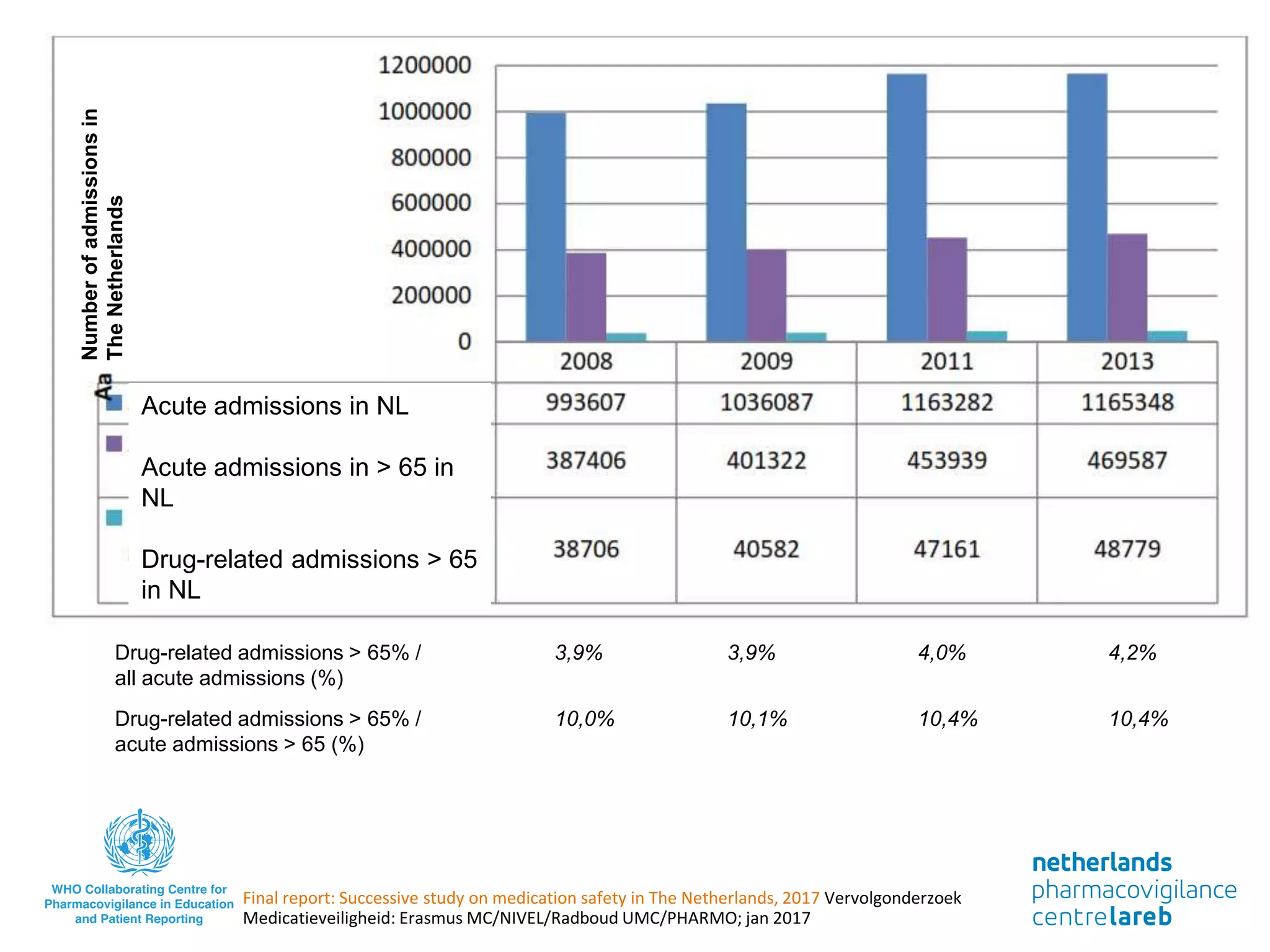
Final report: Successive study on medication safety in The Netherlands, 2017 Vervolgonderzoek
Medicatieveiligheid: Erasmus MC/NIVEL/Radboud UMC/PHARMO; jan 2017
Number
of
admissions
in
The
Netherlands
Acute admissions in NL
Acute admissions in > 65 in
NL
Drug-related admissions > 65
in NL
3,9% 3,9% 4,0% 4,2%
Drug-related admissions > 65% /
all acute admissions (%)
Drug-related admissions > 65% /
acute admissions > 65 (%)
10,0% 10,1% 10,4% 10,4%
Avoidable hospital admissions
Vervolgonderzoek Medicatieveiligheid: Erasmus
MC/NIVEL/Radboud UMC/PHARMO; jan 2017
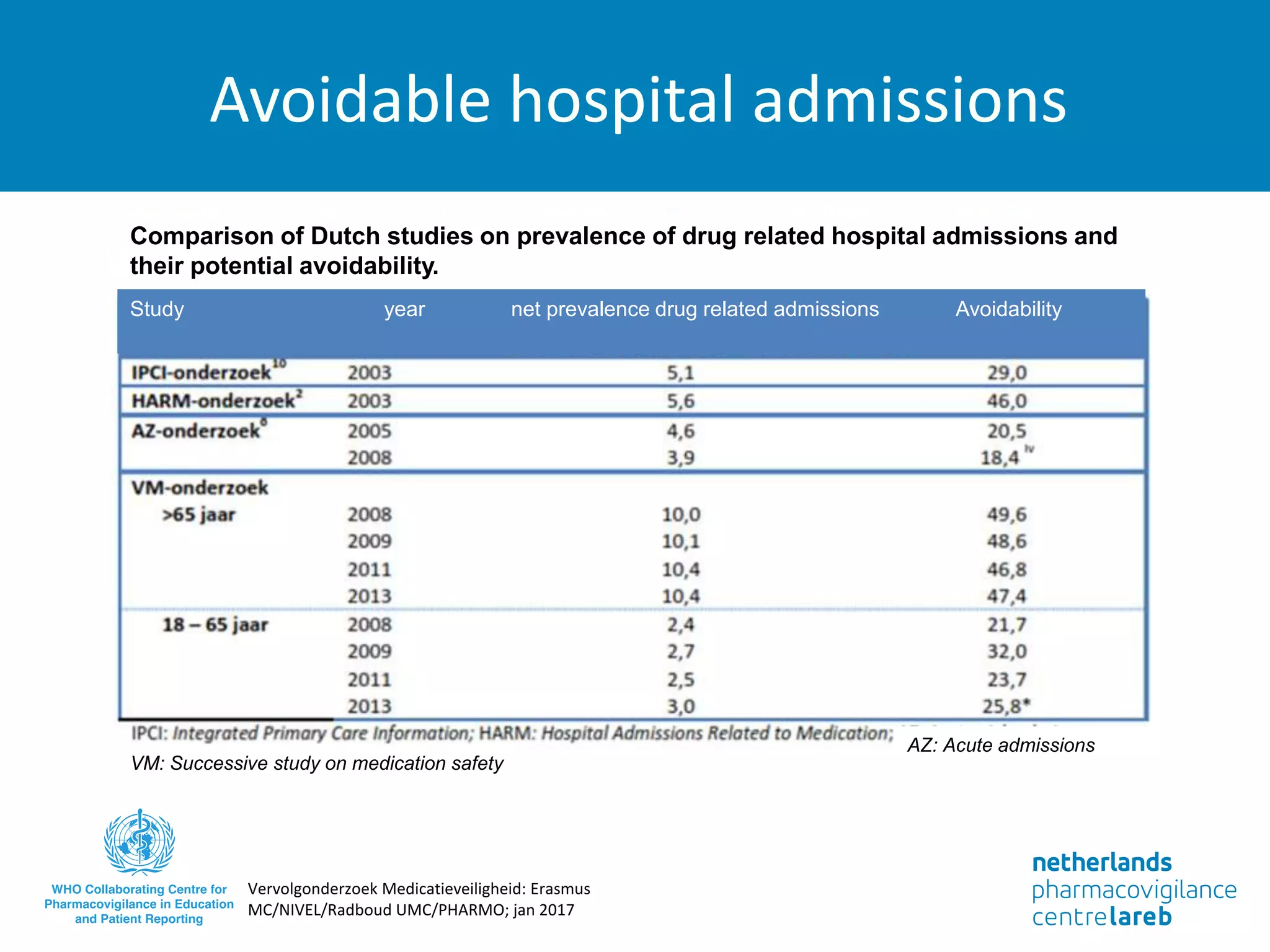
Comparison of Dutch studies on prevalence of drug related hospital admissions and
their potential avoidability.
AZ: Acute admissions
VM: Successive study on medication safety
Study year net prevalence drug related admissions Avoidability
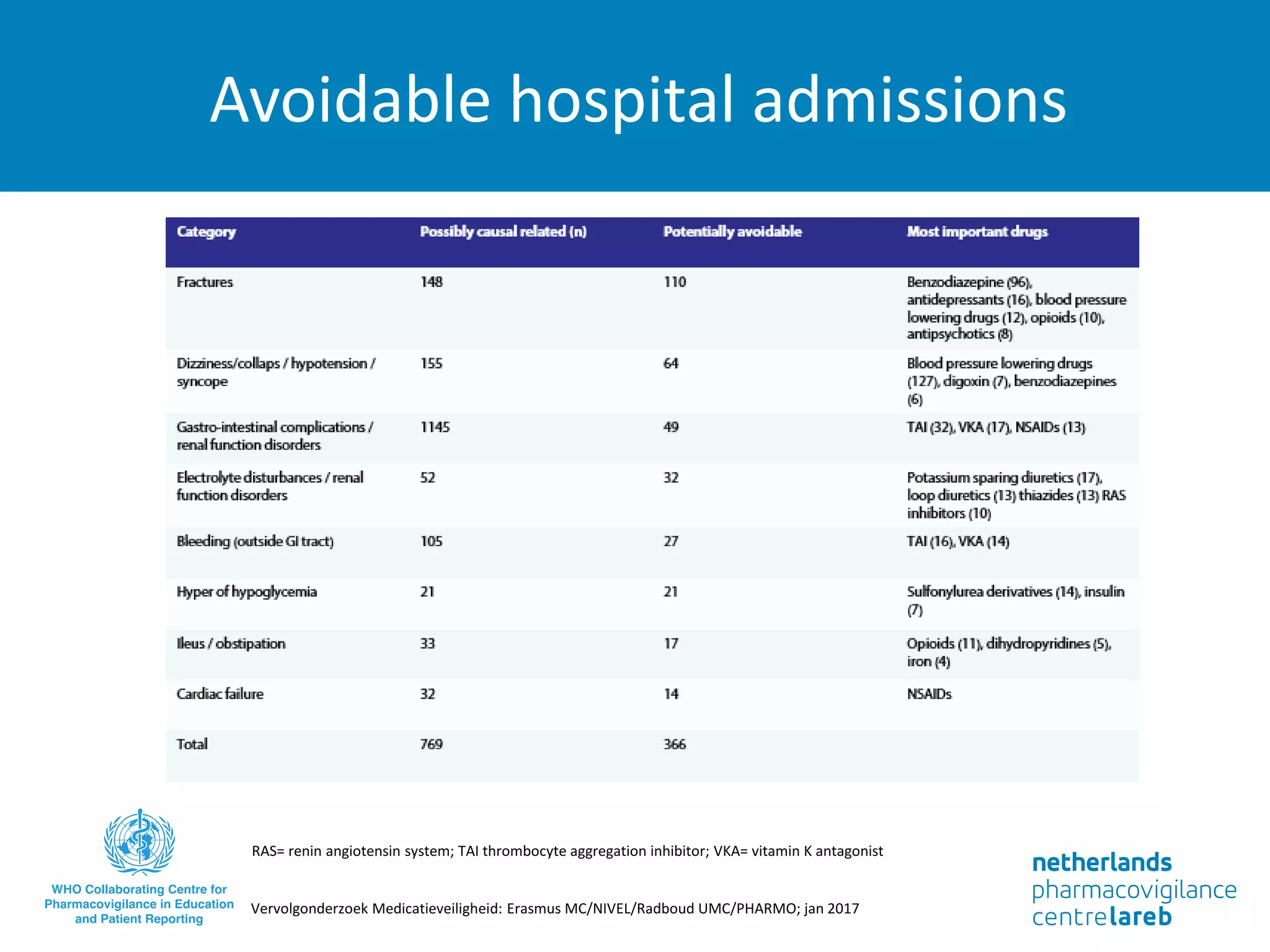
Avoidable hospital admissions
Vervolgonderzoek Medicatieveiligheid: Erasmus MC/NIVEL/Radboud UMC/PHARMO; jan 2017
RAS= renin angiotensin system; TAI thrombocyte aggregation inhibitor; VKA= vitamin K antagonist
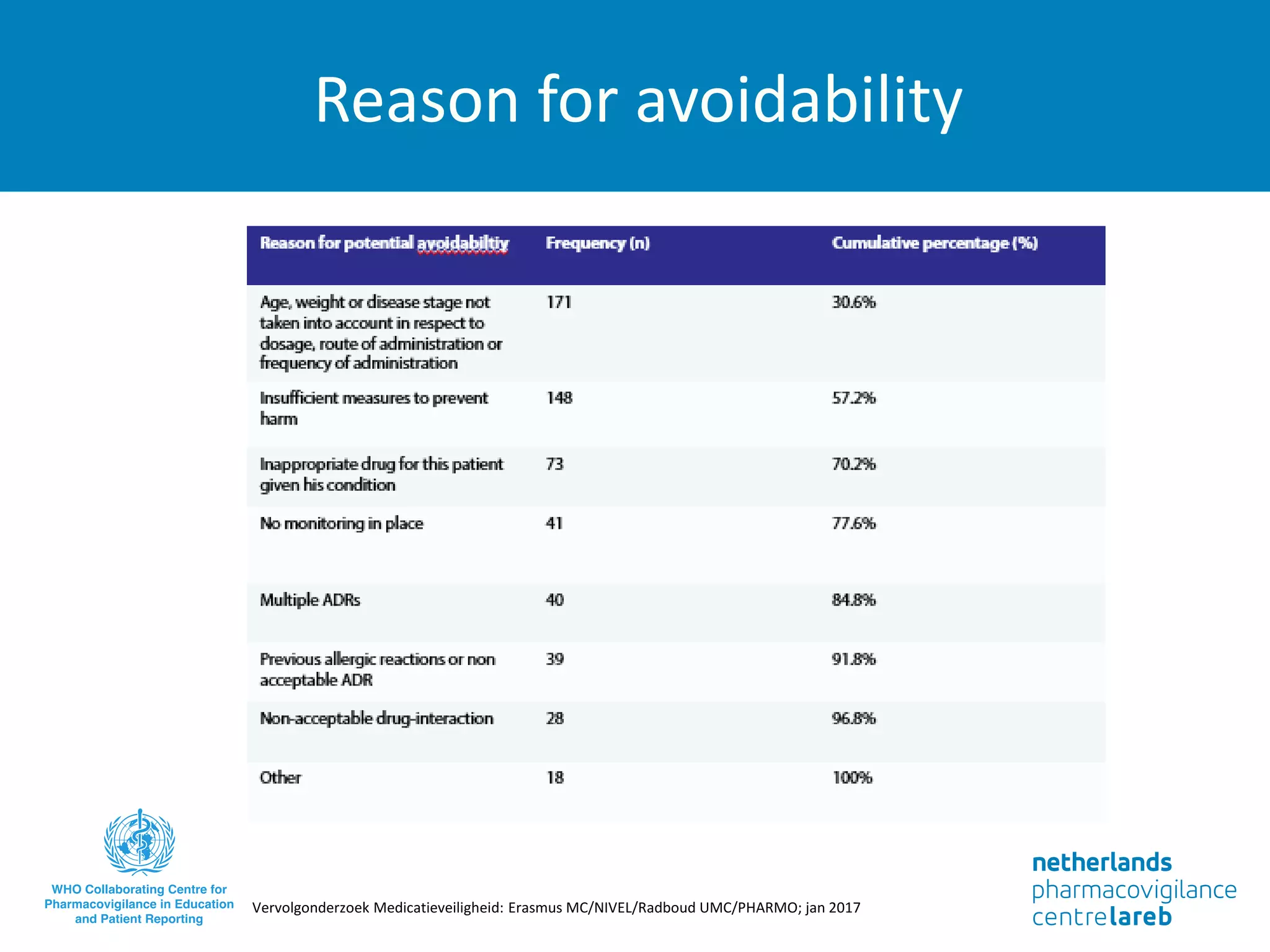
Reason for avoidability
Vervolgonderzoek Medicatieveiligheid: Erasmus MC/NIVEL/Radboud UMC/PHARMO; jan 2017
• Introduction pharmacovigilance
• Drug safety in Practice
• Need for monitoring the safety of drugs
• Organisation of pharmacovigilance
Outline
Louvre: Francisco de Goya y Lucientes (1746-1828)
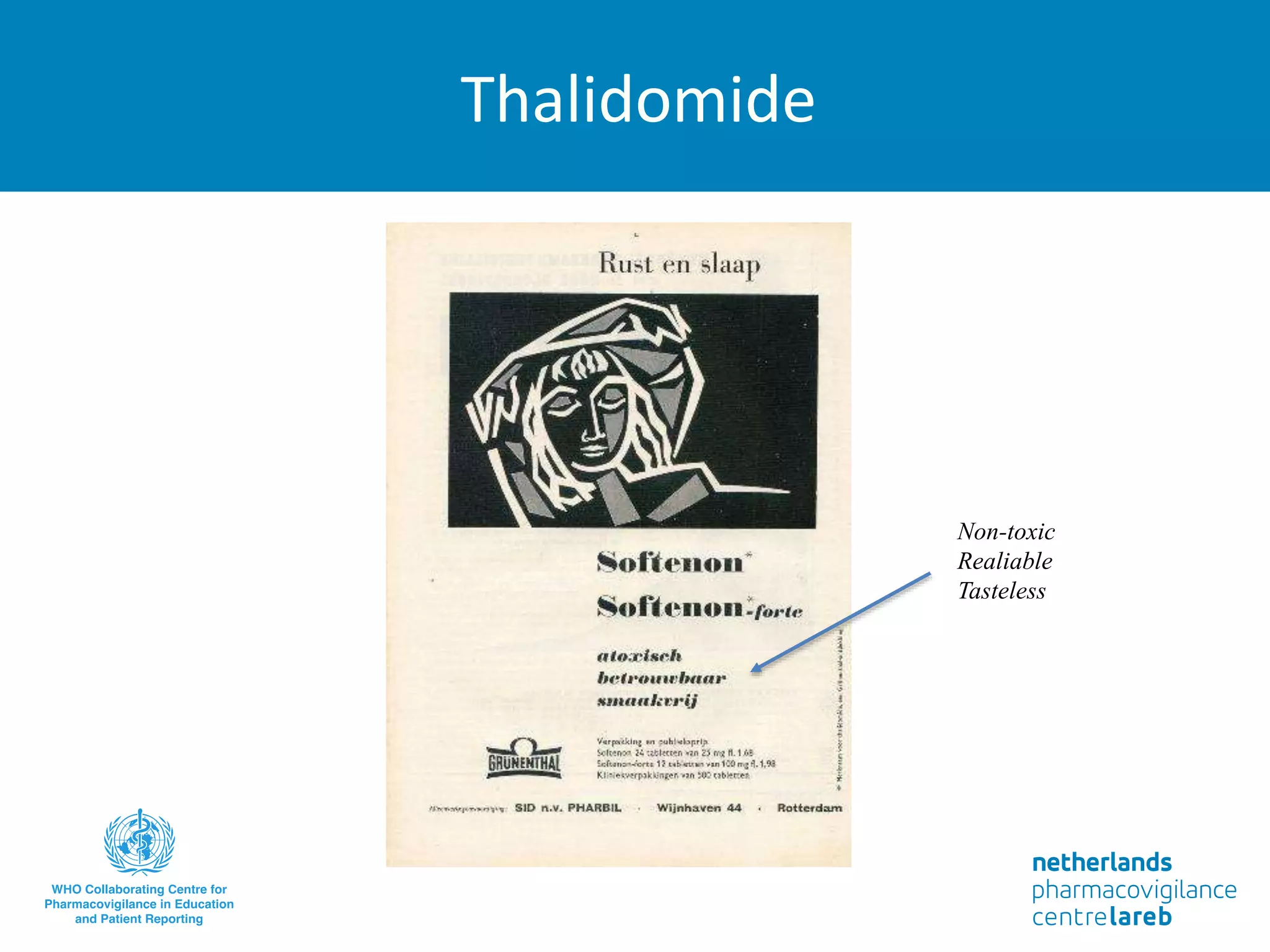
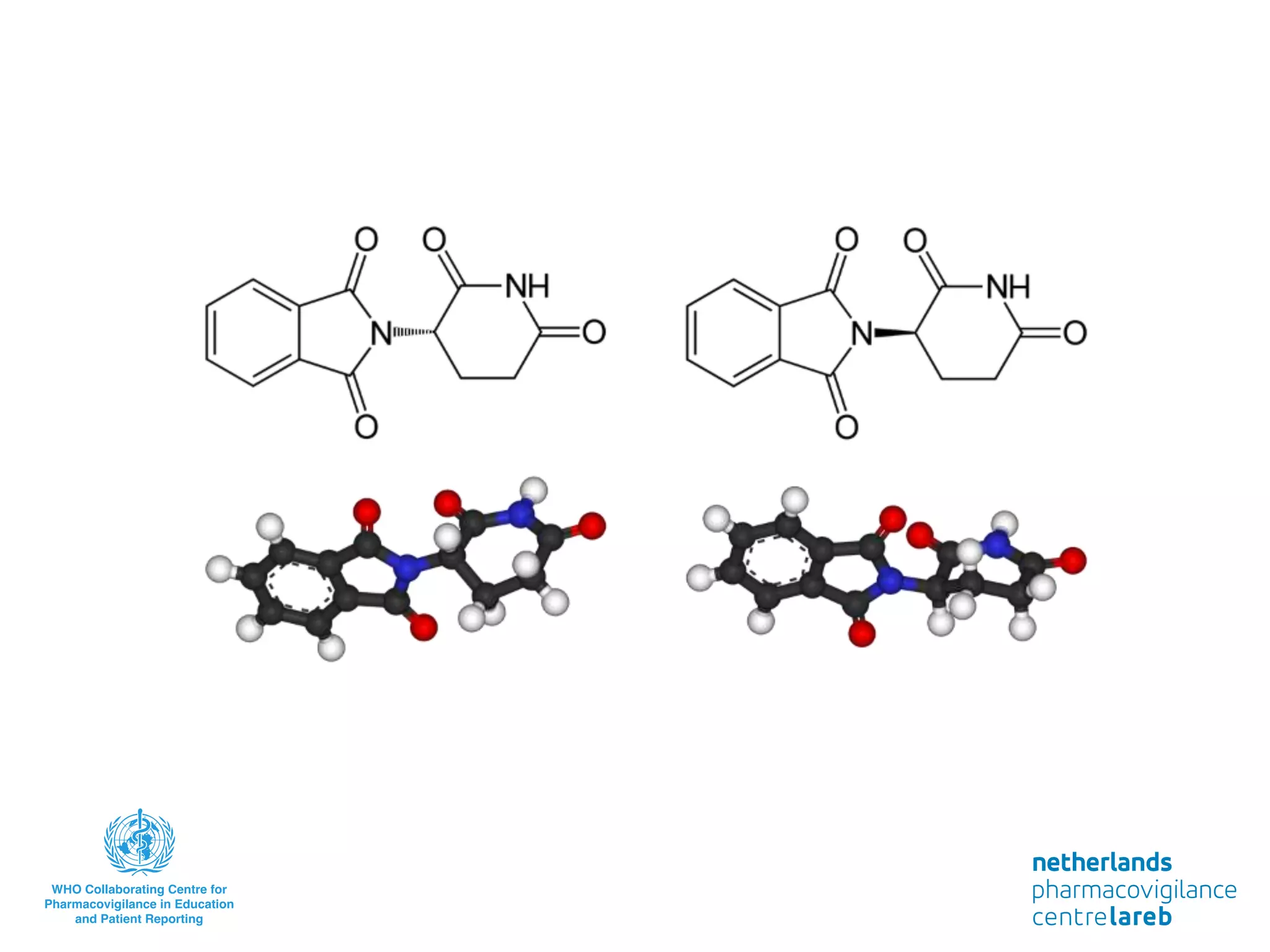
Thalidomide
Non-toxic
Realiable
Tasteless
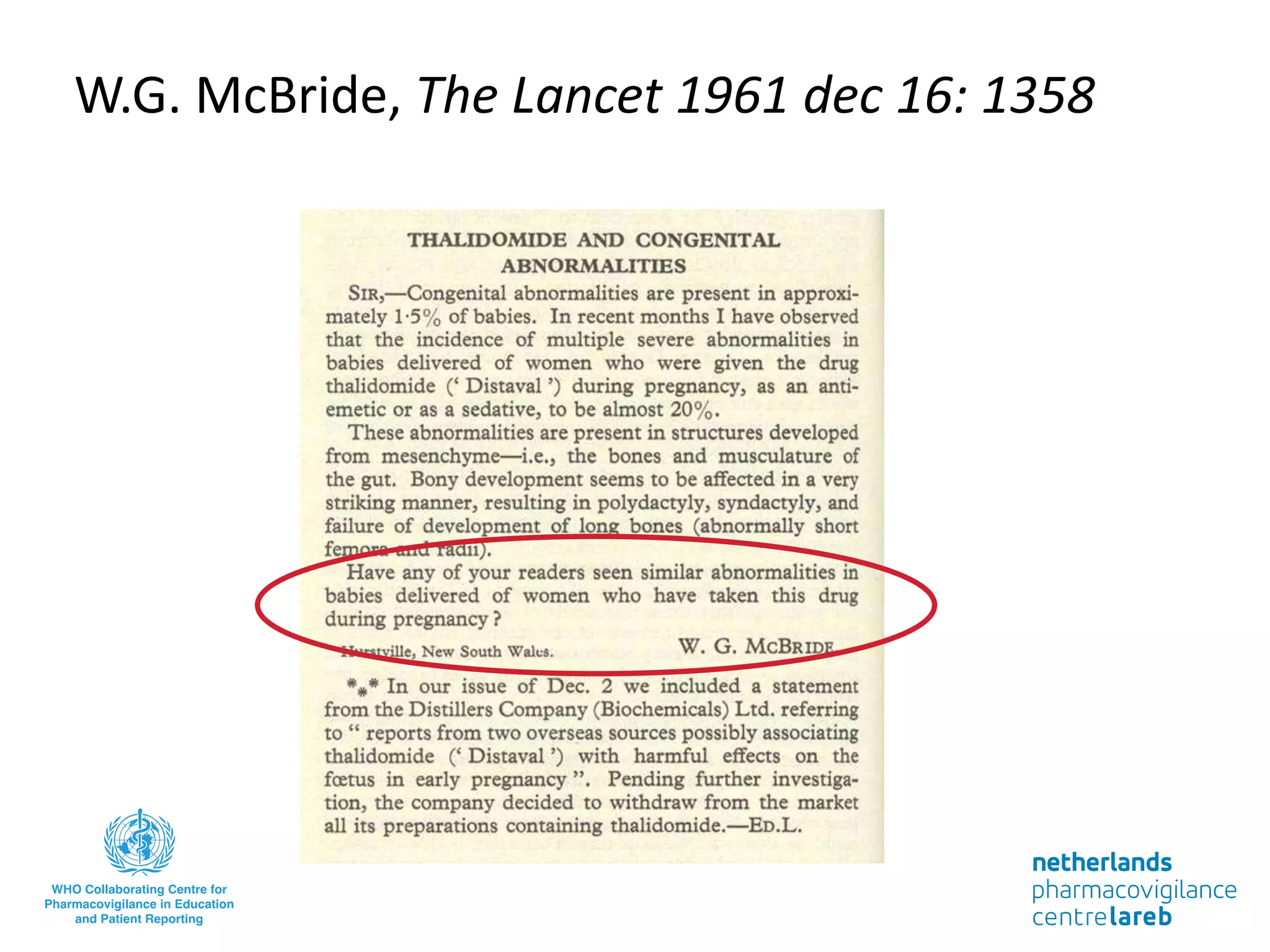
W.G. McBride, The Lancet 1961 dec 16: 1358
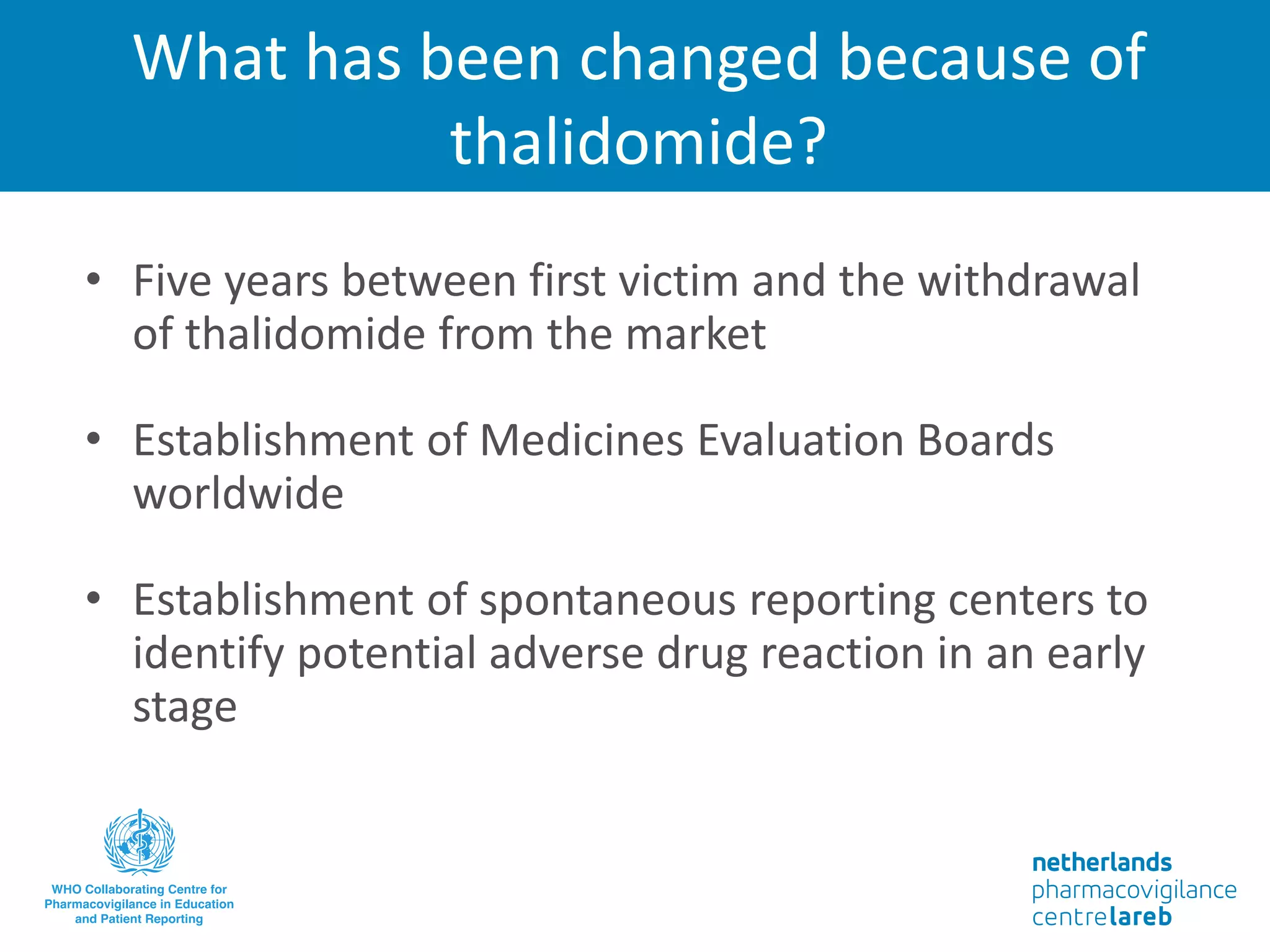
What has been changed because of
thalidomide?
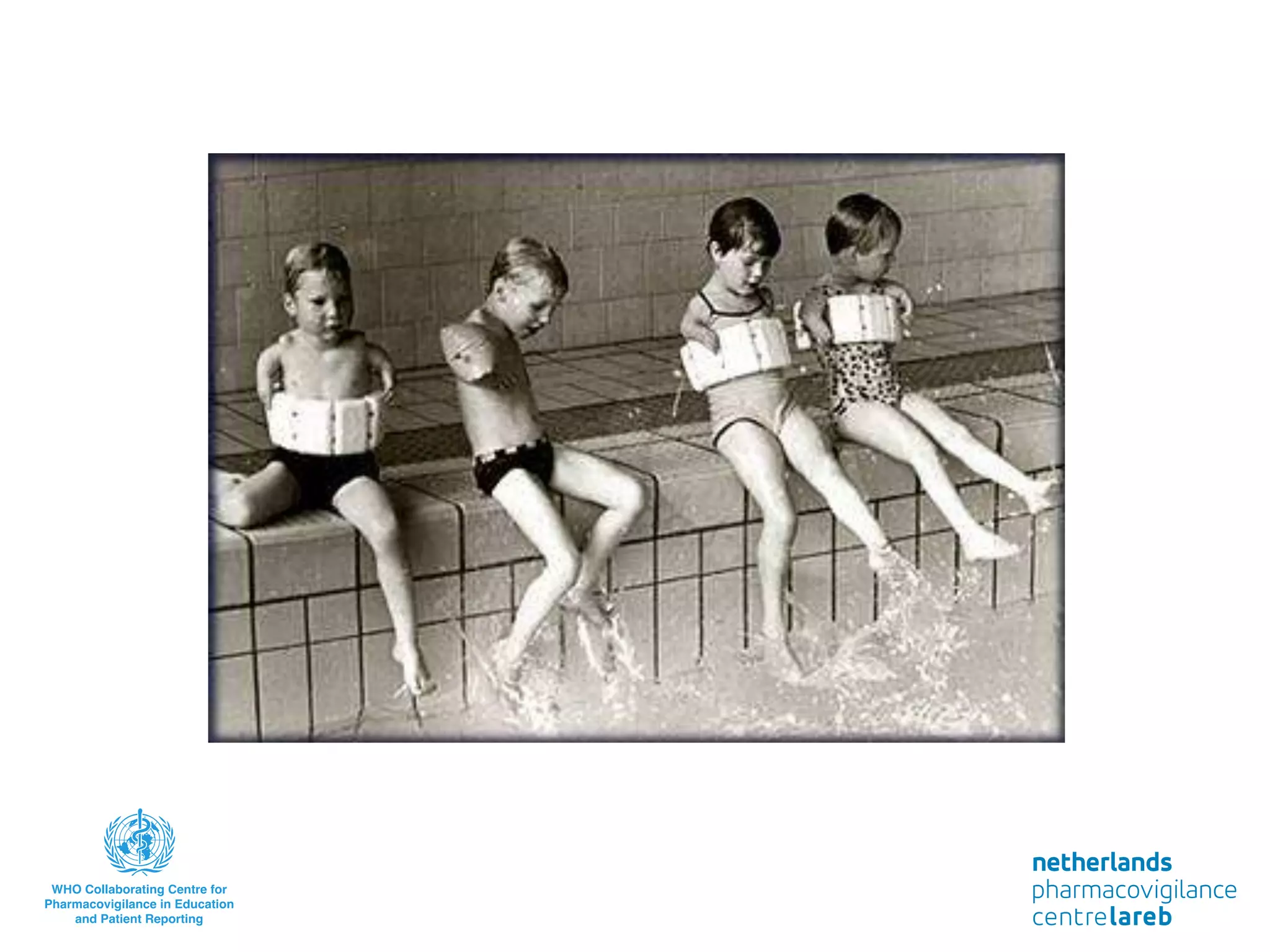
• Five years between first victim and the withdrawal
of thalidomide from the market
• Establishment of Medicines Evaluation Boards
worldwide
• Establishment of spontaneous reporting centers to
identify potential adverse drug reaction in an early
stage
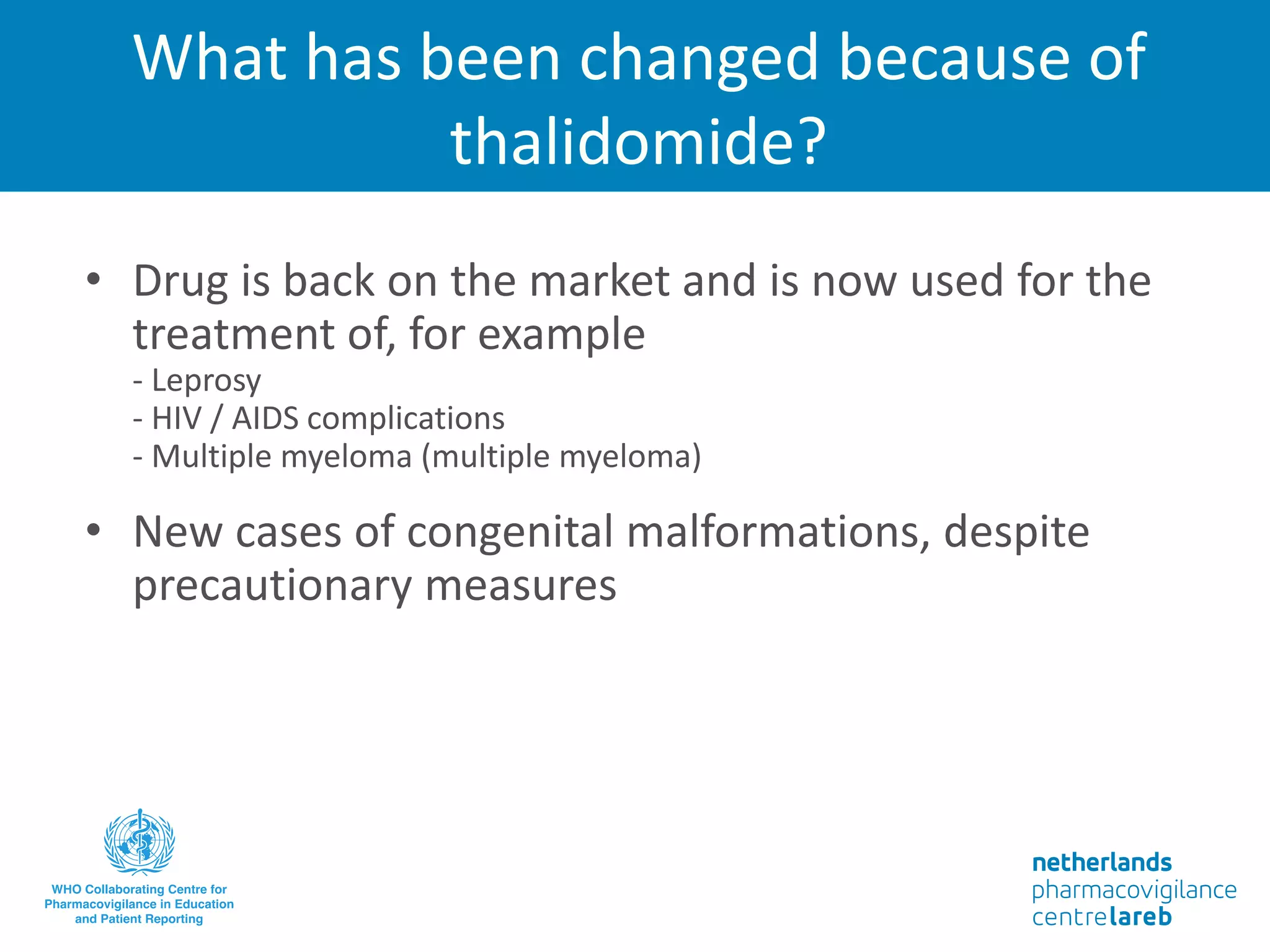
What has been changed because of
thalidomide?
• Drug is back on the market and is now used for the
treatment of, for example
- Leprosy
- HIV / AIDS complications
- Multiple myeloma (multiple myeloma)
• New cases of congenital malformations, despite
precautionary measures
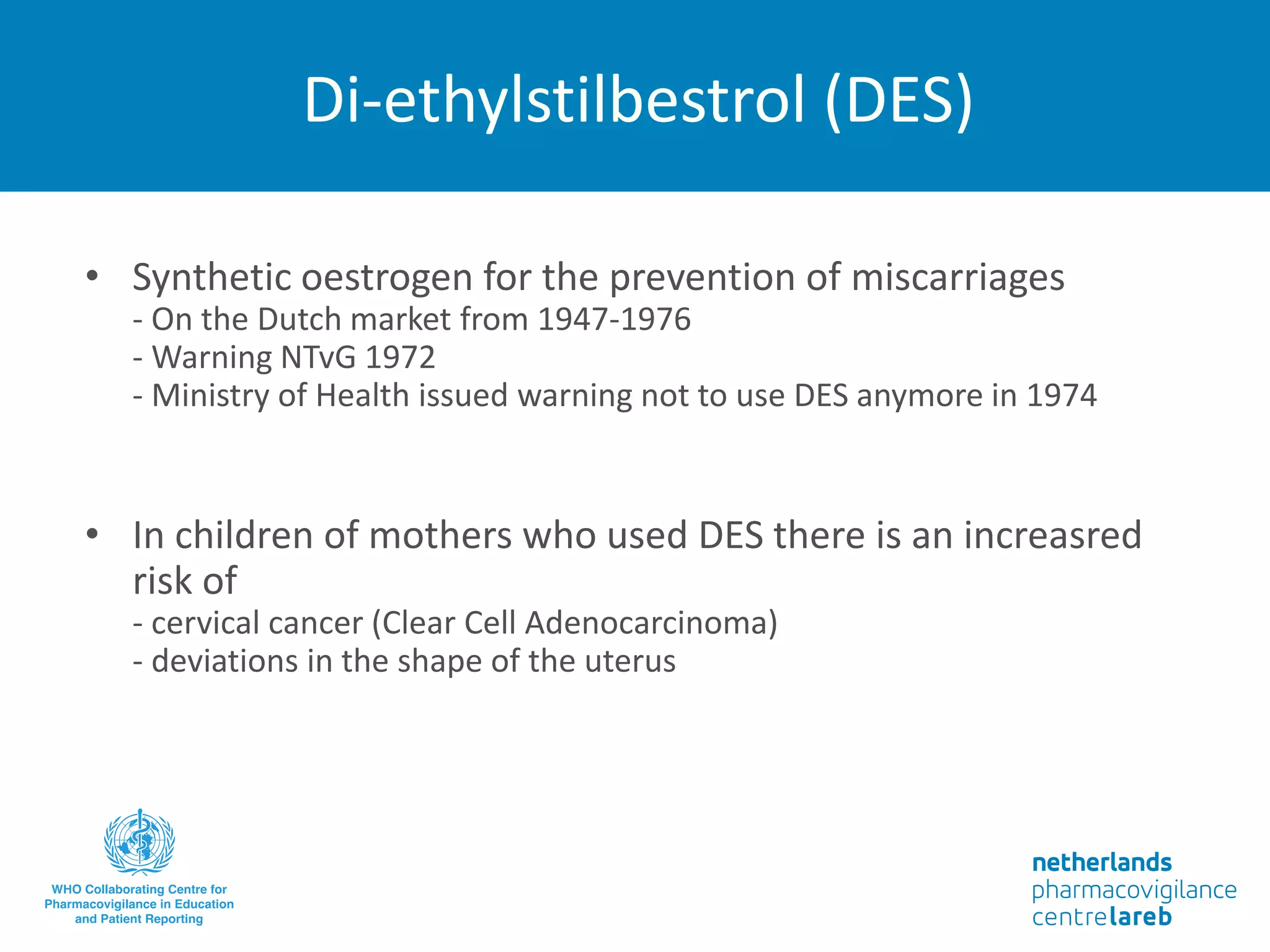
Di-ethylstilbestrol (DES)
• Synthetic oestrogen for the prevention of miscarriages
- On the Dutch market from 1947-1976
- Warning NTvG 1972
- Ministry of Health issued warning not to use DES anymore in 1974
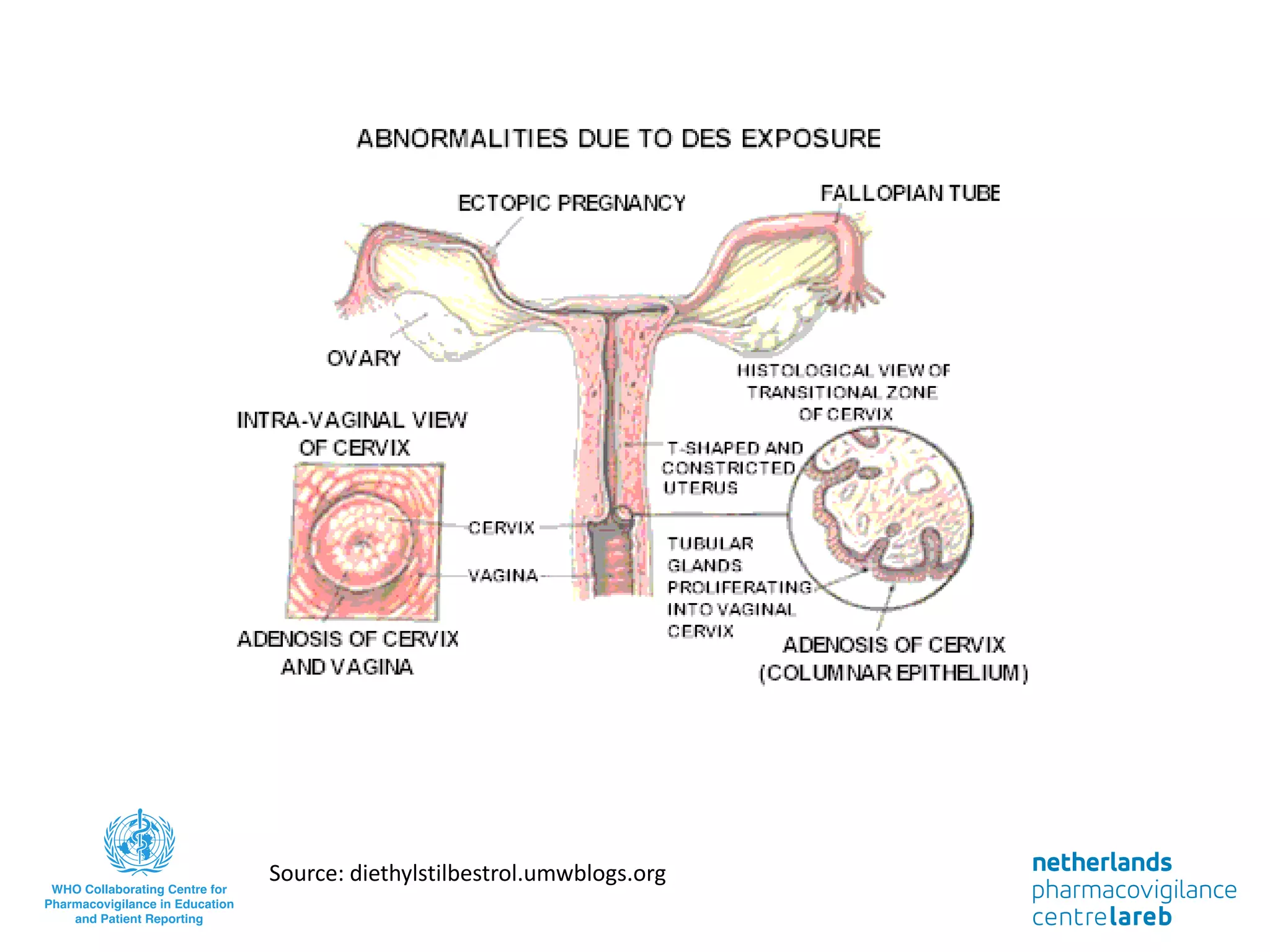
• In children of mothers who used DES there is an increasred
risk of
- cervical cancer (Clear Cell Adenocarcinoma)
- deviations in the shape of the uterus
Source: diethylstilbestrol.umwblogs.org
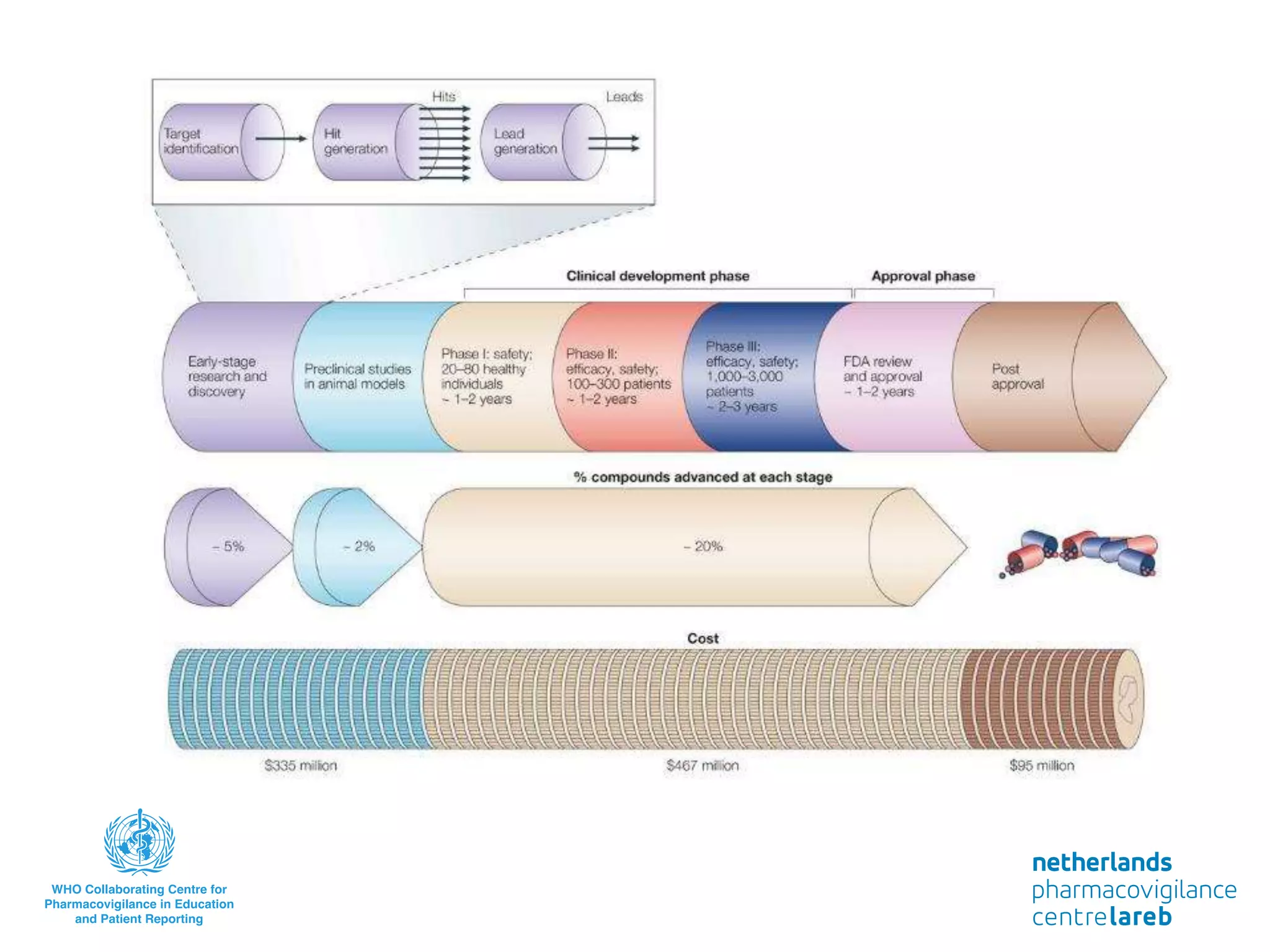
For which categories of ADRs, information is lacking at
the time of marketing?
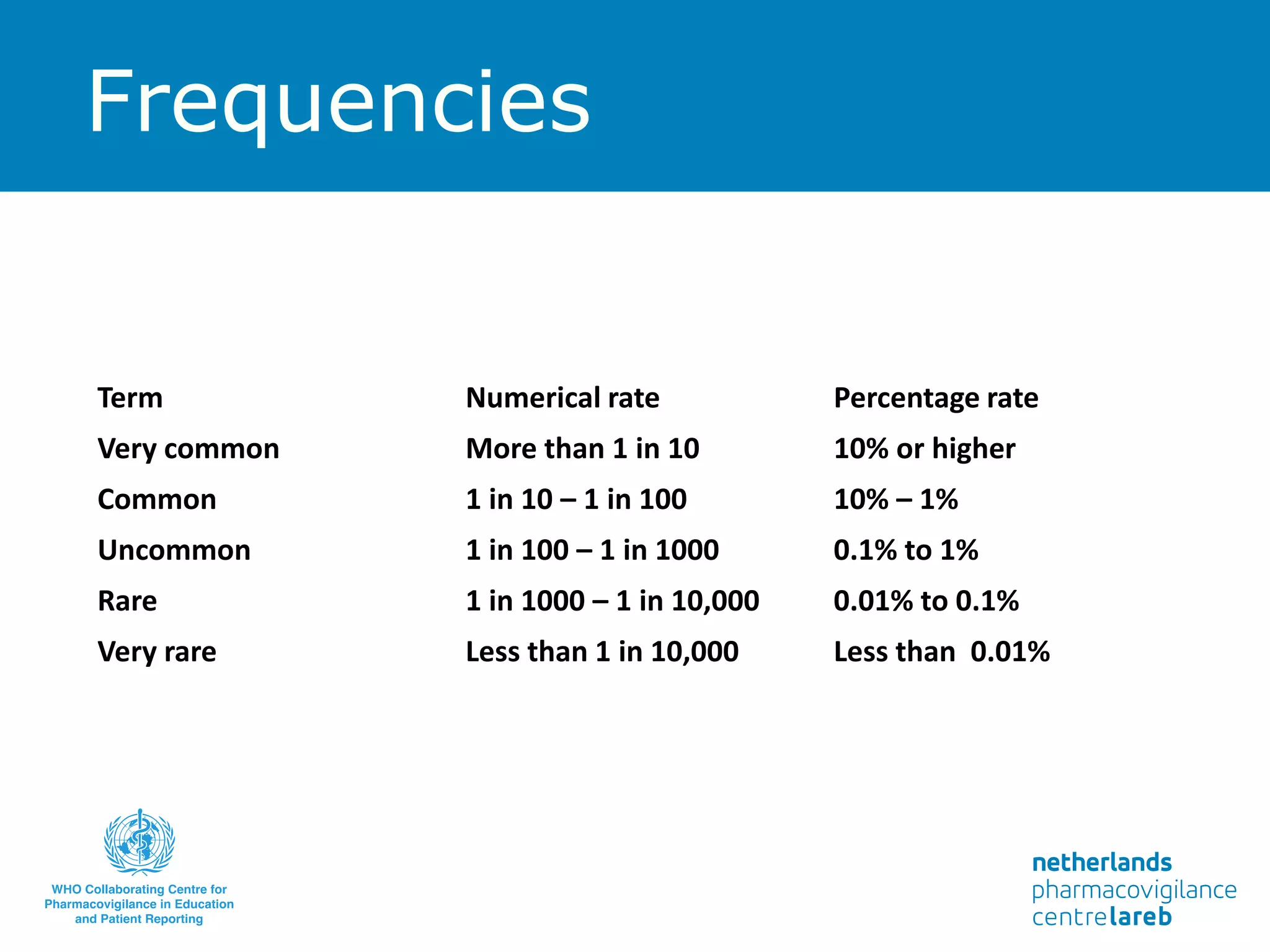
Frequencies
Term Numerical rate Percentage rate
Very common More than 1 in 10 10% or higher
Common 1 in 10 – 1 in 100 10% – 1%
Uncommon 1 in 100 – 1 in 1000 0.1% to 1%
Rare 1 in 1000 – 1 in 10,000 0.01% to 0.1%
Very rare Less than 1 in 10,000 Less than 0.01%
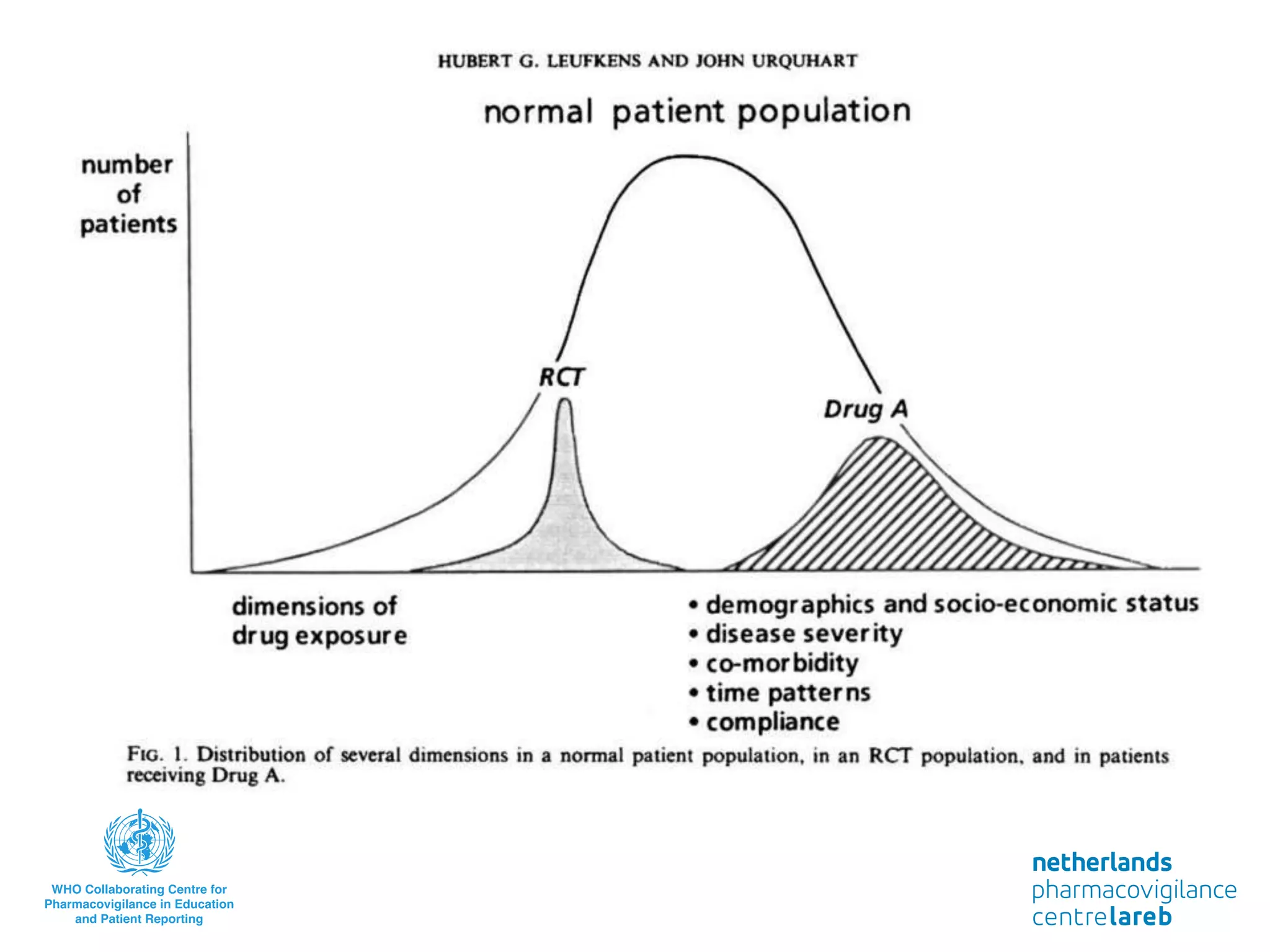
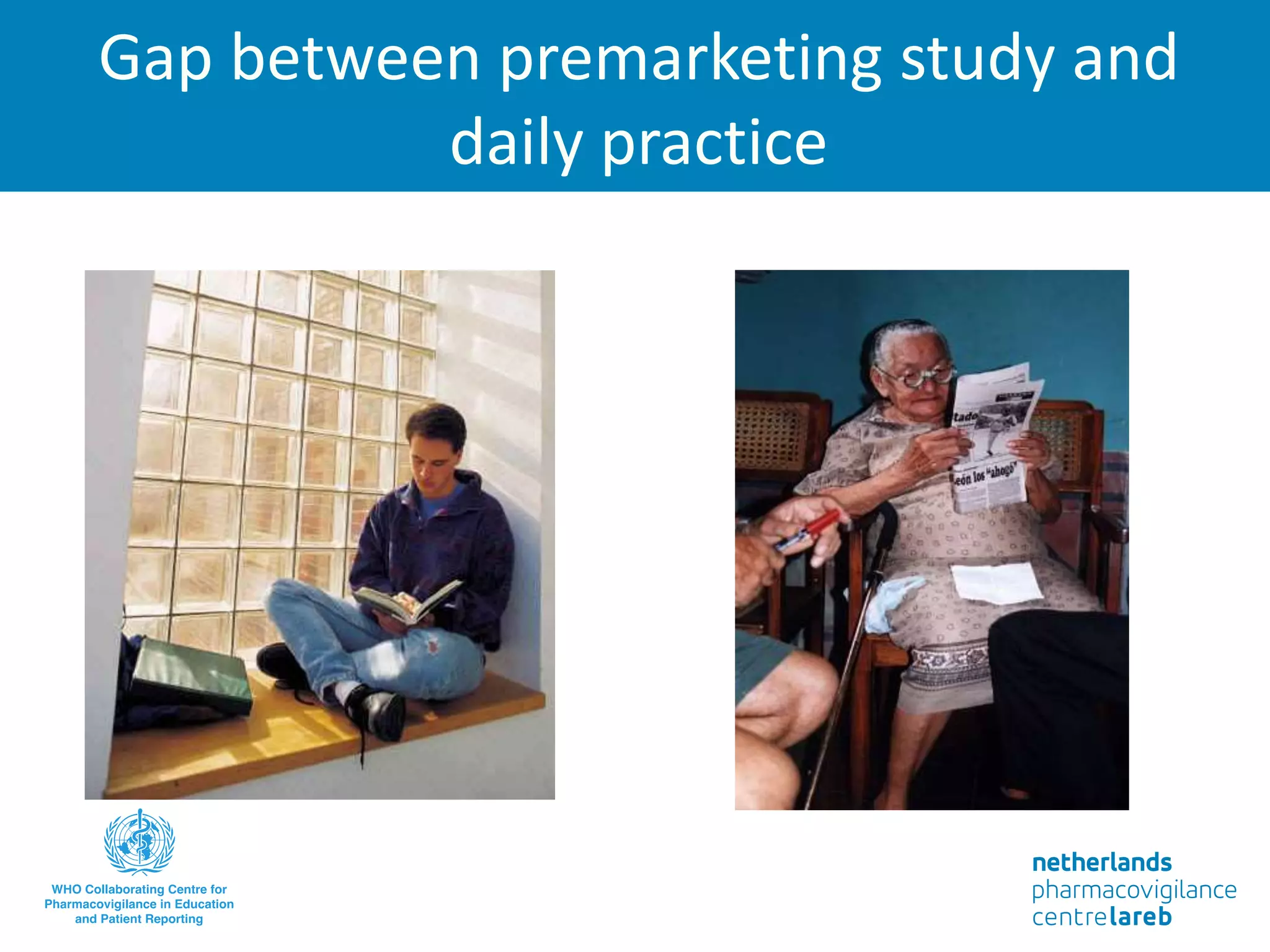
Gap between premarketing study and
daily practice
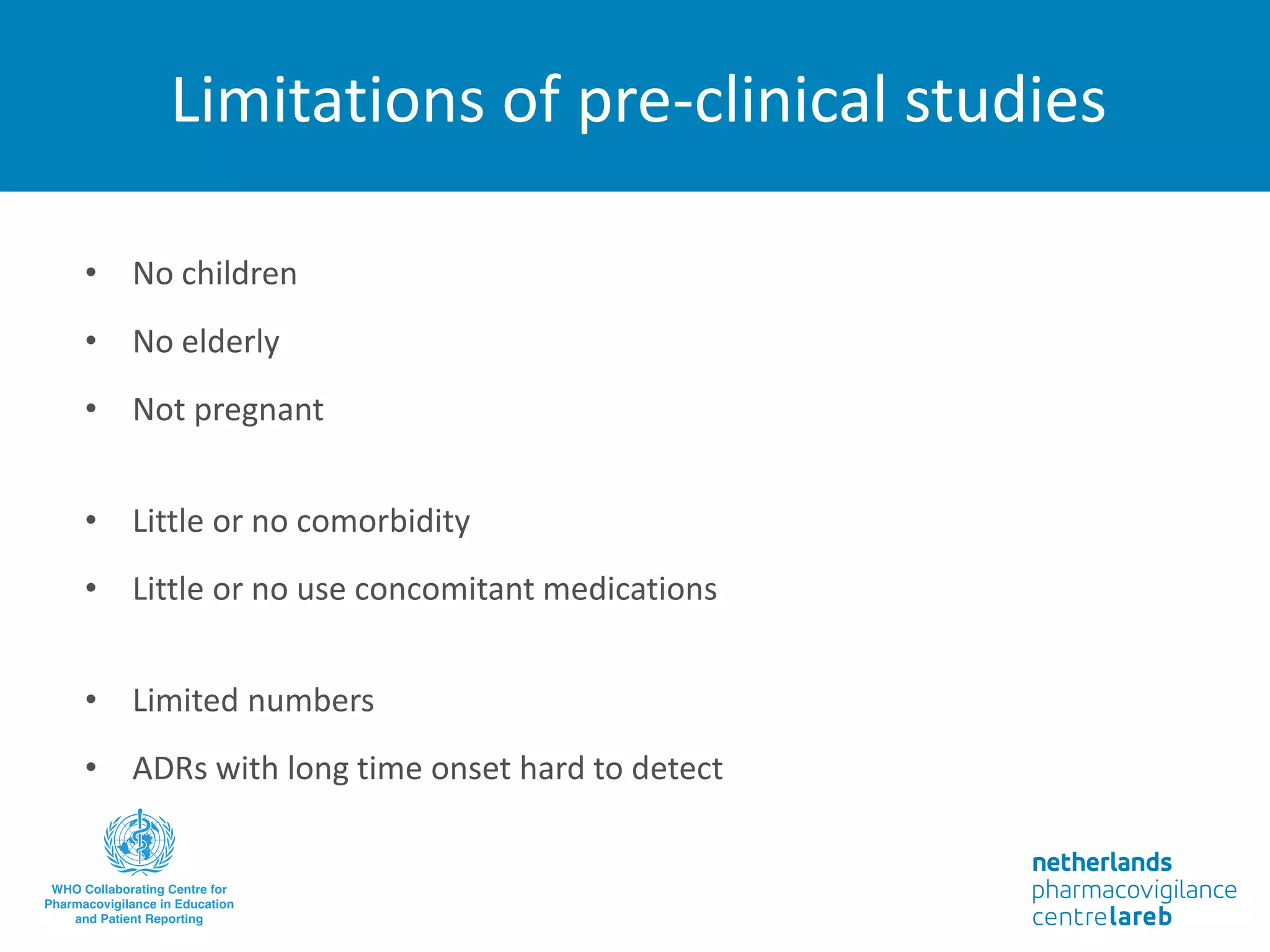
Limitations of pre-clinical studies
• No children
• No elderly
• Not pregnant
• Little or no comorbidity
• Little or no use concomitant medications
• Limited numbers
• ADRs with long time onset hard to detect
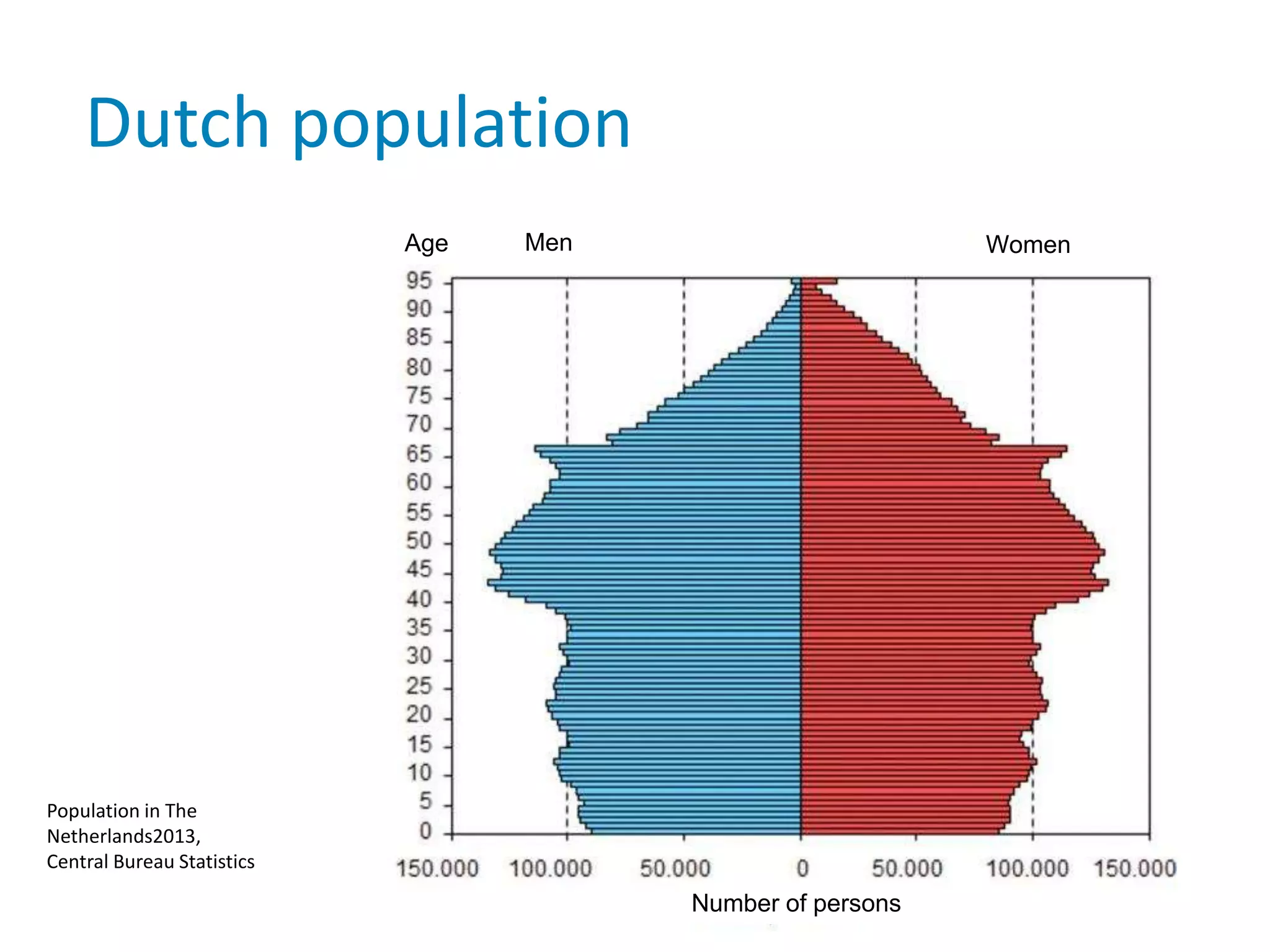
Dutch population
Number of persons
Age Men Women
Population in The
Netherlands2013,
Central Bureau Statistics
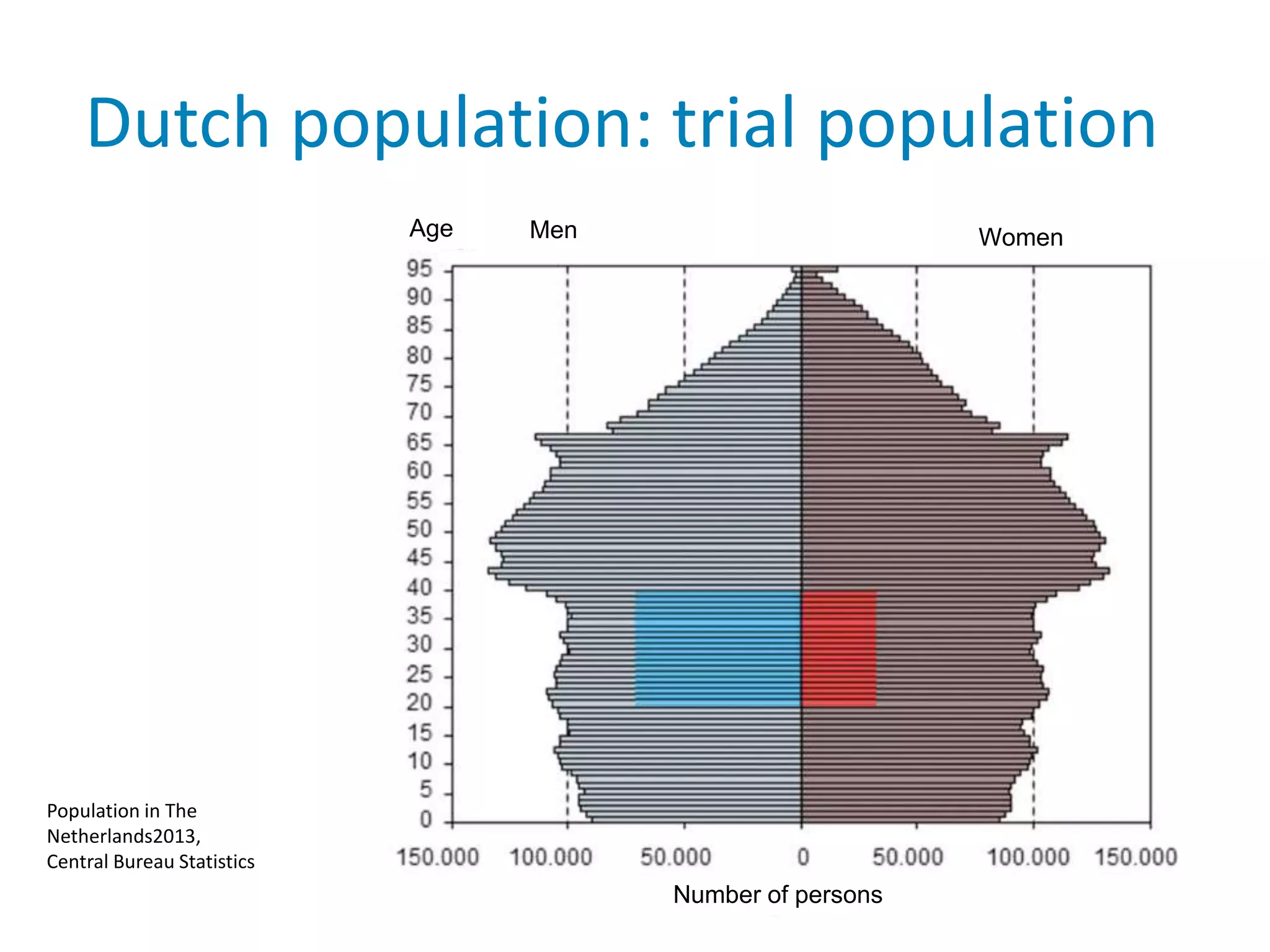
Dutch population: trial population
Number of persons
Age Men Women
Population in The
Netherlands2013,
Central Bureau Statistics
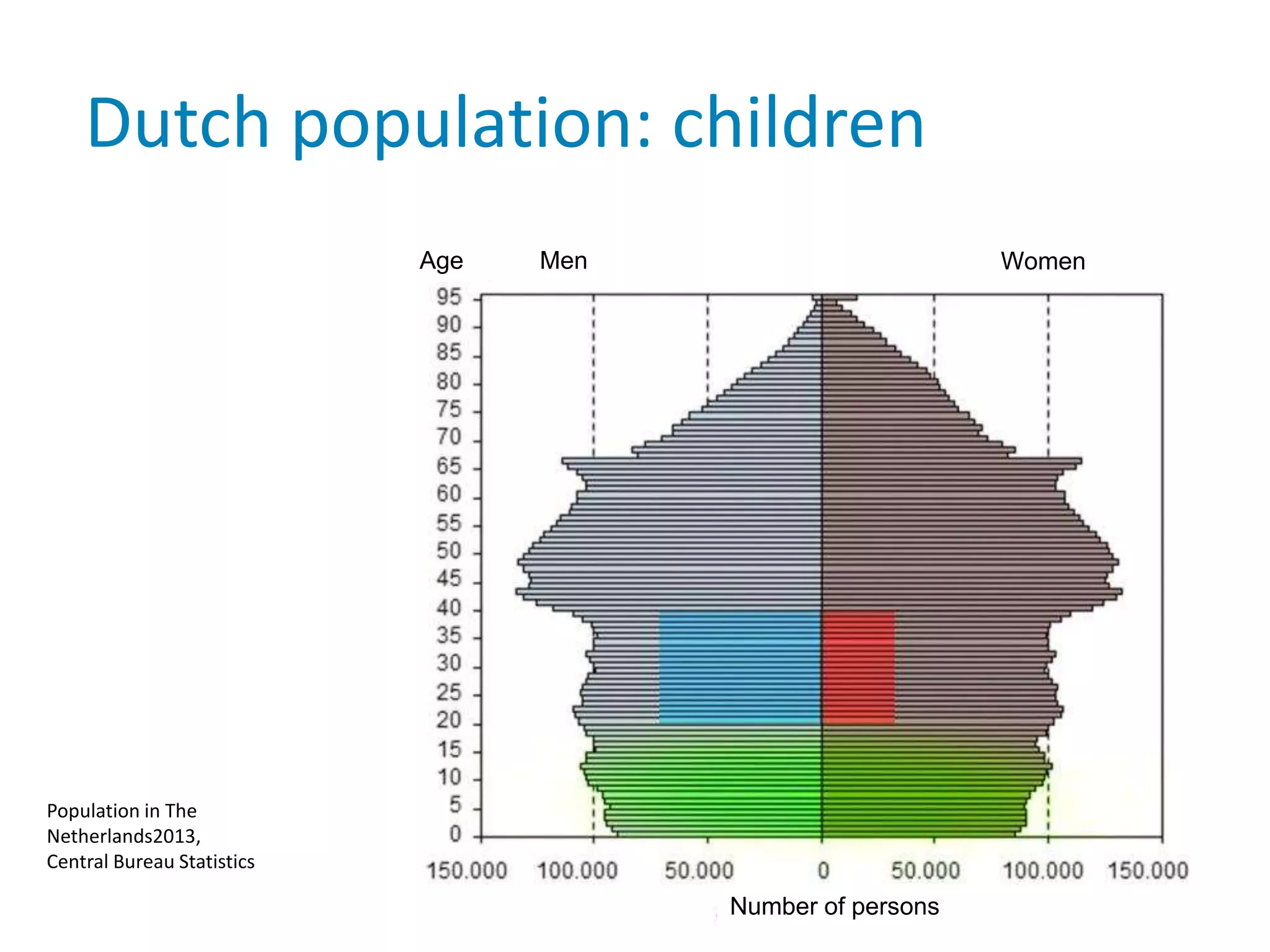
Dutch population: children
Number of persons
Age Men Women
Population in The
Netherlands2013,
Central Bureau Statistics
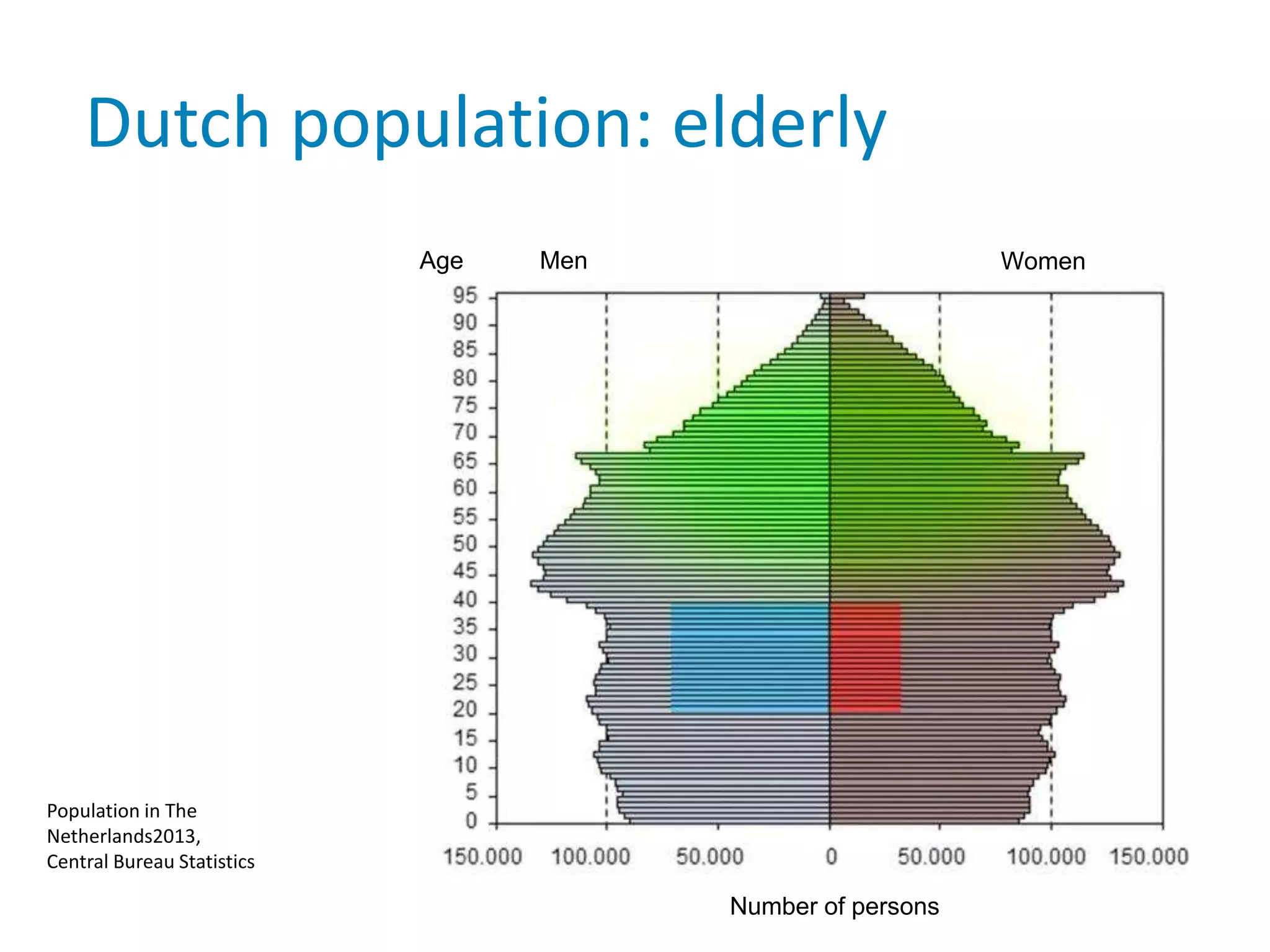
Dutch population: elderly
Number of persons
Age Men Women
Population in The
Netherlands2013,
Central Bureau Statistics
• Introduction pharmacovigilance
• Drug safety in Practice
• Need for monitoring the safety of drugs
• Organisation of pharmacovigilance
Outline
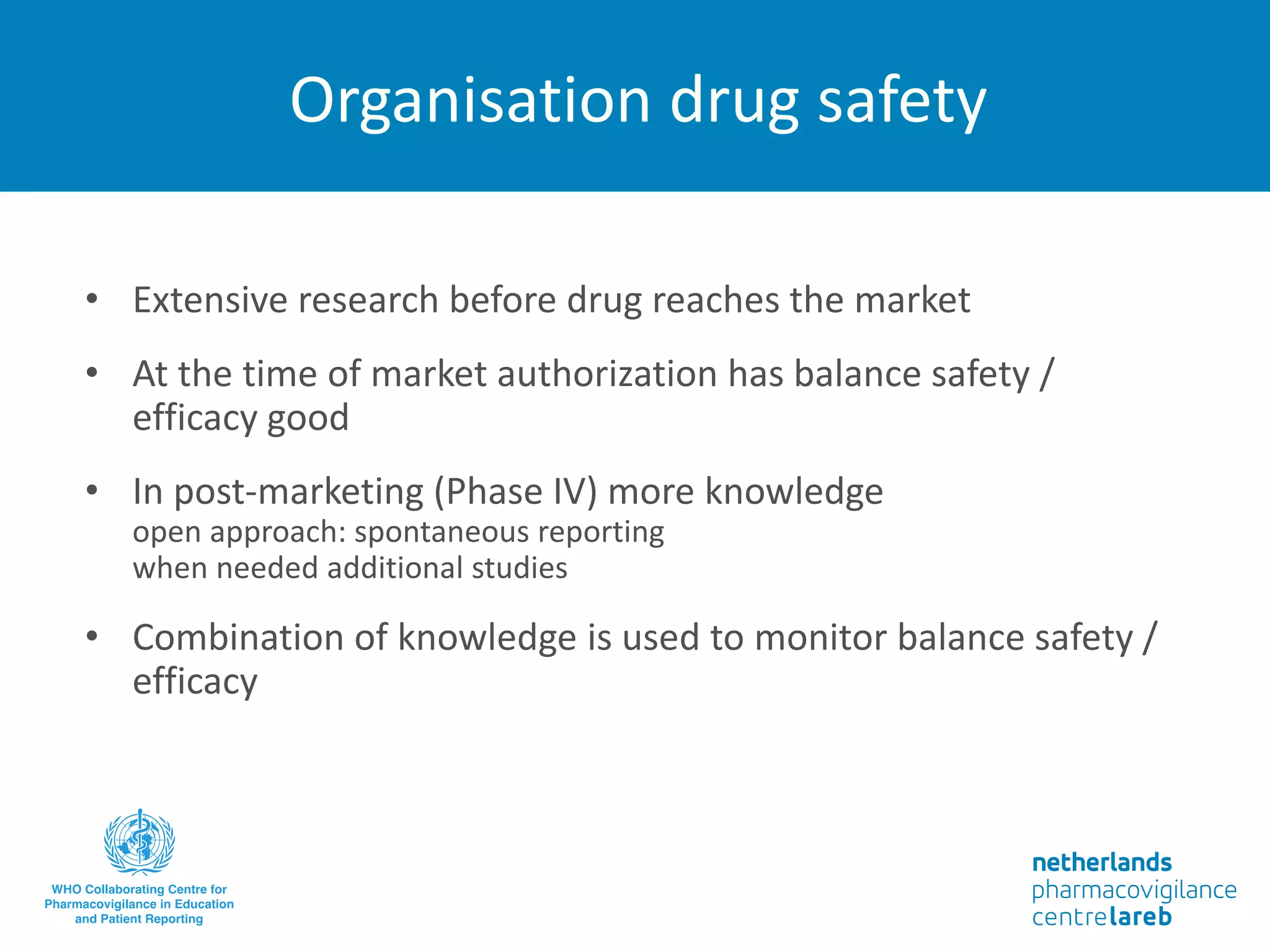
Organisation drug safety
• Extensive research before drug reaches the market
• At the time of market authorization has balance safety /
efficacy good
• In post-marketing (Phase IV) more knowledge
open approach: spontaneous reporting
when needed additional studies
• Combination of knowledge is used to monitor balance safety /
efficacy
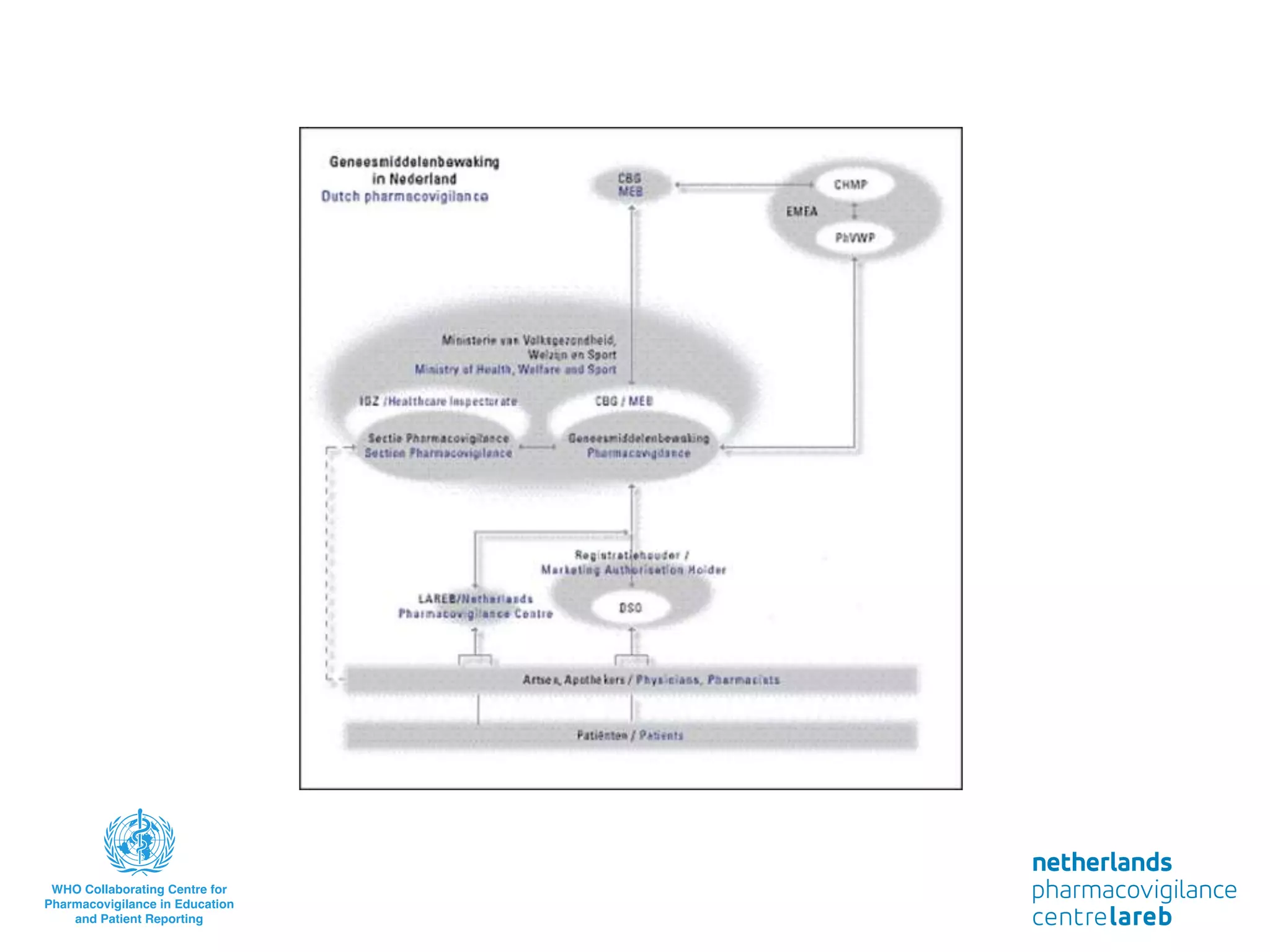
Parties involved in drug safety
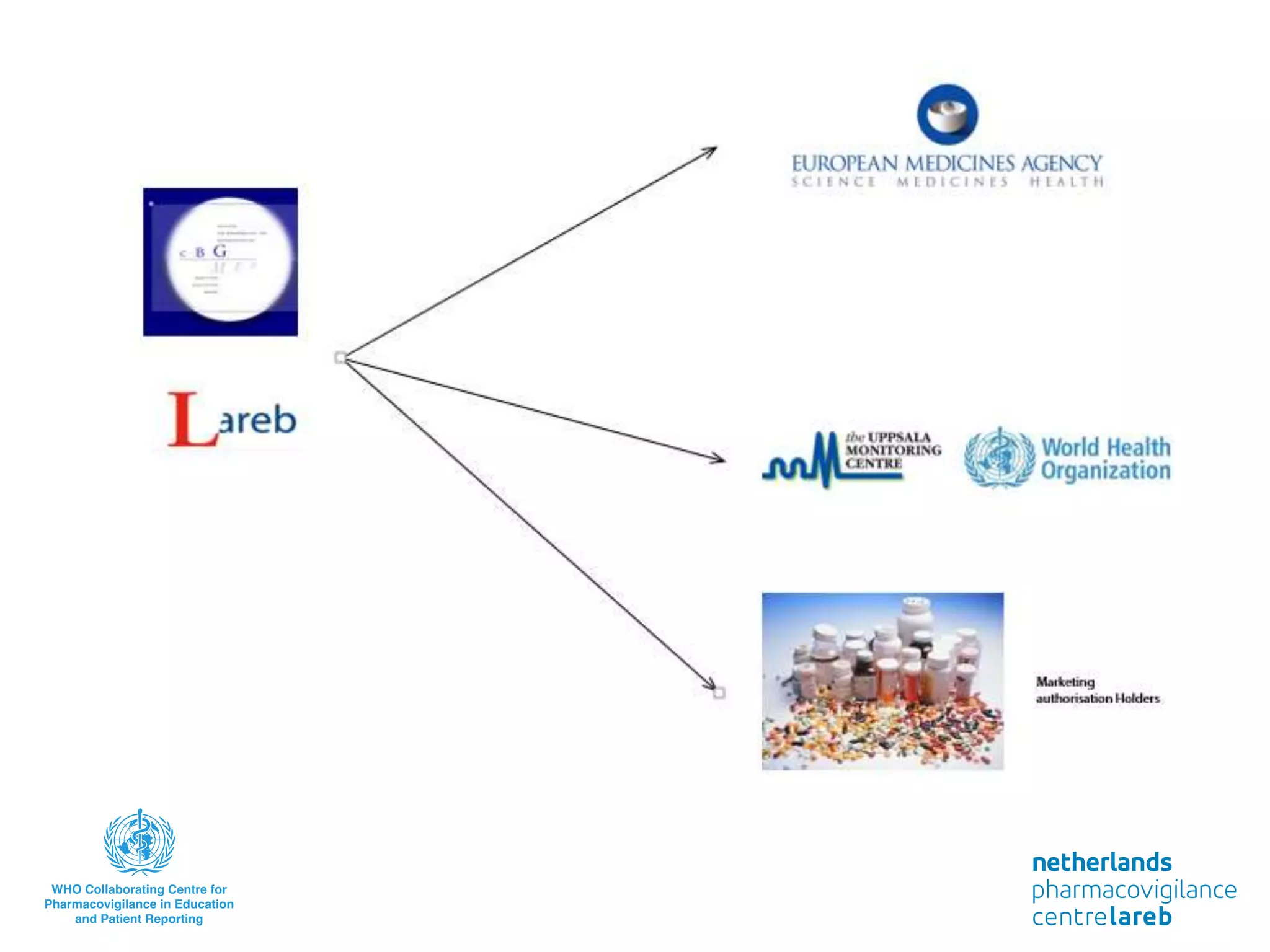
• Medicines Evaluation Board
• Netherlands Pharmacovigilance centre
• Healthcare professionals and patients
• Marketing Authorization Holders
• Inspectorate of health
• EMA
• WHO
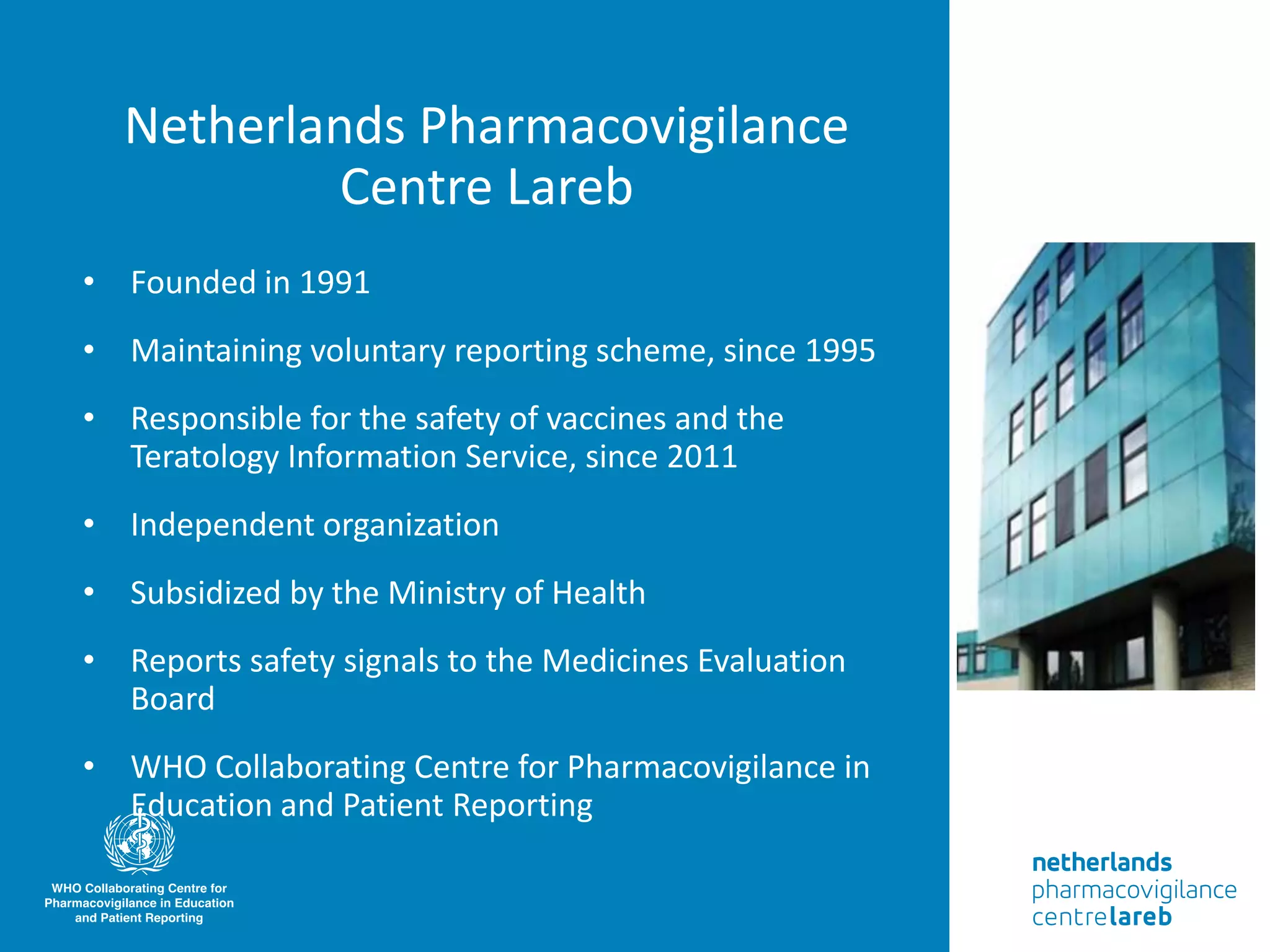
• Founded in 1991
• Maintaining voluntary reporting scheme, since 1995
• Responsible for the safety of vaccines and the
Teratology Information Service, since 2011
• Independent organization
• Subsidized by the Ministry of Health
• Reports safety signals to the Medicines Evaluation
Board
• WHO Collaborating Centre for Pharmacovigilance in
Education and Patient Reporting
Netherlands Pharmacovigilance
Centre Lareb
• Healthcare professionals should immediately report any suspected
serious adverse reactions to a body of professionals and patient
organizations as referred to in Article 76, paragraph three, and any
suspected transmission via a medicinal product of infectious agents
Reporting mandatory in the
Netherlands
Medicines Evaluation Board (CBG)
• Signalling and Analysing as yet unknown adverse events
- Identifying adverse events (partially from Lareb)
- Evaluation of PSURs
• Final risk/benefit assessment
• Determine actions to be taken i.e. by
- Amendment of SmPC
- Dear Health Care Professional letter
- Suspension of withdrawal of drug
Which actions can be taken?
• Amendment Summary of product characteristics
- New update
- Warning
- Contraindication
- Mitigate indication of use
• Temporary suspension of drug
• Withdraw drug from market
• Informing medical professionals by a “Dear Healthcare
Professional Communication” (DHPC)
• Initiate additional reasearch into the safety of a drug
Marketing Autorization Holder
• Monitoring safety of own products on a continuous basis
- Spontaneous reports
- Evaluation of studies
- Literature
• Periodic Safety Update Reports
• If applicable, apply for an update in the product information
in between
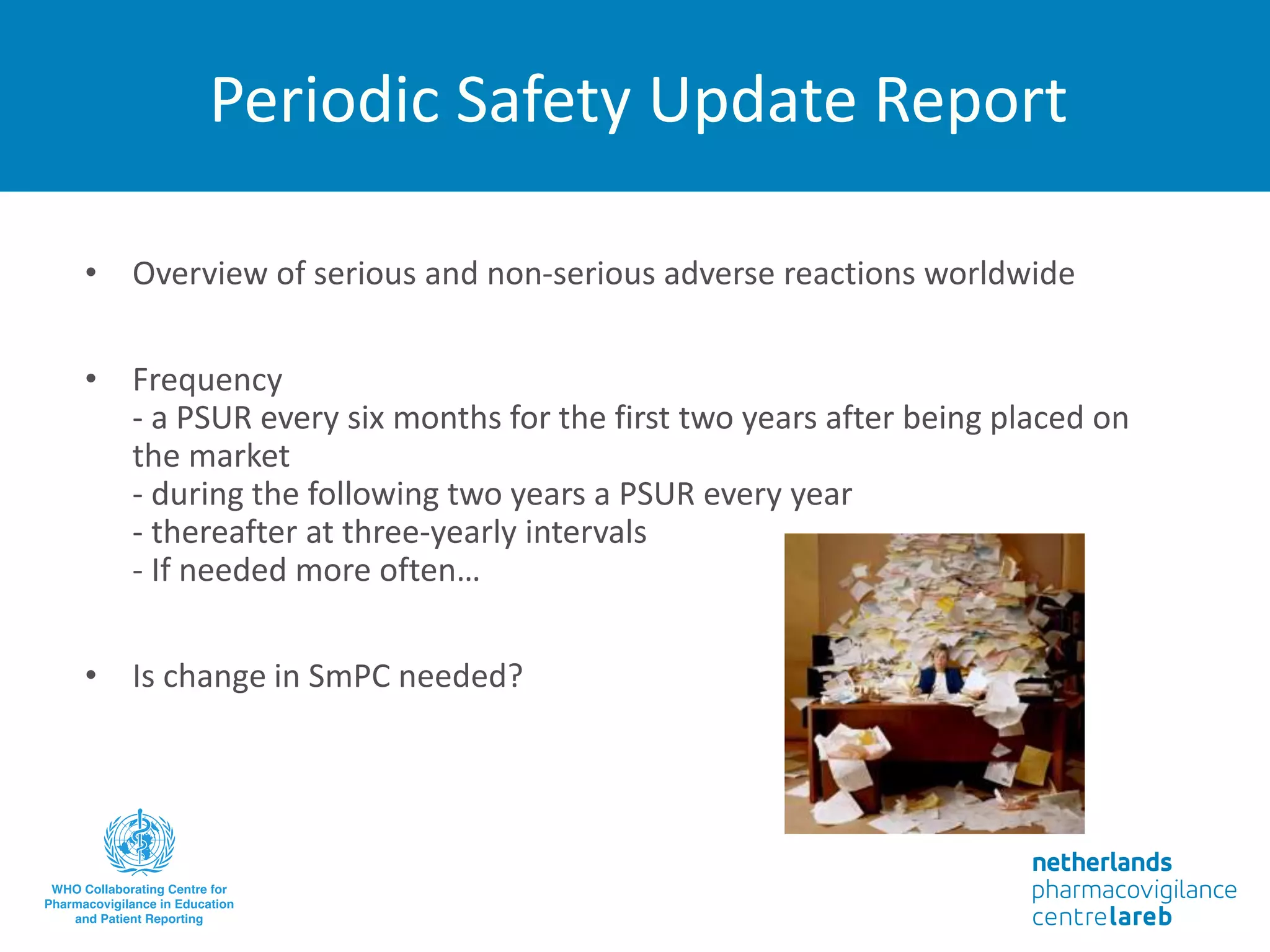
Periodic Safety Update Report
• Overview of serious and non-serious adverse reactions worldwide
• Frequency
- a PSUR every six months for the first two years after being placed on
the market
- during the following two years a PSUR every year
- thereafter at three-yearly intervals
- If needed more often…
• Is change in SmPC needed?
European Medicines Agency
• Reports are forwarded to the Eudravigilance database of the
European Medicines Agency
• Registration
- National (National Authorised products)
- Central (Central Authorised products)
• Signal Detection via member states
- National level
- Central level
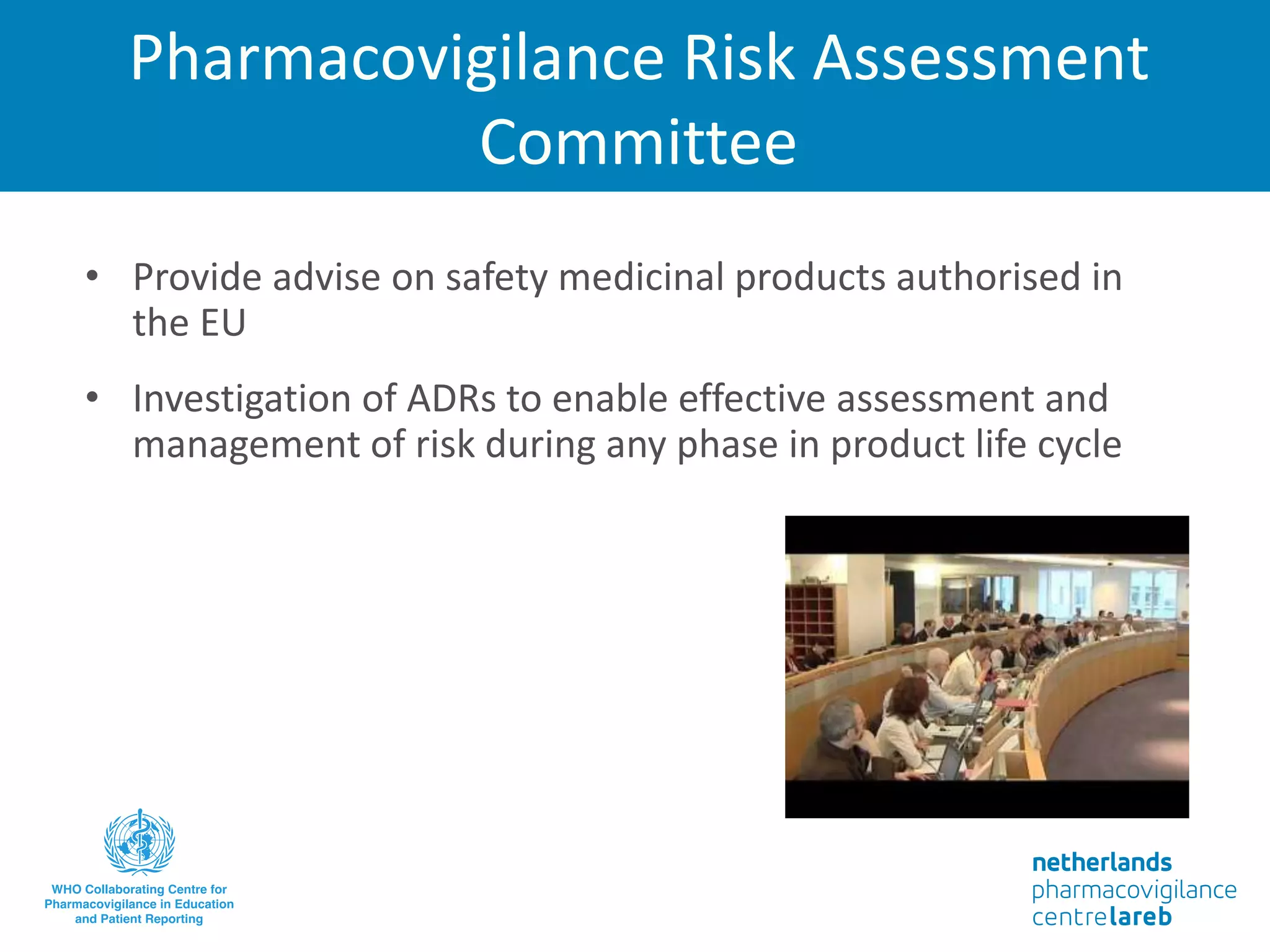
Pharmacovigilance Risk Assessment
Committee
• Provide advise on safety medicinal products authorised in
the EU
• Investigation of ADRs to enable effective assessment and
management of risk during any phase in product life cycle
• Evaluation of potential signals
• Provision of advice on confirmation and quantification of
risk and on regulatory options;
• Risk management
• Monitoring regulatory action and the outcomes
• Setting standards for procedures and methodologies
Key responsibilities
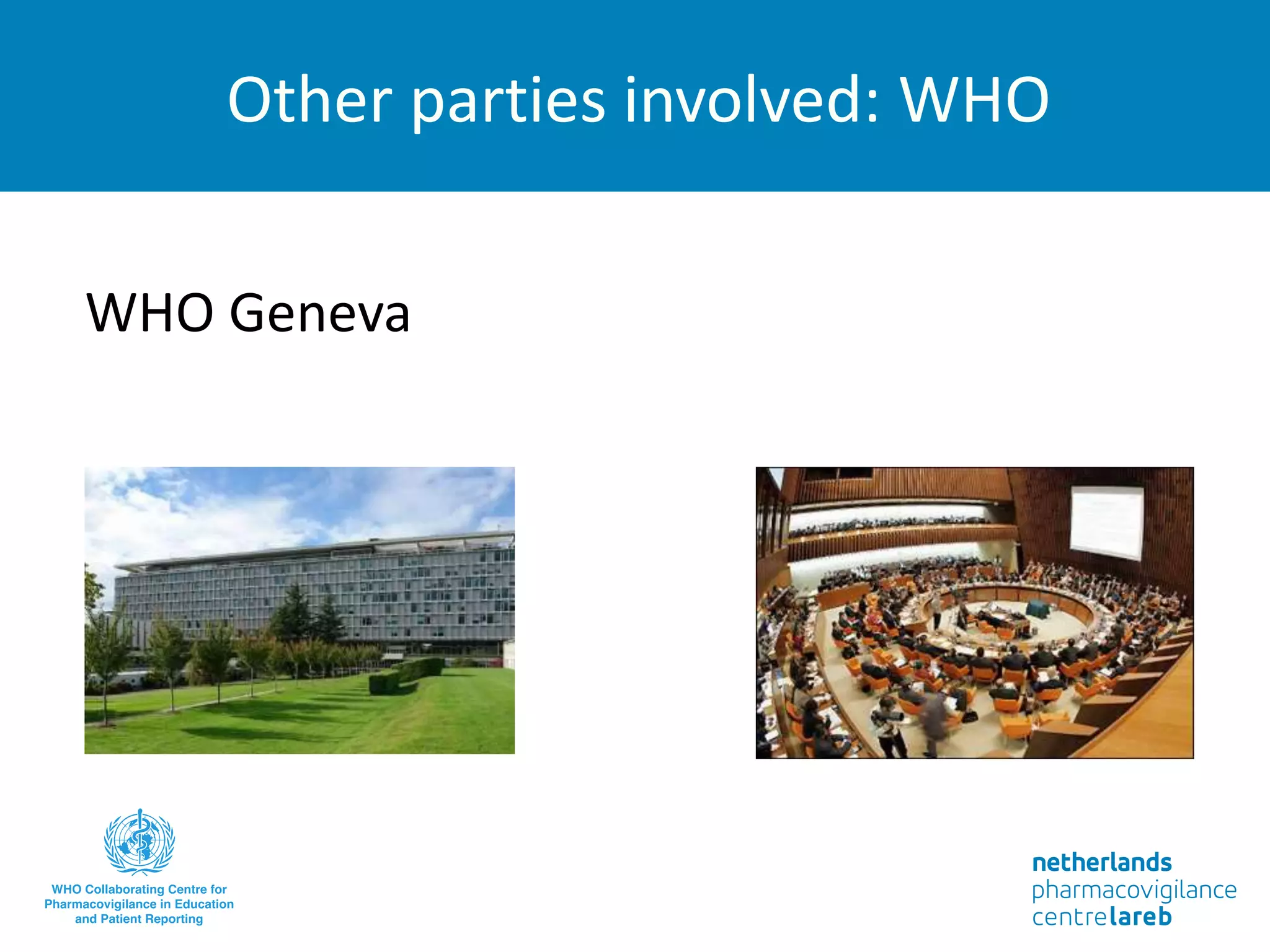
Other parties involved: WHO
WHO Geneva
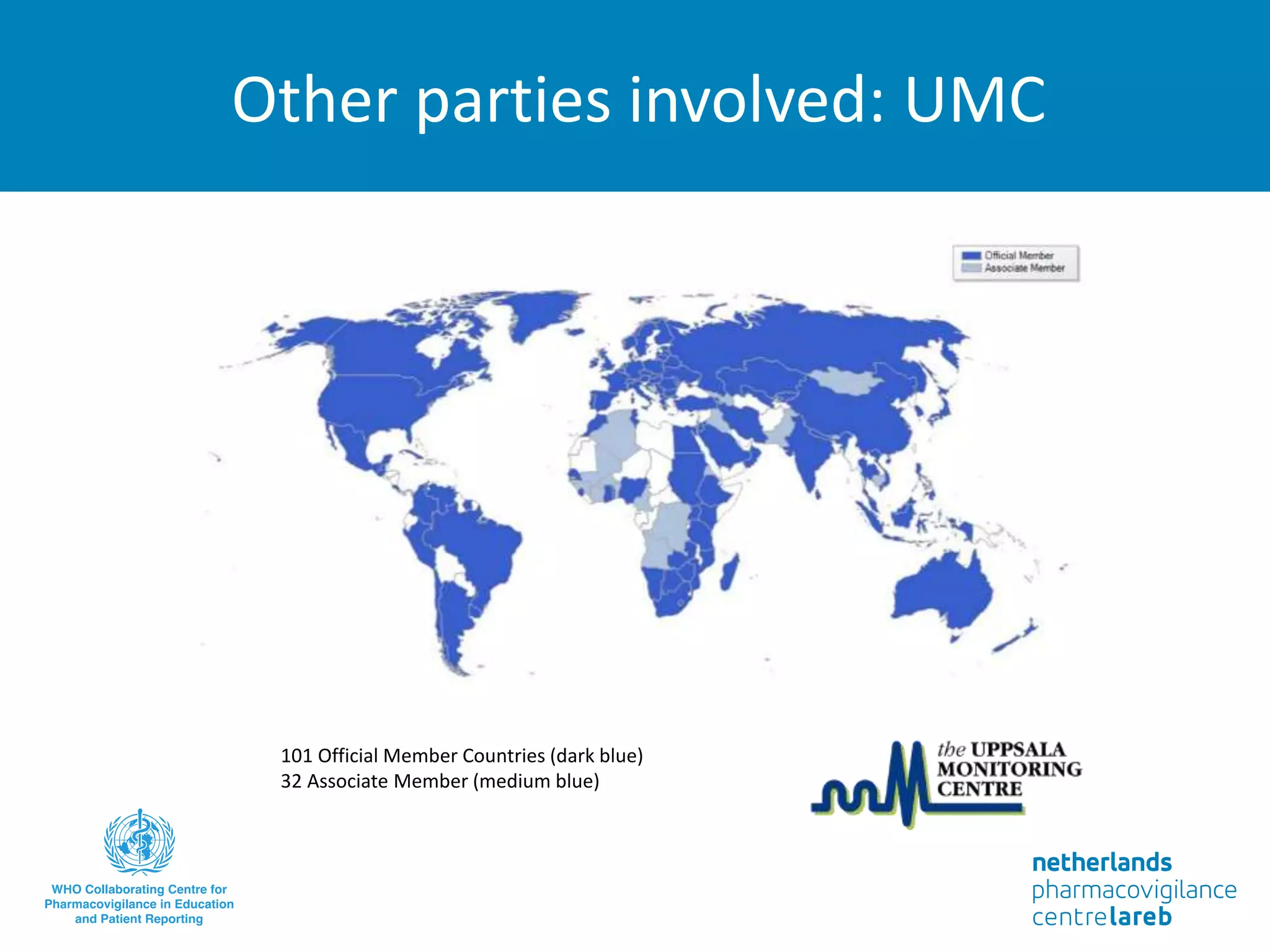
Other parties involved: UMC
101 Official Member Countries (dark blue)
32 Associate Member (medium blue)
WHO/UMC
• Receipt, analysis and recording of worldwide adverse event data
• Maintenance and screening of the international database
• Studies on WHO database
• Training courses and meetings on pharmacovigilance
Where to find information on drug safety?
1. Website EMA: central registered products
2. Website national MEB (CBG): all other products
3. KNMP - Informatorium Medicamentorum (for pharmacists)
4. Farmacotherapeutisch Kompas (free access)
5. Website Netherlands PV centre Lareb: spontaneous reports; not always
a causal relationship!
• 1 and 2 official information
• Other sources additional and interpreted information
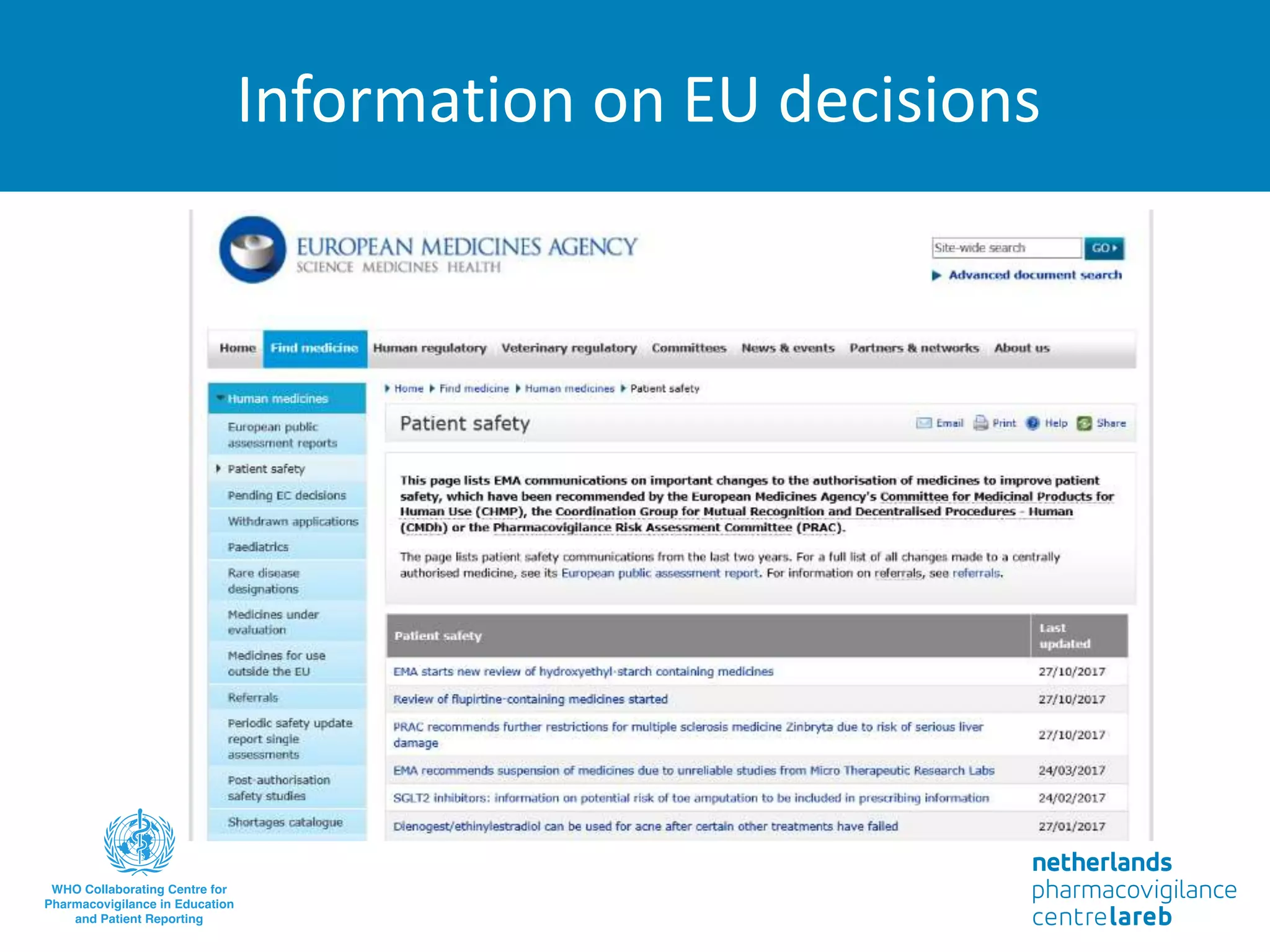
Information on EU decisions
www.ema.europa.eu
• Have knowledge of the definition of pharmacovigilance
• What is a “serious” side effect, according to the formal
definition.
• Peruse the history of pharmacovigilance and a number of
side effects that have played a role:
• Knowledge on how safety of medicines in the Netherlands
and Europe are organised
Learning Objectives introduction
1. Participants in a clinical trial are usually young male volunteers, who
are healthy, do not use medication and have a healthy lifestyle.
2. The conditions in a clinical trial are not ideal for adherence.
3. After a drug has been registered, users of the drug are not allowed to
smoke or drink alcohol if participants in the clinical trials were not
allowed to do so either
4. Pregnant women do not have to be included in clinical trials before a
new drug can be granted marketing authorization
Exam Question (example)
Which statement(s) is or are CORRECT?

general-introduction-2017-1-klein.ppt

  • 1.
    Author: Netherlands PharmacovigilanceCentre Lareb Version date: 14 Nov 2017 Content: This hand-out describes general aspects on pharmacovigilance and provides background information on the lecture ‘Introduction PV’, by Prof. Dr. E.P. van Puijenbroek, The Netherlands. This lecture can be used for teaching key aspect 1: Understanding the importance of PV.
  • 2.
  • 3.
    • Introduction ofpharmacovigilance • Drug safety in practice • Need for monitoring the safety of drugs • Organisation of pharmacovigilance Outline
  • 4.
    • Have knowledgeof the definition of pharmacovigilance • What is a “serious” side effect, according to the formal definition. • Peruse the history of pharmacovigilance and a number of side effects that have played a role. • Knowledge on how safety of medicines in the Netherlands and Europe are organised Learning objectives ‘Introduction’
  • 5.
    IS YOUR MEDICINE LETHAL? SAFETY OFDRUGS LEAVES MUCH TO BE DESIRED Translation:
  • 6.
    Pharmacovigilance WHO: ‘The science andactivities relating to the detection, assessment, understanding and prevention of adverse drug effects or any other drug related problem’ The Importance of Pharmacovigilance, WHO 2002
  • 7.
  • 8.
    A response toa drug which is noxious and unintended, and which occurs at doses normally used in man for prophylaxis, diagnosis, therapy or for the modifications of physiological function Definition WHO Adverse Drug Reaction
  • 14.
    Terminology • ADE: AdverseDrug Event - Medical occurrence temporally associated with the use of a medicinal product, but not necessarily causally related - Not consistent with applicable product information or characteristics of drug • AE: Adverse Event - Medical occurence which is not necessarily causally related to the use of a drug, and might rely on coincidence • Definition WHO - Response of drug action in a person, resulting in experienced harm
  • 15.
    Seriousness of ADRs •A medical event that gives rise to one or more of the following - Death - Life-threatening situations - Hospitalization or prolongation thereof - Permanent incapacity or disability - Birth defects - Other medically important conditions
  • 16.
    • Introduction pharmacovigilance •Drug safety in Practice • Need for monitoring the safety of drugs • Organisation of pharmacovigilance Outline
  • 17.
    Question • Which partof hospital admissions is caused by an adverse drug reaction? 1. 2% 2. 6% 3. 11% 4. 23%
  • 18.
    • 22 hospitalsthroughout the Netherlands • 40 days all hospital admissions were screened and classified as drug-related or non-drug-related
  • 19.
    • 2.4% ofall hospital admissions is drug related • 5.6% of all acute admissions • Mortality 6.6% • 46% preventable • In the elderly risk twice as high
  • 20.
    Successive study onmedication safety Final report: • Following previous studies on possibly avoidable hospital related admissions to medication • Evaluating recommendations to reduce possible harm • Updating data on HARM related admissions
  • 21.
    Final report: Successivestudy on medication safety in The Netherlands, 2017 Vervolgonderzoek Medicatieveiligheid: Erasmus MC/NIVEL/Radboud UMC/PHARMO; jan 2017 Number of admissions in The Netherlands Acute admissions in NL Acute admissions in > 65 in NL Drug-related admissions > 65 in NL 3,9% 3,9% 4,0% 4,2% Drug-related admissions > 65% / all acute admissions (%) Drug-related admissions > 65% / acute admissions > 65 (%) 10,0% 10,1% 10,4% 10,4%
  • 22.
    Avoidable hospital admissions VervolgonderzoekMedicatieveiligheid: Erasmus MC/NIVEL/Radboud UMC/PHARMO; jan 2017 Comparison of Dutch studies on prevalence of drug related hospital admissions and their potential avoidability. AZ: Acute admissions VM: Successive study on medication safety Study year net prevalence drug related admissions Avoidability
  • 23.
    Avoidable hospital admissions VervolgonderzoekMedicatieveiligheid: Erasmus MC/NIVEL/Radboud UMC/PHARMO; jan 2017 RAS= renin angiotensin system; TAI thrombocyte aggregation inhibitor; VKA= vitamin K antagonist
  • 24.
    Reason for avoidability VervolgonderzoekMedicatieveiligheid: Erasmus MC/NIVEL/Radboud UMC/PHARMO; jan 2017
  • 25.
    • Introduction pharmacovigilance •Drug safety in Practice • Need for monitoring the safety of drugs • Organisation of pharmacovigilance Outline
  • 26.
    Louvre: Francisco deGoya y Lucientes (1746-1828)
  • 27.
  • 31.
    W.G. McBride, TheLancet 1961 dec 16: 1358
  • 32.
    What has beenchanged because of thalidomide? • Five years between first victim and the withdrawal of thalidomide from the market • Establishment of Medicines Evaluation Boards worldwide • Establishment of spontaneous reporting centers to identify potential adverse drug reaction in an early stage
  • 33.
    What has beenchanged because of thalidomide? • Drug is back on the market and is now used for the treatment of, for example - Leprosy - HIV / AIDS complications - Multiple myeloma (multiple myeloma) • New cases of congenital malformations, despite precautionary measures
  • 34.
    Di-ethylstilbestrol (DES) • Syntheticoestrogen for the prevention of miscarriages - On the Dutch market from 1947-1976 - Warning NTvG 1972 - Ministry of Health issued warning not to use DES anymore in 1974 • In children of mothers who used DES there is an increasred risk of - cervical cancer (Clear Cell Adenocarcinoma) - deviations in the shape of the uterus
  • 35.
  • 37.
    For which categoriesof ADRs, information is lacking at the time of marketing?
  • 38.
    Frequencies Term Numerical ratePercentage rate Very common More than 1 in 10 10% or higher Common 1 in 10 – 1 in 100 10% – 1% Uncommon 1 in 100 – 1 in 1000 0.1% to 1% Rare 1 in 1000 – 1 in 10,000 0.01% to 0.1% Very rare Less than 1 in 10,000 Less than 0.01%
  • 39.
    Gap between premarketingstudy and daily practice
  • 40.
    Limitations of pre-clinicalstudies • No children • No elderly • Not pregnant • Little or no comorbidity • Little or no use concomitant medications • Limited numbers • ADRs with long time onset hard to detect
  • 42.
    Dutch population Number ofpersons Age Men Women Population in The Netherlands2013, Central Bureau Statistics
  • 43.
    Dutch population: trialpopulation Number of persons Age Men Women Population in The Netherlands2013, Central Bureau Statistics
  • 44.
    Dutch population: children Numberof persons Age Men Women Population in The Netherlands2013, Central Bureau Statistics
  • 45.
    Dutch population: elderly Numberof persons Age Men Women Population in The Netherlands2013, Central Bureau Statistics
  • 46.
    • Introduction pharmacovigilance •Drug safety in Practice • Need for monitoring the safety of drugs • Organisation of pharmacovigilance Outline
  • 47.
    Organisation drug safety •Extensive research before drug reaches the market • At the time of market authorization has balance safety / efficacy good • In post-marketing (Phase IV) more knowledge open approach: spontaneous reporting when needed additional studies • Combination of knowledge is used to monitor balance safety / efficacy
  • 48.
    Parties involved indrug safety • Medicines Evaluation Board • Netherlands Pharmacovigilance centre • Healthcare professionals and patients • Marketing Authorization Holders • Inspectorate of health • EMA • WHO
  • 50.
    • Founded in1991 • Maintaining voluntary reporting scheme, since 1995 • Responsible for the safety of vaccines and the Teratology Information Service, since 2011 • Independent organization • Subsidized by the Ministry of Health • Reports safety signals to the Medicines Evaluation Board • WHO Collaborating Centre for Pharmacovigilance in Education and Patient Reporting Netherlands Pharmacovigilance Centre Lareb
  • 51.
    • Healthcare professionalsshould immediately report any suspected serious adverse reactions to a body of professionals and patient organizations as referred to in Article 76, paragraph three, and any suspected transmission via a medicinal product of infectious agents Reporting mandatory in the Netherlands
  • 53.
    Medicines Evaluation Board(CBG) • Signalling and Analysing as yet unknown adverse events - Identifying adverse events (partially from Lareb) - Evaluation of PSURs • Final risk/benefit assessment • Determine actions to be taken i.e. by - Amendment of SmPC - Dear Health Care Professional letter - Suspension of withdrawal of drug
  • 54.
    Which actions canbe taken? • Amendment Summary of product characteristics - New update - Warning - Contraindication - Mitigate indication of use • Temporary suspension of drug • Withdraw drug from market • Informing medical professionals by a “Dear Healthcare Professional Communication” (DHPC) • Initiate additional reasearch into the safety of a drug
  • 55.
    Marketing Autorization Holder •Monitoring safety of own products on a continuous basis - Spontaneous reports - Evaluation of studies - Literature • Periodic Safety Update Reports • If applicable, apply for an update in the product information in between
  • 56.
    Periodic Safety UpdateReport • Overview of serious and non-serious adverse reactions worldwide • Frequency - a PSUR every six months for the first two years after being placed on the market - during the following two years a PSUR every year - thereafter at three-yearly intervals - If needed more often… • Is change in SmPC needed?
  • 57.
    European Medicines Agency •Reports are forwarded to the Eudravigilance database of the European Medicines Agency • Registration - National (National Authorised products) - Central (Central Authorised products) • Signal Detection via member states - National level - Central level
  • 58.
    Pharmacovigilance Risk Assessment Committee •Provide advise on safety medicinal products authorised in the EU • Investigation of ADRs to enable effective assessment and management of risk during any phase in product life cycle
  • 59.
    • Evaluation ofpotential signals • Provision of advice on confirmation and quantification of risk and on regulatory options; • Risk management • Monitoring regulatory action and the outcomes • Setting standards for procedures and methodologies Key responsibilities
  • 61.
  • 62.
    Other parties involved:UMC 101 Official Member Countries (dark blue) 32 Associate Member (medium blue)
  • 64.
    WHO/UMC • Receipt, analysisand recording of worldwide adverse event data • Maintenance and screening of the international database • Studies on WHO database • Training courses and meetings on pharmacovigilance
  • 65.
    Where to findinformation on drug safety?
  • 66.
    Where to findinformation on drug safety? 1. Website EMA: central registered products 2. Website national MEB (CBG): all other products 3. KNMP - Informatorium Medicamentorum (for pharmacists) 4. Farmacotherapeutisch Kompas (free access) 5. Website Netherlands PV centre Lareb: spontaneous reports; not always a causal relationship! • 1 and 2 official information • Other sources additional and interpreted information
  • 67.
    Information on EUdecisions www.ema.europa.eu
  • 68.
    • Have knowledgeof the definition of pharmacovigilance • What is a “serious” side effect, according to the formal definition. • Peruse the history of pharmacovigilance and a number of side effects that have played a role: • Knowledge on how safety of medicines in the Netherlands and Europe are organised Learning Objectives introduction
  • 69.
    1. Participants ina clinical trial are usually young male volunteers, who are healthy, do not use medication and have a healthy lifestyle. 2. The conditions in a clinical trial are not ideal for adherence. 3. After a drug has been registered, users of the drug are not allowed to smoke or drink alcohol if participants in the clinical trials were not allowed to do so either 4. Pregnant women do not have to be included in clinical trials before a new drug can be granted marketing authorization Exam Question (example) Which statement(s) is or are CORRECT?

Editor's Notes

  • #3 9-11-2017 RvE This presentation has had amandments for sharing purposes on the WHO PV undergraduate education webportal.